Second International Symposium on Engineering Systems MIT, Cambridge, Massachusetts, June 15-17, 2009
Principles of Enterprise Systems
Deborah Nightingale1
Massachusetts Institute of Technology Cambridge, MA 02139-4307
Copyright © 2009 by Deborah Nightingale
Published and used by MIT ESD and CESUN with permission
Abstract:
The Massachusetts Institute of Technology (MIT) through its Lean Advancement Initiative (LAI) research team has been conducting research and facilitating enterprise-level transformations in large complex sociotechnical enterprises for over fifteen years. These enterprises have spanned a broad base of industries and governmental organizations including aerospace, automotive, electronics, health care, transportation, construction, defense acquisition and logistics, research labs and many others. What has emerged from both the action research in the field and its application in case studies in graduate courses is the concept of “overarching” enterprise principles and transformation methodologies that are independent of the industry or organization. A framework for transformation that consists of a set of interdependent methodologies, tools and enterprise principles that support holistic enterprise transformation is described and includes the following five elements: 1) Key Principles of Enterprise Thinking, 2) Enterprise Transformation Roadmap, 3) Lean Enterprise Self Assessment Tool (LESAT), 4) Enterprise Strategic Analysis for Transformation (ESAT) and 5) Enterprise Architecting Framework. The application of this framework to the enterprise systems analysis and design of various industry and governmental organizations is discussed.
Key Words
engineering systems, enterprise systems, enterprise architecting, enterprise transformation
1. Introduction
Most organizations are compelled to continuously transform the way they perform in order to achieve their strategic business objectives. The Massachusetts Institute of Technology (MIT) through its Lean Advancement Initiative (LAI) research team has been conducting research in enterprise-level transformations in large complex sociotechnical enterprises since its inception in 1993. The focus of this research has been aimed at determining effective strategies for successful
enterprise transformation. Additionally, enterprise transformation and architecting is being taught in two graduate level courses: “Integrating the Lean Enterprise” and “Enterprise Architecting”. In these courses, we leverage LAI research and deployment experiences to teach the concepts and the methodologies. Students carry out live enterprise case studies to apply the methodology, as well as demonstrate understanding. In total, over seventy different enterprises have been studied across a broad span of industries and governmental organizations including aerospace, automotive, electronics, health care, transportation, construction, defense acquisition and logistics, research labs and many others. What has emerged from both the transformation research and its application in practice in the field is a set of “overarching” enterprise principles that are implementable through non-domain specific transformation methodologies. A framework for transformation that consists of a set of interdependent methodologies, tools and enterprise principles that support holistic enterprise transformation is described in this paper.
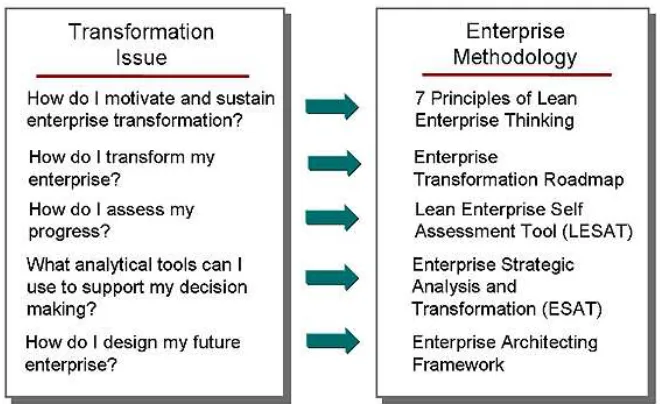
Figure 1 depicts some of the key issues and questions in enterprise transformation along with the methodologies and tools that aid in conceptualizing and executing transformation in an integrated holistic fashion.
Figure 1. Framework for Enterprise Transformation
2. Key Elements of Enterprise Transformation Framework
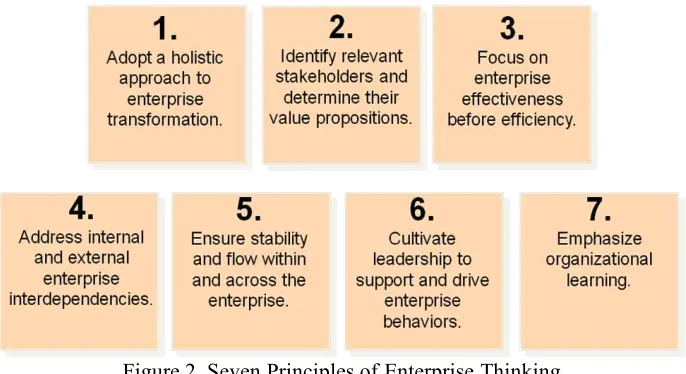
Two elements in the transformation framework assist in how to think about the key elements that are critical for sustainable transformation: the seven enterprise principles and the enterprise architecting framework.
2.A Seven Principles of Enterprise Thinking
Figure 2. Seven Principles of Enterprise Thinking
Principle 1: Adopt a Holistic Approach to Enterprise Transformation
Organizations undergoing transformation often struggle to find the balance between demonstrating short term success and achieving long term enterprise level benefits. Research documented in Lean Enterprise Value (Murman et al, 2002) describes how taking a reductionist approach to transformation results in “islands of success”. Improvement in enterprise silos without consideration of the “enterprise system” may result in short term improvement but often is not sustainable and may actually sub-optimize the enterprise as a whole. It has further been determined that a holistic approach to consideration and integration of lifecycle processes (e.g., design, development, manufacturing), enabling processes (e.g., finance, Information Technology, and HR) as well as key leadership processes (e.g., strategy, planning, resources). The need for a holistic approach is further highlighted through the multiple instances wherein organizations attempting to replicate the Toyota Production System (TPS) have only found only limited success, as they replicated the practices, but not the context within which the practices became successful. A classic example is the use of Kaizen/ Rapid Improvement events within transformation efforts (Manos, 2007). Transformation has to operate at two levels: the strategic level, where improvement events are coordinated to achieve enterprise level benefits, and the tactical level, in which localized improvements are demonstrated (Kosandal and Ferris, 2004). Gathering the benefits at the tactical level is often referred to as ‘harvesting low-hanging fruit’, and has diminishing returns when not coordinated at a strategic level.
Principle 2: Identify Relevant Stakeholders and Determine their Value Propositions
LAI defines a Lean Enterprise as An integrated entity that efficiently and effectively creates value for its multiple stakeholders by employing lean principles and practices (Nightingale, 2009 [8]) .
stockholders, and the community in which the enterprise operates. The principle requires that the enterprise account for more than just the customer (as is the case in traditional lean theory) or the dominant stakeholder (as is the case in publicly traded firms, where the dominant stakeholder is the shareholder).
Principle 3: Focus on Enterprise Effectiveness before Efficiency
Efficiency is the easiest aspect to monitor, improve, and control (Katz and Kahn, 1978); however, it is only one part of the overall ability of the enterprise to effectively deliver value to its stakeholders. Transformation efforts targeted at gaining efficiencies have to necessarily be scoped at the process level, and often neglect to determine whether the process itself delivers the requisite value. Georgopoulos and Tannenbaum (1957) define organizational effectiveness as the extent to which an organization as a social system, given certain resources and means, fulfills its objectives without incapacitating its means and resources and without placing undue strain upon its members. From an enterprise perspective, this requires an understanding of the enterprise strategic objectives, the resources available to deliver the enterprise value proposition and the enterprise value delivery mechanisms. In effect, the transformation effort has to focus on ‘doing the right thing’ before ‘doing it right’.
Principle 4: Address Internal and External Enterprise Interdependencies
The enterprise transformation effort has to be understood through the three lenses of what is controllable by the enterprise, what the enterprise influences, and what the constraints are on the enterprise. The enterprise boundary that is specified to scope the transformation effort determines which segments of the enterprise value stream fall within the controls, influences, and constraints lenses. For example, an enterprise transformation effort that is focused on improving time to market for new product introduction has to account for the internal interdependencies between the design, manufacturing, and marketing value streams, the external interdependencies between the supply network, the enterprise under transformation, and the distribution network value streams; and the constraints imposed by the changing customer preferences on the enterprise. LAI’s enterprise transformation research has shown that often the greatest opportunities for improvement lie at the boundaries of the enterprise.
Principle 5: Ensure Stability and Flow within and across the Enterprise
Ensuring Stability and Flow are foundational to any enterprise transformation effort. Stability of value delivery enables us to determine the current state of enterprise, and form a baseline for improvement. In other words, stability enables us to determine the watermark of enterprise performance. Flow of value within the enterprise allows us to determine the focal points for improving enterprise value delivery to its key stakeholders. Focusing on flow is critical to streamlining enterprise performance. At the enterprise level, information is often the most significant entity that is flowing, in contrast to material flow. Given that the enterprise boundary plays a significant role in determining the selection of transformation projects, we emphasize the need for seeing end-to-end value delivery both within and across the enterprise.
Principle 6: Cultivate Leadership to Support and Drive Enterprise Behaviors
human resources (Conger and Konungo, 1988). Grass-roots level leadership is critical for transformation to become part of the organizational DNA. People within the enterprise have to be empowered to drive transformation within the strategic framework specified by senior leadership. Given that middle management acts as the translator between the senior leadership and the lower levels of the organization, their commitment is key to avoid the ‘flavor of the month’ syndrome (that results in enterprise inertia and significant resistance to enterprise improvement efforts). When all three layers of leadership are aligned, the enterprise speaks with a single transformation voice, and the transformation effort becomes self-sustaining.
Principle 7: Emphasize Organizational Learning
Transformation efforts must be both top down and bottom up (Johnson 1992). That is, the organization must be engaged and involved at all levels. The “learning organization” (Senge 2006) is continuously experimenting and gaining knowledge about its processes and the manner in which it creates value. This learning translates into deeper insights that motivate and support transformation execution. The improvement efforts carried out have to necessarily address the contextual challenges of the location at which they are being carried out. The principle focuses on enabling the enterprise to learn from each of the localized improvement efforts and to improve the effectiveness of the improvement efforts that are undertaken.
2.B Enterprise Architecture Framework
A second set of overarching concepts for thinking about enterprises relates to its architecture. Enterprises have long been studied by management, social and information scientists; however, this has largely been through taking one single view of the enterprise such as studying the organizational structure or the information technology architecture. The inadequacy of single or even pairwise analysis of enterprises is well documented (Drazin and Van de Ven, 1985): Our research on enterprise transformation and design has determined that enterprise architecting
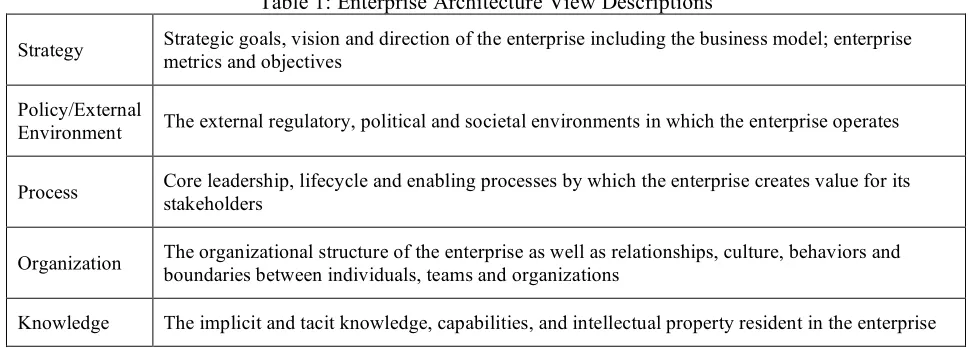
must take a systems perspective, viewing the entire enterprise as a holistic system that can be understood by examining the enterprise through multiple perspectives or views of an overall integrated framework. (Nightingale and Rhodes, 2004, Rhodes and Nightingale, 2009). These include the strategy view, policy/external environment view, organization view, process view, knowledge view, enabling information technology view, product view, service view and the interrelationships between these views. Table 1 provides descriptions of each of the 8 views:
Table 1: Enterprise Architecture View Descriptions
Strategy Strategic goals, vision and direction of the enterprise including the business model; enterprise metrics and objectives
Policy/External
Environment The external regulatory, political and societal environments in which the enterprise operates
Process Core leadership, lifecycle and enabling processes by which the enterprise creates value for its stakeholders
Organization The organizational structure of the enterprise as well as relationships, culture, behaviors and boundaries between individuals, teams and organizations
Information Information needs of the enterprise, including flows of information as well as the systems and technologies needed to ensure information availability
Product Product(s) developed by the enterprise; key platforms; modular vs. integral architectures, etc.
Services Services(s) delivered and or supplied by the enterprise, including in support of products
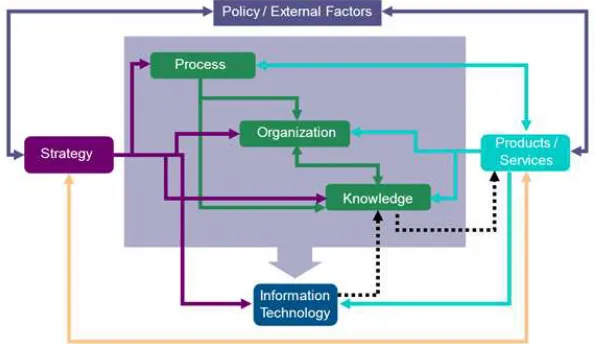
There is a relationship among the different views whereby some views drive or determine the architectures and the required attributes of other views as depicted in Figure 2. For example, the arrow connecting “process” and “organization” implies that the process architecture should drive or influence the organizational architecture. Additionally, the framework suggests that the “process”, “organization” and “knowledge” views should drive the information technology architecture. This is one of the key issues in contemporary enterprises; all too often the IT architectures are established without due consideration of these critical dimensions. Similarly, the “strategic” direction of the enterprise will determine the appropriate product architecture (e.g., modular vs integral) that best suits its needs. Conversely, the selected product architecture will be instrumental in driving the capabilities needed for growth or to achieve competitive advantage. The EA framework has been proven to be a useful structure in many different types of product and service enterprises for examining interrelationships and synergies across the views in both understanding the current state and in architecting potential future states.
Figure 2. Enterprise Architecting Framework (Nightingale and Rhodes, 2008)
2.C Enterprise Transformation Roadmap
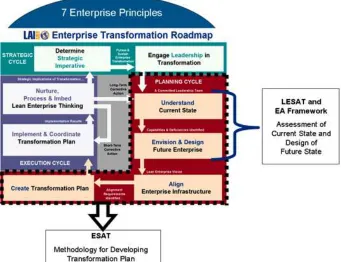
employed by enterprise leaders to enhance the quality of thinking on enterprise transformation issues and has provided guidance for increasing the value delivery for the maximum benefit of the entire enterprise.
Figure 3. Enterprise Transformation Roadmap (Nightingale, Mize, Srinivasan, 2008)
2.D Enterprise Strategic Analysis for Transformation (ESAT)
Figure 4. Enterprise Strategic Analysis for Transformation
2.E Lean Enterprise Self Assessment Tool (LESAT)
LESAT is a tool for assessing the maturity of an organization and its readiness to change (Nightingale and Mize, 2002). It includes a capability maturity model that addresses key integrative and strategic issues in life cycle, leadership and enabling processes. The 54 practices are employed to determine both the current state as well as desired future state of the enterprise. LESAT is linked to the Enterprise Transformation Roadmap and is based on the Seven Enterprise Principles. It has been downloaded from the LAI website nearly 3500 times on a global basis. When used in conjunction with ESAT it is a powerful tool for assessing gaps in enterprise performance.
3. Integrated Enterprise Transformation Framework
LESAT and the EA views are used in concert with ESAT to analyze and assess both the current and future states. The interrelationship of these five enterprise methodologies is depicted in Figure 5.
Figure 5. Enterprise Transformation Framework
4. Enterprise Transformation Cases
Numerous enterprises have utilized these enterprise systems frameworks and methodologies in analyzing, designing and transforming their enterprises. Table 3 reflects some representative case studies where the framework has been applied in various domains including aerospace, healthcare, defense acquisition, and service sector. In each case significant insights were gleaned from taking an enterprise perspective.
Table 3. Transformation Case Studies
Industry Organization Reason to Transform Insights from Enterprise Analysis
Aerospace Air Cargo
Carrier Program Reduce costs and cycle times
Multiple stakeholder (industry, government regulatory) essential for enterprise success
Space Center
Long development /procurement times at high cost
Criticality of including extended enterprise, including key suppliers and requirements generators
Healthcare Mental Health Hospital
Breaking cultural norms to drive needed change, improve service and reduce costs
While experts in patient care, enterprise analysis uncovered traditional behaviors were inadequate for enterprise optimization and operation across boundaries.
Hospital Emergency Dept. overcrowding
(inpatient, operating rooms, etc) and external adopted both effectiveness as well as efficiency measures
Automotive Auto
Manufacturer
Reduced time-to-market in global product development
Required more than just traditional R&D – streamlined cross functional information base and integration of processes with IT systems
5. Conclusion and Future Research
Principles were drawn from lean principles and practices and scaled to drive enterprise level transformation, not just local suboptimal change. The Enterprise Transformation Framework provides an integrated set of methodologies that make these key enterprise principles actionable. Elements of this framework have been successfully utilized by a large cross section of industries in their enterprise transformations and research has shown them to be both domain independent and scalable.
Additional research in performing longitudinal studies of organizations engaged in enterprise transformation will yield additional insights into both the mechanisms of transformation as well as principles of leadership and change management. It is anticipated that enhancements to the framework will emerge in terms of modifications to its specific content as well as determining additional systems engineering tools and methods applicable at the enterprise level. These methods could include real options (Mikaelian et al, 2009), simulation models (Glazner, 2009) and social network theory.
Acknowledgement
References
Conger, J. A., and Kanungo, R. N. Charismatic leadership: The elusive factor in organizational effectiveness. Jossey-Bass., 1988
Drazin, R. and Van de Ven, A. “Alternative Forms of Fit in Contingency Theory”. Administrative Science Quarterly, 30(4): 514-539, 1985
Georgopoulos, B. S., and Tannenbaum, A.S. "A study of organizational effectiveness", American Sociological Review: 534-540., 1957
Gibson, K. The moral basis of stakeholder theory. Journal of Business Ethics 26, no. 3: 245-257., 2000
Glazner, Christopher G., “Understanding Enterprise Behavior using Hybrid Simulation Models of Enterprise Architecture”, Ph.D. Thesis, MIT, June 2009,
Johnson, H. T. 1992. Relevance regained: From top-down control to bottom-up empowerment. Free Pr.
Katz, D., and R. L. Kahn. 1978. The social psychology of organizations.
Kosandal, P., and J. Farris. 2004. The strategic role of the kaizen event in driving and sustaining organizational change. In Proceedings of the 2004 American Society for Engineering Management Conference, Alexandria, VA, 517-26.
Manos, A. 2007. The benefits of Kaizen and Kaizen events. Quality Progress 40, no. 2: 47-49.
Mikaelian, T., Hastings, D.E., Rhodes, D. H. and Nightingale, D. J., "Model-Based Estimation of Flexibility and Optionability in an Integrated Real Options Framework" 3rd Annual IEEE Systems Conference, March 2009
Nightingale, Deborah J., Mize, Joe H., Development of a Lean Enterprise Transformation Maturity Model, International Knowledge Systems Management Journal, December 2002.
Nightingale, Deborah J., and Rhodes, Donna H., “Enterprise Systems Architecting: Emerging Art and Science within Engineering Systems”, MIT Engineering Systems Symposium, March 2004.
Nightingale, Deborah. J., Stanke, Alexis., and Bryan, F., Enterprise Strategic Analysis for Transformation, MIT Lean Advancement Initiative, September 2008.
Nightingale, Deborah J., and Srinivasan, Jayakanth, "Seven Principles of Lean Enterprise Thinking", 2008
Nightingale, Deborah J., Mize, Joseph H., and Srinivasan, Jayakanth "Enterprise Transformation Roadmap", 2008
Nightingale, Deborah J. “Integrating the Lean Enterprise” lecture notes, MIT, Sept., 2008
Phillips, R., R. E. Freeman, and A. C. Wicks. 2003. What stakeholder theory is not. Business Ethics Quarterly: 479-502.
Rhodes, Donna H., Ross, Adam M., and Nightingale, Deborah J., "Architecting the System of Systems Enterprise: Enabling Constructs and Methods from the Field of Engineering Systems", 3rd Annual IEEE Systems Conference, March 2009
Senge, P. M. 2006. The fifth discipline: The art and practice of the learning organization. Currency.
Valerdi, Ricardo, Nightingale, Deborah J., Blackburn, Craig, “Enterprises as Systems: Context, Boundaries, and Practical Implications” accepted to International Knowledge and Systems Management Journal.