OECD Economic Studies No. 32, 2001/I
11
© OECD 2001
THE IMPLEMENTATION AND THE EFFECTS OF REGULATORY
REFORM: PAST EXPERIENCE AND CURRENT ISSUES
By
Rauf Gönenç, Maria Maher and Giuseppe Nicoletti
TABLE OF CONTENTS
Summary and conclusions ... 12
Evolving regulation: trends and outcomes... 15
Regulatory reform in selected industries... 15
Product market liberalisation and performance ... 23
Adapting regulations to the new competitive environment ... 26
Regulatory issues in network industries ... 27
Regulatory issues in transportation industries... 36
Satisfying non-economic objectives in a competitive environment ... 47
Privatisation ... 54
Public enterprises and privatisation in the OECD... 54
Privatisation and regulatory reform ... 56
Privatisation and performance ... 59
Selected political economy issues ... 60
Regulatory capture and institutional design ... 63
Regulatory risk and the design of regulatory mechanisms... 73
Annex. Using Multivariate Data Analysis to Assess Regulation Patterns ... 84
Bibliography ... 86
12
In the past two decades, OECD countries have shifted from using public policy instruments, such as regulation or public ownership of enterprises, to a greater reliance on market mechanisms and incentives to pursue consumer welfare, industrial, regional and/or employment objectives. Similarly, traditional public interest goals, such as universal and equitable access to services and safety and environment concerns have increasingly been met within a competitive framework.
Regulatory reforms have had three main dimensions: liberalisation, state retrenchment and new regulatory design. Liberalisation and state retrenchment were mainly concerned with:
– Liberalising prices and access to markets which had previously been restricted by legal and regulatory barriers.
– Handing or returning to the private sector activities that had been run directly by the government.
New regulatory design was an essential element of regulatory reform to the extent that:
– Rules had to be set in network industries to make access to the non-competitive segments of the industry by a plurality of service providers possible and efficient.
– In industries where liberalisation had involved the unbundling of vertically-integrated monopolies, markets had to be created ex novo to replace transactions that were previously taking place within the firm.
– In industries where (non-economic) public interest objectives were ensured within a regulated non-competitive environment, ways had to be found to achieve these objectives in a competitive framework.
– Where firms had been privatised or activities had been contracted out, regulation through public ownership had to be replaced by arm’s length regulation.
The Implementation and the Effects of Regulatory Reform: Past Experience and Current Issues
13
© OECD 2001
regulatory reform: its scope and impact on performance, issues of regulatory design in network and transportation industries and political economy issues related to the design of regulatory institutions and mechanisms. Of the industries concerned by regulatory reforms in OECD countries, the focus here is on electric-ity, telecommunications, railways, air travel, road freight and retail distribution. This is both because cross-country (and sometimes historical) comparative data on regulations are available from OECD sources, and because these sectors are economically important. Liberalisation, privatisation and their related effects in some of these industries (telecommunications, electricity, air travel, road freight and retail distribution) are analysed in more detail in the other articles contained in this issue.1
The article is in four sections. The first deals mainly with liberalisation and its effects on performance. The second section discusses the regulatory issues arising in the new competitive environment, including the satisfying of non-economic objectives within a market-oriented regulatory framework. The third focuses on general privatisation issues, against the background of actual privatisation outcomes in OECD countries. Finally, the fourth section addresses some of the political economy issues raised by regulatory reform.
The main findings of the analysis of liberalisation and privatisation are the following:
– Liberalisation in OECD countries has been undertaken in competitive industries as well as in some industries with scarcely competitive segments (such as telecommunications and air travel).
– The available empirical evidence strongly supports the view that liberalisa-tion has been beneficial for efficiency and consumer welfare in reforming countries.
– Still, the pace and the extent of liberalisation have differed a lot across OECD countries and in many of them unnecessary regulatory barriers to competition and obstacles to market mechanisms remain (e.g.in the retail distribution industry).
– Liberalisation has been much slower in railways and electricity. This may be partly related to the difficult technical problems that subsequent regulation has to face and, as well, the lack of clear-cut empirical evidence on the effects of deregulation on economic performance in these industries. Espe-cially in the electricity industry, weaknesses in the regulatory framework, such as insufficient attention to ensuring competitive outcomes, have sometimes reduced the benefits of deregulation.
14
non-competitive segments, better regulatory supervision. However, where privatisation revenue has been a prime concern, insufficient attention has sometimes been paid to ensuring efficient outcomes. Moreover, especially in some new member countries, the benefits from the change in ownership have sometimes proved disappointing, due to weaknesses in the legal, institutional and market environment.
The analysis of new regulatory design suggests several ways in which the quality of regulation and its friendliness to market mechanisms could be enhanced:
– Where possible, regulators should allow competition to act as an effective surrogate for regulation, via horizontal and vertical unbundling. Still, due to the existence of the non-competitive component, some form of regulation of network industries is warranted. Specifically, it is imperative that pro-competitive regulatory controls are put in place that will restrain the owners of networks and infrastructures from abusing their monopoly position.
– Vertical separation can prevent the cross-subsidisation of competitive activities from non-competitive ones for predatory purposes, but where scope economies from vertical relationships appear to be large such as in transportation industries, long-term co-operation between service and infrastructure providers should not be discouraged.
– One of the primary goals of regulators should be to restructure tariffs so that they reflect underlying costs, in order to ensure that the allocation of resources and new entry are efficient.
– With some caveats related to coverage, and frequency of changes, policy makers should encourage the use of price-cap regulation (especially in industries such as telecommunications where cost information is difficult to verify) and other forms of incentive regulation.
– In transportation industries subject to congestion, market-determined access prices (such as peak-load charging and congestion pricing) would ensure efficient access to users in the short term. In the longer term, commercial supply of infrastructures (e.g.through privatisation together with market pricing of access) should be encouraged, to direct capacity extensions according to market demand.
The analysis also suggests that non-economic objectives need not stand in the way of greater competition and cost-based pricing:
The Implementation and the Effects of Regulatory Reform: Past Experience and Current Issues
15
© OECD 2001
– Where competition and cost-based pricing can impact unfavourably on the affordability of non-economic objectives, policy makers should attempt to achieve social or universal service objectives through the use of public funds (e.g.direct transfers to low-income households or direct subsidies to the firms constrained by social obligations) and not through cross-subsidies and other inefficient regulations, such as restrictions on entry.
The possibility of “regulatory capture” by regulated firms or other interest groups and the effects of regulatory uncertainties on the investment behaviour of regulated firms need to be taken into account in designing regulatory mechanisms and institutions.2 Political economy considerations suggest that regulatory
institu-tions should be designed to i)ensure independence of the regulator from the exec-utive branch of the government; ii)impose constraints on the regulator’s discretion (for example by allowing appeal procedures with general competition authorities); iii)enhance transparency of the regulatory process so as to limit information asymmetries and reduce regulatory discretion; and iv)ensure consistency of regula-tory approaches across industries. Regularegula-tory mechanisms should incorporate a degree of pre-commitment so as to reduce the risk to firms that investment will be made unprofitable by subsequent regulatory decision while also, possibly, pre-empting political pressures arising as regulatory outcomes become known. Precom-mitment and constraints to regulatory discretion should not prejudge, however, the effectiveness of regulatory enforcement and the ability of the regulator to adjust regulation to changing technological and market conditions.
EVOLVING REGULATION: TRENDS AND OUTCOMES
Regulatory reform in selected industries
In the past two decades, the bulk of sector-specific regulatory reforms have concerned the service industries and the utilities. Services and utilities account for the largest (and growing) share of the OECD economies and are a vital input in the production of manufactured goods. Developments in demand, technology and the competitive environment have spurred the need for reform in these indus-tries, and this has been buttressed by rapid progress in regulatory techniques.
In this section the focus is on seven industries, for which data on regulations and market (or industry) structure are available both across countries and (to a lesser extent) over time:3 electricity, railways, fixed telephony (trunk and
16
segments coexist. Mobile telephony and air travel also have network elements and sizeable fixed costs, but are largely competitive industries. The road freight and retail distribution industries are in principle fully competitive. Across these industries, regulatory provisions have been justified on the basis of both economic and non-economic reasons. Therefore, looking at this sample of indus-tries makes it possible to highlight features of the regulatory reform process, and of its economic impact, and draw lessons that are applicable to other industries as well. Details on the methodology used to construct the industry-specific regula-tory indicators can be found in Gönenç et al. (2000).
Fully or largely competitive industries
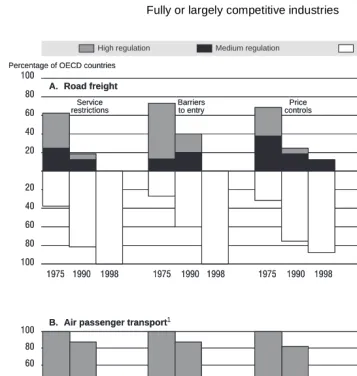
Because of a lack of reliable comparative data (retail distribution) or a short sectoral life-time (mobile telephony), the historical analysis relates mainly to the road freight and air travel industries. For the latter, historical data concerns only regulations in domestic routes or in routes between countries that are members of regional agreements. Regulatory reforms in road freight and air travel across OECD countries are analysed using a partitioning into high, medium and low regulatory intensity covering four dimensions: public ownership, barriers to entry, price regu-lation and service constraints (Figure 1). The indicator of service constraints includes provisions affecting the conditions under which services are provided.
The most striking regulatory changes occurred in the air travel industry at the domestic and regional level. Two decades ago, the domestic (and regional) air travel industry was dominated by publicly-controlled firms enjoying legal monop-olies over their routes and subject to strict regulatory controls over fares and the services supplied. By 1998, domestic and regional routes were liberalised and airlines were given the freedom to set fares. Although no data on service con-straints is available for 1998, these concon-straints had already been somewhat reduced at the beginning of the decade. Public ownership was also significantly reduced, although in almost half of the countries the government retained share-holdings in national carriers. However, while the extent of deregulation in domes-tic and regional routes was extensive, international routes are still dominated by highly regulated bilateral air service agreements between governments and foreign ownership of national airlines is still limited in most countries (see below for a fuller account of the 1998 regulatory environment in international routes).4
The Implementation and the Effects of Regulatory Reform: Past Experience and Current Issues
17
© OECD 2001
Figure 1. Regulatory reform in OECD countries Fully or largely competitive industries
Notes: See Gönenç et al. (2000) for details on the construction of the indicators.
High regulation: Entry is restricted, public ownership is substantial and prices or services are set or approved by a
regulatory authority.
Medium regulation: Some limited entry is allowed, public ownership is limited and businesses have some freedom to
set prices or services.
Low regulation: Public ownership is very limited and businesses are free to entry and have full control over prices and
services they supply.
1. Domestic and regional routes.
Source: OECD, Regulatory Reform, Privatisation and Competition Policy, 1992; and OECD International Regulation Database
1975 1990 1998 1975 1990 1998 1975 1990 1998 1975 1990 1998
1975 1990 1998 1975 1990 1998 1975 1990 1998 1975 1990 1998 20
Percentage of OECD countries Percentage of OECD countries
B. Air passenger transport1
A. Road freight
Medium regulation Low regulation
Service
to entry controlsPrice
Public ownership 1975 1990 1998 1975 1990 1998 1975 1990 1998 1975 1990 1998
1975 1990 1998 1975 1990 1998 1975 1990 1998 1975 1990 1998 20
Percentage of OECD countries Percentage of OECD countries
B. Air passenger transport1
A. Road freight
Medium regulation Low regulation
Service
to entry controlsPrice
18
Deregulation has also been extensive in the road freight industry. Even though regulatory barriers were initially less extensive than in other industries, by 1998 barriers to entry and service constraints had been virtually eliminated in all countries for which data are available, while some price controls and state-controlled trucking companies still remained in a few.
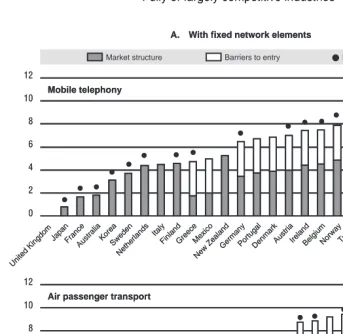
Figure 2 synthesises the regulatory environment in 1998 for competitive industries with and without fixed network elements, drawing on the information contained in the OECD International Regulation Database. In Panel A, the situation for mobile telephony and air passenger travel is described by an indicator of barriers to entry and an indicator of market structure. The existence of significant (more than 30 per cent) share ownership by the government is also indicated when appropriate. The regulatory and market structure indicators measure (on a scale of zero to six) the degree of unfriendliness of regulation to market mechanisms, and the distance of the market from a competitive structure, respectively. They are aggregated to yield a synthetic indicator that captures competitive outcomes in each country (see Annex).7 The summary indicator of regulation and market
struc-ture suggests that the least restrictive country in mobile telephony was the United Kingdom, followed by Japan, France, Australia, Korea and Sweden. However, the relative positions of these countries still differ considerably, with the United King-dom being the only one having a fully liberalised and competitive environment. In air passenger travel, the United States and the United Kingdom had gone farthest with liberalisation, while Poland and Turkey had barely started regulatory reforms in this industry. The summary indicator masks large differences in market struc-ture, public ownership and entry barriers across countries.
In Panel B the regulatory environment in road freight and retail distribution is described by aggregating an indicator of barriers to entry and an indicator of government involvement in business operation.8 By 1998, cross-country differences
in regulation remained significant in both industries. In road freight, particularly restrictive environments were present in Italy, and, to a lesser extent, Greece, where both barriers to entry and involvement in business operation (mainly reflecting the persistence of price restrictions) were important. At the other extreme, New Zealand and the United Kingdom have the lowest regulatory restrictions in both regulatory areas. In retail distribution, the most restrictive environments were found in France and Austria, with barriers to entry generally related to obstacles to the establish-ment of large outlets and business restrictions to limitations on shop opening hours. By contrast, in some new OECD Member and Northern European countries, Australia and Canada, the regulatory environment was particularly liberal.9
Industries with non-competitive segments
The Implementation and the Effects of Regulatory Reform: Past Experience and Current Issues
19
© OECD 2001
Figure 2. Regulatory and market environment in 1998 Fully or largely competitive industries1
Notes: See Gönenç et al. (2000) for details on the construction of the indicators.
In mobile telephony, barriers to entry are defined as legal conditions of entry, while market structure is the market share of new entrants. In air travel, the indicator of barriers to entry summarises information about liberalisation of domestic and regional routes, the existence of open-sky agreements on international routes and flag carrier entrenchment, while the indicator of market structure summarises information about concentration of supply in domestic and international routes. Public ownership is indicated when the government owns more than 30 per cent of the shares in the PTO or in the largest carrier.
1. The indicators for air travel are computed by means of factor analysis; the indicators for mobile telephony are computed by simple average of their components. The scale of each indicator is 0-6 from least to most restrictive. Scores on the two regulatory areas are aggregated in an indicator with a 0-12 scale. For details on sources and methodologies, see Boylaud and Nicoletti (2000) and Gönenç and Nicoletti (2000).
Source: OECD International Regulation Database. 12
A. With fixed network elements
United
Market structure Barriers to entry Public ownership
Austra
FranceAustriaSwed en
A. With fixed network elements
United
Market structure Barriers to entry Public ownership
Austra
20
Figure 2. Regulatory and market environment in 1998 (cont.) Fully or largely competitive industries1
Notes: See Gönenç et al. (2000) for details on the construction of the indicators.
Barriers to entry include industry-specific administrative burdens, capacity limitations and participation of professional bodies in decisions concerning entry. In road freight they also include discriminatory provisions against foreign truck-ing companies and price restrictions; in retail distribution they also include special provisions concerntruck-ing large outlets. Involvement in business operation includes the use of command and control regulations (e.g. restrictions on driving periods, haulage, shop opening hours) and, in retail distribution, price controls.
1. Indicators are computed by means of factor analysis. The scale of each of them is 0-6 from least to most restrictive. Scores on the two regulatory areas are aggregated in an indicator with a 0-12 scale. For details on sources and methodologies, see Boylaud (2000).
2. At least one public-owned business in the industry.
Source: OECD International Regulation Database. 12
B. Without fixed network elements
Cze
Involvement in business operation Barriers to entry Public ownership2
Unite
Involvement in business operation
(price and business restrictions) Barriers to entry Public ownership
2
B. Without fixed network elements
Cze
Involvement in business operation Barriers to entry Public ownership2
Unite
Involvement in business operation
(price and business restrictions) Barriers to entry Public ownership
The Implementation and the Effects of Regulatory Reform: Past Experience and Current Issues
21
© OECD 2001
segments. First, countries that had relied on direct government ownership as a regulatory device increasingly considered arm’s length regulation of a private firm as a valid alternative. Second, technological developments induced a reassess-ment of the borders between the competitive and non-competitive segreassess-ments of these industries. For instance, advances in (airwave and fixed) communications technologies lowered fixed network costs and relaxed line and switching capacity bottlenecks, making competition in telecommunications services easier. Third, while public service obligations have remained a continuing public policy concern, their scope has been reassessed as network size increased, consumer preferences evolved and the use of alternative technologies gained ground. Regulatory enforcement has also increasingly been based on incentive mecha-nisms rather than on command-and-control provisions.
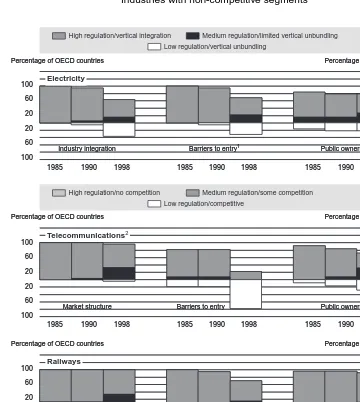
Figure 3 illustrates the move towards regulatory reform in such industries. Several dimensions of regulation and market or industry structure are considered: barriers to entry into the competitive segments of the industry and public owner-ship, each with three levels of intensity of regulation (see above), the degree of market competition in telecommunications and railways and the degree of vertical integration in electricity.10 The general movement towards lower barriers to entry
and private ownership, which characterises the three industries, is strongest in telecommunications,11 where barriers to entry have been virtually eliminated and
public ownership substantially reduced. Entry liberalisation (mainly in the freight service) and privatisation were much less pronounced in railways and electricity supply where, however, the organisation of the industry has changed somewhat because several countries have vertically unbundled their electric utilities.12
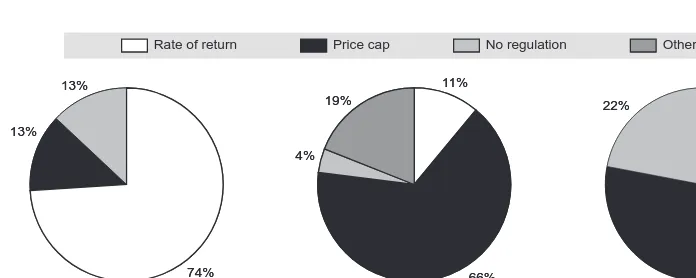
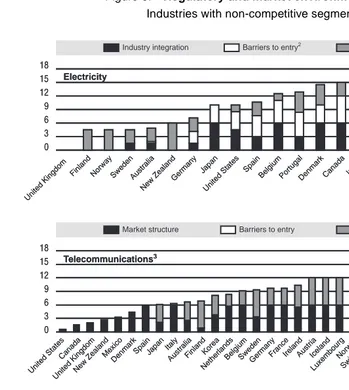
Precise information on price regulation is available only for 1998 (Figure 4). Countries are grouped into four pricing categories: rate-of-return regulation; incen-tive regulation (such as price caps); other regulation (including discretionary tariff approval by the government) and no regulation. Price regulation in the electricity industry was largely dominated by a cost-based approach, either in the form of standard rate of return regulation of vertically integrated utilities or in the form of long-run average incremental cost (LRAIC) regulation of transmission pricing, in industries where generation and transmission have been unbundled. In fixed voice telephony and railways, most OECD countries had switched to either price caps or no regulation.
22
Figure 3. Regulatory reform in OECD countries Industries with non-competitive segments
Notes: See Gönenç et al. (2000) for details on the construction of the indicators.
High regulation indicates that access to competitive markets is restricted and the supplier(s) of the good or service is
(are) fully state-owned.
Medium regulation indicates that some limited market access is allowed and the supplier(s) is (are) partially private. Low regulation indicates that market access is free and the supplier(s) is (are) private.
1. In electricity generation.
2. Fixed telephony: trunk and international.
Source: OECD International Regulation Database.
1985 1990 1998 1985 1990 1998 1985 1990 1998 1985 1990 1998 1985 1990 1998 1985 1990 1998 1985 1990 1998 1985 1990 1998 1985 1990 1998 20 Industry integration Barriers to entry1 Public ownership
Percentage of OECD countries Percentage of OECD countries
High regulation/no competition Medium regulation/some competition Low regulation/competitive
Percentage of OECD countries Percentage of OECD countries
Percentage of OECD countries Percentage of OECD countries
High regulation/vertical integration Medium regulation/limited vertical unbundling Low regulation/vertical unbundling
Market structure Barriers to entry Public ownership
Electricity
Market structure Barriers to entry Public ownership
Telecommunications2
Railways
1985 1990 1998 1985 1990 1998 1985 1990 1998 1985 1990 1998 1985 1990 1998 1985 1990 1998 1985 1990 1998 1985 1990 1998 1985 1990 1998 20 Industry integration Barriers to entry1 Public ownership
Percentage of OECD countries Percentage of OECD countries
High regulation/no competition Medium regulation/some competition Low regulation/competitive
Percentage of OECD countries Percentage of OECD countries
Percentage of OECD countries Percentage of OECD countries
High regulation/vertical integration Medium regulation/limited vertical unbundling Low regulation/vertical unbundling
Market structure Barriers to entry Public ownership
Electricity
Market structure Barriers to entry Public ownership
Telecommunications2
The Implementation and the Effects of Regulatory Reform: Past Experience and Current Issues
23
© OECD 2001
Differences across countries are largest in electricity and telecommunications, reflecting different initial conditions (e.g.different private/public ownership mixes) as well as different scope and time pattern of reforms in each country. In many countries, the dominant role of the incumbent is the only remaining obstacle to competition in telecommunications and in almost half of the countries, public ownership has also been eliminated or is negligible. In the electricity industry, public ownership bears little relationship with industry organisation and entry liberalisation: in some countries, weak public control co-exists with vertically-integrated utilities and relatively high barriers to entry in the competitive segments of the industry. In only a few countries have both vertical unbundling and deregulation of entry been achieved. Regulatory and market conditions are more homogeneous in the railways industry. In this industry, public ownership was, and is, common, reforms have been generally more limited, barriers to entry are widespread, and intra-industry competition is weak.
Product market liberalisation and performance
A number of empirical studies have tried to assess the impact of product market liberalisation on economic performance. The empirical studies are of three kinds: those looking at the effects on economic growth and the macroeconomy;
Figure 4. Price regulation in industries with non-competitive segments, 1998 Percentage of OECD countries falling in each category
1. Including discretionary tariff approval.
Source: OECD International Regulation Database. Electricity
transmission
Fixed telecommunications
Railways passenger service
Other1
No regulation Price cap
Rate of return
13%
74% 13%
66% 11% 19%
4%
50% 28% 22%
Electricity transmission
Fixed telecommunications
Railways passenger service
Other1
No regulation Price cap
Rate of return
13%
74% 13%
66% 11% 19%
4%
24
Figure 5. Regulatory and market environment in 1998 Industries with non-competitive segments1
Notes: See Gönenç et al. (2000) for details on the construction of the indicators.
1. Indicators are computed by simple average of their components. The scale of each of them is 0-6 from least to most restrictive. Scores on the three regulatory areas are aggregated in an indicator with a 0-18 scale. For details on sources and methodologies, see Boylaud and Nicoletti (2000); Gönenç and Nicoletti (2000) and Steiner (2000). 2. In electricity generation.
3. Fixed telephony: trunk and international.
Source: OECD International Regulation Database. 18
Market structure Barriers to entry Public ownership Industry integration Barriers to entry2 Public ownership
Finland Norw
PortugalDenm ark
Market structure Barriers to entry Public ownership Industry integration Barriers to entry2 Public ownership
Finland Norw
The Implementation and the Effects of Regulatory Reform: Past Experience and Current Issues
25
© OECD 2001
those looking at the effects in specific industries (or panels of firms belonging to specific industries); and those looking at panels of firms in a cross-section of industries. Further distinctions are between single-country and cross-country studies and time-series versus purely cross-section studies. The methodologies used to study these (actual or potential) effects include simulation approaches (e.g.using applied general equilibrium or macroeconometric models), descriptive analyses (e.g.drawing on simple plots or correlations) and econometric tech-niques. The definition of performance changes across studies, but generally includes measures of profitability, cost-efficiency and productive and allocative efficiency. A detailed review of the results of these studies in terms of macro-economic and industry level outcomes can be found in Gönenç et al. (2000).
Macroeconomic outcomes
Due to the lack of comparative data on regulatory and market environments across countries, and to the difficulty of conducting time-series analysis, most studies have taken a simulation approach or have related simple indicators of the regulatory environment to macroeconomic outcomes. Studies based on simula-tions all point to significant and positive effects of product market liberalisation on the levels and growth rates of GDP. Studies using relatively simple indicators of regulation tend to find a negative correlation between the strictness of national regulations and the average growth rates of GDP per capita in a cross-section of countries, while studies looking at the effects of trade-openness on TFP growth using a panoply of trade-openness indexes in a cross-section of countries find solid evidence that openness has increased the average growth rate of TFP over the 1980-1990 period in his sample.
All the simulation studies surveyed report either a positive or an insignificant impact on employment of product market reforms when labour market regulations are kept unchanged. The empirical evidence concerning interactions between product and labour market regulations suggests that concurrent liberalisation may moderate wages and increase employment. Some simulations find that simulta-neous reforms in product and labour markets have a significant positive employ-ment impact. An econometric study by Nicoletti et al. (2000), controlling for several dimensions of labour market regulations and institutions, finds a positive relation-ship between some OECD indicators of the strictness of product market regulation (OECD, 1999) and both the average business non-employment rate and manufac-turing wage premia over the 1982-1995 period in 19 OECD countries.13
Industry-level outcomes
26
changes can be related to (more or less) detailed measures of industry efficiency, of the prices and the quality of the products supplied, and to developments in the industry’s profits, wages and employment.
A cursory review suggests several considerations. First, there is overwhelming cross-industry evidence that in most cases liberalisation of entry and prices has improved static and dynamic efficiency, enhanced quality and lowered prices to consumers. Second, the effects on employment vary according to the industry and the country concerned. For example, liberalisation in road freight and telecommu-nications has had a favourable impact on industry employment in several countries (Mexico and Korea for telecommunications and United States and Mexico for road freight) while evidence from the United States suggests that in rail freight post-reform efficiency gains were matched by a substantial decrease in employment. Third, in air travel, reforms have often had beneficial effects on efficiency and fares, but these have been partly offset by fare increases in market segments more sensitive to airport dominance by incumbent carriers. Regulatory flaws in the access to the fixed network elements of the air transport industry are partly responsible for these problems. Fourth, reforms in the electricity supply industry are bedevilled by slow entry, the persistence of market power of incumbent generating companies and the technically complex regulatory issues to be tackled after basic entry liberalisation and unbundling of generation from transmission (and, possibly, distribution) has been implemented. Finally, the little available evidence concerning the effects of liberalisation in retail distribu-tion suggests that outlet restricdistribu-tions distorted industry structure and kept prices high (e.g.in Japan), while simulations hint that liberalisation of entry and opening hours may increase industry employment and lower prices.15
ADAPTING REGULATIONS TO THE NEW COMPETITIVE ENVIRONMENT
The Implementation and the Effects of Regulatory Reform: Past Experience and Current Issues
27
© OECD 2001
Regulatory issues in network industries
Regulation rationales
Network industries usually have a component that is non-competitive.16 For
example, the local loop in telecommunications, electricity transmission and distri-bution, gas and water pipelines, and rail track, are all characterised by economies of scale which give rise to a natural monopoly.17 Competition in these components
may be unsustainable and undesirable, since ceteris paribus costs will be minimised if the non-competitive activity is operated as a monopoly. Although, historically, the regulation of network industries has often been based on various public interest criteria, such as national security concerns and ensuring equal access to all services, the principal economic rationale for regulation rests on the existence of market failures.18
The presence of natural monopoly characteristics often means that competition cannot be relied upon to provide the socially optimal outcome and some form of gov-ernment intervention in these industries may be desirable.19 The hope that entry or
competition will erode the monopoly power of a network in the not-too-distant future, so that regulation can be eliminated altogether is probably misplaced (White, 1999). The important policy issue therefore is how to combine regulation of the non-compet-itive component (the network) with the organisation of competition in activities which use the network as an input and are potentially competitive sectors.
Many network industries also exhibit network externalities or network effects. These arise when demand for the product or service increases with network size, since there are benefits to being connected to a larger network, e.g.telecommunications, software and information technologies, banking (auto-matic teller machine networks), railways and airlines. Network externalities on their own do not imply that competition is not viable since markets that exhibit network externalities can sustain more than one firm.20, 21 However, the presence
of network effects does provide incentives for firms to engage in anti-competitive behaviour. For example, switching costs and lock-in effects serve to increase firms’ market power (Farrell and Shapiro, 1988 and 1989).22 This is why network
inter-connection and access issues are so important with regard to competition policy (Economides and White, 1994).
The market outcome is likely to be socially inefficient in the presence of positive consumption externalities and their existence has been used to justify subsidising access to a network. However, while network externalities are quite large in the early phase of an industry, in mature industries such as telecommuni-cations, where penetration rates are high, it is likely that the divergence of social and private benefits is small.23 On the other hand, the social costs associated with
28
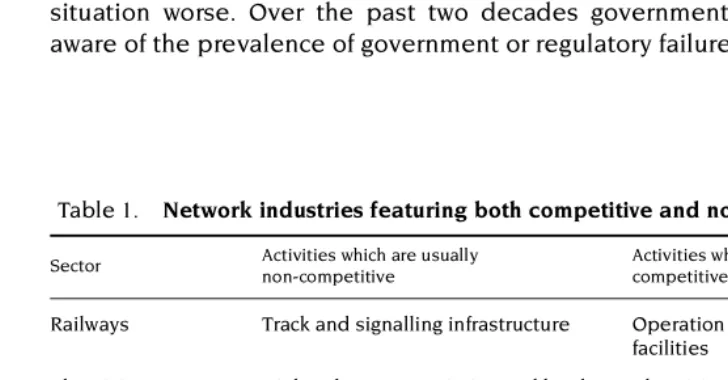
In the past, governments dealt with market failure in network industries either through public ownership or through regulation of privately owned monopolies. The first approach was widely employed in Europe and Oceania; the United States and, to a lesser degree, Canada opted for the second approach. The practical implications of the two approaches differ considerably, due to the different nature of the incentives introduced by direct ownership or by regulation (see the section on privatisation below). In both cases, due to economies of scale and scope, the non-competitive (network) component of the industry was vertically integrated with potentially competitive activities. Examples of the competitive and non-competitive activities of various network industries are provided in Table 1. Furthermore, socially optimal Ramsey pricing,24 combined with non-economic
objectives such as universal service or carrier of last resort obligations, required regulated tariff structures which exhibited cross-subsidies. Government regulation or ownership, therefore, often prevented or restricted competition in the poten-tially competitive segments of the industry in order to maintain the status quo and the sustainability of non-cost based tariff structures.
Although market failures of the sorts discussed above give rise to a prima facie case for government intervention, the actual intervention chosen may make the situation worse. Over the past two decades governments became increasingly aware of the prevalence of government or regulatory failure as mounting empirical
Table 1. Network industries featuring both competitive and non-competitive segments
Source: OECD Secretariat.
Sector Activities which are usually non-competitive
Activities which are potentially competitive
Railways Track and signalling infrastructure Operation of trains and maintenance facilities
Electricity High-voltage transmission and local electricity distribution
Electricity generation and supply
Telecommunications Local residential telephony or local loop
Long-distance telephony, mobile telecommunications, and value-added services
Gas High-pressure transmission of gas
Local gas distribution
Gas production and supply Gas storage
Water Distribution of water and wastewater Water collection and treatment Air services Airport services such as take-off
and landing slots
The Implementation and the Effects of Regulatory Reform: Past Experience and Current Issues
29
© OECD 2001
evidence showed that regulation of private enterprises had not succeeded in decreasing prices in those industries considered to be natural monopolies, and actually increased prices in potentially competitive sectors, see Peltzman (1989). It has also become clearer that privatisation of public monopolies is often a prior and necessary condition for the liberalisation of markets (see section on privatisa-tion below). The incentives of the government to engage in behaviour that favours the incumbent state-owned enterprise at the expense of other firms in the indus-try is very high, particularly if the state-owned enterprise is in financial difficulty. This, in turn, has the effect of deterring entry since potential entrants find the risks of expropriation too high.
Where the network is a true natural monopoly, the choice between govern-ment ownership and private ownership with regulatory oversight is not an easy one. A principal-agent relationship arises regardless of whether governments choose public ownership or regulation of privately owned monopolies. Agency problems are indeed the crux of the regulatory problem. Regulated firms are almost always better informed than the regulators about their costs, demand for their services, and the consequences of adopting particular regulatory schemes.
Incentive regulation
The use of incentive regulation may improve the quality and enhance the efficiency of regulation while, at the same time, minimising its burden. Incentive regulation endeavours to reduce asymmetries of information and to counter unproductive behaviour on the part of the firm.25
A key aspect of incentive regulation are policies regarding entry into segments of the industry where competition is feasible. This entails completely liberalising activities that are competitive. The introduction of competition enhances regula-tory efficiency because it reduces the asymmetric information problem by provid-ing the regulator with valuable information regardprovid-ing the costs and demand. In addition, entry minimises the regulatory burden by circumscribing the area over which regulation is required and by allowing competition to eventually supersede regulation.
In the non-competitive components of the industry where ex post competition is not feasible, the regulator can sometimes introduce ex ante competition into the market, for example, through the use of auctions for new capacity. To benefit consumers, auctions require that firms bid to provide the new capacity at the lowest price.26 Auctions therefore reveal information regarding the incremental
30
Yardstickcompetition, which uses the performance of other firms as a benchmark by which to compare the performance of the regulated firm, is another example of incentive regulation that enhances the information available to the regulator. Benchmarks may include the costs of specific inputs, the rate of return earned and cost of capital faced by firms with similar technologies or capital needs. This approach has been followed by British regulators in the electricity supply and water industries.27 The regulator may also use the performance of similar firms in
other countries. This is the approach suggested by the European Commission for the regulation of interconnection prices in telecommunications.
Price-capregulation is perhaps the most widespread type of incentive regulation in the OECD, and one that often employs yardstick competition. Unlike rate-of-return regulation,28 price-cap regulation does not require detailed and continuous
information about costs and demands. Instead, the aim of price-cap regulation is to provide adequate incentives for the company to reveal costs and to induce lower cost techniques. With incentive-price regulation the regulator sets a cap, including an adjustment factor X, for a specified period, that the firm can charge for a defined basket of goods and services. Over longer intervals, the adjustment factors and the baskets are reviewed and possibly changed. For the pre-specified period, however, the company can make any changes it wishes to prices, provided that the change in the average price of the specified basket of goods and services is below or equal to the price cap.29
The main argument in favour of price cap regulation is that it is less vulnera-ble than rate-of-return regulation to cost-plus inefficiency and over-capitalisation since the firm has the incentive to minimise all of its costs (Beesley and Littlechild, 1989).30 Part of this expected increase in efficiency can then be passed
on to consumers via the level of X. The shorter the time period between regula-tory reviews, however, the more price cap resembles rate-of-return regulation. Therefore, although price-cap regulation provides better incentives for productive efficiency, its merits relative to rate-of-return regulation depend on how it is applied in practice (see Box 1).31
The Implementation and the Effects of Regulatory Reform: Past Experience and Current Issues
31
© OECD 2001
Box 1. Issues in price-cap regulation
An important issue in price cap regulation is the determination of the caps and the frequency with which they are adjusted, especially the value of X. For example, at the end of the period (usually 3 to 5 years), both X and the composi-tion of the basket are reviewed and adjusted, and a new time period until the next review is specified. The shorter the interval between the setting of the price caps, the closer RPI-X is to rate-of-return regulation (Acton and Vogelsang, 1989). This is because, when reviewing the value of X, the regulator’s perception of the scope for performance improvements is influenced by how well the incumbent has done in the recent past as indicated by its rate of profit. Therefore, Liston (1993) argues that a well-functioning price-cap regime requires as much knowl-edge about costs as rate-of-return regulation.
Since at the end of the day the regulator uses the rate of return as a bench-mark when setting the cap, the firm may still have an incentive to inflate or distort its costs. The determination of the price-cap, the basket of goods and services to which the cap applies, and especially the timetable for review, all constitute part of an “implicit” regulatory contract. A problem arises however when excessive profitability leads to unanticipated changes in the value of X since unanticipated changes undermine the regulatory contract (see section on political economy issues below). For example, in the United Kingdom, unexpectedly high rates of return have led to unanticipated changes in the value of X in both the telecommu-nications and electricity industries. This weakens the incentives that price cap regulation is supposed to instil and can be detrimental for both investment and entry in the industry. Therefore, price-cap regulation (as it is applied in practice) may also provide incentives for the regulated firm to engage in various inefficient activities such as cost padding, construction of excess capacity, lobbying, etc. This is because, regardless of the form of price regulation, asymmetric information inevitably leads to regulators being poorly informed relative to those they regu-late and provides incentives for gaming behaviour on the part of reguregu-lated firms.
Another problem with price-cap regulation arises precisely from the price flexi-bility that it is designed to promote. For example, while price caps allow firms greater flexibility to adjust the structure of prices and recover their costs in an efficient manner, it also allows cross-subsidisation which is allocatively inefficient and may be used anti-competitively. One important issue, therefore, is determining the composition of the basket of goods and services that are subject to the price cap. This is particularly important when firms are selling some goods or services in potentially competitive markets. In this case the incumbent firm can bundle competitive services with monopoly services and has an incentive to set prices (within allowances permitted by the cap) to the detriment of competition. In the United Kingdom, for example, British Telecom while operating under a price cap, aggressively countered entry into its long-distance market by lowering prices while raising prices in its uncontested markets (Vickers and Yarrow, 1988 and Armstrong
32
Retail price-cap regulation of the incumbent public telecommunications operator or other dominant operators is now prevalent in the telecommunications industry in OECD countries.32 Price cap regulation is also widespread in railways.
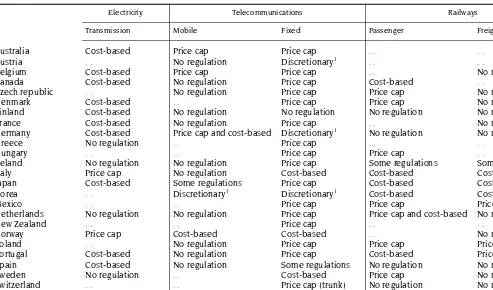
By contrast, the electricity industry is still governed primarily by cost-based regulation. For example, Table 2 shows that for a majority of countries transmis-sion prices in the electricity industry are cost-based, the exceptions being Italy, Norway, and the United Kingdom. One of the reasons why price-cap regulation is more prevalent in telecommunications than in the electricity industry may be that cost information is easier to obtain in the latter.33
Access pricing
Interconnection or access charges, which determine the price at which entrants will be granted access to the network of a vertically integrated incum-bent, play a crucial role in the success or failure of entry in competitive services. A problem arises because to enter a market an entrant will generally find it finan-cially impossible to replicate the facilities of the incumbent. Given the market power of incumbents, access charges will generally have to be regulated.34 The
regulator’s dilemma is to find algorithms for setting access charges at a level that will only allow entry of competitors that are at least as efficient as the incumbent in supplying competitive activities. Charges that are too high relative to actual costs will deter entry into competitive markets, prevent competitors that are potentially more efficient from surviving and encourage inefficient bypass of the incumbent’s network.35 Setting charges below the pertinent costs of the incumbent
(which effectively amounts to a subsidy to entrants) also distorts the competitive process by inducing inefficient entry into competitive markets.
Several pricing rules have been proposed. These include cost-based rules, demand-based rules, and efficient entry rules. A purely accounting approach (or cost-based rule) requires the estimation of the long-run average incremental costs incurred by the incumbent in the provision of access. The difficulty is that incremental costs can be estimated in several different ways (e.g.stand-alone costs, avoidable costs, or fully-distributed costs)36 and in addition an allocation of
com-mon costs is required. This entails a mark-up of price over marginal cost in order to recover total costs. In accounting approaches the mark-up is not based on any prin-ciple of efficient resource allocation and often apportions the common or fixed costs across products in an arbitrary manner. Demand-based rules such as Ramsey pricing (see above) are designed to recover full costs while minimising the efficiency losses from setting prices above short-run marginal costs. However, Ramsey prices are difficult to compute and could lead to cross-subsidisation and inefficient bypass.37
T
Table 2. Price regulation in network industries, 1999
1. Tariff approval.
Sources: OECD International Regulation Database; OECD (2000); Steiner (2000).
Electricity Telecommunications Railways
Transmission Mobile Fixed Passenger Freight
Australia Cost-based Price cap Price cap . . . .
Austria . . No regulation Discretionary1 . . . .
Belgium Cost-based Price cap Price cap . . No regulation
Canada Cost-based No regulation Price cap Cost-based . .
Czech republic . . No regulation Price cap Price cap No regulation
Denmark Cost-based . . Price cap Price cap No regulation
Finland Cost-based No regulation No regulation No regulation No regulation
France Cost-based No regulation Price cap . . No regulation
Germany Cost-based Price cap and cost-based Discretionary1 No regulation No regulation
Greece No regulation . . Price cap . . . .
Hungary . . . . Price cap Price cap . .
Ireland No regulation No regulation Price cap Some regulations Some regulations
Italy Price cap No regulation Cost-based Cost-based Cost-based
Japan Cost-based Some regulations Price cap Cost-based Cost-based
Korea . . Discretionary1 Discretionary1 Cost-based Cost-based
Mexico . . . . Price cap Price cap Price cap
Netherlands No regulation No regulation Price cap Price cap and cost-based No regulation
New Zealand . . . . Price cap . . . .
Norway Price cap Cost-based Cost-based . . No regulation
Poland . . No regulation Price cap Price cap Price cap
Portugal Cost-based No regulation Price cap Cost-based Price cap
Spain Cost-based No regulation Some regulations No regulation No regulation
Sweden No regulation . . Cost-based Price cap No regulation
Switzerland . . . . Price cap (trunk) No regulation No regulation
Turkey . . Price cap Discretionary1 Price cap Price cap
United Kingdom Price cap . . Price cap Price cap No regulation
34
component pricing rule (ECPR), which is frequently advocated, replicates the pric-ing behaviour of competitive markets and is competitively neutral in that it does not give an unfair advantage to either the incumbent or the entrant. The ECPR sets the access price equal to the final product price minus the cost of inputs other than the network (Baumol, 1999). However, if the final product price is higher than socially optimal (i.e.does not equal marginal cost), an access price that is equal to the price determined by the ECPR will in general be inefficient.38 This is because
the rule does not promote any dissipation of the incumbent’s monopoly rents.
Another factor that further complicates the access pricing issue is the existence of non-economic objectives and cross-subsidies (see below). For instance, the use of price-cap regulation for access charges may distort efficient price structures. In telecommunications, if customer access charges are capped at a price below costs, the incumbent firm must charge a price above costs for other services. In this case caps on local access that prevent a normal rate-of-return on this activity may affect prices in the long-distance market. The need to maintain prices at a level that provides for an adequate overall rate-of-return means that the incumbent is at a competitive disadvantage when competing in the long-distance market. Tariff structures that are not cost reflective create the wrong incentives by encouraging entry that is motivated by cream-skimming opportu-nities. These issues are discussed in further depth below where the problems associated with funding non-economic objectives in a competitive environment are addressed.
Vertical separation
One important policy issue is how to control a dominant firm’s anti-competitive behaviour towards its rivals. Separation of the ownership of competi-tive activities from the non-competicompeti-tive component, supported by restrictions preventing re-integration into competitive activities, is often advocated as a way to reduce incentives for anti-competitive behaviour.39 For example, the main
advantage of vertical separation is that it reduces the incentives of network owners to restrict access to rival firms in the upstream or downstream (potentially competitive) markets.40 However, it is often the case that there are economies of
scope between the various components of network industries, which argue in favour of vertical integration.41 At the end of the day, the benefits of vertical
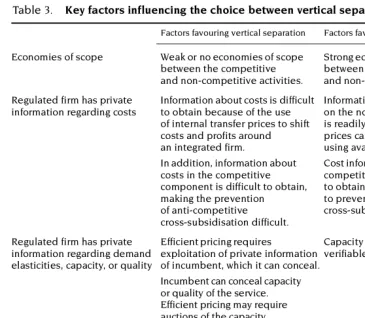
integration need to be weighed against their costs. Table 3 summarises some of the key factors influencing the choice between vertical separation and integration.
The Implementation and the Effects of Regulatory Reform: Past Experience and Current Issues
35
© OECD 2001
vertically separated as this reduces the opportunities and incentives for shifting costs and profits around within the firm for strategic purposes against both rival firms and the regulator.
Another advantage of vertical separation is that it focuses the regulatory inter-vention on the underlying market failure and minimises the scope for regulatory failure. For example, vertical separation avoids the regulatory headache of allocat-ing common costs in a vertically integrated industry, and requires information only on the costs of the network facility. Where sufficient competition exists in the potentially competitive segments of the industry, vertically separating them from the non-competitive network segment may make it feasible to completely deregu-late final prices while only regulating the price of the non-competitive component.
Table 3. Key factors influencing the choice between vertical separation and integration
Source: OECD Secretariat.
Factors favouring vertical separation Factors favouring vertical integration
Economies of scope Weak or no economies of scope between the competitive and non-competitive activities.
Strong economies of scope between the competition and non-competitive activities. Regulated firm has private
information regarding costs
Information about costs is difficult to obtain because of the use of internal transfer prices to shift costs and profits around an integrated firm.
In addition, information about costs in the competitive component is difficult to obtain, making the prevention of anti-competitive cross-subsidisation difficult.
Information about costs on the non-competitive activity is readily available and access prices can be reasonably efficient using available information. Cost information in the competitive activity is easy to obtain and can be used to prevent anti-competitive cross-subsidisation.
Regulated firm has private information regarding demand elasticities, capacity, or quality
Efficient pricing requires
exploitation of private information of incumbent, which it can conceal. Incumbent can conceal capacity or quality of the service. Efficient pricing may require auctions of the capacity
of the non-competitive component.
Capacity and quality are readily verifiable.
Institutional and legal context Incumbent firm has wide scope for using legal and regulatory process to delay or obfuscate. The legal environment is supportive of long-term contracts.
Institutions are effective at controlling the incentives on the incumbent to delay or obfuscate.
36
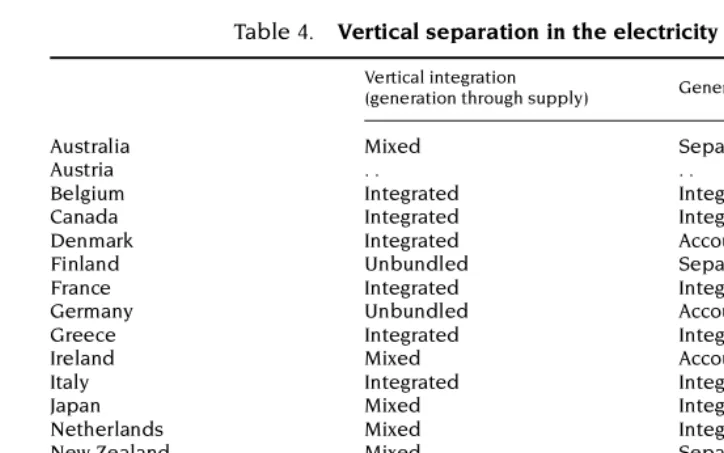
Besides ownership separation, other weaker forms of separation include accounting separation and “functional” separation. However, these do not over-come the incentives of the incumbent to restrict competition in the competitive activities as it remains possible to strategically re-allocate costs and engage in other anti-competitive behaviour. Hilmer (1993) argues that the failure to make a full separation of ownership and control, despite liberalisation and privatisation, is the major reason why infrastructure reform in the United Kingdom (e.g.in the gas industry) has not produced the expected welfare gains. In spite of these difficulties, and presumably to reap the benefits associated with economies of scope, a number of countries use accounting separation as the regulatory instrument. Table 4 provides evidence of the extent of vertical separation in the electricity supply industry in a number of OECD countries.
Regulatory issues in transportation industries
Regulatory reforms have been widespread in transportation industries. Air travel and road freight liberalisation in the United States became showcases for the overall reform movement: large efficiency gains, quality improvements, price
Table 4. Vertical separation in the electricity industry
Source: Steiner (2000).
Vertical integration
(generation through supply) Generation and transmission
Australia Mixed Separate companies
Austria . . . .
Belgium Integrated Integrated
Canada Integrated Integrated
Denmark Integrated Accounting separation
Finland Unbundled Separate companies
France Integrated Integrated
Germany Unbundled Accounting separation
Greece Integrated Integrated
Ireland Mixed Accounting separation
Italy Integrated Integrated
Japan Mixed Integrated
Netherlands Mixed Integrated
New Zealand Mixed Separate companies
Norway Unbundled Separate companies
Portugal Mixed Accounting separation
Spain Mixed Accounting separation
Sweden Mixed Separate companies
United Kingdom Unbundled Separate companies
The Implementation and the Effects of Regulatory Reform: Past Experience and Current Issues
37
© OECD 2001
decreases and output growth of deregulated transport activities became visible to policy-makers and public opinion world-wide (see the first section above), and inspired further reform initiatives in other countries and industries.
In the past, to fully exploit supposed scale economies (Box 2) and avoid perceived destructive competition,42 governments restricted new entries and
price competition, either in the form of economic regulation of private firms, or through public provision of services by government-owned monopolies. As from the 1970s, though, economic research increasingly questioned the actual over-arching presence of scale economies in these services,43 and highlighted the
uneven presence of natural monopoly phenomena in different segments of the transport industry – in low-traffic vs. high-traffic routes, and in infrastructures vs. service operations.
Box 2. Scale and network economies in transportation industries
Economies of scale in transportation industries manifest themselves in a variety of different ways:
– Economiesoffill due to operation fixed costs. They result from indivisibilities in vehicle operations, and imply that marginal costs of additional seats or passengers on an aircraft or train are negligible.
– Economiesofhauling due to tracking fixed costs. These are a specific form of fill-economies absent in air but important in rail transportation and result from decreasing costs of adding capacity to an individual hauling operation. The engine power, energy and crew necessary for a longer and heavier train are not commensurate with the additional wagons which have been added (a train of 40 and a train of 60 wagons have similar trackage costs).
– Economiesofdensity due to route fixed costs. They derive from route-specific infrastructure indivisibilities (such as terminal, track, and route mainte-nance fixed costs) and generate decreasing costs for adding new services/ new capacity on existing routes.
– Economiesofstagelength due to terminal fixed costs. Constant departure and arrival costs generate decreasing costs per distance of operation. These result from the high fixed costs of fuel for take-offs and landings, fixed airport charges, fixed air traffic control charges, and the immobilisation costs of aircraft and crew on route-ends.
38
The findings pointing to the sustainability of competition in certain segments of the transportation industry have been instrumental in creating consensus for transportation reforms more generally, including air transport,44 initially in the
United States and then in the United Kingdom, Continental Europe and other countries. Table 5 reviews the five most far-reaching transportation reforms in OECD countries during the past two decades, together with their renewed economic assumptions and objectives.45
Most OECD countries have initiated reforms in the air sector, albeit mainly on a domestic and regional basis only. International aviation routes remain regulated by a web of bilateral air agreements, which impose different regulatory rules by route, governing entries, route access, capacity and fares.46 Even more liberal
Open Sky agreements constrain the entry of third-party carriers, prohibit the continuation of international flights into domestic routes, and limit ownership changes. The uneven liberalisation of domestic-regional and bilateral-international markets is an important characteristic of the air sector.
In railways, reforms have been limited and concerned mainly the freight business. Some countries, notably the United States and the United Kingdom have significantly liberalised access of infrastructures to multiple providers (the starting reform initiatives at the EU level are discussed below). Transportation reforms have raised new regulatory issues, often because inherited infrastructures have proven inadequate and have failed to adapt to the requirements of new entries and service competition.
The Implementation and the Effects of Regulatory Reform: Past Experience and Current Issues
39
© OECD 2001
Table 5. Five main transportation regulatory reforms in OECD countries
Description of reforms Economic fundamentals
(assumptions and objectives) Observed impacts
US Air reform, 1978-1981
Full liberalisation of entries and fares in domestic air routes.
No risk of natural monopoly, no risk of destructive capacity and price competition in the main domestic air routes.
Many new entries, differentiation of fares according to service class, overall decrease of travel costs, hub-and-spoke reorganisation of networks. Subsequent market consolidation and lesser fare decreases
in hub-dominated routes. US Rail reform,
1982
Full liberalisation of entries and fares in domestic rail routes. Integrated (infrastructure/operation) companies give open access to competitors.
Services are potentially competitive, infrastructures are natural local
monopolies to be opened to competitors under regulation. Services are commercially sustainable if socially valuable – or otherwise decline.
Rail passenger transportation shrunk radically: only one government-owned carrier remained in operation. Rail freight services strongly grew in certain markets, declined in others, and consolidated into a more concentrated market structure. UK Rail reform,
1993
Privatisation of railtrack infrastructure as a regulated monopoly, passenger services franchised for 8 years to private bidders.
Service markets are not potentially competitive but can be open to challenge through periodical bids. Infrastructure is a regulated natural monopoly which can be developed without vertical links to services.
120 new railway companies (20 main passenger service companies) were formed. Fares and productivity increased according to terms of franchising contracts, often giving rise to larger-than-anticipated profits, provoking renegotiations with the regulator. Contracts between rail players (between infrastructure and services) are also being redesigned.
EU Air reform, 1993-1997
Full liberalisation of entries and fares in intra-European air routes, for “community carriers”.
European air service markets are potentially competitive, supply rationalisation can develop in the European internal market.
40
Infrastructure bottlenecks in vertically integrated services (Rail)
After the liberalisation of rail passenger and/or freight services, OECD countries faced two options for ensuring the fair and equal access of all competitors to the natural monopoly railtrack networks: open access or vertical separation.47 The United States chose the first option, while in Europe the second
option is being considered.
Open access
In the US rail reform, competing railway companies have ownership and control rights over their own railtrack and other fixed facilities, but have to give open and equal access to their competitors.48 As regulations permit all sorts of
contracts, a variety of company-to-company arrangements have been designed, and regulators and courts are solicited in case of ex post commercial conflicts, of which there have been several.49 The complex and information-intensive
demands that “open access” can put ex post on the regulatory and judicial system may indeed have persuaded other countries to opt for vertical separation, a solution which eliminates all risk of judicial uncertainties and litigation at the outset of a difficult reform process.
Vertical separation
In Europe, vertical separation of infrastructures and services is seen as a necessary step for rail reform50 in order to give competing service companies
equal access rights to infrastructures at non-discriminating charges. In turn, infrastructure providers can in the future concentrate on maximising revenues from infrastructure supply, focusing on improving the value of their facilities for all service intermediaries, without being constrained by the business strategies of
Table 5. Five main transportation regulatory reforms in OECD countries (cont.)
Source: OECD Secretariat.
Description of reforms Economic fundamentals
(assumptions and objectives) Observed impacts
International “Open Sky” Air Agreements, 1991-1999
Bilateral liberalisation agreements between governments, allowing designation of multiple carriers, capacity and fare freedoms, and traffic rights to third-countries.
Main international air routes are potentially competitive, and competition can develop without open access to domestic (cabotage) routes.
Significant capacity increases and fare decreases on bilateral routes. Market
The Implementation and the Effects of Regulatory Reform: Past Experience and Current Issues
41
© OECD 2001
their former service affiliates.51 Incentives for monopolistic pricing within these
infrastructure monopolies will have to be checked by regulatory supervision. Vertical separation in rail presents similar shortcomings as in other network indus-tries (see above). The EU policy (EC, 1991) foresees successive steps for vertical separation, starting from a simple, and admittedly insufficient, accounting separation of infrastructures and services within railway monopolies.52 Then, the
separation of infrastructures as an individual division of railway companies is recommended. Further steps are the clearer separation of infrastructures as stand-alone subsidiaries, and their fuller autonomy as independent firms. The privatisa-tion of the independent infrastructure firms is an ultimate step taken until now only by the United Kingdom. Table 6 summarises the variety of national arrange-ments governing the vertical relations between rail infrastructure and services in 1998.
Table 6. Vertical relations between rail infrastructure and services
Sources: European Conference of Ministers of Transport, 1998, andOECD International Regulation Database. Infrastructure and services Notes
Australia Different state regimes Austria Accounting separation Belgium Accounting separation
Canada Integrated
Czech Republic Accounting separation Infrastructure a separate division of service operator. Denmark Separate companies
Finland Separate companies
France Separate companies Infrastructure independent, but managed and maintained by service operator.
Germany Accounting separation Open access provisions. Hungary Accounting separation
Ireland Integrated
Italy Accounting separation Infrastructure a separate division of service operator.
Japan Integrated
Korea Integrated
Netherlands Separate companies Infrastructure subsidiary of service operator. New Zealand Integrated
Norway Separate companies
Poland Accounting separation Portugal Separate companies
Spain Accounting separation Infrastructure a separate division of service operator.
Sweden Separate companies
Switzerland Accounting separation Infrastructure a separate division of service operator.
Turkey Integrated
United Kingdom Separate companies