A Quantum of Force: The Consequences of
Counting Routine Conducted Energy
Weapon Punctures as Injuries
Robert J. Kaminski, Robin S. Engel, Jeff Rojek,
Michael R. Smith and Geoffrey Alpert
In a recent paper, researchers reported increases in the risk of citizen injury associated with police use of conducted energy devices (CEWs), a finding that is contrary to that reported in most previous studies. These authors speculate that the differences in findings when compared to other similar studies may be due, in part, to the exclusion of routine CEW dart punctures as injuries by
Robert J. Kaminski is associate professor in the department of criminology and criminal justice, University of South Carolina. His research focuses on violence against the police, police use of force, less-lethal technologies, and the causes and prevention of officer and suspect line-of-duty injuries. His has published in a variety of journals, includingCriminology, theAmerican Journal of Public Health, Criminal Justice and Behavior, Crime and Delinquency, Homicide Studies, and
Violence Against Women. Robin S. Engel, PhD is associate professor of criminal justice at the University of Cincinnati. Her research includes empirical assessments of police behavior, police/ minority relations, police supervision and management, criminal justice policies, criminal gangs, and violence reduction strategies. Previous research has appeared in Criminology, Justice Quarterly,Journal of Research in Crime and Delinquency,Journal of Criminal Justice,Crime and Delinquency, and Criminology and Public Policy. Jeff Rojek is assistant professor in the depart-ment of criminology and criminal justice at the University of South Carolina. His primary research interests are in the area of police officer and organizational behavior. His most recent publications have appeared in Criminology, Journal of Research in Crime and Delinquency, Crime and Delin-quency, andPolice Quarterly. Dr Michael R. Smith is professor of criminal justice and vice provost at the University of Texas at El Paso. Prior to assuming his current position, he served as dean of the College of Liberal Arts and Social Sciences at Georgia Southern University and chair of the Department of Criminology and Criminal Justice at the University of South Carolina. Dr Smith is a former police officer and holds a JD from the University of South Carolina School of Law and a PhD in Justice Studies from Arizona State University. He has served as a principal or co-principal inves-tigator on many research and evaluation grants and contracts over his career. He has written extensively on racial profiling, use of force, and other critical issues at the intersection of law, public policy, and policing. His most recent publications have appeared in Criminology & Public Policy, theAmerican Journal of Public Health, andReview of Policy Research. Geoffrey P. Alpert is a professor in the department of criminology and criminal justice at the University of South Car-olina. Dr Alpert has been conducting research on high-risk police activities for more than 30 years. He is currently working with Cal POST on their Vehicle Operations Training Advisory Council, and the Queensland Police Service and Griffith University in Brisbane, Australia. He is a member of the International Association of Chiefs of Police Research Advisory Committee. Correspondence to Robert J. Kaminski, Department of Criminology & Criminal Justice, University of South Carolina, Columbia, SC 29208, USA. E-mail: [email protected].
Ó2013 Academy of Criminal Justice Sciences
other researchers, and they called on the research community to collectively agree on how CEW injuries should be operationalized. In this paper, we empir-ically demonstrate the differences in findings when routine CEW puncture wounds are included as citizen injuries and when they are not. Ultimately, we reject the authors’ measurement approach as inconsistent with how injuries associated with other types of force are routinely coded and measured.
Keywords police use of force; conducted energy weapons; citizen injuries
Introduction
One of the most consistently documented and researched behavior in policing is the use of force. Despite the litany of studies that have been conducted over the years to measure the types, frequency, and correlates of police coercion, there has been little consensus derived across academics and practitioners regarding many of the most fundamental issues surrounding the use of force by police. In contrast to this larger body of literature, however, recent findings regarding the use of one type of weapon—conducted energy weapons
(CEWs)1—have generated relatively consistent findings. Most recent studies of
the use of CEWs by police have shown that they substantially reduce the num-ber and severity of injuries to citizens compared to other types of force and have similar effects on injuries to officers or are benign (Lin & Jones, 2010; MacDonald, Kaminski, & Smith, 2009; Smith, Kaminski, Rojek, Alpert, & Mathis, 2007; Taylor & Woods, 2010). Notably, the only two studies to date employing quasi-experimental designs bolster confidence in these results (MacDonald et al., 2009; Taylor & Woods, 2010).
These findings, however, have recently been called into question based on new findings reported by Terrill and Paoline (2011) in Justice Quarterly. Employing a nonexperimental design, these authors examined CEW usage in seven mid-to large-size US police agencies. Using different methods and mea-sures, they reported significantincreasesin citizen injuries involving the use of CEWs compared to other types of force across a majority of their statistical models. Terrill and Paoline highlighted the importance of their findings by not-ing that their study “is the first to report a fairly consistent increased risk between the use of CEWs and citizen injury,” leading them to suggest that “recent policy recommendations made by a number of researchers (MacDonald et al., 2009; PERF, 2005; Smith et al., 2007; Taylor & Woods, 2010) as to how or when to use CEWs, are premature” (Terrill & Paoline, 2011, p. 24). Yet, contrary to most prior studies, Terrill and Paoline’s measure of citizen injury included routine minor CEW punctures. They speculated that the differences in their findings when compared to other studies of similar size, scope, and
1. Conducted energy weapons are also known as electro-muscular disruption devices, electronic control devices, neuro-muscular incapacitation devices, and conducted electrical devices.
design may be due to the inclusion of minor dart punctures as “injuries,” and further articulated several reasons why they departed from previous approaches regarding the measurement of citizen injury associated with CEWs. They concluded by recommending that the research community collectively decide how to better operationalize CEW-related injuries.
Given the importance of police use of force, and that Terrill and Paoline’s findings are contrary to those reported in previous research studies, their approach merits additional consideration and attention from researchers. We therefore consider the consequences of including routine CEW-related punctures as measures of citizen injuries. First, we review the prior literature surrounding use of force and specifically CEW usage, including Terrill and Paoline’s most recent contribution. Using data from a large West-coast law enforcement agency, we next empirically demonstrate the differences in findings when routine puncture wounds are included as citizen injuries compared to when they are not. In direct contrast to Terrill and Paoline, we argue that our findings regarding CEW-related citizen injury (when properly measured) are consistent with the majority of previous empirical research find-ings. We conclude with a discussion of the practical and policy implications of including routine CEW punctures in measures of citizen injuries. We also revisit prior measurement decisions in the use of force literature and note how Terrill and Paoline have previously departed from conventional measures of police use of force and now citizen injury. Ultimately, we reject these authors’ measurement approach as inconsistent with how injuries associated with other types of force are routinely coded and measured, and we discuss the negative consequences that such an overly expansive view of injuries may have on the development of future technologies designed to reduce injuries and save lives.
Police Use of Force and Conducted Energy Devices
The use of physical force by police has been a matter of great debate and controversy for decades. From Westley’s (1953) initial characterization of police use of force as violence to Bittner’s (1985) observation that the core of the police role in society is the nonnegotiable use of coercive force, the conceptualization and study of police use of force is often a central compo-nent of criminal justice research. Over the years, successful attempts at reducing police use of force and the resulting harms associated with it have included changes in laws, legislation, policies, training, and practice (Fyfe, 1988). And most recently, law enforcement officials have turned to the use of less-lethal technologies (e.g. CEWs and pepper spray) as weapons of choice to reduce citizen and officer injuries when force must be used to control resistant criminal suspects (MacDonald et al., 2009; Taylor, Alpert, Kubu, Woods, & Dun-ham, 2011).
CEWs have been used by law enforcement since at least the 1980s. They are handheld devices that use compressed nitrogen to launch two or four
(depending on the manufacturer and device) tiny barbed darts tethered to a power source by insulated wires that project outward to maximum distances of 15-35 feet. CEWs also have a “touch-stun” mode used for pain compliance. When the darts attach to clothing or penetrate the skin, they deliver short electric pulses with very low average current that interrupts the electrical sig-nals from the central nervous system to the peripheral body, typically leading to neuro-muscular incapacitation (Kroll & Ho, 2009). Although some law enforcement agencies purchased Stinger Systems’Ò
CEWs, Taser InternationalÒ has been the market leader supplier (US Department of Justice, 2009).
The introduction of CEWs as a use-of-force alternative significantly shifted the use-of-force landscape. Although early models of the TASERÒ
were not widely adopted during the 1980s, in part because they were less effective than newer models (Meyer, 2009), the number of law enforcement agencies employ-ing 100 or more sworn officers adoptemploy-ing CEWs grew substantially followemploy-ing the marketing of the TASERÒ
model M-26TM in 1999. According to the Bureau of Statistics, only 14.5% of agencies deployed CEWs in 2000. This percentage tripled by 2003 (43.9%) and as of 2007, 74.9% of agencies deployed CEWs (Law Enforcement Management and Administrative Statistics, 2006, 2003, 2011).
CEW Effectiveness
An initial consideration regarding CEWs is their ability to successfully incapaci-tate resistant and combative subjects so that they can be brought under control by arresting officers. The early seven-watt versions of CEWs were less effective than current models and were often ineffective against suspects under the influence of Phencyclidine (PCP) or in a state of excited delirium (Meyer, 2009). Other assessments found CEWs to be effective between 50 and 85% of the time (Donnelly, 2001), while more recent evaluations by Taser InternationalÒ and individual law enforcement agencies reported CEWs were effective between 80 and 94% of the time (White & Ready, 2007, 2010). Inde-pendent research on CEW effectiveness has also reported high levels of suc-cessful incapacitation of resistant suspects, albeit the reported percentages are lower than those reported by CEW manufacturers. For example, research conducted by Mesloh, Henych, Hougland, and Thompson (2005) demonstrated that the use of CEWs was immediately effective (with no further suspect resis-tance) in 67.7% of the 400 random sampled use-of-force reports from the Orange County Sheriff’s Office in 2001-2003. Delayed effectiveness was reported in 9.6% of the reports and ineffectiveness on first application in 22.7% of the reports. The main reasons for failure were missed shots, suspects wear-ing baggy clothes, or loosened probes. Subsequent analyses of use-of-force reports from the Orange County Sheriff’s Office and the Orlando Police Department in 2001-2005 reported 59.8% effectiveness without further suspect resistance (Mesloh, Henych, & Wolf, 2009). Importantly, both studies reported that CEWs were more effective than all other types of force at ending suspect
resistance on first application; these findings are similar to those reported by Meyer (2009).
White and Ready (2007) examined 243 CEW uses by NYPD emergency service unit personnel on persons who were in an agitated state (e.g. under the influ-ence of drugs and mentally ill) that presented a danger to themselves or others for the years 2002-2004. They found that suspects were reported as being inca-pacitated 84.7% of the time, but that of those initially incainca-pacitated, 21.3% continued to resist (calculated from Table 2, p. 182). If one considers contin-ued resistance as less than “effective,” the effectiveness rate would be 63.4%, which is similar to other studies. In a follow up study, White and Ready (2010) used multiple regression analyses to examine CEW effectiveness of 375 CEW deployments by the NYPD during 2002-2005. Of suspects initially incapacitated, 33.0% continued to resist and of suspects not incapacitated (e.g. due to CEW failure), 10.9% continued to resist. The authors found that suspect body weight greater than 200 lb, a distance of three feet or less, alcohol or drug intoxication, violence directed towards officers, CEW misses, and use of other less-lethal devices were all significant predictors of continued suspect resistance. Interestingly, other variables, such as suspect race, gender, and mental status were unrelated to reported CEW effectiveness.
CEWs, Deaths, and Deadly Force
One of the major concerns of police use of CEWs is sudden in-custody death following exposure. According to Amnesty International, 500 subjects died following exposure to CEWs in the USA since 2001 (Trimel, 2012). Sudden in-custody death during police confrontations is not a new phenomenon and these outcomes have been variously attributed to positional asphyxia, exposure to pepper spray (oleoresin capsicum, OC), prolonged violent struggle, excited delirium syndrome, drug intoxication, cardiovascular dis-ease, or other factors (Chan, Vilke, Neuman & Clausen, 1997; DiMaio & DiMaio, 2006; Petty, 2004; Reay, Fligner, Stilwell, & Arnold, 1992; Roeggla, Roeggla, Moser, & Roeggla, 1999). The difficulty, of course, is determining whether less-lethal weapons such as OC and CEWs cause or contribute to sudden in-custody deaths, or whether these deaths would have occurred even in the absence of exposure to these weapons.
Several medical-based studies have attempted to determine the contribu-tion of CEWs to injury and in-custody deaths following exposure. Two studies involved medical screenings and record reviews of 1,627 exposed subjects (Bozeman et al., 2009; Eastman et al., 2007). Eastman et al. (2007) examined 426 exposed subjects and found all nonfatal injuries were minor, though there was one death. This subject had a core body temperature of 107.4 and was intoxicated on cocaine, and likely would have died even without the shock from a CEW (White & Ready, 2009). Bozeman and colleagues (2009) examined 1,201 exposed subjects, and reported that the vast majority (99.75%) suffered
no injuries or only superficial injuries. Although there were two fatalities, upon autopsy it was concluded the deaths were unrelated to CEW exposure.
Several retrospective mortality reviews were conducted by medical researchers who examined hundreds of autopsy and toxicology reports of persons who died proximate to CEW exposure. Many subjects were found to be intoxicated on drugs, suffered from cardiovascular disease, and/or were in a highly-agitated state at the time of exposure (excited delirium). The general conclusion from this body of research was that CEWs are not a common cause or contributor to sudden in-custody death (Kornblum & Reddy, 1991; Strote & Hutson, 2006; Swerdlow, Fishbein, Chaman, Lakkired-dy, & Tchou, 2009; US Department of Justice, 2011). An exception is a study by Zipes (2012), who reviewed eight cases of CEW-proximate deaths and concluded that CEWs can cause cardiac dysrhythmias and sudden death, though this study has been challenged on a number of grounds (see, e.g. Vilke, Chan, & Karch, 2013). Furthermore, although the vast majority of CEW-proximate deaths have been attributed to causes other than CEWs, Amnesty International reported that CEWs contributed to or caused more than 60 deaths as determined by medical examiners (Trimel, 2012). Further, some subjects without any apparent risk factors have also died following CEW exposure (US Department of Justice, 2011). Clearly, the deployment of a CEW by law enforcement personnel should not be taken lightly.
While the focus of research on CEWs has been on their contribution or potential contribution to in-custody deaths (Kaminski, 2009), relatively little empirical research has examined the potential of CEWs to reduce citizen fatalities and the use of lethal force by police. Given the deterrent and inca-pacitation effects of CEWs and other less-lethal weapons such as OC, however, it is likely that their use early on during resistive and violent encounters prevents further escalation and the need for the use of deadly force by police in some cases (Mesloh, Henych, Hougland, & Thompson, 2005; Thomas et al., 2010; White & Ready, 2007, 2010). For example, Taser InternationalÒ reports that as of October 2012, police use of CEWs saved over 97,000 people from potential death or serious bodily injury (http://www.taser.com/taser-prod-ucts-save-lives). Likewise, several law enforcement agencies reported large reductions in the use of lethal force by its officers following the introduction of CEWs (see, e.g. Smith et al., 2009), though there have been some excep-tions (Amnesty International, 2004; Thomas et al., 2011). However, these sim-ple pre-post CEWs research designs suffer from a number of threats to internal validity and are often not the product of independent research (Adams & Jenn-ison, 2007; Alpert & Dunham, 2010; Campbell & Stanley, 1966; Kaminski et al., 1998; Smith et al., 2009; Taylor & Woods, 2010).
A more rigorous prospective study of CEW use on mentally-ill subjects by Ho, Dawwes, Johnson, Lundin, and Miner (2007) that used data self-reported by law enforcement agencies submitted to Taser InternationalÒ
estimated that CEWs were deployed in nearly 50% of encounters in which deadly force would have been justified. While they cannot prove a counterfactual, they
estimated that 1,100 lives were potentially saved over a six-year period because of the availability of CEWs. A prospective study of 426 CEW field uses in a large US city concluded that the availability of CEWs clearly prevented police use of lethal force in 5.4% or 23 encounters (Eastman et al., 2008). However, in another pre-post test study, Lee et al. (2009) examined CEW use in 50 of 123 police agencies surveyed in California (40% response rate) and found that CEWs were not associated with a decrease in firearm-related deaths. Given the variability in findings, additional research is needed to better assess the relationship between CEW use and police use of deadly force and civilian fatalities, preferably through studies employing quasi-experimental designs.
CEWs and Nonfatal Officer and Suspect Injuries
Among the reasons law enforcement agencies adopt less-lethal weapons such as CEWs is to gain compliance from resistive and combative suspects while reducing the likelihood of injury and the severity of injury to officers and suspects (Thomas et al., 2011). A central question, therefore, is whether or not CEWs are effective in gaining compliance and reducing injuries and the severity of injuries.
With the widespread adoption of CEWs during the 2000s, many law enforce-ment agencies have since reported substantial reductions in officer and suspect injuries, but these studies were not independent and relied on overly simplistic pre-post test comparisons. Using more sophisticated research designs and statistical methods, several independent studies have since been conducted, with the majority reporting that the use of CEWs significantly reduced injuries to suspects and/or officers as well as the severity of injuries to suspects (Lin & Jones, 2010; MacDonald et al., 2009; Paoline, Terrill, & Ingram, 2012; Smith et al., 2007; Taylor & Woods, 2010). Further these studies reported that the risk of moderate to severe harm from the use of CEWs was quite low. Several studies, however, were correlational, cross-sectional, or relied on statistical controls for potential rival explanations and therefore could not support causal inferences (Kaminski, 2009; Terrill & Paoline, 2011).2
Two studies, however, are noteworthy because they employed quasi-experi-mental designs that reduce many of the threats to internal validity (Campbell & Stanley, 1966). Studies conducted by MacDonald et al. (2009) and Taylor and Woods (2010) reported substantial and statistically significant reductions in injuries to both officers and suspects in several law enforcement agencies. Specifically, MacDonald et al. (2009) examined 108 months of pre-post CEW-adoption data (1998-2006) and 60 months of pre-post CEW-adoption data (2002-2006) in the Orlando (FL) and Austin (TX) police departments,
respec-2. Although a detailed discussion is beyond the scope of this paper, a recent study questioned the objectivity of industry-funded studies on the safety of CEWs (Azadani et al., 2011).
tively. Using count regression models to estimate injury incident rates, MacDonald et al. found in Orlando that the average monthly incidence of suspect injuries decreased by 53% after adopting CEWs while the rate of officer injuries declined by 62%. The adoption of CEWs by the Austin Police Depart-ment was associated with 30 and 25% reductions in the average monthly rates of suspect and officer injuries, respectively.
Likewise, Taylor and Woods (2010) compared four years of pre-post CEW adoption data from seven law enforcement agencies with six matched agencies that did not adopt CEWs. Examining a variety of injury outcomes, they found that CEW adoption was associated with lower rates of officer injuries, the severity of suspect injuries, and injuries to suspects and officers requiring medical attention. In summary, the bulk of the available evidence strongly indicates that CEWs are associated with reductions in the frequency and sever-ity of injury to officers and civilians.
The Terrill and Paoline (2011) Study
Despite the research findings reported above, Terrill and Paoline (2011) recently summarized this body of research as indicating that “the relation-ship between CEWs and citizen injuries is unclear” (2011, p. 6). These researchers further critiqued this body of research by noting that previous studies: (1) did not adequately control for other types of force; (2) did not control for additional factors that might account for injuries; and (3) did not adequately test the impact of CEWs “beyond one simple reference category” (2011, pp. 6-7). To address these concerns, Terrill and Paoline analyzed 13,913 use-of-force cases across seven police departments. Of these use-of-force incidents, 2,607 (18.7%) involved the use of CEWs. Further, the authors reported that of the 13,913 use-of-force incidents, 4,447 (31.9%) involved an injury to the citizen. More specifically, citizens were injured in 41.2% of CEW-only incidents and 47% of CEW plus other types of force incidents, compared to only 28.9% of nonCEW incidents. A series of logistic regression models comparing CEW usage to other types of force demonstrated that even after controlling for some officer and citizen demographics, along with some forms of citizen behavior, the bivariate findings (that CEWs resulted in a greater likelihood of citizen injury compared to other types of force) held in seven of the eight estimated models. Supplemental analyses also demonstrated that CEW usage was significantly associated with a greater likelihood of citizen injury, even when injury was measured as a scaled variable (i.e. no injury, bruises/ abrasions, lacerations, and broken bones) and as a hospitalization dichoto-mous variable.
Yet, as with all studies, Terrill and Paoline’s measurement of key variables likely influenced their findings. In particular, their measurement of citizen injury departs from most previous research and common practice regarding
CEW usage and reporting. Specifically, Terrill and Paoline’s measure of citizen injury was based on officers’ perception and reporting of injuries on official reports (and these reports varied across sites). As they noted:
There was little to no direction in the policy guidelines to designate the criteria individual officers were to apply to determine whether a citizen was injured other than the officer’s perception of injury or complaint of injury by the citizen. According to queries with officials across the sites, each offi-cer using force was provided the discretionary power to determine injury, based on his/her assessment, as to whether the force he/she used caused such. Thus, the injuries analyzed as part of this inquiry are considered inju-ries by police personnel, as opposed to a determination made by the authors. (2001, p.10)
Thus, there was likely little consistency in the reporting of injuries, with some officers in some departments documenting dart punctures and minor burns from CEWs as lacerations or abrasions (and therefore included in Terrill and Paoline’s dichotomous injury measure), while other officers did not report these minor wounds as injuries. It appears that in their scaled injury variable, Terrill and Paoline categorized these minor wounds as either minor injuries (abrasions) or moderate injuries (lacerations). Unfortunately, we could not dis-cern if their findings would change if they had used the more common measure of citizen injury that did not include these types of minor wounds. Also note that these types of minor wounds were not included for uses of force other than CEWs. For example, Terrill and Paoline indicated in a footnote that simi-lar minor “injuries” resulting from the use of chemical sprays were likely not captured in their study, because officers may not perceive skin inflammation or eye irritation and the resulting blurring and burning sensation as injuries (2011, p. 15). Based on findings generated using this more expanded measure of citizen injury, Terrill and Paoline called on the “research community” to “collectively decide how to operationalize police-inflicted injuries as a result of CEW usage, especially in light of the practical implications of our research” (2011, p. 28).
In summary, based on previous studies, we know the following about police use of CEWs. First, current versions of CEWs are highly effective at incapaci-tating subjects when appropriately deployed, but estimates of the rates of effectiveness vary based on how effectiveness is defined. While CEWs are not risk-free, the risk of death or serious injury from CEW exposure appears to be very low. Further, there is some evidence that CEWs have reduced police use of deadly force and civilian fatalities, though to date the findings are mixed. The vast majority of studies show that CEWs are associated with reductions in police and/or suspect injuries as well as the severity of injuries among suspects. This research has been recently called into question by Terrill and Paoline (2011), with claims that the associated reductions reported in police and suspect injuries during use of force incidents involving CEWs are likely due to improper measurement and operationalization of key constructs (in this
case, injuries). This core fundamental question regarding the appropriate measurement of CEW-induced injuries is the subject of our inquiry below.
Data and Methods
Data for our analyses are from one of the 12 police agencies that previously provided data for a study conducted by Smith et al. (2009) (see also MacDonald et al., 2009).3This agency is selected because it provides a data-set containing a large number of use-of-force incidents and the detail necessary to assess the consequences of counting and not counting CEW punctures on suspect injury rates and predictors of injury in regression models. We include only CEW punc-tures because touch-stun mode is infrequently applied and there are only three reported CEW-related burns. The data-set contains information on the types of force used by each officer in a given incident. The data also include an indica-tor of whether or not a suspect sustained an injury and if so the type (e.g. abra-sion, laceration, puncture wound, and broken bone) and severity of the injury sustained, as well as several control variables. Information on 2,477 use-of-force incidents that occurred 1 January 2005-31 December 2005 is included.
Measures and Descriptive Statistics
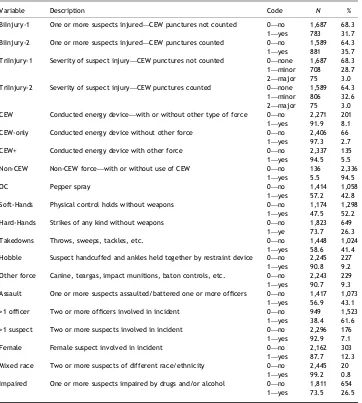
Four dependent variables, displayed in Table 1, examine the effects of exclud-ing and includexclud-ing CEW dart punctures as injuries sustained durexclud-ing use-of-force incidents—two dichotomous outcomes measuring injury/no injury and two
trichotomous outcomes measuring injury severity.4 The first dichotomous measure (labeled BiInjury-1) excludes CEW punctures to approved targets (i.e. not counted as an injury), and is coded 1 if one or more suspects were injured in an incident and 0 otherwise. As shown, 31.7% of the force incidents involve an injury to a suspect when dart punctures are excluded as a measure of injury. Punctures to unapproved targets, such as the head, face, or groin, however, are included as injuries. The second dichotomous variable (labeled BiInjury-2) includes CEW punctures to approved targets as injuries, increasing the injury rate from 31.7 to 35.7% or an increase of 98 injury events (examin-ing CEW incidents only, the injury rate increases from 32.3 to 81.1%). Regarding the trichotomous outcomes, counting CEW punctures does not change the rate of major injuries, but does increase the minor injury rate from
3. Due to the original data sharing agreement, we are obligated to keep the identity of the agency confidential. The agency selected, however, is a large law enforcement agency in the United States.
4. Bruises, sprains, scrapes and soft tissue damage are classified as minor injuries, except when including CEW punctures to approved targets; in which case these are included as an injury for the dichotomous measure and a minor injury for the trichotomous measure. Fractures, lacerations, dog bites, concussions, gunshot wounds, and puncture wounds to the head, face or groin (unapproved targets) are classified as major injuries for both measures.
28.7 to 32.6%, and decreases the no injury category from 68.3 to 64.3% (exam-ining CEW incidents only, the minor injury rate increases from 27.9 to 76.6%).
We also include three measures of CEWs to assess their effects on injuries. CEW is coded 1 if a CEW was deployed, regardless of whether or not another type of force was also used (8.1%) and 0 otherwise. CEW Only is coded 1 if the only force used was a CEW (2.7%) and 0 otherwise, and CEW + is coded 1 if a CEW was used and one or more other types of force also was used (5.5%) and 0 otherwise. NonCEW is coded 1 if force other than a CEW was used (94.5%) and 0 otherwise.
Table 1 Descriptive statistics for variables used in the analysis
Variable Description Code N %
BiInjury-1 One or more suspects injured—CEW punctures not counted 0—no 1,687 68.3
1—yes 783 31.7
BiInjury-2 One or more suspects injured—CEW punctures counted 0—no 1,589 64.3
1—yes 881 35.7
TriInjury-1 Severity of suspect injury—CEW punctures not counted 0—none 1,687 68.3
1—minor 708 28.7
2—major 75 3.0
TriInjury-2 Severity of suspect injury—CEW punctures counted 0—none 1,589 64.3
1—minor 806 32.6
2—major 75 3.0
CEW Conducted energy device—with or without other type of force 0—no 2,271 201
1—yes 91.9 8.1
CEW-only Conducted energy device without other force 0—no 2,406 66
1—yes 97.3 2.7
CEW+ Conducted energy device with other force 0—no 2,337 135
1—yes 94.5 5.5
Non-CEW Non-CEW force—with or without use of CEW 0—no 136 2,336
1—yes 5.5 94.5
OC Pepper spray 0—no 1,414 1,058
1—yes 57.2 42.8
Soft-Hands Physical control holds without weapons 0—no 1,174 1,298
1—yes 47.5 52.2
Hard-Hands Strikes of any kind without weapons 0—no 1,823 649
1—ye 73.7 26.3
Takedowns Throws, sweeps, tackles, etc. 0—no 1,448 1,024
1—yes 58.6 41.4
Hobble Suspect handcuffed and ankles held together by restraint device 0—no 2,245 227
1—yes 90.8 9.2
Other force Canine, teargas, impact munitions, baton controls, etc. 0—no 2,243 229
1—yes 90.7 9.3
Assault One or more suspects assaulted/battered one or more officers 0—no 1,417 1,073
1—yes 56.9 43.1
>1 officer Two or more officers involved in incident 0—no 949 1,523
1—yes 38.4 61.6
>1 suspect Two or more suspects involved in incident 0—no 2,296 176
1—yes 92.9 7.1
Female Female suspect involved in incident 0—no 2,162 303
1—yes 87.7 12.3
Mixed race Two or more suspects of different race/ethnicity 0—no 2,445 20
1—yes 99.2 0.8
Impaired One or more suspects impaired by drugs and/or alcohol 0—no 1,811 654
1—yes 73.5 26.5
Note. Number of observations = 2,477.
Other officer use-of-force related control variables are coded similarly. These include measures of: OC (used in 42.8% of force incidents); Soft-Hands (i.e. any physical control holds without the use of a weapon, such as grabbing, holding, and joint locks, used in 52.2% of force incidents); Hard-Hands (i.e. any strikes without a weapon, such as punching, kicking, kneeing, and elbow-ing, used in 26.3% of force incidents); Takedowns (e.g. throws, tackles, sweeps and swarms, used in 41.4% of force incidents); Hobble (i.e. restraint device in which a suspect’s hands are handcuffed and ankles are held together, used in 9.2% of force incidents); and Other Force (collapsed category including less frequent types of force, such as canines, teargas, impact munitions, baton strikes, and soft baton controls, used in 9.3% of force incidents). Note that CEWs are the least used tactic by this police agency (8.1% of force incidents), likely due in part because not all officers within this agency were issued CEWs during the time of the study.
Several additional dichotomous controls included account for the level of violence directed at police, the number of officers and suspects involved in the encounters, and the gender and racial/ethnic composition of the partici-pants. Specifically, as reported in Table 1 43.1% of incidents involved one or more suspects assaulting or battering one or more officers; 61.6% of incidents involved two or more officers; 7.1% of incidents involved two or more suspects; 12.3% of incidents involved one or more female suspects; .8% of incidents involved suspects of different race/ethnicity; and 26.5% of incidents involved one or more suspects who were perceived to be impaired by drugs and/or alco-hol (26.5%).5
Analysis
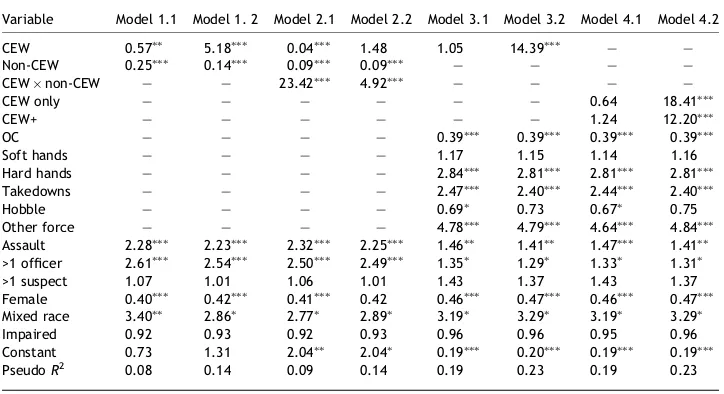
Following Terrill and Paoline (2011), we assess the effect of CEWs on citizen injuries, noting our differences in how injury is measured (including and excluding CEW punctures). We first estimate four models in a series of eight binary logistic regressions (Table 2) using the various CEW measures described above, along with the control variables. Each model is estimated twice; once excluding routine CEW punctures as injuries and a second time including punc-tures as injuries. For example, Model 1.1 in Table 2 excludes routine CEW punctures as injuries, while Model 1.2 includes them.
The first two sets of models (Models 1.1-2.2) use the dummy variables CEW (CEWs used whether or not other types of force also used) and nonCEW (the use of any force other than a CEW whether or not a CEW also used). In addi-tion, to test whether the effect of CEWs on injury is dependent on whether or not force other than a CEW is also used in a given incident, an interaction term between CEW and nonCEW is added to the second set of models (Models 2.1 and 2.2). Our expectation for the set of models without the interaction term
5. Due to the data sharing agreement with the law enforcement agencies, officer demographic characteristics are not available (Smith et al., 2009).
(Models 1.1 and 1.2) is that CEW will be inversely associated with the odds of suspect injury when routine punctures are excluded as injuries, but will be positively associated when punctures are included as injuries. Regarding the sets of models including the interaction term (Models 2.1 and 2.2), we hypoth-esize that the injury-reducing effects of CEWs generally observed in the litera-ture will depend on whether or not other types of force are used. Here, we expect the interaction term to be positive and significant regardless of whether or not punctures are counted as injuries.
In the second and third sets of models (Models 3.1-4.2), the summary mea-sure of nonCEW force is replaced with the specific types of nonCEW force used by officers (e.g. OC, Hard Hands, etc.). The first set of models (Models 3.1 and 3.2) test the effect of CEW when excluding and including routine dart punc-tures as injuries, respectively. We expect CEWs to be inversely related to the odds of injury when punctures are excluded (Model 3.1) and positively related when they are included in the measure (Model 3.2).
The models in the final set (Models 4.1 and 4.2) are similar except that we substitute CEW Only (incidents in which the only reported force was a CEW) and CEW + (incidents in which a CEW and one or more other types of force were used). In Model 4.1 (excluding punctures), we expect CEW Only to be inversely associated with the odds of injury and CEW + to be positively associated. In Model 4.2 (punctures included as injuries), we expect both CEW Only and CEW + to be positively associated with the odds of suspect injury.
A second series of eight models is estimated to assess the effect of CEWs on the severity of injury when punctures are excluded and included as forms of injury. These results are presented in Tables 3 and 4. Following the same basic framework, the sets of models in Table 3 use the summary measure of nonCEW force, while the sets of models in Table 4 use the specific types of nonCEW force in place of the summary measure. Expectations regarding the effects of CEWs are the same as with the binary logistic regression results, except that we are modeling the odds of the severity of injury rather than the odds of injury.
We initially used ordered logistic regression to estimate the severity of injury models; however, tests of the proportional odds assumption indicated that at least one variable in every model failed to meet the assumption (Long, 1997).6 To avoid incorrect inferences, we instead use the generalized ordered logistic regression model, which relaxes the proportional odds assumption and allows the effects of the relevant independent variables to vary over the cut points or thresholds of the dependent variable (Williams, 2006).
6. The ordered logistic regression model produces a single coefficient for each independent variable, with the important assumption that the effects are the same across all of the categories of the dependent variable, i.e., that the slopes are parallel to one another or equivalently that the odds are proportional. When violated, alternative models must be considered See Long (1997, pp. 140–145) for a more thorough explication.
Results
Binary Logistic Regression Results
We begin with a discussion of the binary logistic regression output, displayed in Table 2. As expected, use of a CEW when punctures are excluded as injuries (Model 1.1) significantly decreased the odds of suspect injury (OR = .57,
p6.01), while Model 1.2 shows that use of a CEW when punctures are included as injuries significantly increased the odds of suspect injury (OR = 5.18,
p6.001). In short, the specific measurement of injuries matters in these mod-els. As shown in Models 2.1 and 2.2, the effect of CEWs on injury depends on whether or not other types of nonCEW force are used, regardless of whether or not punctures are included. In other words, the odds of injury are greatest in incidents where officers deployed a CEW and used some other type(s) of force. This suggests that these incidents are somehow unique in their injury potential (e.g. incidents in which nonCEW types of force failed to allow officers to gain control of suspects or that the CEW failed and thus other types of force were needed). Note, however, the effect is substantially larger when punctures are excluded (OR = 23.42, p6.001), compared to when they are included (OR = 4.92,p6.001).
Table 2 Binary logistic regression models of suspect injury
Variable Model 1.1 Model 1. 2 Model 2.1 Model 2.2 Model 3.1 Model 3.2 Model 4.1 Model 4.2
CEW 0.57⁄⁄ 5.18⁄⁄⁄ 0.04⁄⁄⁄ 1.48 1.05 14.39⁄⁄⁄ – –
Non-CEW 0.25⁄⁄⁄ 0.14⁄⁄⁄ 0.09⁄⁄⁄ 0.09⁄⁄⁄ – – – –
CEWnon-CEW – – 23.42⁄⁄⁄ 4.92⁄⁄⁄ – – – –
CEW only – – – – – – 0.64 18.41⁄⁄⁄
CEW+ – – – – – – 1.24 12.20⁄⁄⁄
OC – – – – 0.39⁄⁄⁄ 0.39⁄⁄⁄ 0.39⁄⁄⁄ 0.39⁄⁄⁄
Soft hands – – – – 1.17 1.15 1.14 1.16 Hard hands – – – – 2.84⁄⁄⁄ 2.81⁄⁄⁄ 2.81⁄⁄⁄ 2.81⁄⁄⁄
Takedowns – – – – 2.47⁄⁄⁄ 2.40⁄⁄⁄ 2.44⁄⁄⁄ 2.40⁄⁄⁄
Hobble – – – – 0.69⁄ 0.73 0.67⁄ 0.75
Other force – – – – 4.78⁄⁄⁄ 4.79⁄⁄⁄ 4.64⁄⁄⁄ 4.84⁄⁄⁄
Assault 2.28⁄⁄⁄ 2.23⁄⁄⁄ 2.32⁄⁄⁄ 2.25⁄⁄⁄ 1.46⁄⁄ 1.41⁄⁄ 1.47⁄⁄⁄ 1.41⁄⁄
>1 officer 2.61⁄⁄⁄ 2.54⁄⁄⁄ 2.50⁄⁄⁄ 2.49⁄⁄⁄ 1.35⁄ 1.29⁄ 1.33⁄ 1.31⁄
>1 suspect 1.07 1.01 1.06 1.01 1.43 1.37 1.43 1.37 Female 0.40⁄⁄⁄ 0.42⁄⁄⁄ 0.41⁄⁄⁄ 0.42 0.46⁄⁄⁄ 0.47⁄⁄⁄ 0.46⁄⁄⁄ 0.47⁄⁄⁄
Mixed race 3.40⁄⁄ 2.86⁄ 2.77⁄ 2.89⁄ 3.19⁄ 3.29⁄ 3.19⁄ 3.29⁄
Impaired 0.92 0.93 0.92 0.93 0.96 0.96 0.95 0.96 Constant 0.73 1.31 2.04⁄⁄ 2.04⁄ 0.19⁄⁄⁄ 0.20⁄⁄⁄ 0.19⁄⁄⁄ 0.19⁄⁄⁄
PseudoR2 0.08 0.14 0.09 0.14 0.19 0.23 0.19 0.23
Notes.⁄p< .05,⁄⁄p< .01,⁄⁄⁄p6.001; coefficients are odds ratios; pseudo-R2= McFadden’s.
Model 1.1 = punctures not counted, non-CEW force types collapsed.Model 1.2 = punctures counted, non-CEW force types collapsed.
Model 2.1 = punctures not counted with interaction term, non-CEW force types collapsed. Model 2.2 = punctures counted with interaction term, non-CEW force types collapsed. Model 3.1 = punctures not counted, specific force types.
Model 3.2 = punctures counted, specific force types.
Model 4.1 = punctures not counted, CEW only, specific force types. Model 4.2 = punctures counted, CEW only, specific force types.
Models 3.1-4.2 in Table 2 substitute the specific types of nonCEW force used by officers for the summary measure. In Model 3.1, CEW is not significantly, inversely associated with the odds of injury when punctures are excluded, but given the statistically insignificant effect (p= .779) and a coefficient near 1.0 (OR = 1.05), we conclude that the effects of CEWs are benign and neither decrease nor increase the odds of injury. When punctures are included as inju-ries in Model 3.2, however, we observe large and statistically significant increases in the odds of suspect injury (OR = 14.39,p6.001).
Consistent with our expectations, Model 4.1 shows that the effect of CEWs without other types of force and the use of a CEW in conjunction with other types of force reduces injuries; although the effects fail to attain statistical significance (OR = .64, p= .254 and OR = 1.24, p= .308, respectively). When punctures are included as injuries (Model 4.2), however, the use of a CEW alone and the use of a CEW in conjunction with other types of force signifi-cantly increase the odds of suspect injury (OR = 18.41, p6.001 and OR = 12.20,
p6.001, respectively).
Generalized Ordered Logistic Regression Results
Models 1.1-2.2 in Table 3 repeat the analysis for the corresponding models in Table 2, except we model the severity of injury using generalized ordered logis-tic regression. Note that for ease of display, redundant coefficients equal across the cut points of the dependent variable are not repeated. As expected, when punctures are excluded from the injury measure (Model 1.1), CEWs reduce the odds of both minor and major injury (versus no injury) and the odds of major injury (vs. no or minor injury) (OR = .57,p6.01). However, when punctures are included (Model 1.2), CEWs increase the odds of minor/major injury (OR = 5.35,
p6.001), but dramatically decrease the odds of major injury (OR = .14,
p6.001). This indicates that the effect of counting routine punctures on the relationship between CEW use and the magnitude of suspect injury is an increase in the odds of minor injuries rather than more serious injuries.
Models 2.1 and 2.2 include the interaction between CEW and nonCEW usage. Similar to the binary logistic model results, regardless of whether or not punc-tures are included, the effect of CEWs on injury depended on whether or not other types of force are also used. Model 2.1 shows that the odds of minor/ major injury increased substantially, as did the odds of major injury when other types of force are used in conjunction with CEWs (OR = 26.06, p6.001). Similar results are obtained in Model 2.2, except the effects of the interaction term differed across the cut points. Specifically, the use of other types of force in conjunction with a CEW increase the odds of minor/major injury (OR = 4.70, p6.001), but the effect on major injury is much higher in magnitude (OR = 71.07,p6.001).
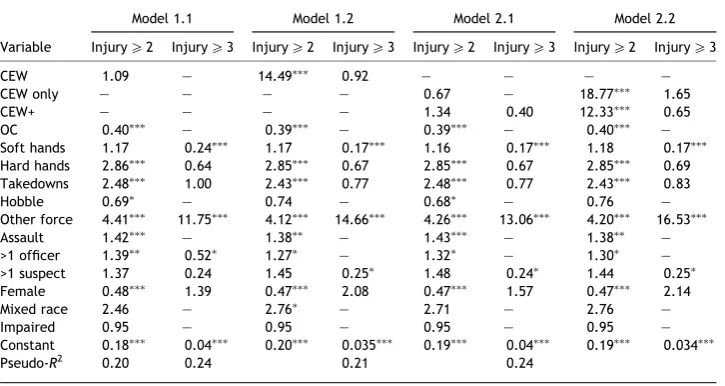
Models 1.1-2.2 in Table 4 substitute the specific types of nonCEW force for the summary measure of nonCEW force used in Table 3. When punctures are
Table 4 Generalized ordered logit models of severity of suspect injury using specific force types
Model 1.1 Model 1.2 Model 2.1 Model 2.2
Variable InjuryP2 InjuryP3 InjuryP2 InjuryP3 InjuryP2 InjuryP3 InjuryP2 InjuryP3
CEW 1.09 – 14.49⁄⁄⁄ 0.92 – – – –
CEW only – – – – 0.67 – 18.77⁄⁄⁄ 1.65
CEW+ – – – – 1.34 0.40 12.33⁄⁄⁄ 0.65
OC 0.40⁄⁄⁄ – 0.39⁄⁄⁄ – 0.39⁄⁄⁄ – 0.40⁄⁄⁄ –
Soft hands 1.17 0.24⁄⁄⁄ 1.17 0.17⁄⁄⁄ 1.16 0.17⁄⁄⁄ 1.18 0.17⁄⁄⁄
Hard hands 2.86⁄⁄⁄ 0.64 2.85⁄⁄⁄ 0.67 2.85⁄⁄⁄ 0.67 2.85⁄⁄⁄ 0.69
Takedowns 2.48⁄⁄⁄ 1.00 2.43⁄⁄⁄ 0.77 2.48⁄⁄⁄ 0.77 2.43⁄⁄⁄ 0.83
Hobble 0.69⁄ – 0.74 – 0.68⁄ – 0.76 –
Other force 4.41⁄⁄⁄ 11.75⁄⁄⁄ 4.12⁄⁄⁄ 14.66⁄⁄⁄ 4.26⁄⁄⁄ 13.06⁄⁄⁄ 4.20⁄⁄⁄ 16.53⁄⁄⁄
Assault 1.42⁄⁄⁄ – 1.38⁄⁄ – 1.43⁄⁄⁄ – 1.38⁄⁄ –
>1 officer 1.39⁄⁄ 0.52⁄ 1.27⁄ – 1.32⁄ – 1.30⁄ –
>1 suspect 1.37 0.24 1.45 0.25⁄ 1.48 0.24⁄ 1.44 0.25⁄
Female 0.48⁄⁄⁄ 1.39 0.47⁄⁄⁄ 2.08 0.47⁄⁄⁄ 1.57 0.47⁄⁄⁄ 2.14
Mixed race 2.46 – 2.76⁄ – 2.71 – 2.76 –
Impaired 0.95 – 0.95 – 0.95 – 0.95 – Constant 0.18⁄⁄⁄ 0.04⁄⁄⁄ 0.20⁄⁄⁄ 0.035⁄⁄⁄ 0.19⁄⁄⁄ 0.04⁄⁄⁄ 0.19⁄⁄⁄ 0.034⁄⁄⁄
Pseudo-R2 0.20 0.24 0.21 0.24
Notes. The coefficients for InjuryP2 correspond to the logit formed from the two categories (major injury + minor injury) and no injury; the coefficients for InjuryP3 correspond to the logit formed from the two categories (major injury) and (minor injury + no injury);
⁄p< .05,⁄⁄p< .01,⁄⁄⁄p6.000; coefficients are odds ratios; pseudo-R2= McFadden’s. Model 1.1 = punctures not counted.
Model 1.2 = punctures counted.Model 2.1 = punctures not counted, CEW only. Model 2.2 = punctures counted, CEW only.
Table 3 Generalized ordered logit models of severity of suspect injury collapsing non-CEW force types
Model 1.1 Model 1.2 Model 2.1 Model 2.2
Variable InjuryP2 InjuryP3 InjuryP2 InjuryP3 InjuryP2 InjuryP3 InjuryP2 InjuryP3
CEW 0.57⁄⁄ – 5.35⁄⁄⁄ 0.14⁄⁄⁄ 0.04⁄⁄⁄ – 1.56 0.03⁄⁄⁄
Non-CEW 0.26⁄⁄⁄ 0.01⁄⁄⁄ 0.17⁄⁄⁄ 0.01⁄⁄⁄ 0.09⁄⁄⁄ 0.00⁄⁄⁄ 0.09⁄⁄⁄ 0.00⁄⁄⁄
CEWNon-CEW – – – – 26.06⁄⁄⁄ – 4.70⁄⁄⁄ 71.07⁄⁄⁄
Assault 2.24⁄⁄⁄ – 2.21⁄⁄⁄ – 2.30⁄⁄⁄ – 2.23⁄⁄⁄ –
>1 officer 2.60⁄⁄⁄ – 2.54⁄⁄⁄ – 2.49⁄⁄⁄ – 2.49⁄⁄⁄ –
>1 suspect 1.07 – 1.03 – 1.06 – 1.01 – Female 0.40⁄⁄⁄ 1.52 0.42⁄⁄⁄ – 0.41 – 0.42⁄⁄⁄ –
Mixed race 2.23 – 2.36 1.41 2.19 1.59 2.27 – Impaired 0.92 – 0.92 – 0.91 – 0.92 – Constant 0.71 0.49⁄⁄⁄ 1.09 0.75 2.06⁄⁄ 1.25 1.94⁄ 1.28
Pseudo-R2 0.12 0.16 0.13 0.17
Notes. The coefficients for InjuryP2 correspond to the logit formed from the two categories (major injury + minor injury) and no injury; the coefficients for InjuryP3 correspond to the logit formed from the two categories (major injury) and (minor injury + no injury); ⁄p< .05, ⁄⁄p< .01, ⁄⁄⁄p6.001; coefficients are odds ratios; pseudo-R2= McFadden’s.
Model 1.1 = punctures not counted, non-CEW force types collapsed. Model 1.2 = punctures counted, non-CEW force types collapsed.
Model 2.1 = punctures not counted with interaction term, non-CEW force types collapsed. Model 2.2 = punctures counted with interaction term, non-CEW force types collapsed.
excluded in the injury measure (Model 1.1), CEWs neither increase nor decrease the odds of injury when other specific force types are controlled (OR = 1.09, p= .627). When punctures are included in the injury measure (Model 2.1), CEW increase the odds of minor/major injury (OR = 14.49, p6.001), but not the odds of major injury (OR = .92, p= .839). Again, this indicates that the effect of CEWs increases the odds of minor injury rather than more serious types of injury, when the injury measure includes puncture wounds.
Models 2.1 and 2.2 in Table 4 use the CEW Only and CEW + measures. As shown in Model 2.1, the direction of the effect of CEW Only is in the expected direction when punctures are excluded, but the effect is not statistically significant (OR = .67, p= .391). The direction of the effects for CEW + suggest that when other types of force are used in conjunction with CEWs, the odds of minor/major injury increase, while the odds of major injury decrease. These effects, however, are not statistically significant (OR = 1.34, p= .319 and OR = .40, p= .163, respectively). As shown in Model 2.2, however, when punc-tures are included, CEW Only and CEW + both significantly increase the odds of minor/major injury (OR = 18.77, p6.001 and OR = 12.33, p6.001, respec-tively), but not the odds of major injury (OR = 1.65, p= .395 and OR = .65,
p= .411). This once more indicates that the effect of including puncture wounds as injuries increases the odds that incidents result in minor injuries rather than major injuries.
Based on the bivariate logistic regression results, we conclude that when punctures are excluded, CEWs either reduce injuries among suspects or are benign in their effects. When punctures are included, regardless of whether a CEW is used alone or in combination with other types of force, CEWs increase the odds of injury. We also find that regardless of the inclusion of punctures as injuries, the relationship between CEWs and suspect injury depends on whether or not other types of force are used in combination with CEWs. This suggests that incidents that combine different use of force tactics have a different injury profile than those involving only CEWs. Unfor-tunately when there are multiple force tactics involved in a single incident, we cannot discern from these data which specific force tactic produced the injury.
The results from the models of injury severity, while somewhat more complex, tell a similar story. When punctures are excluded, CEWs reduce the odds of both major and minor injuries or their effects were benign, neither decreasing nor increasing the odds of major and/or minor injury. When punc-tures are included, CEWs increase the odds of minor injury, but they reduce the odds of major injury or had no effect on the odds of major injury. Further analyses reveal that the odds of minor and major injuries tend to increase when other types of force are used in addition to CEWs, regardless of whether or not punctures were included in the injury measure. As discussed below, we believe these findings have a number of important implications for research, policy, and practice.
Discussion
The data used in the present study provide an opportunity to distinguish injury outcomes using a more traditional definition of CEW-related injury compared to the atypical and more expansive definition recommended by Terrill and Paoline (2011). Our results confirm Terrill and Paoline’s speculation about the role of measuring dart punctures as injuries from CEW deployments. We conclude that the direction and size of the reported impact of CEW use on suspect injury rates is based, in part, on how CEW injuries are defined, measured, and analyzed. It is clear from our results that when routine CEW punctures are excluded from the injury measure, CEWs are associated with reductions in injuries to suspects or are benign, neither increasing nor decreasing injury rates. It is also clear that including CEW punctures as injuries consistently inflates injury rates, whether or not they were used in conjunction with other types of force.
Definition of Injury
While we agree that CEW punctures may create minor wounds, we do not believe these wounds meet the standard definition of injury typically used by law enforcement officials and the courts. Further, we believe that attempts to measure and include routine CEW punctures as injuries could lead to greater restrictions on the use of CEWs and concomitant increases in the number of injuries and the severity of injuries to both suspects and officers. Rather than a simple academic debate, the implication of measuring puncture wounds as injuries has potential serious consequences. The strongest empirical evidence available regarding the injury-reduction effects of CEWs is based on studies employing quasi-experimental designs that found the introduction of CEWs sig-nificantly reduced rates of injury to both officers and citizens (MacDonald et al., 2009; Taylor & Woods 2010). The withdrawal of CEWs or severe restric-tions placed on their use (based on alternative findings using invalid measures of injury) would therefore be expected to lead to an actual increase in the number and severity of injuries during police–citizen encounters.
The proper definition and conceptualization of injury is a difficult one that has produced much controversy in the medical profession (Langley & Brenner, 2004; Robertson, 1998). A common theoretical definition of injury in the medical profession is “damage to the body produced by energy exchanges that have relatively sudden discernible effects,” which is often used to distinguish between injuries and diseases (Langley & Brenner, 2004). Absent in this theo-retical definition, however, is a usable operational definition, where clearly many circumstances of bodily damage that would fit under the theoretical definition would not be operationalized as injuries and vice versa (Langley & Brenner, 2004). It is therefore not surprising that criminal justice researchers also struggle with this concept when applied to police use of force situations.
We argue, however, that punctures caused by CEWs do not rise to the conven-tional level of injury as commonly defined in the medical, legal, and criminal justice professions.
First, routine CEW punctures on approved target areas are minor flesh wounds that are likely similar in pain and severity to receiving an injection with a medium-gage hypodermic needle or a blood draw at a doctor’s office or hospital.7 Just like injections and blood draws, CEW punctures can result in minor pain, bleeding, and bruising. The minor wounds associated with injec-tions and routine blood draws, however, are not documented as injuries by hospitals or physicians, as long as the wounds occur within the normal and approved operating parameters of the device used. Granted, the circumstances for the use of CEWS are different than medical procedures, and in most cases injections and blood draws are given with explicit patient consent, but that is not always the case. For example, in emergency medical situations, medical personnel routinely use injections and blood draws without patient consent, and again the minor wounds associated with these procedures are not docu-mented as injuries to nonconsenting patients.
Consider another medical example: surgical incisions. Clearly, a surgical incision is the result of an intention act by a specialist using a tool designed to aid in his/her craft. In this case, based on his/her training, a surgeon uses a tool (typically a scalpel) that, by design, results in tissue damage. Neverthe-less, surgical incisions on patients are not considered injuries in the medical profession. The same logic can be applied to police use of CEWs. In this case, a trained professional (police officer) uses an approved tool (CEW) to aid in his/her craft (gain citizen compliance while attempting to simultaneously reducing the likelihood of citizen and officer injury). The resulting expected minor punctures from proper police deployment of CEWs should not be consid-ered “injuries” any more than a proper surgical incisions resulting from a doc-tors’ use of a scalpels.
Also consider the results of the application of other police uses of force including exposure to OC spray, which may cause eye, lung, and skin irritation. In addition, joint locks and handcuffs may cause skin irritation and temporary pain. We argue that unless a CEW (or OC) causes an unintended and more serious injury (e.g. a CEW dart puncture of the face, eye or other unapproved target), these routine minor wounds that are expected as part of the deployment of the device should not be included in a measure of injury. Inter-estingly, if the effects of CEWs and OC are not experienced (dart punctures and eye/lung irritation) it means the devices did not work as intended and probably did not produce the desired effect of gaining citizen compliance.8
This suggests that if we adopt Terrill and Paoline’s recommended measure of injury, every successful deployment of these devices would result in coded
7. The TASER X26 dart is .8 mm in diameter (.031 inch) (Webster, 2009, p. 99), equivalent to an approximately 21 gage hypodermic needle.
8. We are indebted to an anonymous reviewer for this insight.
“injuries” to suspects. What then, would be the point of conducting research to determine if CEWs increase or decrease injuries? Accurately measuring inju-ries as proposed by Terrill and Paoline would result in the measurement of a constant rather than variable to be explained; and as a result, CEWs would be the highest injury-inducing use of force tactic.
Previous Lessons Regarding the Measurement of the Use of Force
Terrill and Paoline’s call to reconsider the measurement of a key construct in use of force research is reminiscent of similar concerns raised by at least one of these authors over a decade ago. In the previous circumstance, it was the measure of “force” itself that was called into question (Terrill, 2001). As Garner et al. (2002) demonstrated in their comprehensive literature review, there were dramatic differences in the measurement and operationalization of police use of force across studies. Terrill and his colleagues (Terrill, 2001; Terrill & Mastrofski, 2002), along with others (Garner, Hepburn, & Buchanan, 1995; Klinger, 1995) advocated for the examination of police use of “coercion” rather than “force,” and called for the measure of police coercion on a continuum that included even the most minor actions that were not routinely considered by police agencies or the courts as uses of force (e.g. verbal commands, verbal threats, handcuffing,
Terry frisks, etc.). Most controversial was the inclusion of handcuffing as a form of coercion, or in some studies, use of force. Even though restraining arrestees with handcuffs is considered standard procedure by police agencies across the country (for officer safety reasons and to prevent flight) and not considered by agencies as a use of force, it was often included in academ-ics’ measures of force. Including handcuffing in a measure of force, by definition, would indicate that all (or nearly all) arrestees across the coun-try have been subjected to police use of force. Further, the Bureau of Justice Statistics’ Police–Public Contact Survey, the largest national data collection effort on police use-of-force and other outcomes in the USA, does not consider handcuffing as a use of force (Eith & Durose, 2011).
Researchers’ expansion of force measures to include actions that law enforcement and others do not consider to be uses of force has resulted in a disconnect between research and practice. As might be expected, the inclusion of handcuffing (and other nontraditional measures of force) resulted in a dramatic increase in research reporting percentages of police–citizen encoun-ters that involved use of force. For example, in one use-of-force study examin-ing Project on Policexamin-ing Neighborhoods data, Terrill (2003) reported that of the 3,544 police encounters with criminal suspects that were examined, 58.4% involved the use of verbal and physical force, 21.0% involved the use of only physical force, but only 4.7% involved physical force when handcuffing and pat downs were excluded.
As a result of this change in measurement that artificially inflated the reported prevalence of use of force incidents, this body of research is
unhelpful to practitioners and police executives seeking to better understand-ing correlates of force. Police executives interested in implementunderstand-ing policies and training to reduce the use of force will find little or no value in current reports using these expanded measures of force. When expanded measures of use of force include actions that are not recognized by law enforcement offi-cials or the courts as uses of force, the resulting reported correlates of force are virtually meaningless for policy and training. Contrary to early use of force studies, much of the recent academic research debating the measurement of the use of force seems unconnected to actual police practice and public conse-quences.
While expanding the measures of use of force may be considered an important academic endeavor, police agencies and the public are continually searching for effective means to reduce the use of force. With the exception of a handful of recent studies examining the impact of less-lethal weapons (e.g. MacDonald et al., 2009; Smith et al., 2007), the research community has little to offer about the types of policies, equipment, training, and managerial oversight that are most effective at reducing use of force incidents without compromising officer safety. The research on CEWs is most promising because it addresses critical issues regarding injuries that are important to both the police and the public.
Policy and Research Implications
Even if one believes that the puncture wounds should be measured and included as injuries, efforts to do so are likely to prove fruitless. Just as homi-cides are more reliably reported than more minor crimes, force-related deaths, and major injures are more reliably reported than minor injuries. Thus, we can assume that even if agencies required the reporting of routine CEW punctures, full compliance will be elusive (this includes the present study and we assume that CEW punctures and other forms of minor injury, such as skin/eye irritation from pepper spray and other physical force tactics, were underreported). Indeed, none of the agencies studied by Terrill and Paoline, and few of those studied by Smith et al. (2009) had policies requiring the reporting of routine CEW punctures. In the original Smith et al. (2009) study, some officers in 6 of the 12 agencies reported dart punctures as injuries while other officers in the same agencies did not. This finding is consistent with Terrill and Paoline’s reporting that officers are provided little guidance on the criteria for suspect injury associated with the use of CEWs. For example, in the Seattle Police Department (one agency studied by Smith et al. (2009) that captured detailed information on injuries associated with CEWs), dart punc-tures were reported as injuries in 47.8% of the 437 cases where dart contacts with suspects were verified. If this represents the “typical” experience of agencies with CEWs, then we might expect about half of all CEW deployments in dart mode to produce dart probe penetration to the skin. Yet in the Phoenix
Police Department (another agency examined by Smith et al. (2009)), only 56 of the more than 800 CEW deployments (6.9%) in dart mode produced a reported puncture injury. Again, this suggests the lack of an agency mandate to report CEW dart punctures as injuries. Taken together, the available evi-dence from agencies that have participated in two of the largest CEW-related injury studies to date (Smith et al., 2009; Terrill & Paoline, 2011) suggests that most law enforcement agencies do not require the reporting of CEW dart punc-tures as injuries in the typical case of minor skin penetration in a nonsensitive area.
Given the scrutiny that use of force incidents often produce and the care with which many agencies document such incidents, a likely reason that agen-cies do not require the reporting of CEW punctures as injuries is that they are deemed unimportant and the natural consequence of the use of the weapon itself, worthy of documentation only if the “injury” produced is unusual or more severe than expected. Further, although Terrill and Paoline recommend the use of prospective observational studies as a remedy for measurement concerns, as a practical matter they hardly seem worth the time, effort, and expense to capture such trivial wounds. Prospective observational studies such as those advocated by Terrill and Paoline are highly inefficient as they have to sample a large number of police–citizen interactions over a long period of time to capture enough uses of physical force of any meaningful magnitude, no less injuries of any substance. Public safety will be better served by measuring and studying ways to reduce more serious injuries to both officers and citizens.
We agree with Terrill and Paoline that policing scholars should come to an agreement on how to define force-related injuries. However, the inclusion of routine punctures from CEWs as injuries moves the definition of force-related injuries in the direction of an “all harms” orientation, which raises the question of whether other injuries should be operationalized as well. Should the pain experienced from being “tased” or from the application of a pain compliance technique without visible injury be included in injury measures? Should redness and irritation to the skin from an officer grabbing a citizen or from pepper spray be included as injuries? It is interesting to note that the TASER International literature cited by Terrill and Paoline to make their case for defining CEW punc-tures as injuries also mentions skin irritation, yet little attention is given in their discussion to including this as an injury. Moreover, they assert that the use of CEWs may cause socio-psychological injury, which raises the question of whether or not to include suspect psychological and emotional distress as inju-ries as well. This expansion of the definition of injury would eventually make the measure of “injury” virtually synonymous with the use of any force or even the arrest process itself, which would make any analysis on the connection between force techniques and any form of injury pointless.
The decision to include or exclude dart punctures as injuries while at the same time excluding other harms from the definition of injury highlights that the definition of injuries resulting from force incidents is a social construct. We agree with Terrill and Paoline that the effort to define this construct should be