Brain Research 888 (2001) 302–305
www.elsevier.com / locate / bres
Short communication
The effects of phencyclidine pretreatment on amphetamine-induced
behavior and c-Fos expression in the rat
a,b ,
*
bSarah M. Turgeon
, Lauren C. Case
a
Department of Psychology Amherst College, Amherst, MA 01002, USA
b
Neuroscience Program Amherst College, Amherst, MA 01002, USA
Accepted 3 October 2000
Abstract
Previous data demonstrate that a single injection of phencyclidine enhances amphetamine-induced behaviors 24 h later, suggesting that the delayed effects of a single dose of phencyclidine may produce a schizophrenia-like state in animals. These behavioral changes were accompanied by altered patterns of c-Fos induction, suggesting possible neurochemical correlates to the observed behaviors. Because investigations into PCP’s ability to model schizophrenia have found that the effects of repeated, or subchronic, PCP administration differ according to the dose and administration paradigm, this study sought to determine whether single and subchronic PCP exposure produce different effects on amphetamine-induced behaviors and c-Fos induction. No differences were observed between these administration paradigms; both single and subchronic PCP exposure enhanced amphetamine-induced c-Fos in the striatum, decreased c-Fos in the prefrontal cortex, and decreased the number of cage-crossings. However, the observation that PCP pretreatment affected c-Fos induction in the same manner observed previously while having an opposite effect on amphetamine-induced behavior suggests that these behavioral and neurochemical effects are dissociated. 2001 Elsevier Science B.V. All rights reserved.
Theme: Disorders of the nervous system
Topic: Neuropsychiatric disorders
Keywords: Schizophrenia; Animal models; Striatum; Prefrontal cortex
Phencyclidine (PCP) produces a schizophrenia-like state suggesting possible neurochemical correlates to the be-in humans [2,7] and has thus been repeatedly be-investigated havioral change [15]. However, previous studies inves-for its ability to model schizophrenia-like behaviors in tigating the use of PCP to model schizophrenia have animals [7–10,12–15]. The delayed effects of PCP, those focused on repeated rather than single injections of PCP seen after intoxication has subsided, have been reported to [8–10,13] and studies using different doses and schedules induce a variety of schizophrenia-like behaviors [8–10,12– of administration have yielded disparate behavioral and 15] including enhanced behavioral responsiveness to am- neurochemical results [5,9,10,15]. Thus this experiment phetamine [9,15], thought to be an appropriate animal sought to determine whether single and subchronic PCP model for schizophrenia based on the observation that exposure have different effects on subsequent amphet-human schizophrenics demonstrate enhanced sensitivity to amine-induced behavior and c-Fos expression.
amphetamine [1]. Following exposure to a single high dose Thirty-six male Sprague–Dawley rats (Charles River,
of PCP, this enhanced responsiveness to amphetamine is Wilmington, MA) weighing 225–400 g were housed
accompanied by increased striatal c-Fos and decreased individually with access to food and water ad lib and basal c-Fos induction in the anterior cingulate cortex, maintained on a 12 h reverse light–dark cycle. Animals were acclimated for 60 min to the behavioral testing cage (a 12.5324312 in. glass aquarium with wood shavings located in a room illuminated with red light) once a day
*Corresponding author. Tel.: 11-413-542-2625; fax: 1
1-413-542-for 4 days. One hour following the end of each acclimation
2145.
E-mail address: [email protected] (S.M. Turgeon). period, animals were injected with either PCP (15 mg / kg)
S.M. Turgeon, L.C. Case / Brain Research 888 (2001) 302 –305 303
or vehicle (saline) such that three pretreatment groups were (V–A59068, V–PCP–A5104610, scPCP–A575612, generated: vehicle (V; vehicle injections on Days 1–4), F(2,15)51.9).
single PCP (PCP; vehicle on Days 1–3 and PCP on Day These data demonstrate a similar pattern of
amphet-4), and subchronic PCP (scPCP; PCP on Days 1–4). On amine-induced behavior and c-Fos induction following
the fifth day, animals were acclimated to the testing cage single and subchronic high-dose PCP exposure. While for 60 min and then injected with amphetamine (A; 0.5 most of the significant results indicate overall effects of mg / kg) or vehicle (V; saline) such that six treatment PCP pretreatment without specific intergroup differences groups were generated: V–V, V–A. PCP–V, V–A, scPCP– emerging from post-hoc tests, the effects seen in the single V, and scPCP–A. The doses of PCP and amphetamine and subchronic PCP pretreatment groups are clearly in the were chosen based on previous evidence that 15 mg / kg same direction.
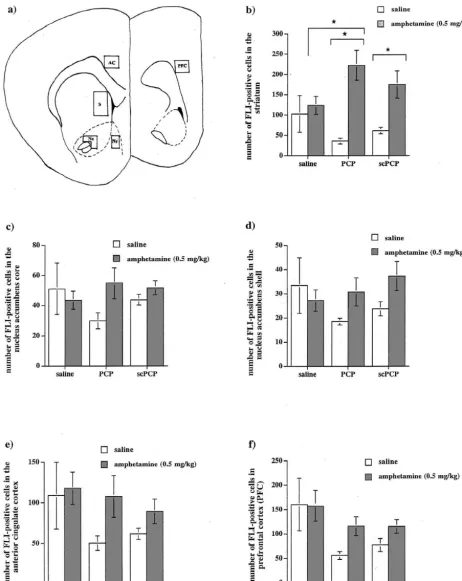
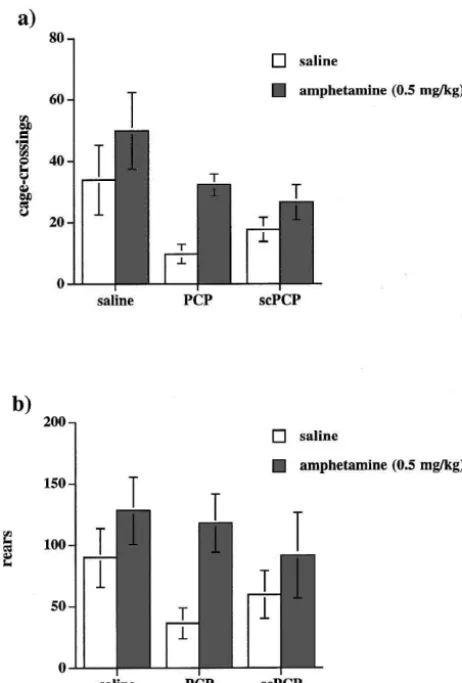
PCP alters the behavioral and neurochemical response to Amphetamine challenge enhanced both the number of 0.5 mg / kg amphetamine [15]. Each group began with six cage-crossings and rears in accordance with previous rats but due to experimental error, behavioral data from studies demonstrating the psychomotor effects of amphet-one rat each was lost in the V–V, PCP–V, and scPCP–A amine [3,5,6,9,11]. PCP pretreatment significantly de-groups and c-Fos data was lost for one rat in the V–V creased the number of cage-crossings but did not affect the group. All injections were administered i.p in 2 ml / kg. number of rears, contrasting with our previous observation Behavior was videotaped for 110 min following amphet- that pretreatment with a single injection of PCP enhances amine or vehicle injection and locomotion and rearing amphetamine-induced cage-crossings and rears in a similar were analyzed as described previously [15]. In addition, paradigm [15]. This decrease does not appear to be due to the number of seconds engaged in repetitive sniffing an increase in stereotypies as there was no difference in the behavior was recorded in the amphetamine challenged rats number of seconds engaged in sniffing behavior of the during three two min periods (20–22, 40–42, and 60–62 V–A, PCP–A, and scPCP–A rats. Previous studies have min. following injection) and combined. 2 h following the found that PCP pretreatment either increases [9] or de-injection, animals were anesthetized, perfused, and their creases [5] subsequent responsiveness to amphetamine, brains processed for c-Fos immunohistochemistry accord- depending on the dose and administration paradigm. In ing to previously published methods [15]. The number of fact, Jentsch et al. have shown that rats have different immunoreactive cells were counted in the regions depicted neurochemical responses to the same dose of PCP adminis-in Fig. 1a by an experimenter bladminis-ind to the treatment group. tered on different schedules [10]. Thus both the behavioral Behavioral measures and regional c-Fos counts were and neurochemical effects of PCP pretreatment appear to analyzed with a 233 ANOVA with the main factors of be dependent on the dose and administration schedule. pretreatment (V, PCP, or scPCP) and challenge (V or A). While the behavioral effects of PCP pretreatment ob-Individual group differences were then assessed with one- served in this study are opposite those seen in the prior
way ANOVAs followed by Student–Newman–Keuls post- study, the effects on c-Fos are similar. The current
hoc tests. Sniffing in the amphetamine-challenged groups observation that PCP pretreatment increases
amphetamine-was compared with a one-way ANOVA. induced striatal FLI but decreases cage-crossings contrasts
Amphetamine challenge increased the number of FLI- with our previous finding that PCP pretreatment increases positive cells in the striatum (F(1,29)529.5, P,0.001) and both amphetamine-induced striatal FLI and cage-crossings. there was a significant interaction between pretreatment Taken together, the data from these two studies indicate and challenge (F(2,29)54.2, P,0.05; Fig. 1b). A one-way that the effects of PCP pretreatment on amphetamine-ANOVA revealed a significant effect of group on the induced locomotion and striatal FLI are dissociated. This number of FLI-positive striatal cells (F(5,29)56.3, P, dissociation is consistent with lesion studies which demon-0.001). Post hoc tests revealed significant differences strate that amphetamine-induced locomotion depends on
between V–A versus PCP–A, PCP–V versus PCP–A, and the mesolimbic rather than the nigrostriatal dopamine
scPCP–V versus scPCP–A. The number of FLI-positive system [3,4,11]. Despite this association between mesolim-cells in the nucleus accumbens and anterior cingulate bic dopamine activity and locomotion, neither this study cortex was not altered by our treatments (Fig. 1c–e). nor our previous study found changes in nucleus accum-Amphetamine challenge did not alter the number of FLI- bens FLI accompaning changes in locomotion [15]. Thus positive cells in the PFC; however PCP pretreatment did this measure of mesolimbic activity may not reflect the significantly decrease PFC FLI (F(2,29)54.5, P,0.05; neurochemical changes associated with locomotion.
Fig. 1f). The observation that subchronic PCP decreases
304 S.M. Turgeon, L.C. Case / Brain Research 888 (2001) 302 –305
2 2
Fig. 1. The areas of FLI quantification are indicated in (a). The area in which FLI was counted was 0.84 mm in the striatum (S), 0.315 mm in the nucleus
2 2
S.M. Turgeon, L.C. Case / Brain Research 888 (2001) 302 –305 305
More importantly, the current data show that previously observed behavioral and neurochemical changes seen following PCP pretreatment are dissociated.
References
[1] B. Angrist, S. Gershon, Clinical response to several dopamine agonists in schizophrenic and nonschizophrenic subjects, Adv. Biochem. Pharmacol. 16 (1977) 667–680.
[2] C.B. Bakker, F.B. Amini, Observations on the psychotomimetic effects of sernyl, Comprehensive Psychiatry 2 (1961) 269–280. [3] B. Costall, C.D. Marsden, R.J. Naylor, C.J. Pycock, Stereotyped
behavior patterns and hyperactivity induced by amphetamine and apomorphine after discrete 6-hydroxydopamine lesions of extra-pyramidal and mesolimbic nuclei, Brain Res. 123 (1977) 89–111. [4] I. Creese, S.D. Iverson, The pharmacological and anatomical
substrates of the amphetamine response in the rat, Brain Res. 83 (1975) 419–436.
[5] B.D. Greenberg, D.S. Segal, Acute and chronic behavioral interac-tions between phencyclidine (PCP) and amphetamine: evidence for a dopaminergic role in some PCP-induced behaviors, Pharmacol., Biochem, Behav. 23 (1985) 99–105.
[6] G.E. Jaskiw, F.K. Karoum, W.J. Freed, I. Phillips, J.E. Kleinman, D.R. Weinberger, Effect of ibotentic acid lesions of the medial prefrontal cortex on amphetamine-induced locomotion and regional brain catecholamine concentration in the rat, Brain Res. 534 (1990) 263–272.
[7] D.C. Javitt, S.R. Zukin, Recent advances in the phencyclidine model of schizophrenia, Am. J. Psychiatry 148 (1991) 1301–1308. [8] J.D. Jentsch, D.E. Redmond, J.D. Elsworth, J.R. Taylor, K.D.
Youngren, R.H. Roth, Enduring cognitive deficits and cortical dopamine dysfunction in monkeys after long-term administration of phencyclidine, Science 277 (1997) 953–955.
Fig. 2. Amphetamine enhanced the number of cage-crossings (a) and
[9] J.D. Jentsch, J.R. Taylor, R. Roth, Subchronic phencyclidine ad-rears (b) across pretreatment groups. Pretreatment with PCP decreased on
ministration increases mesolimbic dopaminergic system responsivity the number of cage-crossings; however pretreatment did not affect the
and augments stress- and psychostimulant-induced hyperlocomotion, number of rears. Data are presented as mean1SEM.
Neuropsychopharmacology 19 (1998) 105–113.
[10] J.D. Jentsch, A. Tran, D. Le, K.D. Youngren, R.H. Roth, Subchronic
notion that PCP pretreatment decreases PFC dopamine phencyclidine administration reduces mesoprefrontal dopamine utili-activity and that such a change in the PFC might underlie zation and impairs prefrontal cortical-dependent cognition in the rat,
Neuropsychopharmacology 17 (1997) 92–99.
the enhanced behavioral responsiveness to amphetamine
[11] P.H. Kelly, P.W. Seviour, S.D. Iverson, Amphetamine and
apomor-[15]. In the current study, we observed that PCP
pretreat-phine responses in the rat following 6-OHDA lesions of the nucleus
ment produced a trend toward decreased FLI in the AC accumbens septi and corpus striatum, Brain Res. 94 (1975) 507– and a significant decrease in FLI in the PFC. However, this 522.
decrease in PFC FLI was observed in the presence of [12] Y. Noda, K. Yamada, H. Furukawa, T. Nabeshima, Enhancement of immobility in a forced swimming test by subacute or repeated
decreased, rather than increased, amphetamine-induced
treatment with phencyclidine: a new model of schizophrenia, Br. J.
behavior. Thus we cannot conclude that PCP-induced
Pharmacol. 116 (1995) 2531–2537.
changes in PFC FLI-induction seen in these paradigms [13] S. Okuyama, S. Ogawa, A. Nakazato, K. Tomizawa, Effect if reflect the neurochemical changes underlying the accom- NE-100, a novel sigma receptor ligand, on phencyclidine-induced
panying changes in behavior. delayed cognitive dysfunction in rats, Neurosci. Lett. 189 (1995)
60–62.
In conclusion, these data fail to identify any differences
[14] S.M. Turgeon, A.E. Auerbach, M.A. Heller, The delayed effects of
between single and subchronic PCP pretreatment on
phencyclidine (PCP) disrupt latent inhibition in a conditioned taste
subsequent behavior and c-Fos expression. However, aversion paradigm, Pharmacol. Biochem. Behav. 60 (1998) 553– previous studies indicate that different schedules of PCP 558.
administration can yield different neurochemical and be- [15] S.M. Turgeon, J.K. Roche, The delayed effects of phencyclidine enhance amphetmaine-induced behavior and striatal c-Fos
expres-havioral responses to amphetamine. Thus it remains
pos-sion in the rat, Neuroscience 91 (1999) 1265–1275.