Full Terms & Conditions of access and use can be found at
http://www.tandfonline.com/action/journalInformation?journalCode=vjeb20
Download by: [Universitas Maritim Raja Ali Haji] Date: 11 January 2016, At: 20:27
Journal of Education for Business
ISSN: 0883-2323 (Print) 1940-3356 (Online) Journal homepage: http://www.tandfonline.com/loi/vjeb20
Developing Professionalism in Business School
Undergraduates
Timothy S. Clark , Tarek S. Amer & Pin T. Ng
To cite this article: Timothy S. Clark , Tarek S. Amer & Pin T. Ng (2014) Developing
Professionalism in Business School Undergraduates, Journal of Education for Business, 89:1, 35-41, DOI: 10.1080/08832323.2012.754736
To link to this article: http://dx.doi.org/10.1080/08832323.2012.754736
Published online: 13 Dec 2013.
Submit your article to this journal
Article views: 196
View related articles
ISSN: 0883-2323 print / 1940-3356 online DOI: 10.1080/08832323.2012.754736
Developing Professionalism in Business School
Undergraduates
Timothy S. Clark, Tarek S. Amer, and Pin T. Ng
Northern Arizona University, Flagstaff, Arizona, USAThe authors explore the importance of developing professional behavior among business students and introduce a program designed to incentivize professionalism during undergraduate study. The Professionalism Recognition Program was established to promote, recognize, rate, and reward the students’ professional conduct in a flexible and widely applicable way. The authors describe key aspects of the program’s formulation and implementation, noting the resources and constituencies involved as well as considerations for development of similar programs elsewhere. The lessons learned may help others successfully enhance their own efforts to improve the professionalism of students and build strategic distinction for their colleges of business.
Keywords: cocurricular programs, professionalism, student conduct
From the perspective of future employers, desirable qualities of candidates are difficult to specify or validate from bullet points on r´esum´es (Barr & McNeilly, 2002). Recruiters can reasonably expect that a degree from an accredited college connotes the necessary technical training (Barrie, 2006), and lists of work experiences provide solid indications of appli-cants’ background, capabilities, and ambitions. But at least as important as those two straightforward indicators is a be-havioral category that may best be called professionalism.
Interviews with executives (Shinn, 2009) indicate that the most important behavioral characteristics for career pro-gression are soft attributes like a positive attitude, initiative, creativity, flexibility, and openness to opportunity—none of which is specified on r´esum´es nor focused upon in typical undergraduate business courses. Business educators share an interest in enhancing and qualifying their students in these behavioral areas, not just to improve the product being of-fered to the job market upon graduation but also to facilitate increasingly productive engagement with faculty and the cur-riculum along the way.
Our college of business (COB)—an Association for the Advancement of Collegiate Schools of Business–accredited program at a midtier state university—developed a cocurric-ular Professionalism Recognition Program (PRP) to address
Correspondence should be addressed to Timothy S. Clark, Northern Arizona University, The W.A. Franke College of Business, Box 15066, Flagstaff, AZ 86011, USA. E-mail: [email protected]
these issues. In this article, we describe the formulation of the PRP in terms of the processes to design and implement the program and discuss the lessons learned. Our intention is to help others evaluate options to develop related programs that recognize and improve the professionalism in students’ conduct and build strategic distinction for their colleges.
BACKGROUND
Success in the workplace, especially for junior employees, depends on navigating reciprocal social exchanges of “orga-nizational socialization. . .the process by which a new
mem-ber learns and adapts to the value system, the norms, and the required behavior patterns” (Schein, 1967, p. 220). How to prepare graduates to develop professional patterns of behav-ior has gained considerable research attention in the medical and legal professions (Shah, Anderson, & Humphrey, 2008) and in pharmacology (Hammer, 2000), but is insufficiently addressed in business scholarship.
Approaches to Enhance Professionalism in Business Schools
Some colleges of business offer stand-alone courses or seg-ments of courses dedicated to teaching soft skills, which Moss and Tilly (2001) defined as “skills, abilities, and traits that pertain to personality, attitude, and behavior rather than to formal or technical knowledge” (p. 44). Examples of
36 T. S. CLARK ET AL.
curricular approaches include the Business Professionalism and Ethics course at Allegany College of Maryland1 and Business Professionalism at University of Cincinnati’s Lin-der College of Business.2 To the extent that soft skills are
taught in this way, the emphasis is on conceptual knowledge reinforced with academic exercises.
Other institutions have established cocurricular endeav-ors to enhance student professional behaviendeav-ors. For example, the Professional Development Program at the University of Missouri provides seminars, skill-building workshops, and a professional development course to strengthen students’ ability to communicate effectively and conduct themselves in a professional manner.3
A third approach to foster professional conduct among business students features cocurricular programs that empha-size the recognition, assessment, and reward of profession-alism exhibited by students. This is the uncommon approach we undertook to go beyond instruction by rating and tracking students’ exhibited professional conduct.
IMPLEMENTING A PROFESSIONALISM RECOGNITION PROGRAM
Developing Objectives and the Program Design
The fundamental idea for what became the PRP derived from a colloquium in our college where faculty indicated a general consensus that a lack of student professionalism was a signif-icant and growing problem, and that a more comprehensive program could facilitate a common language and approach that could be highly beneficial to faculty and students alike.
Assembling a Task Force
With enthusiastic support from college administrators, a cross-college task force was created to design and imple-ment a program focused on professionalism. Faculty devel-oped the conceptual basis of the program for assessing stu-dent professionalism in the classroom. Career development office (CDO) staff provided insights into employer needs and were involved in promoting the program. Information tech-nology (IT) staff developed web-based interfaces to facilitate students’ participation in the program and faculty members’ assessments of students’ professionalism.
Creating Guiding Principles and Program Objectives
Task force members determined that any attempt to address professionalism in the student body would be a valuable ini-tiative, even if not immediately successful. The task force recognized a shared responsibility for the student-body cul-ture in a dyad of structuration (Giddens, 1984), and undertook to meaningfully influence it through this initiative.
A common reaction of educators to perceived deficien-cies in student-agents is to alter formal structure, such as requiring new course content and/or testing knowledge. For behavioral issues, faculty and administrative reactions tend to focus on establishing minimum requirements along with consequences for sub-par performance. But such sticks are of limited use in positively changing behaviors and culture (Bruner, 1985) since they tend to focus on disincentivizing poor performance rather than on incentivizing improvements. A key impetus for our task force was the unanimous belief that stick-type disincentives alone could not address the prob-lem. Sticks tend to enforce minimum thresholds, preventing declines below unacceptable levels, but must be balanced with positive motivators or carrots (Elton, 1999) such as this program introduces.
The formulation phase was completed by the end of the task force’s first semester, and resolved the program’s fol-lowing objectives: to (a) stimulate more frequent discussion around the concept of professionalism; (b) provide a tool to enable those discussions to use a common language; (c) incentivize students to improve their recognition of profes-sionalism, and to provide those students who distinguish themselves with formal recognition. This dual use of the word recognition inspired the program’s name—the PRP; (d) work in congruence with, and augment, traditional puni-tive efforts to regulate minimal norms of behavior; and (e) make participation voluntary for both student and faculty. Voluntary participation enables experimentation with pro-gram refinements, which was considered essential for this unprecedented program.
Conducting a Preimplementation Survey
A survey of COB faculty and declared majors asked for feed-back on the key objectives of the PRP outlined previously. Forty-one faculty members (a response rate of about 48%) and 148 students (a response rate of about 10%) completed the survey. An analysis of the data revealed general support from both constituencies.
LAYING THE GROUNDWORK: PROGRAM FEEDBACK AND PROMOTION
Building Consensus
Before developing the program a considerable amount of po-litical groundwork was laid to address potential roadblocks and to build momentum around the program’s goals. At pre-sentations to working professionals, such as to the COB’s Na-tional Advisory Board, reactions were almost unanimously positive. Professionals tended to feel the PRP’s intentions were aimed squarely at what they considered to be highly important yet notably deficient elements in higher education today.
Outreach
Parallel outreach to students and to faculty then commenced in earnest. Student outreach included email correspondence, announcements, flyers on bulletin boards, and discussions in classrooms. Faculty outreach included presentations at the semi-annual all-hands meetings, informal workshops with passages for syllabi, and targeted one-on-one conversations addressing particular questions.
The first semester’s actual participation included 220 stu-dents (about 15% of those eligible) and 30 faculty members (about one third of the college), and was considered viable for system testing and progress. Participation increased to 353 and 47, respectively, in the second semester of imple-mentation.
OPERATING THE PRP
Once students enroll voluntarily in the PRP, their professionalism-related performance is recorded and tracked.
Enrollment
Any business major in the COB may enroll, although it is intended to appeal most strongly to juniors and seniors. The enrollment process through the college’s website is simple, as is checking their standing in the program.
Orientation
Enrolled students are then required to participate in an hour-long orientation program that introduces them to the rules, expectations, and processes, and fosters discussion on the nature of evaluating professionalism.
Earning Professionalism Points
Once enrolled, students strive to earn professionalism points (calledprops) through coursework and extracurricular activ-ities. Coursework props are earned in regular courses taught by faculty participating in the PRP. For extracurricular ac-tivities, students submit activity forms online for props to be validated by CDO staff. A database maintained in the COB’s IT center tracks the props earned by each student.
Faculty Participation and Criteria
Participating faculty members clarify for their students what they consider to be professional behaviors. A rule of thumb for clarifying expectations holds that, whatever a professor’s areas of concern and ways of evaluating professionalism, no student should be surprised by his or her resulting evaluation. The inevitable variation in professionalism criteria among faculty—and, therefore, the resulting uncertainty for partic-ipating students—is part of the intended lesson since stu-dents will have to adapt throughout their careers to the varied
preferences of different bosses. This aspect of the program echoes Mazen, Herman, and Ornstein (2008), whose program was designed to cultivate organization-citizenship behavior in classrooms by keeping instructions “sufficiently simple and deliberately vague to promote inquiry and enhance cre-ativity” (p. 566). Here, too, criteria-referenced assessment rubrics were not viable for a novel program addressing a soft concept like professionalism.
A Common Language
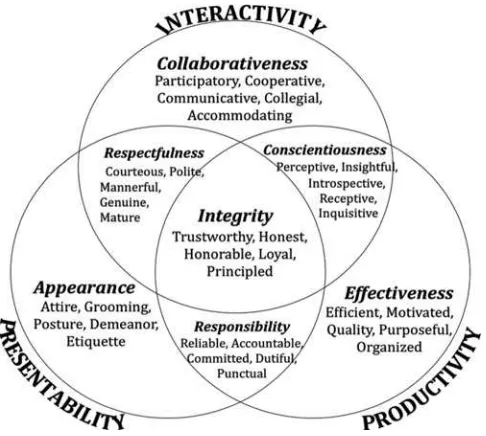
The Venn diagram in Figure 1 was developed to facilitate faculty discussions about the range of behavior that may constitute professionalism in college students, and to help structure consistent communication between faculty and stu-dents. The original words considered came from the COB’s Code of Conduct, which had already been developed and adopted. The rest of the diagram was developed from an ini-tial list of more than 200 positive words drawn from extensive bodies of literature on the topics of teamwork, leadership, and employer selection (NACE Research, 2011). Through a se-ries of surveys of COB faculty, the word lists were refined into seven categories, which were then populated in the Venn diagram (Clark, 2012). Concurrence found in focus-group research with HR-oriented employers (Clark, Lockwood, & Bain, 2012) indicated sufficient validity for this diagram’s use in the program.
Rating Participating Students
Early each semester, all faculty members receive automated e-mail messages containing lists of students in each of their classes who have enrolled in the program, along with
FIGURE 1 Conceptualization of what constitutes professionalism (Clark, Lockwood, & Bain, 2012).
38 T. S. CLARK ET AL.
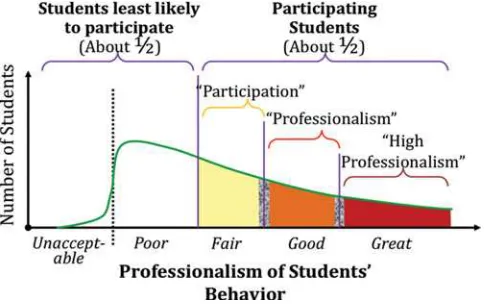
reminders, tips, and resources for faculty participation. At semester end, all faculty members receive another auto-mated message with links to input screens for rating students according to the following categories: highly professional (approximately the top third of participants), professional (approximately the middle third of participants), participa-tion without distincparticipa-tion (approximately the bottom third of participants), and unprofessional (expected to be used very rarely).
In the rating process, faculty members categorize partic-ipants approximately into thirds in a sort of rolling curve. Those participants who are enrolled but have not distin-guished themselves will easily fall into the participant cate-gory. Similarly, top students are likely to be easy to evaluate and categorize. The remaining participants fall in the mid-dle, with relatively few borderline cases. This is reflected graphically in Figure 2.
Tallying Student Ratings
Final categorizations upon graduation are based on terciles, with approximately one third of each cohort being catego-rized into each of the three final rating tiers. Instead of main-stream criterion-referenced assessment, specific rubrics for which were politically untenable, this rolling-curve system of thirds (or terciles) fits with the uncertain nature of profes-sionalism assessments. Also, basing the final ratings on three rolling terciles also simplifies understanding by employers, who are likely to be able to interpret a graduate’s credential such as top third of my cohort more readily than a score from an abstract rubric.
Faculty ratings are recorded in the database. In a typical course, values presently are set at 30 props for receiving a highly professional rating, 20 props for a professional rat-ing, 10 props for a participation rating without distinction, and 0 props for an unprofessional rating. To determine the final professionalism rating, each student’s earned course-work props are divided by the number of ratings received, so as not to penalize those participating students who take
FIGURE 2 Faculty evaluations of Professionalism Recognition Program participating students (Color figure available online).
courses from faculty who have chosen not to participate in the PRP. Details of the ratings algorithm are available from the authors.
Extracurricular activities also earn props since students gain professionalism skills from such endeavors. These ac-tivities could range from attending presentations by outside speakers (one prop for attending) to holding a leadership role in a relevant scholastic organization (up to 10 props per semester). An “other” category exists to accommodate unclassifiable activities, such as study abroad that may lead to considerable development of professionalism skills. For activities with variable props-earning value, students’ sub-missions are reviewed by an administrator in the CDO and either accepted as entered or with a modified props value.
For each graduating cohort, the algorithm provides a sim-ple calculation to finalize each student’s relative standing and resulting professionalism category. Standing within the three categories is determined each semester to give all students a sense of their relative productivity, which could be cited in job-hunting efforts prior to graduation. Students who change cohorts (such as by taking a semester off) have their standing recalculated based on their new target cohort.
Formal Recognition
Participating students receive a letter from the dean when they graduate, which is printed on COB letterhead and signed. Of course, a professionalism letter provides no guarantee of future behavior but it does provide prospective employers with a useful additional indicator of a graduate’s potential. In addition to noting each student’s achievement, the dean’s letters promote the program as a unique feature of the COB curriculum, which is a strategic objective of the program.
First Year of Implementation
After the first year of implementation, 55% of the COB’s 85 faculty members were participating, appropriately skewed toward teachers of updivision courses. Twenty six per-cent of the 1,424 declared COB majors enrolled during the first year of implementation.
Postimplementation Surveys
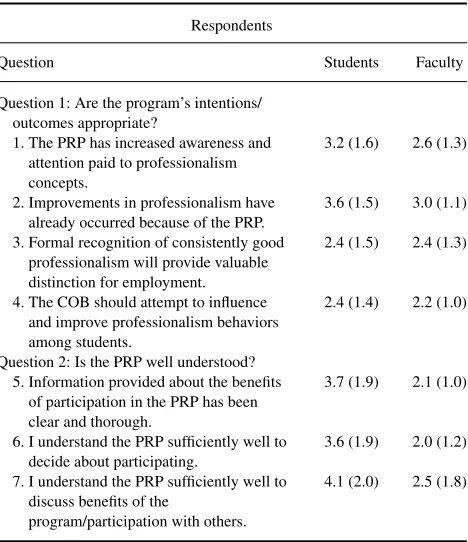
A semester and a half into program implementation, another survey was conducted to explore participation choices by COB faculty and students. A total of 28 faculty members and 155 students completed the survey, of whom 64% and 45% were PRP participants, respectively. Table 1 summarizes the survey results for all respondents.
Responses to the post-implementation survey indicated support for the general intentions of the program. Most re-spondents agreed that “the PRP has increased awareness and attention paid to professionalism concepts.” Further, participating faculty indicated that “improvements in pro-fessionalism have already occurred because of the PRP.” The findings also supported the notion that “the COB should
TABLE 1
Post-PRP Implementation Survey Results
Respondents
Question Students Faculty
Question 1: Are the program’s intentions/ outcomes appropriate?
1. The PRP has increased awareness and attention paid to professionalism concepts.
3.2 (1.6) 2.6 (1.3)
2. Improvements in professionalism have already occurred because of the PRP.
3.6 (1.5) 3.0 (1.1)
3. Formal recognition of consistently good professionalism will provide valuable distinction for employment.
2.4 (1.5) 2.4 (1.3)
4. The COB should attempt to influence and improve professionalism behaviors among students.
2.4 (1.4) 2.2 (1.0)
Question 2: Is the PRP well understood? 5. Information provided about the benefits
of participation in the PRP has been clear and thorough.
3.7 (1.9) 2.1 (1.0)
6. I understand the PRP sufficiently well to decide about participating.
3.6 (1.9) 2.0 (1.2)
7. I understand the PRP sufficiently well to discuss benefits of the
program/participation with others.
4.1 (2.0) 2.5 (1.8)
Note.This survey used a 7-point Likert-type scale ranging from 1 (strong agreement) to 7 (strong disagreement). Responses are mean values; figures in parentheses indicate standard deviations. COB=college of business; PRP=Professionalism Recognition Program.
attempt to influence and improve professionalism among stu-dents.” Both students and faculty respondents indicated much stronger support for this key idea one year into program im-plementation than in the survey one year prior (student means [and standard deviations] improved from 2.9 [1.4] to 2.5 [1.4] on a 7-point scale, ranging from 1 (strong agreement) to 7 (strong disagreement),p<.01; faculty means [and standard
deviations] improved from 3.4 [1.7] to 2.2 [1.0],p<.01).
The postimplementation survey also solicited comments, which exhibited certain themes. First, student participation in the program often appears to be driven by the opportunity to enhance their employability upon graduation, through im-proving professionalism and demonstrating that to employ-ers. Faculty comments tended to focus on the potential of the program to be a helpful tool for improving classroom conduct.
DEVELOPING A SUCCESSFUL PROFESSIONALISM RECOGNITION
PROGRAM
Concept Development
Other colleges of business that may be interested in devel-oping a similar program can benefit from our experience.
Our program had to be launched with quite a bit of wiggle room, such as with broad conceptions of professionalism and the tercile system of ratings that would roll along with the evolution of the program. But many people’s first impres-sion during that time became fixed—often with a negative disposition toward uncertain and unprecedented innovations. The program later settled into greater clarity, which is where others should attempt to begin. For example, the program has come to be known as a mechanism for producing collec-tive letters of recommendation from the entire faculty for the most professional graduates. In our case, while the evolved message resonated with some holdouts, other individuals had formed negative predispositions when the PRP was less clear and have been unwilling to reconsider.
Other colleges can launch a program with greater speci-ficity and clearer communications from the start, which may lead to greater initial buy-in by faculty. In an environment with a very different political climate from our COB, a top-down mandate from the administration to the faculty may be a viable alternative to ensure high faculty participation. Furthermore, where a more specific rubric for criterion-referenced assessment could be structured from the start, some participants could find such structure to be more ap-pealing than the tercile system initially relied upon in our program.
Startup
A crucial ingredient for successfully implementing a PRP is genuinely caring about the culture of the institution, and not holding the status quo as sacred. Committed and politically effective leaders are prerequisite.
Program champions. The PRP was championed by
one of the authors, who was a relatively new faculty member, supported by two senior colleagues who are sensitive to the college’s culture, enthusiastic toward its opportunities and its challenges, and efficient in using key resources to accomplish changes.
Oversight committee. The PRP should be understood and supported by various stakeholders from the outset: advi-sory boards, administration, faculty, staff, and students.
Initial data collection. To allow for the incorporation of varied ideas, we recommend collecting input early in the de-velopment process, against which progress can be measured later.
Implementation
Promotion. Program promotion should target all the stakeholders. Our COB administration bought into the idea of the PRP from the outset, and kept members of the national advisory board apprised. Student outreach efforts were led by
40 T. S. CLARK ET AL.
the CDO, while faculty members on the Task Force reached out to other members of the faculty.
Administration. As this was a faculty-driven initiative, the dean and associate dean deliberately kept a low profile. Nonetheless, the dean has been using the program as a major talking point with advisory boards, potential donors, and community leaders, and in college literature. As the program stabilizes and matures, it is intended that the administration will increasingly take over operations of the program.
IT. The IT department played an important role in im-plementing a Web-based interface for student enrollment and checking their progress in the program, faculty ratings of stu-dents’ professionalism performance, and implementation of the rating algorithm. Having the IT director on the task force helps facilitate more seamless communication.
Ongoing refinement and administration. Ongoing research will inform improvements in the program. Notably, research with employers must guide refinements in both pro-gram particulars and messaging to make it more valuable to them and to our graduates in the job market. Over time, our PRP governance is moving toward periodic oversight by a faculty-led committee, with staff increasingly managing functional elements.
DISCUSSION AND CONCLUSION
The primary value of a professionalism recognition program is expected to be increased employability by participating graduates. But even for nonparticipants, the program’s com-mon language should increase the likelihood that more fac-ulty members will raise the topic in ways that challenge and benefit all students. Increased attention given to the sub-tleties of personal conduct is expected to trickle through the student-body culture.
The PRP also provides opportunities for the school’s strategic differentiation, beginning with visits from prospec-tive students and their parents and extending through long-term alumni relations. In time, derivations of the PRP may be launched in related schools across campus, possibly start-ing with professionally oriented schools like engineerstart-ing and health sciences.
Similar to any distinctive strategy, this program derives from resources and competencies that may be uncommon. Relatively small class sizes, for example, are virtually a pre-requisite for a program of this type to succeed. Upper-division classes in our COB average about 30 students, which gives the faculty ample first-hand knowledge about the behavior of any PRP-participating students in their classes. Other col-leges where class sizes are smaller than average can leverage this strength as a competitive distinction.
Although the logistics of the program are becoming in-stitutionalized, concern remains about the program’s philo-sophical basis. For example, some faculty members have voiced concerns that the PRP rewards behaviors that are already clearly stated in the student code of conduct and should not be singled out for special rewards. But advocates of the program intend for its focus to be on the voluntary acknowledgement of the desirable behavior. This ongoing conversation is seen positively by most on both sides, and the program remains versatile enough to include many forms of use.
We believe the program takes an important step by rec-ognizing that students’ agency alone cannot be expected to produce sufficient gains in individual and aggregate con-duct, especially when so many other sociocultural forces are pulling students the other way. With a little help from subtle changes in the school’s culture, individuals’ agency recursively responds in an interactive dyad, and the culture evolves progressively.
Barr, T. F., & McNeilly, K. M. (2002). The value of students’ classroom experiences from the eyes of the recruiter: Information, implications, and recommendations for marketing educators.Journal of Marketing Education,24, 168–173.
Barrie, S. C. (2006). Understanding what we mean by the generic attributes of graduates.Higher Education,51, 215–241.
Bruner, J. (1985). Models of the learner.Educational Researcher,14(6), 5–8.
Clark, T. S. (2012). Raising ethics and integrity awareness by incentiviz-ing professionalism. In C. Wankel & A. Stachowicz-Stanusch (Eds.),
Handbook of research on teaching ethics in business and management education(pp. 200–213). Hershey, PA: IGI Global.
Clark, T. S., Lockwood, C., & Bain, C. (2012) What do em-ployers want?: Recognizing professionalism in undergraduate busi-ness students. Retrieved from http://www.franke.nau.edu/Faculty/ Intellectual/workingpapers/workingpapers.aspx
Elton, L. (1999). New ways of learning in higher education: Managing the change.Tertiary Education and Management,5, 207–225.
Giddens, A. (1986).The constitution of society. Berkeley, CA: University of California Press.
Hammer, D. P. (2000). Professional attitudes and behaviors: The “A’s and B’s” of professionalism.American Journal of Pharmaceutical Education,
64, 455–464.
Mazen, A., Herman, S., & Ornstein, S. (2008). Professor delight: Cultivating organization citizenship behavior.Journal of Management Education,32, 563–579.
Moss, P., & Tilly, C. (2001).Stories employers tell: Race, skill, and hiring in America. New York, NY: Russell Sage Foundation.
NACE Research. (2011).Job outlook 2012. Bethlehem, PA: National Asso-ciation of Colleges and Employers.
Schein, E. H. (1967). Organizational socialization and the profession of management. In C. L. Cooper (Ed.),Classics in management thought
(Vol. 1, pp. 221–234). Northampton, MA: Edward Elgar.
Shah, N., Anderson, J., & Humphrey, H. J. (2008). Teaching professional-ism: A tale of three schools.Perspectives in Biology and Medicine,51, 535–546.
Shinn, S. (2009, September/October). What business wants from tomorrow’s leaders.BizEd, 28–34.