• Tidak ada hasil yang ditemukan

Directory UMM :Journals:Journal of Information Technology for Teacher Education:Vol6.Num2.1997:

N/A
N/A
Protected

Academic year: 2017

Membagikan "Directory UMM :Journals:Journal of Information Technology for Teacher Education:Vol6.Num2.1997:"

Copied!
16
0
0

Teks penuh

(1)

Does Permeation Work? Promoting

the Use of Information Technology

in Teacher Education

JOHN ROBERTSON

University of Paisley, United Kingdom

ABSTRACT Initial Teacher Education Centres have a crucial role in promoting the use of Information Technology in schools through the opportunity to influence new teachers. Valid educational justification, combined with the need to limit course congestion, have resulted in enthusiasm for permeated

approaches. The results of a survey of United Kingdom teacher education centres suggest concern about the effectiveness of permeated approaches, especially in the areas of school experience and the ‘non-numeric’ disciplines. The potential educational benefits resulting from a permeated approach are restated and a commitment on the part of institutions to support initiatives which may lead to their realisation is called for.

Introduction

Over the last 30 years, teachers in British primary schools have witnessed a radical transformation of the curriculum for pupils in the 5 to 12 age range. Language and mathematics curricula have been extended to allow for a greater emphasis on creativity and practical problem-solving activities. Religious Education now covers other world religions and a range of moral issues, such as equal opportunities. Environmental Studies has swollen to include Information Technology (IT), Technology and a greater emphasis on experimental science. In this time, modern languages have appeared, disappeared and reappeared. Add to this, initiatives in differentiation, the integration of pupils with special educational needs and the European Dimension, and it becomes difficult to imagine how a typical teacher in the 1950s found enough to fill the day.

(2)

The capacity of new technology to support teaching and learning across the curriculum ... is considerable. It is important that the potential of the new technology is exploited to enrich pupils’ education and to familiarise them with ideas and skills which will be valuable in both work and leisure. (Scottish Office Education Department, 1991)

Since the development of low-cost microcomputers at the end of the 1970s, their use in education has been seen as an important issue. The above quotation is an example of the type of statement, often made, which justifies IT in education by an assertion of its wider significance beyond that arena and into work and leisure. This perceived importance is reflected in the level of activity by the educational professions as a whole. Pilot projects, resource development, research studies and guideline production has been extensive (Govier, 1988; Morrison, 1988; Lewis, 1988; Griffin, 1988; Wellington, 1988; Scottish Office Education Department, 1991, 1992).

In new curricular initiatives, initial teacher education has a crucial role to play. With Information Technology, at the very least, this consisted of ensuring that emerging teachers were well-prepared to implement it in the classroom. However, a fairly negative picture of the preparation of student primary teachers to use IT has emerged: “The initial teacher-training system is not well-equipped to make its proper contribution to developments in IT use in school”, Department of Education and Science (1992). “This suggests that initial teacher training is failing to give its students any more insight into CAL than teachers in schools are picking up on INSET courses”, Goler (1990). “Newly qualified teachers must not simply be added to the list of teachers in need of training in the use of IT”, Dunn & Ridgeway (1991). These concerns were reinforced in other studies (Blackmore et al, 1992) including two large-scale national studies in England, Wales, Northern Ireland (Project INTENT, 1990) and Scotland (Project SPRITE, 1991).

In attempting to avoid such a disappointing outcome, teacher education centres adopted a number of strategies. Sometimes they created new structures in the form of departments and discrete course components. In other cases, they attempted to absorb the change through permeation in existing course components. Despite considerable support for a permeated approach (HMI, 1989), many institutions, recognising that they did not have the expertise outside of computing departments to achieve this, have developed and persisted with free-standing IT components (Rothery, 1992).

(3)

institution, permeation simply meant the splitting of the IT component and the allocation of bits to curricular courses, but its continuing separateness. In an Australian context, reluctance by subject specialists to give up time to IT is reported by Downes et al (1995).

Relevance seems more likely where IT use is permeated. Coherence and progression, by contrast, are aspects which pose greater challenges for a permeated approach. The overall coherence of students’ experience of IT depends upon them meeting all of the main applications and having the opportunity to explore the range of possibilities for their use across the curriculum. Where, for example, only the mathematics department makes use of Logo and spreadsheets, students may develop a narrow view of their potential which ignores their respective value in developing linguistic and scientific concepts. Where only environmental studies staff make use of databases, the student may not discover the contribution such resources offer to language arts, religious and moral education or to mathematics. Similarly, the progression in theoretical understanding, pedagogical and technical skills from the use of adventure games to spreadsheets and Logo would require extremely careful phasing of IT experience across the work of all departments. These concerns about the coherence and progression in IT delivery, using permeated approaches, are echoed by academics from teacher education centres in Germany (Gorny, 1995) and Denmark (Hjarnaa and Bollerslev, 1995).

Permeation offers, at least in theory, a kind of relevance not easily achieved by discrete courses. In a congested curriculum, permeation seems an elegant solution. To what extent, however, are these benefits actually realised in the British teacher education sector? A survey of teacher education centres, carried out in 1993, attempted to measure the opinions of those involved. The aims of the study were to:

x identify the extent and overall quality of permeated use of IT in teacher education;

x estimate the time allocated to discrete IT course provision over the four years of BEd (Primary) courses;

x identify the relative effectiveness of IT permeation in each of the main subject areas;

x estimate the extent to which students are formally expected to use IT in assessment including periods of school experience;

x estimate the extent and quality of advice given to students and school experience tutors on assessing IT use in the classroom.

Methods

(4)

of courses and to rate their satisfaction with the level and quality of permeation. The key research questions were:

x How satisfied are you with the level and quality of IT use by B.Ed. students in College/ University classes?

x How satisfied are you with the level and quality of IT use by B.Ed. students in school experience?

x How satisfied are you with the level and quality of personal use of IT by B.Ed. students?

x Is there a discrete IT course in: Years 1–4?

x How satisfied are you with the level and quality of IT use [in each curricular area]?

x Are B.Ed. (Primary) students obliged to use IT in summatively assessed assignments for [each curricular area]?

x How strongly do you feel B.Ed. (Primary) students are encouraged to use IT in summatively assessed assignments for [each curricular area]?

x Are B.Ed. (Primary) students obliged to use IT in school experience?

x How strongly do you feel B.Ed. (Primary) students are encouraged to use IT in school experience?

x How satisfied are you with the advice given to tutors on the assessment of IT in school experience?

x How satisfied are you with the advice given to students on the assessment of IT in school experience?

Where a measure of satisfaction was sought, a four-point scale was used in an effort to force selection of satisfied or dissatisfied ratings.

(5)

Results

General level of satisfaction with IT use by students

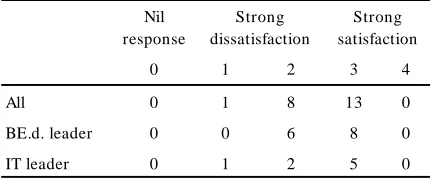
0

Table I. Responses to the question, “How satisfied are you with

the level and quality of IT use by B.Ed. students in college/ university classes?” (n=22).

70mm

Figure 1. Satisfaction: IT in classes: all respondents (n=22).

0

Table II. Responses to the question, “How satisfied are you with

(6)

70mm

Figure 2. Satisfaction: IT in school experience: all respondents (n=22).

0 5 2 1 0

IT leader

0 8 6 0 0

BE.d. leader

0 13 8 1 0

All

4 3 2 1 0

Strong satisfaction Strong

dissatisfaction Nil

response

Table III. Responses to the question, “How satisfied are you with the level and quality of personal use of IT by B.Ed. students?” (n=22).

70mm

Figure 3. Satisfaction: IT personal use: all respondents (n=22).

(7)

however, to avoid the extremes of the scale. Using all respondents and looking at the three categories of school experience, classes and personal use, ‘strong satisfaction’ was consistently rare (1,0,0). By contrast ‘satisfied’ ratings (3) varied more across the three categories (4,10,13). Interestingly, this variation was not mirrored in the ‘dissatisfied’ (2) rating (10,8,8) but more in the ‘strongly dissatisfied’ rating (1), two places along the scale, (7,4,1). Only ‘personal use of IT’ was considered satisfactory or better in slightly more than 50% of institutions.

70mm

Figure 4. Number of respondents to the question, “Is there a discrete IT course in years 1–4?” (n=22).

The extent of provision of Discrete IT course components is illustrated in Figure 4. This shows a tendency for IT courses to be offered in the first year of the degree with a minority, reducing further in size with each year, offering courses in later years. It is possible that some of these entries actually represent elective or option courses. Where this is the case, then the level of provision may actually be lower than indicated for all students.

Table IV shows that the scientific and mathematical subject areas were rated more highly than ‘non-numeric’ areas and were the only ones with 50% or more of (all) respondents rating them as satisfactory. This is further analysed in percentage terms in Table V.

(8)

Looking at all respondents, every subject area received a score of only 1 in at least two institutions (Mathematics and Technology). More than 50% of subjects were rated unsatisfactory with more than 50% of respondents rating them 1 or 2. Overall, most curricular areas across the responding institutions seem to be performing unsatisfactorily in the use of IT.

1 Special Educational Needs

4

Table IV. Response to the question “How satisfied are you

with the level and quality of IT use [in each curricular area]?” (n=22).

68

(9)

3 3

Technology/ IT

8 1

Technology/ B.Ed.

2 2

Science/ IT

2 5

Science/ B.Ed.

1 6

Mathematics/ IT

5 5

Mathematics/ B.Ed.

1 5

Geography/ IT

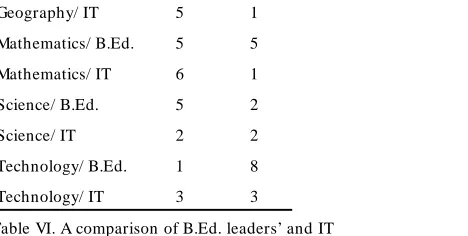
Table VI. A comparison of B.Ed. leaders’ and IT

leaders’ rating of satisfaction with IT in their courses (n=14 and 8).

The extent to which IT use is assessed:

68 mm

Figure 5. Responses to the question, “Are B.Ed. (Primary) students obliged to use IT in summatively assessed assignments for [each curricular area]?”: all staff (n=22).

Figure 5 shows, for each curricular area, the proportion of institutions where students were obliged and those where they were not obliged to use IT in summatively assessed assignments. The grey area indicates no obligation (thought it does not preclude encouragement to do so as discussed next) and the black area indicates a positive obligation.

On the basis of this, obligation to use IT in assessment is the exception rather than the norm. While a high rating for Geography in Table IV (satisfaction in level and quality of IT use) appears to match a relatively high frequency of obligation to use IT, RE seems to combine a low rating in Table IV with a relatively high frequency of obligation to use IT. Also, Mathematics, highly rated in Table IV, has a low frequency of obligation.

(10)

use of IT, or that there has been some misunderstanding of my meaning in using the term ‘obliged’.

Alternatively, this data may mean that there are too many factors influencing a decision to assess use of IT in a subject area for any conclusion to be formed on the basis of only two – satisfaction with use and obligation to use in assessment. Based on my own experience and talking to colleagues from other institutions, I would expect that curricular areas, regardless of the quality of their use of IT, would not oblige students to use it because of limited access to resources or other factors.

3 Special Educational Needs

2

Table VII. “How strongly do you feel B.Ed. (Primary) students are encouraged to use IT in summatively assessed assignments for [each curricular area]?” (n=22).

With between 7 and 13 respondents making a nil response, there is some evidence of uncertainty about what is happening in some subject areas. Where ratings were offered, the ‘numeric’ subjects such as Geography, Mathematics, Science and Technology seemed to be offering encouragement more commonly than the non-numeric subjects such as Language, RE and History:

But even here, less than 50% of respondents rated these areas as satisfactory (3 or 4). Again, the rating for Primary Education was low with only 3 out of 22 (13.63%) institutions reporting satisfaction (3 or 4). A comparison of B.Ed. and IT leaders shows no marked difference in ratings.

45 Technology

(11)

13 History

18 Religious education

22 Language

32 Geography

32 Science

42 Mathematics

Table VIII.

The extent and quality of the use of IT in school experience was examined in Question 1: “Are B.Ed.(Primary) students obliged to use IT in school experience?” A majority (15 out of 22) of institutions indicated that their students were obliged to use IT in school experience. This contrasts markedly with levels of satisfaction with the use of IT by students in school experience (Table II). In the light of this, I am concerned about the way the word ‘obliged’ has been interpreted. For example, course documentation may indicate that students should ‘use a range of resources (blackboard, television, information technology)’ but would this result in an ‘obligation’ to use IT?

75mm

Figure 6. Responses to the question, “How strongly do you feel B.Ed. (Primary) students are encouraged to use IT in school experience?” (n=22).

(12)

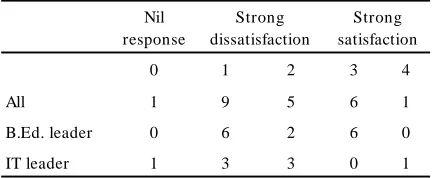
0

Table IX. “How satisfied are you with the advice given to tutors on the assessment of IT in school experience?” (n=14 and 8).

75mm

Figure 7. “How satisfied with advice to tutors?” (n=22).

1

(13)

68mm

Figure 8. “How satisfied with advice to students?” (n=22).

Figures 7 and 8 show that a majority of respondents reported dissatisfaction with the advice given to tutors (15 out of 20) and with the advice given to students (14 out of 21). The ‘strongly dissatisfied’ rating (1) was more commonly selected than ‘strongly satisfied’ for both of these questions.

From the data, IT leaders were more commonly concerned about advice for school experience than were B.Ed. leaders. Only 12% gave a rating of 3 or 4 (satisfied), compared to 43% of B.Ed. leaders.

Discussion

There is a clearly perceived problem with permeated approaches to IT in teacher education. This perception extends beyond the UK to include teacher educators in Europe and Australia.

Even in a ‘strong’ subject such as mathematics, where 17 out of 22 respondents were satisfied or strongly satisfied with the use of IT, 4 respondents were dissatisfied (1 nil response). Yet the use of IT is a clearly specified and an integral part of the mathematics curriculum. This can only be a matter for serious concern.

Students’ exposure to IT during school experience placements was clearly disappointing for the survey respondents. Levels of IT use seem very low (Table II). Yet the classroom is the place where the knowledge, skills and attitudes acquired throughout all course components are typically expected to be demonstrated. Limited formal expectation of the use of IT in this arena (Question 1) must be a matter for concern.

(14)

respondents to the survey (15 out of 22) indicated that students were obliged to use IT during school experience (Question 1).

Despite this, there was fairly widespread dissatisfaction with the extent to which students were encouraged to use IT in school experience (Figure 6) and evidence of a lack of support in the form of the provision of assessment criteria for tutors (Table IX). While there may be some reasonable doubt about respondents’ interpretation of the term ‘obliged’, this may be evidence of a gap between intentions and actual delivery. Overall, respondents commonly rated aspects of IT in school experience as strongly unsatisfactory. They were commonly strongly dissatisfied with student performance, with tutor expertise and with arrangements for assessment. Other studies reinforce this negative view of IT use in school experience (Hodgkinson & Wild, 1994; Loveless, 1995).

Providing effective delivery of permeating themes such as IT continues to challenge teacher education institutions and ensuring comprehensive and coherent permeation may require a level of co-ordination which is difficult to achieve so that the provision of discrete course components, accepting potential limitations in respect of their relevance to curricular contexts, may offer a form of ‘safety-net’.

Conclusions

Conclusions derived from the above results must take account of possible constraints on their validity. In particular, a partial return may have introduced bias. It might be argued that ‘discontented’ staff were more likely to respond and that those who did not do so were predominantly satisfied with the situation in their institutions. However, even if non-responses are taken to imply satisfaction, the level of dissatisfaction reported remains a serious concern for a teacher education system committed to a uniform level of quality in courses, across the sector. Keeping these doubts in mind, the following conclusions seem defensible:

x There is a worrying level of concern, amongst those responsible, about the extent to which permeation has proved an effective strategy for the delivery of information technology outcomes in teacher education.

x The concerns are greatest in the areas of school experience and in the ‘non-numeric’ disciplines.

x The failure to assess IT competencies, to encourage IT use in assessment and to provide tutors and students with advice on the assessment of IT, may be significant factors in inhibiting its use.

x Given the above concern about the effectiveness of permeation, the low level of discrete IT course provision in the later years of BEd courses and the rarity of options or specialisms is not supportable.

(15)

achieved and a commitment on the part of institutions to support initiatives which may lead to their realisation.

Considering that all teacher education institutions have the same responsibility to prepare students for teaching and that this includes the use of information technology, the level of dissatisfaction reported in the survey is worrying. If similar concern was to be voiced about other aspects of teaching such as assessment or discipline, the story would be front page news.

Correspondence:

John Robertson, Department of Curricular Studies, University of Paisley, Craigie Campus, Beech Grove, Ayr KA8 0SR, United Kingdom.

References:

Blackmore, M., Coles, D., Hodgkinson, K., Stanley N., Taylor, C. & Vaughn, G. (1992) A preliminary view of students’ information technology experience across UK initial teacher training institutions, Journal of Information Technology for Teacher Education, 1, pp. 241-254.

DES (1992) Information Technology in Initial Teacher Training. London: HMSO.

Downes, T., Perry, B. & Sherwood, C. (1995) IT in education and teacher education in Australia, Journal of Computer Assisted Learning, 11, p. 30.

Dunn, S. & Ridgeway, J.(1991) Computer use during primary school teaching practice: a survey, Journal of Computer Assisted Learning, 7, pp. 7-17.

Goler, W. (1990) Inset in CAL for Teachers in Primary Schools, British Journal of Inservice Education, 16, pp. 119-121.

Gorny, P. (1995) Teacher education in IT in Germany, Journal of Computer Assisted Learning, 11, p. 44.

Govier, H. (1988) Microcomputers in Primary Education: a survey of recent research. ESRC/ InTER. Lancaster: Lancaster University.

Griffin, J.(1988) Research in Information Technology and Education: issues for LEA advisers. ESRC/ InTER. Lancaster: Lancaster University.

HMI (1989) Information Technology in Initial Teacher Education – Two Years After the Trotter Report, London: DES, HMSO.

Hodgkinson, K. & Wild, P. (1994) Tracking the development of student IT capability, Journal of Information Technology for Teacher Education, 3, pp. 101-114.

Hjarnaa, P. & Bollerslev, P. (1995) IT in teacher education in Denmark, Journal of Computer Assisted Learning, 11, pp. 49-50.

Lewis, R. (1988) Information Technology in Education Research Programme 1988-1993. ESRC/ InTER. Lancaster: Lancaster University.

(16)

Morrison, A. (1988) Information Technology in Primary Schools, a research review for the Scottish Education Department, ESRC/ InTER. Lancaster: Lancaster University.

Project INTENT (1990) Initial Teacher Education and New Technology, project proposal to Department of Education and Science, CARE, University of East Anglia.

Project SPRITE Joint-College Working Group (1991) Supporting and Promoting Information Technology in Teacher Education, project proposal to the Scottish Office Education Department, Dundee Northern College of Education.

Rothery, A. (1992) IT in initial teacher education at Worcester, Developing IT in Teacher Education, 4, pp. 83-97.

Scottish Office Education Department (1991a) Effective Learning and Teaching in Scottish Primary Schools: the use of the microcomputer. Edinburgh: HMSO

Scottish Office Education Department (1991b) Curriculum and Assessment: Mathematics 5-14. London: HMSO.

Wellington, J. (1988) Policies and Trends in IT in Education. ESRC/ InTER. Lancaster: Lancaster University.

Gambar

Figure 2. Satisfaction: IT in school experience: all respondents (n=22).
Table IV. Response to the question “How satisfied are you with the level and quality of IT use [in each curricular area]?” (n=22).
Table VI. A comparison of B.Ed. leaders’ and IT leaders’ rating of satisfaction with IT in their courses (n=14 and 8).
Table VII. “How strongly do you feel B.Ed. (Primary) students are encouraged to use IT in summatively assessed assignments for [each curricular area]?” (n=22).
+2

Referensi

Dokumen terkait

The axiom of her revised understanding is that enduring and profound change cannot occur without the change agent having this clarity of understanding, which can achieve

The main source of information took the form of interviews, held in early 1997 with teachers in secondary schools, providers of in-service education and training (INSET), and

During the teaching practice, student teachers were provided a user-friendly portable PowerBook computer, enabling them to communicate by email messages with their teacher

This article identifies three main obstacles that may limit its successful implementation – student access to computers, the communications and information technology (ICT)

The article has gone on to focus on forums to support teachers and lecturers following a post-degree programme and has argued that on-line discussion can support teacher

In general terms, pre-service and in-service teacher training may benefit from telematics applications in two ways: by the network being used to assist teachers to transfer

In an information-rich society, some faculty continue to use traditional methods of instruction. In order for new teachers to be comfortable with technology, university faculty

Technology, then, is seen as differentiating three generations of distance education (Nipper, 1989): first-generation distance education or correspondence education, based on