Email as a Non-directed Means of
Developing Independent Reflection in
Beginning Teachers of Foreign Languages
ANN BARNES
University of Warwick, United Kingdom
ABSTRACT This article considers the role electronic mail can play in developing the ability of beginning teachers to reflect on their practice and professional development. It also explains how such communication is incorporated into the initial teacher training course in Modern Foreign Languages at the University of Warwick. Using the example of one particular student as a representative of those who use this medium in a ‘reflective’ manner, it illustrates this student’s development and analyses her messages by evaluating them for reflective attributes and reflective discourse (Korthagen & Wubbels, 1995; Hatton & Smith, 1995). The discussion is set against the background of research into student teacher development and reflection and a research project by the author investigating the stages through which
beginning teachers progress, as well as the changing context of initial teacher training. The author concludes that, whilst electronic communication can be an effective tool for promoting reflection, it is at present still not a realistic choice for many student teachers.
The Student Teacher as a Developing Reflective Practitioner
Recent literature has focused on the tendency of student teachers to move on from needing the security of ‘tips’ and ‘survival techniques’ to becoming more pedagogically orientated (Wilson & Cameron, 1996; Rudduck, 1991; Leat, 1995; Furlong, 1996). At this stage, students are concerned with giving pupils learning experiences, and later still they become more professionally orientated and move beyond the specifics of their own classroom. Tann (1994) calls this development “survival – pedagogical – professional”.
their practice and experience. This theme of the ‘reflective practitioner’ has, in recent years, dominated discussion on beginning teachers progressing towards becoming competent professionals (Calderhead, 1992; Bright, 1995; Gardiner, 1996; Bramald et al, 1995). As Calderhead (1995, p. 15) states: “... for the past two decades, teacher educators have constantly extolled the value of reflective practice. Greatly influenced by the writings of Donald Schön, teacher education has become obsessed with the notion of reflection even if the actual nature and content of that reflection remain fairly vague.”
Reflective practice and the reflective practitioner remain terms which are seldom defined effectively and any definitions tend to vary in their theoretical basis. In this article, schemata developed by Korthagen & Wubbels (1995) and Hatton & Smith (1995) have been adopted to analyse student teacher email correspondence. Wubbels & Korthagen (1990) define reflection thus: “One has a reflective attitude if one displays a tendency to develop or alter mental structures, thus indicating an orientation towards one’s own professional growth” (p. 32). Korthagen & Wubbels (1995) identify characteristic attributes and correlates of a reflective student teacher.
Students experience what is often a very steep learning curve (or even ‘unlearning’ curve; that is, they abandon some frequently very strongly held preconceptions), especially at the start of the course (Evans, 1994) and this applies both to pedagogical knowledge and to self-knowledge (Cullingford, 1994). For critical reflection to occur, the appropriate environment must be provided with regard, for example, to time, encouragement and context (Hargreaves & Fullan, 1992). Students need to learn from the lessons of experienced practitioners (Shkedi, 1996), and to see the uniqueness of the particular context in which they are working but be able to generalise from their experiences (Rudduck, 1991).
The Encouragement of Reflection During the PGCE Course
Discovering how students become more efficiently, and where possible, critically reflective and how this reflection can be encouraged and developed are major challenges for all partners in initial teacher training. Many institutions have adopted some form of Record of Professional Achievement or similar student profiling and target-setting documents, intended to help students monitor, evaluate and plan their progress. Such processes are also usually built into both subject and general courses. Claxton (1988) states that “learning is what happens when you take the risk of not being
competent” (p. 22). It is this climate of risk-taking, reflection and subsequent progress which is to be encouraged within the development of prescribed competences. At the UK’s Open University, where distance learning is the norm, students make use of electronic communications as a means of describing, questioning and discussing their progress (Mason & Kaye, 1989; Selinger, 1996), and in the Open University Modern Foreign Languages PGCE this has been a feature for over two years (Swarbrick, 1995).
The Context of the PGCE
Consistent with UK Initial Teacher Education (ITE) criteria, the PGCE in Modern Foreign Languages (MFL) at the University of Warwick comprises a total of 24 weeks spent on school-based activity and a total of 12 weeks at the higher education institution. This time is spread throughout the 36 weeks of the course and students spend a considerable number of weeks following a pattern of two days in school and three at the University. The number of students taking the PGCE in MFL at Warwick has risen from 25 in 1994-95 to 48 in 1997-98, and has grown to include Spanish as a main subject in addition to French and German. Most of the students’ school-based time is spent in two different schools and, as most schools have either one or two linguists at a time, Warwick’s approximately 60 partnership schools for languages are spread over a very wide geographical area and are involved in either one or both placements throughout the academic year. It could be argued that the continuity of experience for the student is potentially fragile. Bursts of activity and information at the University, where new relationships are formed very quickly, are followed immediately by experiences in a school with the consequent need to build new relationships and become accustomed to a new system.
backgrounds. Students have regular meetings and tutorials with each tutor in which they set targets and review their progress as developing teachers. Both subject and core tutors visit the students during school placements and MFL tutors provide additional regular, voluntary ‘twilight tutorials’.
However, due to the location of the schools, student numbers and time pressures (both for students working to a school timetable and for tutors), scheduling quality communication is difficult. Of course, students work extremely closely with their school-based mentors (teachers) during these periods, but most of the University tutor-student conversation takes place outside ‘official’ hours. Students have a range of options, including:
x visit to tutor’s office – either by appointment or on a ‘drop-in’ basis;
x telephone call to tutor’s office;
x telephone call to office voice mail;
x telephone call to home answering machine (in emergencies only);
x written note left for tutor;
x email.
Information and Communications Technology (ICT) in the MFL Component
For the academic year 1996-97, ICT and email were integrated more tightly into the subject programme than in previous years. The cohort of 37 MFL PGCE students were encouraged to register for their email addresses as soon as possible at the start of their course in September. Training is available centrally to all students, but the group were also encouraged to use each other’s (very varied) knowledge and experience. They all received structured guidelines for independent work on aspects of ICT as well as working on their language and integrating both areas (Barnes, 1996). University MFL staff involved used email on a regular basis. An email link with MFL PGCE students at the University of East Anglia was also set up, and although this is still at a developmental stage, some successful links have been established.
initiative launched by the National Council for Educational Technology (NCET) to promote more information technology (IT) awareness in PGCE students and stated that “hundreds of newly qualified teachers enter the profession unprepared for life in the multimedia classroom”. This stems partly, of course, from the wide variation in ages, first-degree programmes and work experience. An example of ICT content in modern foreign languages degree programmes and the lack of student confidence can be found in White & Palfreyman (1994) and further examples of ICT in MFL Initial Teacher Education are given in Higham & Morris (1993) and Gray (1996). Gray looked specifically at PGCE MFL students and found a very wide range of ability and experience and that improved competence was experienced mostly by those students who had access to ICT facilities whilst on school placements.
Students at Warwick were not specifically directed to use email to reflect on their teaching progress at any point, although all students were encouraged to gain practical experience in using ICT in general and to ‘keep in touch’ with the tutors during placements. The use made of this tool in this manner, then, by some of the cohort was a spontaneous action. Many students were unable to use email as they wished due to a lack of facilities in placement schools (for descriptions of similar problems, see also Coyle & Harrison, 1993; Davis, 1992; Blackmore et al, 1992 and Gray, 1997).
Email as a Tool for Reflection
Straten et al (1996) point out that telematic facilities offer new and important opportunities for collaboration and dialogue with colleagues or superiors and thus for the promotion of reflective teaching. Yet while there have been many examples of using email as a means of practising languages (see, for example, Hartmann, 1996; Little & Brammerts, 1996; Marsh, 1997 or Woodin, 1997) or to raise awareness of cultural and European issues (Austin, 1995), its potential for self-analysis and reflection is perhaps not as widely acknowledged or realised in practice. However, Marsh (1997) described a language learning situation where much of the support and guidance needed was provided via email and where learner diaries submitted via email represented a more spontaneous response to learner experience than a comparable written form.
of communications fell off when the school practicum began. Veen et al (1995) found students’ messages moved from describing disciplinary problems to discussing pedagogical issues (although in their case the communication involved was a Listserv [one-to-many] rather than one-to-one). Russell & Cohen (1997) acted as critical friend and reflective colleague to each other via email and found many of its characteristics encouraged reflection, for example its lack of interruptions or side-tracking which would occur in face-to-face dialogue. As Kaye (1989) points out, the freedom from time and place constraints and the potential for one-to-one and group interactivity provide the possibility of a new educational paradigm. However, the use of this means of communication, especially in initial teacher education, is not yet as widespread as would perhaps be expected.
The use of Computer-Mediated Communication (CMC) under discussion in this paper is limited to electronic mail communication between student teacher and subject tutor. This means of communication offers space and time to consider a situation and reflect on it, but with the knowledge that these reflections will be read and answered. Unlike the Record of Professional Achievement, for example, which may be scrutinised by an interview panel, mistakes and worries can be admitted, discussed and reflected upon in safety. As Kaye (1989) explains: “the discipline of being obliged to formulate one’s ideas, thoughts, reactions and opinions in writing in such a way that their meaning is clear to other people who are not physically present, is of key importance in the majority of educational programmes” (p. 10).
In the context of the time and space constraints outlined above, email has the potential to act as a useful tool in teacher education. Harasim (1989) states that the very asynchronicity of electronic communication is to its huge advantage, as is the fact it is not place-dependent. Harasim found users accessed the learning environment 24 hours a day, seven days a week. In the context of a course such as a PGCE, where students are in school for long periods of time and occupied with planning and marking in the evenings, a line of communication which can be accessed immediately is particularly welcome. The question is whether this is achievable in the present context, where the student teachers’ access to email was widely variable.
academic year were indeed of the former type, possibly due in part to restricted access when on school placements. It was the evidence of greater thought and reflection in some of the email correspondence which was the catalyst for this paper.
PGCE (MFL) Email Correspondence with the Author
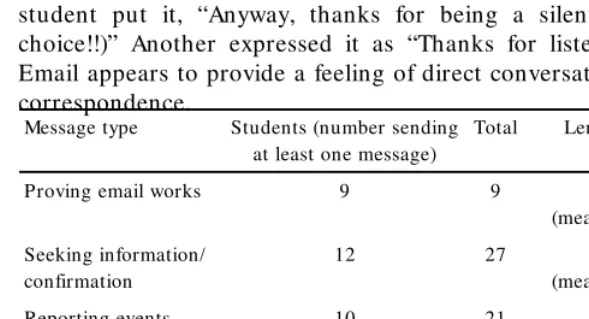
Eighteen of the 37 students on the course used email at least once to communicate with the author. Table I shows that the majority were making queries or seeking information and were relatively brief. Eight students, however, used email to reflect at considerable length on their experiences (most messages of over 200 words and often much longer), often not necessarily expecting a reply or answer as such, but regarding the medium as a way of ordering their thoughts or putting thoughts into words. As one student put it, “Anyway, thanks for being a silent listener!! (Not much choice!!)” Another expressed it as “Thanks for listening. (Well, reading!)” Email appears to provide a feeling of direct conversation rather than written correspondence.
Table I. The type, number and length of messages from PGCE MFL students to the author over an approximately nine month period. Most messages were sent during students’ two block placements in school (six weeks November to December 1996, 10 weeks April to June 1997).
profile given to it at the start of the course, gave the students a reason to contact the author, if only to prove they could use the technology and were on-line.
It is clear that this communication tool does not replicate the features of face-to-face or telephone conversations. It is, however, a valuable alternative and has its own unique properties which, perhaps, engender more reflection than more ‘conversational’ communication. It must also be emphasised that the students were not communicating with a completely ‘unseen’ person. Indeed, they had other, close contacts with the author outside the email environment and this relationship was instrumental perhaps in the personal nature of much of the correspondence. Marsh (1997) also found students regarding the tutor more as a ‘friend’ after email communications; despite the apparent ‘coldness’ of the technology, a personal relationship appears to develop. This contrasts with Wolcott’s findings (1995), but it must be remembered that in the present case, email was not the sole means of contact.
‘Reflective’ Email
The examples of communications from one student, ‘Cheryl’, reproduced in Figure 1 show the depth of information and reflection possible through email, where characteristics of both descriptive and dialogic reflection (Hatton & Smith, 1995) can be detected as well as the reflective attributes described by Korthagen & Wubbels (1995). Figure 1 contains extracts from selected messages, with the student’s abbreviations retained, from a very detailed correspondence throughout the year between the student and the author from the first term to successful completion of the course. The selection inevitably leads to loss of colour and personality but the length and number of the communications prohibit their being reproduced in full. This student has been chosen as she displays the most reflective attributes in her correspondence, where she analyses lessons and approaches sometimes in great detail, and it is also felt to be interesting to follow the student’s development throughout the year. To avoid losing the flavour of Cheryl’s correspondence completely, extracts are set within their conversational context. The author’s contributions were brief (usually between 20 and 50 words) and were reactive rather than proactive. The author’s responses were encouraging but did not serve an explicit “tutoring function” (Veen et al, 1995). The correspondence is reproduced with the student’s permission and the content of this paper has been discussed with and approved by her. Cheryl sent messages in all categories of Table I but only some communications pertinent to reflection are reproduced.
student teacher which Korthagen & Wubbels (1995) describe can be summarised as follows:
x Attribute 1: the reflective student teacher is capable of structuring situations and problems, and considers it important to do so.
x Attribute 2: the reflective student teacher uses certain standard questions when structuring experiences.
x Attribute 3: the reflective student teacher can easily answer the question of what he or she wants to learn.
x Attribute 4: the reflective student teacher can adequately describe and analyse his or her own functioning in interpersonal relationships with others.
Hatton & Smith (1995) distinguish between three types of reflection in discourse, summarised below:
x descriptive reflection (attempts to provide reasons for action based on personal judgement or on students’ reading);
x dialogic reflection (a form of discourse with oneself as an exploration of possible reasons);
x critical reflection (involving reason-giving for decisions or events, taking account of the broader historical, social and/ or political contexts).
Hatton & Smith’s categories and Korthagen & Wubbels’s attributes are indicated next to the extracts as is a selection of other features. The other features are described more expansively after the extracts. Days of the weeks and details about the stage in the course have been added. Unfamiliar terms or additions to preserve the student’s and others’ anonymity are explained in square brackets.
Extracts from Cheryl’s Correspondence
Other Features of ‘Reflective’ Email
Certain features of the ‘reflective’ messages are apparent in the extracts above and appear also in the messages of the other ‘reflective’ students. These include:
x a personal, almost ‘confessional’ style;
x a stated awareness of the convenience of the medium;
x a ‘problem-solving’ approach, where the students suggest their own solutions;
x the addition of conversational, gossip-like elements (only partially reproduced here);
x a varying approach to the ‘immediacy’ of email depending upon the nature of the message (for example, good news is sent almost straightaway);
x the student takes a dominant role in the ‘conversation’ (from the outset of the correspondence);
x messages cluster (not surprisingly) around those times when the students are on school placement and the University link is ‘weaker’;
x the appreciation of an audience who ‘understands’ the specifics of their experiences;
x sensitive or confidential issues are broached more readily;
x no apparent need for extensive replies – the tutor’s replies were, because of time constraints, usually fairly short and concise. This seemed to have little effect on the length of the students’ communications.
This is certainly a distinctive type of discourse; certainly not the same sort of interaction one would find in a face-to-face or voice-to-voice conversation. It resembles more closely perhaps a stream of consciousness. Unlike conversation, there is no immediate response from the tutor – perhaps by making suggestions or providing solutions – therefore the students work through the problem themselves. They are thereby adopting some characteristics of the often elusive ‘reflective practitioner’.
Conclusion and Recommendations
These students had on the whole very good relationships with school-based staff and, very importantly, had easy access to the technology – either in their school-based placements – as a result of living near University campus, or at home. The email facility appears to have provided them with the opportunity to collect and express their thoughts at a time when they were learning a lot very quickly. In a climate of increased student numbers, more prescribed course content and limited contact time, such a facility is extremely valuable.
Some questions do arise, however. If such use of email were to be more directed by the tutor and the potential benefits be made more explicit, would it still be as effective? If more students did choose to use this facility, would this have a positive or negative effect on tutor time (see Campbell et al, 1995)? The planned introduction and expansion of the First Class email facility to the Warwick course would address some of the issues by:
x enabling sub-groups (not necessarily involving tutors actively) to discuss methodological issues;
x allowing confidential communication (and therefore reflection) where needed;
x providing more widespread access to the facility for students on school placement;
x while retaining the opportunity for more reflective communication to develop spontaneously.
The use of email in this area will continue to grow, providing both a tool for communication in language teaching and learning and a medium for reflection and self-evaluation and may be particularly useful when students are working as newly qualified teachers. The features of reflective thinking expressed in this electronic form are surely those which teacher educators would wish to foster in all beginning teachers. All partners in Initial Teacher Education need to work together to establish the necessary technology to improve accessibility and increase participation. It appears that this facility worked well for Cheryl. Therefore, thought should be given as to how to ensure easy access for all, in order for students to be able to make a choice of whether to use the technology or not.
Acknowledgement
The author found the comments of the referees and editor most helpful and constructive in revising this paper.
Correspondence
References
Austin, R. (1995) Using electronic mail in initial teacher education to develop European awareness, Journal of Information Technology for Teacher Education, 4, pp. 227-235.
Barnes, A. (1996) Maintaining language skills in the initial training of foreign language teachers, Language Learning Journal, 14, pp. 58-64.
Blackmore, M., Stanley, N., Coles, D., Hodgkinson, K., Taylor, C. & Vaughan, G. (1992) A preliminary view of students’ Information Technology experience across UK initial teacher training institutions, Journal of Information Technology for Teacher Education, 1, pp. 241-254.
Bramald, R. Hardman, F. & Leat, D. (1995) Initial teacher trainees and their views of teaching and learning, Teaching and Teacher Education, 11, pp. 23-31.
Bright, B. (1995) What is ‘Reflective Practice’?, Curriculum, 16(2), pp. 69-81.
Calderhead, J. (1992) The role of reflection in learning to teach, in L. Valli (Ed.)
Reflective Teacher Education: cases and critiques. New York: SUNY Press.
Calderhead, J. (1995) Understudy part, The Times Educational Supplement, 27 October 1995, p. 15.
Campbell, K., Jamieson S., Olson, A. & Mappin, D. (1995) Telecommunications and an alternative practicum: collaborative entrepreneurship in teacher education,
Journal of Information Technology for Teacher Education, 4, pp. 289-306.
Claxton, G. (1988) Teaching and learning, in R. Dale, R. Fergusson & A. Robinson (Eds) Frameworks for Teaching: readings for the intending secondary teacher.
London: Hodder & Stoughton.
Coyle, D. & Harrison, C. (1993) The EHE-EMSAT Project: the development of awareness of electronic mail amongst student teachers, Journal of Information Technology for Teacher Education, 2, pp. 89-103.
Cullingford, C. (1994) Steps in training must be sound, The Times Educational Supplement, 10 June 1994, p. 22.
Davis, N. (1992) Information technology in United Kingdom initial teacher education, 1982-92, Journal of Information Technology for Teacher Education, 1, pp. 7-21.
Evans, A. (1994) Taking responsibility for the training curriculum within the school: the view of a professional tutor, in M. Wilkin & D. Sankey (Eds) Collaboration and transition in Initial Teacher Training. London: Kogan Page.
Furlong, J. (1996) The developing student teacher – from idealism to realism via disenchantment, in R. Hansford & J. Thorogood (Eds) From Linguist to Language Teacher. London: Centre for Information on Language Teaching and Research.
Gardiner, J. (1996) Teacher training in school no panacea, The Times Educational Supplement, 19 July 1996, p. 5.
Gray, C. (1997) IT in the West Midlands, Language Learning Journal, 15, pp. 52-59.
Harasim, L. (1989) On-line education: a new domain, in R. Mason & A. Kaye (Eds)
Mindweave: communication, computers and distance education. Oxford: Pergamon Press.
Hargreaves, A. & Fullan, M. (1992) Understanding Teacher Development. London: Cassell.
Harrington, H. (1992) Fostering critical reflection through technology: preparing prospective teachers for a changing society, Journal of Information Technology for Teacher Education, 1, pp. 67-82.
Harrington, H. & Hathaway, R. (1994) Computer conferencing, critical reflection, and teacher development, Teaching and Teacher Education, 10, pp. 543-554.
Hartmann, V. (1996) Kreativ schreiben – ein e-mail Projekt des Goethe-Instituts London, German Teaching, 13, pp. 19-20.
Hatton, N. & Smith, D. (1995) Reflection in teacher education: towards definition and implementation, Teaching and Teacher Education, 11, pp. 33-49.
Higham, J. & Morris, D. (1993) Developing Information Technology through
in-service and initial teacher education: a hypercard project, Language Learning Journal, 7, pp. 31-35.
Kaye, A. (1989) Computer-mediated communication and distance education, in R. Mason & A. Kaye (Eds) Mindweave: communication, computers and distance education. Oxford: Pergamon Press.
Korthagen, F. & Wubbels, T. (1995) Characteristics of reflective practitioners: towards an operationalization of the concept of reflection, Teachers and Teaching, Theory and Practice, 1, pp. 51-72.
Leat, D. (1995) The costs of reflection in initial teacher education, Cambridge Journal of Education, 25, pp. 161-174.
Little, D. & Brammerts, H. (Eds) (1996) A Guide to Language Learning in Tandem via the Internet, Centre for Language Communication Studies Occasional Paper No. 46. Dublin: Trinity College.
Marsh, D. (1997) Computer conferencing: taking the loneliness out of independent learning, Language Learning Journal, 15, pp. 21-25.
Mason, R. & Kaye, A. (Eds) (1989) Mindweave: communication, computers and distance education. Oxford: Pergamon Press.
McTaggart, M. (1997) Trainees in touch with tomorrow, The Times Educational Supplement, 10 January 1997, p. 24.
Rudduck, J. (1991) The language of consciousness and the landscape of action,
British Educational Research Journal, 17(4), pp. 319-331.
Selinger, M. (1996) Beginning teachers using information technology: the Open University model, Journal of Information Technology for Teacher Education, 5, pp. 253-270.
Shkedi, A. (1996) Teacher education: what we can learn from experienced teachers,
British Journal of In-Service Education, 22, pp. 81-97.
Somekh, B. (1989) The human interface: hidden issues in CMC affecting use in schools, in R. Mason & A. Kaye (Eds) Mindweave: communication, computers and distance education. Oxford: Pergamon Press.
Straten, G., Korthagen, F. & Veen, W. (Eds) (1996) Reflection at a distance: an inventorial study into reflection and teleguidance in teacher education, Deliverable of the REFLECT report. Available on-line at:
http:/ / www.ruu.nl/ ivlos/ reflect/
Summers, M. (1990) Starting teacher training – new PGCE students and computers,
British Educational Research Journal, 16, pp. 79-87.
Swarbrick, A. (1995) Open University PGCE students on-line, Links, 13. London: Centre for Information on Language Teaching and Research.
Tann, S. (1994) Supporting the student teacher in the classroom, in M. Wilkin & D. Sankey (Eds) Collaboration and Transition in Initial Teacher Training.
London: Kogan Page.
Veen, W., Lockhurst, D. & Korthagen, F. (1995) Tele-tutoring in teacher education. Paper presented at the EDEN/ ICDE conference ‘The Open Classroom’, Oslo.
White, A. & Palfreyman, R. (1994) CALL for beginners: a case study, Language Learning Journal, 10, pp. 75-78.
Wilson, S. & Cameron, R. (1996) Student teacher perceptions of effective teaching: a developmental perspective, Journal of Education for Teaching, 22, pp. 181-195.
Wolcott, L. (1995) The distance teacher as reflective practitioner, Educational Technology, 1, pp. 39-43.
Woodin, J. (1997) Email tandem learning and the communicative curriculum, ReCall, 9, pp. 22-33.