• Tidak ada hasil yang ditemukan

sloane300. 284KB Jun 04 2011 12:09:31 AM

N/A
N/A
Protected

Academic year: 2017

Membagikan "sloane300. 284KB Jun 04 2011 12:09:31 AM"

Copied!
15
0
0

Teks penuh

(1)

23 11

Article 05.3.6

Journal of Integer Sequences, Vol. 8 (2005), 2

3 6 1 47

Sloping Binary Numbers: A New Sequence

Related to the Binary Numbers

David Applegate

Internet and Network Systems Research Center

AT&T Shannon Labs

180 Park Avenue

Florham Park, NJ 07932–0971

USA

[email protected]

Benoit Cloitre

13 rue Pinaigrier

Tours 3700

FRANCE

[email protected]

Philippe Del´eham

Lyc´ee Polyvalent des Iles

BP 887

98820 W´e Lifou

NEW CALEDONIA

[email protected]

N. J. A. Sloane

1

Internet and Network Systems Research Center

AT&T Shannon Labs

180 Park Avenue

Florham Park, NJ 07932–0971

USA

(2)

Abstract

If the list of binary numbers is read by upward-sloping diagonals, the resulting “sloping binary numbers” 0, 11, 110, 101, 100, 1111, 1010,. . . (or 0, 3, 6, 5, 4, 15, 10, . . .) have some surprising properties. We give formulae for then-th term and the n-th

missing term, and discuss a number of related sequences.

1. Introduction

We start by writing the binary expansions of the numbers 0, 1, 2, . . . in an array:

0 1 1 0 1 1 1 0 0 1 0 1 1 1 0 1 1 1 1 0 0 0 1 0 0 1

· · ·

By reading this array along diagonals that slope upwards to the right we obtain the sequence

0,11, 110, 101, 100, 1111, 1010, 1001, 1000, 1011, . . .

ofsloping binary numbers, which we denote by s(0), s(1), . . .. Written in base 10, s(0), s(1),

s(2), . . . are

0,3,6,5,4,15,10,9,8,11, . . . (A102370)†.

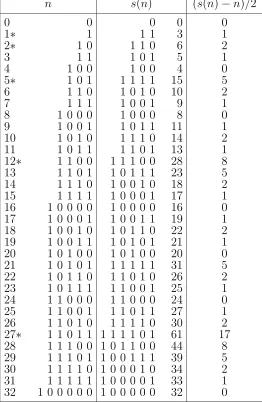
Our goal is to study those numbers as well as several related sequences. Table 1 shows

s(0), . . . , s(32) both in binary and decimal, together with the corresponding values of (s(n)−

n)/2. Not every nonnegative number occurs as an s(n) value: in particular, the numbers 1, 2, 7, 12, 29, 62, 123, 248, 505,. . .(A102371) never appear. We denote the omitted numbers byt(1), t(2), t(3), . . ..

In Section 2 we state our main theorems, which give formulae and recurrences for s(n) andt(n), as well as for a downward-sloping versiond(n). In Section3we discuss some further properties of these numbers, namely the trajectories under repeated application of the map

n 7→ s(n) (it is interesting that the trajectory of 2, for example, follows a simple rule for at least the first 400 million terms, but eventually this rule breaks down); the fixed points (numbersnsuch thats(n) =n); the number of terms in the summations in (3) and (13) (two number-theoretic functions that may be of independent interest); and the average order of

s(n). In the final section, Section 4, we give two related sequences σ(n) and δ(n) which are permutations of the nonnegative integers, and a second downward-sloping sequence which is obtained by left-adjusting the array of binary numbers.

(3)

It is worth mentioning that this work has given rise to an unusually large number of new sequences—see the list at the end of this paper. Only the most important of these will be mentioned in the paper. Conversely, we were surprised to find very few points of contact with sequences already present in [4], sequence A034797 being one of the few exceptions.

2.

The main theorems

The first theorem gives the basic properties of the sloping binary numberss(n).

Theorem 2.1. (i) Let n >0. Then for any m >log2n,

Proof. We first establish some notation. If the binary expansion of a nonnegative number

n is

(4)

(i) Let Ldenote the infinite, right-adjusted, array formed from the binary expansions of the nonnegative numbers (as on the left of Table 1), and let R be the corresponding array formed by the binary expansions ofs(0), s(1), . . . (as in the central column of the table). It follows at once from the definition of s(n) that the right-hand columns (the 1’s bits) of L

andR agree, the second column from the right inR (the 2’s bits) is obtained by shifting the 2’s column of L upwards by one place, the 4’s column of R is obtained by shifting the 4’s column ofL upwards by two places, the 8’s column by three places, and so on.

We also see from Table 1 that while there are 2k vectorsu∈ {0,1}k in L, there are only

2k1 such vectors in R. Exactly one vector u∈ {0,1}k is missing from each set of 2k: this

ist(k).

Because of the way the columns of L are shifted to form R, we have (compare (5)):

s(n) =

where now the upper limit in the summation can be replaced by any number m > log2n. Therefore, for such an m, we have

s(n) = 2

(iii) The starred values of n in the first column of Table 1 indicate where the 2k’s bit of

s(n) is equal to 1 for the first time. Let pk = 2k−k. Then the 2k’s bit (k≥1) of s(n) is 1,

and is the highest order bit that is 1, precisely for n∈ {pk, pk+ 1, . . . , pk+1−1}.

(5)

which proves (3). Equation (3) can also be deduced from (2), using induction on i.

Remarks. 1. The argument in the final paragraph of the proof shows that if n is not congruent to m mod 2k, then s(n) is not congruent to s(m) mod 2k (since n not congruent

tom mod 2k means i k in that argument). Therefore all 2k congruence classes of n mod

2k correspond to distinct congruence classes ofs(n) mod 2k. That is,s(n) is odd if and only Before studying the missing numbers t(n), it is convenient to introduce a downward-sloping analogue of s(n). If we read the array L by downward-sloping diagonals, we obtain the sequenced(n), n≥0, with initial values 0,1,0,11,10,1,100,111,110,101,0,1011, . . ., or in base 10,

0; 1; 0,3,2; 1,4,7,6,5; 0,11,10,9,12,15,14,13,8; 3,18,17, . . . , (A105033). (7)

(6)

(ii) d(n) satisfies the recurrence d(0) = 0, d(1) = 1 and, for i≥1, −1≤j ≤2i1,

Proof. The proof is parallel to that of Theorem2.1 and we omit the details.

The recurrence (9) shows that thed(n) sequence has a natural division into blocks, where the indices of the blocks run from 2i+i1 to 2i+1 + (i+ 1)2 (i 1). The blocks are

separated by semicolons in (7).

We can now identify the missing numberst(n).

Theorem 2.3. (i) For n≥0,

Proof. We have arranged these formulae in the same order as those in Theorems 2.1 and

2.2. But it is convenient to prove them in a different order. (iii) Continuing from the proof of Part (iii) of Theorem2.1, we observe that the missing numbers are missing precisely because

s(n) for a starred value of n has the 2k bit equal to 1; that is, the k-th missing number is

found by erasing the 2k bit froms(2kk), or in other words,

(7)

from which (13) follows immediately. In the sum in (13), the largest contribution is always fromk =n. For the remaining summands, 1≤k≤ ⌊log2n⌋.

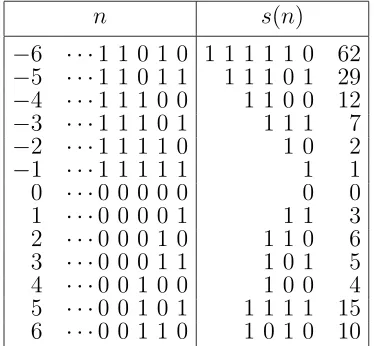
(iv) now follows from (10) and (13), (ii) from (9) and (14), and (v) from (3) and (13). Note that, from (14), t(n) can be obtained by taking the binary expansion of d(n−1) (written with no leading zeros) and exchanging 0’s and 1’s. This leads to a second way to interpret s(−n). Let us write the binary expansions of the negative numbers (using the 2’s-complement notation) above the binary expansions of the nonnegative numbers, as in Table 2. If we define s(n) for all n by reading along upward-sloping diagonals, we see that

s(−1), s(−2), s(−3), . . .are 1,10,111,1100, . . ., or in base 10, the numbers 1,2,7,12, .... That these numbers really are the missing numbers t(1), t(2), t(3), . . . follows from the fact that reading the upper half of Table 2 along upward-sloping diagonals is the same as reversing the order of the rows in the upper half of the table, exchanging 0’s and 1’s, and reading downwards. That is, s(−n) = 2n1d(n1) =t(n), which we know to be true from (iv)

and (v).

(i) Finally, we obtain (11) by considering how the columns in the upper half of Table 2

have been shifted, just as we obtained (1) by considering how the columns in the lower half of the table were shifted. This completes the proof of the theorem.

Remarks. 1. Since the values {s(−n) = t(n) :n ≥ 1} are the numbers missing from the

2. The periodicity of the columns of Table 2 shows that the permutations πk relating the

final k bits of n and s(n) also relate the finalk bits of n and t(n).

3. It is worth mentioning the coincidence which led us to discover (13). We considered the sequence it appeared from the numerical data that

2k+1−R(k) = 2k−t(k), k ≥1, (18)

taking the values

1,2,1,4,3,2,5,8,7,6, . . . , (A103530), (19)

and this coincidence (which is a consequence of Theorem 2.3) suggested (13).

We end this section with two further formulae relating these numbers. They follow easily from the above theorems.

(i) For n ≥0 and any j with j ≤n <2j,

(8)

(ii) Forn ≥0 and any j with 0≤n <2j j,

s(n) = 2j 1d(2j1n). (21)

3. Further properties

In this section we discuss some further properties of these sequences.

3.1. Trajectories

Let Tm ={m, s(m), s(s(m)), s(s(s(m))), . . .} denote the trajectory of m under repeated

application of the mapn7→s(n). The initial terms ofTm appear to follow simple rules. For

example,

T1 = 1,3,5,15,17,19,21,31,33,35,37,47, . . . , (A103192),

appears to agree with the increasing sequence T1b of numbers that are congruent to −1,1,3 or 5 mod 16 (A103127). In fact these two sequences agree precisely for the first 511 terms:

n T1(n) T1b(n) Difference

0 1 1 0

1 3 3 0

2 5 5 0

· · · ·

510 2037 2037 0

511 4095 2047 2048

512 4097 2049 2048

· · · ·

The explanation for this lies in the following theorem.

Theorem 3.1. For n in any arithmetic progression {aj+b:j ≥0}, where a≥1 andb are integers, the values s(n)−n are unbounded.

Proof. Leta =c2d withc odd. For anym such that md and 2m > b+d, let k= 2mb

and choose j ≥1 so that

cj≡ −2m−d mod 22mbd

(this has a solution since c is odd). Then for n =aj +b it is easy to check that n+k ≡0 (mod 2k), and so s(n)n+ 2k.

This phenomenon is shown more dramatically in T2, which begins

(9)

The initial terms match the sequence T2b defined by

b

T2(16j+i) := 8(16j+i) +ǫi ,

for j ≥0, 0≤i≤15, where ǫ0, . . . , ǫ15 are

2,−2,−6,−10,−14,−18,−22,−26,−30,−34,−38,−42,−46,−50,−54,6.

We have checked by computer that the sequences T2 and T2b agree for at least 400 mil-lion terms. On the other hand, the above theorem shows that the sequences must even-tually disagree. For suppose on the contrary that T2(n) = Tb2(n) for all n, and consider

the arithmetic progression 128j + 2, j ≥ 0. These are the values T2b(16j), and in T2b

are followed by 128j + 6. But the proof of Theorem 3.1 shows that when j = 2119 1, s(128j + 2) ≥128j + 2 + 2126 6= 128j + 6. So certainly by term n = 8(21191) 1036.72...,

T2 and T2b disagree.

3.2. Fixed points

The fixed points of s(n), that is, the numbers n for which s(n) =n, are observed to be

0,4,8,16,20,24,32,36,40,48,52, . . . , (A104235) (22)

Dividing by 4 we obtain

0,1,2,4,5,6,8,9,10,12,13,14,16, . . . , (A104401) (23)

which omits the numbers

3,7,11,15,19,23,27,31,35, . . . , (A103543) (24)

The latter sequence in fact consists of the numbers of the form 4j+ 3 (j ≥0), together with

62,126,190,254,318,382,446,510,574,638, . . . . (A103584) (25)

The following theorem explains these observations.

Theorem 3.2. s(n) =n if and only if n ≡0 (mod 4) and n does not belong to any of the arithmetic progressions

Qr:={24rj−4r:j ≥1}, (26)

for r= 1,2, . . ..

Proof. These are straightforward verifications using (3), which shows that s(n)> n if and only if n +k ≡ 0 (mod 2k) for some k 1. From k = 1 and k = 2, we have that if

s(n) = n then n ≡0 (mod 4). We may exclude k ≥ 3 with k 6≡ 0 (mod 4) because such k

are subsumed by k= 1 and k= 2.

Remark. An examination of (13) shows that we may restrict (26) to r such that t(4r) = 24r4r, since if t(4r)6= 24r4r,Q

(10)

3.3. The number of terms in the formulae for

t

(

n

)

and

s

(

n

)

While studying the missing numberst(n), we investigated the numberf(n) (say) of terms in the summation in (13), or, equally, in the summation (17) for the record valuesR(k). That is,

f(n) := #{1≤k ≤n: k≡n mod 2k}, (27)

a number-theoretic function which may be of independent interest. The initial values

f(1), . . . , f(32) are

1 1 2 1 2 2 2 1 2 2 3 1 2 2 2 1

2 2 3 2 2 2 2 1 2 2 3 1 2 2 2 1 · · · (A103318)

The smallestn such that f(n) = 3 is 11, corresponding to the values k= 1,3 and 11; and a 4 appears for the first time atf(2059). A search for the first occurrence of f(n) = 5 would be futile, as the following theorem and corollary will show.

Theorem 3.3. f(n) satisfies the recurrence f(1) = 1, and, for i≥0, 1≤j ≤2i,

f(2i+j) =

(

f(j) + 1 if 1≤j ≤i

f(j) if i+ 1≤j ≤2i. (28)

Proof. Note that k = n is always a solution to k ≡ n (mod 2k), but there are no other

solutions with k > log2n. Suppose first that 1 ≤ j ≤ i. For values of k in the range

1 ≤ k ≤ i, the equation k ≡ 2i +j (mod 2k) is equivalent to k j (mod 2k), giving f(j)

solutions. For k in the range i+ 1 ≤ k ≤ n, we get just one further solution, k = n, so

f(2i+j) =f(j) + 1. On the other hand, suppose thati+ 1j n. We would getf(j) + 1

solutions, as in the previous case, except that some values of k that contribute to f(j) are now lost. The lost values are those k > log2(2i +j), that is, k i+ 1. There is just one

such value, namely k=j, and so f(2i+j) =f(j), as claimed.

Corollary. Let g(m) be the minimal value of n such that f(n) = m. Then g(m) satisfies the recurrence g(1) = 1,

g(m+ 1) = 2g(m)+g(m), m≥1, (29)

with values

1, 3, 11, 2059, 22059+ 2059, 222059+2059+ 22059+ 2059, . . . , (A034797).

Proof. This is an easy consequence of Theorem 3.3, and we omit the details.

(11)

We briefly mention the companion sequence f′(n) (say), giving the number of terms in the summation in (3). The initial valuesf′(0), f(1), . . . are

0,1,1,1,0,2,1,1,0,1,1,1,1,2,1,1,0, . . . , (A104234).

An argument similar to that used to establish Theorem 3.3 shows:

Theorem 3.4. f′(n) satisfies the recurrence f(0) = 0, f(1) = 1, and, for i 1, 0 j 2i1,

f′(2i+j) =

(

f′(j) + 1 for j = 2ii1

f′(j) otherwise. (30)

Also

f′(2nn) = f(n). (31)

The positions g′(0), g(1), . . . where f(n) = 0,1,2,3, . . . for the first time are

0,1,5,2037, . . . , (A105035).

We have not investigated this function, but these four values suggest the conjecture that

g′(m) = 2g(m)g(m), which is consistent with (31). If so, this would imply that g(4) = 220592059. Certainly f(22059 2059) = 4, but is this the earliest occurrence of 4?

3.4. Average order

As the above discussion of trajectories illustrates, the function s(n) for n ≥ 0 is quite irregular. But it is straightforward to compute its average order (cf. [3, §18.2]).

Theorem 3.5. The average order of s(n) isn+O(log n).

The proof is an easy computation from (3), using [3, Eq. (18.2.1)].

4. Related sequences

In this section we describe some related sequences.

4.1. Two permutations of the nonnegative integers

Returning to the standard array of binary numbers, as on the left of Table 1, we define two sequences related to s(n) and d(n) which are actually permutations of the nonnegative integers.

The first sequence, σ(n),n ≥0, begins

(12)

with a block structure indicated by semicolons. The initial term is 0. After that, the m-th block (m≥0),

σ(2m), σ(2m+ 1), . . . , σ(2m+11),

is constructed by starting at the leading 1-bit of the numbers 2m, . . . ,2m+11 and reading

diagonally upwards and to the right. Them-th block is in fact equal to the terms

s(pm), s(pm+ 1), . . . , s(pm+1−1), t(m+ 1),

which relates it to our sequences s(n) and t(n). For example, the third block consists of the numbers 15, 10, 9, 8, 11, 14, 13, 12, ending with t(4) = 12.

On the other hand, if instead we read downwards and to the right, we obtain the sequence

δ(n),n ≥0, beginning

0; 1; 3,2; 4,7,6,5; 11,10,9,12,15,14,13,8;. . . . (A105025)

We recognize this as being obtained from d(n) by omitting repeated terms (compare (7)). Both{σ(n) :n≥0} and {δ(n) :n ≥0} are permutations of the nonnegative integers.

4.2. A second downward-sloping version

We might have begun byleft-adjusting the array of binary numbers, so that it looks like

0 1 1 0 1 1 1 0 0 1 0 1 1 1 0 1 1 1 1 0 0 0 1 0 0 1 1 0 1 0 1 0 1 1

· · ·

Now if we read by downward-sloping diagonals, we obtain the sequence 0,10,110,101, . . ., or in decimal,

0,2,6,5,4,14,13,8,11,10,9,12,30, . . . (A105029).

This seems less interesting than the previous sequence, and we have not analyzed it in detail. There are no repetitions, and the numbers 2m1, m1, do not appear.

Further related sequences can be found in the list appended to the end of this paper.

References

(13)

[2] J. H. Conway and N. J. A. Sloane, Lexicographic codes: error-correcting codes from game theory, IEEE Trans. Inform. Theory, 32 (1986), 337–348.

[3] G. H. Hardy and E. M. Wright,An Introduction to the Theory of Numbers, Oxford, 5th ed., 1979.

[4] N. J. A. Sloane,The On-Line Encyclopedia of Integer Sequences, published electronically athttp://www.research.att.com/∼njas/sequences/, 2005.

2000 Mathematics Subject Classification: Primary 11B83; Secondary 11A99, 11B37 .

Keywords: binary numbers, integer sequences, permutations of integers.

(Concerned with sequencesA034797 A102370 A102371 A103122 A103127 A103185 A103192 A103202 A103205 A103318 A103528 A103529 A103530 A103542 A103543 A103581 A103582 A103583 A103584 A103585 A103586 A103587 A103588 A103589 A103615 A103621 A103745 A103747 A103813 A103842 A103863 A104234 A104235 A104378 A104401 A104403 A104489 A104490 A104853 A104893 A105023 A105024 A105025 A105026 A105027 A105028 A105029 A105030 A105031 A105032 A105033 A105034 A105035 A105085 A105104 A105108 A105109 A105153 A105154 A105158 A105159 A105228 A105229 A105271and A106623.)

Received May 14 2005; revised version received August 2 2005. Published in Journal of Integer Sequences, August 3 2005.

(14)

Table 1: The sloping binary numbers s(n) are obtained by reading the array of binary numbers along upward-sloping diagonals. The table givess(0), . . . , s(32) in both base 2 and base 10, as well as the values of (s(n)−n)/2.

n s(n) (s(n)−n)/2

0 0 0 0 0

1∗ 1 1 1 3 1

2∗ 1 0 1 1 0 6 2

3 1 1 1 0 1 5 1

4 1 0 0 1 0 0 4 0

5∗ 1 0 1 1 1 1 1 15 5

6 1 1 0 1 0 1 0 10 2

7 1 1 1 1 0 0 1 9 1

8 1 0 0 0 1 0 0 0 8 0

9 1 0 0 1 1 0 1 1 11 1

10 1 0 1 0 1 1 1 0 14 2

11 1 0 1 1 1 1 0 1 13 1

12∗ 1 1 0 0 1 1 1 0 0 28 8

13 1 1 0 1 1 0 1 1 1 23 5

14 1 1 1 0 1 0 0 1 0 18 2

15 1 1 1 1 1 0 0 0 1 17 1

16 1 0 0 0 0 1 0 0 0 0 16 0

17 1 0 0 0 1 1 0 0 1 1 19 1

18 1 0 0 1 0 1 0 1 1 0 22 2

19 1 0 0 1 1 1 0 1 0 1 21 1

20 1 0 1 0 0 1 0 1 0 0 20 0

21 1 0 1 0 1 1 1 1 1 1 31 5

22 1 0 1 1 0 1 1 0 1 0 26 2

23 1 0 1 1 1 1 1 0 0 1 25 1

24 1 1 0 0 0 1 1 0 0 0 24 0

25 1 1 0 0 1 1 1 0 1 1 27 1

26 1 1 0 1 0 1 1 1 1 0 30 2

27∗ 1 1 0 1 1 1 1 1 1 0 1 61 17

28 1 1 1 0 0 1 0 1 1 0 0 44 8

29 1 1 1 0 1 1 0 0 1 1 1 39 5

30 1 1 1 1 0 1 0 0 0 1 0 34 2

31 1 1 1 1 1 1 0 0 0 0 1 33 1

(15)

Table 2: By using 2’s-complement notation for the binary expansion of negative numbers,

s(n) can be defined for all n∈Z. The values{s(n) :n ≤ −1} are the numbers missing from

{s(n) :n≥0}.

n s(n)

−6 · · ·1 1 0 1 0 1 1 1 1 1 0 62

−5 · · ·1 1 0 1 1 1 1 1 0 1 29

−4 · · ·1 1 1 0 0 1 1 0 0 12

−3 · · ·1 1 1 0 1 1 1 1 7

−2 · · ·1 1 1 1 0 1 0 2

Gambar

Table 1: The sloping binary numbers sbase 10, as well as the values of (numbers along upward-sloping diagonals
Table 2: By using 2’s-complement notation for the binary expansion of negative numbers,

Referensi

Dokumen terkait

We study polynomial generalizations of the r -Fibonacci and r -Lucas sequences which arise in connection with a certain statistic on linear and circular r -mino ar-

We introduce polynomial generalizations of the r -Fibonacci, r -Gibonacci, and r - Lucas sequences which arise in connection with two statistics defined, respectively, on

The Soules approach to the inverse eigenvalue problem for nonnegative symmetric matrices with n ≤ 5. A note on the eigenvalues of

In Section 3 it is shown that the same situation holds for the nonnegative P0-matrix completion problem, that is, a pattern for n × n matrices that includes all diagonal positions

In this paper, we study matrix functions preserving sets of generalized nonnegative matrices such as the set of real n × n eventually nonnegative matrices, the set of real n ×

Applying the properties of the Hadamard core for totally nonnegative matrices, we obtain the Schur complement inequalities for the Hadamard product of totally nonnegative

Both infinite and sequences of finite Toeplitz matrices are considered, and also studied is the finite section method, which consists in approximating infinite systems by large

In this section we describe a super-field representation of the dispersionless Boussinesq equa- tion; the system at hand admits two infinite sequences of commuting symmetries