~ 587 ~ E-ISSN: 2347-5129
P-ISSN: 2394-0506
(ICV-Poland) Impact Value: 5.62 (GIF) Impact Factor: 0.549 IJFAS 2017; 5(3): 587-592 © 2017 IJFAS
www.fisheriesjournal.com Received: 16-03-2017 Accepted: 17-04-2017
Laxmi Kauwar Rathore
Research Scholar,
Department of Limnology and Fisheries, Rajasthan College of Agriculture, MPUAT, Udaipur, Rajasthan, India
BK Sharma
Professor and Head,
Department of Harvest and Post Harvest Technology, College of Fisheries, MPUAT, Udaipur, Rajasthan, India
Pushkar Lal Dangi
Research Scholar,
Department of Limnology and Fisheries, Rajasthan College of Agriculture, MPUAT, Udaipur, Rajasthan, India
Correspondence Laxmi Kauwar Rathore
Research Scholar,
Department of Limnology and Fisheries, Rajasthan College of Agriculture, MPUAT, Udaipur, Rajasthan, India
Fish biodiversity and fisheries potential of reservoir
Udaisagar (Udaipur, Rajasthan)
Laxmi Kauwar Rathore, BK Sharma and Pushkar Lal Dangi
Abstract
The present study on “Fish Biodiversity, and Fisheries of Reservoir Udaisagar (Udaipur, Rajasthan)” was conducted during September, 2008 to September. 2009. The reservoir has a fairly rich fish fauna and so far 31 species representing 9 families have been recorded in the present investigation, of these, 12 species predominantly contributed to the commercial fisheries of this reservoir. During study period, the Indian major caps dominated the catch by contributing 90 percent to the total landings from this reservoir. Besides Indian major carps, minor carps and catfishes were reported to be 8.84 and 0.9 per cent, respectively. Among the Indian major carps, the Catla catla (70%) dominated the groups followed by
Labeo rohita (25%) and Cirrhinus mrigala (5%).
Keywords: Biodiversity, fisheries, Indian major carp, fauna, species, reservoir
1. Introduction
Biodiversity may be defined as the variety, and variability of flora, fauna and microbes in an ecosystem. In recent years, the sustainable utilization of available biodiversity has assumed great significance in the face of increasing environmental threats. The overexploitation of biological resources to feed the growing human population, especially in densely populated third world countries, is so vivid that most of the resources, be it terrestrial or aquatic, have developed symptoms of impairment which is a matter of serious concern for all. Biodiversity conservation has, thus become a necessity so as to protect this planet from disintegration. Fish constitutes almost half of the total numbers of vertebrates in the world. They live almost all conceivable aquatic habitats; c.21, 723 living species of fish have been recorded out of 39,900 species of vertebrates (Jayaram, 1999) [14]. Of these, 8,411 are freshwater species and
11,650 are marine. India is one of the mega biodiversity counties in the world and occupies ninth position in terms of freshwater mega biodiversity (Mittermeier and Mittermeier, 1997)
[24] In India, there are c. 2,500 species of fishes; which, c.930 live in freshwaterand c. 1570 are
marine (Kar,2003a) [17]. Out of these 400 species are commercially important which includes
wild and culturable species (Das and Kapoor, 1990) [5]. The aquatic eco systems have been
subjected to various forms of environmental stress, during the past few decades. Most of such environmental problems are man-made and thus increased human activities in the catchment area of various aquatic systems have affected the natural processes of these systems adversely thereby threatening the survival and growth of biotic communities.
Fisheries in the state of Rajasthan are mainly of capture type wherein fisheries exploitation is practiced through open bid system. However, in the recent years, water bodies are auctioned on long lease and therefore, fish seed is also stocked for better returns. The water bodies have been categorized into A, B, C and D class waters on the basis of annual revenue (Anonymous, 2004) [1].
In view of the above, the present study on the fish biodiversity and fisheries of reservoir Udaisagar, Udaipur (Rajasthan) has been made as there is no such study conducted earlier on this water body.
2. Materials and Methods A. Study Area
B. Sample Collection
In order to study the biodiversity, samples of fishes were collected from the commercial catches and sample netting during fishing year 2008 at landing centre of Udaisagar reservoir. As far as possible fishes were identified in the field itself using standard manuals (Day, 1994; [8] Talwar and
Jhingran, 1991) [33]. Species that could not be identified in the
field were preserved in 4 percent formalin and brought to the laboratory for identification.
D. Statistical Analysis
The data collected during the present investigation were processed for statistical analysis was done as per the method described by Snedecor and Cochran (1981) [31].
3. Results Fish Biodiversity
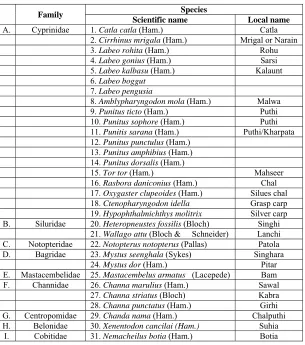
The fish faunal varieties found in the present investigation have been depicted in Table.1. This table clearly indicates that total 31 fish species belonging to 9 families were found from the Udaisagar reservoir. Thus, fish faunal structure appears fairly rich.
Out of the recorded 31 fish species, only 12 species viz., Catia catta, Labeo rohita Cirrhinus mrigala, Labeo gonius, Labeo
calbasu, Ctenopharyngodon idella, Hypophthalmichthys molitrix, Puntius sarana, Puntius sophore, Amblypharyngodon mola, Heteropneustes fossilis, Wallago
attu, Mystus seenghala and Mastacembelus armatus
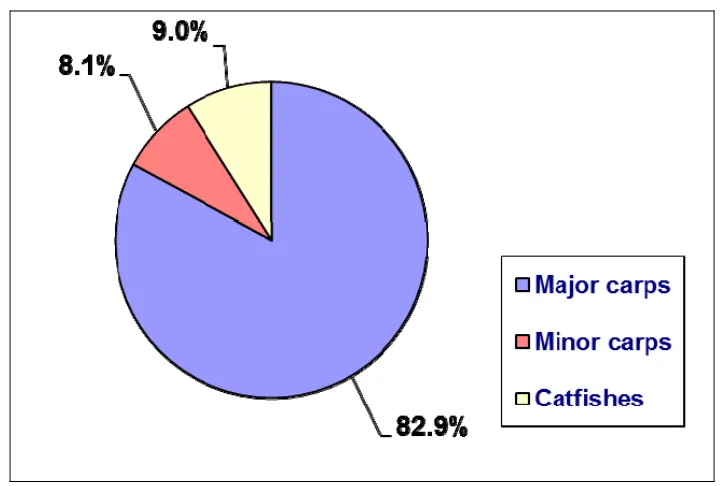
contributed to the commercial catch of this reservoir (Plate1). Indian major carps have dominated the fishery of the reservoir followed by the minor carps and catfishes (Table.2). In general, the Indian major carps appear to contribute around 90 per cent to the total landings of the Udaisagar reservoir. While the per cent contributions of minor carps and catfishes in the total catch were only 8.84 and 0.9, respectively. Amongst the Indian major carps, Catla catla dominated by (70%) followed
by Labeo rohita (25%) and Cirrhinus mrigala (5%) (Fig.1
and 2).
Further, in the case of minor carps, Labeo gonius dominated
with a contribution of 63% followed by Puntius species viz., P. sarana, P. sophore (26%). Other fishes species, formed
11% of the total minor carp catch. The catfishes have also made a smaller contribution to the landings of the Udaisagar reservoir, the highest catfish landing being of Wallago attu
(65%) followed by Mystus seenghala (15%) and others i.e., Mystus aor, lesser silurids and bagrids. The species of air
breathing and cat fishes are represented by H. fossilis and
three species of Channa.
Table 1: List of fish fauna represented in the catch from Udaisagar reservoir, Udaipur
Family Species
Scientific name Local name
A. Cyprinidae 1. Catla catla (Ham.) Catla 2. Cirrhinus mrigala (Ham.) Mrigal or Narain
3. Labeo rohita (Ham.) Rohu
4. Labeo gonius (Ham.) Sarsi 5. Labeo kalbasu (Ham.) Kalaunt
6. Labeo boggut
7. Labeo pengusia
8. Amblypharyngodon mola (Ham.) Malwa
9.Punitus ticto(Ham.) Puthi
10. Punitus sophore (Ham.) Puthi
11. Punitis sarana (Ham.) Puthi/Kharpata
12.Punitus punctulus(Ham.)
13. Punitus amphibius (Ham.)
14. Punitus dorsalis (Ham.)
15. Tor tor (Ham.) Mahseer
16. Rasbora daniconius (Ham.) Chal
17. Oxygaster clupeoides (Ham.) Silues chal 18. Ctenopharyngodon idella Grasp carp
19.Hypophthalmichthys molitrix Silver carp
B. Siluridae 20. Heteropneustes fossilis (Bloch) Singhi 21. Wallago attu (Bloch & Schneider) Lanchi C. Notopteridae 22. Notopterus notopterus (Pallas) Patola D. Bagridae 23. Mystus seenghala (Sykes) Singhara
24. Mystus dor (Ham.) Pitar
E. Mastacembelidae 25. Mastacembelus armatus (Lacepede) Bam F. Channidae 26. Channa marulius (Ham.) Sawal
27. Channa striatus (Bloch) Kabra 28. Channa punctatus (Ham.) Girhi G. Centropomidae 29. Chanda nama (Ham.) Chalputhi H. Belonidae 30. Xenentodon cancilai (Ham.) Suhia
~ 589 ~
Table 2: Per cent composition of prominent fish species in total landings from Udaisagar reservoir during period 2008-09
S. No. Fish group Per cent composition In group In total fish production 1 Major Carps
Catla catla 70 63
Labeo rohita 25 22.5
Cirrhinus mrigala 5 4.5
2 Minor Carps
Labeo spp. 63 5.6
Puntius spp. 26 2.34
Miscellaneous 11 0.9
3 Cat Fishes
Wallago attu 65 0.59
Mystus seenghala 15 0.13
Miscellaneous 20 0.18
Fig 1: Per cent composition of prominent fish species in total landings from Udaisagar reservoir
Plate 1: Plates Showing Prominent Fish Species of Udaisagar Reservoir
4. Discussion
Datta and Majumdar (1970) [7] made an extensive survey at 93
collection stations in 14 districts of Rajasthan from which fishes were obtained and reported 75 fish species. Other notable contributions on the fish fauna of the Rajasthan are of Mathur (1952) [20], Krishna and Menon (1958) [18], Datta et al.
(1961) [6] and Moona (1963) [25]. Paleographical features of
Rajasthan waters with the distribution of fishes were discussed by Hora and Mathur (1952) [12], whereas studies on
fish fossils was made by Borooch (1950) [2] and Tiwari (1968) [34]. Other intensive studies on fish fauna were conducted in
different districts of Rajasthan with a number of new additions to the fauna (Dhawan, 1969[9]; Mathur and Yazdani,
1969[23]; Mahajan et al., 1981[21]; Johal and Dhillon, 1981[15];
Sharma and Johal 1982[29], 1984[30], Johal and Sharma,
1986[16], Kumar and Vijayan, 1988[20] Jain, 2000[13] and
Rajkumar, 2005[28]). Further, fisheries aspects of one of the
biggest reservoir in Rajasthan Rana Pratap Sagar and Mahi Bajaj Sagar were discussed by Choudhary (1978) [3],
Choudhary, (1995) [4] and that of Jaisamand reservoir were
studied by Durve (1976) [10] Vijay kumar (2007) [35].
A total of 116 species of fish belonging to 9 orders 23 families and 58 genera were recorded from Rajasthan by Kumar and Asthana (1993) [19].
The outcome of the present study from the biodiversity and fisheries point of view is that in the Udaisagar reservoir in all 31 species, 9 families (Table.1) were recorded to contribute to the Ichthyofauna of the reservoir. Dhawan (1969) [9] recorded
~ 591 ~
90 per cent of the total fish landing followed by minor carps and catfishes which respectively formed only 8.84 per cent and 0.9 per cent of the total fish catch. The relative abundance of different groups of fishes forming the total catch appeared I.M.C. > Minor carp > Catfishes.
Accepting that there is meagre contribution to the recruitment from the natural breeding, the projected picture of fishable stock appears satisfactory. The relative contribution of major and minor carps was 90 and 8.84 per cent. Further, the fishery is largely contributed by two Indian major carps. viz. Catla catla, Labeo rohita. The contributions of catfishes to the total
catch were 0.9 per cent. Out of the three Indian major carps,
Catla catla, and Labeo rohita contribute 70.0 and 25 per cent
in total fish production.
The relative abundance of IMC species was in the order of
Catla catla > Labeo rohita > Labeo calbasu >Cirrhinus mrigala. Present dominance of Catla catla and Labeo rohita
in Udaisagar reservoir is probably attributable to the regular stocking of these two species.
A. Fisheries Potential
From the available catch records it was observed that total fish production in the year 2008-09 was 90,000 kg., in Udaisagar reservoir. According to Natarajan (1972) [26] in any
water body the fish production potential is affected by certain factors such as lack of understanding of the ecology, paucity of quality seeds, faulty stockings, exploitation policies and presence of predatory and weed fishes. Sugunan (1995) [29]
emphasized that fish productivity is related to morphometric, hydrological and ecological features of a particular water body because the yield is partly a function of biotic and abiotic factors influencing production process of that ecosystem.
Species wise fish composition in total catch has direct influence on production of economically important fish like carps. It is well known that carps have different types of breeding and feeding patterns and presence of weeds and catfishes may directly affect carp fish production. Durve (1976)[10] reported that fish production of Jaisamand
(Udaipur) increased after heavy stocking of fingerlings of major carps. During the present study, major carps visibly dominated the catch, particularly due to continuous stocking and partly due to relatively lower population of large predatory fishes. The total fish production was around 90,000 kg during 2008-09 from this reservoir (Anonymous. 2004) [1].
Thus, there was a large gap between potential fish yield and actual fish harvest. There is an ample scope for increasing fish production which could be achieved through sustainable management practices. According to Sugunan (1995) [32] the
estimated production potential of small (less than 1000 ha), medium (1000-5000 ha) and big reservoirs (above 5000 ha) in India are 200-300, 75-100 and 50-75 kg ha-1 y-1 respectively.
Dwivedi et al. (2005) [11] stated that the annual fish production
of large reservoirs of India is 20 to 150 kg ha-1 y-1 while
average fish production of small reservoirs is varies from 50 to 200 kg ha-1 y-1. On the other hand, Pandey (2006) [27]
recorded 57.89 kg ha-1 y-1 average fish production in Kidari
Jheel in U.P.
Considering all these projections Udaisagar fish production 200 kg/ha should be 210 tonnes. From this it is evident that present production is 90 tonnes only which can be easily double by taking suitable fish stocking measures.
5. Acknowledgement
Authors record their sincere thanks to Dr. L.L. Sharma, Dean, College of Fisheries for their encouragement and for extending facilities for conducting this research
6. References
1. Anonymous. Annual report. State Fisheries Department, Rajasthan, 2004.
2. Barooch SK. Fossil fish and crabs in the Fuller's earth bed at Kapurdi, Jodhpur, Rajasthan. Current Science 1950; 19:165.
3. Choudhary RS. Fish and fisheries of Rana Pratap Sagar (RPS) reservoir, Rajasthan. Journal of Inland Fisheries.
1978; 10:70-84.
4. Choudhary RS. Pre and Post impoundment fisheries status of Mahi Bajaj Sagar in Banswara district (Rajasthan). Journal of Freshwater Biology. 1995;
1:67-72.
5. Das P, Kapoor D. Status report on Natural Genetic Resources of Fish and their conservation, 1990.
6. Datta AK, Menon PKB, Nair CKG, Das CR. A noted list of fishes of Rajasthan state. Proceedings of Rajasthan Academy of Science, Pilani. 1961; 8:129-134.
7. Datta AK, Majumdar N. Fish fauna of Rajasthan, India. Part 7, Fish Research and Zoological Survey of India 1970; 62:63-100.
8. Day F. The fishes of India: Being a natural history of the fishes known to inhabit the seas and freshwaters of India, Burma and Ceylon. Indian Reprint, Jagmandir Book Agency, New Delhi, 1994, 1, 2.
9. Dhawan S. Fish fauna of Udaipur lakes. Journal of Bombay National History Society. 1969; 66:190-194.
10. Durve VS. The fish and fisheries of Lake Jaisamand, Rajasthan. Journal of the Inland Fisheries Society of India. 1976; 8:13-19.
11. Dwivedi RK, Khan MA, Singh HP, Singh DN, Tyagi RK. Production dynamics and fisheries development in Naktara reservoir, Madhya Pradesh, India. Journal of the Inland Fisheries Society of India. 2005; 32:81-86, 12. Hora SL, Mathur BBL. On certain palaeographical
features of Rajasthan as evidences by distribution of fishes. Bulletin of National Institute of Science, India.
1952; 1:32-36.
13. Jain MK. Biology and Fisheries of Indian major carps from Siliserh reservoir, Alwar, Rajasthan. Ph.D. thesis submitted to Maharana Pratap University of Agriculture and Technology, Udaipur, 2000.
14. Jayram KC. The freshwater fishes of the Indian regions. Narendra publicing House, Delhi, 1999, 551.
15. Johal MS, Dhillon KS. Ichthyofuana of Ganganagar district. Research Bulletin of Punjab University. 1981;
32:105-110.
16. Johal MS, Sharma KP. Fish fauna of Sawai-Madhopur district, Rajasthan, India. Yestnik Ceskaslovenske Spoleenosti Zoologicke. 1986; 50:112-119.
17. Kar D, Fishes of Barak drainage, Mizoram and Tripura. Environmental pollution and management, APH publishing corporation, New Delhi, 2003, 203-211. 18. Krishna D, Menon CB. A note on the fishes of Jodhpur
(Rajasthan) (In Hindi with English Abstract). Vijnana Parishad Anusandhan Patrika, 1958; 1:207-209.
19. Kumar CRA, Asthana A. The fish fauna of Rajasthan.
Indian Review of Life Science. 1993; 13:133-148.
National Park, Bharatpur, Rajasthan. Journal of Bombay National Historical Society. 1988; 85:44-49.
21. Mahajan CL, Sharma SD, Sharma SP, Arora NK. Productivity potential of reservoir ecosystems with a special reference to Rajasthan. Acta Limnologica India.
1981; 1:39-40.
22. Mathur BBL. Notes on the fishes of Rajasthan, India.
Rec. Indian Mus. 1952; 50:105-110.
23. Mathur DS, Yazdani GM. Occurrence of Aplocheilus blochii (Arnold) in Rajasthan. Journal of Science and Technology, Kanpur. 1969; 7:77.
24. Mittermeier RA, Mittermeier CG. Megabiodiversity: Earth’s biodiversity wealthiest Nation. In: Mcallister, D.E. Hamilton and Harvery (Eds.) Global Freshwater Biodiversity. Sea wind, Cemex, Mexico City, 1997; 11:1-140.
25. Moona JC. Notes on the fishes of Bharatput district, Rajasthan. Rec. Indian Mus. 1963; 28:59-66.
26. Natarajan AV. Reservoir fisheries in India: Their development and management. Silver Jubilee Souvenir, Central Inland Fisheries Research Institute, Barrackpore, 1972, 139-143.
27. Pandey BL. Fisheries and fish catch composition of Kidari Jheel, Mahoba, Uttar Pradesh and its enhancement. Himalayan Journal of Environmental Zoology. 2006; 20:95-98.
28. Rajkumar. Studies on some aspects of fish biology and fisheries potential in relation to current water quality status of Daya reservoir, Udaipur, Rajasthan. Ph.D. thesis submitted to Maharana Pratap University of Agriculture and Technology, Udaipur, Rajasthan, 2005.
29. Sharma KP, Johal MS. On the fish and fisheries of Jaisamand lake, Rajasthan, India. Vestnik Coskoslovenske Spolecnosti Zoologicke. 1982; 46:56-69.
30. Sharma KP, Johal MS. Fish and fisheries of Kota district - Rajasthan state. Research Bulletin of the Punjab University. 1984; 35:24-28.
31. Snedecor GW, Cochran WG. Statistical methods, 7th
edition, Iowa State University Press, Ames, Iowa, USA, 1981, 593.
32. Sugunan VV. Reservoir fisheries of India. FAO Fisheries Technical Paper. 1995; 345:299-316.
33. Talwar PK, Jhingran AG. Inland fishers of India and adjacent countries. Oxford and IBH Publishing Company, New Delhi, 1991, 1, 2.
34. Tiwari KK. A new fossil period fish from lower tertiary Fuller's earth deposit Kapurdi, Barmer district, Rajasthan. Journal of Zoological Society of India, Calcutta. 1968;
20:95-103.