DEVELOPING STUDENT WORK SHEET OF VIRTUAL LABORATORY
PRACTICE OF DYNAMIC ELECTRICITY BASED ON THE PROCESS SKILL
AND SCIENTIFIC ATTITUDE OF STUDENTS
Zulimah1), Chandra Ertikanto2) Lampung University 1,2
1) [email protected], 2) [email protected]
Abstract
With the aid of computer (virtual laboratory), the use of PhET simulation plays an important role in teaching physics.The combination of pictures or interactive animations and the use of student worksheet virtual laboratory will support the quality of the learning process and help improve the skills of learning physics and scientific attitude of students in obtaining better value.The research aims to produce student work sheet of virtual laboratory as a media for teaching physics in regards of applying electricity concept in many cases and technology product. The subjects in this study are students of grade X at SMAN 10 Bandar Lampung. The method used is an empirical research focusing on the use of student work sheet of virtual laboratory.Based on the result of the survey, the use of student worksheets virtual laboratory practicum to overcome the lack of laboratory equipment and eliminate students fear in using to electricity equipment. The use of student worksheet of virtual laboratory practicum can be able to train their processing skill and scientific attitude. The visibility of the student worksheet is based on the validation result.Feasibility student worksheet developed judged based on the results of the validation and response to students as well as an increase of 80% the value of the learning physics. The results showed that the feasibility worksheet students should be reviewed in terms of appearance, practicum purposes, tools and materials used despite being listed in the program PhET Simulation, data tables results of activities, discussions and conclusions columns and illustrations to make it more attractive and easy to understand students, so that students have processing skills, and scientific attitude.
Keywords : Process Skill, Student Work Sheet, Scientific Attitude, Virtual laboratory.
INTRODUCTION
One of the critical issues in theacing physics is to explain the complex concepts, and the difficulty to conduct experiments or experiments in the laboratory, because they do not have adequate laboratory equipment and lack of instructions to carry out practical activities.
pictures or interactive animations and use of student worksheets virtual laboratory as a practical guide was very helpful in physics learning achievement.
According to Yogendra (2012), the combination of demonstration and electronically virtual laboratory is the bridge between learning and theoretical laboratory class. The
teacher can conduct the virtual laboratory experiments to improve students’ retention.
By conducting interactive simulation (virtual laboratory) as the software that contains hundreds of interactive experiments have been successfully used by teachers and students individually in schools around the world such as England, India, Spain, Mexico, New Zealand, and Australia.
Now, by utilizing information technology needs of the importance of physical laboratories can be solved by providing an interactive virtual laboratory. This software serves to illustrate and clarify partially topics taught in the curriculum, especially physics virtual laboratory in high school. Although this virtual laboratory can not 100% replace the physical laboratory, the existence of the virtual laboratory will greatly assist the process of learning physics, especially in motivating students, improving science process skills, scientific attitude and mastery of science concepts. Therefore, further research is needed in the use of virtual laboratory tools by using virtual laboratory worksheets, so that the aspect of products, processes, and attitudes of learners to be able to investigate, solve the problem and draw the conclusions can be developed. Animations and virtual experiments are expected to meet what is required in the schools and certainly intended to further improve the ability of the students.
Often, problems arise in learning physics, especially in the quality of the learning process and learning outcomes, as well as students when applying learning difficulties in daily life. Then, by using PhET simulation media teachers can obtain a picture of how to improve the process of science skills and mastery of science concepts to students, especially high school students. With the help of student worksheets virtual laboratory, then learning skills that show the overall process and display the scientific skills of students directed to find a concept or theory will be achieved. So, the teacher should facilitate the activities of students in developing their competence so they have life skills for the provision of life and livelihood as independent beings.
Therefore, further research is needed in the use of means of virtual laboratory tools by using student worksheets virtual laboratory, so the aspect of products, processes, and attitudes of learners to be able to investigate, solve the problem to draw conclusions, can be developed. Animations and virtual experiments is expected to meet what is required in schools and certainly intended to further improve the ability of students.
of students so as to encourage the effective and efficient teaching and learning process. Learning media such as PhET simulation is a supporting tool of learning activities. With the learning media it is expected that the students will be more understand the subject lesson they are studying. The quality of learning of physics can be improved through the application of learning strategies as well as supported by the use of appropriate learning media. This research aims to produce physics virtual laboratory worksheets as a learning medium for students of grade ten in the 2nd semester with the basic competency is applying the concept of electricity in a wide range of problems and a variety of technological products to improve the skills of learning and growing scientificattitude.
Combination of pictures or interactive animations and virtual laboratory using the worksheet is very helpful in achieving the study. The existence of virtual laboratory worksheet using PhET Simulation Media will greatly assist the process of learning physics, especially in motivating students, improving science process skills and mastery of science concepts science. Worksheet practicum is a medium in the form of sheet activities that create lab instructions, teaching lessons in carrying out process of physics experiment to find a fact, or a concept, contains a table of data.
Based on the survey results, the use of laboratory practicum worksheet is very useful and necessary as because it is meant to complete the lack of real laboratory equipment and eliminate the fear of students facing laboratory equipment related to electricity. The objectives to be achieved in developing product of the virtual laboratory worksheets are: (a) produce virtual laboratory worksheet which meet the ideal worksheet and suitable to be used properly; (b) find out the increase of learning outcomes and development of students' critical thinking of the virtual laboratory worksheet practical application of PhET media simulation using learning process skills approach in learning physics in high school.
This study is expected to provide benefits to a variety of learning to the students, as follows; (a) virtual physics laboratory worksheet using media PhET simulation as results can be used as lesson development for study resource in developing physics practicum worksheet in high school; (b) virtual physics laboratory worksheet using media PhET simulation resulted from the development can be used as an alternative learning source
to increase the students’ skills of learning process; c virtual physics laboratory
practicum worksheet can be used in learning to improve learning motivation, students scientific attitude and student learning outcomes; (d) as a product fit and proper test of virtual laboratory worksheet; (e) introduce PhET Simulation Media to students.
improvement of learning achievement. Worksheet function for students are as good learning tool in the classroom, in the practice room and outside the classroom so that the students have a great opportunity to develop their skills, apply the knowledge, skills practice, and process themselves to gain knowledge. By using worksheet, the teachers can organize teaching and learning activities that involve students actively. Interventions that the teacher is not in the form of answering to questions of students, but in the form of a guide for students to solve the problem. Trianto (2009) states that the components of the worksheet include: the title of the experiment, a brief theory about the lessons, tools and lessons, experimental procedures, observational data, as well as questions and conclusions.
Virtual Laboratory is laboratory experiment which is described as virtual when it is not directly controlled using laboratory equipment, but with the computer which is connected with the actual lab equipment through the network. Type of virtual laboratory called remote practicum.
Cramer and De Meyer (1997) gave a different virtual laboratory definition: "we define a virtual laboratory as simulation experiment software which outputs data that can’t be distinguished from the real data of physics experiment."
According to Ferreira (2010), some of the benefits that can be gained by using virtual laboratories are: 1. Reduce the time constraints, if there is not enough time to teach all students in the lab until they understand, 2. Reduce geographical barriers, if there are students who located far from the center of learning (college, school), 3. Economical, do not need a lab building, equipment and lessons as in a conventional laboratory, 4. Improve the quality of the experiments, as it allows to be repeated to clarify doubts in the measurement in the laboratory, 5. Improve the effectiveness of learning, because students will be longer spend their time in the virtual lab repeatedly, 6. Increase the security and safety, because it does not interact with real tools and lessons, (which can pose a danger if the use is by wrong way) 7. It can acquire the basic skills and the ability to operate the device without worrying about damaging expensive equipment or cause danger to life or health of their own people and others who were present in the lab. Harlen and Elstgeest, (1993) "... So the skills of process consists of the following skills; viewing, question - raising, predicting, hypothesizing, communicate effectively, designing and planning the investigation, measurement and counting, finding patterns and relationships, manipulating lessons and equipment effectively.
with laboratory equipment. Learning the process skills is a process that the overall display targeted scientific skills (both cognitive and psychomotor) to find a concept, principle or theory in relation to the process of developing a concept that has existed previously, or it can also as an attempt to conduct a denial of a discovery that will ultimately play a role in the development of science.
This study aims to produce virtual laboratory worksheets. Virtual laboratory conducted is conducted to solve the lack of laboratory equipment and not to eliminate the real laboratory. With virtual guide laboratory worksheet and by means of computer-aided PhET Simulation, it is very important to teach the physics subject, and help to improve the skills of learning and growing scientific attitude of students.
Formulation of the problem: 1. How portraits Availability of infrastructures Physics Laboratory High School in New York City? 2. How Practical Implementation Plan to address the shortage complete laboratory equipment? 3. How Practical Implementation based Virtual Laboratory Science Process Skills?
METHODOLOGY
Research conducted as part of the preliminary study, which includes the types of research and development (educational research and development) that has not been tested repeatedly. This development research was conducted to produce student worksheet virtual laboratory practicum. This classstudent worksheets then be tested in grade ten of 2 nd as two classes at SMAN 10 Bandar Lampung. Data collection techniques use observation and administration of questionnaires to uncover the needs of teachers and students' responses to the use of virtual laboratory with media PhET simulation. Afterward, we do tests to students before and after using the virtual laboratory.
DISCUSSION
operate. Students as if do a practicum as actual laboratory experiments, 8. Practicum worksheet as other student activity sheet is able to assist teachers in guiding students to be able to find concepts through its own activities or in the working group. In addition, worksheets can also be used to develop process skills, develop a scientific attitude and arouse the interest of students to observe the natural surroundings.
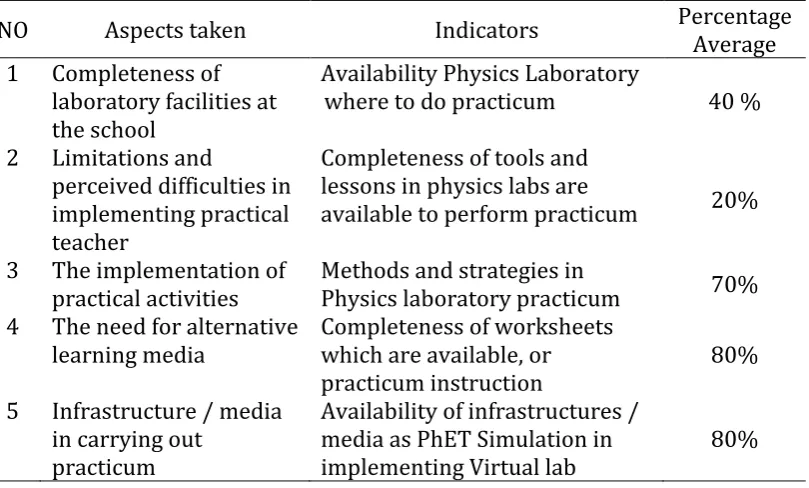
The response toward the use of virtual laboratory and practicum worksheet which impact is perceived by the students, captured through a questionnaire. Results of teacher responses to some of the statements submitted in the questionnaire can be seen in table 1.
Table 1. Responses of teachers to the need for virtual lab laboratory worksheet
NO Aspects taken Indicators Percentage
Average lessons are commonly still lacking. So, to overcome this problem, the virtual laboratory activities are needed (virtual experiment).
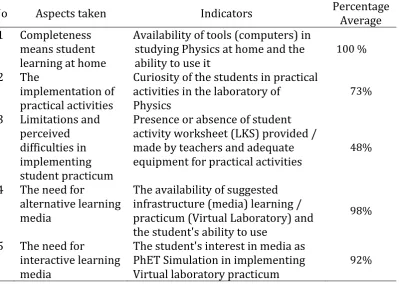
Based on the data analysis of students needs about the importance of practical activities, even though it is inadequate laboratory equipment and media for virtual practicum laboratories are widely available as shown in table 2.
Table 2. The response of students toward the importance of practical activities in virtual laboratory
No Aspects taken Indicators Percentage
Average
Table 2 shows that by using virtual labs that is a series of laboratory equipment in the form of computer software with interactive multimedia-based, which is operated by a computer (laptop) then students can simulate virtual laboratory practicum using PhET media as an interactive simulation program that provides various experimental physics simulation. PhET Media from The University of Colorado in the USA provides a variety of virtual lab in science. With this program students are expected to be able to connect real-life phenomena and basic science, deepen their understanding and appreciation of the world of physics.
CONCLUSION
This research is expected to develop a virtual practicum worksheets are designed so that student skills-based learning process so can support and enhance the utilization of virtual laboratory with PhET simulation program and can provide a good influence on the process of learning so that learning becomes effective, efficient and created a scientific attitude toward the students. In addition, the practicum worksheets are also expected to increase students 'understanding of the abstract physics lesson, increase students' motivation, develop basic skills in conducting experiments, scientific approach to learning tools, and support the learning lessons physics in particular. When conducting practicum by using virtual laboratory, the students will experience: 1). The introduction of a tool, the students are guided immediately by the teacher, so that the experiment can be done easily. The characteristics of virtual laboratory program are described as follows: a) it contains laboratory equipment that can function as real instruments. b) it can be assembled into dozens of experiments or simple technological design. c) it is easy to operate, a user can use one computer or one computer for two or three users. d) In this program, the activity is 100% in the hands of users, users are free to explore /experiments.2) Measurements. Learning competencies are developed in virtual laboratory are: a). doing observation, b) doing process skills, c) solve the problem, d) make a simple technology design, e) reasoning, f) be ilmiah.3) observations on virtual laboratory students observed: a). work independently, with as little as possible teacher assistance. b). Can discuss with close friends. c). Feedback is done either by the response and the key tool of the teacher. Students can directly read the numbers on the device; can see the events / what impact that occur, and also can hear the sound through the sound on the computer. 4) The experiment using virtual laboratory. Students can do their own experiments based on the practicum instructions even the students can develop it itself from the existing practicum worksheet instructions.
REFERENCES
Cramer, P. G. & De Meyer, G. (1997). The philosophy of the virtual laboratory. German Institute for Research on Distance Education at the University of Tuebingen, Konrad-Adenaver-str.40, D-72072, Tuebingen. Accessible on http://www.vlabs.net/philos/vlart_g.html.
Ferreira,E.C., Domingues,L., Rocha,I., Dourado,F., and Alves,M.(2010). Virtual laboratorios in (bio) chemical engineering education. Journal Education for Chemical Engineers, 5, 22-27. Accessible on http://www.elseivier.com/locate/ece
Harms, U. (2000). Virtual and remote labs in physics education. In Second European Conference on Physics Teaching in Engineering Education. Brno University of Technology, Departement of Physic FEEC, June 29 – July 1, 2005, Brno, Czech Republic.
Karamustafaoglu, S. (2011). Improving the science process skills ability of science student teachers using I-diagrams, Eurasian Journal of Physics and Chemistry Education,
3(1), 26-38. Accessible on http://www.eurosianjournals.com/index.php/ejpce. Trianto. (2009).Designing Innovative Learning Model of Progressive. Jakarta: Kencana
Prenada Media Group.