i
THE UNDERACHIEVER OF ENGLISH LEARNING A thesis
A Thesis Presented to
The Graduate Program in English Language Studies in Partial Fulfillment of the Requirements for the Degree of Magister Humaniora (M. Hum.)
in English Language Studies
by Intan Sejati
086332002
GRADUATE PROGRAM ON ENGLISH STUDIES SANATA DHARMA UNIVERSITY
iv
STATEMENT OF ORIGINALITY
This is to certify that all the ideas, phrases, and sentences, unless otherwise stated, are the ideas, phrases, sentences of the thesis writer. The writer understands the full consequences including degree cancellation if she took somebody else‟s ideas, phrases, or sentences without proper references.
v
LEMBAR PERTANYAAN PERSETUJUAN PUBLIKASI KARYA ILMIAH UNTUK KEPENTINGAN AKADEMIS
Yang bertanda tangan di bawah ini, saya mahasiswa Kajian Bahasa Inggris Universitas Sanata Dharma,
Nama : Intan Sejati
Nomor Induk Siswa : 086332002
Menyatakan bahwa demi pengembangan ilmu pengetahuan, saya memberikan kepada perpustakaan Universitas Sanata Dharma karya ilmiah yang berjudul :
THE UNDERACHIEVERS OF ENGLISH LEARNING
Beserta perangkat yang diperlukan (bila ada). Demikian saya memberikan kepada perpustakaan Universitas Sanata Dharma hak untuk menyimpan, mengalihkan dalam bentuk media lain mengelola dalam bentuk pangkalan data, mendistribusikan secara terbatas, dan mempublikasikan karya ilmiah saya diinternet atau media lain untuk kepentingan akademis tanpa perlu meminta ijin dari saya maupun memberi royakti kepada saya selama tetap mencantumkan nama saya sebagai penulis.
vi
ACKNOWLEDGEMENTS
First, praise to Allah, Lord of the worlds. I would like to expess my
greatest gratitute to Him for giving me an opportunity to finish my study in this university. Thanks for Your guide and light.
I would like to express my gratitute to everybody who has helped me along my research. I would like to deliver my deepest thank to my thesis advisor, Dr. J. Bismoko for guiding me patiently. I also thank for the knowledge and
sharing. I also thank Drs. F.X. Mukarto, M. S., Ph.D who always supports me to finish my thesis and for his time. I would like to say thank to Dra. Novita Dewi,
M.S., M.A (Hons).,Ph.D and Dr. B.B. Dwijatmoko M.A. for your attention asking my progress every time we met. Then, I thank all the English Study lecturers for the knowledge.
I would like to express my gratefulness to all members of my family; my parents, my husband, my grandfather, my sister and brother, and my uncle. I
would like to thank you for the motivation. I also thank to baby Op and baby Arf for your sacrifice; I appologize for the less time for you recently.
I thank Christine, Pipin, and Vero for the favour and sharing. Then, I also
thank my beloved friends Rifky, Ule, Bunga, Ratna W, Yeni, Jose, Wedho, Juan, Hil for the sharing.
Lastly, I also like to thank mbak Lely who helped me during my study. I like to express my deepest gratitude to bu Kasi and pak Dul for the cooperation and help. Then, I like to thank also to all my participants; this thesis cannot be
vii WISE WORDS
viii
TABLE OF CONTENTS
Page
TITLE PAGE ... i
APPROVAL PAGE ... ii
THESIS DEFENSE APPROVAL PAGE ... iii
STATEMENT OF ORIGINALITY ... iv
LEMBAR PERNYATAAN .... ... v
ACKNOWLEDGEMENTS ... vi
WISE WORDS ... vii
TABLE OF CONTENTS ... viii
LIST OF TABLES ... xi
LIST OF FIGURES ... xii
LIST OF APPENDICES ... xiii
ABSTRACT ... xiv
ABSTRAK ... xvi
CHAPTER 1 1.1 Research Background... 1
1.2 Problem Identification ... 6
1.3.Problem Limitation ... 8
1.4 Problem Formulation ... 7
1.5 Research Objectives ... 8
1.6 Research Benefit ... 8
CHAPTER 2 1.1 THEORETICAL REVIEW 1.1.1 Underachiever ... 10
1.1.1.1Learning Achievement ... 10
1.1.1.2Evaluation ... 16
1.1.2 Learning English ... 18
1.1.2.1Learning ... 18
1.1.2.2English as Foreign Language and Lingua Franca ... 21
ix
2.1.2.4 English Teaching ... ... 26
1.1.3 Junior High School Students ... 28
1.1.3.1 Psychological Development ... 28
1.1.3.2 Learning English ... 30
1.1.3.3 Junior High Scool Curriculum ... 32
1.1.4 Lived-experience ... 33
1.1.5 Live-Experience Research... 34
1.2 Pre-understanding Framework ... 34
CHAPTER 3 3.1 Progresive Qualitative Method ... 40
3.2 Research Design ... 42
3.2.1. The source of the Text... 45
3.2.2. The Nature of the Text ... 46
3.2.3 Text gathering instruments ... 46
3.2.3. Text processing instrument ... 47
3.3 Research Procedure ... 47
3.4 Text Analysis and Interpretation ... 52
3.4.1. Text Summary ... 52
3.4.2. Text organization ... 52
3.4.3. Text Interpretation ... 52
3.4.4. Trustworthiness ... 52
3.6 Trustworthiness ... 53
CHAPTER 4 4.1 The Lived- Experience Description ... 53
4.1.1. The lived-experience during the English lesson of Budi ... 53
4.1.1.1. Preparing the English Lesson ... 53
4.1.1.2. Attending the English Lesson ... 55
4.1.1.3. Ending the English Lesson ... 57
4.1.2. The lived-experience during the lesson of Wati ... 57
4.1.2.1. Preparing the English Lesson ... 57
x
4.1.2.3.Ending the English Lesson ... 61
4.1.3. The lived-experience during the lesson of Joko ... 61
4.1.3.1. Preparing the English Lesson ... 61
4.1.3.2. Attending the English Lesson ... 63
4.1.3.3. Ending the English Lesson ... 65
4.1.4. The lived-experience during the unscheduled quizess ... 66
4.1.5. The lived-experience during the other type of quiz ... 67
4.1.6. Self-Perception ... 70
4.1.7.The lived-experience of participants daily life ... 72
4.2. The Essential Themes ... 78
4.2.1. Motivation ... 78
4.2.2. Struggle ... 80
4.2.3. Belief ... 82
4.3. The Emergent Themes ... 84
4.3.1. Patience ... 84
4.3.2. Creativity ... 84
4.3.3. Challenges ... 85
4.3.4. Feeling ... 87
4.3.5. Awareness ... 90
CHAPTER 5 5.1 Conclusions ... 89
xi
LIST OF TABLES
Table 1. The research Design on the Underachievers of English Learning... 50
Table 2. Interview II Transcript of Wati ... 105
Table 3. Interview I Transcript of Budi... 112
Table 4. Interview II Transcript of Budi ... 127
Table 5. Interview I Transcript of Joko ... 130
Table 6. Interview II Transcript of Joko... 134
Table 7. The development of the emergent themes of Wati... 141
Table 8. The development of the emergent themes of Budi ... 146
xii
FIGURE
Figure 1. A framework for investigating individuals‟ differences ... 13
xiii
LIST OF APPENDICES
Appendix A. Interview I to Wati ... 98
Appendix B. interview II to Wati... 108
Appendix C. Interview I to Budi ... 115
Appendix D. Interview II to Budi... 130
Appendix E. Interview I to Joko... 133
Appendix F. Interview II to Joko... 137
Appndix G. The development of the emergent themes of Wati... 144
Appendix H. The development of the emergent themes of Budi... 149
xiv
ABSTRACT
Sejati, Intan. 2013. The Underachiever of English learning. Yogyakarta: The Graduate Program in English Language Studies, Sanata Dharma University.
Some students were not able to reach the minimal score determined by the school. They actually did not have low natural abilities. However, such students were usually marginalized. The teacher or friends often thought that they were stupid. The students usually got unfair treatments from the teacher and other students. The marginalization might discourage them more. Therefore, I would like to provide a bridge between the students and the teacher. However, this study focused on students who did not perform well in the English subject only, namely underachievers of English learning. It means that I only focused on underachievers of English learning, and ignored the students‟ achievement in other school subjects. The research was about revealing “What is the lived-experience of the underachievers of English learning like?”. My main intention was to help both the teacher and students by revealing what had happened „inside‟ the underachievers of English learning.
The research was progressive qualitative. The design was constantly modified, based on ongoing process and emergent issues. It was also considered as a reflective research since the participants had to reflect their past experience. The research was conducted in Klaten, Central Java. The participants were two students of SMP N 1 Bayat and a student of MTsN Jatinom. In order to get reliable text, this study used in-depth interviews with two students and their teacher, classroom observation, and document check (the students‟ academic report). The first step was the classroom observation in order to get information on what happened in the classroom during the lesson. The second was the interview with the students. The students were asked about their pre-intention, awareness, action, history, understanding (belief), and intention. The third was the interview with the teacher. The interview tried to explore the teacher‟s experience of teaching the underachievers of English learning. The interview for teacher was conducted for triangulation.
From the study, we could elicit some of probable factors which might influence their learning outcomes. In line with the previous researches, those students had low-motivations to learn English. The second was they were from low-educational family backgrounds. They also got economical problems. The third was they were kinesthetics learners. The fourth was the two of them had high demand teachers. The fifth was they rarely communicated in English language. The emerging themes were they got problem in memorizing English words since the English spelling is different from its writting system. One of them did not get access to good English dictionaries.
xv
may also build my and the readers‟ emphatic understanding of underachievers of English learning.
xvi
ABSTRAK
Sejati, Intan. 2009. The underachiever of English learning. Yogyakarta: The Graduate Program in English Language Studies, Sanata Dharma University.
Beberapa siswa ternyata tidak mampu memperoleh nilai minimal yang telah ditetapkan oleh sekolah. Kalau kita perhatikan mereka bukanlah siswa yang mempunyai kemampuan bawaan rendah. Siswa-siswa tersebut sering mendapat perlakuan „tidak adil‟ dari teman maupun guru mereka. Hal tersebut dapat membuat mereka semakin tidak termotivasi untuk mengikuti pelajaran di sekolah. Oleh karena itu, pada penelitian ini saya berusaha mencari pengalaman hidup mereka dalam belajar bahsa Inggris seperti apa. Sebagai tujuan utama saya yaitu untuk membantu para siswa-siswa tersebut agar dapat meningkatkan kemampuan bahasa Inggris mereka.
Penelitian ini termasuk dalam kelompok kualitatif progresif. Desain penelitian ini akan dimodifikasi secara terus menerus berdsarkan proses dan tema yang muncul. Penelitian ini juga termasuk penelitian reflektif karena partisipan harus melakukan refleksi untuk melihat pengalaman mereka yang telah lalu. Penelitian ini dilakukan di klaten yaitu di SMPN 1 Bayat dan MTsN Jatinom. Kedua sekolah tersebut merupakan sekolah yang paling diburu di kedua tempat tersebut. Untuk mendapatkan data yang sahih, dilakukan pemeriksaan dokumen yaitu daftar nilai siswa dan rapor. Kemudian dilakukan observeasi untuk menentukan partisipan dan yang mereka lakukan di kelas. Setelah itu dilakukan wawancara kepada partisipan. Setelah wawancara, dilakukan wawancara dengan guru dan wawancara ulang kepada partisipan. Setelah teks diperoleh, dilakukan deskripsi dan interpretasi dari teks tersebut. Akhirnya, akan ditemukan pengamalaman partisipan dalam belajar bahasa Inggris.
Dari penelitian, diketahui bahwa partisipan memiliki beberapa karakter yang hampir sama dengan teori maupun asumsi awal saya, namun ada beberapa hal-hal yang baru saya temukan. Sesuai dengan teori, siswa yang nilainya tidak memenuhi KKM biasanya memiliki motivasi rendah untuk belajar bahasa Inggris; orang tua berpendidikan rendah; mempunyai masalah ekonomi; siswa kinestetik, tuntutan guru tinggi, dan jarang „bertemu‟ bahasa Inggris dalam kehidupan mereka sehari-hari. Hal lain yang ditemukan adalah tulisan bahasa Inggris berbeda dengan pelafalnya. Selain itu, salah seorang partisipan kesulitan memperoleh kamus yang baik.
xvii
penelitian ini, diharapkan para pembaca mempunyai rasa empati yang lebih terhadap siswa yang tidak dapat mencapai nilai standar minimal yang ditetapkan sekolah.
1 CHAPTER I
INTRODUCTION
1.1BACKGROUND OF THE PROBLEM
The underachievers often get unfair treatment from both peers and
teachers. The peers often laugh at their mistakes and label them as „stupid‟
students. The students are usually marginalized by teacher and their classmates.
Teachers rarely or never give them praise for their „very little progress or better behavior”. I also treat the underachievers who are considered as „trouble-maker‟
unfair. I often shout at them when they make some noisy. Even though, I never
show that I underestimate them, but actually I label some of my students “left
behind”. I never find out why they do not perform well.
Marginalizing the underachievers may put them in danger. It may make
their affective filter towards English language higher. When their affective filter is high, it is hard for them to master English language more. They feel nervous or
uncomfortable during English lesson. They will resist to English language. They may avoid something written or spoken in English language even though the things are important for them. They will have low self-esteem. What happen if
such thing happen when the world today demand all of us to be able to speak English?
The underachievers might be brilliant students in other subjects or in other occasion. When I was a teacher in a school, I met a student who was an underachiever, especially in English lesson (I do not know about other school
2
class. I talked to one of his teacher. She said that he was great in the previous grade. My second experience is when I saw my neighbor. I got the information
from his teacher, she said that the child is stupid and his classmates often play him such as hiding his lunch box and so on. However, when a person tried to give
some lesson about a school subject in informal situation (outside the class while he feels relax) he is able to perform well. His parents decided to put him in a course, the instructor said that the boy likes to move around instead of listening to
her explanation or doing tasks. The third person was a friend of mine in senior high school. When he was in elementary school, most of his scores were below
the standard which was usually marked with red ink. His junior high school seems become his turning point, even though he only brought a notebook when he attended the school lesson but he performed excellent. When he was in senior
high school, he was the best three students in classroom. He got the ticket to join one of the best universities in this country.
Egbert and Smith (1999:295) show other facts that may help us to understand the underachievers. They state that students who are visual and kinesthetic often underachieve in classroom because the teaching style does not
match their perceptual strength. Visual learners learn by seeing and by watching demonstrations; like visual stimuli such as pictures, slides, graphs,
demonstrations, etc; conjure up the image of a form by seeing it in the “mind‟s eye”; often has a vivid imagination; often stares; need something to watch, are
often quiet and do not talk at length; become impatient or drifts away when
3
learners learn by doing, direct involvement; often fidget or find reasons to move;
are not very attentive to visual or auditory presentations; want to be “doing”
something; try things out and like to manipulate objects; gesture when speaking; are often a poor listener; respond to music by physical movement; often find
success in physical response activities; learn better when able to move during learning; like to move hands while learning; use movement to help concentrate. In classroom practice in Indonesia, the teaching style still cater visual learners rather
that the kinesthetic ones.
My experience above somehow „wakes me up‟ and makes me think about
them. As the consequence, I think that finding out why some students cannot reach the standard is much more important than marginalizing them. They, I think, feel uncomfortable in such condition. They may need someone to talk to
about their problems in learning English. Therefore, to know more about what
happen „inside‟ them I need to talk with them personally about their experiences.
Even though, counseling teacher usually conducts sharing with students who are underachievers but those teachers do not focus on English achievement. Talking about their own experience in learning English will make them feel more
comfortable since they do not only talk about their problems but also their interest or may be some probable solution for their problem. During talking about their
4
awareness, we will find ways to help them to improve their performance in English.
Therefore, I would like to take the students of grade 8 who are underachievers. It is mainly because the participants of this study still have
opportunity to improve their ability in the next grades and they have already have adequate experience in learning English language in the school.
Even though it is important to know more about the underachievers,
especially in learning English, however, what actually happen „inside‟ under achievers in Indonesia have not been reveal much through researches. And even
some teachers or schools have already tried to uncover the reason why some students are under achievers. I see such observation usually stop in finding the
reasons but not really concern with what‟s the next.
This study is important in the way improving the underachievers of English language performance. By voicing the voiceless, this study will build
empathic understanding to other people will end marginalization to them. It will also help them to build their self-esteem, motivation, and feeling secure. The interview in this study somehow may help the students in increasing their
awareness and commitment in learning English.
1.2PROBLEM IDENTIFICATION
Talking about underachievers of English learning is related to learning, and the position of English. The underachievers are ones who do not perform well means that they do not meet the goals of learning. In this term, they do not meet
5
In this research, students who are considered as underachievers are ones whose marks in their academic report less than the achievement standard
determined by the school. They are about 10 percent of the classroom population. English in Indonesia is considered as a Foreign Language. As a foreign
language, English is only spoken in particular place and occasion. As the consequence, the student does not get adequate comprehensible input. Basically, the reasons why student should master English language are to fulfill the needs to
communicate with other people around the world in the future and access knowledge. In other words, student needs to learn English because English is a
lingua franca. English is a language spoken by people from different linguistics background to communicate one another. Even though, nowadays people learn English as lingua franca but in practice the student learns English as a foreign
language. It means that the teaching learning process still centered on native
speakers‟ language not the reputable broadcast and media in Indonesia. Therefore,
the student learn English which used by native speaker.
In the context of English learning in junior high school; there are some factors influencing the learning outcome such as motivation, nature ability,
context of learning, style preference, background experience and qualification, availability of time to give the effort needed, quality input, it is important to see
6 Learners‟ motivation is also one of the factors. It is also related to the
family educational background. Then, it is hard to determine what factors work
much then others because every learner is unique. s/he is different from others. Therefore, in order to know what factors affects to a learner, we have to explore a
learner; and the factors cannot be generalized.
In order to know more about the under-achievers of English learning, it is important to elicit their lived-experience. There are two kinds of lived-experience,
shared and personal. Shared live-experience is experience of two people who shared the same experience. Personal lived experience is experience of a person
only. Lived-experience covers understanding, desire, intention or expectation, anticipation, relations with others, cultural patterns, feeling, belief or sights, smells, sounds and so on ( Murphy,1960:13 in Bradley, 2002). This study is
attempting to elicit the personal experience of underachievers of English language learning.
1.3PROBLEM LIMITATION
There are many aspects related to learning achievement. The learning achievement is affected by the context, goals, resources, and some learning factors
both internal and external; and also the position of English as lingua franca or as foreign language. In classroom practice, we can see some students who success or
fail in learning. Their success and failure are influenced by many aspects. This study will both explore the internal and external factors of learning.
7
learning experience of the participants. It would include how they like to learn, their sources of learning, their motivation, and whether the people around them
support them or not. Even though, there is several coverage of live-experience, I only focus on exploring the under-English achiever‟s awareness, action, experience in general, understanding in learning English, and intention (pre-intention and (pre-intention).
This study appled the qualitative approach. This study will record the
lived-experience of the underachievers. This study focuses on Junior High School students. Since it is conducted in Junior High Schools students, therefore, the
position of English is both as Lingua Franca and Foreign Language. However, I will focus on the underachievers of English learning only.
Because of the limitation of energy and time, I conducted the study in two
junior high schools; I interviewed three underachievers of grade 8. The schools were considered good schools in the areas, and also they were accessible for me. I
assumed that grade 8 students already had adequate experience in learning English in the school and they still had opportunity to perform better after my study.
1.4PROBLEM FORMULATION
To help the underachievers to perform better in learning English, I need
8
aspects related to learning achievement, I have to formulate the questions of this study as:
What is the lived-experience of the underachievers of English learning like?
1.5RESEARCH OBJECTIVES
As the context of this study is the lived-experiences of underachievers of English learning, this study attempts to attain the description of lived-experiences of the underachievers of the English learning and the interpretation. By doing so,
the essential themes of the meaning of lived-experiences of the students will be obtained.
The result of this research hopefully will increase the empathic understanding of the readers particullary educators. Based on the research, educators will improve their teaching by considering the underachievers. The
research may also help the educational institution to set more effective language programs.
The objectives stated above are basically to reach the ultimate objective, that is to improve the undeachievers‟ English competence. Therefore, they will have better livings.
1.6RESEARCH BENEFITS
There are some benefits provided by this study; scientific, humanistic, and
practical benefits. For scientific study, the description and interpretation will enrich the body of knowledge of English language studies. For humanistic, this description and interpretation of this study may improve empathic understanding
9
will help the underachievers of English language learning to have higher awareness, higher commitment in learning English, and higher achievement in the
rest of their life. For the researcher and also for the readers, this study will help to build empathic understanding towards under-achiever and may also help to
10 CHAPTER 2 LITERATURE REVIEW
This chapter attempts to contextualize some theories related to the problems of this study. There are two parts of this chapter, theoretical review and theoretical framework.
2.1Theoretical Review
Here, I would like to review some theories related to the underachievers; factors, I suspects, which may affect their learning achievement; and also some other theories which
are related to this study. 2.1.1 Underachiever
In classrooms, we often find some students who do not perform well in a subject or
some subjects. They are not able to achieve the standard determined by the school. They are considered as the underachiever. Underachievers in Indonesia seem to have several of the
characteristics. The underachievers of English language are usually underachievers of several subjects. They are usually too quiet students or talk active or ones who like to play with
friends during the class. Some of them are really quiet with under confidence, motivation and self-esteem. They have low-confidence, motivation and self-esteem too. However, we can see clearly that they tend to have negative attitudes towards teachers and schools. Some of them
tend to be „trouble makers‟ in classrooms. They do not care about assignments, teachers‟
explanations, even the schools, rules.
There are many factors related to the students‟ achievement. In disscusing the
students‟ achievement, we can refer to some theories which may related to the achievement;
they are as follow :
2.1.1.1Learning achievement
Achievement is the degree of skills measured with reference to particular curriculum.
11
Competence is about what learners know. Then, performance reflects competence. It means that performance is observable and measureable (Oxford, 1990:237).
McCoach (2001) uses the term underachievement. Underachievement is defined as a difference between potential (ability) and performance (achievement) (Reis &McCoach, 2000). Further, McCoach finds out some factors which commonly associated with
underachievement. The factors include academic self-concepts (Schunk, 1998: Supple, 199 Whitmore,1980), low-self efficacy ( Schuk,1998), low-self motivation (Weiner,1992),
low goal-valuations (McCall, Evahn&Kratzer,1992), negative attitude towards school and teacher ( Colangelo, Kerr, Christensen &Maxey,1993:Ford,1996;Kimm,1995). Most literature show that underachievers have lower academic perceptions, lower
self-motivation/regulations, less goal directed behavior, more negative attitudes toward teachers and school than high achievers. She also mentions that low and high achievers are different in
motivational pattern and academic self-perception ( Reis and McCoach,2000).
Basically the terms underachievement refers to students who cannot achieve the
standard given by the educational institution. However, what McCoach means by underachievers are those actually have potential to reach the standard. In this research, I apply his term to choose students as the participants. Therefore, the participants in this
research were ones who are not able to reach the minimum score standardized by their school, however, they were actually potential to achieve it.
An article written by Noble (2009) also characterize the underachievers in general. The writer categorizes the characteristics into personal, family, educationally related factors,
and extracurricular activities. Related o the first category, she writes “Students' perceptions of
their abilities, which contribute to their self-esteem and confidence, are related to educational
achievement”. It means that underachievers tend to see themselves do not have abilities in the
12
positive view of them are more likely to be underachievers than high achievers. Still related to the first category, she says that students who have a low level of motivation to succeed, or
who have a high level of anxiety about their schoolwork or home environment, are five to six times as likely to be under achievers as high achievers. Related to family characteristics, she finds out that students whose parents have less than a bachelor's degree are somewhat more
likely to be under achievers than high achievers: Of students with parents with less than a bachelor's degree, 29% were under achievers and 20% were high achievers. In contrast,
students whose parents have bachelor's degrees or higher are more likely to be high achievers than underachievers (44% vs. 12%). She adds that students who face difficult situation at home are as likely to be under achievers. The third, students who said they needed help in
reading comprehension, study skills, or mathematics skills were more likely to be under achievers than high achievers. The last are related to the last category such as (1) students
who spend more time watching TV are more likely to be under achievers than high achievers, and (2) Students who spend less time on school-related extracurricular activities are more
likely to be under achievers than high achievers.
Vann and Abraham (1990: 177) state that some unsuccessful learners used relatively many strategies. They also used many of the same strategies as the successful learners. All
learners, at least occasionally clarified and verified, guessed at meaning, applied grammatical rules, monitored form, and demonstrated various production tricks and social management
strategies. Their study on the underachievers of IEP at Iowa University shows that the unsuccessful learner emerged as active strategy users, though they sometimes applied
13
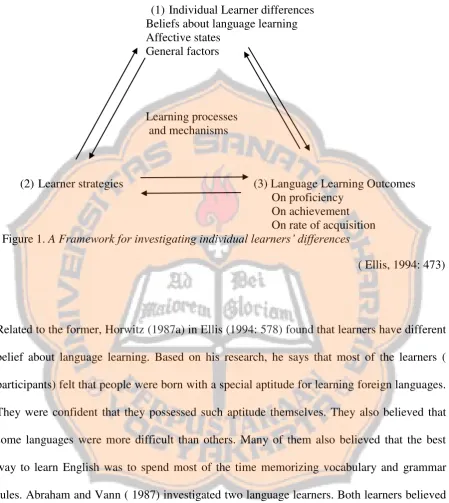
Language learning outcomes are influenced by several factors. Each factor will also influence the other factors. As we see in figure 1
From the figure above, the language learning outcomes of the learners can be
different. The differences can be on proficiency, achievement, or on rate of acquisition of the
learners. The outcomes may influence learning strategies and learners‟ belief about language
learning, however, learning strategies and the belief also influence the language learning outcomes. Then, I would like to focus on the later.
As stated above, language learning outcomes are influenced by factors (1) and (2).
Related to the former, Horwitz (1987a) in Ellis (1994: 578) found that learners have different belief about language learning. Based on his research, he says that most of the learners (
participants) felt that people were born with a special aptitude for learning foreign languages. They were confident that they possessed such aptitude themselves. They also believed that
some languages were more difficult than others. Many of them also believed that the best way to learn English was to spend most of the time memorizing vocabulary and grammar rules. Abraham and Vann ( 1987) investigated two language learners. Both learners believed
that it was important to create situation for using English outside the classroom to practice as much as possible, and to have error corrected. It is also important to practice actively in class. one of the participant, Geraldo, believed that paying conscious attention to grammar is
important. He also believed that it is important to preserve in communication and (1) Individual Learner differences
Beliefs about language learning Affective states
General factors
Learning processes and mechanisms
(2) Learner strategies (3) Language Learning Outcomes
On proficiency On achievement On rate of acquisition Figure 1. A Framework for investigating individual learners’ differences
14
understanding an idea. While, Pedro, did not believed to the importance of paying conscious attention to grammar. He also expressed a strong dislike to metacognitive. For him, topic
abandonment is the best stategy in some cases. The two participants showed different learning outcomes. Geraldo has better TOEFL Score (523v473) while Pedro did better on a test of spoken English ( Ellis, 1994: 478).
Learners are also different in affective states. Rathbone (1987) in Ellis (1994: 479) found that learners seems need to feel secure and to be free of stress before they can focus on
the learning tasks. Further Ellis ( 1989a: 257) found a learner‟s statement saying that s/he felt
that her/his mind blocked when the teacher asked a question , even though the teacher did not frighten him/her. However, anxiety has positive influence to American University students
related to marks in Spanish ( Ellis, 1994 : 479-480).
The general factors also vary based on the extent of the learners‟ control over them.
For instance, learners may change their learning styles, however, they can do nothing with their age ( Ellis, 1994 : 473).
The next factor is learning strategies. Every learner employs different learning strategies. Ellis (1994:541-543) sees how learners‟ personal backgrounds effect strategy use. The strategies are influenced by belief about language learning and learners‟ factors. Related
to the first factor, Wenden (1987a) in Ellis (1994: 541) found that learners who emphasized on the important of learning tended to use cognitive strategies that helped them to understand
and remember specific items of language, while learners who emphasized the importance of using language employed few learning strategies, relying instead on communication
strategies. Age, motivation, and personal background are considered to be the learners‟
factors. Young children‟s strategies are often simple, while mature learners‟ strategies are
more complex and sophisticated. He adds that the strength of learners‟ motivation can be
15 (1990) compared the professional linguists, untrained instructors, and students‟ personal
background. He found that professional linguist use more strategies and more frequently than
the others.
Ellis (1994: 549-550) identifies five major aspects of successful language learning. The fist aspect is a concern for language form. The learners treat language as a system by
making effective cross lingual comparisons, analyzing the target language, and using reference books. The second is a concern for communication or functional practice. The
learners also search for meaning in the target language data which they are exposed to and try to engage in real communication by seeking out opportunities for natural data use. The third is an active task approach. The learners appreciate teachers who are systematic, logical, and
clear, but prefer to treat them as „informant‟. They like to take charge of their own learning
by identifying and pursuing goals and trying to introduce new topics into a conversation.
However, some of them are „silent speakers‟. The forth is an awareness of learning process.
Learners use both meta-lingual strategies and cognitive knowledge use. They tend to take
conscious decisions and follow their own preferred learning styles. They also use meta cognitive knowledge to help them assess their needs, evaluate progress, and give direction to their learning. The last is the learners have a capacity to use the strategies flexibly in
accordance with task requirements. It means that the effective learners have the ability to choose the appropriate strategies and more purposeful.
Related to vocabulary learning strategies, learners have several strategies. Ellis (1994:553-554) points two strategies, those are strategies used to memorize isolated lexical items and to learn new words from context. Further Brown and Perry ( 1991) in Ellis
(1994:554) investigated the success of three vocabulary learning strategies; keyword, semantic, and keyword-semantic. In relation with keyword, teachers have to ask learners to
16
already know. In relation to semantic, they suggest learners to integrate the target word into
the learner‟s existing semantic systems as in identifying how a word relates to other known
words. The last is the combination of the previous two.
In his conclusion, Ellis (1994:555-556) adds some points how learning strategies related to second Language development. (1) the strategies learners use reflect their general
stage of second language development, (2) successful learners use leaning strategies more frequently and in qualitatively different ways than learners who are less successful, and (3)
different kind of learning strategies may contribute to different aspects of second language proficiency.
2.1.1.2Evaluation 2.1.1.2.1. Definition
Evaluation is defined as giving value to something. According to Bismoko (2009)
there are two forms of evaluation, testing and assessment. A test is an instrument to measure, for example, the learners. The measurement usually quantifies the result. Then, the result will
be in the form of number. Conversely, assessment does not quantify the results. Therefore, the assessment results are usually in words.
Evaluation can be defined as the systematic gathering of information for the purpose
of making decisions (Weiss 1972 in Bachman 1990: 22). Evaluation involves making a value judgment or interpretation of resulting text in a decison making context. Evaluation is a
process that comes after measurement is completed. (Chatterdji, 1998 cited in Hopkins) According to Departemen Pendidikan Nasional or National Education Department of Indonesia, evaluation is defined as
17
Evaluation is an activity of identification which is conducted in order to see whether the goals of a program which has planned already reach or not, valuable or not, it can be used
also to see the efficiency level of the process. From the definition, it implies the reasons why evaluation is conducted is to see whether the program ( teaching-learning ) has met its goals or not, valuable or not, and the efficiency levels of the teaching learning. The goals here are
the goals which are already set by the national curriculum.
2.1.1.2.2 Kinds of evaluation
In general, there are two kinds of evaluation. They are testing and assessment. A test is an instrument to measure, for example, the learners. The measurement usually quantifies the result. Conversely, assessment do not quantify the results, it is usually in words.
Assessment encompasses a wide variety of assessment methods applied to educationally relevant construct, and includes essay tests, multiple choice tests, performance
assessment, and portfolio (Chatterdji, 2003).
Wiggins introduces the term educative assessment. As part of evaluation,
assessment is considered fairer rather than measurement. Educative assessment is assessment which may help learners to be better in the future. It may help learners since it focuses on both process and product of learning. Further, he says that the aim of assessment is primary to
educate and improve students‟ performance, not merely audit it. The word „audit‟ means that
to describe checking up on activities after it is over ( Wiggins, 1998:7).
Wiggins (1998:12-13) also states that assessment should be educative in two basic senses. The first, an educative assessment system is designed to teach ( not to measure). It
means that educative assessment should improve students and teacher‟s performance; and
evoke excellent pedagogy. The second is an educative assessment system must provide useful feedback to students, teachers, administrators, and policy makers. It means that the useful
18
enable students and teachers t self-assess accurately and self-correct their own performances increasingly overtime; (2) ample opportunities to get and use timely and ongoing feedback.
In conclusion, the underachievers in this study are ones who cannot reach the minimum standard determined by the schools. In other words, their learning achievement is below the minimum standard determined by the school. The under achiever is assumed has
the potential and performance. Their achievement can be seen from their academic report no matter what kind of evaluation applied by the teacher.
2.1.2 Learning English 2.1.2.1Learning
There are many definition of learning. When, I say the definition mostly based on
the three educational traditions. The traditions are Classical Humanism, Reconstructionism, and Progressivism, and Pragmatic Progressivism.
According to Finney in Richard and Renandya (2002:70), Classical Humanism tradition sees that learning is transmitting the classical culture. In Classical Humanism
tradition, the central of the curriculum is the content of what is to be learnt by, or transmitted to, the learners. The content is a valued cultural heritage.
The next is Reconstructionism which sees learning as habit formation. The main
purpose of the tradition is to bring about social change. I see that the definition of learning by Kimble also carries this tradition.
According to Kimble (1961) in Hergenhahn and Olson (1993: 6-7) “Learning is a relatively permanent change in behavior or in behavioral potentiality that results from experience and cannot be attributed to temporary body states such as those induced by illness,
fatigue, or drugs.
There are five characteristic of learning (1) Learning is a change in behavior,
19
learning the learners are able to do something that they could not do before learning took place. (2) The behavior change is relatively permanent. The change in behavior does not
need to occur immediately following the learning experience. (3) Even though there may be a
potential to act differently, this potential to act may not be translated into behavior immediately. (4) experience and practice change the behavior. (5) the experience or practice
must be reinforced, only those responses that lead to reinforcement will be learnt(p6).
There are several definition based on psycholinguists. The first is Pavlov‟s classical
behaviorism, he says that learning process consisted of the information of the associations between stimuli and reflexive responses. All of us aware that certain stimuli automatically produce and elicit rather specific responses and reflexes and we have also observed that
sometimes that reflex occur in response to stimuli that appear to be indirectly related to
reflex. The second is Skinner‟s operant conditioning, he claims that his operant conditioning
attempted to account for most of human learning and behavior. Operants are classes of responses. For example: crying, sitting down, walking, and batting a baseball. They are set of
responses that are emitted and governed by the consequences they are produce. This
Behavioristic learning theories impact our understanding of the process of human learning. The third is Progressivism. This model has focus on the process itself. And, the
purpose of education is to enable the individual to progress towards self-fulfillment. It
concerns with the development of understanding, not just passive reception of „knowledge‟ or
the acquisition of the specific knowledge (Finney in Richard and Renandya, 2002:73).
Rogers‟s humanistic psychology seems Progressivism. He says that learning how to
learn is more important than being taught something from the „superior‟ vantage point of a
teacher who unilaterally decides what shall be taught (Brown, 2000:89).
The fourth tradition is Pragmatic Progressivism. It is learner-centered called
20
process-oriented approach. And, Needs analysis is the starting point for the development of language program which is responsive to the learner and learning needs, but there has been
some disagreement as to what is entailed (Finney in Richard and Renandya, 2002:7) . I see this tradition combines all the previous three traditions.
Pragmatic Progressivism tradition is seen also in the next three theories. Brown
(2000:7) attempts to extract the concept of learning: (1) learning is acquisition or „getting‟, (2) learning is retention of information or skill, (3) retention implies storage system, memory,
cognitive organization, (4) leaning involve active, conscious focus on and acting upon events outside or inside the organism, (5) learning is relatively permanent but subject to forgetting, (6) learning involves some form of practice, perhaps reinforced practice, and (7) learning is a
change of behavior.
I see how Ausubel defines learning is more like pragmatic progressivism. The
theory is so called meaningful learning theory; the theory says that learning takes place in human organism through a meaningful process of relating new events or items to already
existing cognitive concepts or propositions-hanging new items on existing cognitive pegs ( Brown, 2000:83).
In addition, learning is a process of change from not knowing. Cambourne (1990)
quoted by Sugirin (2003:7) asserts learning is a process of making connection, identifying patterns, organizing previously unrelated bits of knowledge, behaviour, and activities into
new patterned wholes. Learning a language means learning to communicate in that language as a target language, in both oral and written.
Even though there are several definitions of learning. I see the Pragmatic
Progressivism is more suitable to be implemented now. Since it is focuses both process and product. As the consequence, the definition of learning should cover all the three previous
21
information or skills which is relatively permanent. The result of learning is the learners are able to use the information and skill functionally for themselves and other people.
2.1.2.2English as a Foreign Language and a Lingua Franca
The first view is English language is considered as foreign language. It means that English is not the official language nor local language. English language is only spoken by
particular people, in particular places and occasion. Therefore, the English language input is limited. As the consequence, the mastery of English language for most of the people is low.
Indonesia is considered as expanding circle countries.
Such name is proposed Kachru in 1985 cited by Harmer (2007:17). He proposes the classification of the world of English language in to three. (1) The inner circle covers
countries where English is the primary language or first language. The countries are Britain, USA, Australia, Canada, and New Zealand. (2) The outer circle contains countries where
English has become an official or widely-used second language. These include India, Nigeria, Singapore, etc. (3) The expanding circle represents those countries where English is learnt as
a foreign language which includes Japan, Mexico, Egypt, Indonesia, etc.
Since English language is considered as a Foreign Language, the standard is the native speaker of English language. The native speakers are those who are from the inner
circle countries. Therefore, English as a Foreign Language is native speakers- centered. Crystal (2003:20) maintains that English is the language most widely taught as a
foreign language in over 100 countries, this situation makes English becoming Englishes and English is as the World Language or Global Language. Other scholars believe that a global language has no boundary of usage and serves a whole range of different communities and
their institutional purposes, and these transcend traditional, communal and cultural boundaries. It means that the term global or world language suggests that a world language is
22
Besides as a foreign language, English is also considered as a Lingua Franca. English as Lingua Franca means that English is used as the mean of communication among people
from different linguistics ( language) backgrounds. This view moves the center of the standard of English language from native speakers to reputable broadcasts and publishers of each country.
Then, a question raise related to the second stage of learning a language „
imitating the language‟. Who speakers should be imitated by learners? To answer such
question, we have to refer back to our view of English language. 2.1.2.3Multiple intelligences and learning styles
Some learners have low competence in English language; however, some of them
may have high competence in other subjects. Such phenomena may because some learners may have different prominent intelligences. As Gardner says there are eight kinds of
intelligences. The eight intelligences are well known as Multiple Intelligences.
Gardner (1993) classified the intelligences into eight. They are as Linguistics,
Logical-mathematical, spatial, kinesthetic, musical, interpersonal, intrapersonal and naturalistic intelligence (Brewster, Ellis and Girard, 2002:34-35). According to (Brewster, Ellis, and Girard 2002:34-35) and (http://www.learnativity.com/learningstyles.html) (1)
verbal-linguistic; the learner is sensitive to the meaning and order of words, s/he is a good reader), (2) musical; the learner is sensitive to pitch, melody, rhythm, and tone. Therefore,
s/he will learn well through the use of chants, rhymes, and songs, (3) logical-mathematical; this learner is able to handle chains of reasoning and recognize patterns and order. S/he is good in problem-solving and s/he likes working with computers, (4) spatial; this learner may
perceive the world accurately and try to re-create or transform aspects of that world. S/he likes to learn using picture, charts, or maps, (5) bodily-kinesthetic; this person is able to use
23
moving objects, (6) interpersonal; this person understands people and relationships, s/he is good in group working), or (7) intrapersonal; s/he possess access to one's emotional life as a
means to understand oneself and others, (8) naturalist intelligence; this person is good at recognizing patterns in things, at classifying and organizing things into groups. The last intelligence enriches the previous seven intelligences.
Every learner has their own prominent intelligences. For example, a learner may be good in linguistics, but not in logic mathematic and so on. The learner tends to perform better
in using words or language but not in operating numbers. Moreover, intelligences of a learner strongly influence her/his way to learn something. In other words, intelligences may affect the learning styles. For example, learners who are kinesthetic learners will learn well when
they involve body movement while learning.
However, when we talk about learning styles, there are also some other
classifications. The next is about the perceptual learning styles which are actually still related
to Gardner‟s. Another reference defines perceptual learning styles as the means by which
learners extract information from their surroundings through the use of their five senses. Further, there are seven kinds of perceptual learning styles such as print, aural, interactive, visual, Haptic, kinesthetic, and olfactory. (1) Learners whose learning style is the first, print,
often takes notes, may like to write on the blackboard, remembers quickly and easily what is
read, learns better after seeing or writing something, is often perceived as a “bookworm”,
grasps important concepts on first reading of material, loves to read books, journals, magazines. (2) Aural learners tend to remember and repeat ideas that are verbally presented; learn well through lectures; is an excellent listener; can reproduce symbols, letters or words
by hearing them; like to talk; enjoy plays, dialogues, and dramas; can learn concepts by listening to tapes, enjoys music; can repeat or fulfill verbal instructions. (3) Interactive
24
quiet for great lengths of time; often talk at length, like to use other people as a sounding board; enjoy question/answer sessions; find small group discussions stimulating and
informative; prefer to discuss things with others. (4) visual learners learn by seeing and by watching demonstrations; like visual stimuli such as pictures, slides, graphs, demonstrations,
etc; conjure up the image of a form by seeing it in the “mind‟s eye”; often has a vivid
imagination; often stares; need something to watch, are often quiet and do not talk at length; become impatient or drifts away when extensive listening are required; prefer the visual arts
and media. (5) Haptic learners like a “hands-on" approach to learning; involve the sense of
touch in learning; likes to do artwork; like to piece things together; may be fond of doodling; like to trace words and pictures; are often seen “fiddling” with something; are successful with
tasks requiring manipulation. (6) The kinesthetic learners learn by doing, direct involvement; often fidget or find reasons to move; are not very attentive to visual or auditory presentations;
want to be “doing” something; try things out and like to manipulate objects; gesture when
speaking; are often a poor listener; respond to music by physical movement; often find
success in physical response activities; learn better when able to move during learning; like to move hands while learning; use movement to help concentrate. The last is (7) tactile learners learn best though the sense of smell and taste; smell have a special significance; associate a
particular smell with specific past memories; are frequently able to identify smells; find that
smells add to learning (http://learningstyles.org/).
The other category is field independence (FI) and field dependence (FD). In a
field-dependent mode of perceiving, perception is strongly dominated by overall organization of
the surrounding field, and parts of the field are experienced as „fused‟. Conversely, in a field
-independent mode of perceiving, parts of the field are experienced as discrete from organized
25
The next category is from Willing (1987) in Ellis (1994:507). There are four general learning styles used by adults ESL learners (1) concrete learning style, direct means of
processing information; people-oriented; spontaneous; imaginative; emotional; dislikes routinized learning; prefers kinesthetic modality, (2) Analytic learning style, this person focuses on specific problems and proceeds by means of hypothetical-deductive reasoning;
object-oriented; independent; dislikes failure; prefers logical, didactic presentation, (3) Communicative learning style, this person is fairly independent; highly adaptable and
flexible; responsive to facts that do not fit; prefers social learning and communicative approach; enjoys taking decisions, the last is (4) authority-oriented learning style, this person
is reliant on other people; needs teacher‟s directions and explanations; likes a structured
learning environment; intolerant of facts that do not fit; prefers a sequential progression; and dislike discovery learning.
There are still some other categories. Nelson (1973) in Ellis (1994:508) classifies learning style into (1) referential, these learners use language to name things, and (2)
expressive, these learners use the language to indicate feeling, needs, and social forms. While Peter (1974), in the same book, classifies it into (1) analytic, analytic persons are word-learners and they progress incrementally through a recognizable sequence of stages of
acquisition, and (2) gestalt, they are sentence-learners who begin with the whole sentences which are used to perform functions that are important for them. Dechert (1984) classifies it
into (1) analytic, these persons usually manifest long pauses at chunks boundaries, few corrections, and serial processing, while others are (2) synthetic, these persons tends to manifest pauses throughout, more corrections, and episodic processing.
In summary, there is no exact category about learning styles. There are several categories of learning styles. Gardner‟s Multiple Intelligence shows eight learning styles such
26
intrapersonal, and naturalist intelligence. There is also a theory which is almost the same with Gardner, it classifies learning styles into seven such as print, aural, interactive, visual, Haptic,
kinesthetic, and olfactory. While, other experts classify learning styles into field dependence-field dependence, analytic-gestalt, referential-expressive, and analytic-syntactic. No matter many categories proposed by some experts, the most important thing is as teacher or
education practitioners, we have to understand that our learners have different learning styles or in other word, each learner has their own way to learn well.
2.1.2. 4 English teaching 2.1.2.4.1 English teaching
Johnson and Morrow (1981:10) as quoted in Sugirin (2003:27) presents five
principles of communicative language teaching: know what you are doing, whole is more than the sum of part, the processes are as important as the forms, to learn it to do it, and
mistakes are not always a mistake.
The first principle is know what you are doing. It indicates that every student should
know what the function of the language is and how he or she uses it in his or her life. The second principle is whole is more than the sum of parts. Students have to be able to use the language in discourse level. They are able to apply the rules of the language in real situation.
The third principle is the processes are as important as the forms. It implies that a teacher has to create information gap, give choices to his students to choose what they want
to say and how they will say it. The forth principle is to learn it to do it. Learners should be iinvolved in all the activities. Learners practice what they are learning. It will help students internalize the language rules and forms.
The fifth principle is mistakes are not always a mistake. It means that the teacher has
to tolerate learners‟ mistake in learning process. Teacher tolerates learners‟ mistakes in term
27 2.1.2.4.2 Teachers’ role
There are nine roles of teacher in a classroom adapted from J Harmer. The first is
teacher as controller. Exemplify the teacher-fronted classroom. There is transmission of knowledge from the teacher to the students.
The second is teacher as organizer. It means that teacher Organize the students to do
various activities, give information, how to do the activity, put in pairs or groups, close things down when time to stop. Teachers get students involved and ready. Teachers get language
right and present instructions in a logical order. E.g. get a student up front to demonstrate the activity with you. Tell them how much time they have got and exactly when they should start.
The third is teacher as assessor. What students expect from their teachers: Indication
of whether or not they are getting their English right. Students should know what we are looking for and what success looks like so they can measure themselves against this. (Refer
to learning aims and can dos in K2006.) Important: The feeling of fairness. Also be sensitive to the student‟s possible reaction. Give feedback with sensitivity and support.
The fourth is teacher as prompter. If students lose the thread of what is going on or they are lost for words, we may nudge them forward in a discreet and supportive way. We want to help, but not to take over. Balance between taking the initiative away from the
student and – if too careful – not giving the right amount of encouragement.
The fifth is teacher as participant. Traditional picture: Teacher standing back from the
activity, letting learners get on with it. Later giving feedback and/or correcting mistakes. Sometimes we should join in –not as a teacher, but as a participant in our own right. Enliven things from the inside instead of organize from the outside.
28
they can go and look for the information. Help them to become more independent in their learning generally. It is okay to say, “I don‟t know, but I‟ll tell you tomorrow.”
The seventh is teacher as tutor. As a tutor, teachers are working with individuals or small groups, combining the roles of prompterand resource. More personal contact gives the learners a real chance to feel supported and helped.
The eighth is teacher as observer. As observer, teacher have to observe what the students do – especially in oral communicative activities and to be able to give them useful
feedback. The ninth is teacher as teaching aid. It is apart from the different roles and how they are performed; we are a kind of teaching aid ourselves. We mime and gesture, we are the most important language modelsand we provide meaningful input.
www.hivolda.no/neted/upload/.../site/.../elfe_s1_teacher_roles_oh.pdf
2.1.3 Junior High School students 2.1.3.1Psychological development
Junior high school students are usually around 12 until 15 years old. They seem in the
transition time. They are not children anymore but they are not yet mature. They are in the age of teenager or adolescent. Their characteristics or the development step is different from children. The differences are in physical look, cognitive and intellectual development,
emotion, and identity formation.
The physical changes can be seen from the body. The shape of the body changes both
boys and girls. According to Ribner (2000: 11), the adolescents have their body image which may affect their self-esteem. Some worry about the size of their bodies, but some are already satisfied. The other is about health and nutrition. They tend to skip breakfast then having
snack excessively. Boys need more calories than girls, that the reason why boys eat more. Talking about the intellectual and cognitive development, Piaget in Ribner ( 2000: 16)
29
abstraction and possibilities. In these ages, Piaget adds that the adolescents start to have adult-think reasoning.
Egocentrism is one of the developments of cognitive and intellectual in adolescents. as what Ribner (2000:17) says, adolescents begin to see the world as others do and to evaluate themselves as they think others will. Therefore, adolescents think that people around
them will evaluate them. The next is “ adolescents believe that their experience is unique and
they are not subject of rules that govern others”. The other characteristics are adolescents
seem to take every chance to argue with adults and compel to criticize the people they may once idealized. They also like to change their minds, so they tend to believe in something one day and believing in something else the next.
Junior high school is created as the transition of elementary school to high school. The movement of between schools is considered as a major stressor for adolescents. It is not
only because the works get harder but also they have to encouter with new faces, be more anonymous than previous time, and they are more self-conscious. However, most children
adapt well to this transition, though some experience such problems as lowered academic motivation, lowered self-esteem, and increase behavioral acting out. Particularly, young adolescent girls may experience significant drops in low self-esteem because of significant
number of life-changes Ribner ( 2000:17-19).
Teachers‟ demand also contributes in adolescents‟ academic performance. When
teachers are more demanding, their grades may go down. They appear unfocused and unmotivated when they feel out of place, try to cope the pubertal changes, and struggle to keep up her peer. As the consequences, some adolescents get low grades, drops in
self-esteem, negative expectations about their abilities, and avoid or resist to school works. Therefore in this stage, adolescents confront with many stresses in the same time Ribner (
30
Some adolescents are experienced worse, like drop out. There are some factors indicated by Ribner ( 2000: 20) such as poor reading skills, early school failure, low
motivation, impoverished background, disrupted family situation.
The next are related to emotional characteristics of adolescents. anxiety and depression are often found in adolescents. adolescents feel self-conscious, shy, and modest.
They are anxious about what they wear, how they walk and talk, whether other adolescents are talking about them. Depression is also common in adolescence, as they struggle with new
feelings and experiences and are faced with making decision that might affect the rest of their lives. Adolescents who are depressed show social isolation, lower school performance, higher family conflict, and higher risk to suicide. However, in some degree anxiety and depression
are still acceptable Ribner ( 2000:21-22).
Related to identity formation, I would like to focus on the relationship with peers. It is
because that peers influence much in teenager life. As Ribner ( 2000: 28-29) states, peer group becomes a place to experiment with new behaviors and to form intimate relationships.
Ribner shows a research talking about peer influence seems strongest in the eighth and ninth grades. The influence is strongest around everyday social issues, such as dress, school, and so on both positive and negative.
2.1.3.2Learning English
Learning English is part of language learning. In learning a language, there are three