xiv
ABSTRACT
Parhusip, Indes Permatahati, 2015. A Competence-Based Self-Assessment Model for the English Teacher of the Vocational High School. Yogyakarta: The Graduate Program in English Language Studies, Sanata Dharma University
English teacher self-assessment has an important role in their performance. It describes the existing quality of the teacher which can be the strengths and/or weaknesses. There are some reasons why self-assessment is worth investigating. In today’s era of standardization, there are issues of lifelong learning, teacher professionalism, teacher self-actualization, government regulation, certification, and the importance of evaluation. The next is the lack of assessment model of teacher’s performance at the vocational high school level.
By conducting self-analysis and self-assessment using this instrument, it is expected that teachers become autonomous educators who are naturally motivated to watch their own performance periodically. Besides, it is also hoped that this instrument supports teachers to become empowered and self-actualizating in this era of postmodernism.
This research aims to design an alternative self-assessment model for an English teacher especially in a vocational school. There are two research questions to answer: 1) What is the conceptual model of the competence-based self-assessment for the English teacher of the vocational school like? and 2) What is the iconic model of the competence-based self-assessment for the English teacher of the vocational school like? This research used Research and Development (R & D) model. Both closed and open-ended questionnaires were used to gain data. There were two kinds of validation conducted to gain data on the development process. The first validation was conducted to gain data from 4 experts. The second validation was distributed to 15 English teachers as target users.
The answer to the first question is the theoretical model which is used to determine the name, goal, content and procedures to use the self-assessment. The framework of the model is selected according to its suitability to theory of the use of self-assessment, principles of self-assessment, teacher standard, teacher competence, and teacher performance.
xv
evaluation indicates the competence-based self-assessment is applicable and feasible for English teacher of the vocational school.
xvi
ABSTRAK
Parhusip, Indes Permatahati, 2015. A Competence-Based Self-Assessment Model for the English Teacher of the Vocational High School. Yogyakarta: Program Pasca Sarjana. Kajian Bahasa Inggris, Universitas Sanata Dharma.
Penilaian mandiri guru bahasa Inggris memegang peranan penting dalam performansi guru tersebut. Penilaian mandiri guru menguraikan kualitas guru baik kelebihan maupun kekurangannya. Ada beberapa hal mendasar yang menujukkan bahwa penilaian mandiri patut di teliti. Pada era standarisasi seperti pada saat ini, terdapat beberapa isu yang berpengaruh antara lain belajar sepanjang masa, profesionalisme guru, aktualisasi diri, peraturan pemerintah, sertifikasi dan pentingnya evaluasi. Kemudian yang tidak kalah pentingnya adalah kurangnya model penilaian performansi guru pada sekolah kejuruan.
Dengan melaksanakan analisis mandiri and penilaian mandiri menggunakan instrument penilaian ini, diharapakan guru bahasa Inggris menjadi pendidik yang otonom dimana termotivasi secara natural untuk memonitor performansinya sebagai guru bahasa Inggris. Disamping itu, diharapkan juga instrumen ini membantu guru bahasa Inggris untuk mengaktualisasikan diri di era posmoderenisme ini.
Penelitian ini bertujuan to mendesain sebuah alternatif model penilaian guru bahasa Inggris di sekolah kejuruan. Terdapat dua rumusan masalah yang harus dijawab, yaitu 1) Seperti apakah konseptual model dari penilaian mandiri berbasis kompetensi untuk guru baha Inggris pada sekolah kejuruan? dan 2) Seperti apakah ikonik model dari penilaian mandiri berbasis kompetensi untuk guru bahasa Inggris pada sekolah kejuruan? Metodologi yang digunakan dalam penelitian ini adalah penelitian dan pengembangan. Instrumen yang digunakan untuk mengumpulkan data adalah kuesioner. Tedapat dua jenis validasi yang dilakukan untuk memperoleh data pada proses pengembangan produk. Validasi pertama dilaksanakan untuk memperoleh data dari 4 eksper. Validasi kedua didistrbusikan kepada 15 orang guru bahasa Inggris sebagai target pengguna.
Jawaban untuk rumusan masalah yang pertama adalah dilakukannya investigasi perpustaakan untuk mendesain konseptual model. Investigasi tersebut digunakan untuk menetapkan nama, tujuan, konten, and prosedur dari penilaian mandiri tersebut berdasarkan sangkut paut teori dari manfaat penilaian mandiri, prinsip penilaian mandiri, standar guru, kompetensi guru dan performansi guru.
xvii
menyediakan sebuah formula yang dapat digunakan untuk menilai kinerja giuru pada standard dan kategori tertentu. Bagian terakhir pada penilain mandiri ini adala sebuah kotak catatan yang dapat digunakan untuk menulis refleksi kinerja pengguna. Hasil dari evaluasi pada penilain mandiri berbasis kompetensu mengindikasikan banhwa instrument ini relevan dan dapat dilaksanakan untuk guru bahasa Inggris pada sekolah kejuruan.
i
A COMPETENCE-BASED SELF-ASSESSMENT MODEL FOR THE ENGLISH TEACHER OF THE VOCATIONAL SCHOOL
A THESIS
Presented as a Partial Fulfillment of the Requirements to Obtain the Magister Humaniora (M.Hum.) Degree
in English Language Studies
by
Indes Permatahati Parhusip 126332052
Graduate Program of English Language Studies
Sanata Dharma University
ii
A COMPETENCE-BASED SELF-ASSESSMENT MODEL FOR THE ENGLISH TEACHER OF THE VOCATIONAL SCHOOL
by
Indes Permatahati Parhusip Student Number: 126332052
Approved by:
Dr. J. Bismoko __________________
iii
A THESIS
A COMPETENCE-BASED SELF-ASSESSMENT MODEL FOR THE ENGLISH TEACHER OF THE VOCATIONAL SCHOOL
by
Indes Permatahati Parhusip 126332052
Defended before the Thesis Committee and Declared Acceptable
THESIS COMMITTEE
Chairperson : Dr. J. Bismoko ………..
Secretary : F.X. Mukarto, Ph. D. ………..
Members : Dr. B.B. Dwijatmoko, M.A. ………..
Dr. Fr. B. Alip, M.Pd., M.A . ………..
Yogyakarta, June 26, 2015 The Graduate School Director
iv
STATEMENT OF ORIGINALITY
This is to certify that all the ideas, phrases, and sentences, unless otherwise stated, are the ideas, and sentences of the thesis writer. The thesis writer understands
the full consequences including degree cancelation if she took somebody else’s ides,
phrases and sentences without a proper reference.
Yogyakarta, June 26, 2015 The writer,
v
LEMBAR PERNYATAAN PERSETUJUAN
PUBLIKASI KARYA ILMIAH UNTUK KEPENTINGAN AKADEMIS
Yang bertanda tangan di bawah ini, saya mahasiswi Universitas Sanata Dharma:
Nama : Indes Permatahati Parhusip
Nomor Mahasiswa : 126332052
Demi pengembangan ilmu pengetahuan, saya memberikan kepada Perpustakaan Universitas Sanata Dharma karya ilmiah saya yang berjudul:
A COMPETENCE-BASED SELF-ASSESSMENT MODEL FOR THE ENGLISH TEACHER OF THE VOCATIONAL SCHOOL
Dengan demikian saya memberikan kepada Perpustakaan Universitas Sanata Dharma hak untuk menyimpan, mengalihkan dalam bentuk media lain, mengelolanya dalam bentuk data, mendistribusikan secara terbatas, dan mempublikasikannya di internet atau media lain untuk kepentingan akademis tanpa meminta ijin dari saya maupun memberi royalty kepada saya selama tetap mencantumkan nama saya sebagai penulis.
Demikian pernyataan ini yang saya buat dengan sebenarnya. Dibuat di Yogyakarta
Pada tanggal: 26 Juni 2015
Yang menyatakan,
vi
ACKNOWLEDGEMENTS
My greatest gratitude goes to Jesus Christ for his blessing and opportunity so I could complete mystudy by finishing this thesis entitled “A Competence-Based Self-Assessment Model for the English Teacher of the Vocational School”. I thank God for never giving up on me. Thank you for Your love whenever I almost gave up. Thanks for everything that You had done in my life so I can always find hope and try my best.
I would like to express my deepest gratitude to my thesis supervisor Dr. J. Bismoko, who patiently guided me by giving comments, suggestions, and encouragement so this thesis finally came to its final. I also sincerely send my gratefulness to F.X. Mukarto, Ph. D., Dr. B.B. Dwijatmoko, M.A., and Dr. Fr. B. Alip, M.Pd., M.A. for their comment and suggestion for my thesis. I am indebted to all English lecturers and teachers who gave their time, knowledge, comment and suggestion in evaluating the self-assessment product. I hope this product is really useful for English teachers especially in vocational high schools.
vii
Dwiandesti, thank you very much for your time, love, help, kindness, prayer and support during the years of my study. Thanks sisters, for always was there when I needed. For Meilani Sumerdi, Berlianitha and Sanna Rante Situmorang, thank you very much for your pray and annoying question. I am coming home soon.
May we always remember that God is not far away, He is always here to help. All we need to do is keep praying and trying. God Bless us!
viii
TABLE OF CONTENTS
TITLE PAGE ...i
APPROVAL PAGE ...ii
DEFENSE APPROVAL PAGE...iii
STATEMENT OF ORIGINALITY...iv
LEMBAR PERSETUJUAN PUBLIKASI KARYA ILMIAH UNTUK KEPENTINGAN AKADEMIS ...v
ACKNOWLEDGEMENTS ...vi
TABLE OF CONTENTS...viii
LIST OF TABLES ...xi
LIST OF FIGURES ...xii
LIST OF APPENDICES ...xiii
ABSTRACT...xiv
ABSTRAK ...xvi
CHAPTER I INTRODUCTION ... 1
A. Background ... 1
B. Problem Identification ... 4
C. Problem Limitation ... 5
D. Statement of Research Questions... 6
E. Goals of Research and Development ... 6
F. Product Specification ... 6
G. Benefits of Research and Development ... 9
CHAPTER II LITERATURE REVIEW... 10
A. Theoretical Review ... 10
1. Teacher Competence... 10
2. Educative Assessment... 13
a. Meaning of Assessment ... 13
b. Purposes of Assessment... 15
c. Assessment Standards... 17
d. Types of Assessment ... 18
3. Competence-Based Learning ... 21
4. Competence-Based Assessment... 23
5. Self-Assessment for Professional Teacher... 25
6. The Vocational School ... 29
7. The English Teacher of the Vocational School ... 31
8. English Teacher’s Performance at the Vocational School... 33
ix
b. Teacher Standards... 34
9. Assessment Design Model... 36
B. Review of Related Studies ... 39
C. Theoretical Framework ... 40
CHAPTER III RESEARCH METHODOLOGY ... 47
A. Research Design... 47
1. Theoretical Model ... 48
a. Research and Information Collecting... 48
b. Planning... 49
2. Iconic Model ... 50
a. Developing a Form of Product ... 50
b. Preliminary Field Testing... 51
c. Main Product Revision... 51
d. Main Field Testing ... 52
B. Research Procedure... 52
1. Data Gathering Technique in Designing Theoretical Model ... 53
2. Data Gathering Technique in Revising and Improving The Iconic Model ... 53
C. Research Respondents ... 54
1. The Respondents of the Preliminary Field Testing ... 54
2. The Respondents of the Main Field Testing ... 55
D. Research Instruments ... 55
1. Instrument in Revising and Improving the Theoretical Model... 56
2. Instrument in Revising and Improving the Iconic Model ... 59
E. Data Gathering Techniques... 63
1. Data Gathering Techniques in Designing Theoretical Model ... 63
2. Data Gathering Techniques in Revising and Improving Iconic Model .... 63
F. Data Analysis Technique ... 64
1. Preliminary Field Testing ... 64
a. Descriptive Statistic of Expert Validation on the Design Self-Assess. 64 b. Respondents’ Comments and Suggestions... 68
2. Main Field Testing... 69
a. Descriptive Statistic of the User Validation ... 69
b. Respondents’ Comment and Suggestions... 70
CHAPTER IV RESULT AND DISCUSSION ... 71
A. Theoretical Model of a Competence-Based Self-Assessment Model for English Teacher of the Vocational High School ... 71
1. Research and Information Collecting ... 72
x
No.14 in 2005 about Teacher and Lecturer Investigation ... 73
c. The Result of English Teacher Competences Investigation... 74
d. English Teachers Self-Development... 78
2. Planning ... 81
a. Manual Book ... 81
b. Work Book ... 84
B. Iconic Model of a Competence-Based Self-Assessment Model for English Teacher of the Vocational High School ... 93
1. Developing Preliminary Product... 93
a. Manual Layout Design ... 93
b. Workbook... 96
2. Preliminary Field Testing ... 100
a. The Description of the Preliminary Field Testing of the Competence-Based Self-Assessment Design Respondents ... 101
b. The Data Presentation ... 102
3. Main Product Revision ... 107
4. Main Field Testing... 109
C. Challenge of Using the Competence-Based Self-Assessment in Vocational School ... 118
1. Technical Problem ... 119
2. Content Problem ... 120
CHAPTER V CONCLUSIONS AND SUGGESTIONS... 121
A. Conclusions... 121
B. Suggestions ... 125
1. Suggestions to English Teacher of Vocational School ... 125
2. Suggestions for Further Research ... 126
BIBLIOGRAPHY ... 128
xi
LIST OF TABLES
Table 1.1 Product Specification of the Self-Assessment ... 8
Table 2.1 Table of the Category and Standard of the Conceptual Model ... 45
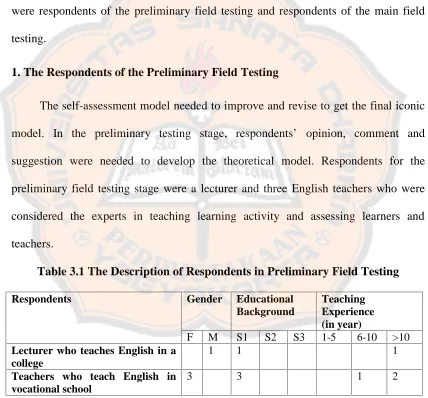
Table 3.1 The Description of Respondents in Preliminary Field Testing... 54
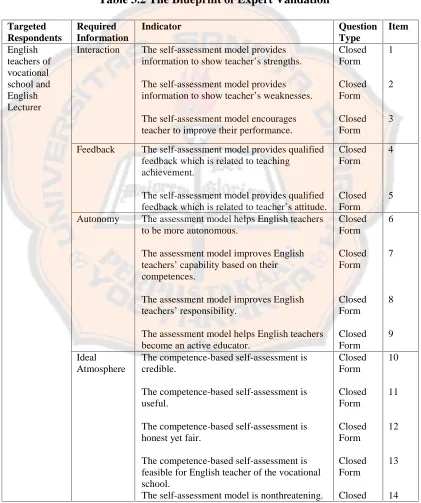
Table 3.2 The Blueprint of Expert Validation ... 57
Table 3.3 The Blueprint of User Validation... 59
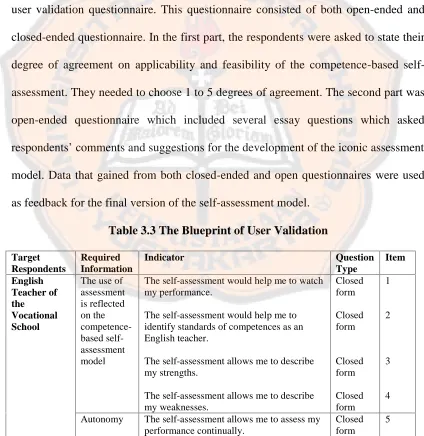
Table 3.4 Data Colletion ... 62
Table 3.5 The Score and Criteria of the Likert Scale... 65
Table 3.6 The Meaning of Score Criteria... 66
Table 3.7 The Interpretation of the Degree of Agreement... 67
Table 3.8 Descriptive Statistic of Expert Validation ... 68
Table 3.9 Descriptive Statistic of User Validation... 68
Table 4.1 Category and Standard of The Pedagogic Competence... 75
Table 4.2 Category and Standard of The Personality Competence ... 76
Table 4.3 Category and Standard of The Social Competence ... 77
Table 4.4 Category and Standard of The Professional Competence... 77
Table 4.5 The Self-Assessment Elements in Category Students’ Diversity and Equity... 85
Table 4.6 The Self-Assessment Elements in Category Knowledge in Teaching English ... 86
Table 4.7 The Self-Assessment Elements in Category Technology in Learning English ... 87
Table 4.8 The Self-Assessment Elements in Category Communication ... 88
Table 4.9 The Self-Assessment Elements in Category Evaluation for Learning English Development ... 89
Table 4.10 The Self-Assessment Elements in Category Learning Environment ... 90
Table 4.11 The Self-Assessment Elements in Category Professional Responsibilities ... 90
Table 4.12 The Self-Assessment Elements in Category Promotion of a Good Citizen... 92
Table 4.13 The Description of Preliminary Field Testing Respondents ... 101
Table 4.14 The Meaning of Score Criteria...103
Table 4.15Descriptive Statistic of Respondents’ Opinion onApplicability... 103
Table 4.16Descriptive Statistic of Respondents’ Opinion on Feasibility... 105
Table 4.17 The Score and Criteria of the Likert Scale... 111
Table 4.18 The meaning of Score Criteria ... 111
Table4.18 The Descriptive Statisticof Users’ Opinion on Applicability... 112
xii
LIST OF FIGURES
Figure 2.1 The Purpose of the Assessment ... 16
Figure 2.2 The Logic of Assessment Design ... 28
Figure 2.3 Conceptual Model of Competence-Based Self-Assessment... 44
Figure 2.4 Iconic Model of Competence-Based Self-Assessment... 46
Figure 3.1 The Mean Criteria Formula ... 66
Figure 4.1 The Description of the Self-Assessment ... 94
Figure 4.2 Goal of the Self-Assessment... 95
Figure 4.3 Content of the Self-Assessment... 95
Figure 4.4 Procedure of the Self-Assessment ... 96
Figure 4.5 Category and Standard of the Self-Assessment... 97
Figure 4.6 Elements of the Self-Assessment... 98
Figure 4.7 Scoring Section of the Self-Assessment ... 99
Figure 4.8 Self-Reflection Box ... 100
xiii
LIST OF APPENDICES
APPENDIX 1 The Blueprint of Expert Validation... 132
APPENDIX 2 User Validation Questionnaire Sample ... 134
APPENDIX 3 The Result of Expert Validation Questionnaire Sample ... 137
APPENDIX 4 The Result of the Expert Validation... 139
APPENDIX 5 The Result of User Validation Questionnaire Sample ... 141
APPENDIX 6 The Result of User Validation... 144
xiv
ABSTRACT
Parhusip, Indes Permatahati, 2015. A Competence-Based Self-Assessment Model for the English Teacher of the Vocational High School. Yogyakarta: The Graduate Program in English Language Studies, Sanata Dharma University
English teacher self-assessment has an important role in their performance. It describes the existing quality of the teacher which can be the strengths and/or weaknesses. There are some reasons why self-assessment is worth investigating. In
today’s era of standardization, there are issues of lifelong learning, teacher professionalism, teacher self-actualization, government regulation, certification, and the importance of evaluation. The next is the lack of assessment model of teacher’s
performance at the vocational high school level.
By conducting self-analysis and self-assessment using this instrument, it is expected that teachers become autonomous educators who are naturally motivated to watch their own performance periodically. Besides, it is also hoped that this instrument supports teachers to become empowered and self-actualizating in this era of postmodernism.
This research aims to design an alternative self-assessment model for an English teacher especially in a vocational school. There are two research questions to answer: 1) What is the conceptual model of the competence-based self-assessment for the English teacher of the vocational school like? and 2) What is the iconic model of the competence-based self-assessment for the English teacher of the vocational school like? This research used Research and Development (R & D) model. Both closed and open-ended questionnaires were used to gain data. There were two kinds of validation conducted to gain data on the development process. The first validation was conducted to gain data from 4 experts. The second validation was distributed to 15 English teachers as target users.
The answer to the first question is the theoretical model which is used to determine the name, goal, content and procedures to use the self-assessment. The framework of the model is selected according to its suitability to theory of the use of self-assessment, principles of self-assessment, teacher standard, teacher competence, and teacher performance.
xv
evaluation indicates the competence-based self-assessment is applicable and feasible for English teacher of the vocational school.
xvi
ABSTRAK
Parhusip, Indes Permatahati, 2015. A Competence-Based Self-Assessment Model for the English Teacher of the Vocational High School. Yogyakarta: Program Pasca Sarjana. Kajian Bahasa Inggris, Universitas Sanata Dharma.
Penilaian mandiri guru bahasa Inggris memegang peranan penting dalam performansi guru tersebut. Penilaian mandiri guru menguraikan kualitas guru baik kelebihan maupun kekurangannya. Ada beberapa hal mendasar yang menujukkan bahwa penilaian mandiri patut di teliti. Pada era standarisasi seperti pada saat ini, terdapat beberapa isu yang berpengaruh antara lain belajar sepanjang masa, profesionalisme guru, aktualisasi diri, peraturan pemerintah, sertifikasi dan pentingnya evaluasi. Kemudian yang tidak kalah pentingnya adalah kurangnya model penilaian performansi guru pada sekolah kejuruan.
Dengan melaksanakan analisis mandiri and penilaian mandiri menggunakan instrument penilaian ini, diharapakan guru bahasa Inggris menjadi pendidik yang otonom dimana termotivasi secara natural untuk memonitor performansinya sebagai guru bahasa Inggris. Disamping itu, diharapkan juga instrumen ini membantu guru bahasa Inggris untuk mengaktualisasikan diri di era posmoderenisme ini.
Penelitian ini bertujuan to mendesain sebuah alternatif model penilaian guru bahasa Inggris di sekolah kejuruan. Terdapat dua rumusan masalah yang harus dijawab, yaitu 1) Seperti apakah konseptual model dari penilaian mandiri berbasis kompetensi untuk guru baha Inggris pada sekolah kejuruan? dan 2) Seperti apakah ikonik model dari penilaian mandiri berbasis kompetensi untuk guru bahasa Inggris pada sekolah kejuruan? Metodologi yang digunakan dalam penelitian ini adalah penelitian dan pengembangan. Instrumen yang digunakan untuk mengumpulkan data adalah kuesioner. Tedapat dua jenis validasi yang dilakukan untuk memperoleh data pada proses pengembangan produk. Validasi pertama dilaksanakan untuk memperoleh data dari 4 eksper. Validasi kedua didistrbusikan kepada 15 orang guru bahasa Inggris sebagai target pengguna.
Jawaban untuk rumusan masalah yang pertama adalah dilakukannya investigasi perpustaakan untuk mendesain konseptual model. Investigasi tersebut digunakan untuk menetapkan nama, tujuan, konten, and prosedur dari penilaian mandiri tersebut berdasarkan sangkut paut teori dari manfaat penilaian mandiri, prinsip penilaian mandiri, standar guru, kompetensi guru dan performansi guru.
xvii
menyediakan sebuah formula yang dapat digunakan untuk menilai kinerja giuru pada standard dan kategori tertentu. Bagian terakhir pada penilain mandiri ini adala sebuah kotak catatan yang dapat digunakan untuk menulis refleksi kinerja pengguna. Hasil dari evaluasi pada penilain mandiri berbasis kompetensu mengindikasikan banhwa instrument ini relevan dan dapat dilaksanakan untuk guru bahasa Inggris pada sekolah kejuruan.
CHAPTER I
INTRODUCTION
This Research and Development (R and D) project is intended to develop a competence-based self-assessment model for the English teachers of the vocational school. This chapter aims to ensure the validity and feasibility of this R and D project. This chapter is divided into seven parts, which are background, problem identification, problem limitation, statement of research question, research question and goals, product specification and research benefits.
A. Background
Teachers need to improve their performance since it is important for learning and teaching achievement. As a program of education phenomena, their performance needs to be valued to gain information about their strengths and weaknesses. By stating their strengths and weaknesses, they know their current quality which is beneficial to use for future decision in teaching and learning needs (Nitho & Brookhart, 2011). A systematic procedure of gaining information and giving judgement about merit, value or worth of educational program is called educational evaluation (Gall, Gall and Borg, 2007).
Assessment as a part of evaluation helps teachers judge and improve their performance. As stated by Bachman and Palmer (2010: 21), evaluation involves two points which are making value judgments and decisions on the basis of information and gathering information to inform such decisions is primary purpose for which language assessments are used. When evaluating a teacher’s
performance, the evaluator usually used assessment to identify one’s strengths and
weaknesses which later will help teacher maintain or improve his/her
performance. By doing an assessment, information about a teacher’s performance
can be collected and used for making decision in the future.
As professionals, teachers need to improve their life quality in this postmodern era. Assessment is considered as one of ways to answer to the challenge since it offers improvement. Teaching is not only about a job but also about a life calling. As the spirit of postmodernism is spreading, it is expected that every teacher realizes the importance to improve their life quality. Evaluation and assessment which are related to reflection can be used to answer to that challenge.
Teacher needs self-assessment to review, judge, and develop their own performance. As self-assessment provides feedback, it naturally motivates individuals to restore their weaknesses which may be necessary for their lifelong learning need. As said by Pak (1986)in Nunan and Lamb (2000: 234) “ultimately, teaching will probably only improve through self-analysis and self-evaluation”.
Teachers’ performance only improves by doing self-assess and self-adjust.
Feedback takes the important role in assessment since it provides useful information. It is in line with Wiggins (1998) who states that educative assessment system is used to audit and it also brings about improvement on individual performance. Feedbacks which are gained through assessment process allow teachers to make improvement related to future decision. This is supported by Nitho & Brookhart (2011) who state that assessment is a process for obtaining information that is used for making a particular educational decision.
As self-assessment brings about development, it is used in various nations. Various nations have taken advantages of an assessment. According to Fletcher (2005), competence-based assessment is also used by England and Scotland. Further he states that in England, competence-based assessment focuses on introducing National Vocational Qualifications (NVQ). In Scotland, there is a competence-based assessment which focuses on introducing Scottish Vocational Qualifications (SVQ).
Competence-based assessment is presented as an alternative model to help teachers in solving performance problem based on teacher standard of knowledge, skill and attitude. English teacher of vocational school needs an alternative
self-assessment model of teacher’s performance. This research designs an alternative self-assessment model of teacher’s performance which is easy-to-use. It is expected that this model will help every teacher assess their own performance especially for English teacher in vocational school. Every English teacher should be assessed to give them feedback for their performance in class. Therefore, they can maintain or even improve their performance which influences students’
achievement.
B. Problem Identification
Vocational school students are prepared as ready-to-work graduates. Based on the Kerangka Kualifikasi Nasional Indonesia (KKNI) which uses to acknowledge working competence which is suitable with working structure on various sectors, graduates of vocational school is in the level 2, which is operator. The KKNI which is also known as Indonesian National Qualification Framework (INQF) states as workers which are in the level of operator, English is important to understand. Knowledge, skill and attitude which are formulated in the curriculum for vocational graduates must be acquired in the end of their study.
Assessment for teachers is important since it shows teachers’ strength and
weakness of their performance. Especially, self-assessment allows English teachers to watch and value their own performance periodically. Every standard
attitude) shows teachers how they must perform as a competent English teacher. Government’s regulation about standardization, issue of lifelong learning, professionalism and self-actualization in the era of postmodernism are considered motivated enough for teacher to develop their life quality. Self-assessment motivates teachers to reflect what they have been done in the past in order to improve in the future.
C. Problem Limitation
The limitations of this research are as follow. First, this research focuses on
assessing English teacher’s performance. Since it assesses English teacher’s
performance, this model cannot be used by the other subject’s teachers. Second,
only need to give checklist (v) for their choice. Five, the sampling of this research is limited to English teachers in vocational school.
D. Statement of Research Questions
There are two questions which guide the researcher does this research. Those are:
1. What is the conceptual model of the competence-based self-assessment for the English teacher of the vocational school like?
2. What is the iconic model of the competence-based self-assessment for the English teacher of the vocational school like?
E. Goals of Research and Development
This research’s goals are to find the answer to those research questions above. Firstly, this research is conducted to discover the truth of theoretical model that can be implemented periodically by English teachers to guide them as professional teacher. Next, this research is aimed to develop the iconic model and discover the truth of this competence-based self-assessment model for English teacher of the vocational school.
F. Product Specification
English teachers can use the self-assessment as a tool for assessing their own performance. This assessment is expected to utilize in the end of the semester. Information is used for semester-end reflective assessment to solve generic problem. This self-assessment is designed to encourage English teachers to get self-actualization through their performance as professional. It also provides information about English teacher performance which is valued based on teacher competences. It is expected to help English teachers assess their own performance to identify areas of strength and areas needing improvement.
In this self-assessment, teachers are expected to notice all statements of a certain standard in each category. By those statements, their performance is valued. Every statement that has not been done is used as feedback. As this assessment aims to show strength and weaknesses of teacher performance, it is used as evaluation need.
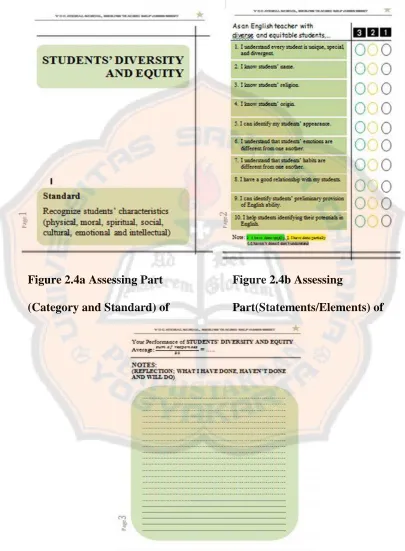
This self-assessment includes self-assessment book and manual. This book consists of assessing section (category of competence, standard, and performance), scoring section and self-reflection section. This self-assessment assesses teachers’ performance based on their competence. Teachers’
Table 1.1 Product Specification of the Self-Assessment
No Contents of Competence-Based Self-Assessment
Function 1 Assessing Part
a. Category
b. Standard
c. Elements/Statements
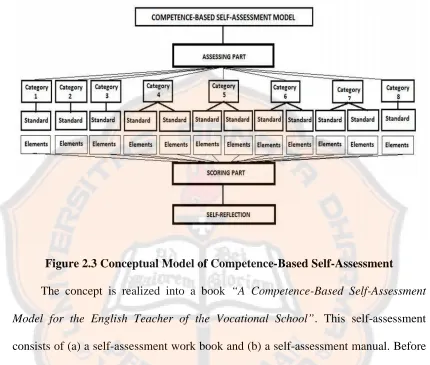
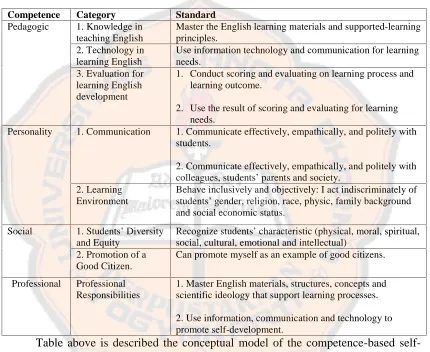
This assessment is divided into 8 categories which are formulated based on Indonesia teacher competences (the Regulation of Education Minister No. 16 year 2007 on the Standard of Academic and Competencies of Teachers) and the other related theories. (see figure 2.2 Conceptual Framework)
Each category has its own standard(s). Each standard informs goal that must be fulfilled based on certain category.
Elements of each standard indicate performances that must be done to reach the standard. Every standard has 10 statements that indicate teachers’performance. 2 Scoring Part Scoring Part uses to value teacher’s self-assessment
score. Elements/statements that are split from standard of each category can be measured as being fully, partially or not fulfilled. English teachers as the users are asked to give check on
a. “1” for answer “I haven’t done/ I don’t understand” b. “2” for answer “I have done partially”
c. “3” for answer “ I have done fully”
3 Self-Reflection Part Users can use the self-reflection box to write down narrativeof “what I have done”, what I haven’t done and what I have to do in the future”. Narrative thatusers can write in the self-reflection box is used as reflection of their performance. By this narrative, teacher can identify what does she/he is already doing and an area of his/her performance that would like to improve.
G. Benefits of Research and Development
This research aims at discovering the empiric model of competence-based self-assessment of English teacher’s performance in vocational school. Thus, theoretically, this research may contribute ideas about English teachers’
performance and self-assessment which enrich the development in teaching performance, language learning, and English Language Studies in Sanata Dharma University.
CHAPTER II
REVIEW OF RELATED LITERATURE
This chapter presents concepts which are used to discover the conceptual truth. This chapter is divided to three sections; theoretical review, review of related research, and framework of pre-understanding. The theoretical review is used to clarify related concepts and their relations of a competence-based self-assessment model for the English teacher of the vocational school. The second section is used to review some related research. The last section explains the framework synthesized from the discussed theories.
A. Theoretical review
The theoretical review clarifies eight concepts include teacher competence, competence-based assessment, competence-based learning, educative assessment, the vocational school, the English teacher of the vocational school, English teacher’s
performance at the vocational school and assessment design model.
1. Teacher Competences
Competence indicates standard of ability of a particular occupation. According to Debling (1995: 80) competence is a broad concept which embodies the ability to transfer skills and knowledge to new situations within the occupational area. In every occupation, includes teacher, there are standards which have to reach as a
professional. Those standards which describe on competence shows teacher what they have to do as a competent person.
Teachers’ competence can be seen on their performance. It is because competence is about performance (Mansfiel, 1995: 28). As the expected outcomes, performance indicates teacher’s ability which consists of knowledge, skill and attitude. According to Musfah (2011) competence is ability of someone which consists of knowledge, skill and attitude which can be seen in his/her actual performance that beneficial for his/herself and environment. Thus, teacher performance directly indicates their competences.
Teachers need to pay attention on the importance of their competences. Competences of teachers in Indonesia are formulated in the Regulation of Education Minister No. 16 year 2007 on the. Based on the regulation on Standard of Academic and Competencies of Teachers, teachers need to notice four areas of competences contains pedagogic, personality, professional and social.
a. Pedagogic Competence
Pedagogic competence is defined as ability in managing students (Musfah, 2011). Based on the Regulation of Education Minister No. 16 year 2007 on the Standard of Academic and Competencies of Teachers, pedagogic competence includes a) mastering students’ characteristic b) mastering material and learning
Teachers are expected to understand the education concept which makes they are aware on their strategic position in society. They also need to pay attention on their personal knowledge bank on English material and language principles, teaching techniques, and technology. They are also asked to understand what they have to do when assessing and evaluating students.
b. Personality
Since the essence of learning process is to transform behavior, teachers are expected become model on living their personal life. Teachers need to concern their act as professional educators who are a part of citizen that are aware on norm. Their proper act are described in items of personality competence which are; a) act properly based on norm, b) act properly as an example of good citizen, c) act properly as a capable person, d) showing pride as a teacher, and e) respect teacher ethical code (the Regulation of Education Minister on the Standard of Academic and Competencies of Teachers, 2007).
c. Social
Students’ diversity of cultural, social, educational and religious was the next
behave inclusively and objectively, b) communicate effectively, emphatically and politely, c) conform with Indonesia diversity of social and culture, d) Communicate with other educators.
d. Professional
As professional, English teachers need to make commitment to provide time for their performance development. There are areas of professional competence which need to notice; a) master material, structure, concept and mindset of certain subject, b) master competency standard and main competency, c) develop material creatively d) improve professionalism continually, e) use technology to improve performance (the Regulation of Education Minister on the Standard of Academic and Competencies of Teachers, 2007).
2. Educative Assessment
Educative assessment is very important for teachers as educator. Since assessment brings about improvement, teachers can use assessment to gain information about their performance. By assessment, their strengths and weaknesses are showed for improvement need.
a. Meaning of Assessment
(2004: 4) that tests are a subset of assessment. Test is only one of devices that can be used to assess individuals. An assessment means wider than a test.
Assessment is important for teacher because it gives certain space for teachers to restore and improve their performance. Assessment can be used to gain information about something which someone is interested in (Bachman and Palmer, 2004). It is defined as a process to collect information through procedures that are
systematic and substantively grounded (Bachman and Palmer, 2010). Teachers’
performance is not only interesting but also important for teachers.
As stated by Salvia, Ysseidyke & Bolt (2010), an assessment refers to a problem analysis and problem-solving activity. Assessment is also defined as a process for obtaining information that is used for making a particular educational decision (Nitho & Brookhart, 2011: 3). Thus, an assessment helps teachers find out their current quality of performance through full range of procedures as a problem analysis and problem-solving.
A good assessment is the one which educates and motivates while it is doing (Wiggins, 1998). As assessment should be non-threatening, naturally improving, provide sufficient chances for individual to show what they know and do not know, and offer beneficial feedback (Cohen, 1994). Assessment allows individuals to know their real current strengths and provides feedback to restore their weaknesses.
An assessment which brings about improvement provides quality feedback. Feedback takes the important part in an assessment (Wiggins, 1998). It informs about
disconfirms the correctness of action (Wiggins, 1998: 46). It tells you what you did or did not do and enables you to self-adjust (Wiggins, 1998:46).
As a process for gaining information which statesindividual’s level, assessment
has many different techniques to be carried out. Some techniques which are usually used to collect the information are; formal and informal observations of a student; paper-and-pencil tests, a student’s performance on homework, lab work, research papers, projects, and during oral questioning; and analysis of student’s records (Nitho
& Brookhart, 2011: 3).
b. Purposes of Assessment
Findings that are gained through assessment must be beneficial for stakeholders. As stated by Bachman and Palmer (2010:22), the primary use of language assessment is to collect information for making decisions that have consequences for stakeholders. It is explained that stakeholders are the individuals and programs in the educational and societal setting in which language assessment takes place (Bachman and Palmer, 2010). The result of doing an assessment must bring effective information which is useful for stakeholders to make decision of a particular education phenomenon.
Assessment principally aims to educate and improve individuals’ performance,
is explained that feedback initiates individuals to develop since feedback derives from and then addresses their intent to complete some particular things (Wiggins, 1998).
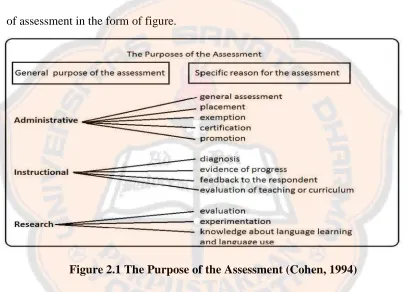
[image:37.612.107.514.210.502.2]In general, purpose of assessment is divided into three different goals; administrative, instructional and research. Cohen (1994: 23) summarizes the purposes of assessment in the form of figure.
Figure 2.1 The Purpose of the Assessment (Cohen, 1994)
c. Assessment Standards
A designed assessment should meet six standards of an educative assessment. First, it must be credible to all stakeholders. Stakeholders are defined as the individuals and programs in the educational and societal setting in which language assessment takes place (Bachman and Palmer, 2010:22). Credibility of an assessment is contributed by four factors: authenticity of the work, technical soundness of the measures, trained and disinterested judging and justifiable content, task and performance standard (Wiggins, 1998: 112).
The second standard is useful. Before an assessment model is design, the designer must be sure that the model gives certain benefits. Wiggins (1998: 114) also states that usefulness implies not only timeless and intelligibility of the results but also opportunities to use them. It is stated that an assessment must be designed to use continually. It also requires providing a powerful feedback. Besides, the designers have to be sure that the users of the assessment model have chances to do assessment. An educative assessment model demands balance in the use of all assessment methods. An assessment must focus on individuals’ effective performance (Wiggins,
An assessment is demanded to be honest yet fair. It is called honest if the assessment accurately and unflinchingly provides feedback which is concerning
individuals’ levels of achievement. The assessment also has to factor in appropriate
information about individuals’ prior level of experience, recent growth and
extenuating circumstances (Wiggins, 1998).
An assessment must be designed intellectually rigorous and thought provoking. Wiggins (1998: 111) states that the assessment must focus on core ideas, questions, problems, texts and knowledge and be designed to be engaging and stimulating of inquiry and interest intellectual work.
The other standard of an assessment which has to fulfil in order to bring about improvement is feasible. Feasibility of an assessment depends on a more intelligent use of existing time, material, and human resources (Wiggins, 1998: 119). It also involves in creating an entirely new conception of professional growth. Besides, feasibility is related to technology which solves the lack of availability of models, feedbacks and easy ways of sharing works.
d. Types of Assessment
1). Based on Nature of Assessment
Based on nature of assessment, Miller et al.(2009) differentiate assessment into two types; maximum performance and typical performance.
a) Maximum Performance
As explained by Miller et al. (2009), this kind of assessment aims to determine
a person’s developed abilities or achievement. In other words, this assessment decides
on what individuals can do to get their best score. Individuals’ motivation is very
important for the result of the assessment since it is necessary for the use and interpretation of the result. Instruments that are usually used include aptitude tests and achievement tests.
b) Typical Performance
Different from maximum performance, this assessment indicates what individuals will do rather than what they can do (Miller et al., 2009: 36). In short, this
assessment is designed to reflect a person’s typical behaviour. It concerns on
individual’s interests, attitudes, adjustment, and other personality traits. Thus, this assessment prioritizes in gaining representative responses rather than high score (Miller, 2009). This assessment uses observational techniques and peer appraisal as the instruments.
2). Form of Assessment
Based on form of assessment, there are two kinds of assessment which are fixed-choice tests and complex-performance assessments (Miller et al., 2009).
Fixed-choice tests use as an efficient measurement of knowledge and skills. It other words, it is used as an indirect indicator (Miller, 2009). This kind of test considers an efficient test since individual can respond to large number of question in brief period of time. This test usually uses standardized multiple choice test.
b) Complex-Performance Assessments
Miller et al. (2009:37) states that complex-performance assessment functions as
measurement of performance in contexts and on problems valued in individual’s own
right. This performance assessment is usually called authentic assessment since it is used to assess performance while individuals are involved in problem-solving learning experience. This assessment usually uses certain instruments such as hands-on laboratory experiment, projects, essays, and oral presentatihands-on.
3). Method of Interpreting results
According to Miller et al. (2009), there are two types of assessment based on its method of interpreting results; criterion-referenced and norm-referenced.
a) Criterion-Referenced
certain standard in interpreting the result. Type of assessment used are teacher-made tests, custom-made tests from tests publishers, and observational.
b) Norm-Referenced
By norm-referenced assessment, individual performance is described according to relative position in some known group (Miller, 2009). In short, the way of interpreting this assessment is comparing an individual among others. In the other words, this assessment discriminates an individual among others since it provides wide spread of score of each individual. This assessment interpretation depends on a comparison among other individuals whose define as norms. Their performance is described by standardized aptitude and achievement tests, teacher-made survey tests, interest inventories, and adjustment inventories.
3. Competence-Based Learning
Learning is defined as “activities or in situations that engage the learners and require adaptation” (Paiget, 1970). Learning also refers to “an active, constructive process where the learner manages the available cognitive resources to create new knowledge” (Kozma, 1991). Others define learning as “the development of understanding on the critical role of social group emphasizing social phenomena”
4. Competence-Based Assessment
Assessment as problem analysis and problem-solving activity are necessary for administrative, instructional and research needs. Full range of procedures of an assessment helps individuals gain information to answer to those assessments purposes. Assessment is considered important for diagnosis, evidence of progress, feedback to the respondent, and evaluation of teaching or curriculum. Thus, assessment aims to provide evidence to prove individual is in minimal standard of a certain role.
What the assessor wants to assess determines what kind of assessment will use. As stated by Cohen (1994), there are some questions must be answered before assessing educational program which concludes methods, materials, individuals, and organizations. Those questions are what to assess?, why?, how?, when?, where?, who?, through what processes?, and for whom?. Those questions work together in conducting and/or implementing a certain model of assessment.
Competence-based assessment values individuals based on certain standard. As stated by Fletcher (2005), competence-based assessment is a collection of evidence
of individual’s working outcome or personal working which is sufficient to show
Competence-based assessment is different from the common assessment system. According to Fletcher (2005), there are some main aspects of competence-based assessment a) It focuses on the outcomes, b) It is an individual assessment c) There is not any percentage score, d) There is not any comparison on the result among the other individuals, e) All standards (requirements) of the assessment must be fulfilled, and f) The result of the assessment states the individual have already competent or not competent yet. Those main aspects above are necessary to consider in determining certain performance standards which are needed in competence-based assessment.
Competence-based assessment aims to gain information as evidence of
individuals’ performance in their working place which demonstrates that they can do
or act based on standards that are required for a certain working role. It also stated that competence-based assessment is usually designed as an individual assessment. Any scoring system is not necessary when conducting this kind of assessment.
5. Self-Assessment for Professional Teacher
Teachers need to assess and analyze their own teaching for improvement need. Their own analysis and assessment provide information of their current level of teaching. As assessment gives certain space for individuals to restore and improve, it allows teachers to gain feedback so teachers can detect what certain area that must be restore and improve. It is in line with Pak (1986) in Nunan and Lamb (2000: 234),
who state that “ultimately, teaching will only probably improve through self-analysis and self-evaluation”.It is also supported by Wiggins (2008) who states effective self-assessment and self-adjustment on performance are the key to educate and improve
individuals’ performance. As the key in education and improvement, self-assessment is very helpful for teachers. By gaining feedback from analysis and assessment, teachers will have information for adjustment. Moreover, self-assessment also provides feedbacks which helps teacher move to self-adjust.
Assessment has various forms. According to Brown (2004: 256), assessment can be in the form of portfolios, journals, conference, interview, observation, self/peer-assessment. Different from the other forms of assessment, self-assessment promotes the principle of autonomy and develops natural motivation. Besides,
self-assessment also improves individuals’ enjoyment, and understanding. It is stated by Loannou-Georgiou & Pavlou (2003) that self-assessment proposes basic skill as an autonomous learner in their own reflection and regular review and it also develops
individuals to become more responsible for their own learning (Keane, 2014). Since individuals know what goals they want to achieve, self-assessment helps them to
become more confidence of their own ability. Appropriate goals are important for
individuals to decide how to assess realistically and accurately since self-assessment promotes cycle of learning and self‐confidence (Ross, 2006).
Self-assessment is a cyclical process on gaining information for future change and improvement need. Self-assessment refers to a process that exposes how well
individuals’ understanding on the benchmarks and standards which they want to meet, think about what they are learning, to recognize quality work and to plan how they can perform better in the future (Wiggins, 1998, Rolheiser and Ross, 2001). It must be effective since it is important for wide-ranging decisions about actions in the past that causes clear benefits for future decision.
current teaching performance. Tierney, Carter, and Desai (1991) in Marzano, Pickering and McTighe (1993: 35) state that there is no reason why students cannot assess themselves on all content and lifelong learning standards. It is also applied to teachers as they are professional who are demanded to do lifelong learning.
Teaching is about performing. Teacher competence which consists of knowledge, skill and attitude can be seen on their performance. Self-assessment is presented to answer teachers need toward instrument to help them develop their performance as professional. It is in line with Pak (1986) in Nunan and Lamb (2000: 234), who states that “ultimately, teaching will probably only improve through self-analysis and self-evaluation”. It is also supported by (Wiggins, 2008) who states the effective self-assessment and self-adjustment on performance is the key to educate
and improve individuals’ performance. By doing a self- assessment continuously, teachers are demanded to be familiar in self-assessment skills which includes effective questioning, reflecting, problem-solving, comparative analysing, and the
ability to share thoughts in a variety of ways.Thus, teachers need a self-assessment as an instrument which supports and helps they do lifelong learning.
The result of doing a self-assessment must offer benefits for teachers on
monitoring, planning, and carrying out development. Since development means
change, it is defined as a process of becoming better, a realizing of our true and full
potential (Byomantara & Mace as cited in Kenny and Savage, 1997:88).
Self-assessment is presented to facilitate teacher to be aware of their potential since it
feedback through a self-assessment, it must be done continuously and become a part
[image:49.612.103.519.172.536.2]of teachers’ working life.
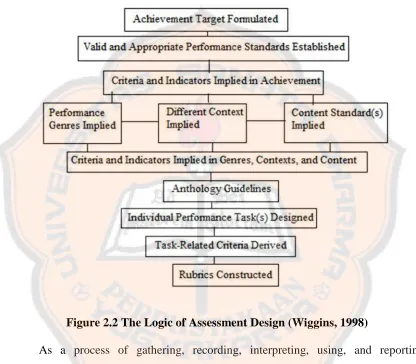
Figure 2.2 The Logic of Assessment Design (Wiggins, 1998)
The performance standard follows logically from the achievement target (Wiggins, 1998). It means that there is a certain standard that lead the users to solve problem which state before in the achievement target or goal.
Another step is deciding criteria and indicators implied by achievement target. A criterion defines successfulness at meeting the target achievement (Wiggins, 1998). Indicator stands for behavior or trait that is typical of the particular performance being assessed (Wiggins, 1998). Next step of designing a self-assessment is suggesting genres, contexts, and content of the self-assessment. This step is used to refine the list of possible tasks types and contexts (Wiggins, 1998). It also used to set a clear standard and criteria that wants to be achieved when doing a self-assessment.
6. The Vocational School
The vocational school is pretty different from the ordinary senior high school although they are in the same level of education. As stated by Kuswana (2013), the vocational school refers to secondary schools which prepare their learners to work in a particular field. The vocational school focuses more on preparing their graduates to become people who are ready to work. In the other words, learners of vocational school are equipped both knowledge and skills for working needs.
The vocational school is managed by both government and industry. As stated by Kuswana (2013: 157), vocational education is important for specific working necessity, such as an industry, agriculture, or commerce field. Based on Keputusan Dirjen Mandikdasmen No. 25/C/Kep/MN/2008 as cited in Kuswana (2013), learners of vocational school have three structures of skill which are skill of discipline, skill of study program and skill of competences. Moreover, disciplines of vocational school are differentiated into six fields which are (a) technology and engineering, (b) information technology and communication, (c) health, (d) arts, industry and tourism, (e) agribusiness and agro technology, and (f) business and management.
By the end of learning process in vocational school, every student must be equipped with skills and competencies which are necessary for their living improvement. Salvia, Ysseldyke and Bolt (2010:3) state that education is intended to provide all students with skills and competencies they need to enhance their lives and the lives of their fellow citizens.Education must change the students’ living condition
Graduated students of the vocational school must fulfil some standards that are written in the Kerangka Kualifikasi Nasional Indonesia (KKNI) which also known as Indonesian National Qualification Framework (INQF). The INQF is a framework that places, equalizes, regulates education, work training and work experience to give an admission of working competence which is appropriate with working structure in various sectors. The INQF divides qualification level into nine levels in which level 1 is the lowest and level 9 as the highest level. The INQF categorizes nine qualification levels into three certain functions; operator, technician and specialist level.
As described on the Indonesian National Qualification Framework (INQF), graduates of the vocational school are involved in the level of operator. As operator, every graduate must be able to do a particular duty using a tool, information, usual working procedures. They also are demanded to be able to show their measured performance under their superior. They must own knowledge of basic operational and factual knowledge on a particular working area, so they can choose an appropriate problem solving for usual occurred problem. They are also demanded to be responsible for their own work and can be responsible in guiding the others.
7. The English Teacher of the Vocational School
and facilitating but also manage learning environment, so every learner is able to
study. Besides, they are responsible to form learners’ attitude. It is supported by
Borich (1996: 2) who states that a good teacher was a good person—a role model who met the community ideal for a good citizen, good parent, and good employee. They are demanded to be lived as well as possible in their private life. Teachers must be people that fulfil society expectation of a good citizen, good parent, and good employee. As model, their life both inside and outside classroom are watched and copied by society.
Teachers are models of ideal people who are also responsible to transferring knowledge, skill and attitude. It also applied in vocational school which is responsible to prepare ready-to-work graduates (Kuswara: 2013). As a vocational school teacher, they are responsible to equip every student with a particular knowledge and skill
8.English Teacher’s Performance at the Vocational School
Teacher’s performance becomes interesting to discuss since it is related to their competences, professionalism, lifelong learning issue and teacher self-actualization. It is also applied for English teacher for vocational school level. By this section, the writer will describe the role of teachers, their standards as teachers, and their awareness generally which determine their performance as English teachers of vocational school. According to Mulyasa(2013: 88) performance refers to someone’s
performance as the accumulation of knowledge, skills, value and attitude which is presented in her working appearance, attitude and achievement. Performance is not only about individual’s knowledge. Knowledge works together with skills, value and
attitude to build up individual’s performance. a. Teacher Roles
As the efforts to improve teachers’ performance, teachers must know their
duties. Teachers should maximize their roles which facilitate learning teaching activity. Since teacher does teaching, her roles must be related to learning activity. According to Brown (1994:8) “teaching is guiding and facilitating learning, enabling
the learner to learn, setting the conditions for learning”. Teaching does not only deal
there are some requirements which must be acquired as a good teacher as well as an English teacher. Teacher must know their subject. They should master English so they can transfer their knowledge well. Before they teach, they must be sure that they are really ready to run a class. They also must use appropriate teaching methodology to give an interesting lesson. Teachers should be creative enough to run teaching activity. One thing that must not be forgotten that teacher must find out about their students, know them and respond to them. Teachers must be able to recognize their student, included their name, face, interest, and attitude. It is not right if a teacher only pay attention to a particular student. Teachers also must be passionate and patient when they teach so they can help students make progress. Teachers need to guide each student to achieve learning goals.
Every teacher needs to understand their roles, so teaching activity will run effectively. When teachers realize their roles, it is expected that they can place themselves in an appropriate position. Thus, learning activity can run effectively. As stated by Brown (2001: 167), there are five roles of an interactive teacher which are as a controller, director, manager, facilitator and resource. In addition, Jacobsen, Eggen, &Kauchak (2009: 9-14) describe that teachers need to encourage development and achievement, constructivism in the class and motivate students.
b. Teacher Standards
they are the expertise involves not only skill and knowledge but also the exercise of highly sophisticated judgment, and whose accreditation necessitates extensive study, often university-based, as well as practical experience”. Indonesia Act No. 14 year 2005 on Teachers and (University) Lecturers Article 1 Verse 1 also states that teacher is a professional educator who educates, teaches, guides, directs, trains, assesses and evaluates learners of a formal kindergarten, elementary and/or senior level. Based on those statements, it can be said that as a professional, a teacher must be an expert in teaching.
Teachers are expert who need to be more than good enough. Teaches are demanded to realize that they are working in high standards of profession. They are responsible to uphold the standards. It is in line with Riddel (2003:245) who says
“good teachers need to be more than good teachers, they need to be good colleagues
and employees, and they need to remember that they are working in a very
responsible profession which aims to maintain high standards.” It is clear that as a
must be owned by a well-educated teacher. Those are; (1) command of theoretical knowledge about learning and human behaviour, (2) display of attitudes that foster learning and genuine human relationships, (3) command of knowledge in the subject matter to be taught, (4) repertoire of teaching skills that facilitate student learning, and (5) personal practical knowledge. Badan Standar Nasional Pendidikan of Indonesia (2013) also states that educator must fulfil academic and competences qualification as a learning agent, and also must has ability to achieve national education purposes. Moreover, it also explained that there are some competences which standardized educator, such as pedagogic, personality, professional and social. Afterwards, it also specified that as an English teacher, those competences are clarified as (1) teacher must has knowledge about any aspect of linguistics of English includes linguistics, conversation, sociolinguistics and strategies, and (2) teacher must master spoken and written English and receptive and productive English for any communicative aspects includes linguistics, conversation, sociolinguistics and strategies.
9. Assessment Design Model
This research is aimed to present an alternative self-assessment model of English teacher performance. Since this research develops an existed product, the researcher must be guided by steps of R & D model. According to Borg & Gall
(1983: 772) “Research and development (R & D) is a process used to develop and
“research and development as an industry-based development model in which the findings of research are used to design new products and procedures, which then are systematically field-tested, evaluated, and refined until they meet specified criteria of effectiveness, quality, or similar standards.” It can be said that R & D model concerns not only in developing a product but also validating. It also described that an R & D product need to be tested, evaluated, and refined to become a standard product. In order to test, evaluate, refine or validate a product, there are some requirements which known as R & D cycle and must be done. According to Borg and Gall (1983), R & D cycle includes (1) research and information collecting, (2) planning, (3) developing preliminary form of product, (4) preliminary field testing, (5) main product revision, (6) main field testing, (7) operational product revision, (8) operational field testing, (9) final product revision, and (10) dissemination and implementation.
instructional material or also known as instructional development refers to the production process of transformation from a particular instructional design into the instructional material which can be in the form of print, video, multimedia or Web-based materials.
There are some different instructional design steps which propose by its experts. Steps of instructional design which proposed by Cennamo & Kalk (2005) involves five steps which are initial study, define, design, demonstrate, and develop. Moreover, Dick, Carey & Carey (2009) propose a system approach model of instructional design which includes (1) identify instructional goal(s), (2) Conduct a goal analysis, 3).Analyze learners and contexts, 4) Write performance objectives, 5) Develop assessment instruments, 6) Develop instructional strategy, 7) Develop and select instructional materials, 8) Design and conduct formative evaluation of instruction, 9) design and conduct formative evaluation of instruction, and 10) Revise Instruction.
B. Review of Related Studies
There are some researchers have done studies on teacher self-assessment. Those self-assessments studies enrich the writer about how to design an alternative assessment based on teacher competence. Even though, those studies are not specialized for English teacher.
The first research is titled Maryland Adult Education Teacher Standards Self-Assessment. It is written by Maryland Adult Education Teacher Standard workgroup in 2008. This self-assessment instrument is conducted to help teachers assess their own performance. By this assessment, teachers are expected to know and able to do certain practice of skills, knowledge and abilities as a professional. Standards (knowledge, skills and abilities) are formulated into series of competencies which promote effective classroom practice, professional development and positive learner outcomes. Thus, this assessment is designed for teachers to develop their professional development confidentially.
Those previous studies enrich the writer in conducting as self-assessment. Based on those studies, it can be summarized that what to assess?, why?, how?, when?, where?, who?, through what processes?, and for whom? are questions that must be answered before conducting a self-assessment. They are important since it determines the self-assessment’s content to value individualwhether the individual is already competent.
C. Theoretical Framework
According to Cohen (1994:1), assessment tasks are nonthreatening and are developmental in nature, allowing the learners ample opportunities to demonstrate what they know and do not know, and providing useful feedback both for the learners and their teachers. Since an assessment facilitates individuals to know their real current strengths and provide feedback to restore their weaknesses, it promotes actualization. As today is in the era of postmodernism which proposes self-actualization, teachers as professionals are also obliged to improve their life quality. Besides, principally, assessment does not intimidate individuals so it allows them to improv