IOP Conference Series: Earth and Environmental Science
PAPER • OPEN ACCESS
Association between level of interferon gamma
and acid-fast bacillipositivity in pulmonary
tuberculosis
To cite this article: N B Priwahyuningtyas et al 2018 IOP Conf. Ser.: Earth Environ. Sci.125 012152
View the article online for updates and enhancements.
Related content
Description of polymerase chain reaction and sequencing DNA Mycobacterium tuberculosis from specimen sputum of tuberculosis patients in Medan
Lily, Y Siregar and S Ilyas
-Knowledge and Attitudes with Family Role in Prevention of Pulmonary Tuberculosis in Maros, Indonesia
Yermi, Muhammad Ardi, Lahming et al.
-Social acceptance among tuberculosis patients at Puskesmas Amplas Medan, Indonesia
P C Eyanoer
1234567890
ICTROMI IOP Publishing
IOP Conf. Series: Earth and Environmental Science 125 (2018) 012152 doi :10.1088/1755-1315/125/1/012152
Association between level of interferon gamma and acid-fast
bacillipositivity in pulmonary tuberculosis
N B Priwahyuningtyas1, B Y M Sinaga1*, P Pandia1 and P C Eyanoer2
1
Department of Pulmonology and Respiratory Medicine, Faculty of Medicine, Universitas Sumatera Utara, Kampus USU Padang Bulan 20155, Medan, Indonesia
2
Department of Community Medicine, Faculty of Medicine, Universitas Sumatera Utara, Kampus USU Padang Bulan 20155, Medan, Indonesia
*
Corresponding author: [email protected]
Abstract. Tuberculosis is an infectious disease which caused by Mycobacterium tuberculosis
(M. tuberculosis) that infected numerous organ especially the lung. A person's immunity is very affecting for a person exposed to pulmonary tuberculosis. T-helper-1 cell (Th1) is very influential in the immune system especially in interfering intracellular bacterial infection. One of the cytokines known produced by Th1 cell is interferon gamma (IFN-γ) which is in eliminating M. tuberculosis. The study aims to identify the association between level of IFN-γ
and AFB positivity in pulmonary tuberculosis patients in Medan.It is a case-control study. The subjects of the study were 60 new cases of pulmonary tuberculosis with AFB sputum smear-positive that never received ATT consisting 20 cases AFB (+1), 20 cases AFB (+2) and 20 cases AFB (+3).Samples were plasma collected from the venous blood of pulmonary tuberculosis patients. The plasma then underwent laboratory assay with ELISA techniques. Independent t-test was p<0.05 considered significant. Level of IFN-γ in TB AFB (+1) is higher than TB AFB (+2) and (+3), with thesignificant statistical result (p=0.001).
1. Introduction
Pulmonary tuberculosis (pulmonary TB) is a disease infected the lung parenchyma caused by Mycobacterium tuberculosis. Indonesia, a country located in Northeast Asia, is recorded as the 2nd
highest case of tuberculosis around the world after India.[1] Several factors can contribute to increasing one’s risk to suffer from it.
T helper-1 cell (Th1) is in the immune system, especially duringintracellular bacterial infection. One of the cytokines produced by Th1 cell is interferon gamma (IFN-γ) is essential in eliminating Mycobacterium tuberculosis. IFN-γ increased phagocytosis potency of macrophage that been infected by Mycobacterium tuberculosis by stimulating phagolysosome. IFN-γ also stimulated the forming of free radical in the destruction of Mycobacterium tuberculosis component which is DNA and cell wall. Disorder in Th1 activity and its cytokine which is IFN-γ, have a significant effect on immune system mechanism in term of pulmonary tuberculosis.[2]
2
1234567890
ICTROMI IOP Publishing
IOP Conf. Series: Earth and Environmental Science 125 (2018) 012152 doi :10.1088/1755-1315/125/1/012152
study by Nadeem et al. (2014) also gave similar results to previous studies, wherein IFN-γ levels in patients diagnosed with tuberculosis having higher than controls in healthy patients and decreased IFN-γ levels in patients undergoing TB therapy.[4]
Previous research in Bandung by J. Teguh Widjaja et al., (2010) conducted a study to analyze the levels of Gamma Interferon in Patients with Pulmonary Tuberculosis and Healthy People. The results of the study mentioned that at the IFN-γ serum levels of patients with pulmonary tuberculosis is lower than healthy people in the community.[2]
However, studies about the relationship between AFB positivity with IFN-γ so far are still limited. Hence, we are interested in identifying the association betweenAFB positivity and IFN-γ level in TB patients in Medan.
2. Method
It is a case-control study. Samples were plasma of pulmonary TB patient with AFB (+1), AFB (+2) and AFB (+3) that never been treated Anti-Tuberculosis Treatment (ATT). Subjectswere men and women, 18-65 years and did not have comorbid such as HIV, DM, renal disease, liver disease and also didnot undertake immunosuppressive medication such as corticosteroid and cancer chemotherapy. The plasma was examined with Enzyme-Linked Analysis Technique Immunosorbent Assay (ELISA).
The samples for case and control were collected using consecutive sampling, of which all sample that the inclusion and exclusion criteria. Samples were from Adam Malik General Hospital, private specialist practice and some primary care in Medan from March to July 2016. IFN-γ level assay was in University of Sumatera Utara Laboratory. Whereas previously received permission from the Health Research Ethical Committee, Faculty of Medicine, University Sumatera Utara, Medan, North Sumatra, Indonesia.
A 3 cc blood was from the median cubital vein in an EDTA-contained tube; then the tube was shaken back and forward. The tubes then are centrifuged at 5000 rpm for 30 minutes. The post centrifuged blood will differ into erythrocyte, buffy coat layer, and blood plasma. Plasma is then extracted and saved in the microtube. Then coated with paraffin and stored in the freezer at -80oC until being used. Blood plasma and ELISA kit are at room temperature. The standard solution was made by diluting Lyophilized IFN-γ standard, and assay diluent then was the vortex. The standard solution is tested by Duplo, while the other well was added to the sample that had been augmented with Assay Diluent. Every well to be added with Rabbit anti-IFN-γ Polyclonal Antibody. The plates then were sealed with Acetate Plate Sealer to prevent evaporation and incubated at room temperature for 3 hours. After incubated, dispatched the sealer and washed the plate with Wash Buffer. Add Goat anti-Rabbit Conjugated Alkaline Phosphatase to every well then sealed and incubated for 45 minutes at room temperature. Open the sealer and washed out the fluid, then wash the plate with Wash Buffer. Add staining reagent and incubated for 6 minutes at room temperature. Finally, add a stop solution. The result was read by ELISA reader, to achieve IFN-γ level of pulmonary tuberculosis patients.[5]
Data analysis with Independent t-test. The result was statistically significant at p<0.05.
3. Result
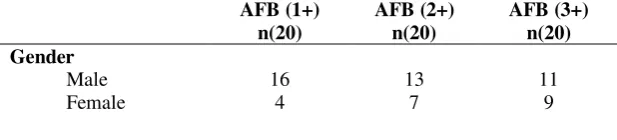
The subjects study’s characteristic is in table 1. The table shows that male subject is the majority of pulmonary TB cases. The age for most pulmonary TB cases are with AFB (+1) and AFB (+2) is 41-50 years old, and for AFB (+3) is 17-30 years old. Body mass index (BMI) calculated shown AFB (+1) and AFB (+2) is normal, and for AFB (+3) is underweight.
1234567890
ICTROMI IOP Publishing
IOP Conf. Series: Earth and Environmental Science 125 (2018) 012152 doi :10.1088/1755-1315/125/1/012152
Age
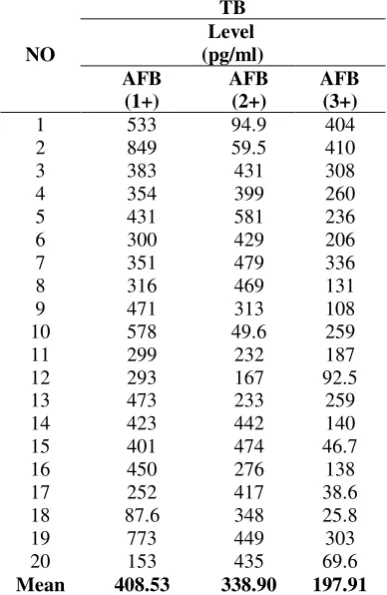
Table 2. Mean comparison IFN-γ level of pulmonary TB based on AFB positivity.
NO
Table 2 shows the mean of IFN-γ level was highest in pulmonary TB AFB (+1) with 408.53 pg/ml, followed by pulmonary TB AFB (+2) with 338.90 pg/ml and the lowest in pulmonary TB AFB (+3) with IFN-γ was 197.91 pg/ml. Data then were analyzed with Mann Whitney test due to non-normal distribution. It can be a conclusion that there is the statistically significant relationship between the level of IFN-γ and AFB positivity in pulmonary TB patients (p=0.001).
4. Discussion
This study found that there is the statistically significant relationship between the level of IFN-γ and AFB positivity. The result showed that a higher AFB positivity in pulmonary TB tendency a lower level of IFN-γ.
The study about the relationship between AFB positivity with IFN-γ so far is still limited. Most of the previous study was compare the IFN-γ levels among pulmonary tuberculosis patients with healthy people.
4
1234567890
ICTROMI IOP Publishing
IOP Conf. Series: Earth and Environmental Science 125 (2018) 012152 doi :10.1088/1755-1315/125/1/012152
tuberculin. These results indicate that immune response to Mycobacterium tuberculosis associated with the decreasing of IFN-γ production, which is not to the decreasing of IL-12 nor increasing of IL-4 and IL-10.[6]
Other studies showed the effect IFN-γ production disorder that caused a low level of IFN-γ in the blood circulation to the vulnerability host with high contact to tuberculosis. Flynn et al. studied in mice by destructing the gene that responsible for producing IFN-γ, so the level of IFN-γ is very low. The fact that even granulomas were formed, the mice failed to produced reactive nitrogen intermediate, a compound that is essential in MTB bactericidal, so it cannot stop MTB growth. In the mice were found tissue necrosis and worsened in the disease that caused a faster mortality.[7]
Lopez-Maderuelo et al. had done a study on blood vein sample of 133 new cases of TB AFB (+). They found in TB patients accrued gene polymorphism that produced IFN-γ, so the level of IFN-γ is very low and had higher risks to be infected by tuberculosis.[8] Pathan et al. found that active TB patients with positive culture had a low level of IFN-γ compared to healthy person, minimal TB or negative bacteriological.[9]
The cause of the decrease in IFN-γ levels was not investigated in this study, but it can assume that some factors may cause decreasing in IFN-γ levels: the first probability is the BMI in TB patients with AFB (3+) is lower than TB patient with AFB (1+) AND (2+). The low value of BMI was supposed to decrease the IFN-γ production. The second possibility is because of the severe disease in AFB (3+) patient is more than patient with AFB (1+) and (2+). The more severity can be interpreted the more amount of IFN-γ likely to be used, so over time, IFN-γ levels in TB patient with AFB (3+) will be lower.
5. Conclusion
In this study confirmed that there was the association between the level of IFN-γ and AFB positivity in pulmonary TB patients. It is necessary to do further research to find out why IFN-γ levels in TB patients with AFB (3+) are lower when compared with AFB (2+) and AFB (1+).
References
[1] World Health Organization 2015Global tuberculosis report 20th edition
[2] Widjaja J T, Diana K J and Rina L R 2010 Analisis kadar interferon gamma pada penderita tuberculosis paru dan orang sehat Jurnal Respirologi Indonesia 30(2) 119-24
[3] Verbon A, Juffermans N, Van Deventer S J H, Speelman P, Van Deutekom H and Van Der Poll T 1999 Serum concentrations of cytokines in patients with active tuberculosis (TB) and after treatment Clin. Exp. Immunol. 115 110-3
[4] Nadeem A, Shahid H, Khursheed J and Waqas S 2014 Inverse correlation of interferon-gamma and CD8+ T lymphocytes in tuberculosis patients Majmaah J. Health Sci. 2(1)
[5] M BioSource.com Antibody-protein-ELISA kit Human IFN gamma ELISA kit
Catalog#MBS824507 Lot#CK1E90A
[6] Swaminathan S, Gong J, Zhang M, Samten B, Hanna L E, Narayanan P R, et al. 1999 Cytokine production in children with tuberculous infection and disease Clin. Infect. Dis. 28(6) 1290-3 [7] Flynn J L, Chan J, Triebold K J, Dalton D K, Stewart T A and Bloom B R 1993 An essential
role for interferon gamma in resistance to Mycobacterium tuberculosis infection J. Exp. Med. 178(6) 2249-54
[8] Maderuelo D L, Arnalich F, Serantes R, Gonzales A, Codoceo R and Madero R 2003 Interferon-g and interleukin-10 gene polymorphisms in pulmonary tuberculosis Am. J. Respir. Crit. Care Med. 167 970-5