DATA SHEET
Product specification
File under Integrated Circuits, IC02
August 1982
SAA3004
August 1982 2
Philips Semiconductors Product specification
Remote control transmitter
SAA3004
GENERAL DESCRIPTION
The SAA3004 transmitter IC is designed for infrared remote control systems. It has a total of 448 commands which are divided into 7 sub-system groups with 64 commands each. The sub-system code may be selected by a press button, a slider switch or hard wired.
The SAA3004 generates the pattern for driving the output stage. These patterns are pulse distance coded. The pulses are infrared flashes or modulated. The transmission mode is defined in conjunction with the sub-system address. Modulated pulses allow receivers with narrow-band preamplifiers for improved noise rejection to be used. Flashed pulses require a wide-band preamplifier within the receiver.
The SAA3004 has the following features:
• Flashed or modulated transmission
• 7 sub-system addresses
• Up to 64 commands per sub-system address
• High-current remote output at VDD= 6 V (−IOH= 40 mA) • Low number of additional components
• Key release detection by toggle bits
• Very low stand−by current (<2µA)
• Operational current<2 mA at 6 V supply
• Wide supply voltage range (4 to 11 V)
• Ceramic resonator controlled frequency (typ. 450 kHz)
• Encapsulation: 20-lead plastic DIL or 20-lead plastic mini-pack (SO-20)
PACKAGE OUTLINES
SAA3004P: 20-lead DIL; plastic (SOT146); SOT146-1; 1996 December 11.
INPUTS AND OUTPUTS
Key matrix inputs and outputs (DRV0N to DRV6N and SEN0N to SEN6N)
The transmitter keyboard is arranged as a scanned matrix. The matrix consists of 7 driver outputs and 7 sense inputs as shown in Fig.1. The driver outputs DRV0N to DRV6N are open drain N-channel transistors and they are conductive in the stand-by mode. The 7 sense inputs (SEN0N to SEN6N) enable the generation of 56 command codes.
With 2 external diodes all 64 commands are addressable. The sense inputs have P-channel pull-up transistors, so that they are HIGH until they are pulled LOW by connecting them to an output via a key depression to initiate a code transmission.
Address mode input (ADRM)
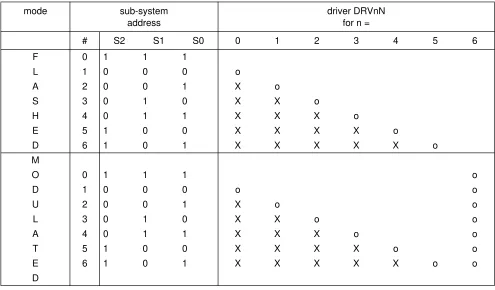
The sub-system address and the transmission mode are defined by connecting the ADRM input to one or more driver outputs (DRV0N to DRV6N) of the key matrix. If more than one driver is connected to ADRM, they must be decoupled by a diode. This allows the definition of seven sub-system addresses as shown in Table 3. If driver DRV6N is connected to ADRM the data output format of REMO is modulated or if not connected, flashed.
The ADRM input has switched pull-up and pull-down loads. In the stand-by mode only the pull−down device is active. Whether ADRM is open (sub-system address 0, flashed mode) or connected to the driver outputs, this input is LOW and will not cause unwanted dissipation. When the transmitter becomes active by pressing a key, the pull−down device is switched off and the pull-up device is switched on, so that the applied driver signals are sensed for the decoding of the sub-system address and the mode of transmission.
The arrangement of the sub-system address coding is such that only the driver DRVnN with the highest number (n) defines the sub-system address, e.g. if driver DRV2N and DRV4N are connected to ADRM, only DRV4N will define the sub-system address. This option can be used in transmitters for more than one sub-system address. The transmitter may
August 1982 4
Philips Semiconductors Product specification
Remote control transmitter
SAA3004
be hard-wired for sub-system address 2 by connecting DRV1N to ADRM. If now DRV3N is added to ADRM by a key or a switch, the transmitted sub-system address changes to 4.
A change of the sub-system address will not start a transmission.
Remote control signal output(REMO)
The REMO signal output stage is a push-pull type. In the HIGH state a bipolar emitter−follower allows a high output current. The timing of the data output format is listed in Tables 1 and 2.
The information is defined by the distance tbbetween the leading edges of the flashed pulses or the first edge of the
modulated pulses (see Fig.3).
The format of the output data is given in Figs 2 and 3. In the flashed transmission mode the data word starts with two toggle bits T1 and T0, followed by three bits for defining the sub-system address S2, S1 and S0, and six bits F, E, D, C, B and A, which are defined by the selected key.
In the modulated transmission mode the first toggle bit T1 is replaced by a constant reference time bit (REF). This can be used as a reference time for the decoding sequence.
The toggle bits function as an indication for the decoder that the next instruction has to be considered as a new command.
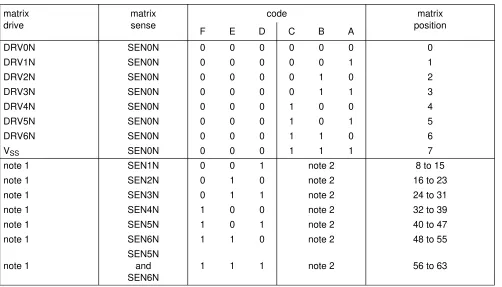
The codes for the sub−system address and the selected key are given in Tables 3 and 4.
Oscillator input/output(OSCI and OSCO)
The external components must be connected to these pins when using an oscillator with a ceramic resonator. The oscillator frequency may vary between 400 kHz and 500 kHz as defined by the resonator.
FUNCTIONAL DESCRIPTION
Keyboard operation
In the stand-by mode all drivers (DRV0N to DRV6N) are on. Whenever a key is pressed, one or more of the sense inputs (SENnN) are tied to ground. This will start the power-up sequence. First the oscillator is activated and after the debounce time tDB(see Fig.4) the output drivers (DRV0N to DRV6N) become active successively.
Within the first scan cycle the transmission mode, the applied sub-system address and the selected command code are sensed and loaded into an internal data latch. In contradiction to the command code the sub-system address is sensed only within thefirst scan cycle. If the applied sub-system address is changed while the command key is pressed, the transmitted sub-system address is not altered.
In a multiple key-stroke sequence (see Fig.5) the command code is always altered in accordance with the sensed key.
Multiple key-stroke protection
The keyboard is protected against multiple key-strokes. If more than one key is pressed at the same time, the circuit will not generate a new output at REMO (see Fig.5). In case of a multiple key-stroke the scan repetition rate is increased to detect the release of a key as soon as possible.
There are two restrictions caused by the special structure of the keyboard matrix:
• The keys switching to ground (code numbers 7, 15, 23, 31, 39, 47, 55 and 63) and the keys connected to SEN5N and SEN6N are not covered completely by the multiple key protection. If one sense input is switched to ground, further keys on the same sense line are ignored.
Output sequence (data format)
The output operation will start when the selected code is found. A burst of pulses, including the latched address and command codes, is generated at the output REMO as long as a key is pressed. The format of the output pulse train is given in Figs 2 and 3. The operation is terminated by releasing the key or if more than one key is pressed at the same time. Once a sequence is started, the transmitted words will always be completed after the key is released.
The toggle bits T0 and T1 are incremented if the key is released for a minimum time tREL(see Fig.4).
The toggle bits remain unchanged within a multiple key-stroke sequence.
Fig.2 Data format of REMO output; .
REF = reference time; T0 and T1 = toggle bits; S0, S1 and S2 = system address; A, B, C, D, E and F = command bits
(a) flashed mode: transmission with 2 toggle bits and 3 address bits, followed by 6 command bits (pulses are flashed).
(b) modulated mode: transmission with reference time, 1 toggle bit and 3 address bits, followed by 6 command bits (pulses are modulated).
Fig.3 REMO output waveform.
(1) Flashed pulse.
August
1982
6
Philips Semiconductors
Product specification
Remote control transmitter
SAA3004
Fig.4 Single key-stroke sequence. Debounce time: tDB= 4 to 9×TO.
Start time: tST= 5 to 10×To.
Minimum release time: tREL= TO.
Word distance: tW.
Fig.5 Multiple key-stroke sequence.
Scan rate multiple key-stroke: tSM= 6 to 10× TO.
Table 1 Pulse train/timing
Table 2 Pulse train separation (tb)
mode TO
ms
tp µs
tM µs
tML µs
tMH µs
tW
ms
flashed 2,53 8,8 − − − 121
modulated 2,53 − 26,4 17,6 8,8 121
fOSC 455 kHz tOSC= 2,2µs
tP 4×tOSC flashed pulse width
tM 12×tOSC modulation period
tML 8×tOSC modulation period LOW
tMH 4×tOSC modulation period HIGH
TO 1152×tOSC basic unit of pulse distance
tW 55 296×tOSC word distance
code tb
logic “0” 2×To
logic “1” 3×To
reference time 3× To
August 1982 8
Philips Semiconductors Product specification
Remote control transmitter
SAA3004
Table 3 Transmission mode and sub-system address selection
The sub-system address and the transmission mode are defined by connecting the ADRM input to one or more driver outputs (DRV0N to DRV6N) of the key matrix. If more than one driver is connected to ADRM, they must be decoupled by a diode.
Notes
1. o = connected to ADRM 2. blank = not connected to ADRM 3. X = don’t care
mode sub-system
address
driver DRVnN for n =
# S2 S1 S0 0 1 2 3 4 5 6
F 0 1 1 1
L 1 0 0 0 o
A 2 0 0 1 X o
S 3 0 1 0 X X o
H 4 0 1 1 X X X o
E 5 1 0 0 X X X X o
D 6 1 0 1 X X X X X o
M
O 0 1 1 1 o
D 1 0 0 0 o o
U 2 0 0 1 X o o
L 3 0 1 0 X X o o
A 4 0 1 1 X X X o o
T 5 1 0 0 X X X X o o
E 6 1 0 1 X X X X X o o
Table 4 Key codes
Notes
1. The complete matrix drive as shown above for SEN0N is also applicable for the matrix sense inputs SEN1N to SEN6N and the combined SEN5N/SEN6N.
2. The C, B and A codes are identical to SEN0N as given above. matrix
drive
matrix sense
code matrix
position
F E D C B A
DRV0N SEN0N 0 0 0 0 0 0 0
DRV1N SEN0N 0 0 0 0 0 1 1
DRV2N SEN0N 0 0 0 0 1 0 2
DRV3N SEN0N 0 0 0 0 1 1 3
DRV4N SEN0N 0 0 0 1 0 0 4
DRV5N SEN0N 0 0 0 1 0 1 5
DRV6N SEN0N 0 0 0 1 1 0 6
VSS SEN0N 0 0 0 1 1 1 7
note 1 SEN1N 0 0 1 note 2 8 to 15
note 1 SEN2N 0 1 0 note 2 16 to 23
note 1 SEN3N 0 1 1 note 2 24 to 31
note 1 SEN4N 1 0 0 note 2 32 to 39
note 1 SEN5N 1 0 1 note 2 40 to 47
note 1 SEN6N 1 1 0 note 2 48 to 55
note 1
SEN5N and SEN6N
August 1982 10
Philips Semiconductors Product specification
Remote control transmitter
SAA3004
Fig.6 Pinning diagram.
PINNING
1 REMO remote data output
2 SEN6N
key matrix sense inputs
3 SEN5N
4 SEN4N
5 SEN3N
6 SEN2N
7 SEN1N
8 SEN0N
9 ADRM address mode control input
10 VSS ground
11 OSCI oscillator input 12 OSCO oscillator output 13 DRV0N
key matrix drive outputs 14 DRV1N
15 DRV2N 16 DRV3N 17 DRV4N 18 DRV5N 19 DRV6N
20 VDD positive supply
RATINGS
Limiting values in accordance with the Absolute Maximum System (IEC 134)
Supply voltage range VDD −0,5 to+15 V
Input voltage range VI −0,5 to VDD+0,5 V
Output voltage range VO −0,5 to VDD+0,5 V
D.C. current into any input or output ± I max. 10 mA
Peak REMO output current
during 10µs; duty factor = 1% −I(REMO)M max. 300 mA
Power dissipation per package
for Tamb=−20 to+70°C Ptot max. 200 mW
Storage temperature range Tstg −55 to+150 °C
CHARACTERISTICS
VSS= 0 V; Tamb= 25°C; unless otherwise specified
PARAMETER VDD (V) SYMBOL MIN. TYP. MAX. UNIT
Supply voltage
(ceramic resonator) 4 to 11 fOSC 400 − 500 kHz
Keyboard matrix
Inputs SEN0N to SEN6N
Input voltage LOW 4 to 11 VIL − − 0,2×VDD V
Outputs DRV0N to DRV6N Output voltage “ON”
Input current (switched P- and N-channel pull-up/pull-down)
Pull-up active 4 IIL 10 − 100 µA
stand-by voltage: 0 V 11 IIL 30 − 300 µA
Pull-down active 4 IIH 10 − 100 µA
August 1982 12
Philips Semiconductors Product specification
Remote control transmitter
SAA3004
Data output REMO
Output voltage HIGH 6 VOH 3 − − V
−IOH= 40 mA 9 VOH 6 − − V
Output voltage LOW 6 VOL − − 0,2 V
IOL= 0,3 mA 9 VOL − − 0,1 V
Oscillator
Input current
OSCI at VDD 6 II 0,8 − 2,7 µA
Output voltage HIGH
−IOL= 0,1 mA 6 VOH − − VDD−06 V
Output voltage LOW
IOH= 0,1 mA 6 VOL − − 0,6 V
PACKAGE OUTLINE
DIMENSIONS (inch dimensions are derived from the original mm dimensions)
SOT146-1 92-11-17
1. Plastic or metal protrusions of 0.25 mm maximum per side are not included.
(1) (1) (1)
August 1982 14
Philips Semiconductors Product specification
Remote control transmitter
SAA3004
UNIT max.A A1 A2 A3 bp c D(1) E(1) e HE L Lp Q v w y Z(1) θ
DIMENSIONS (inch dimensions are derived from the original mm dimensions)
Note
1. Plastic or metal protrusions of 0.15 mm maximum per side are not included.
1.1
075E04 MS-013AC
pin 1 index
SO20: plastic small outline package; 20 leads; body width 7.5 mm SOT163-1
SOLDERING
Introduction
There is no soldering method that is ideal for all IC packages. Wave soldering is often preferred when through-hole and surface mounted components are mixed on one printed-circuit board. However, wave soldering is not always suitable for surface mounted ICs, or for printed-circuits with high population densities. In these situations reflow soldering is often used.
This text gives a very brief insight to a complex technology. A more in-depth account of soldering ICs can be found in our“IC Package Databook” (order code 9398 652 90011).
DIP
SOLDERING BY DIPPING OR BY WAVE
The maximum permissible temperature of the solder is 260°C; solder at this temperature must not be in contact with the joint for more than 5 seconds. The total contact time of successive solder waves must not exceed 5 seconds.
The device may be mounted up to the seating plane, but the temperature of the plastic body must not exceed the specified maximum storage temperature (Tstg max). If the
printed-circuit board has been pre-heated, forced cooling may be necessary immediately after soldering to keep the temperature within the permissible limit.
REPAIRING SOLDERED JOINTS
Apply a low voltage soldering iron (less than 24 V) to the lead(s) of the package, below the seating plane or not more than 2 mm above it. If the temperature of the soldering iron bit is less than 300°C it may remain in contact for up to 10 seconds. If the bit temperature is between 300 and 400°C, contact may be up to 5 seconds.
SO
REFLOW SOLDERING
Reflow soldering techniques are suitable for all SO packages.
Reflow soldering requires solder paste (a suspension of fine solder particles, flux and binding agent) to be applied to the printed-circuit board by screen printing, stencilling or pressure-syringe dispensing before package placement.
Several techniques exist for reflowing; for example, thermal conduction by heated belt. Dwell times vary between 50 and 300 seconds depending on heating method. Typical reflow temperatures range from 215 to 250°C.
Preheating is necessary to dry the paste and evaporate the binding agent. Preheating duration: 45 minutes at 45°C.
WAVE SOLDERING
Wave soldering techniques can be used for all SO packages if the following conditions are observed:
• A double-wave (a turbulent wave with high upward pressure followed by a smooth laminar wave) soldering technique should be used.
• The longitudinal axis of the package footprint must be parallel to the solder flow.
• The package footprint must incorporate solder thieves at the downstream end.
During placement and before soldering, the package must be fixed with a droplet of adhesive. The adhesive can be applied by screen printing, pin transfer or syringe dispensing. The package can be soldered after the adhesive is cured.
Maximum permissible solder temperature is 260°C, and maximum duration of package immersion in solder is 10 seconds, if cooled to less than 150°C within 6 seconds. Typical dwell time is 4 seconds at 250°C. A mildly-activated flux will eliminate the need for removal of corrosive residues in most applications.
REPAIRING SOLDERED JOINTS
Fix the component by first soldering two diagonally-opposite end leads. Use only a low voltage soldering iron (less than 24 V) applied to the flat part of the lead. Contact time must be limited to 10 seconds at up to 300°C. When using a dedicated tool, all other leads can be soldered in one operation within 2 to 5 seconds between
August 1982 16
Philips Semiconductors Product specification
Remote control transmitter
SAA3004
DEFINITIONS
LIFE SUPPORT APPLICATIONS
These products are not designed for use in life support appliances, devices, or systems where malfunction of these products can reasonably be expected to result in personal injury. Philips customers using or selling these products for use in such applications do so at their own risk and agree to fully indemnify Philips for any damages resulting from such improper use or sale.
Data sheet status
Objective specification This data sheet contains target or goal specifications for product development. Preliminary specification This data sheet contains preliminary data; supplementary data may be published later. Product specification This data sheet contains final product specifications.
Limiting values
Limiting values given are in accordance with the Absolute Maximum Rating System (IEC 134). Stress above one or more of the limiting values may cause permanent damage to the device. These are stress ratings only and operation of the device at these or at any other conditions above those given in the Characteristics sections of the specification is not implied. Exposure to limiting values for extended periods may affect device reliability.
Application information