Scopus
PreviewAuthor
details
E.I
The 9opus Arthor ldentifier assigns a unique number to groups of documents Inittcn fo the same euthor uia an algorithm that makhes authorship based on e ertein criteria- lf a document cannot be confidently mrtched with an author identifier, it is grouped scparetely, ln this case, Irou may sle more than one enky for the srmeautl-ror-t.rrli
Anggonq
Willyanto
Uriversitas Kristen Petra, Surabaye, Ea:t Jara, lndonesie
Author lD:55561550300
Othernameformels:
{@ililE)
Subjed area:
Iop Scitbl Topic
@
Biogas I Anaerobic digestion I biogas digestersDocumentand 4
citation trends:
6 0 E o o
a
.r
2012AG€t cit tion alerts $AddtoORODO
&
Regu€struthorderril oorrectior|s16
Documents
Cited by 49 documents 22co-authors
Author historyViar in search results format>
Export
all
Add all tiolist
Set documentalert Set document feed
Doanment
title
Authqrs:.!
i FollowthisArlftor !
Vieu, pateqtiaI luthor matches
I Ooosnents acfrarim
firrint
ElEmeitwA
Anggonq WillyantoaUniraersitas Kristen Petra
}-index@
Viewh-graph6
Documents
\
euthor16 Anrlyze author output
Total citetiom 90 ay +r documents
Sort on: Datc (nerrest) v
Year Source Cited by
fi
a
o a 3 o
o
Combustion Charecteristics Beh:vior of Pterocerpus indiors Leaves Waste Anggono. W., Suprirntg F"D., Gotema. Briquette at \A.aous Pertide Size and Pressure eJ-, Sotrimo, Erander,J_
Open Access
Via* rbstradv Releted documents
Biomass briguette investigation from Pterocarpus indians twigs waste as an alternatirre renanrable energy
Man abstract - . Related documenh
lnvestigation on biomass briqsette from Cerbera manghas r*aste tuigs as renewable energy source
Melr abstract v Related doorrnents
Ef,ect of Cerbera Manghas biodisel on disel engine performance Open Access
Vien abstract v Related documents
Anggonq ltr, Sutntnq Suprianto, f.D,
€vander, J., Gotama, GJ,
Anggono, V., Supriantc, F.D., Sutrisno, (...), Evander,!, l&srun, AW
,dnggonqW, Noor, M,M., Supriantq F-D. (...), Gotama,6J., Setipran, A.
2Ol8 IOP Conferrnce Sedes Materiels O Scienc and Engineering
2018 lnternational Journal of Reneunble Energy Research
ARPN Journal ofEngineering and Applied Scienccs
2018 lntemational Joumal of Automotive rnd M*hanical €ngineering
t
2018
l
Document title Authors Year Source Cited by
Biomass Briquette lnvestigation *om Piterocarpus lndicus Leaves Waste as Anggonq W., Sutning Supriantq F-D., 2017 IOP Conference Series: Materials 4 \.
an Ahemative Ren*reble Energy Evander, I Science and Engincering h '
Open Access
Vianr abstract v Related documents
Behaviourofbiogascortainingnitrogenonflammabilitylimitsandbminar AnggonqW. 2017 lntemationaljournal ofRenewable s
burningvelocities Energy Research
View abstract v Rdated documents
Theelfectsofpartrclesizcandpressureonthe combustioncharacteristicsof Sutrisno,AnggonqW.,Suprianto,F.D., 201? ARPNJournal ofEngiaeeringand 6 cerbera manghasleaf briquettes Kasrun, A\ff., siahaan, l.H. Applied Sciences
Vierr abstract v Related documents
Performence of gasoline/LPG Bl-fuel engine of manifold absolute pressure Setiyq M-, Waluy+ 8., Anggonq )V. , 2AL6 ARPN Journal of Engineering and 6
sensor (MAP!) variations feedback Husni, M. Applied Scienccs
Vicw abstract v Related documents
The influence of Co2 in biogrs flammability limit and laminir burning Anggonq W.. I\lVardana, l.N.G., Larrcs, M., 2016 AIP Conference Pmceedings 3 velocity in spark ignited premix combustion at various pre$sures (..-), Hamidi, N., Hayakewa, A
Manr abstract v Relrted documents
The ef,ect ofnitrogen on biogas flame propagation characteristic in premix Anggonq W., Supriantq F,D., Hartantq 2016 AIP Conference Proceedings I
cornbustion T.l-, Pumomq K., l#iiaya, T.P.
View abstract v Related documents
Etrect of carbon dioxide on flame characteristics in biogas external prernix tuprianto, F.D., l*tggons, !U., Tanoto, 2016 lntemationaljourffil of Applied 2
combustion M.s.C Engineering Re*arch
View abstract v Related docriments
Bdravior offlame propagation in biogas spark ignited prtmix combustion Anggonq W., Dwipulra Supriantq F., 2014 Mvanced Materials Research 4
with carbon dioxide inhibitor Wijrya, T.P., Tanoro, M.S.C. View abstractv Related documcnts
Etrect of inhibitors on biogas larninar burniag velocity and fammebility Anggoirq V., Wardana, LN.G., Lawrs, M., 2013 lntemationalJournal of Engineering Ll
limits in spark ignited premix combustion Hughes, KJ. and Technology View abstract v Related documents
Laminar burning rrelocity and flammability characteristics ofbiogas in spark Anggonq W., Wardana, 1., Lawas, M., {..-}, 2013 Applied Mechanis and Materials 13
ignited premix combustion at reduced pressure Wahyudi, S., Hamidi, N. View abstract v Related dooments
Biogas laminarburningvelocityand flammabilitycharacteristics in spark AnggonqV-,Wardana, l.N.G-, Law*, M-, 2013 Journal of Physies: Conference Series 15
ignited premix combustion (...) H*midi, N., Hayakewa, A.
0pen Access
Mew abstract v Retated documents
laminar burning characteristics cf biogas-air mixtures in spa* ignited Anggonq W-, Wardana, l.N-6., Laues, M-, 2012 Journal ofApplied Sciences Research 15
premix ombustion (..J, Wahyudi, S., Hamidi, N.
View abstract v Related documents
Display
20
re'sults per pege^Top ofpage ' Thc data displayed abcw is compilcd exdusivdy from doanmcnts indcrcd in thc Scopus databasc, Tc rrqucst mrrrdiof,s to any ioarurtries or providc
any furdrer fcedbac*, please use the Author Feedbac* Mzard .
l
hr"'" i
Whetis Sspus Content coverage
Scopus blog Smpus API
Pdyacy metterr .
B*EE|;$DEZA
ffiHt
6+t
tI*SJIFGTFX Pyccru$ nst*x
Hclp
Contact us
'n
t
h.
k
tdx
EISEVIER Terms and conditions
a
Pdvrcy policy,
Copyright @ 2019 Ehryicr B.V a, AI rights rcserued. SopsrrD is a registcrcd tndcma* of Bscvier B.V.
V/c usc cookies to hdp proride and enhencc our s:rvic and teihr contcnL By continuing, you agrec to thc use of cookics,
l .6 r-9
ES
oo 6'.rA'i.+l
,.
-
:Glj : o o, dr (, o 6 {,rl Il .,1
o, (J :r
.'""::t :
0, E aE, 2,,: !l O:r o .ct3: O-,:, L] OI':
z
UI thg':r\
FE
E:]:
l, cl n L:I o ?o fii= ? fo,
lt.<:,:
(/, L9z
v
z
Eo
z
o
tr'
=
t
F a z_o
L2 =o
H
ii
ED (E .E o U' -o 3(u CL (} E 0 T' oal, $ il I i'":lE
l:*.i
..r '\r' l
oq', o6aI a\tt* o. ,:Nt l', oi \Ol
o.i
ll r
i,l
r; !
tl,
U
(r, 1('s
Es
SE
E58
-6CJ
o
i; CO :1 ,i
F ::J F:;J rO rt E@
rg
OG G c) BA6E
t! cr P (r, ot\ (D N tn Ec. 3 o -) o. !, I t, o o F N5
o E'I c -v.c .! d e = o C)gI
$I
toa:) F:::: €h].l t,1irr 1l
.aj
n)ii
Fii
E,O.l., )- C.
df, oi 8R 6 ?x !,g ai \Oi \ttt o 6 6 -g E
:
6 6 I a o Ea
t,d d-l
o t,l (c E (} U' @ L o U' =
g
o LL )ggs
E{e P N N (\lfr
HB,KB
.*oo
6
E,
o t cL Fri:
\-r' .9,(, E a o oo = 5 o il _9, o:
o -, o J lrl o .A E o tl o J 3 F :.;;:;;:':i;. !t {g9>
.=
cr,be
a,O
.EE
CD*'Eg
hr(,ro
b=
cO U.l ELG]: E:, Oi
I
'E ri(l)i:
o;
Eir 'Et l l!l
0'l tr
c, r:
t: F]
o:
6: E:]='.
o;
-) 6 o EN c,=
c' .ot
.if L L J o -, 0, E -yoFI .(E d.
c
= o C) oA G .E = o -),o
o) .E ,E a U),(O
r9
(6*O
o
(r)_o(qE
5a
lJo,C
E TI'
E(u .9EPG
6t C>
s
bH
l-!C o
,,d
:c
:::i. f
o
.,
:r': ir: 6u :at g
li: O
,:
<FT
,E
i.,
E:i'
:,r [J 6l:
l
5=
s.0
qa^-' 3?E!-E
;Ei
nESHE
. eo o
=
6
+E+;
E
I
E HE HE
i.AE
osPa
.
EE:
AEP.SE
€et*
-CEEfrEE*
EE
EE
EEEe
=eEE
c*:6Et
H E'l0JE,g Hg-.8 5 dE.e
8=38
E! $*
o.g =E -rl E E" e'E
EEE
4 ol e
aE g';
>E O=
bhSE
EorE
SEEB
rSfE
o hl, I
r;E
afE.Er
;
B*'Eoil O >
EE:3
.ga o r
.E-,- O
$e=E
E6oO;t!rf
EEEf;
:'-o t ui*#p:t
9;a?
ar'=
;
'-o)ii
ffgEE,.
g BE
gq
E
==Ei T.E
E
fiE*gP
I
#E5sE
-*E
E.e
oePtcE+
€;
gE
s:.E
P
e
*
I
E6*
gE
a!
g;E
e
H
,s'Er'€
fiEE
@ai
b.::PEa
EE.hEE
HF
EiE-nl#
gP
.E
irr
;o-
e_ i' fr,B*
F
e, EEP-HE
BE
E
*
F
F
EgE#_g
,"'#
: E ii 3
E€5EE
S
i
E
ii
E+EET
{, ts o g a G 6 6 !--iI H ]d F"4aa
i: =E€
F
ooz
Ez
d U'z
o 5 FY F6 vtzz
o8=e
=dgE
H3
uE
t,lLEE
EE
BE
?o a a o o I60 f a o n L CO-
J-o
L
(u
o
o
o
E,
C'I
L
o
g
lr|
o
--cl
rtr
=
o
tr
o
t,
qr
o
-
G
-
l-
f--J
o
-,
I(E
tr
o
.If
(u
fL
L
o
y
s
EL E I o 6o F o ol ! o &, h tr)
o (, o o! c I tr o d 6. E)
o l na It o? .l
ra oooo >! Fb ?t EPo,= oz 'Lr oo =! d! ?E
Ea'
a5 t6ec g6 do x>i .ar 60 CC u 60 o3 EB60 =co&
? e:
.2 t = c-E E. fo oi tg te =@ o€Egd.
.=clooo
gPG-E=*c
o 6 0 {t
k.
,lt$"1 il+
& :':' \+ ts o N I o d D o d o d o N ^^^gsg
ooo
*
Eg.g.- o *0N d.io oo6 r 666 E \\\
:.l 666ooo
9XE (,(J(]
.
Blf
l o c a o
-.9 ? o o ^O E.P 6; oo rozcL OEE.;
G'
EE
=2
1 E;
?
es
c,zaz 6=Q
Z
EEE
=
3.af
o
r Ig i o. Ec
CL 0 E E o o I o' tr!F E '6 o;
=-\
ut CL*
c o cr L a o fo:
(, o Eo or o (! o E. n E'o so E = o E o C' o} E IE.
C 9E E
Eo 3= i;
8,8 *9.
EE9 ;E
id
.e.7
E
=
EE= aE
ir;a
eEt;t
I
I att
.EEr
si
tE fr ,B't;
:r
Ei
E'} E Eo o E o o E o:
o -i e a! o o o a o o E U -g l,o'
I c 'o d. e,,:,, Ntr 6: N::,i o
Ei,5
ol c
N3
'lt:o
-l.C
o: o
NE
6 SO
5A
NO':, Z
oir N@ c oP
R*;
lPo rE5r, o
9.o (ro .E I,() T'o g =o ! ! Eo (, 6 o = o '= o o s o F E EI E ,= ,E o -e :{? o o (f o o tt o = (J (t o o o o. 0 o (", =.IrI :F ri o N
.::
oi Ni l s:. oii (t <t: o Nc co i:€
EE
N:E ::< d9 F: o! Ni' 6:: Ni, r o € o N e c d o N o o N N e N o N ,J-r o:.
o 6:N6 .c-P
o: Nlo o ::an tEE
].E Nt: '6=
o o
N
,:o
I :-
b otr N= io:o Fiat5r:
NO i'6*
, 'ii.,ifta:. o Ni, D:: N ,l FC
F€
E -o-rr
oo N= ::6 i()d: ?
oc N,O :o _:c =o N: ' iiP e !s N oo (J
*
(u at) t.o ro,:()
:o tr oo oo ::6*il I ${
i J
-L
*+
4
!
)
I
'
Energy Research-IJRER
HOME ABOUT LOGIN
REGISTERARCHIVES Af.JItOUT'ICEHEffTS
Home > Vol 8, Ho 4 {2018).
International Journal
of
Renewable
Energy
Research
(IJRER)
The International Journal
of
Renewabte Energy Researchf"*t*i
ir
,"i
"
for profit organisation. IJRER is a quarterly published, open source journal
and operates an online submission with the peer review system allowing authors
to
submit articles online andtrack their
progressvia its
webinterface. IJRER seeks
to
promoteand
disseminate knowledgeof
the various topics and technologiesof
renewable (green) energy resources.The
journal
aimsto
presentto
the
international community important results of work in the fieldsof
renewable energy research, development, application or design. The journal also aims to help researchers, scientists, manufacturers, institutions, world agencies, societies, etc. to keep up with new developmentsin
theory and applications andto
provide alternativeenergy
solutionsto
current
issuessuch
as the
greenhouse effect, sustainable and clean energy issues.The
IJRERjournal
aims
for
a
publication speedof 60 days
from submission until final publication.The coverage of IJRER includes the following areas, but not limited to:
.
Green (Renewable) Energy Sources and Systems (GESSs)as
Windpower,Hydropowe,;
Solar
Energy, Biomass, Biofuel,
GeothermalEnergy, Wave Energy, Tidal energy, Hydrogen
&
Fuel Cells, Li-ionBatteries, Capacitors
.
New Ttends and TEchnologies for GESSs.
Policies and strategies for GESSs.
Production of Energy Using Green Energy Sources.
Applications for GESSs.
Energy Transformation from Green Energy System to Grid.
Novel Energy Conversion Studies for GESSs.
Driving Circuits for Green Energy Systems.
Control Techniques for Green Energy Systems.
Grid Interactive Systems Used in Hybrid Green Energy Systems.
Peformance Analysis of Renewable Energy Systems.
Hybrid GESSs.
Renewable Energy Research and Applications for Industries'
GESSs for Electrical Vehicles and Components.
Artificial Intelligence Studies in Renewable Energy Systems.
Computational Methods for GESSs.
Machine Learning for Renewable Energy Applications.
GESS DesignI
Energy Savings.
Sustainable and Clean Energy Issues.
Public Awareness and Education for Renewable Energy'
.
Future Directions for GESSs.
Thermoelectric Energyel_qk tlere for Author Guidelines
USER
ur"rn"'n"fiiiifr'riiT
r-Password lrrooooooo
ll
Remember me .,tpgl.+iNOTIFICATIONS r VLs\r{
. Sqbssr&.e
JOURNAL
CONTE NT
Search
I
Search Scooe
IIIT
l"t#i.
Browse
. -Ey,Is-s-ue
.
Bvlslh-o.r'
-QY-Titi-eFONT SIZE
INFORMATION
.
Eo_r* Rendels.
-Esr {u_Lhprs.
Eer-l=Lb-rariars-J-Euraal-U_elp
International Journal
of
Renewable
_Clskllc_rc for Template for Peer Review Papers
-el_ct_H_er_e for Template for Accepted Papers
Onlinc ISSN: l3O9-O127
IJRER is cited in SCOPUS, EBSCO, WEB of SCIENCE (Clarivate Analytics);
WEB of SCIENCE between 2016-2018; h=11,
Average citation per itcm=1.98
Impact Factor= 14861 633=2.347
Announcements
URERis inthe
Emergrng SourcesCitation Indexonweb
of ScienceIIRER has been cited in Emerging Sources,Citation Index from 2016 in web of science-WEB of SCIENCE between 2016-2078;
h=11,
Average citation per item=1.98
Impact Fac'tor= 1486/633 =2.347
Posted: 2018-03-19
IJRER
Citation in
SCOPUS-November-2ol8Posted: 2017-08-14
Impact
Factor ofIJRER
http ://www.scimagojr.com/journalsearch.php?q =21 1962587 47 &tip =sid
SCOPUS SCIMAGO Journal Ranking
SIR
..
Total
TotalRank Sourceid Issn
SJR Best
I -
Docs. Docs. I
Quartile -
lnoex
{,ofi)
(3years) K14688
2LLOO258747 L3O9OL270,262
Q3
18
227
46t
7&.
!.rEi-.r
&
20,4 CiteScora
20L4
slR 20L4SNIP 2015 CiteScore
2015
slR 2015SNIP
2015 CiteScore
2016
slR 20L6SNIP 201 Clte
x".
I
r-:r
AN HOU HCT$EIITS
...,... ..,...-q,...
Home > About the lournal > Editorid Team
Editorial
Team
Editor in Chief
eLoI_DjIlraA1,__C!_lzS(,GaziUniversity,Editor-in-ChletIIRER,Turkey Associate Editors
Prqfssor-l{amadoulamilEl)aumhia, University of Quebec at Trois-Rivieres, Canada -eralDLf€BEtaBfiEltLOIE, Stefan el Mare University, Romania
Proiqssor-laelp-Chol, chungbuk f{ational University, Republic of Korea
ProfessoLTadaihl Suelslrgu, I a pa n
Pr-olespr*l{obumasa-}1atsui, Nagasakl Instltute of Applied Science, Japan
Plo{.fia$aysshi-yamamola, Nagoya University, Japan
erofssorfrdallmak, Gazl University, Turkey
AssociateProf-Afdelhakfnn*KAlD, Bordj Bou ArreridJ University, Algerkr
Associate_ProLlL ErsarLKabalq, Nevsehir University, Turkey
Assosiiete--Erot-Dl-,Uamdi-Tob-a-Kah&!0ae, lGradenlz Technical University, Turkey
Assislant-P-roi-tildengi-Maruta, Nagasak, Untuersity, Japan
AssisLPfql_Dr,*Uehmetlfesilbudak, Nevsehir Haci Bektas Veli University, Turkey
Dr--Botrertll,-CnzBe]; University of wisconsin-Milwaukee, Unlted States
Dr-Karharlxayjsli, Nisantasi University, Turkey
Dr-litoo,5cklya, Chiba University, Japan
Oc-Ea.bioVisla, Unlversit5 dqli Studi di Palermo, Italy
Dr-"troshiyuklZaitsu, Technology omron Co., Japan Ai,-Odertyecioglq, Nis.tntasi Unlverslty, Turkey
Or.fiassimo-Carusa, Universitir degli Studi di Pabrmo
Dr. A,htlouTankariMaha00adou, CERTES Laboratory - IUT of Creteil University of Creteil, France
DcEkhs-Hsss€in, Oregon Tech, United States
.Dl.-Nala&laE-Pfalaiara& SASTRA Deemed University, India A['.$ahla-Bguazia University of Tunis El Manar, Tunish
Layout Editors
A5*soEbte-Prcl-Dr. ttamdi-1-bkal(abrarlla!-r, lGradeniz Technical Universlty, Turkey !{r.AE-dllL Qqadslunshl Ba ng ladesh
Er-V-i-sl'!al-Qba-an, Fijl natlonal u niversity. Fiji
l4ls-s_Ayge.-ephk, Un iversity of Card 1f f, U n ited K in gd om
sj.-llatar_Elarr-Erabaharas, SASTM Deemed University, India
Copyeditors
l-kfatdl_Ls_5_I, Ca n kl ri Ka rate ki n Un i versity, Tu rkey
D-r=-fablin ElllLojrlS, Netherla nd s
gr,luaklQuht Gazi University, Turkey
Mr__Vjshallhann, Fiji national university, FiJi
l_qr._Ip_Siqba4atrIrad, The University of Manchester, Unitd Kingdom .ltt-ss_Ayse-_qshk, University of Cardiff, United Kingdom
-DL-!{atarajan!-rabahaEr, sAsTM Deemed University, India
Proofreader
A99tcLfLoi_0l_llej!0el_Y_es_i.lb[dak, I'levsehir Haci Eektas Veli University, Turkey
Br__S_s&l_ehaco,Fijinationaluniversity,Fiji
gis-S1y=te-go.bk, University of Cardiff, Unfted Kingdom D"|llla_tqrili-an-UA!_alBlarr, SASTRA Deemed Unlversity, Ind ia
Ohllne ISSN: 1309-0127
www.Urer.org
USER
usemame!friiifrilll-*]
Password
lffi
fi Rernember me ri"4,gb
TIOTIFICATIOI{S
. Vlew
. SuEserlbe
]OURNAL COTITEI.IT Search
t-:
Seardr soDelAil
riffi{
Brows€
. Ef-I-ss-ue
. -BJnuth_of
. B-Y-lEle
FOI{T SIZE
IiIFORMATION
. E-&EdsG
. fu-Aqth,olE
. Eq Lllrat:tan6
J.onl0al llelp
International
Journal
of Renewable
EnergSr
Research-IJRER
Urer€dltorogmall.oom; mcologmaff.coryu
URER b cit€d h SCOFUS, EBSCO, WEts of SCENCE (Cbriv*e Anatytica) WEB of SCIENCE b€f,,f@n 201&2018i
h=11,
:Research-IJRER
HOME ABOUT LOGIN
At{NOUHCET.lENTS
Home > About the lournal > kple
People
Editorial Board
Pref--OLIharu-COlAK, Gazi Unlversity, Editor-in-Chief, [RER, Turkey Prof-Dr-SerefSagirog.lu, Gazi University, Turkey
P-rolDLffde-Blaa&ierg, Aalborg University Department of Energy Technoloqy, Denmark ProlDr-Eulip-Lfurokarua, Nagasaki University, Japan
Prat-Adel-14--Uasirj, University of Wisconsln-Mllwauke, United States
Pj:at -Dl-Ahmet-Masmaudi, Chairman of EVERJIiONACo Conference, Tunisia Praf.-D-L-Lof,q-I4arlins, U niversil ad e Nova d e Llsboa, Portu g al
Prpt-Dr--HalillkabirnnRJ-Bilt, Gai Untuersity, Turkey Prat--Dilihurar-5ethi, oakland University, United states
&gL-fu.lilal1flkis, Baskent Untuersity, Turkey
PrpL,lD.r-OmelFarxk-tsily, Gazi University, Turkey Prof,-Dr.Jan:Xin-5feo, Zhejiang University, China Erof--Dr-YuuuE-Cengel, Ylldiz Technical Unl\rersity, Turkey
Praf.DLAndrcas-Hojtnuog, U niverslty of Birm i ng ham, United Ki ngd om
Irof-Df-Sergeflyvlin, Trapeznikov Institute of Control Scierrces Russlan Academy of Scbnaet Russian Federatbn
EoL-Dr.-Zi:Qiang,7hu, The University of Sheffield, United Kingdorn
.PrgL-Dr.-BrdyjmaD-arqy-a,UniversitdduHavre,France
.ProLnr-Silyiu-lodta, University of Pitesti, Romania
Profmsor Erdallrmak, Gazi University, Turkey
PrafssorllamadsrlamineDoumhia, Universlty of Quebec at Trois-Riviereq Canada
Prof-.D[.sjohodan-tlircsyski, Chairman of EPE-PEMC 201O, Ss. Cyrit and Methodius Univ., Macadonia
Safacas, University of Patras,EMromechanical ErErgy Conversion laboratory Greece
D[.Jolgle-G1rulermq-Cal[er6ft-Gujz.ar, lnstituto de Investlgaciones El6ctrlcas, Mexlco
Prs[-D-r.-tligseiA-Sanz---gabi, Comillas Pontiflal University, spain
P-rot-Dr-Ceeirsav, Ss. Cyril and Methodlus University, Macadonla Associate-Prof. DJ, Youcef Saufi, University of Tabessa, Algerh ffol_Or,Eakh$_t{atkrimoy, Nazarbayev University, Kazakhstan Proinr-Cor*antiaEilote, University of Suceava, Romania
ProLdr-sa-ttarijallilasexdc, University of Dubrovnlk Department of Ehctrlcal Eruineering and
International
Journal
of Renewable
Energy
REGISTER SEARCH CURRENT ARCHIVES USER
E Remember rre
T{OTIFICATIOIIS
. Vleut
. Sx-bscrlbe
JOURNAL CONTENT seardr
Seardr scoDe
I;;.-t:i
Brotvse
. -BJl-slle . -BlAutb-oj
. Bi-Itle
FOI'lT SIZE
I N FORMATION
. f-q:&adeI-s . Ear-Autt_olE
. Esr_Ullad-as
Crmputlng,
Croatia
f,,
P-LoJ_qE-VlLo_LPir]?s-Polytechniclnstituteof Set{bal,Portugal
Assoe,-P!p!-J-ua[-I-Arriba-g,Univ.valladolH,spain
gr:ol-es-Sof-Balaazgl-gAID{ir, eazi Universiry hculty of iechrtology,
Turkey
t
,.{q
Ptot-Dr.5ev-El-Qelnjrbirs,GaziUniverslty,friikey
PruI Universidad Folftecnica de Valencia, Spaln Associate_Prof. Dr. ibrahim Sefa, G#l Unlversity, Turkey
8Iof-Df-layle-t Bilbaa, Universlty of Basgue codntry spain
PLof._D_I.__GheAgh*D_a0ieLAnd_r-eeSgU, Politehnha UnavErsaty of Tlmlsoara, Rornania .Pr9!,-Dr._lu_an_W.Dixs!L-Pontifria Universilad Cat6llca de Chlle,
Chile
*. AEseebte--elaf.-QC-ErSan-Gbalct, Nevsehir Unlverstty, turrey
P_!of.__D_L&o_Sarc_L{Eeli,Unlilettab,UniversitadiPalenno,Italy
Erof. Dr. adenet_@rsy$ky, Technlcitl Unhrersity of Prague, Czech Republic
Assosrale-P-rol-Ur.-tl-oiamad&ha,Rafl kHarirlUniverslty,lebanon _QLIaS.!_EalUr_L Aston University, United Kingdom
AsSpSlrle-grsf-&-Eaguli-Tgba_Kahnman, Karadenlz Technical University, Turkey Dr=-tl-stor-Ze-hya-de-la-Pafla, ABB, Sweden
Pr_o_f,_p1_pao_*_Iqlel, Universlty of lGntucky, Unlted States Prqf-Dl-V_hdlmir_lGt!_c,NwiSadUniversity,Serbia
ASSlS!-eIof-ULUehnEe!]GS[lUdAt, t{evsehlr tlaci Bekhs Veli Universlty, Turkey
PfSf-S.LUb*hIan$-SeIharD_ash,SrmUntuersity,Chennai,Indla
Onllne ISSN: L3O9-O727 www.Urer.org
Urereditor@gmail,com; ilhco@gmail,com;
IrRER is cit€d in SCOPUq EBSO, WEB of SCIENCE (Chrivate Anatytics) WEB of SCIEIICE between 20162078;
h=11,
Average cltation per ltern=1.98 Impact Eactor= L486 / 633= 2.347
k
t,
Research-IJRER
USER
u*."rr*!ffi
Password
l;$;nf
il Remember me
i:ti
NOTIFICATIONS
. Yiew
. Sxbserlbe
IOURt{AL COt{TEl'lT
search
t_-:
Seardr ScoDerry
ii
[i$ Browse
r EJ_t_sS_A€
. BJ-Auths
. Ey-TLtle
FOIIT SIZE
INFORMATIOTI
. f-alSgaders
. re[Arthsl!
.fq.|JbradAlE
J-o-ulnalllelp
Intgrnational
Journal
of Renewable
Energy
HOMF ABOUT LOGIN
AII}ICUHCEMENTS
REGISTER SEARCH CURRENT ARCHIVES
"""""""':"""
"""'*:"""""""""""
Home > About the Journal > Submissi,onsSubmissions
._o_[lixe_5_ubmlsslo_ns
. Au_tlxrr_G_qd-eliEs
. eopyjo}rtllofiee
.gri_laEy,S-tafeEes-!
. Attlh_or_Ig
Online
Submissions
Already have a Username/Password for lnternatlonal lournal of Renewable Energy Research (xRER)?
.@*i0*LQGIN
Need a Usernamey'Password ?
Eo_I8_R_EqI_SIRAT_IOJ!
Registration and logln are required to submit iterns onllne and to check the status of current
submissions.
Author Guidelines
elick-tlere for Author cuidelines
eILcl(IelE for Ternplate for Peer Review Papers eiiek_tscse for T€rnplate for Accepted Papers
Submission
Preparation Checklist
As part of the submission process, authors are required to check off their submissbn's compliance with all of the following items, and srbmissbns may be retlrned to authors that do not adhere to these guidelines.
1. The submisslon has not been previously published, nor is it before anotherjournal for @nsk eration (or an exphnatbn has'been provided in Comments to the Editor). 2. The submission flle is Macrosoft Word docurnent fih format,
3, Where amilable, UR[s for the references have been provided with the last visited date. 4. The text ls single-spaced; uses a 12-point font; empbys italics, rather than urderlining
(acept with URL addresses); and all illustrations, flgures, and tables are phced within the
te)c at the appropriate points, rather than at the end.
5. All illustrations, figures, and tables are placed within the text at the approprlate points, rather than as separate files at the end.
6. The text adheres to the styllstic and bibliographic requirernents outllned in the Aullpr
Guidelitres, which ls found in About the Journal.
7. ffsubmlttlrE to a peer-reviewed section of the journal, the lnstructions in Ens_urifrg_a-Blu:d
Beyje$ have been followed,
8. Once ttE copyright form is signed, please upload on the last step of the submlsslon as a
srpplernentary material.
.
Click Here for.QrByfigb_t_FolJn9, All authors have been rEgbterEd with affiliatiorE and e-maib on the IIRER WEB system (www.ijrer.org).
11. IJRER Template for Peer Revbw Papers has been used as given at the llnk below.
http:l/www. ijrer.org/ijrer/index.php/r$er/about/submissions#authorGuidelines
12. I will give the paper ID in all communbatlons regarding my manuscript, Paper ID is given automathally by the system aft€r suDmittirE the paper.
Copyright Notice
OOPYRIGHT TRAilSFER
The undersigrrcd hereby transfers tlie copyright of the submitted article to International lournal of Renewable Energy Research (the "IIRER"). The Author declares that the contribution and work is
original, and telshe is authorized by all authors'and/or grant-funding agency to sign the copyright form. Author hereby assigns all includirq but not limited to the rights to publish, distribute, reprints, transhtes, electronic ard published derivates in varbus arrangernents or any other
versions in full or abridged forms to IIRER. IJRER holds the @pyright of Article in its own name.
Author(s) retain all rlghts to use author copy in his/her educational activities, own websites, institutlonal andlor funder's web sltes by providing full citatbn to final version published in IJRER. The full citation is provided including Authors list, title of the article, volume and issue number, and page number or using a link to the.artkle in IIRER web slte. Author(s) have the right to transmit,
print and share the first submitted copies with olleagues. Author(s) c€in use the final published
article for his/her own professional positions, career or qualifications by citing to the IIRER publication.
Onae the copyrlght form ls slgned, any charEes about the author names or order of the authors listed above are not accepted by DRER
Privary Statement
The names and email addresses entered in thisJournal stte will be used exclusively for the stated purposes of this journal and will not be made a\rallable for any other purpose or to any other party.
Author
FeesThis journal charges the following author fees,
Article Submissbn: 25.00 (EUR)
Authors are required to pay an Article Submission Fee as part of the submission process to
contribute to reyiew ard administration costs.
Paper ID number is rcqu€€ted while paying dre
fe
from following link;gehopier.om/222249
Article Publication: 50.00 (EUR)
If this paper is accepted for publication, you will be asked to pay an Article Publication Fee to cover publications and administration msts,
Paper ID number is rcqueit€d whlle paying the
fe
from following linlqgoohopbr.om/225291
Extra page fees shouH be paid if the final accepted version ofthe paper in double column exceeds 12 pagps for
l.eserch paper and 20 pages for review
papers-Payment forone elcra page:shopier.co
^l**"
Payment for two extra pages:shopier.com,/48560O Payment for three extra pages :sh opielt.com l 4J,,0422Payment for.four extra pages:shofier.com I 478153
Payment for five o<tm pag es : shoiler.com I 48,57 14
This payment is done through a Shopier account, If you are unable to use a Shopier account, you
can make your payment directly to following IBAN number;
Beneficiary name: ILHAMI COLAK
Address:Ankara
Branch l{ame : TANDOGAI{/ANKAM
Swlft (BIC) code: AKBKTRIS Eranch code:0395
IBAN :TR540OU600395036O00 188903
If you do not have furds to pay such fees, you wlll have an opportuntty to walve each fee, Wb do
not want fees to prevent the publlcatlon of worthy work
Online ISSN : L30-9-O127 il,ww'Urer,org
fl [email protected]; [email protected];
IrRER b cfted in SCOPUS, EBSCO, WEB of SCIEI\rcE (Clarivate Analytics) WEB af SCIENCE betwe,n 207G2O78;
h= 11,
Average cltatlon per ltem=1,98
Table of Contents
Articles
b.fr.#fr,-As.#8.$frerL-o-t-!ls!,.fifier.irg-?;I-Be-xdl*a}L4l P_lw}p_v_ebaif-g_s:,Ltba-td
Se8eratla , rrr Peru
Alberto Rbs Villacorta, laime Luyo Kuong, David Humpire Mojonero
?Lr&rid-fir*1Li-4.lgeriLbfr.'.i€t UrL$e-&-Eaxjr!$LEoly-el-Ef,U?-LsB-stLy]t-r]|rd
E*etw!:.t2*\t-gts1.f;,fr.-5ystgfi
Ratna Ika futri, Inran Mahmudi, Margo fujhntara, Ardyono Priyadi, Taufik
Taufik, Mauridhi Hery Purnomo
r,&hq:Ecst-in{-Are1'tgs-s!-t)fi"-wld.Senewa!-le_f.neJgy-Sy$-ter$-ls; P.il&!
f lectriti(atiail.ill-I{ofi h-caste{fi -$io-e,:ia
Nouruddeen Bashir
tb--L;txbx:eal-te$*s$aresc,l.fri82_fst_eB_etg.y_5_teege_S_u9cleap_44let_\lr).
,1ajfr:51;d-e.-D.eEWs
Amr Obektat, l.lohammad A. Gharatb€h
A.-f.e-rlie-l-1-.s{:'-QB-tima-l -&lk*a.trsn.ari.giail!g..fee_hs!su_e-r__la,{.QQjn-.F-.i$lJ"i_t}nt_ie._fl 5.y51*s3*
SAMMIAH SAMPANGI KOLA
!:.xpe-r]fi]er1[d-ti]Ye-stiga-tis-Ii.-{,.-B,Ihe.1il-t$.ratio-.[-.sf-Ra-Eer:{-ay-.Po-urd,-.arr-d -6i.r!itl-.P-unrp laL.U-reroa,Bai-C-uJ.t!-!Etiar.t
Afshln Ghorbani, l4ohammad Reza Rahimpour, Younes Ghaseml, Sona Raeissi
Nurtr*t'mLand-Exwt"irfie$tat_lnueFtgaii$n$i-tjy-dmfien_Enrjctrrr;xt_Et.teti.-*.r],
!.1-e"-Csm-b-u.sl,ia.{!'q-tr.affi#sr-i$tir-E _o.!.. b-il4Ja,
Vinod KumarYadav
5i{rulati{r,B-be-rsl-Energy..anl-C;esL!}rrtjwiz_lj--L1..tff-Ul{rw-L}.xr-E.i!1.a efiBmu-n,-ty-9-o1E-(t-G.{U
MD MAMUN UR RASHID, M. MEHEDI HASAT,I
Qrid-ep_o$liasee-a:$-tu?fiaadil}_ea_@rt'8r*_-e1,!{iad_9jarrts_:ailb-*=JffE}_esI
T Lttb*&.
e#
-G!. 14 7y pezFikri Baflg Uzunlar, Onder Gtiler, Ozcan Kalenderll
!-?.t-l-a.t.La.r.sr$fi1.$.uj-tjybt_td_fiitrs._{jtid_5ya|8]s..t}.t}.Urs;}LaLl\e.fi&Lal.r}e.Lt?as E,hs-L{uK_$1a$i
^kD-r}tbII.
Sudhanshu Panjan, Duhl Chandra Das, Abdul Latif, Nidul Sinha
es-et.-ttf,eetile.-$0.!i:ajy,-$-taae--S-lrs!e-.P.ha*-1il.v-e.rle.r.-for.Sclar.!.I(-.lLr.teg.laLia-.r. itl
l$-.$.rltl-Nammah/ar Pachaivannan
F--tL#.-fi.f.Alkafis-.$-r-e-lr-e;lmej-{-.-e.[-1-UDesalluJs-$is.!iI-as!e-,8-ier-Ba$s'frt-Bicrgag Pjc-d.!(lisr
TAWAF AU SHAH
P.eris-rnas{€.-aL:-4!:}fi4-]iiubiil?E-at.Thttr"9i!tr-i.1"1{ag All M. Rasham, Jaslm M, Mahdi
flu-rEer.L(aLajr.d..Ex-pejin.entnl-A-llaly.sis--s-f--$-qh-egler-ge-,l{er-tjn-tp-r..&e{.-elyet-f.D-r.
Shubham ., Prine Kumar, Shashank Kumar, Rahul KumaL Ssrmen Mandal
D;?
1200-L207
L208-L2L6
L2t7-lrrS
Drg
t22s-Lia
?._t.
L236-L256
Pilf
1257-1268
Dtr
1269-1280
?Ef.
1281-1287
DS
1288-L296
+fiF
1297-1308
1309-1317
v-t|?_
1318-1326
L327-133a
r-\.!:
1339-134s
USER
u.".u,r.1frffi--
.1Password
W.
[:
tlemember meiiiMi
NOTIFICATIOiIS . Vleru
. $-rb.$ff!le
touRNAL aontaot
search
ffi
Seardr S6De
lry!
lt:iliiffi;t
Browse
. -ffy-l$irg . B.y-.*Lti.tx
. g-:-liile
FOI{T SIZE
It{FORMATIOTI
. .f$-8r6de.LE
. rs-Aq&ar9 .
f$.Ltbnfrerls-l-{}x.r.$a.-1,H8.-lp
Intgrnational
Journal
of Renewable
Energy
Research-IJRER
HOmF A80Ul- L*GIl'l RESlliTrRAlt llotihtcEt"tEt{Ts
gEARCH CI.JI{RIfiiT ARCHIVES
--.--.-.--..--i.-. ...*,...
tlct$re > Archivet > Vol 8, ilc 3 (2$181
Vol B, No
B
(zor8).
E
I
e-o:..{t11**.ir:n.sL.Qalt-le,l!*r-ire-a]f{]- lEts..tr{B$}e!$".b-ipsaa.P-rlIjlu_c.!,iatt MEHMET VOLKAN AKSAY MEHMET OZKAYMAK, MHMAN CALHAN
fra.ru)$9,-&31t{tl E$als *s-szt-9tiiLtv:9eale.fl kx-ovolt air lirv efte r s
1246-1353
v"tf
'rtr: 1369-1385
t.Dt
1386-1392
Olusayo Adekunle Ajeigbe, Shyama Pada Chowdhury Thomas Otieno
Olwal,
1354-1368 Adnan M Abu-MahfouzArouge Aoha, tlassam Nasarulhh Chaudhry Fan tiYbng
b,{;r2?\t)Btfr:!it!.s -s1ad.y-r4-f:*zl,1.sgi'"_1;p.r*.r.ttle$_lst Ilisl-T-u-fiLne'S-a,r*d-p-n ilt1_.56
chaftk EDDAHMANI
_>
!iifl#,;?iiii;i;lfrlfilfu1f#--f:l5#lr. nsxt-s,*tssa*ite.rrdieu'rl:{rs$--v,ilseai.i}"o 13s3_1;H5G
Vt
-t:{:l:o
a,Ed;d; SiiiGil sutrisno, hndi suprianto, rovian Evander,Qp.lirfr.ie".\is2q--ol-!he-.L-bEryna-t-?.e.rt.s,.-rjEai]ge-.e1.'t.h6-.5.pii[,-U/e!e.i -fisolpc
i,glA{!'t} 4..
p.p-F-1401-1410U,?ir.|$..5tqcL!i:-sj!.E-Iee.hrr.iq.uf
Badr Ouhammou, Mohammed AGGOU& Brahlm DAOUCHI
,..etign.atfr-.i$tt jpmet,$iriliiefr eJ .fiDbuIj-!-1.Etlil:e&!-.{}r;_-ts-s1}etlpL.Ayb{}4-?-D.\t;sL
?g-5p_Etsffi.y!ab-t$.ns.g,ejilS._t1)w_p_i-l=Ds._5e.t
t4tt-L4tgMasoud Bahmanpour, Hamid Reza Koofigar, Majid Delshad, Mohammad Hasan Tosifian
&y: E*e=# {s:t:!l-e}.4lsafi1halitl*1:?51taw4.\fii.:.P'$"ei.$*-"*:1*.9bs-o]:1hr
uah
i:E-€-Slls:ryable 8turdary'f.r-',."{!iffe-r-f.u.t.J.o.a4-g.ntff
142o-L429Noor Mazliza Badrul Sham, Shamsul Alzam Zulkifli, Ronald Jackson
Y!-?7EB1EAL.*.I| hLUAIl.?. g ,ef.-$Q-l=4-f:1&EAp. .14!{e t .*fi?EU. N}ttlj
flt-?,
r.if. ?Ia-CJlfifL:t{]-&4Ilti-6=!-f-L4-&-P$tc-EE-$-v.-5.1f-l{-5
L43o-t44LAbdelkader BEYOUD, Najern Hassanain, Ahmed Bouhaouss
&s:>-mp-]st-stsizA)-W-rytesbrusq-4,ts-r-J}Eltia.Uv.r@*.gtil:Fs.tt31€i:.1# EA
Shelqag&EEysLsnt-
t442-t453Afef Badis, Mohamed Hablb Boujmll, Mohamed Nqib Mansouri
Wr!)e.l*-I-ris8*t4--"5irsiE:&x!c,5-ah.r
tr3.$kirs.Sygs!-wkfr)laj.Yjps-finsl"e-el
'ttxLtttjiews,
t454-1463Umesh Mohan kumar, Joshua Freeman, Balakrishnan Shankar, Krishnashree
Achuthan
lL.t@,pgtd{,y_EaIra,y-!,$_-*j-rrailggj1*.8}e,L1tw__yAfiAr}!5.-tl2l-Piastrqjlt_f-,ltg,l'l Pp!:
Lrap.p).{.q.?.$.ier}Esre.r-,l:aibiatitfi b!4r#r;re}9--arfiq:rsfzzis.pt}ies*..y;b:-se}.1, L464-t475 Chetan V Radder
$j|&lis-D.}. ..4tt.Yt1g.?i9ar.b:.)n-D.sL9..?)at1g-c.pttLw-ejle..A.-.e:i-u"e4 t:rwr:
Bis.s-.?l,yaL-tt>:
?.'.tr?.9.ajrfr.tta.tq-c")lp-t'Ebs"tmie=r
L476-L482Akhiruddin Maddu, Angga Saputra, Noor Intan Ayuningtiyas, Annisa
Tsalsablh, Nurhalim Nurhalim
gpi'$ai-p-h$rlls-.s.J-er.€.rsy-5.!p-rase_$J-$-temliglffilqlagrid_s.-ta{.!mpra.-v-e.Lr,rgit-!rt tDr.
ape_{a$s,r,Liirr-lgee
1483-1498Reza Safipour, mahmoud oukati sadegh
t=*.1asri"{e:Eafis.#.ler-{.ttfrti$:l--,Jf-.fi:r;rsa}S*
r,rtYtl:ls-p$-a-s-b-t*inl.t4e!Is-r_}:
try.!1e.xn.r-qr-Ui,:Lllr,e-
.:d-$...$r-l:!s..t\1
L499'15o7 Yano Surya Pradana, Wildan Masruri, Fatiz Avilat Azmi, Eko Agus Suyono,Hanifrahmawan Sudibyo, Rochmadi Rochmadi
f;Epjeralian gt lrtfrJts-rrse_.a.f_.e.t!Br-Bi1al"_&I{!ps,s!t_tsi1_<).|l_.i..q,3].bj$jisi!._e.{xl-fus! !tl}E i;fla{p.et€-{.s"!!9,$,-af-Ws{)d,:$tEj:-r.ga.tt ealrnranly-:.,.r-rr!,il} !:dq.chi_g!a1e,.-fl.tgt"J_E 1508-1519
Haruna Adamu, Ahmed Sabo, Ahmed AMullahi Chinadg Fa'izu Ahmed Lame
D..s.s-is*..p.L.alp.v--tsgg!w-!-a:."gtts.&y.id
*r1y'.2|!)lglBysrj<fi-rei.r!,yagreI
?-ea$ynehr_p!:]JA..tw.lrifa-tp._r.p-/_fid't!]r.b.irefi.frp*]lt_dt.iitfr_s
1s2o-1s27Nabil Abdel-karim, Nabil Abdel-karim, Mohamed Tarnini, Semaan Georges
fx.alaalip-**r$.}!tD9i*{:il@t*"*Enfy_!rjs.E_fie.tis]y.&s_wlL<*.it}_S.a}!a:!aLe p!
qnti,n
?,1f-$sirjS.hr.aly.ti_wj-Ll_!9,r.,?_r-th.y-,f._rsre,ss
1528-1534Mohammed Hasham Azam, Mohammed F.M. Abushammala, Wajeeha Anum
Qazi
f:sr.ru.f;raL?:s4yfiyiLr/-4td-t92.ttryir_inr..1q..?aE.*N];.&fr-Eto-tfifre.!,r.{. i:!8
&txjxp-is
1535-1543Zahoor Hussain Javed
ge.B!]fra\itla ?ryk]lljae,.{l;lc-{atiits .g-*.b.yfr,ttdbB \il:tfrfi a*4 .g.?kr
k&{ialiaa
t544-1s52 Wah|b KHIARI, Mehd| TURKI, Jame. BELHADJBalr-{,ng,sl-B-qreryalle-E.rcrsyjblll}e-L{-at-alalEt-E;Llicrty
-Pla*-yt{.*a:btt$.*siug
?-ry:aL!fiaj*:E*\fr1*La$"?$*we_*Uf]
1ss3-1s62
tRattiya Chanchawee, Parnuwat Usapein
ry-u,!ii:j]!.ie-L't-i-v.e.-Qr{lm.i/rl!,s-,1,-U,-5-rfi9"..!ys::-s}ag-e-.E$!).,1s:i3ej#$.ab"l€*f.neiry fry.
lldfr4)#31sn\-jfi
f."ledi{Al-lj-drjlily
1563-1571h.
Matsui, Fujio lturokawa
Etg:.9y..?.p,{tt2twr.{E.e$ E )!i{s-fi!fi,4!tra'kh.t}dt!,.tJ.-afi_**3.iye.p-9.!t,ip.F_1i_c-5e_Lat_ ?-tr
Wa.l-eLfre-}g-j*-fiag}]Jrgb.lLr"b-A'.\Da-Efii$}Iile
L572'1579 Azzeddlne LakniziImpad.A.15e5-$I-e.ntpf.Y.e.hi-c.le-Ip:gri4-I-es.hr.olagy.
irt.i=fq!}-i!tu-l&:ar-gn-.$j)b-*:
f.p.i:lbe_$Irdt.t.qwgt-Sya15:m _.
1580-1s90Pushpa Gaur, Nirmala Soren, Debashlsh Bhowmlk
Sl;;itw-a"sl,a#1:al$*..qff::tti4 .\:!.ltd Eurbltri:b.alt*jy.p,1t$sr._r.!.e.!,8{.r.r-.{p[.a_$tn$le Zr't hqu.se-_,&-ea!Bj6E_&tB.rib.ul
&rkfJ
1s91-1603Ercan Ert0rk
tLunredsal iluds i.rlXr__t&-E{t&,.srl_y_l$Ll_t-g'_t&itrsj,.tfrc.r-tt_pj.EB*rfly-E'!re{sJ} v.ry.
ihfsmLo-nw-.sf.Iardtm-4-rja-'$d--Esep,-aoS,-l--q.ils
1504-1611Ma ryam Pou rmaMavl, Mohammad nag hi safarl, Shahmm Derakhshan
Nae*:PslveifuEw-Te]:sttlra'1Le-s):gasuj--rLer-as-:r1ffib&,9t-tgy-tt#srtg ?,ry Nildalila Radenahmad, Irzah Syaaidah Abdul Rahpan, Nurul Aflqah
Haji
a,
t6t2-L62OMorni, Abul Kalam Azad '
-s.ji$i!Js-.!l-a-de -Qp]*!-B) -5t -ale*y-1.ff-9e-Ler-.!:-t1?rsi!x-st'frisyj.Ew!.syr!.!,Ja$1-
?tr-fra&stts1
1621-1630A$na Mahjoub Mlayah, Adel Khedher
9.iarEl-a!i!-5-*lEg.p.I-.-1yses-i-i:IY--{!-c--tiri-ils--rlsil1s,1]htsp-,s::ass.,Eted-tirc-v.da!r-anal fef
g!:arEl&lgsnt&r
1631-1640Muhammad Irfan, Sara Ashraf, Abdul Rehman Imtiaz, Hafiz Muhammad
Ashraf
SELu-sJ !,-,{r{:i!-pj.s.r.g-tfln*.$s"x!:t*".p"1:!1i!fr:iali.grr..sl a-.-s.irtd-!ur,!,-ile.
p}}r}pt.r.*.s.y.*efi.
tff
Olfa Gam, Riadh Abdelatl, Mahamadou Abdou Tankari, Moharned
Faouzi
L64L-L647Mimouni, Gilles Lefebvre
S-haH*slisa-ti9llaj!d-T.hBu]a_Et!em!sE!-ep-r!!,-€-i:i-isr}jrl&i-c.e.-tJ.u-s-k"fsr-,[!f$s-ha{ tv.
pje-d-uclislt
1548-16s6MUJAHID AL HINAI
!&rme.ilsgt-Analysi-s-s!-.D-lflgts.rtL.frks!.e-.$.-hapes."q{.-a.--6ny.,acl$.5-.$.-ty-le,'-{.-grit{a-!-Axi-q ?-EE
W-ifl1._!tr1ni1e
1557-1666Sarath Kumar Ramar, Micha PremkumarL Sivamanl Seralathan, Hariram V
f,efi1paj:ie.].jL-tl-Ef-E! P-t*i*.{tn
B,N}*t$}_e_Dr}-d_il'plt},fsr-:tia?&.f!i*,_$n-afr
?EKyungnam Ko, Undarmaa Tumenbayar, Jinhyuk Son
tveeiwqld-p1&s{fftr.-i.l2r-rujis*r.Efui.4Erwti{rq.sf}Xstsyeililc--rEDd-ultr
?ff
\*4e{,!p.!-qtwa-?e
t673-t684Moussa Y SORO
?!elyI;it*ty-N-ht5"1{,2{-Qirek:$nsb
lig,3.}Erfia}_P_pyc.J_t]afi,-b]..Ati}ctuerw
rL:rf-!-{-lh(&,h. s..5.tu{.y"; 1$ab.ju
W-titctJrfrlj.:twer.?]es1:L&-arcsk-
168s-1696 Allmuddln Muchtar6.ese-r-a$ej!--iD-tp.r.L91ter-U"s"iDE-
I2!ff$e-D!-!4{*r-,}u-1l-tlal?.me,!eIli
16s7-1708Munlr Effiarra
T-lxsrelkal and,Exa*rirriq*ta.l.5lutly.-sl..L*.It'grr.mal.?_Erle-ryrlar&e.at.-a_l1ul1i:Ltffi P:tf
F.-A.iat-.-0,e.y.-r_c_r.l
L7O9-L717Mohamed Hassan Ahmed
4.,:i8-al-1-.qs-.ri1lo_[-gyeJe.m fs{ ,!oll1r_?:{fiDu{?l!aL!sxsi =upply lfr
!?}}*lA!.tW
?.riRihab FADHEL KHEUFA, Khaled
JELASSI
1718-1728dumeriqal-lrye.drgetisB af-821a{
Esergy-Drirr-€E-Di{&$Lar3}_egrp_ti.s.!i
{:tr-lrestaltsl9_-y_.e_
Kishan Pal Singh, Onkar Singh r729'L739^.tfrlyzit"w-!be.frfiss.t,'-$L(afi.yf.:1.q{".i}-ild.Qe*fl]-e.-e-!l!a3s1x-du-q_&-ii!,9iri_b]r.tEd.
fp-f
\lellage.g t$.!.p-1-]lt-Ae::410-e-?-i*-trj-h!tti-sn
t[etiryry-&
L74o-t748 Muhammad Omer KhanIta{e.lifig-,t-ha'Lnparl-oL-1frri-sya-tio.rl-D.if;.u$ioo--q0-5e.1at._[V_6dqp-iii]r}_.i.n_e$y P-!f
llelqilberJps"d-s
t749-t761Ameni BOUMAIZA, Sofiane ABBA& Nassma MOHAI{DES, Antonio SANFIUPPO
!fr*-Efrt9w:/"fs:L)sniil{2s..LE::1-Ei.$.\fie-f*-rye:}.\tal-ol-gaEl.qeiii-p.sruD,
?La-lhe0Fr,.-ard".St!l,rrliltis.!:
1762-L769Abu Kowsar, Syed Farid uddin Farhad
E:&tvatisr p1-9tav$-Qa$e-'\s-,fr-qBl-5!*"e.fi-wi!ltlltgf'f-Lwgstry-t7-elLss
*T
Fabio Vloh, M.C. Dl Plazzr,, G.Vitah
L770-t778 Erh.nn-ci-4s.t!ie pe.flqmlan-qe=$-0ffY ffiay-.(hr.trs-u-mtiur$-Under-P.a.frBitySha-{ed
lc.risrl"Ait-nr's:}-eernp-aiajiye-
st"di,
7779-1790LAHCEI{ EL IYSAOUY, Mhammed LAHBABI, Abdelmajid OUMNAD
Cx.irer]dtl$t-*AJ-In/e,,*t{{a3isfi-p-li1Lbe.1t:J-Lt$u.e-.p.1--*:t-err1rp-}fi-t)-Qr-i-5-
ersriu.g
ig.fqtllne
ilerfafii]a14s
179l-1799Tania Rus, tuclan Florln Rus, Dana Adrlana lluthr-\hlara, kxana I'lare, Ancuta Abrudan, Florln Domnlta
frabrype--Pey=e-lplmen!-aD{ glleff0€ntall$de$lgic!0rl9n-easeadedj!_rr_c_Lq€! lnye$er-Easd.Sdlye-firiel.tqr-Larse$mJe.$rid :thd P.lrslsyoltalc
Soumyadeep Ray, Nttln Gupta, RaruA\rtarGupta
Onllne ISSN: L309-O127
www.lrrer.org
a:.ijrereditor@gmail,om; [email protected]; i
IrRER b cit€d in SCOPUS, EBSCO/WEB of SCENCE (Clarivate Anatyti:s) WEB of SCIEilCEbcJrv@n 201G2018;
h=11,
Average citatlon per Itern=i.g8
Impact ractor= L486 I 533=2.347
INTERNATIONAL JOURNAL of RENEWABLE ENERGY RESEARCH W. Anggono et al., Vol.8, No.3, September, 2018
Biomass Briquette Investigation from
Pterocarpus
Indicus
Twigs Waste as an Alternative Renewable
Energy
Willyanto Anggono*
‡, Sutrisno*, Fandi D. Suprianto*, Jovian Evander*, Gabriel J. Gotama*
*Centre for Sustainable Energy Studies, Petra Christian University, Surabaya Indonesia 60236 *Mechanical Engineering Department, Petra Christian University, Surabaya Indonesia 60236
([email protected],[email protected], [email protected], [email protected], [email protected])
‡Corresponding Author; Willyanto Anggono, Jalan Siwalankerto 121 – 131 Surabaya Indonesia 60236, Tel: +62 31 2983472,
Fax: +62 31 8436418, [email protected]
Received: 20.02.2018 Accepted:02.05.2018
Abstract-Pterocarpus indicus are commonly utilized as greening and found in Surabaya city. Since this plant exists in large number, its fallen twigs become waste and aggravating the cleanliness of the Surabaya city. This study has investigated the possibility to utilize Pterocarpus indicus twigs waste as a renewable energy source. The study investigated the effect of tapioca (binding material) proportion toward the calorific value of briquette. The investigation was conducted using biomass composition ranges from 50% to 90% with 10% increase for each trial. The result suggests that the 90% biomass material - 10% binding materials blends are the ideal composition for Pterocarpus indicus twigs waste briquette. Afterward, proximate and ultimate analyses were conducted to determine the viability of Pterocarpus indicus twigs waste as fuel. Another investigation was also conducted to discover the effect of particle size and compacting pressure on briquette quality. The parameters used for assessing briquette quality include flame temperature, ignition time, burning time, and combustion rate. The result suggested that the value of flame temperature, ignition time and burning time increase with the increase of compacting pressure and smaller particle size. Combustion rate dropped as the pressure increase and particle size reduced. The best quality for briquettes of Pterocarpus indicus is acquired with a particle size of 60 mesh and compacting pressure of 2 MPa, which have a flame temperature of 515 °C, ignition time 251 seconds, burning time of 6590 seconds, and a combustion rate of 0.00303 gr/seconds.
KeywordsPterocarpus indicus, briquettes, biomass, renewable energy, green energy 1. Introduction
Demand for energy is currently on the rise in respond with the shortage of non-renewable fuel resources and increase in human population [1,2]. This reduction of non-renewable energy sources, imprudent exploitation of them coupled with higher demand for energy affects the market by increasing the price of fuel for the consumer. Subsequently, the sustainable energy sources are expected to meet the energy needs and balance the demand and supply of energy sources [3,4,5]. These sustainable energy sources come in many forms, including biomass [6].
Biomass can be defined as any form of organic material derived from living organism which is renewable and
capable to be utilized as fuel. Biomass origins are classified into two major groups, natural and derived materials. Biomass is found in the form of wood and wood wastes, agriculture crops and wastes, urban solid waste, animal wastes, aquatic plants, algae, and industrial waste. Since the origins of biomass are obtainable from nature, biomass is available in large number and require small to no cost to obtain [7,8].
In term of production and usage, biomass has a wide range of production methods and utilization methods [9]. In term of pollution reduction, biomass has the potential to be CO2 neutral since biomass is mainly derived from resources
INTERNATIONAL JOURNAL of RENEWABLE ENERGY RESEARCH W. Anggono et al., Vol.8, No.3, September, 2018
1394
features put biomass as an important asset for tackling the energy problem in modern society [13].
In utilizing biomass as useful products, two types of process are mainly used. These processes are known as thermo-chemical process and bio-chemical process. Thermo-chemical processes are processes conducted to convert biomass resources into products which are high in energy. Thermo-chemical processes include hydrogenation, pyrolysis, liquefaction, gasification, and combustion [1]. The bio-chemical process is a process to decompose biomass which contains carbohydrates into sugars and further into biofuels using catalyst and microorganism. The by-products of bio-chemical conversion include alcohols, chemical products, diesel, and gasoline [14].
To this day, the most common and oldest thermo-chemical process is direct combustion [15, 16]. Combustion is a process of chemical reaction which occured exothermically between fuel, oxygen and combuster [17]. Direct combustion works by directly burn the biomass and transform the chemical energy keep in biomass into electricity, heat or machine-driving power and many more. While combustion is one of the most common methods to utilize biomass, it comes with several disadvantages. Most of the time, biomass requires pre-treatment before igniting. Pre-treatment is required because the combustion process is only attainable with a moisture content of biomass lower than 50% and sometimes the biomass obtained has higher moisture content than 50% [1]. Additionally, biomass has low bulk density and thus requires more effort in handling biomass in large quantity. The difficulty in handling high quantities of biomass results in higher expenditure for handling, transporting and storing biomass [18,19].
In order to reduce these disadvantages of biomass such as high moisture content and low bulk density, biomass may be processed into briquette [18-20]. Briquette is a type of fuel created to increase the bulk density value of biomass and turn it into a fuel with higher energy density [20]. Briquette has better energy parameter, higher calorific value, higher density, lower moisture content and easier to use than its raw material [8,21]. In addition, briquetting (the process of creating briquette) prevents redundant handling of biomass derived from waste such as storing, burning and burying [20]. The process of creating briquette consist of drying, shredding, and pressing (compacting). While these additional processes for converting biomass into briquette require energy, the energy used to develop briquette was found to be lower than the energy obtained from utilizing briquette [22]. In Bangladesh, the utilization of briquette from rice husk waste has been proven as a financially viable solution towards the maintainable growth of forest resources [23]. In a social context, some studies have suggested that briquette is welcomed by society as alternative renewable energy and making it marketable. Briquetting stands as an important asset in providing an improvement to ecological environments, reducing energy shortages, and increasing
people’s income [24]. Studies also suggested that people are
willing to change from charcoal to briquettes fuel as long as the price of briquettes is comparable with that of charcoal [25].
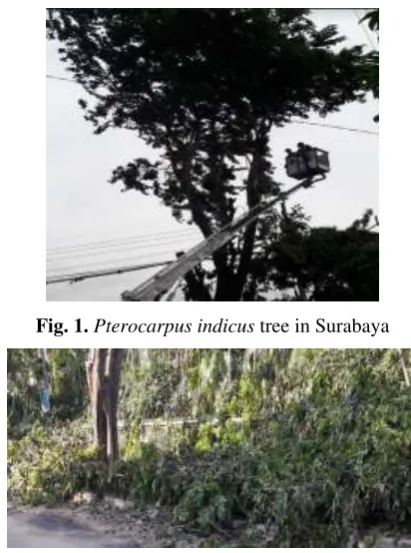
Since biomass may be acquired from wastes of plants, these wastes have potential to be used as biomass fuel resources [26]. Tropical countries with high varieties of floras produce an abundant number of biomass resources. Developing countries were also found to generate a high amount of biomass as well [7,27]. One of many countries that fit both descriptions is Indonesia. Indonesia is a tropical nation in developing state with a gamut of plant species across the country. Some of these plants produce waste which leads to abundant biomass waste in Indonesia [28]. In Surabaya, Indonesia for example, Pterocarpus indicus as shown in fig. 1 is a plant that is commonly found on the street and produce a high number of wastes. The twigs of this plant fall to the ground regularly in every season and causing litters in the street of Surabaya, as seen in fig.2. The abundance of these twigs waste produced by Pterocarpus
indicus on the street may raise a question regarding
Surabaya’s city cleanliness. Furthermore, unnecessary
handling of these wastes by burning causes not only additional GHG (greenhouse gases) production, which are commonly produced in energy and transportation sectors [29], but also wasting usable energy source. One method to solve this problem of Pterocarpus indicus twigs waste is by converting these twigs waste into briquettes.
Fig. 1. Pterocarpus indicus tree in Surabaya
Fig. 2. Pterocarpus indicus twigs and leaves waste in Surabaya
By converting these twigs waste into briquette, the number of twigs waste in Surabaya will be reduced. Furthermore, the efficient utilization of these twigs waste may reduce GHG production from unnecessary burning of twigs waste. In order to maximize the potential of briquette derived from Pterocarpus indicus twigs waste, investigations
of Pterocarpus indicus twigs waste need to be conducted.
INTERNATIONAL JOURNAL of RENEWABLE ENERGY RESEARCH W. Anggono et al., Vol.8, No.3, September, 2018
1395
2. Experimental Method
The first process of creating briquette is drying the biomass which is used as briquette raw material. In this study, drying was conducted by gathering the wastes that fall from Pterocarpus indicus trees and exposing them to sunlight for three days. After sun-dried, the next step is to shred the material into desired proportions. After shredded into a suitable size, the shredded biomass was mixed with tapioca flour as to bind the biomass. Finally, the biomass and tapioca flour combination were compacted by putting them under a certain pressure in the die to mold them into a cylindrical shape. The finished briquettes were then tested to determine the optimum particle size and compacting pressure. An example of finished briquettes is shown in fig. 3.
Fig. 3. Pterocarpus indicus twigs waste biomass briquette In the investigation for the proportion of biomass to tapioca, the proportion is varied from 50% biomass-50% tapioca to 90% biomass-10% tapioca with an increase of 10% for biomass proportion. The calorific value estimation was performed using 1341 Plain Coat oxygen bomb calorimeter. The result of this investigation showed the effect of biomass to tapioca proportion in determining the calorific value of briquette.
Pterocarpus indicus twigs waste briquette were also
examined for its proximate and ultimate analyses. Proximate and ultimate analyses have been used in briquette investigations to help predict the condition when the briquette is utilized as fuel [34-37]. These analyses are the straightforward fuel characterization method which is easily performed in conventional or state-of-the-art laboratories [38]. The result of proximate analysis gives information such as moisture content and volatile matter which are important when discussing the viability of fuel’s utilization in society [34]. Some studies have suggested that proximate analysis results can predict the calorific value of product [38-40]. The result of ultimate analysis provides information regarding the important elemental composition of Pterocarpus indicus
twigs waste briquette including carbon, hydrogen, nitrogen, sulfur, and oxygen. All of these tests were performed under ASTM standards.
For investigating the effect of particle size, three types of particle size were used. These three types of particle size consisted of 20 mesh (size of 800 μm), 40 mesh (size of 425
μm), and 60 mesh (size of 250 μm). The particle sizes were obtained by grinding the biomass in wire mesh. The size of wire mesh determined the particle size obtained for briquette raw material. These three types of particle size differences were studied to determine the ideal briquette particle size in terms of physical strength and burning feature. Fig. 4 displays the result of processing the biomass into three different particle sizes.
Fig. 4. Particle size variation of Pterocarpus indicus twigs waste biomass
Another parameter tested is the pressure used in compacting the briquette. The pressure variations used in this study are 1 MPa and 2 MPa. A higher magnitude of pressure caused the briquette to break and unable to retain its form. All of these pressure variations for compacting briquette were used in each type of particle size of shredded
Pterocarpus indicus twigs waste. A hydraulic machine was
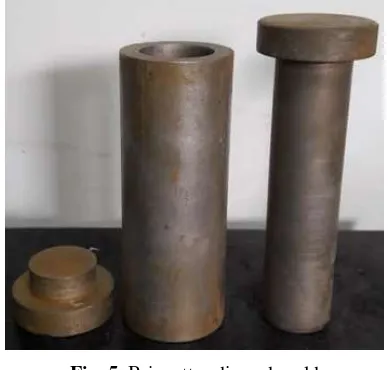
used to apply pressure for compacting briquettes. The pressure was applied to a die with a diameter of 25 mm to shape the briquette. The shape of the die can be seen in fig. 5.
Fig. 5. Briquettes die and mold
INTERNATIONAL JOURNAL of RENEWABLE ENERGY RESEARCH W. Anggono et al., Vol.8, No.3, September, 2018
1396
Ignition time is a parameter which measures the time required for briquette to combust continuously from the start of ignition. Burning time is the time required for briquettes to reduce into ashes. Both ignition time and burning time were measured using a stopwatch. Combustion rate is the speed required for the change of mass to occur in briquette.
Most of the methodologies used in this study are similar to most briquette investigations’ procedures [34,35,41-43]. However, some studies have suggested that different species of biomass significantly affect the quality of briquette and its combustion properties [44-46]. Since no study has been conducted to analyze the potential of Pterocarpus indicus
twigs waste as briquette, the results of this study merit the novelty of discovering it.
3. Results and Discussion
The effect of proportion between Pterocarpus indicus
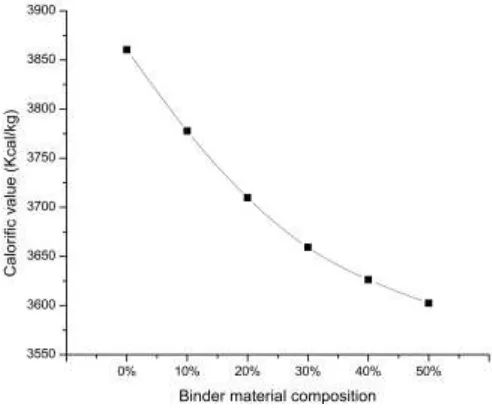
twigs waste to tapioca for briquette calorific value is shown in table 1. A graph that shows the change of calorific value in respond with the percentage of Pterocarpus indicus twigs waste is shown in figure 6. The investigation result indicates a strong relationship between briquette composition with a calorific value of briquette. A higher percentage of
Pterocarpus indicus twigs waste in briquette yields higher
briquette calorific value. The biomass-binder relationship toward calorific value discovered in this study is similar with the result of the study conducted by Thabuot et al and Willyanto et al [2,35]. From the investigation, it was found that 90% biomass and 10% tapioca mixtures yields the highest calorific value. This finding is also in line with the calorific value of its respective materials. 100% Pterocarpus
indicus twigs waste has calorific value of 3860.39 kcal.kg
and 100% tapioca flour has a calorific value of 3574.47 kcal/kg. Since tapioca has smaller calorific value than
Pterocarpus indicus twigs waste, the more tapioca added in
briquette composition, the lower the heating value of briquette produced. Although 100% Pterocarpus indicus
twigs waste has higher calorific value than 90% twigs waste and 10% tapioca mixtures briquette, pure Pterocarpus
indicus twigs waste briquette will not be able to hold its
form.
Table 1.Pterocarpus indicus twigs waste biomass briquette calorific value at various composition
The good news of this finding is the economic advantage it gives. Since Pterocarpus indicus twigs waste can be
obtained with almost no cost, the only expenditure for obtaining the material for this briquette is from tapioca mixtures. The lower is the tapioca as binding material needed, the lower is the cost of producing Pterocarpus
indicus twigs waste briquette.
Fig. 6. Effect of binder material to the calorific value
Pterocarpus indicus twigs waste briquette
Pterocarpus indicus twigs waste briquette analyses
result for both proximate and ultimate have been conducted. These analyses were performed on the best proportion of
Pterocarpus indicus twigs waste and tapioca mixture. Table
2 shows the test result for proximate analysis. The total moisture content of Pterocarpus indicus twigs waste briquette was found to be 9.8 %wt, which is less than 50% and thus indicate its capabilities to be combusted [1]. The fixed carbon value shows the range of non-volatile matter in
Pterocarpus indicus twigs waste briquette. The higher the
value of fixed carbon, the harder it is to burn the product. The volatile matter value shows the capability of a material to be burned. The higher is the value of volatile matter, the less effort is needed to ignite the product. Since Pterocarpus
indicus twigs waste briquette has higher volatile matter (67.9
%wt) than fixed carbon value (12.2 %wt), it can be inferred that Pterocarpus indicus twigs waste briquette is easy to burn. The value of ash content indicates the vestigial product after combustion. The higher the value of ash content, the bigger is the ash remain found after the combustion process. The desired value for ash content is to be as small as possible [2,47].
The result of ultimate analysis for Pterocarpus indicus
twigs waste briquette is shown in table 3. The carbon content
in Pterocarpus indicus twigs waste briquette was found to be
41.55%wt and the element of hydrogen was found to be 4.76 %wt. The higher the percentage of carbon and hydrogen in the product, the higher its energy content [39]. The value of nitrogen and sulfur obtained from ultimate analysis affect the by-products of combustion. The result of burning nitrogen and sulfur produce NOx and SOx which are highly hazardous
INTERNATIONAL JOURNAL of RENEWABLE ENERGY RESEARCH W. Anggono et al., Vol.8, No.3, September, 2018
1397
considered safe [48]. Some empirical formulas have suggested that the effect of oxygen content can either be positive or negative in determining the calorific value of the fuel. However, these formulas show that the effect of oxygen content on calorific value is small compared to carbon and hydrogen elements [39].
Table 2. Proximate analysis result of Pterocarpus indicus
twigs waste and tapioca mixture
Table 3. Ultimate analysis result of Pterocarpus indicus
twigs waste and tapioca mixture
The pressure and particle size effect on briquette combustion characteristic have been examined. Their effect of these variables on the flame temperature of Pterocarpus
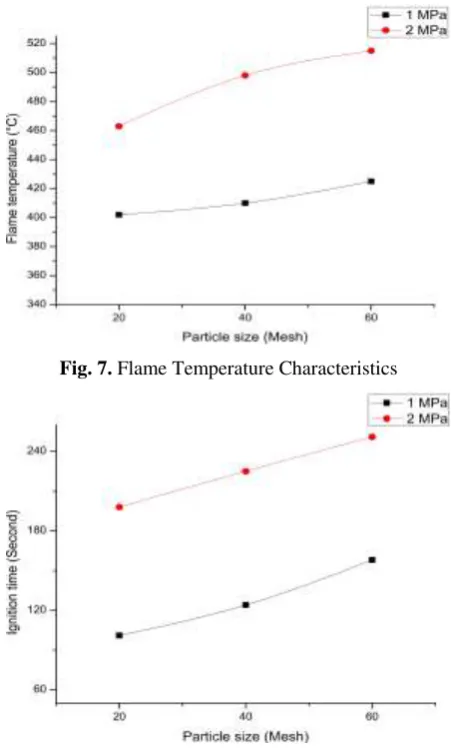
indicus twigs waste briquette is shown in fig. 7. Fig. 7 shows
that the finer the size of shredded biomass, the higher is the flame temperature obtained. The higher magnitude of pressure shows an increase in flame temperature as well. The relation of these parameters to flame temperature are in line with the previous study conducted with Cerbera manghas
leaf waste as briquette’s raw material [2]. The highest flame
temperature (515 °C) is acquired with Pterocarpus indicus
twigs waste briquette produced using a particle size of 60 mesh and compacting pressure of 2 MPa.
Figure 8 displayed the influence of particle size and compacting pressure on ignition time of Pterocarpus indicus
twigs waste briquette. The result indicates the positive relationship between particle size and pressure to ignition time. The finer the particle size of biomass in briquette and the pressure used to form briquette, the longer the time needed for ignition. This finding is similar to studies conducted by Al-Malah et al and Davies et al [41,42]. From this result, it can be seen that the highest ignition time (251 seconds) is obtained from Pterocarpus indicus twigs waste briquette produced using a particle size of 60 mesh and compacting pressure of 2 MPa.
Fig. 7. Flame Temperature Characteristics
Fig. 8. Ignition Time Characteristics
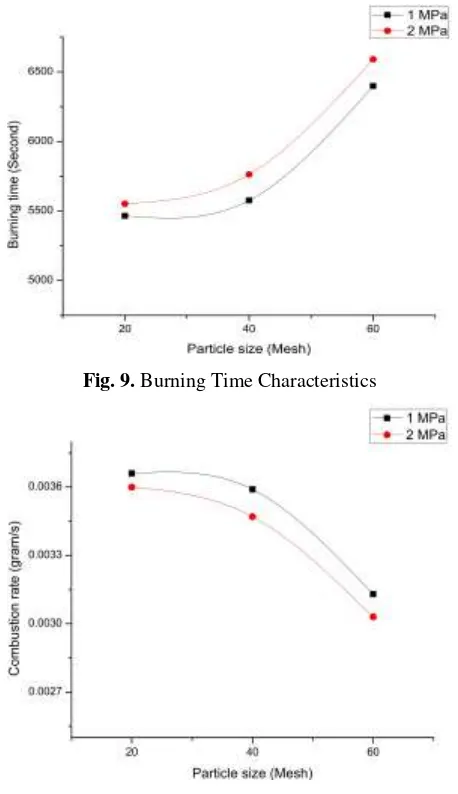
Figure 9 displayed the effect of particle size and compacting pressure on burning time of Pterocarpus indicus
twigs waste briquette. Similar to the previous two characteristics, the value of burning time increases with finer particle size and higher compacting pressure. The longest burning time (6590 seconds) is obtained from Pterocarpus
indicus twigs waste briquette with 60 mesh particle size and
compacting pressure of 2 MPa. Studies conducted by Bahttarai et al and Willyanto et al supported the effect of reduced particle size and increased pressure in rising the burning time of briquette [2, 43].
Figure 10 shows the influence of particle size and compacting pressure for the combustion rate of Pterocarpus
indicus twigs waste briquette. In contrast with the three
INTERNATIONAL JOURNAL of RENEWABLE ENERGY RESEARCH W. Anggono et al., Vol.8, No.3, September, 2018
1398
Fig. 9. Burning Time Characteristics
Fig. 10. Combustion rate Characteristics
Some studies have investigated the calorific value of briquette from various biomass. Lela et al have investigated the calorific value of sugarcane briquette (3903 Kcal/Kg) and rice straw briquette (3927 kcal/kg) [49]. The highest calorific value obtained from this study (90% twigs waste – 10% tapioca blend) is used as a basis to compare the calorific value of various biomass briquettes. Compared with the briquette caloric value obtained from this study, it is apparent that briquette derived from Pterocarpus indicus twigs waste is comparable with the biomass briquette made of any other material. The calorific value difference between Pterocarpus
indicus twigs waste briquette and other briquettes is small.
Furthermore, the advantages of using Pterocarpus indicus
twigs waste to clean the street of Surabaya city, avoiding unnecessary burning and wasting energy, and preventing the competition of fuel derived from the edible sources are far more superior than the small calorific value difference with other biomass briquettes.
4. Conclusion
Pterocarpus indicus twigs waste is a viable raw material
for biomass briquette. The positive effects it brings to Surabaya city and its properties as a renewable energy source will be an asset in tackling the energy issue. Both proximate
and ultimate analysis results support the viability of
Pterocarpus indicus twigs waste as briquette. The highest
calorific value was obtained with the proportion of 90%
Pterocarpus indicus twigs waste and 10% tapioca mixture.
The correlation of particle size to briquette quality has been investigated and the result indicates a positive increase in briquette quality with smaller particle size. As for the effect of compacting pressure, the higher magnitude of pressure leads to higher quality of briquette. The best parameters used for creating Pterocarpus indicus twigs waste briquette are obtained by utilizing particle size of 60 mesh and pressure of 2 MPa. Pterocarpus indicus twigs waste briquette with these level of particle size and pressure has a flame temperature of 515 °C, ignition time of 251 seconds, burning time of 6590 seconds, and combustion rate of 0.00303 gram/second. Acknowledgments
Thanks to Petra Christian University Indonesia and Direktorat Jendral Pendidikan Tinggi Kementerian Riset Teknologi dan Pendidikan Tinggi Republik Indonesia (Hibah Penelitian Produk Terapan 2016-2017) for their supports during this research.
References
[1] H.B. Goyal, D. Seal, and R.C. Saxena, “Bio-fuels From
Thermochemical Conversion of Renewable Resources:
A Review”, Renewable & Sustainable Energy
Reviews, vol. 12, pp. 504-517, February 2008.
[2] Sutrisno, W. Anggono, F.D. Suprianto, A.W. Kasrun, and I.H. Siahaan, “The Effects of Particle Size and Pressureon on The Combustion Characteristics of Cerbera Manghasleaf Briquettes”, ARPN Journal of Engineering and Applied S