978-1-4244-2328-6/08/$25.00 © 2008 IEEE
Human Skin Detection Using Defined Skin Region
Handaru Jati
CIS Department
Universiti Teknologi PETRONAS
Email : [email protected]
Dhanapal Durai Dominic
CIS Department
Universiti Teknologi PETRONAS
Email : [email protected]
Abstract
Skin detection has been widely used in image processing application. Several skin detection methods have been introduced including defined skin region. Overall, skin detection has been challenged by the fact that skin appearance in the image can be affected by many factors including ethnicity thus reducing its accuracy.
This study aims (i) to obtain the skin detection model by ascertaining the threshold values of human skin color model and (ii) to evaluate the skin detection model among ethnicities and to evaluate the accuracy of the model by comparing the model in human and animal skin.
The results of our study show that the value of skin parameter is not different among ethnicities. We also found that using this method, animal skin was often misinterpreted as human skin. This problem should be particularly addressed in the future work.
1. Introduction
Skin detection is widely used in image processing application and up to recently is becoming the topics of an extensive research. Among of the applications using skin detection are face detection, content based image retrieval and objectionable content internet filtering. Several methods have been introduced in the field of skin detection including skin region, parametric-skin distribution modeling and edge detection. A research has provided a comparison of five color spaces and two non-parametric skin modeling methods [1]. Another research has compared nine chrominance spaces and two parametric techniques (Gaussian and mixture of Gaussian models) [2].
Up to now, the major hindrance which complicated the skin detection process is that skin appearance in
the image can be affected by many factors such as illumination, characteristics of the camera, and ethnicity. This situation decreases the skin detection accuracy. The level of accuracy of skin detection using defined skin region methods has been limited. This paper aimed to obtain (1) the skin detection model by ascertaining the threshold value of human skin based on the combining color model and (ii) to evaluate the skin detection model among ethnicities and to evaluate the accuracy of the model by comparing the model in human and animal skin.
This paper is organized as follows: section 1 presents the introduction of the topic, section 2 explains the human skin pixel classification and color model, section 3 discuss about skin color model, section 4 describes the experimental and analysis results, section 5 present the conclusion, and section 6 recommends future work.
2. Color Model
.There are many of color spaces already used in skin detection, such as red-green-blue (RGB), normalized RGB, luminance-chrominance (YCbCr), and hue-saturation-value (HSV).
• RGB
An RGB color image is an MxNx3 array of color pixels, where each color pixel is a triplet corresponding to the red, green, and blue components of an RGB image at a specific location. RGB is a widely used color spaces for processing and storing digital image data. However, the RGB color space alone is not reliable for identifying skin-colored pixel because RGB represents not only color but also luminance. This color space was used in detecting human skin [3].
• Normalized RGB
978-1-4244-2328-6/08/$25.00 © 2008 IEEE
The R and G are often labeled as pure colors thus we can omit B component because this component does not hold any significant information. This color space is very popular among the researchers who have to deal with human skin detection [4], [5].
• HSV
In the HSV, H (hue) defines the dominant color of an area while saturation measures the colorfulness of an area in proportion to the brightness [6].
)
H varies from 0 to 1 on the circular scale, while S (saturation) varies from 0 to 1, representing 100 percent purity of the color. There is a research which mentions that HSV gives the best performance [1].
• YCbCr
The YCbCr color space is widely used in digital video. Color information is represented as two color difference component Cb and Cr. Component Cb is the difference between the blue component and a reference value, whilst component Cr is the difference between the red component and the reference value. The transformation that was used to convert from RGB to YCbCr is
The simple transformation and explicit separation of luminance and chrominance components make this color space attractive for skin color modeling [7], [8].
3. Skin Color Model
The skin detector will detect whether the regions in color image represent human skin or not. Several skin color modeling methods have been introduced, including:
• Explicitly defined skin regions.
In this category, color space and skin region boundaries are found empirically [9], for example : (R, G, B) is classified as skin if: R>95 and G>40 and B>20 and max{R, G, B} – min{R, G, B}>15 and
G
R− >15 and R>G and R>B. The advantage of this method is the simplicity of skin detection rules that leads to the construction of very rapid classifier.
• Non parametric skin distribution modeling. This skin color distribution is created using training data without derivation of the explicit model of the skin color, [10] use a histogram based approach to skin pixels segmentation. The color space is quantized into a number of bins, each corresponding to particular range of color component value pairs (in 2D case) or triads (in 3D case).
• Parametric-skin distribution modeling.
Parametric skin color distribution can be modeled by an elliptical Gaussian joint probability density function defined as:
) distribution parameters (mean and covariance matrix respectively). The model parameter are estimated from the training data by
• Edge Detection.
978-1-4244-2328-6/08/$25.00 © 2008 IEEE
Gaussian, Zero-Crossings Detector, and Canny) which can be used in skin detection.
4. Experiments description and results
A practical system was implemented using MATLAB 7.3. The first step was the initializing of the skin detection module. More than 500 human and animal skin samples were used in this research. We manually cropped human skin and animal skin in the same size (16x16 pixels images) and all the samples are pure skin areas. The next step was finding the parameter values of the sampling which consist of hue, saturation, Cb, and Cr. The final step in determining the skin value threshold was estimating the mean of the color distribution in chromatic color space. Those values were presented in Table 1.
Table 1. Mean Values of Skin Parameter
Race H S Cb Cr
Asia 0.08 0.31 109.00 148.00 Europe 0.11 0.43 105.00 156.00 Black 0.09 0.44 112.00 151.00 Animal 0.15 0.33 116.00 139.00 The color distribution of skin color among people from different ethnicities was found to be clustered in a small area of the chromatic color space. Skin colors of different ethnic were very close whilst they only differed in the intensities. The background lightning in the picture has a big effect on the skin color.
Figure 1. Color Chart for Human Skin
It was very difficult and almost impossible to find the precise value of skin based on the attribute color which e used to identify skin pixels and non skin pixels for the entire image.
Original 42.93% (CbCr)
57.22% (H) 42.93% (HCbCr)
Figure 2. Human Skin Detection Using Skin Region Method
In this experiment, we used explicitly defined skin region method. Based from the mean value of the parameter collected from the sample, the span of the value were:
100 < Cb < 150, 130 < Cr < 160 0.01 <H < 1
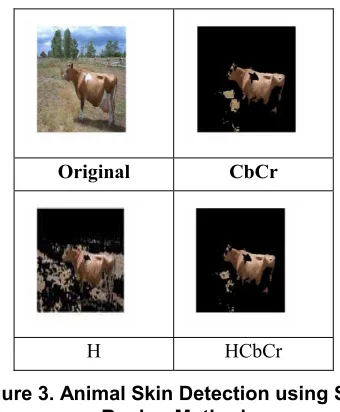
Using this span of parameter, this method identified the majority of human skin but still detected animal skin which the parameter value was similar to human skin
Original CbCr
H HCbCr
Figure 3. Animal Skin Detection using Skin Region Method
978-1-4244-2328-6/08/$25.00 © 2008 IEEE
pixels. Although it found skin pixel in the picture, the percentage of non skin picture detected as a human pixel when hue was used 57.223 (H) was bigger than when CbCr and combination of HCbCr method were used (42.93). The combination method also worked well for determining a skin pixel in the animal skin, which has similar value with human skin.
5. Discussion and Conclusion
There are too many outside factors such as lighting that can change the apparent color of skin, and of course, different people have different colored skin. In addition, objects in the background may be the same color as a person's skin and there is no clear way of telling the difference using these methods. However, if these methods must be used, it is wise to use a combination of color-related factors as the red, green, and blue values of a pixel are not enough. By adding hue, saturation, and intensity, a more defined idea of skin color can be formed.
Skin colors among different ethnicities are not significantly different. It only differs in intensities. Background lightning in the picture can have a big effect on what color of the skin. If we implement narrow threshold value, then the amount of segmented skin region will decrease. Mean while, if we setup wide threshold value then non human skin pixels will be detected as a human skin region. This problem should be particularly addressed in human skin detection especially when the defined skin region is employed.
6. Future work
To address the accuracy problem in skin detection using defined skin region skin detection, we recommend that human body recognition should also use other method such as human body shape detection in conjunction with skin detection.
7. References
[1] B. D. Zarit, Super, B.J, and Ouek, F.K.H, "Comparison of five color model in skin classification," ICCV-Int’l Workshop on recognition, analysis and tracking of faces and gestures in Real Time System, 1999.
[2] A. S. Terrillon J., "Comparative Performance of Different Chrominance Spaces for Color Segmentation and Detection Of Human faces in Complex Scene Image," 1999.
[3] J. Brand, Mason, J, "A comparative assessment of three approaches to pixel level human skin detection," In Proc of the International Conference of Pattern Recognition, 2000.
[4] D. Brown, Cra, I., And Lewthwaite, J., "A som based approach to skin detection with application in real time systems," In Proc. Of the british Machine Vision Conference,
2001.
[5] J. Yang, Lu, W., and Weibel, A, "Skin color modeling and adaptation," In Proceedings of ACCV, pp. 687-694, 1998.
[6] C. A. Poynton, "Frequently asked question about colour."
[7] S. L. Phung, Bouzerdoum, A., and Chai, D. , "A novel skin color model in ycbcr color space and its application to human face detection," In IEEE International Conference on Image Processing vol. 1, pp. 289-292, 2002.
[8] B. Menser, and Wien. M, "Segmentation and tracking of facial regions in color image sequences," In Proc.SPIE Visual Communications and Image Processing, pp. 731-740, 2000.
[9] P. Peer, Kovac, J., and Solina, F, "Human Skin Color Clustering For Face Detection," In submitted to EUROCON – International Conference on Computer as a Tool. , 2003.