Biosaintifika
Journal of Biology & Biology Educationhttp://journal.unnes.ac.id/nju/index.php/biosaintifika
Bioinformatics Education in Greece: A Survey
Efrosyni-Alkisti Paraskevopoulou-Kollia, Pantelis G. Bagos
DOI: 10.15294/biosaintifika.v9i1.7257
Department of Computer Science and Biomedical Informatics, University of Thessaly, Lamia, Greece
Abstract
Bioinformatics is an interdisciplinary field, placed at the interface of Biology, Mathematics and Computer Science. In this work, we tried for the first time to investigate the current situ-ation of Bioinformatics educsitu-ation in Greece. We searched the online resources of all relevant University Departments for Bioinformatics or relevant courses. We found that all the Depart-ments of Biological Sciences include in their curricula courses dedicated to Bioinformatics, but this is not the case for Departments of Computer Science, Computer Engineering, or Medical Schools. Despite the fact that large Universities played a crucial role in establishing Bioinformatics research and education in Greece, we observe that Universities of the periph-ery invest in the field, by including more relevant courses in the curricula and appointing fac-ulty members trained in the field. In order for us to “triangulate” we didn’t confine ourselves to online resources and descriptive statistics but we also included interviews so as to have a more spherical view of the subject under discussion. The interviews provided useful insights regard-ing the teachregard-ing methods used by bioinformatics tutors, their attitudes and the difficulties they encounter. The tutors mentioned also the material that they choose, the audience’s attraction techniques and the feedback they receive.
How to Cite
Paraskevopoulou-Kollia, E.-A. & Bagos, P. G. (2017). Bioinformatics Education in Greece: A Survey. Biosaintifika: Journal of Biology & Biology Education, 9(1), 1-10.
© 2017 Universitas Negeri Semarang History Article
Received 16 September 2016 Approved 27 February 2017 Published 1 April 2017
Keywords
bioinformatics; education; Greece; universities; qualitative study
Correspondence Author:
Papassiopoulou 2-4, GR 35131 Lamia, Greece E-mail: [email protected]
The interviews were conducted with a view to dealing with the subject using a wider perspective and closely examining the personalities of the ed-ucators and the specific educational procedures that are followed in the auditorium.
There is little-published data related to the Bioinformatics community and the respective re-search in Greece. Valuable and important efforts aimed at recording and organizing all activities associated with this specific scientific field are made by HSCBB. A previous bibliometric study (Bagos, 2010) that attempted to analyze the sci-entific activity in Bioinformatics in Greece identi-fied 405 published research conducted from 1976 until early 2010. This research showed that the scientific community in Greece is rapidly en-gaged with Bioinformatics during the last decade. Moreover, the oldest and largest Universities seem dominant, but the newer Universities have a strong presence in recent years, as well. The re-search and teaching activity regarding Bioinfor-matics the last 15 years in Greece is booming. A sufficient number of scientists who will advance the field have started to accumulate. The origin of these scientists clearly appears to be interdis-ciplinary. We have to bear in mind that every re-searcher of Bioinformatics not only comes from a specific scientific discipline, but s/he is also not exclusively devoted to a given scientific field.
METHODS
Data collection and analysis
We conducted an exclusive search on the websites of all Greek Universities in order to identify courses on Bioinformatics. We included in the search a) Departments of Biological Sci-ences (including Departments of Biology, Bio-chemistry, Molecular Biology and Genetics, and Biotechnology), b) Departments of Computer Science (including Departments of Informat-ics and Telecommunications), c) Departments of Computer and Electrical Engineering, and d) Medical Schools. We searched the online curri-cula of the respective Departments and identified relevant courses. We included courses on Bioin-formatics, Computational Biology and other rel-evant courses (e.g. Programming in Bioinformat-ics, Special Topics in Bioinformatics and so on). We analyzed the curriculum of each Department, and we investigated the research interests of the faculty members that teach the respective course. The data were presented as descriptive statistics in tables and graphs.
INTRODUCTION
Bioinformatics is an interdisciplinary field, placed at the interface of Biology, Mathematics and Computer Science. For this discipline, it is not easy to reach a common definition. The defi-nition given by the National Center for Biotech-nology Information (NCBI) states that:
«Bioinformatics is the field of science in which biology, computer science, and information technology merge into a single discipline. There are three important sub-disciplines within bioinformatics: the development of new algorithms and statistics with which to assess relationships among members of large data sets; the analysis and interpretation of various types of data including nucleotide and amino acid sequences, protein domains, and protein structures; and the development and implementation of tools that enable efficient access and management of different types of information».
Sometimes the terms Bioinformatics and Computational Biology are used without distinc-tion, but there are strong objections to this. Nev-ertheless, the International Society for Computa-tional Biology (ISCB) describes the society as:
«a scholarly society dedicated to advancing the scientific understanding of living systems through computation»
Similarly, the Hellenic Society for Com-putational Biology and Bioinformatics (HSCBB) makes no such distinction and encompasses all areas of computation applied to living systems. The interdisciplinary nature of the field raises im-portant questions regarding the training of young scientists. The pioneers in the field all came from a distinct discipline, most notably from Computer Science, Biology, Mathematics, Physics or Chem-istry (since at that time no dedicated curricula were available). But the main problem nowadays is how to train interdisciplinary scientists, that is, how to train individuals that can communicate efficiently with scientists of other fields. There is a lot of theoretical work on how a Bioinfor-matics curriculum should be built, combining el-ements of the «mother» disciplines, and several approaches have been described to incorporate Bioinformatics training in the Biological, Medi-cal or Computer Science curriculum (Altman, 1998; Ditty et al., 2010; Floriano, 2008; Honts, 2003; Searls, 2012; Welch et al., 2014; Yan, et al., 2014).
Qualitative analysis - Interviews
This study is, as noted earlier, based on 12 interviews (face-to-face, telephone or e-mail) with teaching staff who teach Bioinformatics in Greek Universities, and has sought information on the realities of the teaching process, as well as the prospects regarding the particular subject, and any emotions developed via the relation-ship with the students during the academic year – within and beyond the auditorium. It is at this point necessary to mention that not all the tutors were responsive to our call but a satisfying and notable number of them (Cohen, et al., 2013); those who agreed to talk to us were positive about discussing with us as well as talking about issues concerning Bioinformatics. More specifically, we interviewed the teaching staff on five questions stated below (two of which have sub-questions attached to them). The reason for focusing the research on the view of the tutors (we may also refer to them as educators) is because they are, to a great degree, the mediators between knowledge and students, and are therefore the main agents responsible and their role in teaching and utilis-ing Bioinformatics is considered as particularly important.
We have chosen to conduct the research by interview (face-to-face, telephone, e-mail) rather than by questionnaire which belongs to qualita-tive methodology because this is a method con-sidered more capable of allowing the interview-ee’s personal views to emerge (Flick, 2004). The main reason for choosing interviews is to collect information with as much accuracy as possible from situations and events in which researchers have never been present. Interviews help bring to light the interviewee’s knowledge (information and knowledge), preferences (values, likes and dislikes) and thoughts (opinions and perceptions) (Paraskevopoulou-Kollia, 2008). The elements above enable the researcher not only to approach the subjects and their statements but also to place them under the perspective of the broader social structures and the context of the groups and insti-tutions within which the subject is active, trying at the same time to avoid results’ generalisation. From the available types of interview, we have chosen to use semi-structured ones. We chose them because ‘[…] it is important to note that on-line, asynchronous, in-depth interviewing, which is usually conducted via e-mail, is, […], semistructured
in nature’ (Meho, 2006). As regards e-mail
inter-view we chose them because they are a lot more cost-effective than a live interview since there are no travel expenses to cover. However, a negative aspect is that it may take a lot of time. The
inter-viewee may delay the response, and there are two risks associated with this, firstly to lose interest and secondly to never bother to respond (Kivits, 2005). An immediate response pre-requires being in a good mood for participating in the research and feeling secured (Meho, 2006). If it takes long to respond the possibility of not participating or even be frustrated –both the interviewer and the interviewee- could be a reality (Hodgson, 2004).
One must not forget that: “For the purposes of a qualitative interview, the metacommunicative con-tents expressed in the text and the paralinguistic use of the technology could then assume the same significance carried by body language and voice qualities in face-to-face interviews” (Olivero & Lunt, 2004). It is a fact that body language is important and often betrays elements related to social background and situa-tions that cannot be revealed by the interviewee’s response alone. The lack of visual communica-tion and other senses are also negative elements of telephone or e-mail interviews (Robert & Den-nis, 2005). However, the timbre and tone of voice may constitute useful additional data for the re-searcher.
RESULTS AND DISCUSSION
Descriptive Statistics
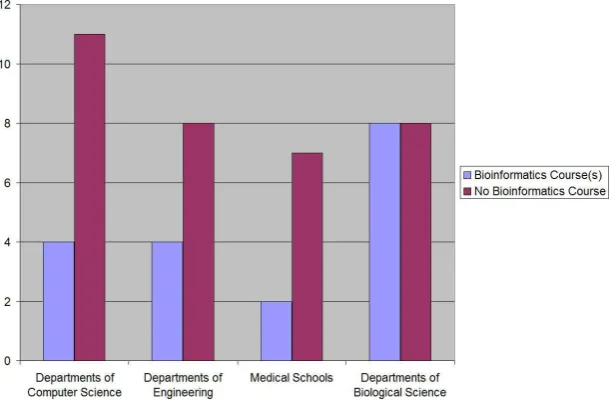
Extended search on websites and in the curricula of Greek Departments of Biological Sciences, Medicine, Computer Science and Com-puter Engineering, indicated that Bioinformatics is taught at undergraduate level in 18 Depart-ments; 8 of these are Departments of Biological Sciences, 4 are Departments of Computer Engi-neering, 4 are Computer Science Departments and 2 are Medical Schools. In 11 of the 18 De-partments, there is a faculty member which was hired especially for performing research and teaching in the particular field (e.g. Bioinformat-ics or Computational Biology), in 3 of the 18 there is a faculty member for whom Bioinformat-ics is part of her/his main research interests while in the 3 remaining Departments, there is no such faculty member.
At the University of Thessaly, 4 different Departments belonging to 3 different Schools, teach Bioinformatics in their curricula. All of them include faculty members which were hired specifically for performing research and teaching in the particular research area. At the Depart-ment of Computer Science and Biomedical In-formatics, Bioinformatics is taught in 3 courses and the curriculum includes also other courses of biological orientation (Biostatistics, Biology, Bio-chemistry, Genetics, and Medical Informatics). The Department of Molecular Biology of the University of Thrace includes -in the curriculum-
more courses (4) than any other Department. In the University of Crete, the course is taught in the Departments of Biology, Medicine, and Com-puter Science. Especially in the Department of Computer Science two such courses are offered, while other elective courses in Biology are offered by the Department of Biology. At the University of Athens, Bioinformatics is offered as an elec-tive course in both the Department of Biology and the Department of Informatics and Telecom-munications, whereas in the University of Patras Bioinformatics is an elective course in the De-partment of Biology and in the DeDe-partment of
Table 1. The University Departments included in our study. We list the University, the Department and the number of Bioinformatics courses included in the curriculum. The asterisk denotes the pres-ence of additional related courses (see the text for explanation).
University Department
Number of Bioinformat-ics courses (the asterisk denotes the presence of additional related courses)
University of Thessaly
Department of Computer
Sci-ence and Biomedical Informatics 3* Department of Biochemistry
and Biotechnology 2*
School of Medicine 1* Department of Electrical and
Computer Engineering 1
University of Thrace
Department of Molecular
Biol-ogy and Genetics 4*
Department of Electrical and
Computer Engineering 1
University of Crete
Department of Biology 1* School of Medicine 1 Department of Computer
Sci-ence 2*
University of Athens Department of Biology 1* Department of Informatics and
Telecommunications 1
University of Patras Department of Biology 1 Department of Computer
Engi-neering and Informatics 1 University of Ioannina Department of Biological
Ap-plications and Technologies 2* University of Piraeus Department of Informatics 1
University of Western Macedonia Department of Engineering Informatics and Telecommuni-cations
1
Computer Engineering and Informatics. Finally, Bioinformatics is absent from the curriculum of the Departments of Computer Engineering of the National Technical University of Athens and the Aristotle University’s of Thessaloniki, where most faculty members are mainly engaged with Medical Informatics and Health Informatics, but not with Bioinformatics.
Qualitative Results
As it has been mentioned above apart from descriptive statistics the research has been conducted also using the qualitative methodol-ogy. We conducted interviews (from June 2015 to February 2016) and in the section that follows we will quote some indicative answers given by the members of the teaching staff. Due to ethical rea-sons, we will refer to them by the letter T (tutor) and the number that each one of them has (this is according to the time the interview took place).
The questions asked are listed below:
• How do you think that they deal with your lectures?
• Do they respond? Do they attend?
• What is your relationship with your students?
• How do you select the syllabus material?
• How do you prepare?
• Do you use tricks during the teaching pro-cess?
• How can you tell whether they are actually learning?
• How do you examine your students?
The teaching process
This sub-section is an introductory one, emerging from the discussions we had with the teaching staff and is not directly related to the
specific questions asked in the interviews. Issu-es directly related to the teaching procIssu-ess are the testing of whether the students have learnt; the method of testing; any techniques for attracting interest during the lecture, etc. Each teacher fol-lows a different pattern, entirely personal. We will present here a few individual teachers’ views and will attempt to identify any common points.
One tutor commented on her teaching methods:
“I already have notes so before I begin I do a small catch-up and accordingly to the students I adjust them” (December 2015, T10)
whereas another tutor’s view was centred around her perception of the process before the term started:
“I was anxious whether they would turn up or not, whether they would like it or not” (September 2015, T7).
The process of teaching in a lecture room is, without a doubt, a form of expression for a teacher (Hare, 1998; Parkay et al., 2010). Tutors act in accordance with their personal ideas and experiences (Sutton & Wheatley, 2003), which are plenty on a daily basis (Burchielli & Bartram, 2006). Their loneliness against the audience they face is the factor maintaining a delicate balance between the need to present themselves as seri-ous professionals who know everything, and the need to structure the teaching material within their own minds before they deliver it (Noddings, 2003).
Regarding our research, if we try to com-pare the course descriptions currently available on the internet, we will quickly reach this con-clusion: each teacher chooses the syllabus mate-rial based on different criteria, based on different teaching objectives. Developing the syllabus is
drops, sometimes even below 50% during the last few weeks of lectures” (June 2015, T2),
The relationship with the students was also described by equally unique responses, which nevertheless showed characteristic similarities: most teachers reported that their relationship with the students ranged from good to very good and highlighted a number of reasons for that situ-ation:
“[…] very good relationship with the students, despite the module’s slightly scary title. I enforce clarity from the first lecture, and then try to present problems that cannot be solved in any other way, i.e. real-world problems. Perhaps this is the way to win over any hesitant students. Eventually, a small percentage will develop fatigue, the module has a reputation of difficulty, but I assist, I try to build a relationship of trust, and always maintain transparency when it comes to grading” (September 2015, T7),
“Excellent I think, especially in courses at more advanced years. I treat them as my future partners. With the students of my research group, I have a closer relationship, and we go out –socially- in order to create a sense of teamwork. [...] I never had any particular problems with students and the anonymous official reviews of my courses prove this” (February 2016, T12),
“I find it exceptional very positive, feedback is very good. They feel that you are interested and that you always arrive prepared” (July 2015, T4).
Teaching syllabus and preparation (q.2)
Preparation of teaching material and lec-ture content differs between tutors, but there are some common elements. Many have reported that they prepare a plan or diagram, which they typically follow, but do deviate from it if some-thing emerges or if it turns out not to be function-al. Of course, they always also consult a lot of books and websites for the basics “My preparation concerns sites from abroad, but there is already a base”
(August 2015, T6), and make sure that they keep
up to date with any progress on the subject. This is something expected when taking into account the fact that bioinformatics is a rather new and rapidly evolving field. Essentially, the stronger factor when choosing the material and preparing for teaching it is the tutor’s own idiosyncrasy and worldview, and it is also clear that the manner of preparation depends on a lot of the audience that they expect to address.
Tutors reported that the choice of material to teach is an ongoing concern. They stressed that a very important factor is the faculty, the depart-ment and the scientific direction of the institution involved, as well as the audience profile since this is what determines the audience’s interests. Usu-ally, whatever happens within the classroom does not occur randomly. It has to be carefully planned an issue common to all, but the way it is
actu-ally done is up to each one’s discretion and re-flects one’s priorities and choices. We could say that tutors have the capacity to propagate implicit influences affecting them and may be related to country of study, scientific traditions or scientific orientation in general (Paraskevopoulou-Kollia, 2012).
Within the classroom, there are limited (if not specific) chances for tutors to think through any problems and adapt their views and other people’s knowledge into their own interpretation of the subject matters. Time availability is typical-ly scarce too. Tutors have to respond directtypical-ly and intuitively. Essentially, teaching is not about the transmission of knowledge, but about students’ participation in active learning and structuring knowledge, they already possess in terms that they themselves can understand (Biggs & Tang, 2011).
Tutors face complex situations since au-ditoria (and classrooms) are considered areas of vigorous activity (Parkay, et al., 2010). It is widely admissible that indoor teaching cannot offer as much activity as other, wider places; however, students may become particularly active within the classroom, and usually more active than they normally are (Biggs & Tang, 2011). To quote, characteristically, a tutor:
“The teaching process is a painstaking effort, you need to be alert, objectives change and become different, the knowledge, the enthusiasm, the example, the effort… I feel constantly tired, drained, but I have so much satisfaction that I offered something to these children and made them sensitive”(October 2015, T8). Student’s response-attentiveness (and the relationship to them) (q.1)
Depending on students’ response, the tutor can assess their acceptance of the subject matter, and this is something that affects the development of the teacher-student relationship. Therefore, tu-tors’ views on this issue are, particularly of inter-est. Most tutors have reported high attendance rates; however, each response is particularly spe-cial, making it hard to infer a generalised response that would allow us to quantify and categorise the responses.
Bioinformatics is institutionally secured within the departmental degree programmes. This, however, does not replace the ordinary flow with regards to attendance and handling of stu-dents.
and predetermined. In this case, the teacher will be able to avoid any administrative problems (Marzano et al., 2003). If the tutor prepares enough material for the lecture, this helps elimi-nate any time gaps, which are usually a cause of administrative problems (Evertson et al., 2006). One must not forget that a classroom is a living society and each student (as well as each teacher) carries along a background that might, at any moment, impair the teaching process (Jacobsen et al., 2008; Slavin, 1989).
Techniques for attracting interest (q.3)
A resultant factor in teaching methodology and decision making on the part of the teacher is the set of techniques and methods used in order to attract the students’ interest. One extra prob-able reason is that they try to deliver an element of the syllabus in such a manner as to make it more easily understandable by the students.
“I try to make the lecture interesting by using material from very famous universities, e.g. MIT, Harvard. I also assign group coursework to ensure constant contact with the syllabus. Also, during lab sessions, bioinformatics’ tools are used in order to solve smart problems” (August 2015, T5),
“Funny examples from everyday life”(June 2015, T2),
“Of course. Sometimes I will say something to intrigue them, even something silly to wake them up, or throw in something totally crazy, while I keep a simpler example handy to present to them if they seem to be particularly sleepy…” (October 2015, T8), “Examples from everyday life, many slides and images”(September 2015, T7).
Tutors often use attraction techniques in order to attract an audience that is diverse and possibly hostile to their subject matter. The main techniques are the application of subjects/prob-lems into everyday life situations, simplification of the subject matters, parallelisms, parables and last, but not least, humour. Finally, student’s at-tention is of great importance. In their attempt to make the lectures attractive teachers invent methods and techniques, but is not always easy to assess the students’ level of learning intake. The one thing that can be easily quantified, how-ever, is the students’ responsiveness following the above-stated techniques, methods and examples.
Post-lecture evaluation (q.4)
Tutors were explicitly asked about ele-ments that contribute to the a posteriori evalua-tion of their students. The term refers to the ways in which they evaluate and judge the level and extent to which their students benefit from the teaching of Bioinformatics and how and when they perceive it. The value of the lectures is
ap-preciated during the course of studies.
“In due course, who has been attending and who has absorbed what has been taught will become evident… biologists have learned to think in a manner that has no continuity… Some students write using short-hand. So, when some of them who connect whatever they have mentioned just before, then we can say that they have learned” (November 2015,Τ9),
“I can tell by the way they use it and the way that they find it useful. The nicest moment was when one student attended for second-time classes” (June 2015, T2)
According to the tutors’ statements, the ba-sic means for a teacher to evaluate whether the taught material has been received and understood is the questions (in both directions) during the term and during teaching, and also the lab ses-sions.
“Due to selected questions during the lesson, but also due to the exercises that are given to them during the whole semester” (July 2015, T3),
“During term, from their questions and this coursework”(June 2015, Τ1),
“Coursework and lab work. Also, discussions during the theoretical lecturing”(August 2015, T5),
“I can figure it out from the questions I ask them” (June 2015, T1).
Student intervention during the lectures is the most clearly distinguishable honest indicator of understanding on their part. What they say during teaching assists the teachers in “encoun-tering” the level of perception and absorption of the concepts taught. If students can participate in the conversation within the classroom, or even outside it, teachers can check what has been ac-complished so far, as well as predict what there is to come. Of course, success in exams, written or otherwise, is also a clear means of evaluation of what has been happening during the term. As Biggs and Tang state, ‘knowing where you are go-ing, and feedback telling you how well you are progress-ing, heightens expectations of success’ (Biggs & Tang, 2011)
The importance of feedback is well docu-mented. It provides students with information on the clarity, precision and suitability of a response during the process of knowledge transmission (Brosvic et al., & Dihoff, 2005) and helps them develop motivation, understand whether they have learned and whether they are making prog-ress. Efficient feedback is direct, specific, contains corrective information and is phrased in a posi-tive tone (Jacobsen et al., 2009).
Methods of examination (q.5)
of the term, is the most popular choice for most of them. However, since the particular subject relies heavily on laboratory session attendance, many tutors replied that they calculate a final score that combines the final written exam result with the score from laboratory exercises and assignments. To conclude, coursework and exercises of every kind are necessary and are a popular method for evaluating students.
“Written exams, and a series of six two-hour lab ses-sions” (June 2015, Τ1),
“Exercises in computer room” (January 2015, T11), “Small exercises that need to be delivered and jointly checked, questions with interaction, papers (explain what you understood)” (December 2015, T10).
Tutors have the grosso modo freedom to choose how they evaluate and assess their stu-dents. The examination method is included in the dimensions of the teaching process, and within a university (also within a school, albeit with a lesser degree of freedom) there are a number of rules that are followed that always involve some means of examination. To conclude, each teach-er implements hteach-er/his own examination system, as dictated by her/his personal and professional identity and her/his personal view on the teach-ing process (Matsagouras, 2006).
As we already stated, bioinformatics is a rather new, interdisciplinary and rapidly evolving field. This is the first study that investigates the teaching of bioinformatics in Greek Universities. In general, the Bioinformatics course is consid-ered to be suitably incorporated if the curricu-lum includes relevant introductory prerequisite courses. For instance, in Departments of Bio-logical Sciences, the relevant courses considered are: Mathematics, Computer Programming and Biostatistics - all of which are available to stu-dents in all 8 such departments listed in Table 1. Overall, the Departments of Biological Sciences seem to have adapted to the new era of Bioin-formatics and all of them (i.e. 8 out of the 8 de-partments) include one or more relevant courses in their curricula (Figure 2). On the other hand, students in Computer Engineering and Computer Science departments would need to attend Biol-ogy courses as a prerequisite to Bioinformatics. These courses, however, are not available for all such departments. Despite the fact that the older Universities played a crucial role in establishing Bioinformatics research and education in Greece, we observed that newer Universities invest in the field, by including more relevant courses in the curricula and hiring faculty members trained in the field. Among the Biological Sciences Depart-ments, the Department of Molecular Biology
and Genetics of the University of Thrace and the Department of Biochemistry and Biotechnol-ogy of the University of Thessaly, offer the larger number of relevant courses and the curriculum is structured to accommodate these. Concerning the Departments of Computer Science, the De-partment of Computer Science and Biomedical Informatics of the University of Thessaly and the Department of Computer Science of the Univer-sity of Crete, are the Departments that have man-aged to include several courses of Bioinformatics and introduce Computer Science students better in this field.
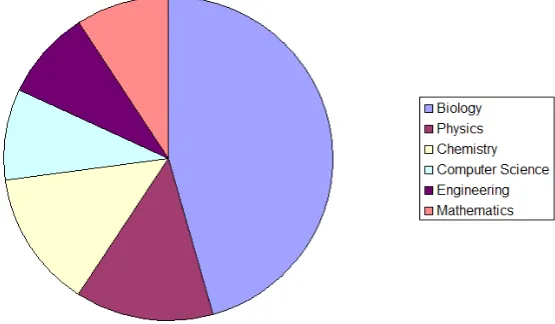
Given the fact that the university staff teaching Bioinformatics come from very diver-gent scientific fields (Figure 1) we feel that it is important to define the appropriate profile of the lecturer. A lecturer in third-degree education must possess a number of responsibilities that re-quire a broad and diverse set of skills. Lecturers in the country’s institutes of higher education are expected not only to teach but also conduct re-search, produce publications, supervise students, participate in events and committees, etc. Profes-sors have the obligation and the right to provide individual and self-motivated teaching, research-scientific and administrative work, in accordance with relevant legislation. Each professor has the obligation to regularly see students on issues re-lated to teaching and research. Full-time profes-sors are obliged to teach a minimum of six (6) hours per week, on average over two semesters. In addition to these hours, they are required to be present on campus for twelve (12) hours per week and provide teaching, research or administrative work. The physical presence must be distributed so that it occurs over no less than three days per week. Part-time professors are obliged to teach and be present for half the hours stipulated for full-time professors (N4310, 2014).
The formerly established model that was traditionally used to grant professors with dog-matic powers is no longer in action. Professors and other teaching staff undergo regular internal and external evaluations and are assigned specific duties including participation in committees. The academic freedom, although sometimes difficult to implement, is considered granted. Neverthe-less, during the last years, there have been several attempts to reform the universities (N4009, 2011), that have been considered by many as attempts against academic freedom (Gounari, 2012; Gou-vias, 2012; Stergiou & Machias, 2015).
produc-ing work and ideas which are beneficial both immediately and in the long-term. However, most have converted to the view that there is no inherent characteristic defining which teaching profile is the most suitable for the teaching pro-cess. It also becomes clear that, during the teach-ing process, the teacher may have to proceed to actions that are necessarily inconsistent (Veneti, 2001). If, however, it is essential to point out a common element in reference to their profile, this is the preparation for each semester and/or lec-ture. Auditoria are spaces where emerging new citizens communicate, learn and confront each other. And educators, as well as students, adapt the features and roles that correspond to their social environment (Dussel, 2013) and attempt to successfully carry out multiple social roles si-multaneously. Therefore, because the university education system is anything but homogeneous, multiple factors contribute to making the role of higher education professors difficult. What is more, the number of Bioinformatics educators in Greece is very limited causing their task to be even more challenging.
CONCLUSION
Bioinformatics, being an interdisciplinary field, has a special role and it is placed at the in-terface of Biology, Mathematics and Computer Science. In this work, we investigated for the first time the current situation of Bioinformatics edu-cation in Greece. By analyzing the curricula of the relevant University Departments we found
that all the Departments of Biological Sciences include in their programmes’ courses dedicated to Bioinformatics, contrary to what is the case for Departments of Computer Science, Com-puter Engineering, or Medical Schools. We also noticed that the newer Universities of the periph-ery have invested in the field, by including more relevant courses in the curricula and appointing faculty members trained in the field. Finally, we performed a qualitative study using interviews so as to have a more spherical view of the sub-ject under discussion , From the interviews we obtained useful insights concerning the methods used by bioinformatics tutors, their attitudes and the difficulties they encounter. Tutors mentioned that the educational process could not be conside-red as an easy one; the material that they choose, the audience’s attraction techniques, the conti-nuous questions for feedback (in classrooms and in labs) and their thoughts within interaction with their students compose an ongoing, demanding process.
REFERENCES
Altman, R. B. (1998). A curriculum for bioinformatics: the time is ripe. Bioinformatics, 14(7), 549-550. Bagos, P. G. (2010). Bioinformatics and Computational
Biology in Greece: a bibliometric study. Paper presented at the 5th Conference of HSCBB (HSCBB10), Alexandroupolis.
Biggs, J., & Tang, C. (2011). Teaching for quality learning at university: What the student does: McGraw-Hill Education (UK).
Brosvic, G. M., Epstein, M. L., Cook, M. J., & Dihoff, R. E. (2005). Efficacy of error for the
tion of initially incorrect assumptions and of feedback for the affirmation of correct respond-ing: Learning in the classroom. The Psychologi-cal Record, 55(3), 401.
Burchielli, R., & Bartram, T. (2006). ‘Like an Iceberg Floating Alone’: A Case Study of Teacher Stress at a Victorian Primary School. Australian Journal of Education, 50(3), 312-327.
Cohen, L., Manion, L., & Morrison, K. (2013). Re-search Methods in Education: Routledge.
Ditty, J. L., Kvaal, C. A., Goodner, B., Freyermuth, S. K., Bailey, C., Britton, R. A., Gordon, S. G., Heinhorst, S., Reed, K., Xu, Z. & Sanders-Lo-renz, E. R. (2010). Incorporating genomics and bioinformatics across the life sciences curricu-lum. PLoS Biol, 8(8), e1000448.
Dussel, I. (2013). The assembling of schooling: dis-cussing concepts and models for understanding the historical production of modern schooling. European Educational Research Journal, 12(2), 176-189.
Evertson, C., Emmer, E., & Worsham, M. (2006). Classroom management for middle and high school teachers. Boston, MA: Pearson.
Flick, U. (2004). A companion to qualitative research, ed-ited by Uwe Flick, Ernst von Kardoff and Ines Stein-ke; translated by Bryan Jenner. London: SAGE Publications.
Floriano, W. B. (2008). A portable bioinformatics course for upper-division undergraduate curric-ulum in sciences. Biochem Mol Biol Educ, 36(5), 325-335.
Gounari, P. (2012). Neoliberalizing Higher Education in Greece: new laws, old free-market tricks. Power and Education, 4(3), 277-288.
Gouvias, D. (2012). The post-modern rhetoric of re-cent reforms in Greek higher education. Jour-nal for Critical Education Policy Studies, 10(2), 282-313.
Hare, W. (1998). Critical thinking as an aim of edu-cation. Inquiry: Critical Thinking Across the Disci-plines, 18(2), 38-51.
Honts, J. E. (2003). Evolving strategies for the incor-poration of bioinformatics within the under-graduate cell biology curriculum. Cell Biol Educ, 2(4), 233-247.
Jacobsen, D. A., Eggen, P. D., & Kauchak, D. P. (2008). Methods for teaching: Promoting student learning in K-12 classrooms: Prentice Hall.
Kivits, J. (2005). Online interviewing and the research relationship.
Marzano, R. J., Marzano, J. S., & Pickering, D. (2003). Classroom management that works: Research-based strategies for every teacher: ASCD.
Matsagouras, E. (2006). Theory of teaching. Athens:
Gutenberg (in Greek).
Meho, L. I. (2006). E‐mail interviewing in qualitative research: A methodological discussion. Journal of the American society for information science and technology, 57(10), 1284-1295.
Law 4009/2011 “Structure, function, ensuring the quality of studies and internationalization of higher education.” (2011).
Law 4310/2014 “Research, Technological Develop-ment and Innovation and other provisions.” (2014).
Noddings, N. (2003). Is teaching a practice? Journal of Philosophy of Education, 37(2), 241-251. Olivero, N., & Lunt, P. (2004). When the ethic is
func-tional to the method: the case of e-mail qualita-tive interviews. Buchanan (2008). How do various notions of privacy influence decisions in qualitative internet research, 101-113.
Paraskevopoulou-Kollia, E.-A. (2008). Methodology of qualitative research in social sciences and interviews. Open Education-The Journal for Open and Distance Education and Educational Technol-ogy, 4(1).
Paraskevopoulou-Kollia, E.-A. (2012). Teaching Phi-losophy to non philosopher. Thessaloniki: Afi Kyriakidi.
Parkay, F. W., Stanford, B. H., & Gougeon, T. D. (2010). Becoming a teacher: Pearson/Merrill. Robert, L. P., & Dennis, A. R. (2005). Paradox of
rich-ness: A cognitive model of media choice. IEEE transactions on professional communication, 48(1), 10-21.
Searls, D. B. (2012). An online bioinformatics curricu-lum. PLoS Comput Biol, 8(9), e1002632. Slavin, R. E. (1989). Effective programs for students at risk:
ERIC.
Stergiou, K. I., & Machias, A. (2015). Nailing down ‘academic’freedom and tenure in Greek re-search institutions. Ethics in Science and Environ-mental Politics, 15(1), 59-62.
Sutton, R. E., & Wheatley, K. F. (2003). Teachers’ emotions and teaching: A review of the litera-ture and directions for fulitera-ture research. Educa-tional psychology review, 15(4), 327-358.
Veneti, M. (2001). Teaching Philosophy [I didaskalia tis philosophias]. Athens: Ekdosis Papadima. Welch, L., Lewitter, F., Schwartz, R., Brooksbank, C.,
Radivojac, P., Gaeta, B., & Schneider, M. V. (2014). Bioinformatics curriculum guidelines: toward a definition of core competencies. PLoS Comput Biol, 10(3), e1003496.