Introducing the CLTS approach in Zimbabwe
In this article I describe the piloting of the CLTS approach by Plan International in Zimbabwe. In 2008, Plan, through its Regional Office for East and Southern Africa (RESA), was seeking sustainable and innovative ways of scaling up provision of safe sanitation in rural communities across the region. The need was urgent. Sanitation coverage in Zimbabwe had been falling, from 58% in 1999 to 56% in 2003, and 46% in 2006. By 2009 it was predicted to fall further, to around 30% in rural areas.1
Although the participatory sanitation approaches Plan Zimbabwe had been using were popular with communities, they relied on subsidies, limiting the potential for scaling up. Plan heard about a new approach, Community-Led Total Sanita-tion (CLTS), and decided to give it a try.
CLTS does not promote any particular latrine design, or provide any subsidy for building latrines. It focuses on changing minds, stopping open defecation and encouraging communities to build latrines using local materials.
Plan introduced the CLTS approach in Zimbabwe in November 2008, at a time when some of the targeted communities faced outbreaks of cholera and other diar-rhoeal diseases. The country was also facing unprecedented economic decline, with infla-tion above 230 million percent. Despite this unpromising context, significant progress has been made in convincing communities and district-level government staff of the huge potential of CLTS, even turning adverse circumstances into opportunities (see also Chimhowa, this issue). However, challenges still remain if CLTS is to be more widely accepted as an effective and sustain-able approach to sanitation in Zimbabwe.
1Source: UNDP Human Development Index report, 2008. This coverage is based on the
number of latrines which meet the Zimbabwe national standard for latrine design and construction, the BVIP. This is a relatively high standard and the true number of latrines is likely to be higher.
by SAMUEL RUKUNI
Challenging mindsets:
CLTS and government
Piloting the CLTS approach
In July 2008, a core team from Plan Zimbabwe and other country offices under-went a training of trainers (ToT) course in Zambia, which was facilitated by CLTS pioneer, Kamal Kar. Plan Zimbabwe decided that the best entry point for CLTS work was through the government District Water and Sanitation Sub-committees (DWSSC), the institutions mandated to coordinate water and sanitation activities at district level. This body consists of government line ministries, NGOs and other partners working in the water and sanitation sector.
However, we were aware that this approach would present challenges. These once-vibrant district committees were now largely dormant. Also, working through the government meant challenging the notion of a national standard latrine design. Sani-tation programmes in Zimbabwe had been based around this idea of a national stan-dard since the mid-1970s. However, the standard adopted – the Blair ventilated improved latrine (BVIP) is expensive to construct and unaffordable for most rural communities unless subsidies are provided (see Box 1). Both the existence of the national standard and the usual practice of Current sanitation strategies and technology options in Zimbabwe can be traced back to research work carried out in the mid 1970s by the Ministry of Health’s Blair Research Laboratory. The Blair ventilated improved latrine (BVIP) was adopted as the national minimum standard for latrines in rural communities. In the minds of rural communities, ‘toilets’ are BVIPs.
However, the BVIP has major drawbacks: it is expensive to construct (estimated at US$80-100 per unit) and unaffordable for most rural communities. Subsidies are needed if households are to build them. This encourages communities to rely on the government to repair or rebuild the latrines when needed, and the latrines are not always used. Also, free inputs can be misappropriated.
Although further research was undertaken to develop a more affordable BVIP, using some low cost and locally available materials like grass roof thatching, the new BVIP still retains the same minimum standards and is beyond the reach of many poor rural communities without subsidies, which the government cannot afford.
Box 1: The role of the BVIP in sanitation approaches in Zimbabwe
Photos:
NIHR
providing subsidies presented barriers to the introduction of CLTS in the DWSSCs and in the communities.
Despite this, fifteen members of the DWSSC in Mutoko were persuaded to take part in a CLTS training together with Plan field staff, during which they successfully triggered the first three villages. Slowly, the number of successfully triggered villages grew, and a group of confident and
passionate CLTS champions/facilitators began to develop amongst Plan staff and district partners. This encouraged other members of the DWSSC to join the trig-gering, and the number of villages constructing latrines without any outside support was evident, as observed by the Plan field staff reports.
The triggering spread spontaneously through diffusion and peer pressure among
Pit latrine made from local materials.
Photo:
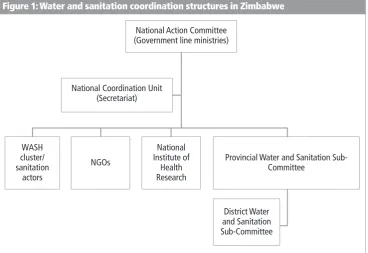
neighbouring villages, as they also started to organise themselves to construct latrines. Communities developed innova-tive designs using locally available materi-als. Several neighbouring and surrounding communities found themselves under scrutiny to construct toilets. This attracted the attention of the Water and Sanitation Programme National Coordination Unit (NCU) (see Figure 1). NCU members visited some of the triggered villages in Mutoko district in preparation for the annual National Sanitation Week (NSW). After the field visit the NCU decided that the 2009 National Sanitation Week (NSW) should be held in Mutoko District. The Mutoko DWSSC led the preparations and hosting of the NSW.
Spreading the word about CLTS
The theme of the NSW was ‘Community-led sanitation: key to a cholera-free envi-ronment.’ The climax of the week was a celebration attended by the Permanent
Secretary in the Ministry of Infrastructure Development and members of the National Action Committee (NAC) for sanitation, made up of government line ministries, the NCU and DWSSCs from other districts. The media were also invited.
The communities and school children provided dramas, poems and games on CLTS triggering and testimonials on their outcome. The visitors were taken on a ‘transect walk’ through the host village to inspect and view some of the latrines constructed. Although many did not meet the national BVIP standard, government officials recognised that villagers had taken a step onto the ‘sanitation ladder’.
The visit was an extremely effective way of showing higher level officials what CLTS can achieve: the Permanent Secretary and his team are today advocates for ‘Commu-nity-Led Incremental Sanitation’ at policy level, with due cognisance of preserving the health and hygiene standards.2 The role of
the media was also important in publicis-Figure 1: Water and sanitation coordination structures in Zimbabwe
2Community-Led Incremental Sanitation is where communities are given the
opportunity and leeway to climb up the sanitation ladder using approved methodologies.
National Action Committee (Government line ministries)
National Coordination Unit (Secretariat)
WASH cluster/ sanitation
actors
NGOs
National Institute of
Health Research
Provincial Water and Sanitation Sub-Committee
ing the CLTS approach, as the NSW event was broadcast on TV.
To date, Plan has led the introduction of CLTS in three other districts: Kwekwe, Chiredzi and Mutare, through the training of Plan staff and members drawn from the respective DWSSC and partners. These trainings also culminate in villages being triggered, as the CLTS training is field-based.
Challenging the BVIP standard
After the NSW event the minimum stan-dard BVIP latrine came under scrutiny from partners and government health and envi-ronmental workers. District-level staff began to recognise that the BVIP standard was too high for many rural communities. Communities have to be given the opportu-nities and encouragement to develop in stages, upgrading their latrines as they have the means to do so. CLTS triggers action towardsthe standard, but begins with home-grown local technologies and harnessing local resources. Communities should be allowed to raise their own sanita-tion profile through a ‘sanitasanita-tion ladder’ (Figure 2), mentoring each other through behaviour change to achieve the higher level.
Turning obstacles into opportunities Most of the community natural leaders in triggered villages have accepted the CLTS approach as it provides flexibility on what action needs to be taken and opens the way to finding local sanitation solutions. In some ways the economic situation and the devastating cholera outbreak worked in
our favour. The decrease in the volumes of development assistance and subsidies in Zimbabwe led communities to realise that they had to find their own solutions to sani-tation problems. Triggering was also signif-icantly more successful in communities that had been affected by cholera. The uptake within communities ravaged by cholera was significantly higher. The CLTS approach was welcomed as it encouraged people to reflect on their sanitation behav-iour stimulated by a collective sense of fear of cholera. Communities immediately decided to take action and accepted the CLTS approach as an alternative and sustainable approach to sanitation.
Transect walks through the villages which have been triggered showed various stages of latrine constructions coupled by a deliberate effort by communities to bury human faeces rather than leave them in the open (referred to as ‘cat’ sanitation). Is this the start of behaviour change? Although no ward in Mutoko has been declared open defecation free (ODF), there is clear evidence of a collective sense of purpose as the communities influence each other to end defecating in the open. However, Plan is yet to prove (which may not be so easy) that the introduction of CLTS has had a major role to play in the purported behav-iour change.
At the district level, Plan has started to make progress in converting sanitation practitioners and partners to the CLTS approach. Staff have gradually embraced CLTS after seeing the results, and are acknowledging the challenges which came Figure 2: The sanitation ladder model for rural communities in Zimbabwe
Ventilated pit latrine with handwashing facility (BVIP – the national standard)
Ventilated pit latrine
Non-ventilated pit latrine
‘Cat’ sanitation (dig and bury)
Open defecation
Top
with previous approaches to sanitation in Zimbabwe. To spread, CLTS needs ‘trig-gered’ individuals who can act as champi-ons within organisatichampi-ons. Key factors that contributed to some of the successes were the transect walks through the open defe-cation (OD) areas of the village, especially the disgust of watching and tempering with raw shit which defied custom and culture. Engaging and partnering with the media through photos and videos taken during triggering sessions help to spread the word and sensitise policymakers, donors and other NGOs to their collective responsibility to provide safe sanitation for all. Information, education and communi-cation (IEC) materials were shown to part-ners and communities as an advocacy and awareness tool. Some government author-ities are now gradually moving towards advocating for CLTS. However, they also argue that the approach can be blended into existing participatory health and hygiene packages. One senior government official said that ‘CLTS can be adopted in Zimbabwe with some modifications here and there to suit our conditions’. Another wrote: ‘The water and sanitation sector in Zimbabwe has approved the VIP toilet as the technology of choice… Adoption of CLTS should be done with this aspect in mind.’ Indeed some government officials are missing the point. There is need for a
complete paradigm shift by the authorities and leadership which then can be cascaded down to communities. Plan Zimbabwe continues to lobby at national level for the adoption of CLTS. The hope is that the government will realise the positive impact that such an approach could have on the health and hygiene in the communities: that it is not about sanitation structures but rather the change of mindsets.
CLTS challenges
Continuation of subsidised programmes
Subsidised NGO -funded sanitation programmes are still running in Zimbabwe, and are popular with communities, since these inputs are easily converted to economic value. The cement can be sold or exchanged for other needs. Moving away from subsidised programmes is a challenge for some NGOs as many of these subsidised programmes are now entrenched. Plan still faces the challenge of persuading all part-ners in the districts to move away from subsidies, and this is being done through advocacy and bringing these partners on board during CLTS triggering sessions.
Lack of clear responsibility for water and sanitation
In common with other sanitation programmes and approaches, CLTS suffers Ministry
Health and Child Welfare
Water Resources
Infrastructure Development
Local Government Rural and Urban Development
Environment and Tourism
Responsibility (sanitation)
Environmental health and sanitation
Water supply (rural and urban)
Water and sanitation infrastructure
Water and sanitation service provisions
Environmental protection
Official (representation)
Environmental Health Officer/ Environmental Health Technicians (NAC/DWSSC)
Water Engineers/Technicians (NAC)
Water and Sanitation Engineers/Technicians (NAC)
District Administrator (chairs DWSSC)
from the lack of a lead ministry for sanita-tion (Table 1). The government has created new ministries with overlapping responsi-bilities, and although all these ministries are represented within the NAC and DWSSC structures (see Figure 1), there is often confusion over responsibilities. More-over, the national coordination unit (NCU) has difficulties in fulfilling its appointed role because it lacks experienced and qual-ified staff, due to poor remuneration and conditions of service. For instance, Plan has submitted a concept note to introduce CLTS in Zimbabwe through the NCU – and the NCU has subsequently passed it to the NAC. However, this NAC is composed of non experts in sanitation.
The success of CLTS in Zimbabwe would require that government clearly identifies the lead agency or department to the lead sanitation issues and create CLTS champions within and through the Partic-ipatory Health and Hygiene Education (PHHE) toolkit.
UNICEF has also been engaging with the Zimbabwe government to review policy changes arising from the sanitation situa-tional analysis through the global Water Sanitation and Hygiene (WASH) cluster. However, the WASH cluster, led by UNICEF and Oxfam and mainly composed of NGOs, has little government ministry participation, and the cluster’s work has in any case been focused on emer-gency and humanitarian work over the last two to three years, limiting its interest in new sanitation approaches like CLTS.
Lack of support
Other institutions are known to have also been exposed to the CLTS concepts, through the WSSC, such as the Institute of Water and Sanitation Development (IWSD) – an NGO and key player in water and sanitation programmes in Zimbabwe. However, CLTS has failed to take off due to underfunding in their sanitation programme budgets. Their efforts have only been limited to ‘raising awareness’
among sanitation practitioners. Although fewer financial resources are needed for CLTS (e.g. there are no subsidies) substan-tial human resources are still needed to monitor village’s ODF status and continue to provide health and hygiene education.
Ways forward
It is imperative that new initiatives and innovations should be led by the govern-ment. Government ministries are the custodians and primary duty bearers for scaling up good sanitation for all. Although the uptake of CLTS at the national level in Zimbabwe has been very gradual, successes at the district and lower levels have received appreciation. The Mutoko Rural District Council Executive Officer says:
We also need to come up with action plans to scale up the programme so that the CLTS programme is universally adopted out the whole district and finally through-out the whole country (Sigauke, 2009).
Plan Zimbabwe will continue to work with the government and other partners in improving sanitation for rural communi-ties through approaches that empower them and unleash the potential for self sustainability. Organisations working in the sanitation sector should continue to challenge conventional sanitation approaches through approaches like CLTS. They should not be deterred by challenges emanating from policy or other institu-tional barriers. Coordination among CLTS players in the country and the region needs to be enhanced in order to cement the various efforts – and to convince sceptics that the CLTS approach is a viable way to improve rural sanitation coverage in line with the MDGs.
CONTACT DETAILS
Samuel Rukuni Habitat Advisor Plan Zimbabwe 7 Lezard Avenue, Harare Post Bag 7232 Highlands Zimbabwe
Tel: +263 04 791601 4/737070/735021/737067 Fax: +263 04 796283 Email: [email protected]
Website: www.plan-international.org
REFERENCES
Kar, K. with R. Chambers (2008) Handbook on Community-Led Total Sanitation. Plan: UK and Institute of Development Studies (IDS): Brighton, UK. Online: http://tinyurl.com/CLTShandbook. Full URL: www.communityledtotalsanitation.org/resource/handbook-community-led-total-sanitation
Sigauke, P. (2009) Community-Led Total Sanitation: A Participatory Approach to a Public Health Program: a case stufy of Mutize village in Mutoko Rural District Council, Zimbabwe. Prepared by Peter Sigauke with the support of Plan International, Mutoko Programme Unit.
2008). Could this be the beginning of a sanitation revolution in Zimbabwe? Plan Zimbabwe intends to continue with the advocacy route to lobby for CLTS.
Conclusion
For sanitation approaches like CLTS to be successful we need to change mindsets and behaviour in communities and at all insti-tutional levels. But it also requires a recog-nition that we need sanitation facilities and standards which are acceptable and afford-able for rural communities. If sufficient flexibility is not permitted, institutional settings can be barriers against new design
innovations and initiatives which will help communities to move up the sanitation ladder. Even though CLTS presents insti-tutional challenges, at the community level it has boosted the confidence of communi-ties to solve their own problems. The CLTS approach provides flexibility on the type of action to be taken and opens the way to finding local sanitation solutions.