On: 27 Sept em ber 2013, At : 00: 47 Publisher: Rout ledge
I nform a Lt d Regist ered in England and Wales Regist ered Num ber: 1072954 Regist ered office: Mort im er House, 37- 41 Mort im er St reet , London W1T 3JH, UK
Accounting and Business Research
Publicat ion det ails, including inst ruct ions f or aut hors and subscript ion inf ormat ion:
ht t p: / / www. t andf online. com/ loi/ rabr20
On the emergence of strategic management
accounting: An institutional perspective
Yi Ma a & Mike Tayles ba
Capgemini plc, London
b
Hull Universit y Business School, Hull, HU6 7RX Phone: 44(0)1482 463094 E-mail:
Published online: 04 Jan 2011.
To cite this article: Yi Ma & Mike Tayles (2009) On t he emergence of st rat egic management account ing: An inst it ut ional perspect ive, Account ing and Business Research, 39: 5, 473-495, DOI: 10. 1080/ 00014788. 2009. 9663379
To link to this article: ht t p: / / dx. doi. org/ 10. 1080/ 00014788. 2009. 9663379
PLEASE SCROLL DOWN FOR ARTI CLE
Taylor & Francis m akes every effort t o ensure t he accuracy of all t he inform at ion ( t he “ Cont ent ” ) cont ained in t he publicat ions on our plat form . How ever, Taylor & Francis, our agent s, and our licensors m ake no represent at ions or warrant ies w hat soever as t o t he accuracy, com plet eness, or suit abilit y for any purpose of t he Cont ent . Any opinions and view s expressed in t his publicat ion are t he opinions and view s of t he aut hors, and are not t he view s of or endorsed by Taylor & Francis. The accuracy of t he Cont ent should not be relied upon and should be independent ly verified w it h prim ary sources of inform at ion. Taylor and Francis shall not be liable for any losses, act ions, claim s, proceedings, dem ands, cost s, expenses, dam ages, and ot her liabilit ies w hat soever or how soever caused arising direct ly or indirect ly in connect ion w it h, in relat ion t o or arising out of t he use of t he Cont ent .
On the emergence of strategic management
accounting: an institutional perspective
Yi Ma and Mike Tayles
*Abstract—Strategic management accounting (SMA) has been presented as an efficacious approach to strategy formulation
and implementation. It also suggests accountants move away from purelyfinancial concerns to give consideration to wider business issues. Management accounting change has attracted significant research attention in recent years. This case study explores the issues which surround change and which enable the adoption of SMA and the repositioning of management accountants to become more strategic. The empirical enquiry is based in one company through a prolonged series of interviews and meetings which enabled activities over a number of years to be reviewed. This revealed an increasing strategic role for management accountants in informing strategic decision-making and how this role came into being. The research is informed by institutional theories and neoinstitutionalism in particular, to interpret the external and internal influences on the change in roles of some management accountants and the outputs of their work.
Keywords:strategic management accounting; institutional theory; accounting change
1. Introduction
This study investigates management accounting change in a large UK pharmaceutical company. There was an evolution process of accounting from conventional/routine operations to strat-egic involvement in and support of management decision-making. Strategic management account-ing (SMA) practices have become gradually relied upon by the management accountants to provide decision support. The main objective of this paper is to document how these practices have been adopted within the processes of management accounting change; what kind of change process the case company experienced and what caused the change. From a theoretical perspective, the paper draws on a neoinstitutional framework (Powell, 1985; Greenwood and Hinings, 1993, 1996). New man-agement accounting practices emerged in the case company and these are interpreted as administrative
innovations, the success of which was influenced by
both organisational contexts and organisational actions.
The paper makes three contributions to the recent literature on management accounting change. First,
it specifically sheds light on how the adoption of
SMA practices is influenced by organisational
environments and organisational actions. SMA studies conducted in the past have placed focus on how popular the various SMA practices are in a
given population of organisations. This kind of
research did not present sufficient reasoning as to
why certain practices are popular or not; and also most of these static investigations relied upon
cross-sectional survey methods (Guilding, 1999;
Guilding et al., 2000; Chenhall and Langfi
eld-Smith, 1998); they could not offer adequate insight
into how SMA practices are influenced by
organ-isational contexts (Malmi, 1997; Covaleski et al., 1993, 1996; Burns and Scapens, 2000; Granlund, 2001).
Second, from a theoretical perspective, the employment of a neoinstitutional framework in this study is offering further theoretical
develop-ment to bridge the gap between the‘old’and‘new’
institutional frameworks (Dillard et al., 2004; Modell, 2005). Compared to the conventionally utilised institutional theories in the research area of management accounting change, especially old institutional economics (OIE) (Burns and Scapens, 2000; Burns and Baldvinsdottir, 2005; Lukka, 2007) and new institutional sociology (NIS) (Granlund and Lukka, 1998; Granlund, 2001), this neoinstitutional framework has made explicit link-age between organisational contexts and
organisa-tional actions; it embraces comprehensive
consideration of human actors. Therefore, it has the potential to advance our understanding of the interaction between the wider social, environmental and political pressures for change and organisa-tional behaviour, i.e. how organisations respond to and process institutional changes.
Third, the case study design helps to explore management accounting change as a set of organ-isational behaviours and interprets the meanings of *The authors are at Capgemini plc, London, and Hull
University Business School respectively.
Correspondence should be addressed to: Mike Tayles, Hull University Business School, Hull HU6 7RX. E-mail: m.e. [email protected]. Tel: 44(0)1482 463094.
This paper was accepted for publication in July 2009.
these behaviours in their specific organisational contexts. Detailed examination of the actual
prac-tices within a specific setting can be very valuable.
Ahrens and Dent (1998) argue that analysing managerial ambiguities, tensions, and
contradic-tions is a major opportunity offered byfield research
methods, as they permit an analysis of themes and interpretations, and can assist understanding of the complexity of accounting operations in organisa-tions. It is precisely this type of analysis the researchers pursued in this study, which responds to the numerous calls over the recent decade for
theoretically informed case study research
(Atkinson et al., 1997; Shields, 1997; Scapens and Bromwich, 2001).
The rest of the paper is organised as follows. In
Section 2, we briefly review the literature on SMA
and management accounting change. The neoin-stitutional theoretical framework is discussed next in Section 3, where brief comparisons are made to other institutional theories used by management accounting researchers. In Section 4, the research method is outlined. The case description is then presented. This is followed by an analysis section which discusses the observed management account-ing change. The paper ends with conclusions, limitations and potential for future research.
2. Literature review
2.1. Strategic management accounting
During the past two decades, SMA has generated
significant research interest. SMA has been
pre-sented as the common-sense approach to the problems emanating from a changing competitive and technological environment. Some accounting researchers have seen SMA as implying a greater contribution by accountants to strategy formulation and implementation (Shank, 1989, 1996). Some have viewed it as suggesting accountants move
away from purely financial concerns to larger
business issues (Roslender, 1995; Roslender and Hart, 2003). Others have seen it as an opportunity to make accounting relevant again so as to elevate its standing relative to other functions within the organisation (Johnson and Kaplan, 1987; Johnson, 1992).
The term SMA is open to a number of variations,
reflecting the fact that there is still no agreed
conceptual framework about what constitutes SMA (Tomkins and Carr, 1996; Roslender and Hart, 2003). Various authors have posited slightly differ-ent terms for this phenomenon including, account-ing for strategic position (Simmonds, 1986), strategic cost management (SCM) (Shank, 1989, 1996), and strategic management accounting
(SMA) (Bromwich, 1990; Guilding et al., 2000),
though they, to a large extent, overlap. Langfi
eld-Smith (2008: 212) summarises this as:
‘taking a strategic orientation to the generation,
interpretation and analysis of management accounting information and competitors activ-ities.’
In this study, SMA was defined as:
‘The body of management accounting concerned
with strategically orientated information for
decision making and control.’
This definition resonates with Bromwich and
Bhimani’s (1994: 127) vision of SMA that:
‘it (SMA) allows management accounting, in
addition to its conventionalfields, to concentrate
upon the consumer value generated relative to
competitors. It also aids in monitoring thefirm’s
performance in the market place using a whole range of strategic variables over a decision
horizon sufficiently long for strategic plans to
come to fruition.’
Therefore, SMA embraces the management accounting techniques with a clear strategic focus, with future-orientated stance and explicit external focus forming the core of the concept of SMA.
Additionally, SMA draws heavily on non-financial
measures (Bhimani and Langfield-Smith, 2007).
For example, the efficient functioning of
customer-related and competitor-customer-related practices all rely
heavily on measures of non-financial nature (Seal,
2001). In contrast, the conventional management accounting operations tend to be predominantly
financially oriented, paying more emphasis to
historicalfinancial evaluation.
Survey evidence shows that SMA practices have widely ranging degrees of application; and the adoption rates of innovative SMA practices are
comparatively low (Chenhall and Langfield-Smith,
1998) even the awareness of the term was limited (Guilding et al., 2000). But the potential of SMA
should not be overlooked; Guilding et al.’s (2000)
study found that for all SMA practices appraised,
the perceived merit scores are significantly greater
than the usage rate scores. Bhimani and Keshtvarz
(1999) indicate that senior accounting officers are
offering more and more strategy-related informa-tion for decision-making. Otley (2001: 245) also
remarked that SMA has made a‘major impact on
the thinking of practicing management account-ants’.
Contingency studies have also examined the linkages between SMA practices and an
tion’s market and economic performance. Simons (1987) found that ROI is higher when accounting control systems and business strategy are more closely linked. The study of Said et al. (2003) also
suggests that SMA practices are significantly
asso-ciated with future accounting-based and market-based returns. However, they are not effective for all
firms. The results indicate that the benefits of
adopting SMA practices is significantly associated
with many other factors, such as innovation-oriented strategy, length of product development,
industry regulation, and level of financial stress
(Said et al., 2003).
To summarise, a substantial body of accounting research has offered evidence on how popular the various SMA practices are and whether manage-ment accountants are playing strategic roles. Management accountants are also encouraged not only to provide strategic information but also to participate in the decision-making process itself (Bhimani and Kershtvarz, 1999). However, there is less insight as to how accountants engage with strategic issues (Tillman and Goddard, 2008). There is a lack of evidence on how these SMA practices have become adopted (or denied) by the organisa-tions and the processes of these adoporganisa-tions (or rejections). These are the research questions or
puzzles that are addressed in this paper.
Theorisations on the adoption process of SMA practices and the role change of management
accountants are relatively scarce. As Langfi
eld-Smith (2008: 224) points out in her review of the
last 25 years experience of SMA‘it would be useful
to understand how techniques diffuse into more
general practice and into organisational processes’.
2.2. Management accounting change
In the founding work of SMA, Simmonds (1981) urged management accountants to change their orientation to provide information deemed of greatest value to the business. This implies that accountants need to change their perspective from a
purefinancial focus to a broader business
perspec-tive, which entails a detailed understanding of the business and its environment. However, the major-ity of studies conducted in the past placed main focus on the technical perspective of new account-ing practices. This research trend has been heavily
influenced by the‘consulting genre’(Lukka, 2007:
79) which places primary attention on new man-agement accounting techniques and their successful implementation (Kaplan and Norton, 1996; Cooper, 1996). But despite the strong suggestions of innovative SMA practices from academics and consultancy, there is ample evidence that the
promotion of this management accounting change
faces significant organisational tension, conflict,
and resistance, which quite often results in failure of
the change or merely‘ceremonial’conduct of new
management accounting practices (Scapens and Roberts, 1993; Malmi, 1997; Granlund, 2001). The process of how accounting operations change with emerging organisational situations has only recently been addressed. Burns and Baldvinsdottir (2005) argue that studying the processes of management accounting change requires a conceptualisation of the ways in which new accounting practices evolve over time. However, only recently has research attention been given to understanding the account-ing change processes through which new practices emerge (or fail to emerge) through time (Burns and Vaivio, 2001; Tsamenyi et al., 2006; Coad and Cullen, 2006).
Shields (1995) argues that accounting changes are administrative innovations, the success of which depends on how well behavioural and organisa-tional implications are dealt with. Friedman and Lyne (1997) comment that the elimination of the bean-counter image attached to accountants will depend on the ability of accountants to continually adapt to a rapidly changing environment. Pierce and
O’Dea (2003) also posit that for the management
accountant to cope with the ever-changing envir-onment and promote their strategic importance, they need to adapt information to the needs of a given situation and achieve an optimum balance between technical and organisational validity.
Therefore, the linkage between management
accounting change and its collective context, the wider social and institutional forces that surround it, are largely unexplored (Bhimani, 1993; Granlund and Lukka, 1998; Burns and Scapens, 2000).
3. Institutional theories
3.1. Institutional theories and management accounting research
Currently, a number of researchers, who view management accounting practices as socially
con-structed, are drawing on a range of ‘institutional’
perspectives to examine the process of accounting change in correspondence with organisational change (Granlund and Lukka, 1998; Burns and Scapens, 2000; Burns and Vaivio, 2001; Scapens and Jazayeri, 2003; Yazdifar et al., 2008). They have been successful in illuminating issues in both theory and practice.
Employing institutional theories in assisting management accounting research, however, is not all that straightforward. Scott (1991: 1025) advised
that ‘the beginning of wisdom in approaching
institutional theory is to recognise that there are not
one but several variants’. DiMaggio and Powell
(1991), for example, distinguished between old1
and new2 institutionalism. New institutionalism
(NIS) is primarily related to organisations-in-sec-tors and has its major emphasis on how individual organisations are embedded in a given population or
field of organisations (DiMaggio and Powell, 1983;
Meyer and Rowan, 1977). The success of an organisation from an NIS perspective is therefore
defined by the extent to which it embodies societal
‘ideals’(myths) regarding norms of rational
behav-iour (Scott, 2001). Management accounting
researchers who adopt NIS tend to explore the extent to which wider institutional arrangements
have influenced the development of accounting
practices, indicating that the selection of manage-ment accounting practices is not dictated by
tech-nical criteria or economic efficiency alone, but also
a cultural and political process that concerns legitimacy and power (Covaleski et al., 1996; Collier, 2001; Hussain and Hoque, 2002). For example, Granlund and Lukka (1998: 153) use NIS to argue that there is currently a strong tendency
toward ‘global homogenisation’ of management
accounting practices, which are heavily influenced
by a global market, accounting professionalisation, and consultancy suggestions.
Despite its current vogue in organisational analysis, NIS has, however, been frequently criti-cised for its deterministic nature and its neglect of the role of active agencies and issues of power and interest at the micro-level (Carmona et al., 1998). This can be seen as largely stemming from its heavy focus on change at an extra-organisational level (Dillard et al., 2004). The same concern is
addressed by Powell (1991: 194) that NIS‘portrays
organisations too passively and depicts
environ-ments as overly constraining’. Additionally,
Yazdifar et al. (2008) pointed out that the assump-tion that practices designed to secure external legitimacy are only symbolic and always decoupled from internal operating systems needs to be
seriously questioned (Carruthers, 1995;
Mouritsen, 1994; Zucker, 1987). NIS thus needs to be complemented by other perspectives, one which factors internal organisational dynamics into the explanation (Fligstein, 1989; Scott, 1987; Zucker, 1988).
Old institutionalism (OIE) places its focus on the
individual organisation and thus could complement NIS on analysing the complex dynamics of change
at a micro-level and explain conflict and actors’
struggle for power (Burns and Scapens, 2000; Modell, 2001). OIE implies that the individual organisation is not passive in its choice of work arrangements and practices. On the contrary, it makes conscious choices in response to various pressures (Oliver, 1991; Scott, 1991). Furthermore, to be implemented effectively in the organisation, any choice must be backed with sanctioning power. OIE is used by management accounting research-ers to offer insights into micro-studies of the production and reproduction of accounting prac-tices (Burns and Scapens, 2000). Its concern is primarily with management accounting change within individual organisations, i.e. the intra-organ-isational processes of change. The advocates of OIE theory picture management accounting operations within organisations as institutionalised, organisa-tional practices, as budgets are prepared, perform-ance monitored, and reports produced all in a
regular and routine fashion guided by specified
rules and procedures (Burns and Scapens, 2000). As such, management accounting can, over time,
become the ‘taken-for-granted’ ways of thinking
in particular organisations and promote stability (Lukka, 2007). Granlund (2001) uses OIE to explore why accounting systems can sometimes
prove to be difficult to change despite significant
operating and environmental pressures for change. Organisational routines, conservative organisa-tional cultures and failure to legitimate change intentions are key factors that cause resistance to change.
In summary, NIS theorists claim that expect-ations of acceptable practices exist and organisa-tions need to conform to them (Covaleski et al., 1993, 1996, 2003; Granlund and Lukka, 1998). However, the major drawback is that research has focused almost exclusively on macro-effects, leav-ing institutionalised practices within organisations largely unexamined (Tolbert, 1988; DiMaggio and Powell, 1991). By contrast, the OIE framework provides insightful supplements by interpreting institutionalisation as a process that is profoundly political. There is however a need to integrate the
influences from the different institutional powers
into the analysis of individual organisations. The variety among institutional theories may suggest theoretical richness, but some theorists argue that there is a need to link all the contributions
into a more compact theoretical body of findings
that enable researchers to understand social phe-nomena (Oliver, 1991; DiMaggio and Powell, 1
Or alternatively called old institutional economics (OIE) (e.g. Burns and Scapens, 2000; Lukka, 2007).
2
Often being referred to as new institutional sociology (NIS) (e.g. Covaleski, 1993, 1996; Granlund and Lukka, 1998; Granlund, 2001).
1991; Siti-Nabiha and Scapens, 2005). For example, DiMaggio and Powell (1991: 27) suggest
that‘something has been lost in the shift from the
old to the new institutionalism’ and went on to
suggest that‘power and interests have been slighted
topics in institutional research’. In the context of
management accounting change research, Burns and Baldvinsdottir (2005: 728) also call all
institu-tional theorists to further‘develop conceptualisation
of, and seek empirical evidence for, when, why and
how organisational actors influence management
accounting changes while embedded within the institutional fabric of a particular time and space’.
In this study, the researchers use a neoinstitu-tional framework (DiMaggio and Powell, 1991; Greenwood and Hinings, 1996). Compared with the institutional theories introduced above, neoinstitu-tionalism represents a convergence around multiple themes suggested by both old and new institution-alism. In particular, neoinstitutional theory offers an excellent basis for an account of organisational change as it pays special attention to the link between organisational contexts and organisational actions and offers a more detailed account of the different interests and powers of human actors (Dougherty, 1994). This framework particularly serves as an explanation of this study in two respects.
First, both market influence (competitive
pres-sure) and legitimating arguments (institutional pressures) are considered in the same framework rather than placing an emphasis on just one element (Scott, 2001). Early work using institutional theor-ies was focused on the public rather than private sector. A common assumption underlying this was that in the private sectors, market forces would prevail (Meyer and Rowan, 1977; Scott, 2001; Major and Hopper, 2005). But more recent research work has found evidence that management
account-ing practices in the private sector are influenced by
institutional pressures to a substantial degree (Ribeiro and Scapens, 2004; Tsamenyi et al.,
2006). How for-profit organisations respond to
both the pursuit of efficiency and institutionally
driven choices remains, however, an area that is relatively unexplained.
Second, this neoinstitutional framework deals more directly with the dynamics of power and
politics which influence the transformation process
of management accounting operations. How human interest and power are involved in promoting or suppressing management accounting changes can be further investigated within this framework by paying attention to the different factors of intraor-ganisational dynamics.
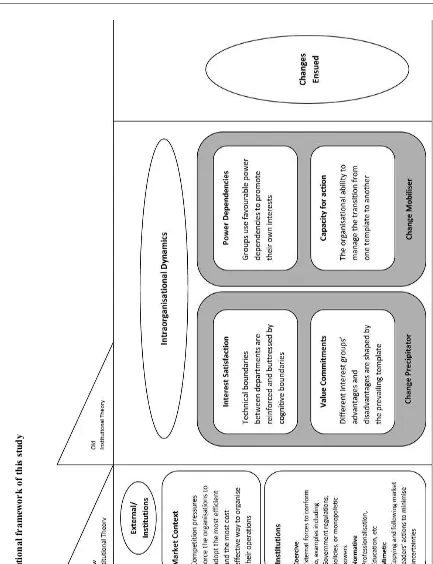
Figure 1 demonstrates the main ideas behind the neoinstitutional framework. This theoretical
con-figuration implies that organisations are open to the
external environment and influenced by external
forces, but organisations’ responses to external
pressures and expectations are no longer assumed to be invariably passive and conforming across all institutional conditions. How organisations respond
to‘institutional prescriptions’, becomes a function
of ‘intraorganisational dynamics’, which involve
power and interests of organisational actors (Greenwood and Hinings, 1996: 1024).
The left-hand side of the chart shows the institutional contexts in which the organisations are embedded. Granlund and Lukka (1998) hold the view that in analysing business organisations, both market (economic) and institutional pressures have important roles to play. In this neoinstitutional
framework, the model of institutional isomorphism3
(DiMaggio and Powell, 1983) is applied as the primary means to structure the analysis of external institutional environments.
Changes in market pressures can have effects on shaping and reshaping intraorganisational power balances, which then enable change. The
institu-tional context also acts to configure the power and
status of groups within an organisation and not necessarily in a manner consistent with market
exigencies. Where management accounting
change is concerned, different organisations face different pressures and have different incentives to adopt innovative practices and change their sys-tems. For example, government regulations, can coerce organisations into adopting new
proced-ures; a large manufacturing firm can force its
suppliers to standardise their logistics operations
3Institutional isomorphism is based on two core ideas: environments are collective and interconnected and organisa-tions must be responsive to external demands to enhance the possibility of survival (DiMaggio and Powell, 1983; Oliver, 1991).
DiMaggio and Powell (1983) distinguish between competitive and institutional types of isomorphism. Competitive isomorph-ism concerns efficiency. When there is one best, cheapest or most efficient way to do things, then the forces of competition will eventually impose upon organisations that one best way. The latter category, institutional isomorphism, can be subdiv-ided into coercive, normative and mimetic isomorphism. Coercive isomorphism represents the pressures to conform, exerted through standards, regulations, and the like. Normative isomorphism refers to the diffusion and institutionalisation of structural attributes as a result of professionalisation. The experience of a specialised education, and the involvement in professional networks, influence how professional personnel undertake their activities within the organisation. Mimetic isomorphism stems from the tendency of organisations to imitate each other in response to uncertainty. In situations where they are not sure what to do, organisations frequently look to a reference group, to kindred organisations, and emulate what they do in the same situation.
(coercive pressure); some firms may be more
willing to imitate otherfirms’ practices than other
firms (mimetic pressure); some companies might
have closer cooperation with consulting com-panies and be more adaptive to external
sugges-tions (another mimetic pressure); some
management accountants are equipped with more business orientation (at least willingness) to cooperate with other functions while others might prefer to operate solely within the
account-Figur
e
1
Neoinstitutional
framework
of
this
study
ing department (normative pressure deriving from education and professional training).
The middle section of Figure 1 describes the internal dynamics of the organisation as it struggles with different values and interests. To obtain detailed knowledge of organisational change pro-cesses, it is critical to pay attention to the beliefs and
actions of those who have the power to define and
influence direction of change. This demonstrates
another idea of this neoinstitutional framework, that the individual organisation is the locus of institu-tionalisation and the primary unit of analysis; the role of intraorganisational dynamics in accepting and rejecting institutionalised practices is critical. Organisations respond to institutional contexts differently. To understand the differences, organ-isations are conceptualised in the neoinstitutional framework as heterogeneous entities composed of functionally differentiated groups pursuing their own goals and promoting their own interests. Two
aspects of an organisation’s internal dynamics are
focused upon, namely, change precipitator and change mobiliser.
Central to the intraorganisational analysis is the concept of change precipitator, which is comprised
of ‘interests’ and ‘value commitments’.
Functionally differentiated groups are not neutral and indifferent to other groups; technical boundar-ies between departments and sections are reinforced
and buttressed by cognitive boundaries
(Greenwood and Hinings, 1996). Thus, in any organisations are the seeds of alternative ways of
viewing the purposes and configurations of the
organisation concerned. One outcome of such interest differentiation is that groups seek to trans-late their interests into favourable allocation of scarce and valued organisational resources. Hence, a potential pressure for change comes from the
dissatisfied groups whose interests are inadequately
accommodated under the current organisational configuration.
Dissatisfaction itself, however, does not provide direction for change. Intense pressure arising from dissatisfaction will not lead to change unless
dissatisfied groups recognise the connection
between the prevailing organisational confi
gur-ation4 and their position of disadvantage. Thus,
what becomes critically important in explaining the possibility of change is the pattern of value
commitments5 within the organisation. Interests
and value commitments have been described as
‘discrete’ precipitators of pressure for change
(Greenwood and Hinings, 1996). One of the crucial attributes of value commitments is that they become taken-for-granted and can serve to mute or temper
expressions of dissatisfaction. That is, dissatisfied
groups may not recognise that the prevailing template is the cause of their disadvantage.
Change, however, will occur only in conjunction
with an appropriate ‘change mobiliser’, which
comprises of ‘capacity for action’ and supportive
‘power dependencies’. As Fligstein (1991: 313)
noted,‘Change . . . can only occur when either a
new set of actors gains power or it is in the interest of those in power to alter the organization’s goals.’
Groups with different beliefs and interests use favourable power dependencies to promote their
interests. As the prevailing organisational confi
g-uration grants more power to some groups and not to others, there is a reciprocal relationship between power dependencies and value commitment. The second enabling dynamic, capacity for action, is the ability to manage the transition process from one
configuration to another. Change cannot occur
without the organisation having sufficient
under-standing of the conceptual destination, its skills and competencies to function in that new destination, and its ability to manage how to get to that destination. Power dependencies and capacity for
action are necessary but not sufficient conditions for
organisational change. By themselves they will not lead to change, but they can enable or constrain it.
4. Research method
Theoretically informed case study research has been subject to numerous calls in recent decades (Scapens, 1990; Atkinson et al., 1997). In this paper the researchers attempt not only to report innovative SMA practices, but also to tease out the historical development of SMA and the dynamics
around the research subject (Scapens and
Bromwich, 2001).
The neoinstitutional framework outlined above is intended to inform analysis of the processes of management accounting change and to identify the relevant factors around the adoption of SMA practices.
So far as SMA practices are concerned, the case
4
Or in Greenwood and Hinings’words, archetypal template, which shapes the distribution of privilege and disadvantage.
5
Greenwood and Hinings (1996) identify four generic patterns of value commitments, which are: (1) status quo commitment, in which all groups are committed to the
prevailing archetypal template; (2) indifferent commitment, in which groups are neither committed nor opposed to the prevailing archetypal template; (3) competitive commitment, in which groups are divided in preferences and in turn support different templates; and (4) reformative commitment, in which all groups are opposed to the prevailing archetypal template and prefer an articulated alternative.
study method offers a comparative advantage of describing innovative management accounting phe-nomena and the settings in which they exist (Shields, 1997). In other words, changes happening within management accounting can be effectively interpreted in relation to the particular organisa-tional and environmental context. Yin (1989: 23)
defines a case study as ‘an empirical enquiry that
investigates a contemporary phenomenon within its real-life context when the boundaries between phenomena are not clearly evident and in which
multiple sources of evidence are used.’
Guilding (1999) suggests that a case study design can be a potentially fruitful research initiative. Close involvement in an organisation may be the most appropriate means to further our understand-ing of the variety of forms that SMA can assume. A more comprehensive appreciation of organisational factors affecting adoption of SMA can be achieved as well as an improved understanding of the different uses that are made of SMA.
As Ahrens and Dent (1998) argue the potential of
field research to provide rich accounts of the often
very complex relationships between organisational contexts and the functioning of accounting has not been discussed in great detail. This suits the purpose of this study in the sense that SMA has been proposed for more than two decades; however, the effects of SMA in helping organisations to achieve better performance are still ambiguous and some-times even contradictory (Lord, 1996; Cooper, 1996). Ernst and Ewert (1999: 45) believe that one reason which has caused this situation was that
‘highly complex issues (around SMA techniques)
are often treated in a fairly casual or even simplistic
way in the existing literature . . .’ and‘our
know-ledge of their implications is still far from com-plete.’
Initial contacts with the case company were
established through a seniorfinance manager, who
was particularly helpful in arranging visits and scheduling interviews at different sites, different departments, and different levels of seniority. Several company visits were conducted. The com-pany kindly made available a room on the site to
facilitate the interviews and subsequent reflection
and discussion by the researchers. Both researchers were present at all interviews and this proved valuable in improving continuity of the interviews, striking links, and affording thinking time.
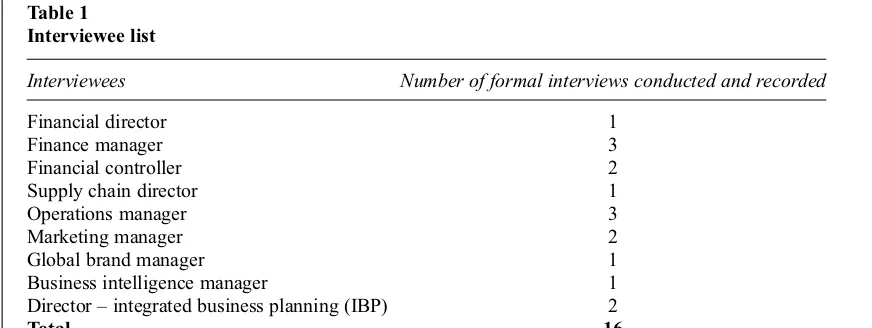
The original data about this case company was collected in a series of meetings between 2004 and 2006. Each formal interview lasted for approxi-mately one hour. Interviewees included both accounting-information owners and users, for
example, financial director, financial managers,
marketing managers, commercial managers and others. (See Table 1 for full list of interviewees). Interviews were semi-structured in the sense that broad themes were agreed in advance. All the interviews were tape recorded and notes taken during the interviews, transcriptions were produced immediately after the interviews, the researchers
then met to discuss and reflect on the transcribed
outcomes. Complementary materials were collected by studying both public and internal materials, such
as annualfinancial reports, budget reports, manuals
and memos. All these meetings and organisational materials helped the researchers obtain the histor-ical insights of the organisation covering a much longer period than the research interaction. Several informal conversations with managers also pro-vided valuable clues as to how interviews and documents should be interpreted.
The relationship evolved such that, in addition to scheduled interviews the researchers were able to contact both the interviewees and various other organisation members, informally to clarify any
issues raised, to probe and confirm any observations
made, check approximate dates and chronology and Table 1
Interviewee list
Interviewees Number of formal interviews conducted and recorded
Financial director 1
Finance manager 3
Financial controller 2
Supply chain director 1
Operations manager 3
Marketing manager 2
Global brand manager 1
Business intelligence manager 1
Director–integrated business planning (IBP) 2
Total 16
obtain, or ‘chase’ for copies of documents men-tioned in interviews. Various techniques were used to ensure recollection was accurate including locating insights by reference to major stages in the organisation development, major staff
appoint-ments or procedural changes. Additionally,
responses and dates quoted were confirmed with
more than one interviewee in order to confirm data
by triangulation.
5. Case description
5.1. Background
Meditech6 Group is a global medical technology
company currently operating in 33 countries with four global business units (GBUs). The company
first set up as a family business in England more
than 150 years ago. In the last decade, it has gone through a series of successful organisation-wide changes in reshaping its organisational structures and it has grown into one of the top companies in its
field in the world. These changes have also led to
noticeable transformation of its management accounting operations.
Due to the wide scope of the company operations
in variousfields, this case study will focus on one of
the GBUs, Wound Management (WM). WM is the second largest GBU within the group with an annual turnover of around £350m, it is a world-leading provider of advanced wound care products used to treat hard-to-heal wounds. To date, WM has four manufacturing sites and 35 outsourcing
sup-pliers worldwide. WM’s major customers are the
various providers of medical and surgical services worldwide. In many parts of the world, these are largely governmental organisations funded by tax revenues, but they also include private medical providers.
5.2. Organisational change
The global business structure was a relatively new development. During the 1990s Meditech had an established regional structure. The origination of this regional structure could be traced historically to the geographical expansion pattern of the company over the previous decades from the local UK market to Europe, US, and then over other continents. In line with this regional structure, the global oper-ations had been delegated to several regional central
offices, namely Europe, US, Africa and the Far East.
The regional directors oversaw the management of operations of the whole region and then reported to the global headquarters in the UK.
From the late 1990s, the organisation launched a series of successful products and had been enjoying
fast growth. This fast growth exposed the ineffi
-ciency inherited in the regional governance struc-ture. All the regional functional departments, from operations, to marketing, to commercial, were tasked with dealing with all the different lines of products at the same time, but constrained by their limited regional visibility. Different markets have distinctive needs for different products. For example, Britain has the highest demand on advanced wound foam products. In contrast, while America has the largest wound dressing market, the dominating products are still very traditional. It is therefore critical for the organisation to design appropriate products to suit the individual markets. However, because in the regional structure the global markets were segmented geographically, it did not help the commercial departments gather market intelligence, nor did it assist the central innovation to provide appropriate new product designs and improved functionality.
The regional headquarters had traditionally
placed considerable stress on financial
perform-ance. This emphasis on growth andfinancial health
was inevitably linked to an environment of mount-ing global competition. The control mechanisms
imposed upon operating units were veryfinancially
orientated, aggressive pursuit of year on year growth of sales was demanded by the regional finance office.
‘Obviously, growth rate is paramount. We are in
very competitive markets with other big players. It is actually a very fast growing, dynamic market. We have got to make sure our growth
rate overtakes our competitors.’ – Financial
Controller
However, this caused serious limitations in terms of a general overview of the business. As one marketing manager recalled,
‘The only way the marketing budgets got
chal-lenged was that the numbers were not aggressive enough or not seen as aggressive or ambitious enough. But there was no real understanding of
issues at the markets.’–Marketing Manager
This regional structure, compounded by rigid
financial control, in fact hindered the company’s
development and pursuit of growth and caused
various intraorganisational conflicts. Tensions
could be easily found between the commercial
teams and the regional financial administration. A
common perception shared by the individuals through that period was that:
6The names and precise details of the company and its products have been changed to preserve confidentiality.
‘Nobody was there setting strategies of what should be sold in the market . . . There was
nobody centrally saying well, actually‘‘we want
this product to go this direction’’and‘‘those are
the new products we have got coming through’’.’
–Director–Integrated Business Planning
The headquarters was trying hard tofind answers
to solve the dilemma between tight regional control and global business integration. As part of the solution, a major consulting group was involved to help develop an organisational-wide strategic trans-formation. In the early 2000s, A GBU structure was suggested, which aimed to remodel the business by the distinguishable nature of their different activ-ities.
Thus Meditech launched the change from a regional to a GBU structure. Four GBUs were set up
in the hope of‘creating and defining a new set of
businesses instead of individual countries’–Global
Brand Manager. The Meditech centralfinance office
was downsized to a small team with responsibility
to consolidate all the globalfinancial data and deal
only with financial reporting procedures, as each
GBU developed its own finance function. The
reorganisation from regional structure to GBU structure was a relatively smooth transition, fuelled
by the headquarters’ emphasis on more globally
coherent operations. In addition, as the production, supply, and commercialisation of different products were naturally separated, reorganising the oper-ations along the product lines was fairly straight-forward.
Along with this development of GBUs, came greater autonomy. GBUs were required to bring forward their own strategies and the WM Board united on the notion of shaping the GBU with a
clearly defined strategy of‘focusing on the higher
added value segments of wound healing’. Many
traditional products with low-tech inputs have since been either sold or eliminated from production in order to give way to the strategically prioritised high-value added products, the market for which includes expensive capital equipment and advanced
foam products.7
WM’s emphasis on high value-added products
gradually led to a‘super-brand focus’. There were
three‘super-brands’which accounted for the major
part of the total revenues. Investment in these super brands were inclined to be approved more easily, while many other smaller brands were somehow
overlooked and it was difficult for them to attract
enough financial support. Super brands were also
competing against each other for investment. This lack of coordination on brands was largely caused by the structure of the marketing department, in which different brand teams reported to different brand directors, which resulted in a situation where there was not enough communication between different brand teams. At around this time, com-petitors started to bring to market more innovative products, many of which were focusing on the more
profitable capital equipment market. Meditech
lagged in this new market sector and were under mounting competitive pressure.
In the regional structure that existed previously,
the lack of attention from the central office to
operational details had led to a situation where individual selling organisations in different country markets were doing things in their own way. For example, sales managers used to drop prices periodically to generate bigger sales volume, but once the prices were lowered, it was hard to put them up again, given the high price transparency and advanced market intelligence of competitors. A price reduction in one country could also lead to cross-border transactions and a chain-reaction to other markets, causing serious loss in revenues, in addition to causing damage to the brand image.
A major reason for this situation was that the
selling organisations were managed by rigidfi
nan-cial controls which were administered remotely.
This ‘management from headquarters’ actually
impelled the sales department to make decisions
for their own benefit, but not necessarily optimally
for the whole organisation. So the selling organisa-tions always regarded reaching targets of sales
revenues/profits the top priority. Such problems
pointed to a major issue for top management, dealing with the supply chain.
‘We were obviously struggling with the supply
chain and not getting products through from production to market in a controlled way . . . We were all working in isolation to each other. As
much as we tried to talk to each other, we didn’t
have a forum. Supply Chain for example, would rely on conversations with the markets and that depended on whether that person had a good relationship with that market, but markets did change and people moved around. To me, that was too weak a process, you know, relying on
people’s good relationship.’ – Director –
Integrated Business Planning
All of these signals pointed to a central problem
that WM was facing–the lack of an efficient central
planning function that could organise all the 7
Wound management is not restricted to simply applying a dressing but can use foam to treat infection and capital equipment to close and‘seal’a wound.
business operations under a unified strategy. In seeking a remedy, the WM Board initiated further changes to improve the coordination of the global operations. An initial step agreed by the Board was that there was a need to improve the global supply
chain structure as significant savings were expected
from efficient shipping, forecasting, optimising best
production sites and similar actions.
As a result, a new supply chain director was appointed. The new supply chain director felt that, based on his experience from previous appoint-ments in the FMCG sector, WM had historically overlooked the importance of planning and coordination. Soon afterwards therefore, WM
launched a consultancy-initiated programme,
Integrated Business Planning (IBP). The Board agreed to the initiative from the supply chain director and the consultancy that the central
plan-ning function needed to be strengthened.
Consequently, a new department IBP was estab-lished to take control of all business planning activities. The main responsibility of the IBP
director was ‘to integrate the global business
processes to make sure the GBU is on track to
achieve its strategic targets.’ –Director Integrated
Business Planning
The launch of IBP was aimed at improving WM’s
central planning and coordination function. To do so, IBP explicitly linked the long-term strategy of
the GBU (normallyfive years ahead) and the
short-term operational goals at departmental levels (one-to two-year plans). IBP makes viable and explicit plans for the next three years to translate the
long-term inspirational objectives into short-term
actions.
‘IBP is looking at both the current launches (of
products) and the future. So it’s tracking what’s
coming through the innovation pipeline. It’s the
current situation and future of three years out.’–
Operations Manager
IBP also categorises all business projects into three distinctive groups, namely, Brand Building,
Commercial, and Supply Chain. The biggest benefit
of this categorisation is that it helps to draw out the clear scope of these projects and to focus the attention of multiple functional areas to deliver the projected results. This whole activity has been
undertaken with support from thefinance function
from whom investment, cost and revenue informa-tion are sourced.
Observing the importance of efficient
communi-cation, the IBP has implemented a new
computer-based sales reporting system,‘Business Objects’, to
provide unified and reliable information across all
business functions in the place of previously segmented information sources operated by differ-ent departmdiffer-ents. The new planning and forecasting information has resulted in greater involvement and
credibility for thefinance function and the
commu-nication between departments has also been facili-tated by the shared information. To resolve the silo mentality existing in marketing, a new marketing director was also appointed to supervise all the
brands and ensure efficient communication and
logical and transparent resource allocation between different brands.
5.3. An overview of the management accounting operations in WM
In WM, the management accounting function went through an initial denial phase to be followed later by one of transformation. When the organisation changed from the regional structure to GBU structure, the accounting operation remained largely unchanged. It was only when the new IBP came into operation that SMA practices started to be system-atically developed and utilised.
During the organisational transition from
regional to GBU structure, most of the conventional
management accounting functions previously
undertaken at a regional level were passed onto
thefinance8departments of the new GBUs. Within
the regional structure, the management accounting
function was not clearly defined and accounting
staff spent most of their time dealing with external reporting. This can be explained by the fact that historically accounting operations were detached from the real business operations. The internal management functions, such as planning and con-trolling, had been performed, as best described,
‘superficially’ without sufficient consultation with other business functions. One example in point is that, before the installation of Business Objects, both accounting and commercial departments used to report their future forecasts into their own systems. However, data in the different systems was rarely cross-validated resulting in inevitable tension and some confusion. In addition, the lack of attention from management to the traditional
man-8
In this paper the term‘management accounting’ is used interchangeably with the term‘finance’. Within the literature,
‘management accounting and strategic management accounting’
are widely used to apply to the activities we were investigating. However, within the case company the department carrying out these activities was called‘finance’. Hence in our discussion of the literature‘management accounting’is used whereas in the case study ‘finance’ applies. In the case we also mention management accounting operations being the managerial accounting activity carried out by those in the companyfinance function.
agement accounting reports resulted in the percep-tion within the organisapercep-tion of their limited rele-vance. For example, even if the operational and/or selling units missed their budget targets, there were rarely any consequences or remedial actions,
there-fore, there was lack of incentive forfinance to get
involved in operational details.
With the development of IBP,finance underwent
a significant reorientation. A small team of
account-ants now deals with transaction processing and
statutory reporting. Hence the energy of thefinance
function has been liberated into a new business-support role, which is linked to the IBP process. In each team, assembled around the different business
cases, there is a finance manager in charge of the
budgets and he/she sits on the IBP panel as a member of the team sanctioning business projects. IBP meetings are held monthly to discuss the business cases. As business cases are categorised into three areas (brand building, commercial and supply chain), there are corresponding global brand review meetings, global commercial review meet-ings, and global supply chain meetings to discuss the progress of the various development initiatives. Management accountants as key members of the teams play a major and proactive part in the review meetings and for these they produce three key SMA reports which they term: Decision Tool, Rolling Forecast, and General Executive Measures (GEM), (For an outline of these see Appendix.) These new reports have embraced distinctive SMA character-istics, such as market and competitive concerns, and future orientation, all of which have a clear contrast with the traditional management accounting
oper-ations which were largely historical andfinancially
orientated.
The cooperation between finance and other
functions has thus been largely reshaped by the introduction of IBP. A new role, brand accountant,
has been created as finance identified the need to
strengthen their support of marketing operations; brand accountants now offer marketing teams the
support of dedicated contacts infinance. Previously,
some of the projections produced by marketing for investment decisions were seen by senior
manage-ment as implausible. For example, the financial
director expressed concerns, on many previous occasions, that marketing plans and brand
promo-tions were ‘too good to be true’ and the financial
impacts‘cannot be right’.
‘Brand accountants are there to help the
market-ing teams with a series of operations that were
historically regarded as being ‘‘unsatisfactorily
conducted’’by marketers. These include product
pricelists, profitability analysis, business growth
projection, etc. Adding brand accountants into the marketing teams has proved very useful. The
accountants have effectively instilled financial
awareness into the daily marketing and commer-cial operations. This helped to improve the report
quality and communications across all functions.’
–- Financial Director
Thefinancial director believed that close
day-to-day contact between marketing and accounting is essential in nurturing business-wide integration. The marketing managers gradually accepted this proximity, as one marketing manager commented:
‘More and more we are involvingfinance for data
and evidence to back up commercial decisions. While before, they probably were in some kind of
isolation, now, finance gets involved from the
very beginning. You have the formality of IBP
meetings, but that doesn’t stop you if you have
any questions popping down to thefinance office
or picking up the phone, I think because they spend a fair bit of time here, the relationship is built up, and most people are comfortable asking
finance for their point of view and advice on
anything, which involves financial inputs. In
terms of this relationship, I don’t think it’s an
issue. It’s good to have the visibility offinance
people here.’–Marketing Manager
Additionally, a brand profit and loss report (brand
P&L) is produced, a new creation led by the brand accountants. This new monthly report, in which a view is taken two to three years ahead, provides a future trend analysis. A list of future brand devel-opment initiatives is provided. These initiatives are categorised into brand building, commercial, and
supply chain, with theirfinancial impacts provided.
They are closely monitored and constantly
reviewed as they progress. The brand P&L is aimed at bringing improvements to the brand performance by focusing on all possible options. The analytical and interpretive skills of brand accountants have been drawn on to evaluate the investment impacts of various alternatives and integrate the data into the brand P&L reports.
In WM, management accounting operations have changed. The management accountants have dem-onstrated their success in blending into the new decision-making and commercial support role. That
is, the finance function within WM has gradually
taken on the ‘internal consulting’ or ‘business
strategist’ role (Fern and Tipgos, 1988). This
reflects a change in the wayfinance is being used,
from a traditional monitoring and control
tive, to a more business and support-oriented perspective.
6. Case analysis: the evolution of the
management accounting operation
In this section, the evolution of management accounting is interpreted through the neoinstitu-tional framework outlined in Section 3. Figure 2 captures the application of this neoinstitutional framework to the case study.
6.1. External and institutional environment
Intensified competition has been argued by many
management accounting researchers to be a major driver of management accounting change (Hoque et al., 2001; Krishnan et al., 2002). For Meditech, the market pressure triggered the change of the organ-isational structure, which in turn called for account-ing change. The competition pressure in the healthcare product market was highly visible and
this was heavily influenced by the ongoing
healthcare reformation across many countries, typ-ical examples include NHS in UK and Medicare in US. Healthcare institutions required more and more products with lower costs and improved healing performance, e.g. faster and improved healing to reduce hospital stays and rehabilitation time; or reduced number of product applications required for effective treatment.
As suggested in Figure 2, for the wounding healing sector, market demand has been growing
particularly in the use of innovative‘capital
equip-ment’. Capital equipment is significantly more
expensive than a traditional wound dressing,
hence financial criteria become a more important
part of the sales dialogue. Sales people are more
involved in justifying and persuading thefinancial
managers of large customer organisations (mainly institutional buyers, such as hospitals or health authorities) to make purchase decisions. This
required the sales people to understand thefinancial
impact of the purchase and demonstrate how the purchases can contribute to more cost-effective solutions for healthcare services.
These new external conditions called for a change of management accounting to embrace more business considerations and to support com-mercial operations. SMA offered appropriate ideas to address these market demands. The emergence of SMA in Meditech can be seen as a reaction to the economic pressures which have created the need for better performance monitoring, more accountability of marketing and commercial operations, and enhanced balancing of short- and long-term per-spectives in decision-making. There is considerable
evidence of the wide use of non-financial measures
and the popularity of business-oriented manage-ment accounting practices, such as competitor
performance appraisal, and customer profitability
analysis (Granlund and Lukka, 1998; Vaivio, 1999; Smith, 2002 ).
Also shown in Figure 2 is another institutional
pressure, which is largely ‘mimetic’ in nature.
Mimetic pressures exist when firms learn from
each other because not doing so would potentially disadvantage them relative to the competition and erode their edge in the market place (Guler et al.,
2002). Big organisations are constantly‘infighting’
with rivals for market share and customers. Mimetic pressures suggest that companies, under conditions of uncertainty, tend to copy their models of operation from each other, especially from
success-ful companies that have good reputations (O’Neill
et al., 1998). Imitating competitors’
way-of-doing-things is another channel for the diffusion of management innovations (DiMaggio and Powell, 1983). Several interviews revealed that various management accounting practices employed by
Meditech as‘not unusual across the industry’.
‘We like to think we are doing something very
distinctive, different, and unique. The reality is we will have slightly different terminology, or we
are doing it at different paces, but what’s
happening to thefinance function in companies
of our sort of size is very consistent. Again, the techniques which feed into that vary somewhat and that’s largely influenced by what the strategic priorities are for particular organisations at a point in time. But it’s perfectly possible to trace a
consistent story of what’s happening tofinance.’
–Financial Director
This mimetic process is also facilitated by the involvement of the consulting industry. Consultants promote their successful experiences in certain companies as responses to similar problems encountered in other companies (Granlund and
Lukka, 1998). In WM, the influence of consultancy
has also been significant, from macro level
organ-isational change (from regional structure to GBU structure), to micro level internal planning (the launch of the IBP programme). The adoption of many of the SMA practices can also be traced back to the suggestions from the consultancy.
From the above description of the external environment, it seems the market pressures offered a strong incentive for management accounting change and the diffusion of SMA practices has been largely through mimetic processes.
Figure 2
Application of neoinstitutional framework to the case study
486
ACCOUNTING
AND
BUSINESS
6.2. The intraorganisational dynamics
Despite the encouragement from the external environment for the change from conventional management accounting operations and the adop-tion of SMA practices, there is plenty of evidence of intraorganisational resistance to the SMA practices (Burns and Baldvinsdottir, 2005). Granlund (2001) believes that the external institutional and economic
factors alone do not offer sufficient explanation of
management accounting change.
The external market environment triggered
Meditech’s organisational reformation. However,
in spite of the set-up of the GBUs, most of the conventional accounting operations performed by
the regional finance offices were inherited by the
finance departments of the new GBUs. Historically,
within the regional structure, the responsibilities of
the regional finance offices were very vaguely
defined, and accounting personnel were expected to
perform various roles coveringfinancial reporting,
auditing, and transactional data processing and not only the management control. The reality was because accounting staff had spent most of their time dealing with external reporting, the internal management accounting functions, such as plan-ning or controlling, had been performed, at best,
‘superficially’ without sufficient consultation with other business functions. This situation is described
by Meyer and Rowan (1977) as ‘ceremonial’
organisational behaviour or‘loose coupling’,
indi-cating that these routinised practices were
main-tained to give an appearance of meeting
management requirements rather than having any value-adding or other practical purposes. Burns and Scapens (2000) also articulate in their framework how the old accounting routines with historical institutional encoding tend to survive in the new environment, as they are somewhat abstracted from day-to-day activities and have become established practice. In Meditech, there was also a lack of
incentive forfinance to initiate any changes as there
was traditionally a lack of attention from manage-ment to the reports produced by the accountants.
The reason that no management accounting change materialised at this stage was mainly due
to the lack of a ‘change precipitator’, which was
mainly caused by ‘indifferent commitment’
(Greenwood and Hinings, 1996: 1035), meaning that there were groups that were neither for nor against particular changes, nor were they aware of any possible directions of change. One of the crucial attributes of value commitment is that if they
become taken for granted, they can‘serve to mute or
temper expressions of dissatisfaction’(Greenwood
and Hinings, 1996: 1036). In this case, with all the
different tasks thefinance office handled,financial
reporting was the most demanding and conse-quently prioritised task. Without clear allocation of job responsibility, the personnel assigned to man-agement accounting operations could be easily
borrowed to deal with more ‘pressing’ reporting
matters. Therefore the importance of management accounting operations had been marginalised and
there was lack of incentive for finance to get
involved in operational/commercial details. On the other hand, since management accounting oper-ations were undertaken only to sustain a ceremonial control role without getting in touch with the real operations of the business, other business functions also took it for granted that this was how things had been done in the past and no one questioned the
efficiency and/or efficacy of the management
accounting operations.
The main trigger for the management accounting change in Meditech was the subsequent implemen-tation of IBP. As competitors started to introduce to the market innovative products, some of which were focused on the capital equipment sector,
WM’s weakness on innovation and lack of
coordination on brands was exposed. Interest dissatisfaction had been further increased in two
respects. First, there were conflicts between
differ-ent brand teams as they were fighting each other
over resources. Second, the lack of effective control from the GBU headquarters had negatively impacted the implementation of the global strategy.
Finance was, however, perceived as lacking suffi
-cient business understanding and thus placed at a distance in helping to solve these problems. This was caused by the image created earlier of their
‘bean-counting orientation’ and their emphasis on
‘rigidfinancial control’of the global business.
Change would only happen when dissatisfied
groups recognised the availability of alternative ways of operating in which way they can better express their interests. This will effectively change
the ‘value commitment’ from ‘indifferent’ to
‘reformative’. In this case, the‘change precipitator’
emerged following the appointment of the new supply chain director from a leading fast-moving consumer goods (FMCG) company. He introduced
to WM a consulting firm to help redesign the
planning process. The consultant’s collaboration
revealed that the finance department needed to
support the planning and coordination role more appropriately and a route for potential change emerged. Thus, by hiring key personnel from
another institutional sector, a new ‘template’ or
new way of doing things was built into the
organisation. This corresponds to what