A CASE STUDY OF PUBLIC RESTROOMS IN CHINA SINCE THE CHINESE COMMUNIST REVOLUTION
© 2017
By Elizabeth S. Newsom
A thesis presented in partial fulfillment of the requirements for completion
Of the Bachelor of Arts degree in International Studies
Croft Institute for International Studies Sally McDonnell Barksdale Honors College
The University of Mississippi
University, Mississippi as;dlkfj;asdlkfj;asldkfj;asldkfs;dalkfjas;lkdflMay 2017
Approved:
_____________________________
Advisor: Dr. Minjoo Oh
_________________________________
Reader: Dr. William Schenck __________________________________
Reader: Dr. Joshua Howard
2
Key Words: Public Restrooms, toilets, gender, privacy, hygiene, China
Abstract: This thesis is a case study of China’s changing perceptions on privacy, hygiene and sanitation, as well as gender through public restrooms across the three different time periods of the 1950s, the early 2000s, and the 2010s. I analyze the situations, laws, civil codes, and perceptions that lead to different toilet styles. As toilets and defecation are taboo subjects, I use online anonymous resources like Zhihu to discover the modern perceptions of people on today’s toilets as well as architecture and statistics. I in part find that I can analyze China’s income disparity through toilets as the Coastal region of China has the most public restrooms and the Western region of China has the least. Then, I analyze what effect and correlation this has on their society.
3
Table of Contents I. Introduction
II. Literature Review III. Method
IV. Brief History of China in the Past 100 Years V. Analysis of Gender, Hygiene, and Privacy
a. Gender Parity
b. Sanitation and Hygiene c. Privacy in Public Spaces VI. Findings and Discussion
References
4
ON THE 路(LU) TO THE LOO:
A CASE STUDY OF PUBLIC RESTROOMS IN CHINA SINCE THE COMMUNIST REVOLUTION
ELIZABETH S. NEWSOM I. Introduction
One of the simplest, most essential facts ignored by those in academia is that
everyone must poop. The research of how human waste disposal and removal shapes or is shaped by society remains largely unanalyzed due to the topic’s status as a social faux pas. Yet, it offers a wonderful opportunity to study the changes in perceptions over time in a country that has rapidly developed like the People’s Republic of China (PRC). In this thesis, I will address how the Chinese public toilet facilities and public defecation
statistics reflect a larger phenomenon of change in the country since the 1950s according to the three important aspects of privacy, gender, and sanitation and hygiene.
Before I can use methods of excretion as indicators of change in my thesis, I must first explain why the removal and disposal of waste is a prime subject for scholarly research. There are many other basic human commonalities and necessities that have been analyzed by researchers like food, government, and even dance. These subjects have their own academic name and category despite their inability to perfectly cross cultures for analyzation. For example, the field of gastronomy encounters difficulties regarding the variations in ingredients and prices in each region. The field of political science suffers complications due to history, language barriers, and economic inflections.
Ethnochroreology (dance anthropology) also experiences similar barriers as political science as well as numerous musical subgenres that may not be able to be found in other cultures.
5
Excreting waste, however, is a natural human necessity that has less issues crossing cultural boundaries for the analysis of social implications due to its common bodily movement and problems that it causes regardless of region. The action itself and the need itself is present in all humans across age, race, religion, belief, and gender identifications.
Yet, despite its potential to simplify research for issues such as how people deal with large group problems, an academic name does not exist for the field. In fact, very few names exist that can describe the action of excreting waste that do not sound crass in an academic paper due to its status as a taboo topic. Instead, in common language polite phrases like “going to the restroom/bathroom” are used. However, I will not be able to use these terms in this thesis as many citizens do not have access to a real toilet, much less a restroom, and must therefore participate in open defecation. Throughout this thesis all terms will be literal including “going to the restroom/bathroom” which will be
indicative of a person going to a place that provides a type of shelter or privacy in order to excrete or urinate.
Not all bathrooms can be researched the same. Private restrooms will not be focused on in this thesis as they have a greater potential to be influenced by only one viewpoint instead of several. As I am focusing on the change in cultural and political perceptions, a one person sample is not enough information. Public restroom facility installations are publicly planned and executed, rarely encompassing more equipment or investments than the minimum amount needed. For example, objects that citizens commonly perceive as superfluous in restrooms, like a bidet, will not be found in a public toilet facility.
Therefore, as public restrooms usually only encompass what a government or group of
6
citizens sees as the basic minimum, they more easily display a nation’s wealth, goals, and policies regarding the public.
For example, the US government compared to China owns little land and often exempted health issues from core concerns leaving private citizens and municipalities to deal with the issue of public restrooms. Thus, few public restrooms exist. Most European governments have a history of providing relatively more health care coverage for their citizens, despite promoting stronger individualistic tendencies and capitalism. This phenomenon causes European countries to have more public restrooms then in the USA but require payment is for use. In China, the Chinese Communist Party (CCP) retains the ideology that it is working for the people, and thus provides healthcare for its citizens.
Furthermore, while Chinese people are allowed to rent land from the local government, they are not allowed to own it. This creates an easier opportunity for the government to quickly, and more cheaply, install public restroom facilities. Thus, public restrooms are comparatively abundant and usually require no payment for use.
Last spring semester, I studied abroad for a semester in Harbin, China. For a week, several friends and I traveled through Beijing and unto Qinghai, then Xinzhang. The differences in public restroom facilities was astounding. From lack of plumbing, to high tech toilets that sang, to bathrooms with stall walls reaching up to the ceiling and
restrooms without stalls or roofs, the amazing differences between regions and people began to make me question why bathrooms were built the way they were. The nicer toilets with plumbing were generally concentrated in large cities causing me to question whether economic situations influenced who the government was willing to provide for, and if so, who did they favor? Furthermore, with these differences was there a way to
7
read what the people and government valued in a particular region through the public toilet?
China has gone through massive economic, social, and political changes in the last 100 years. The country has a population with a large economic disparity rate, large differences in degrees of development, and large differences in cultures and perceptions.
Despite being internationally known for being “communist” or “socialist with Chinese characteristics”, the people of China are far from being equal to one another as
inequalities still exist and may have infact been sharpened by time. These issues may impact the development and installation of public toilets and therefore they are important to understand. Thus, after I provide a brief literature review I shall give a brief history of China’s past century in order to provide essential background and context for the case study.
I will specifically hone in on the three phases and toilet revolutions of the 1950s, early 2000s, and at last the 2010 decade to decide how issues such as privacy, sanitation and hygiene, and gender have developed, or have been forced to develop, new
perceptions concerning those topics. I propose the best way to analyze the topic of change of perception in the three subtopics is to analyze China during these times as a case study. In “A Case for the Case Study” edited by Joe R. Feagin, Anthony M. Orum and Gideon Sjoberg, case studies provide for contextual grounding about cultural and political issues at the time. To fully analyze the change of the facilities of excretion in these three periods, I first analyze the laws and civil codes available during that phase. I will then look at the important historical events that are surrounding that period. Next, I look at news articles for information and perceptions of the restrooms to investigate
8
whether the government is being driven by its citizens or by ulterior motives. In
attempting to see changes in perception I will then look at online forums to discern what the public perception may be, and if there are any backlash to the rapid development or governmental pushes in certain directions.
In researching with this method, I search for the meaning behind public restrooms and the symbol they represent for the government. I predict that in the 1960s, the toilet and restroom were a symbol of the peasant’s plight and old world aristocracy’s
domination, thus leading to numerous toilet instillations to help sway peasants to the Party’s cause. In the 2000s, public restrooms were a symbol of what separated the PRC from rising to be a developed nation and achieving international approval. In the 2010 decade, it has become a symbol of the influx of foreigners and investment into China as it becomes more globalized.
9 II. Literature Review
Toilets and waste management are a global necessity that has been researched very limitedly in the humanities and social sciences. However, authors are beginning to delve into the realm of restrooms and proving that they are unique tools that can be used in analyzing a culture. Ladies and Gents: Public Toilets and Gender edited by Olga Gershenson and Barbara Penner, is a wonderful collection of essays that work to prove that “public toilets provide a unique opportunity for interrogating how conventional assumptions about the body, sexuality, privacy, and technology are formed in public spaces and inscribed through design across cultures.”1 Gershenson and Penner continue on to make a wonderful case that these aspects are shown through toilets all over the world and can be read by their bathrooms. In China’s broad collection of events and quick development that has happened over the past 100 years, it is easy to see where finding a common cultural indicator across ages and beliefs is difficult. Privacy, gender, and sanitation issues have always been necessary throughout her history and are
mentioned by Gershenson and Penner as topics that are available for analysis through public restrooms. Thus, I have chosen these three aspects to more thoroughly analyze the country since the 1950s in this thesis’ case study.
The three aspects of privacy in public, sanitation and hygiene, and gender are at both times impacted by the government policies as well as culture. Public toilets display the changing perceptions of both the public and the state as they mutually impact the other.
Lucy Pickering writes in “Toilets, Bodies, Selves: Enacting Composting as
1 Gershenson, Penner 2009.
10
Counterculture in Hawai’i” that “disposal of excretion is never simply disposal. Rather, it entails engagement with the state, one’s own body”.2 The humble toilet stall may not seem as a presentation of force or power by the government, yet where the government chooses to build the stalls and who is expected to use them are surprisingly influential questions. For example, the state can use the shape, build, location and technology of the public toilet in order to sway or reinforce the belief of certain populations. Take for example the desegregation of bathrooms in America. Today, many Americans would gawk at the sight of a segregated bathroom and the injustice that was once on full display.
As seen in the brief example above, public restrooms may also be an indicator of who the government deems to hold power, or how they react to people coming into power. Women historically have less restrooms in older public buildings as their traditional roles are in the private sphere, but quickly gained more as the economy
boomed after the Second World War. Today, new awareness and sympathy for the LGBT community has risen the status of transgender people and lawmakers have felt pressure from citizens to rewrite public restroom laws.
“Toilets, Bodies, Selves: Enacting Composting as Counterculture in Hawai’i”
continues to reinforce the idea of the state pressure through restrooms as in Hawai’i there is a problem of “white, West Coast ‘hippies’ and ‘drop-outs’ living in Hawai’i”
(Pickering 2010)3 who are quite content with practicing open defecation.4 Therefore, to counter this social normality, the government critically considers where to provide the public toilets to enforce approved perceptions of privacy and sanitation. Public toilets on
2 Pickering 2010
3 Ibid.
4 Ibid.
11
the island and where they are placed is also an issue of an interaction with the state as those places are areas deemed by the government to be acceptable to go to the restroom.
Therefore, this case study has made me aware of how critical it is to consider where the government decides to build public restrooms and who they are attempting to cater to and why.
As previously mentioned with the idea that the people are pressuring the government to rewrite transgender bathroom laws, perception of toilets reflect not only the state’s interaction with the people, but also the people’s interaction with the state. In “The 2011 Toilet Wars in South Africa: Justice and Transition between the Exceptional and the everyday after Apartheid” by Steven Robins, the case study of the 2011 South African
‘Toilet Wars’ or ‘2011 Toilet Elections’ is examined. Right before the local government elections, the media circulated “images of unenclosed modern, porcelain toilets struck a raw nerve as the nation was preparing to vote in local government elections…. Partly because these images seemed to condense and congeal long historical practices of racism and apartheid”5. Through the pictures that were released the citizens became concerned with the problems that were related “to land, housing, sanitation, service delivery, labour conditions and employment and unemployment equity. The TRC’s (Truth and
Reconciliation Commission) seemed unable to address these struggles to improve conditions of everyday people’s life” (Robins 2014). Thus, a main election issue and political tool of the media was the plight of the everyday people and their perceptions of the inequality and injustice of the public restroom situation in South Africa.
5 Robins 2014.
12
China has often been viewed as a country with a large issue of inequality and
injustice despite its history as a communist country. As the economy has grown, there has also been a growth of public restrooms making for more windows into how issues are perceived and changed over time. There is a strong correlation between increased country infrastructure, i.e. public restrooms, and economic rise.6 As mentioned in the article
“Small Bathroom, Big Impact on People’s Lives—How the Age of Information Lends a Helping Hand to Continuing the Toilet Revolution” by Flag Tourism Planning the “toilet is an important window into my country’s economic development level and degree of social civilization. The toilet revolution background has profound meaning in interpreting the improvement of people’s livelihood progress”. Thus, if a Chinese tourist agency believes that toilets give deep insights into the economic and social development of a country in recent years, I theorize that in my research I will be able to find more effort by agencies to improve China’s toilets to even influence the perception of foreigners. Thus, when appropriate, I shall research how China is attempting to sway foreigners to invest, like, or agree to their rising power, through the public restroom.
I have decided to focus on gender, hygiene and sanitation, and privacy through my readings as they have been repeatedly written to be researchable. Furthermore, bathrooms are one of the last places that are strictly segregated by gender, making them a prime researchable topic for public toilets. Sexism is still believed to be a large issue in China by western foreigners despite the extremely feminist movement that came with the Communist Party. As there have been many waves of feminism throughout the last 100 years of Chinese history, I shall use China as a case study to determine whether the
6 Flag Tourism Planning 2017.
13
theory of the being able to perceive sexism through public restrooms by Gershenson and Penner is correct.
Hygiene and sanitation is desirable by all humans as an instinct to keep a healthy body. Like view on feminism, medicinal knowledge has expanded and progressed exponentially. Further like feminism, the CCP has been a strong advocator of the health of their citizens since their installment. Thus, as economic growth has allowed for better technology and installations in China, there should be an increase in hygiene and
sanitation as well as a difference in perception of what is hygienic and sanitary. As it is economically tied, I will consider the economic disparity that plague the coastal, middle, and western regions of China.
Privacy was mentioned by Lucy Pickering in “Toilets, Bodies, Selves: Enacting Composting as Counterculture in Hawai’i” as a large component of people’s interaction with the state in public restrooms. The government chooses who has the rights, or the needs, to privacy in a public space in part by constructing restrooms for those who willing choose to open defecate. China’s massive economic growth has been effected by, and effected, her urbanization. As people go to live in the cities, they oftentimes do not know their neighbors and the environment lacks the form of intimacy that was once found in a village. Therefore, I will investigate the needs for privacy and if and how they have developed through the bathrooms to decide whether it is valid to study through the public restroom.
In all, the literature review spurns reason to investigate a case study of public restrooms in China based on the three important aspects of privacy, hygiene, and sanitation, as well as gender. China’s economy and cultural values have developed
14
rapidly since the Communist Revolution. Therefore, I shall look at how the perceptions have changed since the 1950s, the years leading up to 2008, and the 2010s decade. I predict after reading these literature reviews that I can show a stronger correlation of being able to tell the change in the perception of gender, hygiene, and sanitation through the public restroom. Furthermore, I predict that the public restroom will be a good indicator of the state versus the citizen.
15 III. Methodology and Analysis
For this thesis, I will be doing a case study of China’s methods of dealing with human waste. Countries that see it as their duty to install public restroom facilities for their citizens, like the PRC, make for fascinating case studies in that there are many examples over long stretches of time of government influence. For this thesis, I will focus on three phases of “toilet revolutions” to examine if one can draw meaningful
information from change over time in public restrooms. “Toilet Revolution” is a
movement enforced by the CCP that aims to either considerably increase the number of public toilets in the country, or significantly improve and repair the existing toilets in the country. China has had multiple “toilet revolutions” over its years.7 Officially announced and carefully organized and executed by the CCP, these toilet revolutions offer wonderful possibilities of snapshotting what the government and people believed important at those times. The toilet revolutions I have come to find most interesting and telling occurred during the 1960s, the early 2000s, and the last few years of the 2010 decade. These dates have been chosen due to the 1960s including the years leading up to, and during the Cultural Revolution, the 2000s with China seeking establishment as a rising power especially through usage of the Olympic games, and the 2010 decade as urbanization, globalization, and economic flourishing have come to its highest point yet.
Furthermore, I believe that case studies are the proper way to study this subject as public restrooms are shaped by many different factors and their influences are wide. “A Case for the Case Study” by Joe R. Feagin, Anthony M. Orum, and Gideon Sjoberg
Z Xue, Zi “厕所革命”.
16
mentions that there are four main reasons that a case study is invaluable when trying to understand a complex issue. The first is that it provides background and understanding for the issues at hand in a way that is not forced and provides intimate study.8 Continuing, it draws from numerous sources over a wide period of time, creating the opportunity for the research to be more intensive and holistic as social meanings and actions are
complex.9 Thirdly, it provides the researcher the ability to pay attention to the history and time as well as the relationship this may have to continuity and changes.10 And lastly, a case study provides for the opportunity for the researcher to engage in generalization and theoretical innovation.11
China is a wonderful country to conduct a case study of as it has gone through many phases of development over the years as well as has a wide range of social issues and economic disparity. Data for the thesis was collected from the time of May 2016 to April 2017 at multiple occasions. In researching I attempted to pull from texts published after 2010 due to China’s rapid development. However, for some topics like history, old laws, and previous civil codes that do not change with time, then the research may be pulled from older documents. The data is gathered from articles in journals online, books, civil codes, laws, or news articles. Despite attempts to focus solely on large cities such as Beijing or Shanghai, there was not enough data on public restrooms to form a complete thesis emphasizing one city. Thus, research is done on a national level to better explore
8 Feagin et al. 1991.
9 Ibid.
10 Ibid.
11 Ibid.
17
the cultural differences within China as well as economic disparity and how these factors may impact the installation of toilet facilities.
Excretion and going to the restroom are rather taboo social topics in China, and it is hard to find material on people’s perceptions of public restrooms as well as the issues surrounding them. Therefore, civil codes and laws must be looked as evidence for the desires of the people. Though some researchers argue that it is not effective to use legal methods to analyze culture due to various histories and economic situations, I strongly disagree as many laws would not exist without the influence of culture. I.E.: The change of acceptance of gay marriage and the desegregation of the United States public
restrooms.
Civil codes and laws are reactive interpretations of people’s desires and needs instead of people’s perceptions of current issues. Therefore, some Zhihu and other Chinese commenting websites will be used to examine how going to the restroom in China is viewed. Zhihu is an anonymous site that allows commenters and questioners to display their inner-feelings and thoughts without being traced. Yet, no matter how beneficial this is for taboo topics like toilets, the research pulled from it is incomplete as we do not know the participants’ age, gender, or real identity. If information is provided for a Zhihu post it is the information pulled from the user’s profile page. Therefore, it is the identity that they would like to present on the internet and not necessarily their own.
As the public restroom is a taboo topic across cultures, it is an important benefit that through using the case study model I will be able to pull from a wide number of sources to draw a conclusion and reflect on the literature review. It is very difficult to get
information and statistics on excretion and urination, and more so to get people’s private
18
perceptions of that. However, I believe by looking through the wide range of time from the Communist Revolution to the modern day, I will be able to draw a conclusion.
Especially if I can narrow down the wide time period by choosing the three phases as mentioned in earlier chapters and follow them through with the three cultural aspects.
The disadvantage of the case study is that there will be no statistics that can be laid across the whole study for comparison. Instead, I will merge many ideas and various statistics together in order to gain a more complete picture of what could be happening as a whole. With such a broad method, the research for the case study could have no end.
Yet the research that I do in this thesis could be continuously expanded upon, especially as more anonymous platforms become available to express feelings and perceptions on the Chinese public restroom situations. Note that in each subsection there is at least one Chinese source. I have personally translated each source using into English in order to make reading easier for the anticipated audience.
I shall first begin by giving a brief 100 year history of China in order to provide basic background information. The background information chapter shall work to inform of any political situations, large economic changes, or social evolutions that may have taken place. Brief descriptions from Peter Zhang’s article “Toilet Revolution in Beijing Neighbourhood” shall also be discussed as well as the modern toilet revolution’s impact on the global perception of China with statistics provided by the World Health
Organization (WHO).
After the chapter on history I shall delve into the issue of gender parity. In this instance, gender “parity” is used instead of “equality” as women statistically spend a longer amount of time going to the restroom. Therefore, equal number of stalls means
19
women will have longer lines then men. Therefore, for restrooms “parity” is desirable with many cities now requiring more women’s restrooms to be built than men’s. The gender parity chapter shall look into such articles such as: “Potty Parity in Perspective:
Gender and Family Issues in Planning and Designing Public Restrooms” by Anthony and Dufrese, “Cesuo Geming” or “Toilet Revolution” by Jinxing Zhong and Yao Liu,
“Dilemmas of Inside Agitators: Chinese State Feminist in 1957” by Wang Zheng, “For Chinese Women, a Basic Need, and Few Places to Attend to It” by Sharon Lafraiere,
“Half the Sky, But Not Equal: China’s Feminist Movement” by Alice C. Hu, “Occupied”
by The Economist Online, and “Flush with Pride, China Hosts Toilet Summit” by Toby Louie. Furthermore, I look at studies done by international organizations such as the World Economic Forum’s study on gender equality. Laws and civil codes are also studied, such as the Marriage Reform Law, City Public Restroom Instillation Standards, Genderless Bathroom Act, and of course the three Toilet Revolutions which are
prescribed by the government and have required installations for different cities and zones.
Sanitation and hygiene is the next chapter in the analysis section of the thesis. In this section I studied such articles as: “Toilet revolution in China” by Yang Yang, “The Countryside’s Large Toilet Revolution: How to Improve Rural Toilets” by Journal of Overlooked Problems, “Regional Disparities in the Burden of Disease Attributable to Unsafe Water and Poor Sanitation in China” by Elizabeth J. Carlton, Song Liang, Julia Z.
McDowell, Huazhong Li, Wei Luo and Justin V. Remais, “ Access to Water and
Sanitation in China: History, Current Situation and Challenges” by Dajun Shen, “China is Investing $290 billion to Kickstart a ‘Toilet Revolution’ by Business Insider, and “Beijing
20
to Upgrade Public Toilets in Time for Olympics” by Anon. As Sanitation and Hygiene has more statistical data, I was able to glean more information from reports from global organizations like: “Progress on Drinking Water and Sanitation: 2014 Update” by the WHO, the World Bank’s 2015 statistics of improved and unimproved sanitation, and the 2015 CIA World Factbook population statistics. Laws and civil codes analyzed include the Rural Cooperative Medical System (RCMS).
The privacy section is the last section with the least amount of material available.
Articles analyzed in it are: “Protecting the Right to Privacy in China” by Huixing Cao,
“Chinese Concepts of Privacy” by Bonnie S. McDougall and Anders Hansson, “Hong Lou Meng” by Cao Xueqin, and “Private Life Under Socialism” by Yunxiang Yan. In this section, the lack of laws and civil codes surrounding bathroom privacy is studied, and there are more Zhihu responses as restroom privacy is a perception and cultural
preference that remains largely unanalyzed.
21
IV. A Brief History of the People’s Republic of China and its Impact on Public Restrooms
In this section I shall work to make a brief history of the People’s Republic of China from 1900 to 2017. The history shall be purely from a historical viewpoint until the end when toilet instillations start becoming more common.
In the year 1900, China was in decline financially and politically. Foreign nations heavily controlled her as they ruled crucial ports such as Shanghai. The ruling Qing dynasty was unable to stop the involvement of the European powers. The Opium Wars crippled the effectiveness of the Qing government and Japan had recently defeated China in 1895.12The economy was in ruins and the Western states seemed to be powerful causing many people to hope for modernization. Yet the ruling family did not wish for modernization as they feared it would weaken their power.
By 1900, the Boxer Rebellion began to spread in the Northern part of China which included Beijing.13 The people behind the rebellion were called “Boxers”. The Boxers felt that the Manchu (Qing) government was merely a puppet for the Europeans who oppressed their country. The Empress Dowager Tzu defied gender roles by ruling and made a secret agreement with the Boxers to force them to turn their attention to the common enemy of the Europeans.14 Violence against the Europeans ensued and
eventually the Manchus rejoined the Europeans. They returned to the Forbidden Palace unharmed while the Europeans re-established control.
12 Trueman, C N “The Boxer Rebellion”.
13 Ibid.
14 Ibid.
22
News that the Manchu dynasty was corrupt reached the ears of a promising once- peasant student Sun Yet-sen abroad. He returned to China and became a revolutionary against the Manchu government. When he was in America, the Chinese Revolution of 1911 overthrew the Qing dynasty. He was soon elected “President of the Untied
Provinces of China” despite resigning a couple of months later to create peace within the different factions.15 In 1921 the Communist Party was founded. The Guomindang, the party that Sun Yet-sen had founded and supported democracy was the CCP’s enemy and both wanted to take control of China. The rivalry lasted through the end of World War Two. Once World War Two ended and the parties could focus on defeating each other instead of Japan, civil war broke out. In 1949, the Communists overtook Beijing and Chiang resigned to flee to exile in Taiwan until his death in 1975.16 The “Party of the People” had finally officially taken control.
The Communist Revolution led by Mao succeeded because it focused on earning support from commoners and peasants. The Manchu government and Chiang government seemed to favor those in power and the oppressors: the wealthy and the foreigners. After over 10 years of corruption in the CCP, the Cultural Revolution started in 1966 in part to punish those in power and help the common man to return to the purer ideals of
communism. Thus, from the beginning of the CCP the government has developed and enforced the idea that they are fighting for the common man. At the time, the poorest citizen’s needs, certain rights, and status were all loudly fought for by the CCP. In
15 Trueman, C N “The Boxer Rebellion”.
16 Ibid.
23
pledging to help improve the lives of the common man, the first “toilet revolution” was born in the 1960s under Mao’s leadership.17
People in the Maoist era joined together in a massive movement to create communes, or large group living spaces for entire villages who had a government.
Communes merged political and economic ideas as opposed to the cooperatives which were only economically focused.18 By the end of the summer of 1959, communes
included 120,000,000 households, or roughly 99% of the peasant population.19 In an era of celebrating the once considered socially lowest worker, Shi Chuan Xiang was a maintenance worker who received stardom and a handshake from two of China’s most important men at the time, Liu Shaoqi a government official and Mao Zedong, for cleaning public toilets from his twenties, 1933-1943, until his death in 1987.20 Once seen as a degrading act that nobles forced onto peasants, Mao turned it into a heroic job that opened up the discussion to toilets and their maintenance. In Beijing, the classic 1950’s toilet was a small brick structure that became the center for social interactions as an open space.21 Geisler notes that there were often “no dividing walls between toilet holes, making for casual on-the-stool chats quite convenient” (Geisler 217).
After Mao Zedong died, the leadership then transferred through other hands until it ended up in Deng Xiaoping’s in 1978 until 1983. He famously moved the economic system towards one of “socialism with Chinese characteristics” otherwise encompassed
17 Yang, Yang “Toilet Revolution in China”.
18Orleans, Leo A. “Serve the People. Observations on Medicine in the People's Republic of China.”
19 Strong, Anna Louise. “The Rise of the Chinese People’s Communes -And Six Years After.”
20 Geisler, Tim C. “Public Toilets in Beijing”.
21 Ibid.
24
by the famous quote: “It doesn’t matter if the cat is black or white, as long as it can catch mice it’s a good cat” during his time in Beijing.22 Economically, China began to boom as certain cities like Shanghai and Beijing were chosen to be experimental economic policy cities and preparations were made for foreign investors to come into the country. In Beijing, the early 1980s saw diligent efforts into maintaining and beautifying existing toilets.23 Hundreds of small toilet facilities were rebuilt by the Construction and Sanitation Ministries, all without a standardized government design and with builders taking chances with architectural expression. They are regarded as extremely attractive with modern day tourists who are unable to read signs now stopping in front of these old public restrooms to take pictures.24 The economic growth that had happened with Deng as the leader lead to a beautification of a facility once believed undesirable,
unmentionable, and extremely unclean and low class.
In the 1990s, the Party ingeniously used teaching history to young people in order to change the narrative from the Communist “victor” to one of where China was a victim of the West. This served as a justification of the One Party method that had become
criticized after the failed protests at Tiananmen Square.25Thus, many citizens today feel pride for the “Chinese” way of doing things. Most notably for this thesis, the pride in squat toilets and their superiority to Western toilets in terms of cleanliness. The Three Represents are the current values that the CCP now claims to stand for. They are
representing: “the developmental trends of advanced productive forces…orientations of
22 Liao, Wen.“China’s Black Cat, White Cat Diplomacy.”
23 Geisler 2000.
24 Geisler 2000.
25 Greis, Peter. “Chinese Politics: State, Society and the Market”.
25
an advanced culture… fundamental interests of the overwhelming majority of the people of China” (China.org.cn 2000)26. These Three Represent outline a drive for China to improve its global image and status as they wish to be an “advanced productive force” as well as have the “orientations of an advanced culture”. These goals imply that they are seeking to become more developed economically and socially than other countries. Thus, when organizations like the World Health Organization (WHO) and World Toilet
Organization (WTO) release figures about China’s problem of open defecation and lack of improved sanitation the central government rushes to solve the issues. Thus, now China is responsible for 95% of the “progress” in sanitation in East Asia.27 Through investments from foreign countries as well as large funding from the Chinese
government, China has striven to make its nationalistic image better by improving their citizens, and tourists’ access to restrooms.
Now, to build status in foreign countries as well as to keep the title of a provider for the people and assuring them that their needs are being provided for, the CCP has launched into its current ambitious cesuo geming, or “toilet revolution”. Toilets have continued to be an important topic and issue for the CCP throughout its development in the past and modern era, often a reaction and outward sign of the political and historical events that are occurring around them.
26 China.org.cn 2000.
27 WHO 2012.
26
V. Analysis of Methods of Excreting through Gender, Hygiene, and Privacy i. Introduction
China’s toilets and cultural perceptions change rapidly through the last sixty years when studied from a standpoint of gender, hygiene and sanitation, as well as privacy. Not only do I expect these restroom phases to reflect the nation’s economic growth by
becoming more modern through the years, I also believe they will display the methods and ideology the government was using to attempt to remain, and excel, in power. By examining articles, civil codes and laws, statistics, and anonymous reviews I seek to effectively respond to the literature review as well as determine if toilets can be used as indicators of cultural perceptions and preferences.
a. Gender
As Kathryn H. Anthony and Meghan Dufresne note in their article “Potty Parity in Perspective: Gender and Family Issues in Planning and Designing Public Restrooms”,
“Public restrooms are among the few remaining sex-segregated spaces in the American landscape, tangible relics of gender discrimination” (Anthony and Dufrense 2007:267).
Although most people scuff at the idea of gender discrimination appearing in places as plain and seemingly equal as public restrooms, new research has shown that matters such as “potty parity” are crucial and can be used to examine gender inequality as well as who holds power in public and is deserving of improved sanitation in public.
To understand the sexism that occurs in public restrooms around the world and especially in China, it is important to study how sexism occurs in the basic public restroom. While there are blatant cases of sexism in restrooms which will be addressed
27
later in the paper, there are less obvious impacts of sexism that occur in even building the restroom. The issue of public toilet facilities being built without careful thought about the problem of “potty parity” is common despite the numerous laws encouraging architects to resolve this issue. “Potty parity” is the idea that it should take men and women equal time to go to the restroom. Yet, because men are typically employed in construction, the restroom will probably be built with the idea of a man’s needs in mind. For example, many public restrooms, if newly built, will have the same number of stalls between men and women, yet women use the restroom more frequently due to menstruation, small child care, the need to sit when using the restroom, breastfeeding, and pregnancy.
Humans on average will spend 3 years of their life on the toilet, with women going to the restroom 1.5 more times more than men and spending 2.3 times more time on the toilet than men.28
Buildings that are built before women commonly entered the public sphere, like government buildings, educational buildings, and public park buildings, are riddled with issues for potty parity as public restrooms reflect who was expected and had the power to go out in public. Thus, examples as extreme as even the most powerful women in the United States who worked with the “House of Representatives didn’t get a bathroom near the Speaker’s Lobby until 2011. Prior to that, the nearest women’s room was so far away that the time it took women to get to the bathroom and back exceeded session break times” (Chemaly 2015) thus damaging their career reputation and limiting their ability to use the restroom when needed. In contrast, however, the male representatives had a restroom on the same floor with easy access away from the tourists with “a fireplace, a
28 Liu, Yao. “Cesuo Geming, Jinxing Zhong”.
28
shoeshine stand, and televised floor proceedings” (Chemaly 2015). Thus, many scholars believe public restrooms are valuable in determining who in the society has political and economic power. China’s rough equivalent of the House is the Great Hall of the People.
It is an old building from before women were generally accepted into the workplace.
However, I was unsuccessful in finding the schematics for the important government building and can only suggest that those who wish to do more research include this in their pieces.
Per the World Economic Forum’s study on gender equality, which studies the educational, economic, political and health attainment of women versus men to rate the most gender equal countries, China placed as 91st out of 144 countries in the 2015 World Economic Forum Gender Equality Ranking.29Thus, one can question if China’s economic boom changed the perception of gender in public, or if women had always been valued as highly during the CCP’s rule as its ideology suggests.
In the 1960s, the CCP only approved of encouraging a very specific feminism that aided in the advancement of the party, and highly discouraged the development of other feminist ideology. The 1957 All-China Women’s Federation moved away from its theme of gender equality and towards a more conservative ideology of women working
“diligently, thriftly build the country, and diligently, thriftily manage the family” (Zhang 2006). Women were urged to partake in the family and away from public spaces. The Party furthermore devoted itself to become the most important aspect in a family, and for
29 World Economic Forum 2015.
29
a phase “women’s equality and full participation was promoted so long as it benefited the party and it strengthened its coercive apparatus” (Hu 2016).
When researching restrooms, it quickly became apparent that though the toilets installations could not be for certain dated to the 1960’s period, there was an astounding amount of men’s public toilets when compared to women’s public toilet facilities. It was not until the mid-2000s that the ratio for men to women’s public toilets was expected to reach a 1:1 standard.30 Laws such as the “City Public Restroom Instillation Standards”
and others by China’s Ministry of Housing and Urban-Rural Development were passed in 1988 requiring that there be three women’s restrooms for every two men’s restroom, and in in more populated areas that the ratio be 2:1. Yet despite this, nine of China’s biggest cities including Beijing, Guangzhou, and Chengdu still in 2017 have more men’s restrooms than women’s restrooms. 31These already established restrooms are proof of China’s traditional cultural preference for men not women to assume public roles. Thus, as the central government reaffirmed a national standard of a 1:1 ratio for men and
women’s restrooms in 2005, these laws put forth in 1988 were either too expensive or not important enough in the eyes of government officials to support. Women continued to be pushed out of the public sphere due from 1972 to 1992 as the state controlled market was terminated and women had to compete with men for jobs.32
Chinese women faced a higher risk of being laid-off, forced to retire at a younger age, as well as had a more difficult time finding new work. Furthermore, with the new
30Lafraniere, Sharon. “For Chinese Women, a Basic Need, and Few Places to Attend to It”.
31 Liu 2016.
32 Ibid.
30
discrimination in the economy women also faced an increase in sex trafficking, domestic abuse, and sexual misconduct by male peers in the workplace.33 Now, young women who grew up without the impact of the Cultural Revolution or the pressure of state-run
feminism have also been exposed to other countries’ ideas of feminism through media.
They have come to the age where they are interpreting feminism for themselves.
Some of the most well-known women from the new movement have formed the China’s Women’s Rights Action Group, which includes Li TingTing, otherwise known as Li Maizi. Li TingTing organized a peaceful movement called “Occupy the Men’s Toilets” starting in 2012.34 In this movement she and other women warded off men for three minutes at a time and ushered in women to use the men’s restrooms to shorten the female line.35 Although this movement lasted only an hour and was stopped by police, it garnered international media attention and forced the city of Guangzhou where they first protested to build new restrooms at a 1:1.5 men to women’s ration. In response to their success the activists went to Beijing to protest where they were met with “10 officers and three police vehicles” (LaFraniere 2012) who cited that they did not have a permit to protest. Instead of giving up, the protesters went to another restroom where they were met with more police officers who disbanded them once again and took the leaders to a
restaurant to sit for five hours to ensure that they did not try and occupy yet another bathroom.
Yet, as a party that was founded for all the people, the Chinese officials could not admit that they stopped a protest that would help the common woman. Instead, they
33 Hu, Alice C. “Half the Sky, But Not Equal: China’s Feminist Movement”.
34 “Occupied” by The Economist Online
35 Lafraniere 2012.
31
reported in the state-run China Daily that the grassroots group had a successful occupation and the women’s voices were heard.36 This is essential considering that
“Taiwan recommends a 1:3 ratio for public toilets, while Hong Kong recommends a ratio of 2:3” (LaFraniere 2012) in favor of women and the CCP has in recent years tried to prove themselves more developed and responsible than these two countries. Public spheres that are economically driven by women in contrast excel at installing multiple public toilet facilities. In fact, “China adopts Hong Kong’s ratio only in certain public structures like shopping malls, presumably in recognition of the fact that women are bigger shoppers” (Lafraniere 2012). Thus, although legislation prompts government officials to recognize women’s bathroom plights, economics and social expectations still handicap the amount of private space women can have in public outside of expected realms.
In recent years, scrutiny of world organizations like the World Health Organization (WHO), the United Nations (UN), and the World Toilet Organization (WTO) as well as movements and protests from young people have placed China’s potty parity issue into the international spotlight. Thus, currently the Chinese government is attempting to solve the issue of potty parity at a much more aggressive rate than other Western countries, like the United States, that view themselves as less sexist. Over 84%
of Chinese respondents in an online survey sponsored by China Daily voted in favor of the construction of more female toilets.37 In fact, the CCP is so eager to pass new laws to improve potty parity and establish new public restrooms that Chinese citizens are calling
36 Ibid.
37 The Economist Online 2012.
32
these acts the new “Cesuo Geming”, or Toilet Revolution, in a play of words on the infamous “Wenhua Da Geming” or Cultural Revolution. The Cultural Revolution was a political and social movement that largely impacted China and its development.
Yet, as the Chinese government and people fight against gender inequality, China is using public restrooms to show their support for more equal treatment of women. Since the Public City Restroom Instillation Standards law passed, local and county level
governments have committed themselves to finding new ways to improve potty parity as well as to install public restrooms. Recent years have seen a renewed commitment to this cause. In 2015, the CCP erected and updated over 2.2 million toilets to create more public restroom opportunities for their female citizens. Although I was unable to find the
statistics regarding how many were built for men, the pride that the feminist article held for the success of social pressures leads to the belief that there were many less men’s toilets erected. This year alone China has set a goal of “building 19,512 public restrooms and renovate another 6,685… investing over 10 billion yuan” (Yang 2017).
This exuberant attempt to solve the potty parity issue in China does not go without notice, nor is the issue itself unnoticed as it has even created a new popular saying of “Nüxing Ru Ce Nan”, or “It is hard for a woman to go to the restroom”. 38 Due to increased awareness in such medias as plays, social media sites like Weibo and
WeChat, and even a movie, women going to the restroom in China and the lack of potty parity has brought international shame to the country’s toilet issues. Now, the number of toilets per gender is the closest to being equal as it has ever been in China as the more
38 Liu 2016.
33
traditional city of Beijing has a ratio of 1.22 men’s public restrooms to every 1 women’s public restroom. 39
During the third case study the 2010s, the Shanghai public government approved the more unconventional, but more economical, plan of adding unisex bathrooms. These new genderless restrooms will have 4 squat toilets, a few men’s urinals, as well as 6 Western style toilets. The person in charge of monitoring Shanghai’s quality of city environment life stated that “The establishment of genderless restrooms is not only beneficial to men and women’s toilet status, but is also beneficial for solving the
problem of women having to wait worrying for a long time to use the restroom, as well as overcomes a few upscale business and scenic districts issues of having open toilets.”40 Now, more than 30 genderless restrooms have, or are in the plans, to be established in Shanghai with plans for the genderless toilets to continue to expand to Beijing. However, these genderless restrooms are still met with controversy as people worry about people of the opposite sex (usually women afraid of men) doing uncivilized, or “Bu Wenming”
things to others to whom they hold a sexual attraction.
Overall, there is a clear improvement in public toilet facility accessibility for women in restrooms in line with their more pronounced role in the public sphere. As the 1960s saw women focus on taking care of the private sphere there was a lack of bathroom equality and potty parity in cities. As the years progressed, laws that were passed to increase potty parity for people were not enforced as women were not greatly involved in the workforce when the guarantee of work was taken away. During the second largest
39 Ibed.
40 Liu 2016.
34
toilet revolution, Beijing spent over $24 million in public restroom reconstruction in the three years after its 2001 toilet revolution began to earn a bid from the Olympic
committee.41 Numerous toilets were built to current standards and regulations in an attempt to accommodate the influx of tourists for the Games.42 Today, as more women have joined the labor force and China has raised its international profile, the CCP has become more concerned with its international reputation. The government took the potty parity criticism in stride from the renowned international organizations and quickly invested millions into tourist areas for increased potty parity. Thus, though a wave of feminism began with Mao, the later feminism which lead to increased women’s public restrooms and more potty parity was pushed by the people rather than the state.
Therefore, gender can be used as an indicator of change in perceptions when researching Chinese public restrooms.
b. Hygiene
The statistics of China’s lack of unimproved sanitation can be staggering, yet perhaps more staggering is the rate at which the Chinese Communist Party has attempted to solve this dire issue. The WHO notes that “Progress has been greatest in Eastern Asia, where coverage of improved sanitation has increased by 40 percent points since 1990, largely driven by China, which now represents 94% of this region’s population. The level of open defecation in this region is only 1%” (WHO 2014;18).43 “Improved sanitation” is a toilet setup that is able to safely separate the human from the waste that was deposited, usually through a flush system or sanitation pipeline. The safer sanitation option is crucial
41 Louie, Toby. “Flush with pride, China hosts toilet summit”.
42 Louie 2004.
43 Progress on Drinking Water and Sanitation: 2014 Update by World Health Organization
35
to deterring the culture of chronic disease, lowering rates of sickness in adult, and
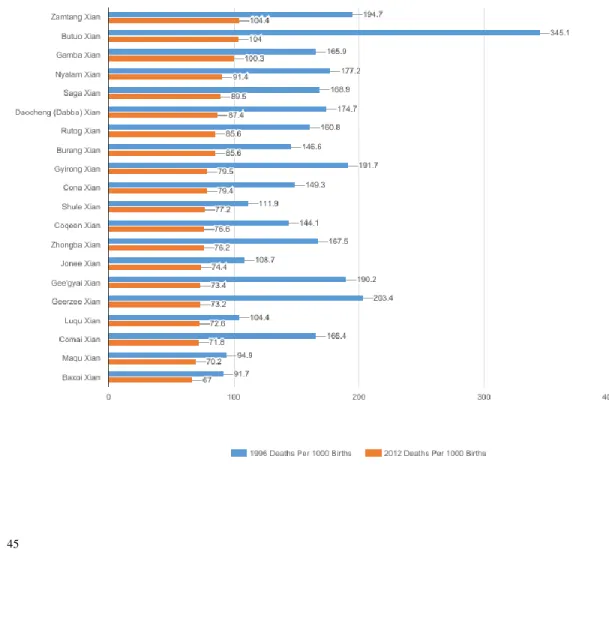
decreasing the infant and child mortality rates as 80% of infectious diseases are caused by unsafe drinking water and more importantly fecal pollution.44 Even just the installation of a public toilet has correlation to decreased child mortality rates. The worst situations for high child mortality rates is understandably in Western China. All rates in Figure 1 are according to the “"Under-5 Mortality in 2851 Chinese Counties, 1996–2012: A
Subnational Assessment of Achieving MDG 4 Goals in China” recorded in the journal The Lancet. Figure 2 displays the 30 municipalities and their ranking for number of
44 Yang 2017.
36 public restrooms.
45
45 Graph based off statistics gathered from The Lancet “Under-5 mortality in 2851 Chinese counties, 1996–
2012: a subnational assessment of achieving MDG 4 goals in China”. Graph compiled by Elizabeth S.
Newsom.
Figure 1:
37
46
46 Table information taken from China’s Business and Industry Research Institute as well as Knoema
“China Population 2016”.
Provinces, municipalities, and autonomous regions with the most public toilets
Ranking Location
# Public Toilets
2015 Population
Size Key:
1 Jiangsu 11739 79,760,000 Blue= Coastal
2 Guangdong 9769 107,240,000 Green= Inland
3 Zhejiang 8199 55,080,000 Purple=North
4 Henan 7540 94,360,000 Yellow=West
5 Heilongjiang 6617 38,330,000
6 Shandong 6351 97,890,000
7 Hebei 6298 73,840,000
8 Shanghai 6197 24,260,000
9 Hubei 5475 58,160,000
10 Beijing 5401 21,520,000
11 Liaoning 5056 43,910,000
12 Sichuan 4383 81,400,000
13 Shaanxi 4266 37,750,000
14 Inner Mongolia 4171 25,050,000
15 Jilin 3643 27,520,000
16 Hunan 3371 67,037,000
17 Shanxi 3261 37,750,000
18 Anhui 3223 60,830,000
19 Chongqing 3208 29,910,000
20 Fujin 3185 38,060,000
21 Yunnan 2619 47,140,000
22 Xinzhang 2493 22,980,000
23 Jiangxi 1887 45,420,000
24 Gansu 1518 25,910,000
25 Guangxi 1496 47,540,000
26 Guizhou 1440 35,080,000
27 Tianjin 1327 14,170,000
28 Ningxia 746 6,620,000
29 Qinghai 457 5,830,000
30 Tibet 317 3,180,000
Figure 2:
38
Thus, through the figures above it can be seen that Western provinces on the bottom with the least amount of public toilets also have the highest child mortality rates.
While cities and provinces like Tianjin and Jiangsu attempt to break the mold, around half of the counties with the highest child mortality rates are in Tibet. Other issues such as low income, lack of education, and lack of good healthcare are also important. Yet, the correlation between lack of public restrooms and child mortality rates cannot be ignored as there are currently more than 30 different diseases that come from feces.47
In fact, disease caused by lack of sanitation and open defecation was the reason why Mao declared the first toilet revolution in the 1960s.48 Mao recognized the need for a healthy society when he began his time as the chairman. During the 1960s Mao wished for a great return to the original communist ideology and encouraged young people to learn from the peasants. The need to demonstrate that the Party still supported the people led to numerous public restrooms being were installed in rural and urban areas.
Despite the efforts by the government in the1960s, China’s economic disparity can still be seen through her toilets. Rural areas have disproportionately worse sanitation than more developed urban areas. In 2008, cities like Shanghai had 99% of their
population people in access to improved sanitation, but regions like Tibet only had 23%
of their population able to access acceptable sanitation means.49 In this chapter, the differences between urban and rural China will be discussed through the perspective of
47 Yang 2017
48 Ibid.
49 World Bank 2015.
39
access of improved sanitation and its effect on health, gender, and economic disparity in the country.
An article on Zhihu from the “Overlooked Problem Journal” perhaps explains it best, “Rural toilets can be organized into two types: One is where you do not stand over the pit directly but rather two boards and you scoop the excrement out, the other is where there is a slope on one side for the excrement to go down. The weak point of these two forms is that they do not have separated squat toilets and sanitation tanks, you cannot refrain from looking at the manure reservoir. It also gives rise to mosquitos and other bugs” (Zhihu 2016).50 In order to understand the sanitation disparity that is occurring in China, it is important to understand how unimproved sanitation in basic public restroom effects not only its users, but also those around it.
Open defecation is the prime example of unimproved sanitation and the most likely method of transmitting disease. “Progress on Drinking Water and Sanitation: 2014 Update” by the WHO and Unicef note that 82% of the one billion people practicing open defecation in the world live in only 10 countries. As of 2014 China had 10 million people practicing open defecation, placing it tenth in the world ranking.51 The practice is largely a rural one, both globally and nationally as 2015 city statistics note that 0% of urban dwellers usually practice open defecation. In contrast, 2% of rural dwellers do.52 In 2015 China’s population was 1,376,048,943, 44% of which were rural dwellers, meaning that
50 Journal of Overlooked Problems. “The Large Countryside Toilet Revolution: How to Improve the Rural Toilet”.
2016, translated by Elizabeth Newsom
51 World Health Organization and Unicef .“Progress on Drinking Water and Sanitation: 2014 Update”.
52 World Bank 2015
40
of roughly 12,109,231 people out of the 902 million who still participate in open defecation are Chinese and more importantly, rural Chinese.53
Unsurprisingly, developing nations and areas due to lack of money and infrastructure have the largest percentage of population who are unable to access
improved sanitation and coincidently have the highest percentage of child mortality rates.
As of 2015 in China, 77% of the population had improved sanitation, a drastic increase from only 48% in 1990 having access to the lifesaving toilet and plumbing system.54
In 2008 during the second case study, poor sanitation and hygiene accounted for 62,800 deaths in China, of which 83% were children and more than 2.81 million
disability-adjusted life years (DALYs). 55 As expected, the DALY’s grow higher in statistics from east to west as urban areas become rural on a map during this period. The Olympic Games, a driving force behind the 2001-2008 toilet revolution, was not
concentrated in China’s middle or western areas. Instead, while cities gained large
sanitation improvements the rural areas remained at a dire disadvantage. If the party were to hold true to the 1960s ideology of serving the common rural man, then the highest number of DALYS would not be located among inland citizens who earn the lowest income per capita, yet they are.56 Differences between the regions in economic policy, infrastructure development, urbanization and environmental issues all affect the local income and thus the ability of citizens to buy a toilet and avoid numerous diseases. Yet, the central government itself has enjoyed greater centralization, income, and technology
53 CIA Factbook 2015.
54 World Bank 2015.
55 Carlton et. Al. “Regional disparities in the burden of disease attributable to unsafe water and poor sanitation in China”.
56 Ibid
41
to make installing improved sanitation in rural areas easier but has chosen to largely ignore the recent sanitation disparity. In fact, the income disparity map of China as well as the unimproved sanitation map look oddly similar and should be used by the CCP in order to target vulnerable populations for investment in increased infrastructure.57 Thus, poor sanitation or open defecation is not a choice, but rather an example of inadequate education and money to support sanitation programs.
An inadequate education of the rural Chinese population can in part be attributed to inadequate access to improved sanitation. Noted by the WTO, “a lack of sanitation is an issue that disproportionately affects women” (WTO 13).58 High rates of the dropout statistic for women have been attributed to embarrassment of menstruation and the inability of girls to properly deal with their sanitation needs at school. Furthermore, teachers are not as willing to teach at schools without proper hygiene facilities further affecting the rate of attendance and teaching quality of the school.59 Although women have become more integrated into the workforce over the course of the PRC, lack of proper education hurts their chances at becoming fully integrated into the economic system.
After pressure from organizations like the United Nations (UN), WHO, and Unicef, the Chinese government has implemented ambitious plans to increase the improved sanitation available for its citizens. Since 1980 rural areas on paper have been the national priority through the CCP’s rural development projects. In 1978 China
57 Carlton et al. “Regional disparities in the burden of disease attributable to unsafe water and poor sanitation in China”.
58 World Toilet Organization. “We Can’t Wait”.
59 WTO 2014.