PRESENTED BY:
THE 1st – 2023
INTERNATIONAL ACCOUNTING STUDENTS CONFERENCE MULTIPARADIGM PERSPECTIVE ON ACCOUNTING, FINANCE
AND TAX
THEME
MULTIPARADIGM PERSPECTIVE ON ACCOUNITNG, FINANCE, AND TAX
TITLE: THE 1 ST – 2023 INTERNATIONAL ACCOUNTING STUDENTS CONFERENCE (IASC)
E-ISBN:
Editors:
-Prof. Dr. Indra Devi., P.hD., ACMA (UK), CGMA, CA (M), AFMIM (M) – Manipal International University, Malaysia
-Dr. Arfan Ikhsan., SE., M.Si., CATr – Universitas Negeri Medan, Indonesia -Dr. Enkleda Lulaj – University Haxhi Zuka, Kosovo
-Dr. Ahmed Elamer – Brunel University London, United Kingdom
-Dr. Prihat Assih., M.Si., Ak., CA., CSRS – Universitas Merdeka Malang - Indonesia
-Dr. Kanitsorn Terdpaopong – Rangsit University, Thailand
- Dr. Velissa Rubaya – Rizal Technological University, The Philippines -Almira Keumala Ulfah, M.Si., Ak., CA – IAIN Lhokseumawe, Indonesia -Azizah Binti Saban BBA., MBA – Manipal International University, Malaysia Publication together by:
Manipal International University (MIU) and
Association of Indonesian Accounting Lecturers (ADAI) Email: [email protected] / [email protected]
Website: miu.edu.my / adai.or.id
Copyright © 2023 by Manipal International University and Association of Indonesian Accounting Lecturers All rights Reserved.
No part of this publication may be reproduced or transmitted in any form or by any means, electronic or mechanical, including photocopying, recording, or any other information storage and retrieved without prior permission in writing from the publishers Concerned author is solely responsible for his views, opinions, policies, copyright infringement, legal action, penalty or loss of any kind regarding their content. The publisher will not be responsible for any penalty or loss of any kind if claimed in future. Contributing author have no right to demand any royalty amount for his content.
Foreword and Opening Remark
THE 1st – 2023 INTERNATIONAL ACCOUNTING STUDENTS CONFERENCE (IASC)
In the name of Allah, The Most Gracious the Merciful Assalamu’alaikum Wr. Wb.
Heartiest Greeting from Indonesian Accounting Lecturer Association (ADAI) - Indonesia, to you All in all over the Worl
Honorable, Keynote Speaker. Respectable, all presenters for this THE 1st INTERNATIONAL ACCOUNTING STUDENTS CONFERENCE (IASC).
Beloved committee, students, participants, ladies and gentlemen My Name is Arfan Ikhsan Lubis as Chairman of the Asosiasi Dosen Akuntansi Indonesia (Association of Indonesian Accounting Lecturers/ADAI), it is such an honor for me to welcome you all to our THE 1st INTERNATIONAL ACCOUNTING STUDENTS CONFERENCE (IASC) in keynote speakers’ session and parallel sessions with lecturers, researchers and students world wide. This is our 1st International Accounting Students Conference Talk by the theme: MULTIPARADIGM PERSPECTIVE ON ACCOUNTING, FINANCE AND TAX.
Dear Brothers and Sisters
Through the introduction of this Forum, we can learn about the strengths/
weaknesses of students and give them the opportunity to learn through their strengths. students have the opportunity to explore the world, develop their own skills and develop their own abilities. Accounting, Finance and Tax is a process that provides appropriate information from an entity not limited to financial data to stakeholders to ensure that the entity continues to carry out its operations within legal limits and achieve its socio-economic goals.
The fundamental role of accounting is as a provider of information and a source of answers for all matters related to corporate finance. You can use reports that contain complete and accurate information to stabilize and even improve your company's performance.Therefore, you should immediately compile your books and update them regularly so that your company's finances can be neatly arranged. You can use accounting software or digital accounting services to make your accounting work easier.
In addition, this step aims to prevent human errors that occur in manual recording, which can impact the company's performance.
INTERNATIONAL ACCOUNTING STUDENTS CONFERENCE (IASC) is a series program of student. International conferences are an important thing for Indonesian and international students to attend, by attending international conferences, students can express opinions effectively. Academic benefits that can be obtained by participating in international conferences, namely international conferences will be a place for students to meet experts in various fields, so that these students feel they can expand their networking and also gain new knowledge from professors, speakers, and scientists from around the world, by participating in international conferences.
Ladies and gentlemen, That’s the end of my opening remark, thank you very much for your kind attention.
Best regard,
Dr. Arfan Ikhsan Lubis
Chairman of the Association of Indonesian Accounting Lecturers (ADAI)
IMPLEMENTATION OF AAOIFI (ACCOUNTING AND AUDITING FOR ISLAMIC FINANCIAL INSTITUTION) IN ISLAMIC BANKING
INDONESIA Ahmad Yani1, Naz’aina2
Departement of Accounting, Faculty of Economic and Business, Malikussaleh University email: [email protected]
ABSTRACT
Islamic banking currently provides comprehensive products and services like conventional banks, but with different Islamic principles. Therefore, The purpose of this paper is to analyze the extent to which Indonesian Islamic banking has adopted AAOIFI (Accounting and Auditing for Islamic Financial Institution) standards in its financial reporting. This study uses the annual reports of Islamic banking in Indonesia for 2020-2022 obtained from 12 Islamic banks in Indonesia and sampled. This study aims to measure the suitability of 3 Islamic banking products in Indonesia, namely murabahah, mudharabah and musyarakah. The data collection method in this research is library research. The data analysis used is descriptive statistics. This study found that Islamic banking disclosures related to murabahah, mudharabah and musyarakah are still relatively low. There is no difference in the level of alignment between 2020-2022, with murabahah having the highest average level of difference among the three Islamic banking products.
Keywords: Murabahah; Mudharaba; Musyarakah; Islamic Banking; AAOIFI (Accounting And Auditing For Islamic Financial Institutions)
INTRODUCTION
The Islamic Financial Services Board (IFSB) in 2018 released data regarding the market share of Islamic banks in several countries in ASEAN.
Malaysia has a market share of 24.9% of Malaysian banking assets. Indonesia has a market share of 5.4% of total national banking assets. Brunei Darussalam experienced an increase in its market share for Islamic banks to 61.8% of Brunei Darussalam's total banking assets. Singapore and Thailand as Muslim minority countries have a market share of under 1% of total banking assets in the country
Research on the application of AAOIFI standards in Islamic banks has been carried out in several countries around the world. Ullah (2013) examined compliance with AAOIFI guidelines regarding presentation and disclosure in the financial statements of Islamic banks registered in Bangladesh. This study examines seven Islamic banks listed on the Bangladesh Stock Exchange and includes 203 compliance items. Ullah (2013) concluded that the level of compliance was relatively low because only 91 out of 203 items were disclosed. Therefore, he suggested that Islamic banks in Bangladesh increase the level of standardized disclosure in their financial statements.
Nadzri (2009) tested the effectiveness of AAOIFI in handling the accounting and disclosure of zakat and usury at IFIs. By using content analysis and including 25 IFIs that are members of AAOIFI, researchers conclude that the level of disclosure is lower than the requirements of AAOIFI. Another study was also conducted by Husainey (2016) who examined the level of compliance with AAOIFI standards in MENA countries (Bahrain, Yemen, Qatar, Syria, Palestine, Sudan,
Oman and Jordan). Based on the results of this study, the average compliance level of financial accountability based on AAOIFI standards is 73%. This study replicates research conducted by Al-Sulaiti et al (2017) who tested disclosure compliance with AAOIFI accounting standards related to Islamic financing products at Islamic banks in Bahrain and Qatar during the 2012-2015 period. The study found that compliance with AAOIFI murabahah, mudharabah and musyarakah disclosures by Islamic banks in Bahrain and Qatar was relatively high in the 2012-2015 period.
In this study, researchers focused on disclosing three sharia financing products, namely murabaha, mudharabah and musyarakah. Research was conducted on the three financing products because these three financing products were the most widely applied by Islamic banks (Vinnicome, 2012).
LITERATURE REVIEW Sharia Accounting
Napier (2017) states that Islamic accounting is a field of accounting that emphasizes 2 (two) things, namely accountability and reporting. Accountability is reflected in monotheism, namely by carrying out all economic activities in accordance with Islamic provisions. Reporting is a form of accountability to God and humans. Meanwhile, Karim (2010) states that Islamic Accounting is often also called Islamic Accounting, which is a new field in accounting studies, in principle this accounting is developed on the basis of values, ethics and Islamic sharia.
Islamic Bank
According to Law Number 21 of 2008 concerning Islamic banking, what is meant by Islamic banks is everything related to Islamic banks and Islamic business units, including institutions, business activities, as well as procedures and processes in carrying out their business activities. Basically Islamic banks are the same as commercial banks, namely companies engaged in the financial sector, meaning that banking activities are always related to the financial sector. So talking about banks is inseparable from financial problems.
Accounting and Auditing Organizations for Islamic Financial Institutions (AAOIFI)
The Accounting And Auditing Organization For Islamic Financial Institutions (AAOIFI) is an international non-profit organization responsible for the development and issuance of accounting, auditing, governance, ethics and governance standards for international Islamic finance. AAOIFI was formed in Bahrain on March 27, 1991. AAOIFI carries out these objectives in accordance with Islamic sharia teachings which represent a comprehensive system for all aspects of life, in accordance with the environment in which Islamic financial institutions have developed. This activity is intended to increase the confidence of users of the financial statements of Islamic financial institutions in the information generated about these institutions, and to encourage users to invest or deposit their funds in Islamic financial institutions and use their services (AAOIFI, 2018).
Disclosure
The word disclosure means not covering or not hiding (Ghozali and Chariri, 2007). When associated with disclosing information, disclosure implies that disclosing such information must provide sufficient explanation and be able to represent the actual situation in the company. Thus, information must be complete, clear, accurate and reliable in accordance with the conditions currently being experienced by the company, both financial and non-financial information, so that no party will be harmed.
Sharia Accounting Standard Disclosure (SAS)
The fundamental thing in the presentation of sharia accounting financial reports is the obligation to disclose sharia aspects, which is intended so that financial reports can truly comply with sharia provisions and not deviate from sharia accounting principles. Sharia Accounting Standards (SAS) is a Statement of Sharia Financial Accounting Standards (PSAK) which is intended for entities that carry out sharia transactions, both Islamic institutional entities and non-Sharia institutions (IAI, 2019).
RESEARCH METHODS
This research is a quantitative research where this type of quantitative research explains the facts of the object under study by analyzing numerical data using statistical methods through hypothesis testing. The data used is secondary data/secondary sources. This study uses content analysis in disclosing the AAOIFI sharia accounting standards in Islamic banks in Indonesia with the unit of analysis of Islamic bank annual reports. Content analysis is an observational research method used to systematically evaluate the contents of an information.
Data Sources and Data Collection Techniques This research uses secondary data sources. Data collection in this study uses documentation techniques. The data in this study is in the form of data on Financial Reports of Islamic Banks in Indonesia for the 2020-2022 period.
Population and Sample The population in this study are 13 Islamic banks in Indonesia and 16 Islamic banks in Malaysia. In determining the sample, researchers used a purposive sampling technique. According to Sugiyono (2010), purposive sampling technique is a technique for determining research samples with certain considerations that aim to make the data obtained later be more representative. The sample in this study are 12 Islamic commercial banks in Indonesia.
RESEARCH RESULT
Results of Interpretation of AAOIFI Standard Disclosures in Indonesia Based on the data in table 4.1, it shows that the sharia principle most disclosed by banks in Indonesia is Murabaha with an average company disclosing 42.19% in the annual reports it publishes in 2020 and 2022. Furthermore, on Mudharabah accounting principles, sharia banking only discloses 31.67% in the annual reports published in 2020 and 2022. Then in musyarakah, Islamic banking only discloses 27.38% in 2020 and 2022. The musyarakah principle is the least disclosed by Islamic banks compared to the other two Islamic principles.
Banking and Disclosure it does
Based on the data, it can be seen that Indonesian banks have disclosed at most 18 items out of a total of 45 items issued by AAOIFI, at a percentage of 40%.
Where the bank that makes the most disclosures is Bank Panin Syariah. Meanwhile, the bank that made the least disclosures was Bank BTPN Syariah with 7 items or 16%.
CONCLUSION
Based on data analysis and interpretation regarding the disclosure of AAOIFI sharia accounting standards in the annual reports of Islamic banks in Indonesia, the following conclusions can be drawn:
1. The level of disclosure by Indonesian Islamic banking, the average disclosure by Indonesian Islamic banking is 41.25% for murabaha, 28.00%
for mudharabah, and 25.71% for musyaraka.
2. The highest disclosure is in murabaha sharia principles, where in Indonesian sharia banking a maximum value of 43.75% is obtained
3. There has not been any increase in the disclosure of murabaha, mudharabah and musyarakah during 2020 to 2022 in Islamic banking.
4. Based on the items observed, banks tend to disclose sharia musyarakah principles that are general in nature and directly related to activities that can affect banking finances and tend not to disclose matters related to agreements made with other parties or matters that can damage the good name of the bank in the eyes of the public
REFERENCES
Abdullah, R. Mohamed. 2011. Development of Islamic Banking in Malaysia.
KLRC Newsletter
Accounting and Auditing Organization for Islamic Financial Institution. 2018.
http://aaoifi.com/?lang=en
Darrough, M.N. 1993. Disclosure Policy and Competition: Courtnot vs Bertrand.
The Accounting Review, Vol.68 No.3, pp. 534-561
Fraenkel, J. R. & Wallen, N. E. 2007. How to Design and Evaluate Research in Education. Singapore: The McGraw-Hill Companies
Islamic Financial Services. 2018. IslamicFinancial Services Industry Stability Report
2018.https://www.ifsb.org/docs/IFSB%20IFSI%20Stability%20Report%2 02017.pdf
Jabir Al-Sulaiti, Abdulrahman Anam Ousama, Helmi Hamammi. 2017. The compliance of disclosure with AAOIFI financial accounting standards: a comparison between Bahrain and Qatar Islamic banks. Journal of Islamic Accounting and Business
Napier, C. 2007. Other Cultures, Other Accountings? Islamic Accounting From Past to Present. In 5th Accounting History International Conference, Banff, Canada, 9-11 Religion Fact. 2018. The Big Religion Chart.www.religionfacts.com/big-religion-chart
Ruziana, M., dan Norilawati, I. 2008. The Development of Islamic Banking Laws in Malaysia: An Overview. Jurnal Undang-Undang, 2008, pp.191-205l. 1 Issue 2. pp:111-123, ISSN 2289 – 3318
Ullah, md.Hafij. 2013. Compliance of AAOIFI guidelines in general presentation and disclosure in the financial statements of Islamic bank in Bangladesh.
International journal of social science research, vo
IMPLEMENTATION OF NON-PROFIT ORGANIZATION GOVERNANCE: THEORETICAL REVIEW
Aisyah Rifda Salsabila1, Rohmawati Kusumaningtias2
1,2Accounting Department, Faculty of Economics and Business, Universitas Negeri Surabaya
[email protected], [email protected] ABSTRACT
This study examines governance implementation in non-profit organizations based on stewardship theory and Sharia enterprise theory. The research method used in this study is a literature review. The research object on implementing the theory that will be used as a research topic consists of Zakat Management Organizations (ZMO), Pesantren, and Orphanages. The research identified how the two theories were applied to Zakat Management Organizations, Islamic Boarding Schools, and Orphanages. Stewardship theory emphasizes service. ZMO, Islamic boarding schools, and orphanages must be able to provide services, maintain integrity, and be responsible for managing resources as a form of accountability to stakeholders.
Meanwhile, the Sharia Enterprise Theory theory balances the interests of others and God. ZMO, Islamic boarding schools, and orphanages manage resources by forming character and morals following Islamic principles.
Keywords: non-profit organization, governance, theory INTRODUCTION
Non-Profit Organizations (NPO) are entities whose implementation is not intended to generate profits but to achieve social, humanitarian, or environmental goals (Muallief Umar, 2021). NPO has different characteristics from business companies in general because the primary purpose of a non-profit company is to serve the community. One example of this organization is engaged in the management of Zakat Management Organization (ZMO) in Indonesia has developed since 1943, which was marked by the establishment of the Baitul Maal for the first time. The development of ZMO has been going very fast until now because of the high public awareness of paying zakat. However, ZMO sometimes faces various internal and external problems in its journey.
The triggers for these problems include regulations and political will that are less supportive, muzakis distrust of existing zakat management institutions, both private and state institutions, especially the government, to internal problems of zakat management organizations themselves, such as lack of accountability, lack of transparency, and managerial problems. (Nature, 2018). This problem is caused by failing to fulfill organizational governance according to standards. Organizational governance is a system that aims to regulate and control the relationship between management (managers) and all interested parties (slake/more expansive) to the organization regarding their rights and obligations (Widayati, 2018). Therefore, good governance is essential to ensure that a non-profit organization can achieve its goals effectively and efficiently.
In order to achieve good governance, many theories and concepts have been developed. The theory will later serve as a basis for correlating an organization run
by guidelines. This literature review will discuss two theories: stewardship theory and Sharia enterprise theory. Stewardship theory aims to create effective and efficient governance by prioritizing sound management principles and appropriate policies, while Sharia enterprise theory aims to apply Sharia principles in company management.
In its implementation, stewardship theory experiences several problems, such as difficulty measuring manager performance, conflicts of interest, limited access to information, lack of incentives, and dependence on individuals. Not all companies are compatible with this theory. In implementing Sharia enterprise theory, several problems arise due to the difficulty of interpreting Sharia principles, not following market needs, difficulty finding appropriate resources, not consistently producing maximum financial benefits, and requiring adaptability for all companies.
The problems above are one of the reasons for the need for further study of the two governance theories. This literature review will discuss implementing stewardship and Sharia enterprise theories that can be applied in managing non- profit organizations. This is important to learn because non-profit companies have different goals from business companies, and a different approach is needed in the management process. Thus, this literature review can provide a clearer view of the implementation of stewardship theory and Sharia enterprise theory in the governance of non-profit organizations.
LITERATURE REVIEW Non-Profit Organizations (NPO)
Non-profit organizations can be interpreted as organizations engaged in the social, charitable, humanitarian, and environmental fields and do not aim to generate financial benefits for owners or investors. The unique characteristics that underlie these differences, according to PSAK No. 45, lie in how non-profit organizations obtain the resources needed to carry out their various operational activities. Not-for-profit organizations obtain resources from benefactors who do not expect repayment or return of economic benefits in proportion to the resources provided (Institute of Indonesia Chartered Accountants, 2012) (Ismatullah, 2018).
Good Corporate Governance
Good Corporate Governance (GCG) is a concept related to how a company is managed and run ethically, transparently, and accountable to create long-term value for all stakeholders. (Sektiono, 2016).
Stewardship Theory
Stewardship is a perspective where people work not only to maximize their utility but they can be more responsible together in achieving organizational goals.
Organizational theory and corporate policies have shifted towards stewardship theory, which focuses on information, transparency, accountability, and aspects that are collective or together, partnership, empowerment, long-term goals, performance improvement, and trust. (Jefri et al., 2018).
Sharia Enterprise Theory
SET has the three most important values, which are in the form of vertical and horizontal accountability. The intended vertical responsibility is responsibility to God, while horizontal accountability is accountability to humans and the environment (Hikmaningsih & Scouts, 2020). SET theory is known to be concerned with the owner and other parties. From this, SET has a great sense of responsibility to the stakeholders. The responsibility in SET referred to is a responsibility to God, humans, and nature. According to Irawan and Muarifah (2020), God is the highest
stakeholder because God is the highest party and is the sole purpose of human life.
By placing God as the highest stakeholder, the connecting link so that shari'ah management continues to aim at creating awareness of God for its users is guaranteed.
RESEARCH METHODS
This study uses a literature review. A literature review is a research method that aims to collect, review, evaluate, and synthesize information from literary sources or references related to the research topic being studied (Crisnaldy, 2021).
The object of research is the implementation of the theory in Zakat Management Organizations (ZMO), Pesantren, and Orphanages.
RESULTS AND DISCUSSION
A. Stewardship Theory in Non-Profit Organizations
Stewardship theory refers to management responsibility entrusted to individuals or groups within an organization to manage organizational resources accountable and transparently. This concept focuses on the responsibility of leaders to maintain organizational resources and carry out their duties correctly (Budiarsi et al., 2021).
1. Zakat Management Organization (ZMO)
As a non-profit organization responsible for managing zakat, ZMO must demonstrate accountability and transparency in using zakat funds following Islamic principles and providing optimal societal benefits.
2. Pesantren
As traditional Islamic educational institutions, Pesantren can also be associated with stewardship. As an educational institution, Islamic boarding schools are responsible for managing the mandate in the form of religious knowledge, morals, and morals entrusted to them by society. Islamic boarding schools must be able to account for managing their resources, whether in the form of donations or other assets, by prioritizing the public interest and a balance between responsibility and power. As a non-profit organization responsible for managing zakat, ZMO must demonstrate accountability. Furthermore, transparency in using zakat funds follows Islamic principles and provides optimal societal benefits.
3. Orphanages
As an institution responsible for providing services to needy children, orphanages must uphold the principles of trust, integrity, and responsibility in managing their resources. Orphanages must be able to be accountable for managing their resources, whether in the form of donations or other assets, by prioritizing the public interest and a balance between responsibility and power. Orphanages must maintain a balance between the academic and moral development of the children they care for and provide maximum benefits for society and the country.
B. Sharia Enterprise Theory in Non-Profit Organizations
In managing non-profit organizations, SET emphasizes the importance of active participation from the community in decision-making and the development of social programs. This can increase the sense of community ownership and involvement in the non-profit organization.
1. Zakat Management Organization (ZMO)
ZMO applies Sharia principles in decision-making and actions. In the context of zakat management organizations, the principle of compliance with sharia is applied in the collection, management, and distribution of zakat following sharia provisions. ZMO must also maintain public trust and ensure that all zakat
management is carried out by prioritizing good values and benefits for the community.
2. Pesantren
The main objective of pesantren is to educate and guide students to become a generation beneficial to religion and society. SET theory underlies the management of Islamic boarding schools based on Islamic Sharia values by prioritizing the concept of sustainability.
3. Orphanages
In the context of SET, organizational management must be carried out by considering the values of goodness and benefits for society. This aligns with the primary objective of establishing an orphanage: to provide protection, care, and maintenance for neglected or underprivileged children. In addition, SET also emphasizes the importance of compliance with Sharia principles in decision- making and organizational actions based on Islamic Sharia values.
CONCLUSION
In implementing the stewardship theory, the three non-profit organizations (ZMO, pesantren, and orphanages) are entrusted by stakeholders to manage their resources by prioritizing shared interests in a balanced manner. Management is carried out with integrity, fair distribution, development of a balanced moral- intellectual aspect, and providing benefits to members. Meanwhile, in implementing the Sharia Enterprise Theory, the three organizations are responsible to each other and God. So that resource management is carried out on an economic, mental, and spiritual level. Forming character and morals in implementing Islamic principles for stakeholders, especially members, is directed as a service to God.
BIBLIOGRAPHY
Budiarsi, S. Y., Pradana, D. W., & Tulasi, D. (2021). Pelatihan Implementasi Tata Kelola Organisasi Yang Baik Bagi Organisasi Non Profit Di Surabaya. Peka:
Jurnal Pengabdian Kepada Masyarakat, 4(2), 83–90.
https://doi.org/10.33508/peka.v4i2.3558
Jefri, R., Negeri, U., & Abstrak, M. (2018). Teori Stewardship Dan Good Governance. In Riny Jefri (Vol. 4, Issue 003).
Muallief Umar, O. : (2021). Manajemen Strategis Pada Organisasi Non Profit (NPO).
Crisnaldy, A. (n.d.). Literature Review Metodologi Penelitian.
Davis, J. H., & Donaldson, L. (1991). Stewardship theory or agency theory: CEO governance and shareholder returns. Australian Journal of Management, 16(1), 49-64.
Maali, B., Casson, P., & Napier, C. (2006). Social reporting by Islamic banks.
Abacus, 42(2), 266-289.
Hassan, M. K., & Lewis, M. K. (2007). Handbook of Islamic banking. Edward Elgar Publishing.
Ariff, M., & Rosly, S. A. (2010). Islamic banking in Malaysia: industry at crossroads. International Journal of Economics, Management and Accounting, 18(2), 75-120.
Mulyani, S., & Jannah, M. (2019). The Effect of Syariah Enterprise Theory on Islamic Social Reporting in Indonesia. International Journal of Business and Management Invention, 8(8), 2319-2326.
ANALYSIS OF THE PROFITABILITY RATIO OF SHARIA COMMERCIAL BANKS IN INDONESIA
DURING THE COVID-19 PANDEMIC IN 2021
1Arini Lestari Sugiarti, 2Fedora Azalia, 3Neng Hasnah Siti Aminah, 4Elis Mediawati,
5Raihan Hazim, 6Aristanti Widyaningsih, 7Indah Fitriani
1, 2, 3, 4, 5, 6, 7Accounting, Faculty of Economics and Business Education, Indonesian University of Education, Bandung, Indonesia
[email protected], [email protected], [email protected] ,
[email protected], [email protected], [email protected], [email protected]
ABSTRACT
This study aims to analyze the profitability ratio of Sharia Commercial Banks in Indonesia during the pandemic in 2021. This study uses quantitative methods to collect and analyze data from the financial statements of Sharia Commercial Banks registered in Indonesia. The data collected includes the Return on Assets (ROA) profitability ratio, which is an important indicator in measuring the efficiency of asset use and the ability of banks to generate profits from assets owned. This research involves collecting financial data from various Islamic Commercial Banks taken from the 2021 annual report or financial statements published by these banks.
The data analyzed used statistical methods to identify trends and changes in profitability performance during the pandemic. The results of this study show that the profitability of BUS in Indonesia during the 2021 Pandemic experienced a low average level due to factors such as the impact of the pandemic, which made companies have to carry out various policies to maintain their business continuity.
Keywords: Profitability Ratio, Sharia Commercial Bank, COVID-19 INTRODUCTION
In December 2019, the world community faced a global challenge, namely the COVID-19 pandemic. This phenomenon has caused significant multidimensional impacts. The COVID-19 pandemic was triggered by infection with the SARS-CoV-2 virus that first appeared in Wuhan City, Hubei Province, China (Ihsan & Hosen, 2021). In the economic field, the COVID-19 pandemic has caused a global crisis with disruptions to supply chains, decreased industrial activity, and job cuts. Lockdown policies and mobility restrictions implemented have resulted in severe economic contractions, triggered recessions, and created instability in financial markets.
The first COVID-19 case in Indonesia was confirmed on March 2, 2020 (Ikmal & Noor, 2022). Due to the high transmission rate and demographic factors with a large population in Indonesia, this virus is spreading rapidly. Over time, the spread of this virus shows an exponential trend, where the number of new cases increases significantly daily. On March 11, 2020, the government designated COVID-19 a national disaster. Therefore, the government is trying to break the chain of spread of COVID-19 by enforcing various policies such as the
implementation of WFH (Work From Home), social distancing, 3M campaigns (wearing masks, washing hands, and maintaining distance), vaccinations, PSBB (Large-Scale Social Restrictions), PPKM (Enforcement of Restrictions on Community Activities), lockdown and others (Ikmal & Noor, 2022).This policy was taken as an effort to control the spread of the virus and protect public health.
COVID-19 has had a significant impact on society. The economic impact is very complex and multidimensional. Restrictions on the movement of goods and people affect production, distribution, and trade activities. Many companies have been forced to stop or reduce their operations, resulting in decreased revenue and increased risk of bankruptcy. Disruptions to the supply chain can also lead to limited availability of goods and increased prices. The micro, small, and medium enterprises (MSMEs) sector was also severely affected. MSMEs that rely on direct sales to consumers are forced to close or face a significant decrease in demand.
Limited access to markets and declining consumer purchasing power exacerbate this situation. Many workers working in the informal sector are also affected by the loss of livelihoods. The employment sector was also affected. Many companies are forced to make layoffs or reduce working hours to reduce operational costs. The high unemployment rate and limited new job opportunities are challenges for people looking for work. Financials are experiencing instability, with falling stock values and currency fluctuations. Investors have become hesitant to make long-term investments due to economic uncertainty caused by the pandemic.
Most researchers and economists consider that this outbreak triggered the most severe global financial crisis compared to the Asian financial crisis of 1997 and 1998 or the subprime mortgage crisis of 2008 . This pandemic has had a much broader and deeper impact on the global financial system, including the economies of developed and developing countries (Habibah, Nisa, & Risqi, 2020). The outbreak has caused severe economic shocks and extended to all sectors, including banking, stock markets, and international trade (Diana et al., 2021). A drastic decline in global economic growth, a sharp recession, and high volatility in financial markets marked the crisis. Regarding its impact on the financial sector, the COVID- 19 pandemic has led to an increase in credit risk, a decrease in credit demand, and an increase in bad loans in most financial institutions. Limited liquidity and market volatility have also led to instability in the global financial system. In previous financial crises, such as the Asian financial crisis of 1997 and 1998 and the subprime mortgage crisis of 2008, the impact was limited to certain geographic regions or sectors. However, the COVID-19 pandemic has had a global impact and involved almost all sectors of the economy, including tourism, transportation, manufacturing, and others.
Many countries are facing economic recession due to a continued contraction in economic growth from the previous quarter, characterized by negative growth. The government and economic authorities implement various fiscal and monetary policies to overcome this situation to encourage consumption, investment, and production. In line with global economic conditions, the domestic economy contracted by -5.32% in the second quarter of 2020, which is a significant decrease compared to growth of 2.97% in the previous quarter. This decline occurred in all types of expenditures, especially declining consumption due to weak purchasing power that affected demand and investment related to business activities that have not fully recovered due to the implementation of the transitional PSBB (Febrianto &; Hidayati, 2021).
In difficult economic conditions due to COVID-19, analyzing the profitability ratio of Islamic commercial banks in Indonesia is very important. The
profitability ratio is a tool used to measure a bank's efficiency and ability to make a profit (Diana et al., 2021). This analysis will provide deeper insights into the financial performance of Islamic commercial banks amid the COVID-19 pandemic.
This analysis aims to evaluate the impact of the COVID-19 pandemic on the profitability performance of Islamic commercial banks in Indonesia in 2021. The profitability ratio consists of Return on Assets (ROA), Return on Equity (ROE), Net Profit Margin (NPM), and Gross Profit Margin (GPM) (Viaranti & Handri, 2021). These ratios will help us understand how Islamic commercial banks in Indonesia can deal with the challenges presented by this pandemic (Diana et al., 2021). In addition, this analysis will also discuss the factors that affect the profitability performance of Islamic commercial banks in Indonesia during the pandemic. This analysis will focus on factors such as increased credit risk, changes in customer behavior, interest rate cuts, and government policies. Understanding these factors will help us identify the challenges and opportunities Islamic commercial banks face in Indonesia. Through this analysis, valuable insights into the profitability performance of Islamic commercial banks in Indonesia in 2021 are expected. The results of this analysis can provide guidance and recommendations for Islamic commercial banks in Indonesia to overcome the challenges faced and improve their performance in the future. Based on this description, this study aims to analyze the profitability ratio of Islamic commercial banks during the COVID- 19 pandemic in 2021.
LITERATURE REVIEW Sharia Commercial Bank
Sharia Commercial Bank is a bank that carries out business activities based on Sharia principles in its activities to provide services in payment traffic (Riyadi et al., 2015). Islamic banks adopt Islamic economic principles prohibiting riba (interest), speculation, and unethical activities. The main objective of Sharia Commercial Banks is to provide financial products and services following Sharia principles to its customers. Sharia Commercial Banks offer various products and services, such as Sharia financing, savings, investment, and other banking services based on Sharia principles. In Islamic financing, this Bank does not provide loans with interest but applies a profit-sharing scheme or mudharabah. Sharia Commercial Banks also apply the principle of musharakah in the form of Islamic investment, where customers and banks share risks and benefits proportionally.
The development of Islamic banking performance in February 2021 showed positive results despite the COVID-19 pandemic. It can be seen from the growth of bank assets and third-party funds (DPK) of Sharia Commercial Banks (BUS), which is relatively higher than the growth that occurs in conventional banks (Ihsan &
Hosen, 2021). In February 2021, Islamic banks experienced significant asset growth. This shows that Islamic banks can maintain and increase their asset portfolios, despite the challenging conditions due to the impact of the pandemic. In addition, the growth of third-party funds (DPK) at Islamic banks also increased higher than conventional banks (Ihsan & Hosen, 2021). Deposits reflect funds placed by customers in banks, such as savings, time deposits, and other deposits.
The increase in deposits at Islamic banks shows the high public confidence in utilizing Islamic banking products and services.
The successful growth of Islamic bank assets and deposits can be attributed to factors such as increasing public awareness of Sharia-based finance, innovating products and services following Sharia principles, and Sharia banks' efforts to improve the quality of service to customers. In conclusion, despite the COVID-19
pandemic, Islamic banking achieved good performance development with relatively higher growth in bank assets and deposits compared to conventional banks. This demonstrates the potential and excellence of Islamic banking in facing global economic challenges and positively contributing to a sustainable economic recovery.
Profitability Ratio
Profitability is the final net result of various policies and decisions taken by a company. This ratio serves as a pen toolmaker to evaluate the company's ability to generate profits from each unit of sales currency (Widarjo & Setiawan, 2009).
The profitability ratio is a metric used to measure a company's or financial institution's profit performance. This ratio shows the company's ability to generate profits based on its revenue and assets. The higher the profitability, the better the company's financial performance (Sholihah & Sriyana, 2014). The profitability ratio evaluates a bank's ability to generate profits over a certain period. In addition, this ratio also aims to measure the level of management effectiveness in running company operations (Diana et al., 2021). To assess the level of profitability of a company, the ratios used include Gross Profit Margin (GPM), Net Profit Margin (NPM), Return On Assets (ROA), and Return On Equity (ROE) (Viaranti & Handri, 2021).This study only shows the profitability ratio from Return On Assets (ROA) on Sharia Commercial Bank companies in Indonesia in 2021.
Return on Assets (ROA) Ratio
Return On Asset (ROA) ratio is a profitability indicator that describes the relationship between the profit generated by a bank and its total assets. This ratio reflects the level of efficiency in asset management by the Bank concerned (Rina &
Rofiuddin, 2021). This ratio measures how efficient the company is in generating profits from its assets. The higher this ratio, the better the profitability performance of the company. The ROA formula is as follows:
These profitability ratios provide important information in analyzing the financial performance of a company or financial institution, including Islamic Commercial Banks. Analysts can use these ratios to evaluate the level of efficiency and profit the Bank generates.
RESEARCH METHODS
In this study, the data analysis method used was a quantitative analysis method with a descriptive approach. Quantitative descriptive research is a research method that describes, researches, and explains something studied conventionally and draws conclusions from observable events using numbers (Agustin & Lestari, 2022). According to Arikunto, quantitative research requires numbers, starting from data collection and interpretation of the data, as well as the appearance of the results (Suharsimi, 2010) Researchers use quantitative descriptive methods to collect quantitative data, namely data in the form of numbers or numbers depicted in a table. Researchers interpret the data to provide a concrete picture of the state of Islamic Commercial Banks (Shabrina, 2019). The quantitative data used in this study is Return on Asset (ROA) profitability ratio data at Sharia Commercial Banks in Indonesia. The data to be analyzed is 2021 data.
RESULTS AND DISCUSSION
Financial Report of Sharia Commercial Bank (BUS)
Sharia Commercial Bank (BUS) financial statements are reports that contain financial information about the financial performance of Islamic banks. The report can serve as an evaluation tool for the financial performance of Islamic banks in terms of financial and social performance (Azita, 2018). BUS financial statements can be taken from secondary data such as BUS financial statements for a certain period.
While financial statements that provide information about a measurement of an opera's successThe company during a certain period is called an income statement, financial statements can describe the company's financial condition in a certain period so that the resulting report can contain information about the weaknesses and strengths that the company has in the financial field. The company can consider the information obtained when making policies for the next period of improvement (Iswandi, 2022).
Table. 1 Net Income and Total Asset Data of BUS in 2021 No. Bank
Syariah Indonesia
Year Net Income (Rp)
Total Assets (Rp) 1 PT. Bank
Muamalat Indonesia, Tbk
2021 8.927.051.
000
58.899.174.
319.000
2 PT. Bank Mega Syariah
2021 537.707.206.
000 14.041.750.
908.000 3 PT. Bank
Syariah Bukopin
2021 232.283.491.
422
6.220.221.221 .378 4 PT. Bank
Panin Dubai Syariah, Tbk
2021 818.112.377.
000 14.426.004.
879.000
5 PT. Bank Victoria Sharia
2021 119.063.497.
000
24.947.143.
045.000 6 PT. BCA
Syariah
2021 87.442.212.
976
10.642.337.
798.588 7 PT. Bank
Jabar Banten Syariah
2021 21.898.773.
000
10.358.849.
568.000
8 PT. Bank Aladin Syariah
2021 121.275.000.
000
2.173.162.000 .000 9 PT. Bank
Tabungan Pensiunan Nasional
2021 1.465.005.
000.000 18.543.856.
000.000
Syariah
10 PT. Bank Aceh Syariah
2021 392.127.034.
310 28.170.825.
805.198 11 PT. BPD
West Nusa Tenggara Sharia
2021 138.349.258.
121
11.215.180.
007.793
Minimum -818.112.377.000
Maximum 1.465.005.000.000
Average 123.702.015.453
Here is the table. 1 is a summary of financial statement data inIt is necessary to calculate the profitability ratio: On the table. 1 above, it can be seen that the highest value of BUS's net income in 2021 was 1.5 trillion obtained by PT. Bank Tabungan Pensiunan Nasional Syariah. This achievement is stated in its annual report that the improvement in the Bank's operational efficiency has reduced operating expenses to operating income to support net profit achievement. While the lowest net income occurred at PT. Bank Panin Dubai Syariah, Tbk, has a value of -818 billion. This is due to the impact of write-offs carried out by the company.
When viewed from the total assets of BUS in 2021, PT. Bank Muamalat Indonesia, Tbk, is the BUS with the highest total asset value of 58 trillion. The Bank said that this achievement came from a significant increase in investment in 2021 and public trust in Bank Muamalat, which succeeded in increasing fundraising.
Then PT. Bank Aladin Syariah is the BUS with the lowest total asset value of 2.17 Trillion. This is because the company does not have subsidiaries, associated entities, or joint ventures compared to other BUSs. BUS's average net income and total assets in 2021 were 123 billion and 18 trillion, respectively.
From the data in the table. 1, the Return On Asset (ROA) Ratio can be obtained as follows:
Table. 2 Return On Asset (ROA) Calculation Results No. Bank Syariah
Indonesia
Year ROA 1 PT. Bank
Muamalat Indonesia, Tbk
2021 0,02
2 PT. Bank Mega Syariah
2021 3,83 3 PT. Bank Syariah
Bukopin
2021 -3,73 4 PT. Bank Panin
Dubai Syariah, Tbk
2021 -5,67
5 PT. Bank Victoria Sharia
2021 -0,48
6 PT. BCA Syariah 2021 0,82 7 PT. Bank Jabar
Banten Syariah
2021 0,21 8 PT. Bank Aladin
Syariah
2021 -5,58 9 PT. Bank
Tabungan Pensiunan Nasional Syariah
2021 7,90
10 PT. Bank Aceh
Syariah 2021 1,39 11 PT. BPD West
Nusa Tenggara Sharia
2021 1,23
Minimum -5,67
Maximum 7,90
Average -0,01
Performance of Sharia Commercial Banks (BUS) Based on Profitability Profitability in this study was measured using Return On Assets (ROA).
This ratio describes the extent of the company's ability to generate profits seen from the total assets owned by the company.
The higher the company's profitability, the better the company's state. Based on the results percent on, table. 2 shows that the highest level of ROA BUS in 2021 was 7.90% obtained by PT. Bank Tabungan Pensiunan Nasional Syariah. This means that the Bank has a high profitability value where the company's condition shows very good even though it is in the Covid-19 Pandemic. This is due to the increasing level of efficiency of the company.
The company with the lowest ROA value compared to other BUS is PT.
Bank Panin Dubai Syariah, Tbk, which has a ROA value of -5.67%. This shows that the company is in a very unhealthy state. The low ROA rate is caused by the company's policy towards write-off financing, which needs fixing.
When viewed from the average return on assets of BUS in 2021 of -0.01%, it means that the net loss obtained is 0.01% of total assets. So from the analysis, the performance of Sharia Commercial Banks in Indonesia in 2021 based on the average return on assets is considered very unfavorable. However, companies below the average ROA level are still less than companies above the average even though they have a low ROA rate, namely four banks below the average and seven banks above the average.
This, the analysis results found that BUS is in bad condition, with the average profitability of BUS in Indonesia in 2021. This happens because many factors can affect the Bank. Among them is the impact of the Covid-19 Pandemic, where banks face various challenges. Banks must also maintain sustainability by making various policies to maintain liquidity against external parties.
CONCLUSION
Sharia Commercial Bank (BUS) financial statements are reports that contain financial information about the financial performance of Islamic banks
(Iswandi, 2022). In comparison, financial statements that describe information explanation of a measurement of the success of a company's operations during a certain period is called the income statement.
Based on ROA data owned by BUS, the average profitability of BUS in Indonesia in 2021 is in bad condition. This happens because many factors can affect the Bank. Among them is the impact of the Covid-19 Pandemic, where banks face various challenges. Banks must also try to maintain sustainability by making various policies to maintain liquidity against external parties.
In this case, it is expected to provide a better understanding of the profitability performance of Islamic commercial banks in Indonesia during the Covid-19 pandemic. This information can be useful for regulators, decision-makers, and the Islamic banking industry to identify relevant policies and appropriate strategies in dealing with crises such as the Covid-19 pandemic.
ACKNOWLEDGMENTS
The researcher would like to thank Mrs. Dr. Elis Mediawati, S.Pd., S.E., M.Si., Ak., CA., who provided opportunities and guidance to researchers in making this research journal well and smoothly. The researcher also expressed his gratitude to colleagues who were willing to contribute and helped a lot in completing the creation of this journal.
REFERENCES
Agustin, L., & Lestari, K. E. (2022). Studi Deskriptif Kuantitatif Hubungan Antara Kompetensi Strategis Matematis dan Kepercayaan Diri Siswa. Jurnal THEOREMS (The Original ResearchofMathematics),7(1), 53.
https://doi.org/10.31949/th.v7i1.3794
Azita, N. (2018). ANALISIS PENILAIAN KINERJA KEUANGAN BANK UMUM SYARIAH (BUS) DENGAN MENGGUNAKAN PENDEKATAN ISLAMICITY PERFORMANCE INDEX (Studi Pada Laporan Keuangan BUS Periode 2012-
2016) (Vol.
53,Issue1).http://www.tfd.org.tw/opencms/english/about/background.html%0 Ahttp://dx.doi.or
g/10.1016/j.cirp.2016.06.001%0Ahttp://dx.doi.org/10.1016/j.powtec.2016.12.
055
%0Ahttps://doi.org/10.1016/j.ijfatigue.2019.02.006%0Ahttps://doi.org/10.10 16/j.m atlet.2019.04.024%0A
Diana, S., Sulastiningsih, S., & Purwati, P. (2021). Analisis Kinerja Keuangan Perbankan Syariah Indonesia Pada Masa Pandemi Covid-19. Jurnal Riset Akuntansi Dan Bisnis Indonesia, 1(1), 111–125.
https://doi.org/10.32477/jrabi.v1i1.327
Habibah, N. F., Nisa, F. F., & Risqi, S. (2020). TANTANGAN DAN STRATEGI
PERBANKAN SYARIAH DALAM MENGHADAPI COVID-19.
Iqtishodiah:
Jurnal Ekonomi dan Perbankan Syariah, 1-9.
Ihsan, D. N., & Hosen, M. N. (2021). Performance Bank BNI Syariah Di Masa Pandemi Covid-19 Pertumbuhan BUK dan BUS. Jurnal Ilmiah Ekonomi Islam, 7(02), 756– 770.
Ikmal, N. M., & Noor, M. (2022). Kebijakan Pemerintah Indonesia Dalam Penanganan Covid-19. Jurnal Litbang Provinsi Jawa Tengah, 19(2), 155–167.
https://doi.org/10.36762/jurnaljateng.v19i2.910
Iswandi, A. (2022). Analisis Rasio Profitabilitas sebagai Alat Penilaian Kinerja Keuangan Bank Syariah di Indonesia (Studi Kasus Laporan Tahun 2016- 2018). Al-Tasyree: Jurnal Bisnis, Keuangan Dan Ekonomi Syariah, 14(01), 22–34. https://doi.org/10.59833/altasyree.v14i01.712
Rina, R., & Rofiuddin, M. (2021). Faktor-faktor yang mempengaruhi profitabilitas pada Bank Umum Syariah. Journal of Accounting and Digital Finance, 1(1), 25–35. https://doi.org/10.53088/jadfi.v1i1.7
Riyadi, S., Iqbal, M., & Lauren, N. (2015). Strategi Pengelolaan Non Performing Loan (Npl) Bank Umum Yang Go Public. Jurnal Dinamika Manajemen, 6(1), 84–96. https://doi.org/10.15294/jdm.v6i1.4299
Shabrina, N. (2019). Analisis Rasio Profitabilitas Dan Rasio Likuiditas Untuk Menilai Kinerja Keuangan Pada Pt. Astra Internasional,Tbk. JIMF (Jurnal
Ilmiah Manajemen Forkamma), 2(3), 62–75.
https://doi.org/10.32493/frkm.v2i3.3398 Sholihah, N., & Sriyana, J. (2014).
Profitabilitas Bank Syariah Pada Kondisi Biaya Operasional Tinggi. Prosiding Seminar Nasional, Penelitian Ekonomi, Bisnis Dan Keuangan: Pemberdayaan
Perekonomian Nasional 2014, January, 1–21.
https://doi.org/10.13140/RG.2.1.2707.0164
Suharsimi, A. (2010). prosedur penelitian suatu pendekatan praktis. Jakarta:
Rineka Cipta.
Viaranti, & Handri. (2021). Prosiding Manajemen Analisis Perbandingan Profitabilitas Saham Sebelum dan Saat Pandemi COVID-19 pada Perusahaan Viaranti, Handri. Prosiding Manajemen, 6(2), 40–44.
Widarjo, W., & Setiawan, D. (2009). Pengaruh Rasio Keuangan Terhadap Kondisi Financial Distress Perusahaan Otomotif. Jurnal Bisnis Dan Akuntansi, 11(2), 107– 119.
IMPLEMENTATION OF PSAK NO.109 CONCERNING FINANCIAL REPORTING FOR ZAKAT, INFAQ, SADAQAH AT LAZISMU ACEH
Aulia Saputra1, Naz'aina2
Accounting Department, Economics and Business Faculty, Malikussaleh University
[email protected]1 ABSTRACT
The Aceh Amil Zakat Infaq and Sadaqoh Muhammadiyah Institution (LAZISMU) is a non-governmental organization engaged in the non-profit public sector.
LAZISMU, which has earned the trust of the community in carrying out its activities, collects and distributes ZIS according to PSAK109, as a form of responsibility to the community.This study aims to determine the financial reports prepared by LAZISMU starting from measuring and recording both receipts and distribution to produce financial reports that can be trusted. In this study, researchers used qualitative research methods, namely collecting data by conducting interviews and collecting documentation. The results of this study indicate that LAZISMU's financial statements include statements of financial position, cash flow reports, and reports of changes in funds. However, the financial statements according to PSAK 109 consist of a statement of financial position, a statement of cash flows, a report on changes in funds, a report on changes in assets under management, and notes to financial statements. while the report on changes in assets under management is very important in the financial statements to assess the assets under management at LAZISMU, both current assets and non-current assets. and notes to financial statements are also important elements for presenting a narrative explanation, or a detailed list of other financial statements.
Keywords : Statement of Financial Accounting Standards No. 109, Financials Reporting For Zakat, Infaq, Alms, Lazismu Aceh
INTRODUCTION
In Indonesia, zakat is one of the great potentials besides taxes, therefore the government and community institutions continue to make it easier for the community to distribute zakat so that it can be distributed to those who are entitled to receive it. The only official zakat agency established by the government based on RI Presidential Decree No. 8 of 2001 is the National Amil Zakat Agency (BAZNAZ) which has the duties and functions of collecting and distributing zakat, infaq and alms (ZIS) at the national level.
One of the Amil Zakat Institutions that was established in Aceh among them is the Muhammadiyah Amil Zakat Institution (LAZISMU) which is a national level institution that is dedicated to community empowerment through zakat, infaq, waqf and other generosity from individuals, institutions, companies and other agencies.
The Muhammadiyah Zakat Amil Institute (LAZISMU) was founded by PP.
Muhammadiyah in 2002, was subsequently confirmed by the Minister of Religion of the Republic of Indonesia as the National Amil Zakat Institution through Decree No. 457/21 November 2002.
LITERATURE REVIEW Amil Zakat Institution (LAZ)
The Amil Zakat Institution is a zakat management institution that was fully formed on the initiative of the community and by the community engaged in da'wah, education, social and benefit of Muslims. The Amil Zakat Institution is confirmed, fostered and protected by the government. LAZ inauguration is carried out by the government at the suggestion of LAZ that has met the requirements. The inauguration is carried out after first conducting a requirements study. Inauguration can be canceled if the LAZ no longer meets the requirements.
After obtaining the inauguration of the Amil Zakat Institution (LAZ) they have the following obligations :
1. Immediately carry out activities according to the work program that has been made.
2. Prepare reports including financial reports.
3. Publish audited financial reports through the mass media . 4. Submit a report to the government.
There are three special Characteristics which distinguishes the Amil Zakat Institution (LAZ) from non-profit organizations others, namely:
1. Bound by the rules and principles of Islamic shari'ah . This is inseparable from the existence of funds which are the main source of the Amil Zakat Institution (LAZ) which has been regulated in the Al-Qur'an and hadith.
2. sources of funds are zakat, infaq, shadaqah and endowment funds.
3. Usually has a Syari'ah Council in its organizational structure The concept of Zakat, Infak and Sadaqah
Zakat
Zakat is a mandatory worship carried out by a Muslim by setting aside a portion of his assets to be handed over to people who are entitled to receive it according to sharia provisions. The person who pays zakat is called muzakki while the recipient is called mustahiq.
Infaq and Sadaqah
Infak according to syara' is to spend part of the assets or income/income for an interest that is commanded by Islamic teachings (Wahyuddin, 2006).Sadaqah in Islamic law has the same meaning as infaq, but in terms of scope it is different, if infak is more towards material understanding, while alms has a broader scope regarding matters that are material and immaterial (Wahyuddin, 2006).
Amil Zakat Financial Report Components
In accordance with PSAK 109, the components of a complete financial report from Amil consist of:
1. Statement of Financial Position
Amyl entities present items in the balance sheet (statement of financial position) by taking into account the provisions in the relevant PSAK, which include, but are not limited to:
Asset
a) Cash and cash equivalents b) Financial instruments c) accounts receivable
d) Fixed assets and accumulated depreciation A. Obligation
a) Accrued cost
b) Employee benefit obligations B. Fund balance
a) Zakat Fund b) Infaq/alms fund c) Amil fund d) Non-halal funds
2. Report on changes in funds
Amil presents reports on changes in zakat funds , infaq/alms funds, and amil funds. Presentation of a report on changes in funds includes, but is not limited to the following items :
Zakat Fund
a) Receipt of zakat funds b) Distribution of zakat funds
i) Amil ii) Mustahiq
c) Initial balance of zakat funds d) Final balance of zakat funds Infaq/alms fund
a) Receipt of infaq/alms funds:
i) Bonded infaq/alms (muqayyadah) ii) Infaq / alms are not bound (mutlaqah) b) Distribution of infaq/alms funds:
i) Bonded infaq/alms (muqayyadah) ii) Infaq / alms are not bound (mutlaqah) c) The initial balance of infaq/alms funds d) Final balance of infaq/alms funds Amyl Fund
a) Receipt of amil funds:
i) The amil portion of the zakat fund ii) The amil portion of the infaq/alms fund iii) Another reception
b) Use of amil funds
c) Amil fund initial balance d) Amil fund ending balance
3. Report on changes in assets under management
Amil presents a report on changes in assets under management which includes, but is not limited to:
a) Assets under management which include current assets and accumulated allowances
b) Assets under management which include non-current assets and accumulated depreciation
c) Addition and subtraction d) Beginning balance e) Ending balance 4. Cash flow statement
Amil presents a statement of cash flows in accordance with PSAK 2:
statement of cash flows and the relevant PSAK. A cash flow statement is a report that describes cash inflows and cash outflows for a certain period. The purpose of preparing this report is to present information regarding the organization's cash receipts and disbursements in a certain period which is divided into three, namely cash flows from operating activities, from investing activities, and from financing activities.
5. Notes to Financial Statements
Amil presents notes to financial statements in accordance with PSAK 101:
presentation of Islamic Financial Statements and relevant SAK.
RESEARCH METHODS Research sites
This research was conducted at the Representative Office of the Amil Zakat Muhammadiayah Institute (LAZISMU) Aceh which is located at Jl. KHA Dahlan No. 7 Banda Aceh. Telephone 0651-24840.
Types of research
This research uses comparative qualitative research methods, qualitative research is research that describes data by presenting words instead of summaries of numbers arranged in the form of expanded text.
Data collection technique 1. Interview
The interview technique is a process of interaction and communication to obtain information by asking the respondent directly. This technique is implemented to determine the internal condition of the Muhammadiyah Zakat Amil Institute (LAZISMU) in implementing PSAK 109.
2. Documentation
According to Sutrisno Hadi (1998:67) documentation techniques are data collection by taking data that has been recorded in documents. Documentation techniques are carried out to obtain data, collect data, study documents. PSAK Financial Report No. 109 Concerning Zakat , Infaq and Sadaqah Financial Reporting.
Data analysis method
To answer the formulation of the problem in this study, in describing and analyzing the application of PSAK No. 109 regarding the accounting of zakat, infaq and alms at the Amil Zakat Muhammadiyah Institute of the Aceh Branch, the authors used Descriptive-Comparative analysis techniques, namely describing the reality in the field and comparing with theory from existing references, and draw conclusions.
Data Validation Techniques
In fulfilling the validity of the data in this study, tests were carried out using reference materials. What is meant by reference material is the existence of supporters to prove the data that has been found by researchers. (Sugiyono, 2013:
375).
RESULTS AND DISCUSSION 1. Confession
At LAZISMU zakat, infaq/alms are recognized when cash or non-cash assets are received. Zakat received from muzakki is recognized as an addition to zakat funds in the amount received if it is in the form of cash, and at fair value if it is in the form of non-cash. This is in accordance with PSAK 109. If the muzaki determines the mustahik who receives zakat distribution, then there is no amil portion of the zakat received. This is also in accordance with PSAK 109.
Zakat distributed to mustahik is recognized as a deduction from zakat funds as well as infaq/alms. Funds channeled to amil are recognized as additions to amil funds . This is in accordance with PSAK 109
2. Presentation
LAZISMU presents reports on zakat funds , infaq/alms funds and amil funds separately in financial reports. This is in accordance with PSAK 109.
3. Reporting
The components of LAZISMU's financial statements to date consist of a cash flow statement, a report on changes in funds and a statement of financial position. Whereas in PSAK 109 the components of Islamic financial statements consist of a statement of financial position, a report on changes in funds , a report on changes in assets under management, a cash flow statement, and notes to financial statements.
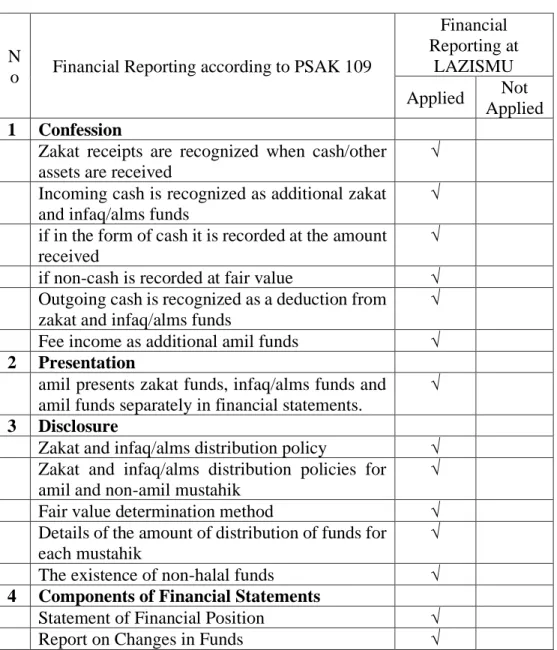
PSAK 109 is a guideline that regulates the recognition, measurement and financial reporting. PSAK 109 regulates how a transaction is recognized or recorded, when it should be recognized, how to measure it, and how to disclose it in the financial statements. The conformity of the presentation of the financial statements of the Amil Zakat Muhammadiyah Institution with PSAK 109 can be seen in the following table:
Table 4.1 Conformity of Presentation of LAZISMU Aceh Financial Statements with PSAK 109
N
o Financial Reporting according to PSAK 109
Financial Reporting at
LAZISMU Applied Not
Applied 1 Confession
Zakat receipts are recognized when cash/other assets are received
√ Incoming cash is recognized as additional zakat
and infaq/alms funds
√ if in the form of cash it is recorded at the amount
received
√ if non-cash is recorded at fair value √ Outgoing cash is recognized as a deduction from
zakat and infaq/alms funds
√ Fee income as additional amil funds √ 2 Presentation
amil presents zakat funds, infaq/alms funds and amil funds separately in financial statements.
√ 3 Disclosure
Zakat and infaq/alms distribution policy √ Zakat and infaq/alms distribution policies for
amil and non-amil mustahik
√
Fair value determination method √
Details of the amount of distribution of funds for each mustahik
√
The existence of non-halal funds √
4 Components of Financial Statements
Statement of Financial Position √
Report on Changes in Funds √
Report on Changes in Assets Under Management
√
Cash flow statement √
Notes to Financial Statements √
CONCLUSIONS AND RECOMMENDATIONS Conclusion
Based on the results of the research that has been done, it can be concluded that:
1. Muhammadiyah Amil Zakat, Infak/Sedekah Institutions in the aspects of measurement, presentation and disclosure have fully implemented PSAK No.
109, and continue to improve to implement PSAK 109 more perfectly.
2. The components of the financial statements of Amil Zakat, Infak/Sedaqah Institutions only apply a statement of financial position, a report on changes in funds and a cash flow statement, whereas in PSAK 109 the components of the financial statements for Institutions Zakat, Infak/Sedaqah consist of 2 more reports, namely a report on changes in assets under management, and notes on financial reports.
Suggestion
1. To the Amil Zakat, Infak/Sedekah Muhammadiyah Institutions to be able to im