Your purchase, acceptance or use of the Software will constitute your acceptance of such terms. Your purchase, acceptance or use of the Software will constitute your acceptance of such End User Licenses.
Cisco Certified Internetworking Expert (CCIE)
Always check the Cisco website (www.cisco.com) for the most current information. Cisco recently added new sites for the CCIE lab; it is best to check the Cisco website at http://www.cisco.com/warp/.
Cisco’s Network Design and Installation Certifications
Cisco Certified Design Associate (CCDA)
Cisco Certified Design Professional (CCDP) 2.0
What Does This Book Cover?
To really master your skills, read each question carefully and, if possible, go through the hands-on labs in some chapters.
Where Do You Take the Exam?
Tips for Taking Your CCNP Exam
After you complete an exam, you will receive immediate online notification of your pass or fail status, a printed Exam Score Report indicating your pass or fail status, and your exam results by section. If you pass the exam, you will receive confirmation from Cisco, usually within two to four weeks.
How to Use This Book
Before taking the exam, practice the additional practice exam included on the CD that comes with this book. This will give you a complete overview of what to expect on the real thing.
What’s on the CD?
Study on the go with the CCNP: Routing Study Guide eBook in PDF, and be sure to test yourself with the electronic flashcards. The electronic flash cards can be used on your Windows computer or on your Palm device.
The EdgeTest for Cisco Routing Test-Preparation Software
Flashcards, Boson software utilities and EdgeTest exam preparation software have been specially selected to help you study and pass the exam. If you want to learn all the material covered in this book, you will need to study regularly and with discipline.
Electronic Flashcards for PC and Palm Devices
To find more test simulation software for all Cisco and NT exams, please find the exam link at www.lammle.com and www.boson.com.
Boson Software Utilities
CCNA Virtual Lab AVI Demo Files
How to Contact the Authors
IGRP C. RIP1
When you configure an OSPF area as a fully staggered area, which of the following routers must be configured as fully staggered. When a BGP peer attempts to open a session with another endpoint, the peer is in one of the following states.
RIP B. IGRP
RIP B. RIPv2
In the IOS command area area-id virtual-link router-id router-id is the highest loopback IP number configured on the router. The clear ip bgp * command is used to clear all entries in the BGP table.
Chapter
Scaling Large Internetworks
THE CCNP ROUTING EXAM TOPICS COVERED IN THIS CHAPTER ARE AS FOLLOWS
We begin this book with a review of Internet works and a discussion of the typical business requirements for their implementation in today's marketplace. With a combination of powerful workstations, desktop audio and video, and network-intensive applications, 10 Mbps Ethernet networks no longer offer enough bandwidth to meet the business demands of the typical large enterprise.
Segmentation with a Bridge
The disadvantage of using bridges is that if the destination MAC address is not known to the bridge, it will forward the frame to all segments except the port from which it received the frame. This delay can increase significantly if the frame cannot be forwarded immediately due to current activity on the target segment.
Segmentation with a Router
Segmentation with LAN Switches
Routers offer a lower level of performance in terms of the number of frames or packets that can be processed per unit. Sometimes a protocol is assigned to more than one layer of the OSI model, and sometimes multiple protocols communicate within a single layer.
The Core Layer
There are a few things we definitely want to do when designing the core. Fast and redundant data link connectivity won't help if your routing tables are broken.
The Distribution Layer
Consider data link technologies that facilitate both speed and redundancy, such as FDDI, Fast Ethernet (with redundant links), or even ATM.
The Access Layer
Cisco IOS provides solutions to provide Quality of Service (QoS) that will allow multiple protocols to be supported on the network without compromising QoS requirements. Cisco IOS provides dedicated and switched WAN support such as Frame Relay, SMDS, X.25, and ATM to provide network professionals with options to meet cost, location, security, and traffic requirements.
Reliability and Availability
Cisco IOS also provides support for external routing with the Exterior Gateway Protocol (EGP) and Border Gateway Protocol (BGP) to allow Internet routing with maximum security. Convergence Scalable routing protocols can converge quickly because of each router's complete understanding of the Internet and the ability to detect problems.
Responsiveness
These routing protocols analyze a combination of factors to determine the actual cost of a network path, enabling Cisco routers to support very large networks.
Efficiency
Adaptability
Accessibility and Security
In this chapter, we discussed the problems with network congestion and how to solve them. We also discussed in this chapter that the key requirements of a scalable internetwork are based on an ideal design using Cisco's hierarchical model to simplify management, allowing for well-planned growth that meets the requirements of the network .
Key Terms
Bridges filter the network using the hardware address in a frame and create smaller collision domains. The distribution layer is responsible for connecting the access layer devices and managing data flow to the core layer.
2 THE CCNP ROUTING EXAM TOPICS
COVERED IN THIS CHAPTER ARE AS FOLLOWS
This is called framing and is required to forward the packet to the next-hop logical unit. Routing tables in each device are used to send the packet to the correct destination network.
Routing Tables
If not, discard the packet and send an Internet Control Message Protocol (ICMP) message to the sender. If the logical destination address is in the routing table, to which interface the packet will be forwarded.
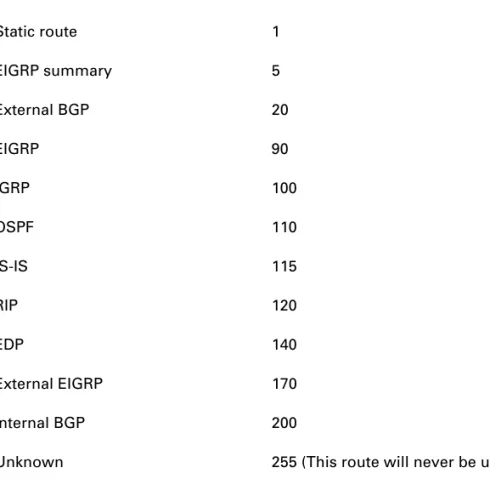
Administrative Distances
However, you can change the administrative distance of static routes, but by default they have an administrative distance of 1.
Packet Switching
Dynamic Routing
Routing Protocols
Both distance vector and link state routing protocols are discussed in more detail later in this chapter. Examples of stylish routing protocols include the Routing Information Protocol version 1 (RIPv1) and the Interior Gateway Routing Protocol (IGRP).
RIP Timers
RIP version 2 provides so-called prefix routing and sends subnet mask information with the route updates. The value of the route invalid timer must be less than that of the route flush timer.
RIP Updates
In Figure 2.4, the four routers start with only their directly connected networks in the routing table. Each router's routing table contains the network number, exit interface, and number of hops to the network.
Verifying RIP
In Figure 2.5, the routing tables are complete because they include information about all the networks on the Internet. In the output above, note that the R means that the networks were added dynamically using RIP.
IGRP
IGRP Timers
Invalid Timer They define how long a router should wait before declaring a route invalid if it does not receive a specific update for it. Leak Timer These indicate how much time must elapse before a route is removed from the route table.
Verifying IGRP
When a change occurs in a network, routers send Link State Advertisements (LSAs) about the change. Since the network cannot converge during this hold period, this can cause a delay in the routing process in the network.
RIP Convergence
Hold timers are used to ensure network stability while new route calculations are performed. Because of this slow convergence time, link state routing protocols do not use hold timers.
IGRP Convergence
Hold timers expire on routers C, B, and A, causing routing table entries to be updated. The time required for RouterA to converge is the discovery time, plus the dwell time, plus two update times and another update time.
EIGRP Convergence
OSPF Convergence
EIGRP B. IGRP
Which of the following protocols uses only hop counting to determine the best path to a remote network. RIP, RIPv2 Maximum 15 hops by default RIP, RIPv2 Administrative distance of 120 IGRP Administrative distance of 100 EIGRP Administrative distance of 90 OSPF Administrative distance of 110.
3 THE CCNP ROUTING EXAM TOPICS COVERED IN THIS CHAPTER ARE AS FOLLOWS
When we review IP addressing, we'll provide you with detailed descriptions and examples of advanced IP addressing techniques that you can use in your production networks. After reading the chapter, you can use the written and hands-on exercises to better prepare yourself to use the advanced IP addressing techniques found in this chapter.
IP Terminology
One of the most important topics in any TCP/IP discussion is IP addressing. The hardware address is hard-coded on the network interface card (NIC) and is used to locate hosts on the local network.
The Hierarchical IP Addressing Scheme
The disadvantage of the flat addressing scheme, and the reason it is not used for IP addressing, is related to routing. Rather than treating all 32 bits as a unique identifier, as in flat addressing, one part of the address is designated as the network address, and the other part is designated as either the subnet or host address.
Network Addressing
Here's an example of how to find valid host IDs on a Class A network. That's 216 minus two reserved patterns (all zeros and all ones), for a total of 65,534 possible node addresses for each Class B network.
Variable-Length Subnet Masks
Create a table detailing the segments and the number of hosts required for each segment, as shown in Table 3.6. We can use our formula 2n – 2 = number of hosts to create a useful reference chart to quickly determine how many hosts can be supported for any given subnet mask, as shown in Table 3.7.
Design Considerations with VLSM
Classless Interdomain Routing
This is because the mask must at least default to class A and you must leave at least two hosts.
Cisco and CIDR
Route Summarization
Route Summarization Example 1
Examine the table to determine the maximum number of bits (starting from the left) that all addresses have in common (where they stop lining up; we've bolded them to make them easier to see). In our example, we can see from the table that all addresses have the first 20 bits in common.
Route Summarization Example 2
If we were to add a network later, it would have to come from the router and enumerate this address space. Because eight bits are bolded in the first octet and five bits in the second, we get:
Route Summarization Example 3
Now create the summary mask by counting all the bits in bold until the point where they stop lining up. We have eight bits in the first octet, eight bits in the second octet and four bits in the third octet.
Route Summarization Example 4
Design Considerations for Route Summarization
In the VLSM section of this chapter, we discussed how route summarization in disjoint networks could cause some hosts to become unreachable, as we saw in Figure 3.4. To prevent routing protocols such as RIPv2 and EIGRP from automatically summarizing routes, we can explicitly disable route summarization in Cisco IOS.
IP Unnumbered
Therefore, by using IP unnumbered, the apparently disjoint subnets shown in Figure 3.4 are actually supported. We also showed how to overcome the caveat of having disjoint address spaces by using methods such as disabling auto-summarization on our routers and using IP unnumbered.
Commands Used in This Chapter
Design Requirements
Solution to Written Exercise
Each of these numbers in the range can be assigned to one side of the serial link. Next, as shown in the following table, we will calculate the range of IP addresses to use for our server farm segment, which needs 50 IP addresses.
Using IP Unnumbered
Which of the following router configuration commands would you use to disable automatic route summarization in an EIGRP. Which of the following IP addresses do Cisco routers use to specify the default route.
4 THE CCNP ROUTING TOPICS COVERED IN THIS CHAPTER ARE AS FOLLOWS
While doing this, Cisco has also added features to its version of OSPF that may not be found in other OSPF implementations. OSPF is a robust protocol, and because of its robustness, you have to learn a lot of terms to understand how OSPF works.
OSPF Terminology
This type of network allows for multi-access but has no broadcast capability like Ethernet. Cisco selects the router ID using the highest IP address of all configured loopback interfaces.
OSPF Operation
Neighbor and Adjacency Initialization
Router priority An 8-bit value used to help elect the DR and BDR. You will see the dotted lines connecting the DROther routers to the DR and BDR routers.

LSA Flooding
You can tell that this is a link state acknowledgment packet based on the OSPF header information. This information is used to ensure that the router possesses the most recent copy of the link state database.
OSPF Metrics
Once all OSPF routers have synchronized databases of link states, each router is responsible for calculating the SPF tree for each known destination. With extensive configurations on NBMA interfaces, an administrator can ensure that OSPF behaves as if it were running on one of the following four network types:
Broadcast
This configuration ensures that all routers have connectivity and will all be able to participate in the DR/BDR election process. When DR and BDR are selected, complex networks act as a broadcast network.
Non-broadcast
All LSA updates are sent to the DR and BDR, and the DR flows the updates out of each interface. One of the biggest weaknesses of this configuration is that if one of the PVCs goes down (especially if it is a PVC between a DROther and the DR), communication is also stopped between the two adjacent peers.
Point-to-Point
PVCs on a subinterface can fail, but there is still OSPF connectivity to other PVCs on the same physical interface. Due to multiple PVCs per interface and depending on the network of PVCs, one LSA update can be flooded multiple times.
Point-to-Multipoint
Enabling OSPF is common to all implementations of OSPF; The difference comes when you configure parameters to make OSPF behave the way you want. We will start with basic configuration of OSPF, then introduce commands related to NBMA, as well as the methods and commands used to verify proper configuration and operation of OSPF.
Discovering the Network with OSPF
The wildcard mask indicates that only this one IP address will be part of the connection. OSPF: Build Router LSA for Area 0, Router ID We end the output here because we know that the link state databases need to synchronize between Exchange state and the transmission of DBD packets containing LSA updates.
Configuring OSPF—Single Area
Therefore, the first selection that occurs is the selection of BDR because Ethernet 0 is the only active OSPF interface at the moment and the router ID of the loopback 0 IP address) is selected to be BDR. However, if one of the many interfaces fluttered, you couldn't easily isolate that interface so it wouldn't cause unnecessary LSA flooding.
Configuring OSPF—Single Area (NBMA Environment)
Broadcast Configuration
The key to this configuration is to override the default network type using the ip ospf network broadcast command.
Non-broadcast Configuration
The same ip ospf network broadcast command is used to specify that the network type is not point-to-multipoint broadcast. This tells the router that no DR/BDR needs to be resolved and that the interfaces are treated as individual point-to-point links.
Verifying OSPF Configuration
There are several display commands that make this task easier and we discuss them in the next section. The information displayed by this command shows the number of connections and the neighbor router ID.
Answer to Lab 4.1
Answer to Lab 4.2
Answer to Lab 4.3
BDR C. DR
Which of the following OSPF terms refers to a connected (or adjacent) router running the OSPF process, with the adjacent interface assigned to the same area.