5TH ASEAN’S
INTERNATIONAL CONFERENCE ON ISLAMIC FINANCE
(AICIF)
VOLUME 2
5TH ASEAN’S
INTERNATIONAL CONFERENCE ON ISLAMIC FINANCE
(AICIF) VOLUME 2
EDITED BY
ABDUL GHAFAR ISMAIL
ROSE ABDULLAH
Published by:
UNISSA Press
Centre for Research and Publication Sultan Sharif Ali Islamic University Simpang 347, Jalan Pasar Baharu BE 1310, Gadong
Brunei Darussalam
© UNISSA Press First Published 2017
All right reserved. No part of this book may be reprinted or reproduced or utilized in any form or by any electronic, mechanical or other means, now known or hereafter invented, including photocopying and recording, or in any information storage or retrieval system, without permission in writing from the copyright owner.
Perpustakaan Dewan Bahasa dan Pustaka Brunei
Pengkatalogan Data-dalam-Penerbitan (Cataloguing-in-Publication)
ASEAN International Conference on Islamic Finance (5th : 2017 : Bandar Seri Begawan) Proceedings 5th ASEAN’S InternationalConference on Islamic Finance (AICIF) (Vol. 2). -- Bandar Seri Begawan : UNISSA Press , 2017.
414 p. 21.59 cm x 27.94 cm.
E-ISBN 978-99917-82-79-9 (Ebook)
1. Finance--Islamic countries--Congresses 2. Bank and banking--Islamic
countries--Congresses 3. Finance--Religious aspects--Islam--Congresses 4. Islamic countries--Economic conditions--Congresses 5. Globalization--Economic aspects-- Congresses I. Title
332.091767 ASE (DDC 23)
i CONTENTS
LIST OF CONTENTS i-iii
1. Sharia Marketing Innovativeness on Marketing Performance Model
Hendar & Mutamimah
1-16
2. Maqashid Al-Sharia Approach in Human Development Index: Case Study at Six Provinces in Java Island Dr. Muhammad Zilal Hamzah & Dr. Eleonora Sofilda
17-30
3.
ةيداصتقلاا تلاماعملا ىف ةعيرشلا دصاقم قيبطت
Mulyono Jamal
31-39
4. The Financial Stability of Islamic Financial Institutions in Malaysia
Nur Lalua Rashidah Mohd Rahsiad & Nur Hidayah Mohd Nor
40-46
5. Grievances on Islamic Banking Issues: Causes and Remedies Ahmad Shaharudin Abdul Latiff, Haryani Haron &
Muthukkaruppan Annamalai
47-57
6. The Contribution of Islamic Social Reporting to The Financial Performance of Sharia Banking in Indonesia Provita Wijayanti & Mutoharoh
58-67
7. Towards Transforming The Cooperative to a Bank: An Analysis
Selamah Maamor, Husin Abdullah, Fauzi Hussin, Norehan Abdullah * Mohd Saifoul Zamzuri Noor
68-83
8. Privatization Predicament and Shari’ah Compliant Alternate Solutions
Malik Shahzad Shabbir
84-89
9. A Study of Factors Influencing The Choice Of Islamic Banking Among Non-Muslim Customers in Nigeria Buerhan Saiti & Abubakar Aliyu Ardo
90-99
10. Islamic Banking Dispute: Critical Analysis on The Contract Structuring and Recovery Practices
Dr Hakimah Yaacob, Dr Kamaru Salam bin Yusof & Hajah Nurliza binti Dato Mahalle
100-110
11. Examining The Shariah Non-Compliance Events in The Malaysian Islamic Financial Institutions: Post Shariah Governance Framework Implementation
Prof. Dr. Rusni Hasan, Muhammad Issyam bin Itam@Ismail &
Associate Prof. Dr Adnan Yusoff
111-123
ii 12. The Impact Of Sharia Principle Adherence and Islamic
Corporate Governance on Trust in Islamic Financial Institutions
Lisa Kartikasari
124-129
13. Islamic Corporate Governance and Islamic Reporting in Sharia Banks: The Case Of Indonesia
Luluk Muhimatul Ifada
130-136
14. Equal Employment Opportunity in Leadership of Islamic Universities
Tri Wikaningrum, Ahyar Yuniawan & Udin
137-153
15. Antecedents of Enterpreneurship’s Motivation Among Young Muslim Students
Nurhidayati
154-158
16. The Impact of Knowledge Sharing and Islamic Ethic Works on Innovation Capability and Competitive Advantage of Small and Medium Enterprises
Mulyana & Sutapa
159-169
17. Developing Framework for Improving Indonesian Islamic Banking Performance Through The Construct of Service Innovation, Human Capital Drivers, and Knowledge Management Capability
Ruspita Rani Pertiwi, Jann Hidajat Tjakratmadja & Hary Febriansyah
170-186
18. The Effects of Enterprise Risk Management on Bank Performance: Evidence from Indonesian Public Listed Companies
Hamdi Agustin, Azwirman & Siska
187-194
19. Analysis of Effect of Intellectual Capital and Good Corporate Governance to Bank in Indonesia Sri Indrastuti, Amris Tanjung & Hamdi Agustin
195-200
20. The Effect of Institutional Ownership, Profitability and Company Size on Islamic Social Reporting
Sutapa
201-210
21. Faktor Determinan Rendahnya Likuiditas Project Based Sukuk di Pasar Sekunder
Wafi Azkia Zahidah & Rizal Nazarudin Firli
211-224
22. Implications of Islamic Corporate Social Responsibility (Icsr) and Corporate Social Responsibility (Csr) on Firm Value: A Conceptual Model (Comparative Study of Islamic Banking Versus Conventional Banking)
Muhammad Ja’far Shodiq
225-233
iii 23. Earning Management of Indonesian Islamic Banks
Saiful
234-243
24. Legal Documentation in Islamic Home Financing in Malaysia: Concepts, Conundrums, and Contextualization Syarah Syahira Mohd Yusoff
244-256
25. Determining The Causes of Bank Runs in Sharia Banking in Indonesia
Sunaryati
257-277
26. Service Quality from Customer Perception: Evidence from Carter Model on Bank Islam Brunei Darussalam (Bibd) Qaisar Ali
278-293
27. Sharia Financing Analysis on The Financial Performance Sharia Banking in The Moderation of The Syariah
Supervisory Board (Dps)
Osmad Muthaher & Edy Suprianto
294-306
28. Bounded-Mosharaka A Unifying Islamic Banking and Finance Contract
Dr Fawzi Gherfal
307-332
29. Determinants of Corporate Governance Disclosure in Indonesian Islamic Banks
Hendri Setyawan & Devi Permatasari
333-346
30. Analysis of Good Corporate Governance (Gcg)
Implementation Effect on The Achievement of Maqashid Sharia of The Indonesian Islamic Banking for The Period of 2012 – 2015
Rifaldi Majid & Moh. Hamilunni’am
347-369
31. Corporate Governance and Islamic Social Reporting in The Indonesia Sharia Banking Companies
Indri Kartika
370-386
32. Shariah Governance in Islamic Wealth Management: A Learning Lesson from Securities Commission Malaysia Nor Razinah Mohd Zain, Prof. Dr. Rusni Hasan & Assoc. Prof.
Dr. Salina Kassim
387-396
33. Islamic Microfinance in The Light of Maqasid Shariah from Experts’ Perspective
Hartomi Maulana & Khoirul Umam
397-414
294 SHARIA FINANCING ANALYSIS ON THE FINANCIAL PERFORMANCE SHARIA BANKING IN THE MODERATION OF THE SYARIAH SUPERVISORY BOARD (DPS)
Osmad Muthaher Edy Suprianto
Dept. of Accounting, Faculty of Economics, UNISSULA, Semarang, Indonesia Email: [email protected]
ABSTRACT
The aim of this study is to research and examine the effect of Mudharaba, Musyaraka, Murabaha financing on sharia financial performance moderated by sharia supervisory board on sharia bankings in Indonesia during 2013-2016. This study employed descriptive quantitative method by using secondary data i.e. data of Financing, and Return on Asset of sharia banking companies in the period of 2013-2016. The samples were reports published continuously from 2013 to 2016 and financial statements which have complete data based on researched variables derived through purposive sampling. To analyze the data, this study used some tests of multiple linear regression, classical assumption, and hypotheses test which included coefficient determination test of R2, F test, and t test. Based on the data analysis, it can be concluded that the factors that affect sharia financial performance (ROA) included Mudharaba, Musharaka and Murabaha financing, where all independent variables have significant effect on ROA. While DPS has been successful in moderating the correlation of mudharaba and Musyarakah variable and ROA but DPS has not been successful in moderating the correlation of Murabah and ROA
Keywords: Mudharaba, Musyarakah, Murabaha Financing, Financial Performance of Sharia Banks, Sharia Supervisory Board
295 INTRODUCTION
Banking in Indonesia is experiencing growth along with the development of public thinking about the system of sharia without interest (usury). Banks are divided into two, namely sharia banks and conventional banks. Both types of banks have almost the same bank products, just different in the operating system. Conventional banks use interest systems, whereas sharia banks implement profit sharing systems. The products of banks applying the profit-sharing system are on working capital and investment financing in the form of mudharaba and musyarakah financing. Financing is the provision of money or invoices based on an agreement between the bank and other parties that are required to return the money or invoice after a certain period of time in rewards or profit sharing.
The financing products researched are mudharaba, musyarakah and murabaha, since they are the three financing distributed by sharia banks, so that large amounts of mudharaba, musyarakah and murabaha financing can be profitable for the banks, if the return on financing by their customers runs smoothly. The amount of profit is associated with the amount of financing disbursed and shows the success rate of sharia banks in conducting their business activities. The research by Khan and Ahmed (2001) placed murabaha schemes as financing with the lowest risk rating, while the sharing scheme financing tends to have high risk ratings. According to Kinasih (2013) sharia bank financing exposure is currently focused on productive sectors, especially SMEs and consumption sector, mudharaba and musyarakah financing are more relevant to represent financing in the SMEs sector, while murabaha schemes are more relevant to represent financing in consumptive sector.
Each bank product provides benefits to themselves, as well as the three investment financing. The profit can be seen from the level of profitability measured using financial ratio. The financial ratio used is the ratio of Return on Assets (ROA) i.e. the return rate of the bank's capital.
The reason for using the ratio is to know the ability in managing the assets they have for mudharaba, musharaka and murabaha financing.
This study employed annual financial statements of Sharia Banks in Indonesia during 2013-2016 to examine the efficiency of capital management in each bank. The opinion of Aisyah et al. (2016), about the effect of mudharaba and musyarakah financing on the level of ROE causes phenomenon and encourages this study. The purpose of this study is to analyze the effect of DPS in moderating the correlation of mudharaba, musyarakah and murabaha financing and financial performance of sharia banks.
LITERATURE REVIEW
1. Profitability of Sharia Banks
Profitability (profitability) is a group of ratios that show a combined effect of liquidity, asset management, and debt to operating results (Brigham and Houston, 2001). Profitability analysis is very essential to assess the ability of management in generating profit. Based on Bank Indonesia regulation no. 13/1 / PBI / 2011 that one of the indicators to assess the health of the bank is earnings. Earning is one of bank evaluations in terms of profitability or also called rentability.
These indicators include Return on Assets (ROA) and Net Interest Margin (NIM). ROA is one of the most common indicators used in assessing bank profitability. ROA as a ratio that describes the
296 ability of banks in managing the funds invested in their overall assets that generate profits.
According to Joel (2001), ROA is calculated by comparing the entire profit before tax with total assets.
2. Mudharaba Financing
Mudharaba Financing is a partnership of a partner who gives money to another partner to invest in a commercial company. The bank (shahibul maal) is obliged to provide 100% funds to the customer (mudharib) and mudharib only manages the business that has been determined by the shahibul maal. Profit sharing will be divided according to agreement at the beginning of the contract, whereas in case of loss, it will be borne by the owner of capital. Manager is also responsible if the loss is caused by the manager. (Rivai, 2012) The requirements of this mudharaba financing contract are (1) the capital must be in money or valued goods, must be known its amount, must be in cash not credit (2) profit must be shared by both parties, the amount of profit should be agreed upon at the beginning of the contract, the provider of funds is responsible for a loss. The principles of this financing contract are (1) the contractor (2) the object of the contract (3) the ijab and qabul. (Jayadi, 2011) The types of mudharaba financing are (1) Mudharaba muqayyadah, the type of business will be determined by the bank (shahibul maal) and the customer only manages it, (2) mudharaba mutlaqah, where the type of business may be determined by the customer (mudharib), although the capital is still borne by shahibul maal. (Sulhan dan siswanto, 2008) Technical mudharaba financing in Indonesian banks is financing aimed to finance investment, working capital and facility provision. The profit sharing calculation is done through revenue sharing method, because the loss risk is less. The income of the owner of the capital depends on the business uncertainty and the costs incurred in the process. (Ascarya, 2011)
3. Musharaka Financing
Musharaka financing is a partnership where two or more entrepreneurs work together as business partners in business. Each party includes its capital and participates in managing the business.
Profits and losses will be divided on the percentage of capital participation (Ascarya, 2011) the requirements of the contract are (1) the validity of the contract (2) the legality of the contract (3) the realization of the contract (4) syarat lazim (common requirements). The pillars of the contract are (1) the actors of the contract (2) object of the contract (3) Ijab and qabul. (Ascarya, 2011) The types of musharaka financing are (1) shirkah al-milk, the ownership of two or more parties for a property (2) shirkah al-'aqd, the partnership occurs because of joint contract. This Shirkah al-aqd 'is divided into four, namely: (1) shirkah al-amwal, cooperation between business partners where the participation rate of capital and work is not the same, (2) syirkah al-mufawadhah, cooperation between business partners with equal portion of equity, profit sharing and work management, (3) shirkah al-a'mal, cooperation where all business partners participate.
4. Murabaha Financing
Murabaha is a sale and purchase transaction of an item at the cost of the item plus a margin agreed by the parties, in which the seller informs the purchase price in advance to the buyers. According to Pramuka, et al (2014) murabaha is a financing contract of an item by establishing and affirming the purchase price to the buyer, then the buyer buys it at a price more, in accordance with the benefits agreed at the beginning.
297 5. The Definition of DPS
DPS is an existing agency of Islamic financial institution and is tasked with overseeing the implementation of DSN decisions in those syariah financial institutions. Sharia Supervisory Board is appointed and dismissed in Sharia Financial Institution through GMS after receiving recommendation from DSN. The main role of ulama in the Sharia Supervisory Board is to oversee the daily course of Sharia Financial Institutions in order to always comply with the provisions of sharia. In addition, Sharia Supervisory Board should make a statement periodically (usually every year) that the Sharia Finance Institution under his supervision has been running in accordance with the provisions of sharia.
6. The Correlation of Murabaha, Mudharaba and Musharaka Financing toward Sharia Banks’ Performance with DPS Moderation
Each bank must raise funds and allocate funds for other profitable activities. One of the fund allocations is financing of murabaha, mudharaba and musyarakah. These three financing will generate profit from the calculation of the profit sharing. These profits will be shared between the bank and the customer. The profit will be used to return the capital allocated for financing. The rate of capital return can measure the level of financial performance of a bank by comparing the profit / earnings and capital it has.
Some findings from previous studies on Islamic banks illustrate the gap in theoretical concepts with the practice of sharia banks, and one of them is the lack of supervisory control and lack of strong stakeholder committees. Therefore, the task of sharia banking today is to eliminate people's doubts and ensure that the implemantation of products is in accordance with the syara ' (sharia guidelines). The effectiveness role of Sharia Supervisory Board within sharia financial institutions should continue. This is because the essential difference between sharia financial institutions and conventional financial institutions is on the implementation of Sharia principles in both mechanisms and products. The existence of DPS in sharia financial institutions (including sharia bank) is very important for the supervision of the implementation of sharia principles in its transactions.
7. Hypotheses Formulation
H1: There is a significant effect of murabaha financing on the financial performance of sharia banks
H2: There is a significant effect of mudharaba financing on the financial performance of sharia banks
H3: There is a significant effect of musharaka financing on the financial performance of sharia banks
H4: The role of DPS is able to moderate the correlation between the structures of financing and the financial performance of Sharia Banks
298 8. Research Framework
RESEARCH METHOD
This study aims to analyze the correlation between two or more variables, consisting of Mudharaba, Musharaka and Murabaha financing, and profitability with moderate variables of DPS (Sharia Supervisory Board) that have been formulated into several hypotheses which are ready to be tested. Based on the background of the problems and the formulations of existing problems, the characteristics of the problems studied in this study are classified as an explanatory research i.e.
the research that explains the correlation of a variable with other variables and tests the correlation between several variables through hypothesis testing or what-so-called explanatory research.
1. Population and Sampling Technique
The population of this study were Sharia Banks (BUS), namely Bank Syariah Muamalat Indonesia Ltd., Bank Syariah Mandiri Ltd., Bank Syariah Mega Indonesia Ltd., Bank Syariah BRI Ltd., Bank Syariah Bukopin Ltd., Bank Panin Syariah Ltd., Bank Victoria Syariah Ltd., BCA Syariah Ltd., Bank Syariah BNI Ltd. and Bank Jabar and Banten Ltd. (Source: BI, Sharia Banking Statistics November 2016) obtained through the official website www.bi.go.id with observation methods from 2013 to 2016.
The sampling technique was conudcted by using Purposive Sampling method. The selection of samples was based on predetermined criteria i.e. Sharia Banks (BUS) which stand and issue their financial statement during 2013 – 2016.
2. Operational Devinition of Variables and Measurement
In this study, there are two variables namely exogenous latent variable and endogenous latent variable. The first variable consists of Mudharaba, Musharaka, Murabaha financing and Moderation Function i.e. DPS, while the latter is Sharia Bank Financial Performance (ROA).
Operational definitions and measurements for each research variable are as follows:
Murabaha Mudharaba
Sharia Supervisory
Board Musharka
Financial Performance
of Sharia Banks
299 a. Mudharaba Financing
Mudharaba financing can be calculated based on the ratio of mudharaba financing to total financing. Systematically, the risk level of the financing is formulated as follow:
Mudharaba Financing = Mudharaba Financing x 100%
Total Financing b. Musharaka Financing
Musharaka financing can be calculated based on the ratio between total musharaka financing with total financing. Systematically, the risk level of the financing is formulated as follows:
Musharaka Financing = Musharaka Financing x 100%
Total Financing c. Murabaha Financing
Murabaha financing can be calculated on the basis of the ratio of murabaha financing to total financing. Systematically, the risk level of the financing is formulated as follows:
Financing Murabaha = Financing Murabaha x 100%
Total Financing
d. Sharia Supervisory Board (DPS)
Sharia Supervisory Board which was measured from the total of DPS, Cross membership, educational background, experience/reputation.
1. Total DPS = if it equals to or above 3, so it should be given score of 1, If not, the score = 0
2. Cross membership = If yes, so the score is 1. If not, the score is 0,
3. Educational background = If DPS has educational background of S2, S3 and others, the score is 1, if not, the score = 0
4. Experience/reputation= if DPS has experience in an institution, the score is 1, if not, the score
= 0.
e. Sharia Financial Performance
The dependent variable in this study is the financial performance of sharia commercial banks proxied with Return on Assets (ROA). ROA is chosen because it is one of the financial performance ratios used to measure the effectiveness of a company in producing the best performance.
Financing Mudharaba Financing Musyaraka
Kinerja Keangan Bank Financing
Murabaha
Dewan Penagawas Financing
Mudharaba Financing Musyaraka
Kinerja Keangan Bank Financing
Murabaha
Dewan Penagawas
300 ANALYSIS RESULT AND DISCUSSION
1. The Description of Sample
This study aims to determine the effect of financing on the financial performance of sharia banking in 2013-2016 which is moderated by Sharia Supervisory Board. The sampling technique used purposive sampling technique with the following criteria: (1) annual report of Sharia Commercial Bank in 2013-2016, (2) murabaha, mudharaba and musharaka financing in 2013-2016, (3) ROE data in 2013- 2016. The sample used was 40 data covering 10 Sharia Commercial Banks in 4-year period.
2. Data Analysis
Based on Table 1 of the descriptive analysis, the mudharaba variable has a minimum value of 22.67 and a maximum value of 24.75 with an average value of 23.5435. While the standard deviation value is 0.52871, therefore the size of mudharaba variable distribution is 52.8% from the data studied. The result of descriptive analysis of the musharaka variable has a minimum value of 23.30 and a maximum value of 25.70 with an average value of 24.3931. While the standard deviation value is 0.57740, therefore the size of musharaka variable distribution is 57.7% from the data studied. The result of descriptive analysis of the murabaha variable has a minimum value of 24.29 and a maximum value of 27.11 with an average value of 25.8571, while the standard deviation value is 0.69361, therefore the size of musharaka variable distribution is 69.3% from the data studied. The results of descriptive analysis of the Return On Assets (ROA) variable has a minimum value of -9.07 and the maximum value of - 4.41 with an average value of -6.1167, while the standard deviation value is 1.25222, therefore the size of variable Return On Assets (ROA) distribution is 125.2% from the data studied.
3. Multiple Linear Regression Analysis
This model is intended to analyze the effect of mudharaba, musharaka, and murabaha financing on Sharia Bank's Financial Performance (ROA) and financing effect with Sharia Supervisory Board variable as a moderating variable. Based on the calculation, regression result was obtained as follows:
301 Table I
The Result of Multiple Linear Regression Coefficientsa
Model
Unstandardized Coefficients
Standardized Coefficients
t Sig.
B Std. Error Beta
1 (Constant) .747 .349 2.139 .040
Mudharaba 7.129 1.777 1.702 4.012 .000
Musharaka 2.114 .754 1.485 2.804 .008
Murabaha .730 .267 .589 2.735 .010
DPS .075 .097 .112 .776 .443
modeat1 2.123 .466 1.947 4.558 .000
modeat2 .639 .255 1.407 2.510 .017
modeat3 .152 .071 .421 2.134 .061
a. Dependent Variable: ROA
Source: Processed Secondary Data, 2017
Based on the result of regression presented in table 1 above, multiple linear regression equation was then obtained as follows:
ROA = 0.747 + 7,129 Mdh +2,114 Msy +0,730 Mrb + 0.075 DPS+ 2,123 Mod1+ 0.639 Mod2+ 0.152 Mod3+ ℮1
By using the result of the equation, the regression result can be interpreted as follows: The value of the constant for the regression equation was 0.747. This shows that if mudharaba, musharaka, and murabaha are considered constant, they will increase the ROA by 7.47%. The regression coefficient value of mudharaba was 7,1294. This can be interpreted any increase of mudharaba by 1% wiould have an effect on the increase of ROA by 7,129. Regression coefficient value of Musharaka was 2.114. This can be interpreted any increase in musharaka by 1% would have an impact on the decrease in ROA by 2.114. The regression coefficient value of murabaha was 0.730. This can be interpreted any increase of murabaha by 1% would have an effect on ROA increase by 0.730.
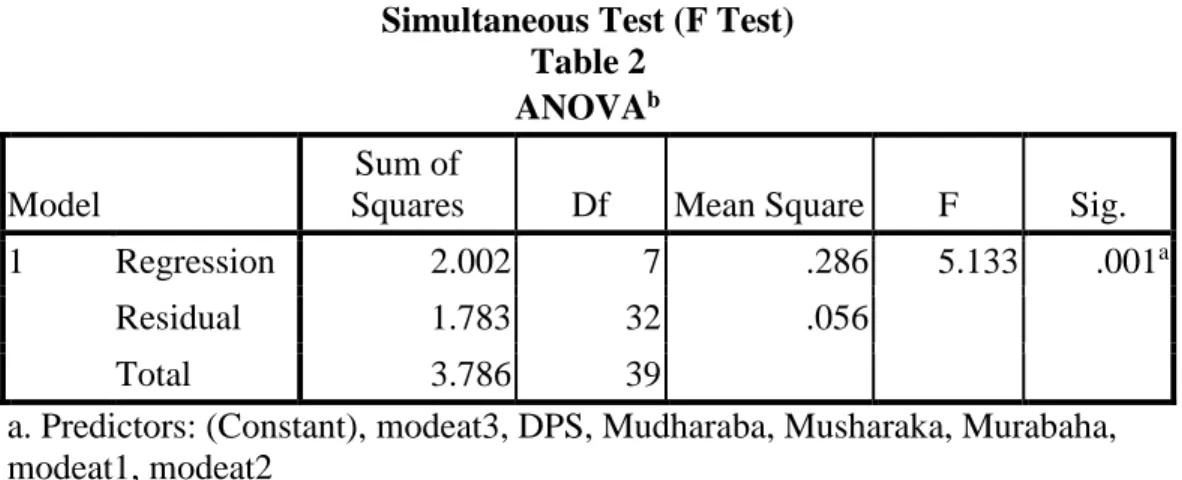
302 Simultaneous Test (F Test)
Table 2 ANOVAb Model
Sum of
Squares Df Mean Square F Sig.
1 Regression 2.002 7 .286 5.133 .001a
Residual 1.783 32 .056
Total 3.786 39
a. Predictors: (Constant), modeat3, DPS, Mudharaba, Musharaka, Murabaha, modeat1, modeat2
b. Dependent Variable: ROA
Based on Table 2, the result of the statistical test F used to test the level of effect of independent variable on dependent variable can be said that the probability value of the regression model used in the study is smaller than the significance level of research 5% (α = 0 , 05) of 0.001.
When compared to F count with F tabel value can be seen that the statistical test result and the distribution of F count> F table i.e. 5.133> 2.82. This result indicates that the regression model used in this study is feasible to be used as a regression model for hypothesis testing. So, the variables of mudharaba, musharaka, and murabaha simultaneously have an effect on profitability (ROA).
Partial T Test (T Test).
Based on Table 1, the result of t test for mudharaba variable obtained t-count 4.012> t-table as much as 2.015 with significance level of 0.000 < p value of 0.05, therefore the hypothesis was accepted. This means that mudharaba affects financial performance (ROA). Thus, the first hypothesis that states mudharaba has an effect on financial performance (ROA) is proven.
From the result of t test test for musharaka variable, it obtained t-count of 2.804> t-table of 2.015 with a significance level of 0.008 < p value of 0.05, therefore the hypothesis was accepted.
This means that musharaka has an effect on financial performance (ROA). Thus, the second hypothesis that states musharaka has an effect on financial performance (ROA) is proven.
From the result of t test for the murabaha variable, it obtained t-count 2,735 <t-table (2,015) with significance level of 0,010> p-value of 0.05 hence the hypothesis was rejected. It means that murabaha has no effect on profitability (ROA). Thus, the third hypothesis that states murabaha has an effect on financial performance (ROA) is proven.
303 Tabel 3
Model Summary Model R R Square
Adjusted R Square
Std. Error of the Estimate
1 .727a .529 .426 .2360769
a. Predictors: (Constant), modeat3, DPS, Mudharaba, Musharaka, Murabaha, modeat1, modeat2
Based on Table 3, the Determination Coefficient Test (R2) result indicated that the value of Adjusted R² was 0.426 indicating 42.6%. This finding indicates that the independent variables in this study consisting of mudaraba, musharaka, and murabaha were able to explain the dependent variable of financial performance (ROA) as much as 42.6%. Meanwhile, the remaining 57.4% was explained by other variables outside of this research model.
5. DISCUSSION
The partial testings of all variables i.e. mudharaba, musharaka, and murabaha were found an effect on the disclosure of profitability (ROA). The discussion of each variable in the test partially is as follows:
a. The Effect of Mudharaba on Financial Performance (ROA)
Mudharaba in this study has an effect on the financial performance of Islamic banks (ROA) with significance value of mudharaba variable was 0.000 <0,05. This shows that the higher mudharaba financing which is one type of profit sharing, the higher the bank's financial performance proxied with (ROA).
With the principle of revenue sharing in accordance with the management of financing management, it would provide income that affects the expected profit (earnings) which would affect financial performance.
Profit sharing financing is one component of asset compositions in Islamic banking. Profit sharing financing in sharia banking is done through mudharaba contract. Mudharaba is a partnership contract which is based on the principle of revenue sharing by giving one's capital to another to do business and both parties share the profit or loss under a collective agreement.
Empirically, the finding of this study is relevant to the study which was conducted by Aisyah et al (2016), who stated that mudharaba has a significant positive effect on profitability.
b. The Effect of Musharaka on Profitablity (ROA)
Musharaka in this research has an effect on profitability (ROA) with significance value of musharaka 0,008 <0,05. This shows that the higher financing musharaka which is one type of joint- venture business form, the higher the performance of Islamic banks proxied with (ROA).
Musharaka is all forms of business involving two or more parties in which they jointly integrate all forms of tangible and intangible resources. Profits and losses are borne together in proportion to the pre-determined. Through the distributed profit sharing financing, the sharia bank will earn revenue in the form of profit sharing which becomes part of the bank.
304 Empirically, the finding of this study is relevant to the study which was conducted by Permata et al. (2014) who stated that musharaka has a significant positive effect on profitability.
c. The Effect of Murabaha on Profitablity (ROA)
Murabaha in this study has an effect on profitability (ROA) with the significance value of murabaha variable of 0,010 <0,05. This shows that the higher murabaha financing which is one type of financing sale, the higher the performance of Islamic banks proxied with (ROA). Murabaha is a financing that uses the principle of buying and selling goods where the bank purchases goods from the supplier and then sells it back to the customer. The selling price of the items is the acquisition price plus the mark up or the agreed profit between the bank and the customer who is the buyer. From the management of murabaha financing, Islamic banks earn revenue in accordance with the ratio agreed with the customer.
Empirically, this finding is in line to the study which was conducted by Fahrul et al (2012), who stated that murabaha has an effect on financial performance of sharia banks.
d. The Effect of DPS on the Correlation of Mudharaba, Musharaka and Murabaha towards Financial Performance of Sharia Banks
The effect of Sharia Supervisory Board successfully moderated the correlation of mudaraba and musharaka towards financial performance of sharia banks (ROA). This is proven from the significance value of both below 0.05 seen in table 1. However, DPS does not moderate the correlation between Murabaha and financial performance of sharia banks. It can be seen from table 1 which shows the significance value of 0.060 or> 0.05.
DPS is an independent agency placed in a sharia bank that plays a role in overseeing the implementation of sharia principles in the bank business. Its members consist of experts in fiqh muamalah who know the general knowledge in banking and other capabilities relevant to their daily tasks. Sharia Supervisory Board (DPS) in supervising the operations of sharia banks shall refer to the National Sharia Board's fatwa (DSN) to ensure the conformity of bank products and services with the provisions in the fatwa.
The role of DPS as a control in sharia financial institutions becomes very important to reduce the process of making false decisions on the financing contracts made.
6. Conclusion
Based on the results of data analysis, it can be concluded that the factors that affect profitability include Mudharaba, Musharaka and Murabaha financing where all those independent variables have a significant effect on profitability. This is indicated by the value of p value of each variable
<0.05. Hence, the hypotheses H1, H2 and H3 are acceptable. In moderating terms, DPS moderates the correlation between mudharaba and musharaka with shariah bank's Financial Performance (ROA) but DPS does not moderate the correlation between Murabaha and Sharia bank's financial performance (ROA). This is indicated by Sig> 0.05 or 0.060.
305 7. Suggestions
a. Sharia banking should continue to improve the quality of its management considering the three types of financing products are a financing product that occupies a large portion and is expected to increase in number in the future.
b. Improving the quality of financing management can be done by sharia banking through arranging more integrated financing disbursement policy by taking into account various factors and criteria that determine the quality of the policy.
c. Sharia banking party should be able to perform a stronger monitoring of financing given / distributed.
d. Sharia banking party should further improve the prudential principle so as to minimize non performed financing, which among them is to be more innovative in developing products that exist and still pay attention to the principles of sharia.
e. The role and function of DPS in moderating the correlation between financing and financial performance, need to be re-examined. This is in consideration that there is a finding of distortions on financing especially murabaha as well as the existence of low scheme financing profit sharing compared to profit margin. Future studies should be done using primary data sources by conducting data excavation in interviews to produce findings that support this study or vice versa to further enrich the sciences and research in the area of Islamic financial institutions.
REFERENCES
Ascarya dan Yumanita, 2006, “The Lack of Profit and Lost Sharing Financing in Indonesia Islamic Banks: Problems and Alternative Solution, paper INCEIF Islamic Banking and Finance Education Colloqullium, KL Convention Center , Kuala Lumpur Malaysia, April 3-5 . 2006 Ascarya. 2011. Akad & Produk Bank Syariah. Jakarta: PT. Raja Grafindo Persada
Ach Bakhrul Muchtasib. 2008. Konsep Bagi Hasil Dalam Perbankan Syariah. Diakses dari http://zanikhan.multiply.com/journal/item/435.
Dewi Yulianti Fuadah. 2008. Faktor-Faktor Yang Mempengaruhi Financing Investasi Mudharaba Dan Musyarakah Di Bank Syariah Mandiri. Skripsi, Fakultas Ekonomi Universitas Islam Negeri Sunan Kalijaga, Yogyakarta.
Diyana Al Barra. 2006. Evaluasi Akuntansi Praktik Penghimpunan Dana Dan Financing Di BMT Yogyakarta (Studi Kasus Pada Bmt Artha Mulia Insani Dan BMT Al-Ikhlas Yogyakarta).
Skripsi, Fakultas Ekonomi Universitas Islam Indonesia, Yogyakarta.
Duddy Roesmara Donna. 2007. Perbankan Syariah (1). Buletin Ekonomika Dan Bisnis Islam.
Edisi: 1i/V - 8 Jumadil Ula 1428 H / 25 Mei 2007 Laboratorium Ekonomika Dan Bisnis Islam (Lebi) Feb Ugm, Yogyakarta.
Fahmi Indi Fikar. 2007. Analisis Beberapa Faktor Yang Berpengaruh Terhadap Keputusan Pemilihan Produk Financing Syariah. Skripsi, Jurusan Akuntansi Fakultas Ekonomi Universitas Islam Sultan Agung, Semarang.
Fauzan Fahrul, Muhammad Arfan, Darwanis .” Pengaruh Tingkat Resiko Financing Mudharaba, Musyarakah dan Murabaha Terhadap Tingkat Profitabilitas Bank Syariah, Jurnal Akuntansi Pascasarjana Syiah Kuala, Vol 2, No1 Tahun 2012
Ghozali, Imam. 2005. Aplikasi Analisis Multivariate Dengan Program SPSS, Cetakan Keempat. Semarang: Badan Penerbit Universitas Diponegoro.
Jayadi, Abdullah. 2011. Beberapa Aspek Tentang Perbankan Syariah. Yogyakarta:Mitra Pustaka Khan, Tariqulla dan Ahmad (2001). “Risk Management on Analysis of Issues in Islamic Financial
Industry”. Islamic Research and Training Institute : Islamic Depelopment Bank.
306 Kinasih, Septrivia Wahyu. 2013. “Pengaruh Profil Risiko Jenis Financing Terhadap Rasio Non
Performing Financing Bank Syariah Di Indonesia”. Departemen Akuntansi Fakultas Ekonomi Universitas Indonesia.
Lewis, M K, Algoud, LM. 2001. Perbankan Syariah. Jakarta: Serambi Ilmu Semesta.
Maryanah. 2008. “Faktor-Faktor Yang Mempengaruhi Financing Bagi Hasil Di Bank Syariah Mandiri”. Jurnal Ekonomi Keuangan Dan Bisnis Islami. Vol 4. No. 1.
Nur Indriantoro dan Bambang Supomo. 1999. Metode Penelitian Bisnis Untuk Akuntansi dan Manajemen, Cetakan Pertama. Yogyakarta: BPFE.
Osmad, Muthaher, 2011, Akuntansi Perbankan Syariah, Yogyakarta: Penerbit Graha Ilmu.
Peri Umar Farouk. 2009. Sejarah Hukum Perbankan Syari'ah di Indonesia.
http://mhugm.wikidot.com/ Sejarah-Hukum-Perbankan-Syari'ah-di-Indonesia/.
Pramuka, Bambang A. dkk. 2014. Sistem Ekonomi Islam: Tinjauan Praktis dan Aplikatif.
Yogyakarta: Deepublish
Rivai, Veithzal, dkk. 2012. Banking and Finance (Dari Teori ke Praktik Bank dan Keuangan Syariah Sebagai Solusi dan Bukan Alternatif) Edisi Pertama. Yogyakarta: BPFE
Rosly, Saiful a & Mohd A. Abu Bakar. Performance of Islamic and mainstream banks in Malaysia, International Journal of Social Economics, Vol 30 (11/12), 2003
Russely Inti Dwi Permata, Fransisca Yaningwati, Zahroh Z.A, “ Analisis Pengaruh Financing Mudharaba dan Musyarakah Terhadap Tingkat Profitabilitas Bank Syariah , Jurnal Administrasi Bisnis (JAB)|Vol. 12 No. 1 Juli 2014
Siswati. 2009. Analisis Pengaruh Dana Pihak Ketiga (DPK), Non Performing Financing (NPF), Dan Bonus SWBI Terhadap Penyaluran Dana Bank Syariah (Studi Kasus Pada PT. Bank Syariah Mega Indonesia). Skripsi, Fakultas Ekonomi Universitas Negeri Semarang, Semarang.
Sovi. 2010. Faktor- Faktor yang Berhubungan dengan Financing. http://sovi70- ovi.blogspot.com/2010/04/faktor-faktor-yang berhubungan-dengan.html
Sulhan, Ely Siswanto. 2008. Manajemen Bank: Konvensional & Syariah. Malang: UIN Malang Press
Sula, Shakir & Dina Jamali. 2010. Institutional investors and CSR: the role of Islamic finance institutions. International Review of Business Research Paper, Vol. 6 (1), Pebruary