Indonesian Journal of Interdisciplinary Islamic Studies (IJIIS) Vol. 5 No. 1 September 2021
Tübingen M a VI 165 Quran Manuscript and its Compatibility with ʿUthmān's Codices
Mohammad Said Mitwally Alrahwan*
Al-Azhar University, Cairo, Egypt [email protected]
Article Info
Submitted Accepted Published
: : :
December 27, 2020 June 3, 2021
September 29, 2021
DOI:
10.20885/ijiis.vol5.iss1.art3
*Corresponding author Abstract
Being one of the presumably earliest Quran manuscripts which may belong to the Umayyad era, Tübingen M a VI 165 is referred to as an ideal material for a paleographical study to resolve inquiries on earlier muṣḥafs written at the time of ʿUthmān and were elaborately described in Muslim traditional sources. This paper attempts to measure to what extent does Tübingen M a VI 165 Quran Manuscript reflect and adhere to what traditional Muslim sources reveal on earliest codices of ʿUthmān, particularly textual patterns, consonantal and vocal variations reflecting modes of recitation in addition to their scripts, overall and detailed verse numberings, to develop our vision on the transcription of muṣḥafs at the Umayyad period.
Keywords: Quran, Manuscript, Tübingen M a VI 165,ʿUthmān, Muṣḥaf, Umayyad
A. Introduction
The codex Tübingen M a VI 165 comprising seventy-seven folios of a Quran fragment does now belong to Universitätsbibliothek Tübingen. A radiocarbon was conducted on the parchment through Docmenta Coranica and it was dated to between 649 and 675 CE with greater than 95.4%
probability1, making it one of the earliest surviving manuscript of the Quran
1 "Rarität entdeckt: Koranhandschrift stammt aus der Frühzeit des Islam" at Universitätsbibliothek Tübingen, Germany, https://uni-tuebingen.de/universitaet/aktuelles- und-publikationen/pressemitteilungen/newsfullview-pressemitteilungen/article/raritaet-
46 Mohammad Said
produced between 20 and 40 years after the death of the Prophet of Islam and slightly earlier than the Sanʿāʾ palimpsest. The parchment contains continuous text of the Quran from 17:35 to 36:57, constituting 26.2% of the total text of the Revelation. The remaining portion is missing. They were brought to Germany by Gohann Gottfried Westzstein, while serving as first Prussian Consul to Damascus in the middle of the 19th century. Wetzstein made numerous acquisitions of ancient Arabic manuscripts. He forwarded a small catalogue he published with his confirmation that more than 1,100 Kufic folios of the Quran he had collected would be of some interest to those involved in paleography and Quranic criticism2. He was the first to provide a brief description for M a VI 1653. He labeled those folios as Kufic, though they are all Hijazi. He further provides the first verse of the manuscript as 17:37 instead of 17:35 according to modern printed editions of the Quran4.
The manuscript is vertical-format parchment leaves of 19.5 cm x 15.3 cm, with a range of 18-22 lines to the page (99.3% of the total of 154 pages having between 19 and 22 lines to the page). There is only one page which contains 23 lines. The script is fairly large, thick, rather narrow, slightly rounded, with high shafts and slight tilt to the right. In some folios, the script has faded and it has been retouched by a later hand with black ink. The manuscript seems homogenous to be written by one standard hand. The consonants are frequently, but not consistently, differentiated by little dashes on top or bottom of the letter. Those dashes are most probably added along with the original text with the same ink color and thickness. A set of 2 or 3 oval dots punctuate the end of verses. Every tenth verse is marked by a
entdeckt-koranhandschrift-stammt-aus-der-fruehzeit-des-islam.html, Accessed on 18th March 2019.
2 J. G. Wetzstein, Catalog Arabischer Manuscripte In Damaskus Gesammelt, (Druck
von Trowitzsch & Sohn: Berlin, 1863), p. 2.
3Ibid. p. 17.
4 M. Weisweiler, Verzeichnis Der Arabischen Handschriften, Universitätsbibliothek
Tübingen, Volume II, Verlag von Otto Harrassowitz (Leipzig, 1930), p. 125. (No. 161).
red hollow circle surrounded by dots. The end of a sūra is characterized by a series of sets of dots forming triangles to fill the line. Sometimes it includes a word or two of the end of the sūra in addition to these triangles as in f. 5r (the end of Q. 17 and the beginning of Q.18). The name of a sūra is provided at the beginning, written in naskh script and black ink, different from the original color of script which is brown. Both names of sūras and the number of their verses were written inconsistently by a later hand. Basmala is written in same color of the text and is followed by oval dashes and is thus counted as a verse.
As they appear at the manuscript, the alifs are bending to the right, invariably have a marked tail or a lower hook with tiny end at the base that re-curves to the right, and sometimes seems like a right angle. There is no sharp contrast between the alif and the lām, both being often written as vertical strokes.
The final mīm is almost round and always terminates with a tail. In very few instances a protuberance is left as a reminder of the tail. The nūn is sickle-shaped and yāʾ goes to the left side underlining preceding letters. The initial and medial hāʾs each looks like a circle straddling the line. Diacritical marks are present: the original dashes, very numerous, have been complemented by same hand and take the same color of the text. They include dashes to discern letters like yāʾ, tāʾ, jīm and khāʾ. The transcription of this manuscript complies with the rules of the scriptio continua adapted to the Arabic script, with words cut at the end of the line when the space left would not accommodate them conveniently.
The parchment includes many features to prove its scriptio defective. I am going to examine alifs in sample words such as qāla, ibād, ʿadhāb and shayʾ, in addition to the yāʾ in words like āyāt (when introduced by a
48 Mohammad Said
preposition like bi-)5 and the ending alif of dhū. Spellings without alif in words such as qāla, qālat, qālū, qāʾil, and so on, are inconsistent throughout this manuscript, a situation largely similar to that found in Or. 2165 and Paris 328a as noticed by Dutton6, Codex Parisino-petropolitanus and many others.
Words like shayʾ, as the custom of other parchments was written inconsistently throughout the text. It is written, for instance in (Q. 18: 23; 6v, 7), (Q. 18:45; f. 7v, 17), (Q. 20:50; 16r,12) and (Q. 21:30; f. 21r, 2) with alif between shīn and yāʾ while it is written without alif in (Q. 18:54; f. 8r, 19), (Q.
18:70; f. 9r, 10), (Q. 18:76; f. 9r, 19), (Q. 18:84; f. 9v, 22), (Q. 20:50; f. 16r, 12) and (Q. 20:98; f. 18r, 13).
Other peculiar features include the word bi-āyātin, āyātī, bi-āyātinā, and so on, which was written with the yāʾ and with three denticles in the majority of the occurrences found on the fragment like (Q. Q.18:105; f. 10v, 15), (Q.
25: 37; f. 31r, 17), (29: 23; f. 55v, 20) and (30:10; f. 58v, 19), but in other examples it includes two denticles only such as in (Q. Q.18:57; f. 8v, 5), (Q.
20:127; f. 19r, 15), (Q. 23:58; f. 31r, 15) and (Q. 32:22; f. 64v, 16). Similarly, the word dhū, is spelled with an alif after the waw, but we have only one instance available at the parchment; (Q. 18:58; f. 58v, 11). Unlike Or. 2165 and Paris 328a, ulū, as in the phrase ulū'l-faḍli (Q. 24:22; f. 34r, 6) and ulū quwattin (Q. 27:33; f. 46, 6) is spelled with five letters (alif, wāw, lām, wāw, alif) rather than four (alif, wāw, lām, wāw). Both M a IV 165 (f. 46r, 10) and Or. 2165 (f. 78r, 11) add an alif after lām and before dhāl in the word la- adhbaḥannahu (Q. 27:21).
ʿIbād and ʿadhāb exhibit the same inconsistency throughout the parchment. The word ʿibād was written with alif in (Q. 21: 26; f. 20v, 13) while ʿibādī was written without alif in (Q. 17:65; f. 2v, 4), (Q. 18:102; f. 10v,
5 Franşios Déroche, Qur'ans of the Umayyads: A Preliminary Overview, Leiden Studies
in Islam and Society (Brill: Leiden and Boston 2014), vol. 1, p. 22.
6 Yasin Dutton, Some Notes on the British Library's 'Oldest Qur'an Manuscript' (Or.
2165), in Quranic Studies, vol. 6, No. 1 (2004) p. 63.
11), (Q. 21:105; f. 24r, 1), (Q. 23:109; f. 32v, 11), (Q. 25:17; f. 38v, 7) and (Q.
34:13; f. 70v, 3). Similarly, the word ʿadhāb was written inconsistently. It was rendered without alif in (Q. 17:57; f. 2r,3), (Q. 19:45; f. 12v, 19), (Q. 21:46; f.
21v,6), (Q. 22:4; f. 24r, 21), (Q. 22:9; f. 24v, 15), (Q. 22:22; f. 25v, 6), (Q. 22:57;
f. 27v, 12), (Q. 24:19; f. 34v, 19), (Q. 24:23; f. 34r, 12), (Q. 24:63; f. 37v, 11), (Q. 25:65; f. 40v, 8), (Q. 26:135; f. 43v, 8), (Q. 26:156; f. 44r, 4), (Q. 29:23; f.
55v, 11), (Q. 31:6; f. 61v, 17), (Q. 34:12; f. 70r, 7), (Q. 34:42; f. 72r, 9), (Q. 35:7;
f. 73v, 3) and (Q. 35:10; f. 73v, 15), while it is written with alif in (Q. 22:2; f.
24r, 18), (Q. 22:25; f. 25v, 15,16), (Q. 22:55; f. 27v, 8), (Q. 23:77; f. 31v, 11), (Q. 24:11; f. 33v, 5), (Q. 24:14; f. 33v, 11), (Q. 26:198; f. 44v, 5), (Q. 31:24; f.
63r, 2,3), (Q. 32:14; f. 64r, 14), (Q. 32:20; f. 64v, 4,5), (Q. 34:5; f. 69v, 11), (Q.
34:46; f. 72r, 19), (Q. 36:18; f. 76v, 4).
As observed by al-Ḥamd, this feature continued in later Kufic muṣḥafs like the Samarqand Quran Codex, Fustat Codex (Marcel 13) Sanaa codex and the Egyptian Library and Archives Manuscript 1157. The forgoing analysis confirms that early Hijazi and Kufian muṣḥafs did not consistently add alifs in middle position; a phenomenon which continued in modern scripts as in words like ar-rahmān, ar-raḥīm, Allāh, and so on. Quran experts were, as Gallez and Lamsia confirmed, "aware of the ambiguous nature of the alif which, in its higher position, belongs to the set diacritical marks subsequently added.8" Déroche assumed that copyists' 'relationship with the original they were transcribing was not of a complete subservience. They were willing to improve the rasm they were copying.9' But the question remains why did not they accomplish at least a scriptio plena in one of those
7 Ḥamd, Ghānim Qaddūrī al- and Iyād al-Samirrāʾī, Ẓawāhir Kitābiyyah fī Maṣāḥif Makhṭūṭah, Dār al-Ghawthāʾī, Damascus 1431/2010, p. 29.
8 Edouard-M. Gallez and M. Lamsiah, Suspicions of Ideological Manipulation and
Codicology: A Provisional Synthetic Approach, in K.-H. Ohlig und M. Gross (ed.), Die Entstehung einer Weltreligion III, Inârah-Sammelband 7
(Schiler Verlag, Berlin-Tubingen, 2014), p. 12.
9 François Déroche, La Transmission écrite du Coran dans les deébuts de l'islam. Le codex
Parision-petroplitanus, (Leiden and Boston: Brill 2009), p. 174.
50 Mohammad Said
repeated scriptio defectivia. We can hardly identify a norm or a consistent rule for adding and deleting alifs, which appeared differently at the same page and sometimes at the same line. I strongly assume that their complete subservience to particular earlier codices resulted in this inconsistent scriptio defectivia of the dominant majority of words including alifs, a practice which continued even in muṣḥafs written in Kufian script. Each scribe attempted to brutally stick to the codex he used in transmitting the text. Alifs, wāws and yāʾs at dominant majority of positions were originally regarded as matres lectionis and mostly treated as diacritic additions. This is further substantiated by ascertaining that this inconsistency is exhibited in other numerous words such as kāna/kana, ʿibādatihi/ʿibadatihi, li-lʿābidīn/ li- lʿabidīn, khāshiʿīn/khashiʿīn, shurakāʾ with or without waw at the end, bi- ʾayidin with two or one yāʾ, bi-ayyikum with two or one yāʾ, raʾaw with or without alif at the end and many others10. Our preliminary conclusion that these differences are mostly attributed to a meticulous imitation of earlier codices is further supported by our analysis of consonantal variations of the Tübingen codex which belonged to the early Medinan muṣḥaf, a conclusion which was earlier confirmed with Or. 2165 and Paris 328a by Dutton who attributed them to the earlier Damascene muṣḥaf and the Reading of Ibn ʿAmir.
B. Consonantal Variations of the Text Skeleton
The surviving 77 folios of codex Tübingen M a VI 165 are extensive enough to contain several distinctive consonantal variants marked by the addition or omission of a particular letter in the consonantal outline of the text. Dānī could discern 38 cases where we could examine 12 which are available in those fragments.
Ḥamad, Ẓawāhir, p. 41-115.
1. Q. 18:36 (f. 7r, 20): khayran minhumā, with mīm after hāʾ to indicate dual (Ibn Kathīr, Nāfiʿ, Ibn ʿAmir, Abū Jaʿfar and Ibn Muḥayṣin), instead of khayran minha, which is the reading of the others11. Ibn Mujāhid confirms the former is consistent with the script of Meccan, Medinan and Syrian muṣḥafs12.
2. Q. 18:95 (f. 10r, 16): mā makannī, with emphatic nūn after kāf (all reciters except ibn Kathīr), instead of mā makananī with two nūns (according to ibn Kathīr)13. The parchment is consistent with the former and is, thus, compatible with all codices except the Meccan14. 3. Q. 21:4 (f. 20r, 2): qul rabī yaʿlamu al-qawl, without alif after qāf (ibn Kathīr, Nāfiʿ, Abū ʿAmr, Ibn ʿAmir, Shuʿba) instead of qāla rabbī yaʿlamu with alif after the qāf (according to others including Ḥafṣ, Ḥamza, Kisāʾī, Khalaf and Al-Aʿmash)15. According to Dānī, the Kufi codex added alif while others did not. Shuʿba belongs to Kūfan reciters but he did not pronounce it according to the script of Kufi codex.
4. Q. 21: 30 (f. 20v, 18): awalam yara, with waw after hamza (all reciters except ibn Kathīr and ibn Muḥayṣin) instead of alam yara, without waw (ibn Kathīr and ibn Muḥayṣin)16. According to Dānī, the Meccan codex does not have waw and is therefore consistent with ibn Kathīr's qirāʾa17.
11 Ibn Mujāhid, Aḥmad b. Mūsa b. Al-ʿAbbās Al-Tamīmī. Kitāb al-Sabʿa fī al-Qirā'āt. Ed.
Shawqī Ḍayf. (Egypt: Dār al-Maʿārif 1997), p. 390; ibn al-Jazarī, Shams al-Dīn abū al-Khayr Moḥammad b. Moḥmmad b. Yūsuf, al-Nashr fī al-Qirāʾāt al-ʿAshr, ed. ʿAlī Moḥmmad al-Ḍabbāʿ, (Egypt, al-Maktaba al-Tujāriyya, n. d.), vol., 2, p. 311; al-Bannāʾ, Aḥmad b. Moḥammad b.
Aḥmad ʿAbdul-Ghanī al-Ḍumyāṭī, Itḥāf Fuḍalāʾ al-Bashar fī al-Qirāʾāt al-Arbaʿat ʿAshara, ed.
Anas Muhra, (Beirut: Dār al-Kutub al-ʿIlmiyya, 2006), p. 366.
12 Ibn Mujāhid, al-Sabʿa, p. 390.
13 Al-Bannāʾ, Itḥāf, p. 37; ibn Mujāhid al-Sabʽa, p. 121.
14 Dānī, ʿ‘Uthmān b. Saʿīd b. ʿUmar abū ʿAmr al-, al-Muqniʾ fī Rasm Maṣāḥif al-Amṣār, ed.
Moḥammad al-Ṣādiq Qamḥāwī, (Cairo: Maktabat al-Kulliyyāt al-Azhariyyah, n. d.), p. 108.
15 ibn Mujāhid, al-Sabʿa, p. 428; al-Bannāʾ, Itḥāf, p. 391.
16 Al-Bannāʾ, Itḥāf 391.
17 Danī, Muqniʽ, p. 108.
52 Mohammad Said
5. Q. 21:112 (f. 24r, 9): qul rabbī iḥkum, without alif after qāf (all reciters except Ḥafṣ), instead of qāla (according to Ḥafṣ alone). The parchment is consistent with all codices except the Kūfan.
6. Q. 22:23 (f. 25v, 9): wa lūluʾā with alif at the end of the word to indicate that it is in accusative case (Nāfiʿ, ʿAṣim, Yaʿqūb and Abū ʿJaʿfar) instead of lūluʾin to indicate dative case in conjunction with prior nouns (other reciters)18. Dānī records disagreement on whether all codices added alif in Q. 22:23 or only Medinans19, but he confirms it did certainly exist in the two Medinan codices. He based his view on accounts he authenticated.
7. Q. 23:87 and 23:89 (f. 32r, 6,8): sayaqūlūn Allah without lām before the name Allah (Abū ʿAmr Al-Baṣrī20, Yaʿqūb and Al-Yazīdī21), instead of li-llah (according to all other reciters). Dānī confirms that the former is consistent with the codices of Baṣrans22. He recounts Abū ʿUbayd who observed that it was devoid of the alif at the early Medinan codex.
8. Q. 25:25 (f. 39r, 3): nuzzila al-malāʾikatu with one nūn and the word malāʾikatu in the nominative case (all other reciters except ibn Kathīr and ibn Muḥayṣin) instead of nunazzilu al-malāʾikata with two nūns and the word malāʾikata in accusative case (ibn Kathīr23 and ibn Muḥayṣin24) Dānī and ibn al-Jazarī confirmed that the word was written with two nūns in the Meccan codex only 25, while other muṣḥafs have only one nūn.
18 Al-Bannāʾ, Itḥāf, p. 397.
19 Dānī, Muqniʽ, p. 147.
20 Ibn Mujāhid, al-Sabʿa, p. 447.
21 Al-Bannāʾ, Itḥāf, p. 405.
22 Dānī, Muqniʿ, p.108.
23 Ibn Mujāhid, al-Sabʿa, p. 464. Ibn al-Jazarī, al-Nashr, vol. 2, p. 334.
24 Al-Bannāʾ, Itḥāf, p. 417.
Dānī, Muqniʿ, p. 109.
9. Q. 26:217 (f. 45r, 9): fatawakkal ʿala al-ʿazīzi ar-raḥīm with the preposition fa at the begging (Nāfiʿ Abū Jaʿfar and ibn ʿAmir). Dānī confirmed the replacement of waw with fā' was extant at Medinan and Syrian codices26. Ibn Al-Jazarī confirmed that waw was extant at the rest of codices27.
10. Q. 28: 37 (f. 51v): wa qāla mūsa with waw at the beginning of the verse (Nāfiʿ, Ibn ʿAmir, Abū ʿAmr, Abū Jaʿfar, Yaʿqūb, Khalaf, Kisā'ī and Ḥasan), instead of qāla mūsa without waw (ibn Kathīr and Ibn Muḥayṣin)28. Dānī affirmed the existence of waw at all codices except the Meccan29.
11. Q. 36: 35 (f. 77r, 6): wa mā ʿamilathu aydīhim with hāʾ at the end of the verb ʿamilat-hu (ibn Kathīr, Nāfiʿ, Abū ʿAmr, ibn ʿAmir, Ḥafṣ, instead of ʿamilat (Shuʿbah, Ḥamzah, Kisā'ī, Khalf and Al-
Muṭawwiʿī30). Dānī recounted hāʾ as extant at all codices except the Kūfan31. Ibn Al-Jazarī affirmed him32.
12. Q. 33:35 (f. 75r, 4): lūlūwā with alif at the end (Nāfiʿ, ʿAṣim and Abū Jaʿafar) instead of luʾluʾin in dative case (other reciters). The first waw does not have a hamza according to Sūsī, Shuʿba and Abū Jaʿafr while the rest add it33. The parchment is consistent with the former script and is thus compatible to the Medinan codices34.
Of these twelve variants, 11 are consistent with the readings of Nāfiʿ and Abū Jaʿfar; the well-known reciters of Medina. Similarly, those 11 instances
26 Dānī, Muqniʽ, p.110.
27 Ibn Al-Jazarī, al-Nashr, vol. 2, p. 336.
28Al-Bannāʾ, Itḥāf, p. 436.
29 Dānī, Muqniʽ, p. 110.
30 Ibn Mujāhid, Al-Sabʿa, p. 40; Ibn Al-Jazarī, Nashr, vol. 2, p. 353; Al-Bannāʾ, Itḥāf, p.
467.
31 Dānī, Muqniʽ, p. 101
32 Dānī Muqniʽ, p. 110; Ibn Al-Jazarī, Nashr, vol. 1, p.28.
33 Al-Bannāʾ, Itḥāf, p. 397.
34 Dānī, Muqniʽ, p. 47.
54 Mohammad Said
are compatible with the early Medinan codex as recounted by Muslim sources. The only exception is Q. 23:87 and 23:89 (f. 32r, 6,8) which are distinctive for the Baṣran codex and the reading of Abū ʿAmr Al-Baṣrī. I presume the script was consistent with the Medinan codex at an earlier stage but a scribe added the alif at a later stage. This probability is supported by the color of the alif which seems black and written by the same hand which added diacritic marks. My supposition is further supported by a red dot beneath the hāʾ in Q. 23: 89 (f. 32r, 8) which suggests the word was read in its dative case and is therefore consistent with the reading of Medina and its early codex. Our conclusion that Ma IV 165 was written as an imitation of the early Medinan codex and is consistent with reading of Abū Jaʿfar and Nāfiʿī is further confirmed by reference to other vocal variants which were represented by three different diacritical systems which were introduced to the parchment at different stages of improvement.
C. Vocal Variations
The parchment exhibits three distinctive diacritic features which include: 1) Dots which were attached to a great number of consonants and added simultaneously with the text due to their shape, color degree and thickness which are all comparatively close to the original script. 2) Red dots which are spread throughout the parchment. However, they are not peculiar to this parchment. According to Déroche, the Fustat and Damascus codices are partially indicated with red dots too, as he exclaimed, "we do not have any clues about the time which elapsed between the two operations. Were the dots added immediately afterwards or were they a later addition?"35 He further confirms that a fair portion of ŞE 6277, 10670, 12903 and 13009 exhibit the same feature of Damascus and Fustat codices, for example, short
Franşios Déroche, Qur'ans of the Umayyads, vol. 1, p. 77-8.
vowels marked with red dots36. Though he did not introduce a date for their introduction either, he suggested that "they could be contemporary with the diffusion of this script, which would be in agreement with what is reported of al-Ḥajjāj’s “Maṣāḥif project”37. He based his suggestion on their multiplication on the O Ib manuscripts. I think we can draw an approximate answer on the date of those red dots by comparing them to other diacritics supposed to be added at the same or closely alter time in section three of this paper. 3) The third feature of this parchment is its inclusion of more developed diacritics such as fatḥa, ḍamma and kasra which appear in black ink similar to that used for sūra headings and overall verse-numbering.
However, consonants in this manuscript are relatively frequently differentiated by dashes, thus allowing the identification of several more variants where a single consonantal shape is pointed in a distinctive way.
This is the case of Paris 328a, b, c, d, e and f and Birmingham Mingana Islamic.
Arab. MS 1572a. The following table shows how the text is read according to vocal variations as represented by dashes, red dots and modern diacritics.
We will compare them to reciters of 14 qirāʾat and their students38. Since it is too long to elaborate all vocal variations at the whole parchment, I only pursued them in Q. 17, 18 and 19. They almost include 25% of the parchment.
36 Ibid 99.
37 Ibid.
38 I used the following symbols for the 14 reciters and their respective students according to Shāṭibiyya, Nashr and Itḥāf: N: Nāfiʿ, Q: Qālūn, W: Warsh, K: ibn Kathīr, B: Bazzī, Qu: Qunbul, Ia: Ibn ʿAmir, H: Hishām, Dh: Ibn Dhakwān, Ab: Abū ʿAmr, D1: Dūrī, S: Sūsī, A:
ʿAṣim, Sh: Shuʿbah, Ḥ: Ḥafṣ, Ḥz: Ḥamzah, Kh: Khalaf, Khl: Khallād, Ks: Kisāʾī, Ḥr: Abū al-Ḥārith, D2: Dūrī of al-Kisāʾī, Y: Yaʿqūb, R: Ruwyas, Ra: Rawḥ, J: Abū Jaʿfar, Wr: Ibn Wardān, Jz: Ibn Jammāz, Kh10: Kalaf al-ʿAshir, Is: Isḥāq, Id: Idrīs. Ḥs: Ḥasan, Am: Aʿmash, Ya: Yazīdī, Mḥ: Ibn Muḥayṣin, Sha: Shannabūdhī. Mṭ: Muṭawwiʿī.
56 Humera & Sitti
Table 1: Vocal variances of surāt al-Isrāʾ, al-Kahf and Maryam
No
Modern Quran Numbering
- M IV 165
Variant 1 Variant 2 and 3 Dashes Red dots Later diacritics
1 Q. 17:38; f.
1r, 5
Sayyiʾuhu (Ia, A, Ḥz, Ks, Kh, Ḥs, Am)
sayyiʿatan (other reciters)
sayyiʾatan sayyiʿuhu Both variants
2 Q. 17:41; f.
1r, 11
li-yadhkurū (Ḥz, Ks, Kh, Am)
li-yadhdahkarrū (other reciters)
Both variants li-yadhdahkarrū Both variants
3 Q. 17:42; f.
1r, 12
Kamā yaqūlūna (K, Ḥ, Mḥ, Sha)
Kamā taqūlūna (other reciters)
Kamā taqūlūna Both variants Both variants 4 Q. 17:43; f.
1r, 13
ʿammā taqūlūna (Ḥz, Ks, Kh10, R, Am)
ʿammā yaqūlūna Both variants Both variants Both variants
5 Q. 17: 44; f.
1r, 13
yusabbiḥu (N, K, Ia, Sh, J, R)
tusabbiḥu (other reciters)
Both variants Both variants Both variants 6 Q. 17: 61; f.
2r, 15
li-lmalāʾikatu sjudū (Wr)
li-lmalāʾikati sjudū (other reciters)
Both variants li-lmalāʾikati sjudū
Both variants
7 Q. 17:64; f.
2v,2
Wa-rajilika (Ḥ) Wa-rajlika (other reciters)
Both variants Wa-rajlika Both variants 8 Q. 17:68; f.
2v, 10
Nakhsifa (K, Abu, Mḥ)
Yakhsifa (other reciters)
Not visible Both variants Both variants 9 Q. 17:68; f.
2v, 11
Nursila (K, Abu, Mḥ)
Yursila (other reciters)
Not visible Both variants Both variants 10 Q. 17:68; f.
2v, 10
Fa-tughriqakumu (J, R)
Fa-yughriqakumu (other reciters)
Not visible not visible Fa-yughriqakumu 11 Q. 17: 76; f.
3r, 10
Khalfaka (N, K, Sh, J, Mḥ, Ya)
Khilāfaka (Ia, Ḥ, Ḥz, Y, Khl10, Ḥs, Am)
Both variants in case of excluding
alif
Khilāfaka Both variants
12 Q. 17:77; f.
3r, 11
Ruslinā (Abu, Ya, Ḥs)
Rusulinā (other reciters)
Both variants rusulinā Both variants 13 Q. 17: 82; 3r,
19
Wa-nunzilu (K, Abu, Ya)
Wa-nunazzilu (other reciters)
Both variants Both variants Both variants 14 Q. 17:90,
3v15
Tafjura (A, Ḥz, Ks, Y, Khl10, Ḥs, Am)
Tufajjira (other reciters)
Both variants Tufajjira Both variants
15 Q. 17:93, 4r, 2
Tunzila (K, Abu, Ya)
Tunazzila (other reciters)
Both variants Tunazzila Both variants 16 Q. 17:90; f.
3v, 18
Kisafan (N, Ia, A) Kisfan (other reciters)
Both variants kisafan Both variants
58 Mohammad Said 17 Q. 17: 93; f.
4r, 2
Qāla (K, Ia, Mḥ) Qul (other reciters)
Both variants in case of discarding alif
qāla Both variants
18 Q. 17: 102;
4v, 4
ʿalimtu (Ks, Am) ʿalimta Both variants ʿalimta Both variants 19 Q. 18: f. 5r, 8 Ladnihi (Sh) Ladunhu (other
reciters)
Both variants Ladunhu Both variants 20 Q. 18: 2; f. 5r,
8
Yabshura (Ḥz, Ks, Am)
Yubashshira (other reciters)
Both variants Yubashshira Both variants 21 Q. 18: 16, f.
5v, 14
Marfiqan (N, Ia, J)
Mirfaqan (other reciters)
Both variants Marfiqan Marfiqan 22 Q. 18: 17; f.
15
Tazwarru (Ia, Y) Tazāwaru (A, Ḥz, Ks)
Tazzāwaru (other reciters)
Both variants Tazāwaru Tazzāwaru
Both variants
23 Q. 18: 18; f.
6r, 2
taḥsabuhum (Ia, A, Ḥz, J)
taḥsibuhum (other reciters)
Both variants taḥsabuhum taḥsibuhum
taḥsabuhum taḥsibuhum 24 Q. 18:18; f.
6r, 4
Wa-tuqlibuhum (Ḥs)
Wa-
nuqallibuhum (other reciters)
Wa- nuqallibuhum
Both variants Wa-
nuqallibuhum 25 Q. 18: 18; f.
6r, 5
iṭalaʿtu (Mṭ) iṭalaʿta (other reciters)
Both variants iṭalaʿta iṭalaʿta
26 Q. 18: 18; f.
6r, 6
ruʿuban (Ia, Ks, J, Y)
ruʿban (other reciters)
Both variants ruʿuban Both variants 27 Q. 18: 19; f.
6r, 9
Bi-wariqikum (N, K, Ia, Ḥ, Ks, J, R, Mḥ, Ḥs)
Bi-warqikum (other reciters)
Both variants Both variants Both variants
28 Q. 18: 25; f.
6v, 10
Thalāthamiʾata (Ḥz, Ks, Kh10, Ḥs, Am)
Thalāthama'a (J) thalāthamiʾatn (other reciters)
Both variants Thalāthamiʾata thalāthamiʾatn
29 Q. 18: 25; f.
6v, 10
tasʿan (Ḥs) tisʿan (other reciters)
Both variants tisʿan Both variants 30 Q. 18: 26; f.
6v, 14
Wa-lā-tushrik (Ia, Mṭ, Ḥs)
Wa-lā-yushriku (other reciters)
Wa-lā-tushrik Both variants Wa-lā-tushrik 31 Q. 18: 28; f.
6v, 20
Bi-l-ghudwati (Ia)
Bi-l-ghadāti (other reciters)
Both variants Bi-l-ghudwati Bi-l-ghudwati 32 Q. 18: 28; f.
6v,
Wa-lā tuʿaddi ʿaynayka (Ḥs)
Wa-lā taʿdu ʿaynāka (other reciters)
Both variants Wa-lā taʿdu Wa-lā taʿdu
33 Q. 18:31; f.
7r, 9
Min taḥtihumi l- anhāru (Abu, Y)
Min taḥtuhumu l- anhāru (Ḥ, Ks, Kh10)
Min taḥtihihimu l-anhār (other reciters)
Both variants Min taḥtihihimu l-anhār
Min taḥtihihimu l-anhār
60 Mohammad Said 34 Q. 18: 34; f.
7r, 16
Wa-kāna lahu Thamarun (A, J, R, Mḥ)
Wa-kāna lahu Thumrun (Abu, Ḥs, Ya)
Wa-kāna lahu Thumurun (other reciters)
Both variants Variants 2 and 3 Both variants
35 Q. 18: 34, f.
7v, 9
Wa-uḥīṭa bi- thamarihi (A, J, Mḥ)
Wa-uḥīṭ bi- thumrihi (Abu, Ḥs, Ya)
Wa-uḥīṭa bi- thumurih (other reciters)
Both variants Both variants Variants 2 and 3.
36 Q. 18: 43, f.
7v, 12
Wa-lam yakum lahū (Ḥz, Ks, Kh10, Am)
Wa-lam takun lahū (other reciters)
Both variants Both variants Wa-lam takun lahū
37 Q. 18: 44; f.
8, 13
Al-wilāyatu (Ḥz, Ks, Kh10)
Al-walāyatu (other reciters)
Both variants Al-walāyatu
38 Q. 18: 44; f.
8, 13
Lillahi-l-ḥaqqu (Abu, Ks)
Lillahi-l-ḥaqqu (other reciters)
Both variants Lillahi-l-ḥaqqu Lillahi-l-ḥaqqu 39 Q. 18: 44, f.
7v, 14
ʿuqban (A, Ḥz, Kh10)
ʿuquban (other reciters)
Both variants ʿuquban ʿuquban 40 Q. 18: 47;
f.7v, 20
Tusayyaru-l- jibālu (K, Abu, Ia)
Tasīru-l-jibālu (Mḥ)
Tasīru-l-jibālu Both variants Tusayyaru-l- jibālu
Nusayyuru-l- jibāla (other reciters)
Tusayyaru-l- jibālu 41 Q. 18: 51; f.
8r, 11
Mā-
ashhadnāhum (J)
Mā-ashhadtuhum (other reciters)
Both variants Both variants Mā-ashhadtuhum 42 Q. 18: 51; f.
8r, 13
Wa-mā kunta mutakhidh (J)
Wa-mā kuntu mutakhidha (other reciters)
Both variants Both variants Wa-mā kuntu mutakhidha 43 Q. 18: 51; f.
8r, 13
ʿaḍadan (Ḥs) ʿaduḍan (other reciters)
Both variants ʿaduḍan ʿaduḍan 44 Q. 18: 55; f.
8r, 13
Wa-yama naqūlu (Ḥz, Am)
wa-yama yaqūlu (other reciters)
Both variants Both variants wa-yama yaqūlu 45 Q. 18: 55; f.
8v, 2
Qubulan (A, Ḥz, Ks, J, Kh10, Am)
Qiblan (other reciters)
Both variants Qiblan Both variants 46 Q. 18: 56; f.
8v, 6
Huzuwan (Ḥ) Huzuʾan (Ḥz, Kh10)
Ḥuzuʾan (other reciters)
Both variants Huzuwan and Ḥuzuʾan
Both variants
47 Q. 18: 59; f.
8v, 14
li-mahlakihim (Sh)
li-mahlikihim (Ḥ) li-mohlakihim (other reciters)
Both variants li-mohlakihim li-mohlakihim
48 Q. 18: 66; f.
8v, 14
Rashadan (Abu, Y, Ḥs, Ya)
Rushdan (other rectiers)
Both variants Both variants Rushdan
62 Mohammad Said 49 Q. 18: 71; f.
9r, 12
li-yaghraqa ahluha (Ḥz, Ks, Kh10, Am)
li-tughriqa ahlaha
Both variants Both variants li-tughriqa
50 Q. 18: 74; f.
9r, 17
Zākiyatn (N, K, Abu, J, R, Mḥ, Ya)
Zakiyyatan (other reciters)
Both variants Both variants Both variants 51 Q. 18: f. 9r,
16
Nukuran (Sh, Dh, J, Y)
Nukran (other reciters)
Both variants Nukuran Nukuran 52 Q. 18: 76; f.
9r, 19
Ladunī (N, J) Ladunnī (other reciters)
Both variants Both variants Both variants 53 Q. 18: 77; f.
9v, 2
yuḍīfuhuma (Mḥ, Mṭ)
yuḍayyifūhma (other reciters)
Both variants yuḍīfuhma yuḍīfuhma 54 Q. 18: 77; f.
9v, 3
yunqaḍa (Mṭ) yanqaḍḍa (other reciters)
Both variants yanqaḍḍa yanqaḍḍa 55 Q. 18: 81; f.
9v, 10, 11
Yubaddilahuma (N, J, Abu)
Ybadilahuma (other reciters)
Both variants Ybadilahuma Ybadilahuma 56 Q. 18: 81; f.
9v, 11
ruḥuman (Ia, J, Y) ruḥman (other reciters)
Both variants ruḥuman ruḥuman 57 Q. 18: 85, 98,
92; f. 9v, 19, f. 10r, 8, 11
Fa-̕atbaʻa, thumma-̕atbaʻa, thumm-̕atbaʻa (Ia, A, Ḥz, Ks, Kh10, Am)
Fa-t-tabaʻa, thumma-t-ttbaʻa, thumma-t-ttbaʻa (other reciters)
Both variants Both variants Both variants
58 Q. 18: 86;
f.10r, 2
Ḥamiʻatin (N, K, Abu, Ḥ, Y, Ya)
Ḥāmiyatan (other reciters)
Both variants Both variants Both variants 59 Q. 18: 88, f.
10r, 7
Jazā'ani l-ḥsna (Ḥ, Ḥz, Ks, Kh10, Y, Am)
Jazā̕u l-ḥusna (other reciters)
Both variants Both variants Jazā̕u l-ḥusna
60 Q. 18: 93, f.
10r, 11, 12
As-saddayni (K, Abu, Ḥ, Mḥ, Ya)
As-suddayni (other reciters)
Both variants Both variants As-suddayni 61 Q. 18: 93, f.
10r,
Yufqihūna (Ḥz, Ks, Kh10, Am)
Yafqahūna (other reciters)
Both variants Both variants Both variants 62 Q. 18: 93; f.
10r, 15
Kharajan (Ḥz, Ks, Kh10. Ḥs, Am)
Kharjan (other reciters)
Both variants Both variants Both variants 63 Q. 18: 96; f.
10r, 18
aṣ-ṣudfayni (IA, Abu, K, Y, Ya, Mḥ)
aṣ-ṣadafayni (other rectiers)
Both variants Both variants Both variants 64 Q. 18: 97; f.
10v, 3
Fa-mā-asṭāʻū (Ḥz)
Fa-mā-astaṭāʻū (other reciters)
Fa-mā-astaṭāʻū Both variants Fa-mā-astaṭāʻū 65 Q. 18: 98; f.
10v,
dakā̕a (A, Ḥz, Ks, Kh10)
Dakkan (other reciters)
Both variants Dakkan Dakkan
66 Q. 18:104; f.
10v, 14
yaḥsabūna (Ia, A, Ḥz, J)
yaḥsibūna (other reciters)
Both variants Both variants yaḥsibūna 67 Q. 18: 109; f.
11r, 4
Yanfada (Ḥz, Ks, Am)
Tanfada (other reciters)
Tanfada Both variants Both variants 68 Q. 18: 109; f.
11r, 5
Midādan (Mḥ, Mṭ)
Madadan (other reciters)
Both variants Both variants Madadan
64 Mohammad Said 69 Q. 19: 6; f.
11r, 19
Yarithnī (Abu, Ks)
Yarithunī (other reciters)
Both variants Both variants Yarithunī 70 Q. 19: 7; f.
11v, 1
Nabshuruka (Ḥz) Nubashshiruka (other reciters)
Both variants Both variants Nubashshiruka 71 Q. 19: 8, 69;
f. 11v, 3
ʻitiyyan (Ḥz, Ks, Am, Ḥ)
ʻutiyyan (other reciters)
Both variants ʻutiyyan Both variants 72 Q. 19: 68, 72,
9; f. 14r, 7
Jithiyyan (Ḥz, Ks, Am, Ḥ)
Juthiyyan (other reciters)
Both variants Both variants Both variants 73 Q. 19: 70; f.
14r, 4
ṣiliyyan (Ḥz, Ks, Am, Ḥ)
Suliyyan (other reciters)
Both variants Suliyyan Both variants 74 Q. 19: 58;
f.13v, 4
Bikiyyan (Ḥz, Ks, Am)
Bukiyyan (other reciters)
Both variants Bukiyyan Both variants 75 Q. 19:19; f.
11v, 17
li-yahaba (Q1, W, Abu, Y, Ḥs, Ya)
li-̕ahaba (other reciters)
Both variants li-̕ahaba Both variants 76 Q. 19:23; f.
12r, 4
mittu (N, Ḥ, Ḥz, Ks, Kh10)
muttu (other reciters)
Both variants Both variants Both variants 77 Q. 19:23; f.
12r, 5
Nasiyyan (Ḥ, Ḥz) Nisyyan (other reciters)
Both variants Nisyyan Both variants 78 Q. 19: 24; f.
12r, 5
Min-taḥtihā (N, Ḥ, Ḥz, Ks, J, R, Kh10)
Man-taḥtahā (other reciters)
Both variants Min-taḥtihā Both variants
79 Q. 19: 25, f.
12r, 7
tasāqaṭ (Ḥz, Am) tusāqiṭ (Ḥ, Ḥs) yassāqaṭ (Sh, Y)
All variants tassāqaṭa All variants
tassāqaṭa (other reciters)
80 Q. 19: 34; f.
12v, 2
Qwla l-ḥaqqi (Ia, A, Y, Ḥs, Sha)
Qawlu l-ḥaqqi (other reciters)
Both variants Qawlu l-ḥaqqi Qawlu l-ḥaqqi 81 Q. 19: 34; f.
12v, 4
Kun fa-yakūna (Ia)
Kun fa-yakūnu (other reciters)
Both variants Kun fa-yakūnu 82 Q. 19: 35; f.
12v, 4
Wa-anna allaha (N, K, Abu, J, R, Mḥ, Ya, Ḥs)
Wa-inna allaha (other reciters)
Both variants Wa-inna allaha Both variants
83 Q. 19: 40; f.
12v, 11
Yarjiʻūna (Y) Yurjaʻūna (other reciters)
Both variants Both variants Yurjaʻūna 84 Q. 19: 44,45,
46; f. 12v, 13, 14, 16
Yā-abata (Ia, J) Yā-abati (other reciters)
Both variants Yā-abata Yā-abata
85 Q. 19: 59; f.
12v, 2
aṣ-ṣalawāti (Ḥs) aṣ-ṣalāta (other reciters)
Both variants aṣ-ṣalāta aṣ-ṣalāta 86 Q. 19: 51; f.
13r, 10
mukhlaṣan (A, Ḥz, Ks, Kh10)
mukhliṣan (other reciters)
Both variants Bothe variants Both variants 87 Q. 19: 60; f.
12v, 2
Yudkhalūna (K, Abu, Sh, J, Y)
Yadkhlūna (other reciters)
Both variants Both variants Both variants 88 Q. 19: 61; f.
13v, 8
Jannatu ʻadnin (Ḥs)
Jannata ʻadnin (Mṭ)
All variants Jannatu ʻadnin Jannati ʻadnin
Jannatu ʻadnin Jannati ʻadnin
66 Mohammad Said
Jannatu ʻadnin (sha)
Jannati ʻadnin (other reciters) 89 Q. 19: 63; f.
13v, 12
Nuwarrith (R, Ḥs, Mṭ)
Nūrithu (other reciters)
Both variants Both variants Both variants 90 Q. 19: 66; f.
13v, 18
Mittu (N, Ḥ, Ḥ, K, Kh10)
Muttu (other reciters)
Both variants Both variants Both variants 91 Q. 19: 72; f.
14r, 6
Nunji (Ks, Y) Nunajjī (other reciters)
Both variants Nunajjī Both variants 92 Q. 19: 73; f.
14r, 7
Yutla (Mḥ) Tutla (other receiters)
Tutla Both variants Both variants 93 Q. 19: 74; f.
14r, 8
Muqāman (K, Mḥ)
Maqāman (other reciters)
Both variants Maqāman Both variants 94 Q. 19: 77; f.
14v, 10
Wuldan (Ḥz, Ks) Waladan (other reciters)
Not visible Wuldan Both variants 95 Q. 19: 90; f.
14v, 11
Yakādu (N, Ks) Takādu (other reciters)
takādu Both variants Both variants 96 Q. 19: 90; f.
14v, 11
yatafaṭṭaran (N,Ks, K, Ḥ, J, Mḥ, Ḥs, Mṭ)
yanfaṭirna (other receiters)
Not visible Not visible Not visible
97 Q. 19: 97; f.
15r, 1
li-tabshura (Ḥz) li-tubashshira (other reciters)
Both variants li-tubashshira Both variants
From the above it can be seen that 9 instances could distinctively show a certain variant, while the rest are either written in a way susceptible to equally read words or phrases according to all possible variants or are invisible in the text. All those nine cases are consistent with the recitations of Nāfiʿ and Abū Jaʿfar. It affirms our prior conclusion on consonantal variations which pointed to the recitations of those two qārīs. This compatibility between consonantal and vocal variations further affirms that dashes which show short vowels were added to the text simultaneously when it was first written. The remaining 88 cases are either invisible in the text or they do show distinction and can, therefore, equally exhibit two or three variations. As far as the red dots are concerned, the total number of cases where those dots could discern two variants are 47 out of 97. Forty cases exhibit consistency with the recitations of Jaʿfar and Nāfiʿ, 3 are compatible with Abū Jaʿfar alone and one point to the recitation of Nāfiʿ alone.
The remaining 50 instances can be equally read in two or three variants.
Black diacritics showed 3 cases of agreement with the recitations of Nāfiʿ, 2 with Abū Jaʿfar and 27 consistent with both. The remaining 66 cases can tell two or three variants equally. Since the red dots reflect to a great extent the recitation of Abū Jaʿfar and Nāfiʿ, we may conclude that they were most probably added immediately after introducing the parchment. There is a possibility that M IV 165 was produced fairly later than other copies of Qurʾan in ḥijāzī style such as Arabe 328, B. L. Or. 2165, Mingana Islamic. Arab.
MS 1572a and Saint Petersburg NLR, Marcel 18, which are mostly devoid of any red dots. This feature extended to later Quran copies such as, according to Déroche, the Fustat and Damascus codices which were partially indicated with red dots too. Déroche exclaimed, "we do not have any clues about the time which elapsed between the two operations. Were the dots added
68 Mohammad Said
immediately afterwards or were they a later addition?"39 He further confirmed that a fair portion of ŞE 6277, 10670, 12903 and 13009 exhibit the same feature of Damascus and Fustat codices, i.e. short vowels marked with red dots40. Though he did not introduce a date for their introduction either, he suggested that "they could be contemporary with the diffusion of this script, which would be in agreement with what is reported of al-Ḥajjāj’s
“Maṣāḥif project”41. He based his suggestion on their multiplication on the O Ib manuscripts.
However, we can generally confirm that the parchment is of a Medinan origin or at least it was copied from the earlier Medinan codex. This conclusion is further emphasized by examining the overall and detailed verse numberings of the parchment and comparing them with major codices as described in traditional Muslim sources.
D. Verse-Numbering
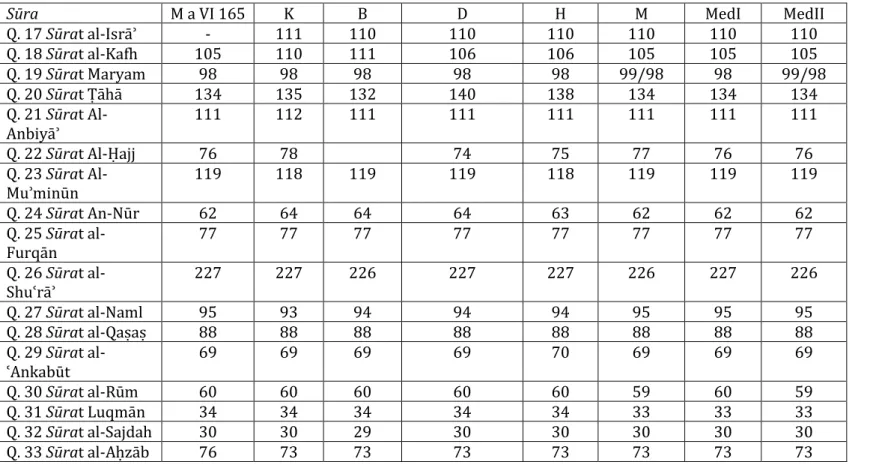
The codex Tübingen M a VI 165 contains all or parts of the twenty sūras between sūrat al-Isrāʾ (Q. 17) and sūrat Yāsīn (Q. 36). In all instances where the beginning of a sūra is present, there is a gap of at least the major part of a line, if not a whole line or more, which includes the title and number of verses of the following sūra. This line has been written out in naskh, in a different, presumably later, hand than the main text, and in black ink rather than brown. This numbering accords consistently with that of the first among the Medinans as described in the traditional sources42. The following table compares the general verse numbering at the beginning of each sūra with standard numberings. 'K' stands for Kufa, 'B' for Basra, 'D' for Damascus, 'H'
39 Franşios Déroche, Qur'ans of the Umayyads: A Preliminary Overview, Leiden Studies in Islam and Society, Brill: Leiden and Boston 2014, vol. 1, p. 77-8.
40 Ibid 99.
41 Ibid.
I have primarily relied on al-Bannā's Itḥāf.
for Ḥims, 'M' for Mecca, 'MedI' for early Medinan and MedII for the late Medinan system.)
70 Humera & Sitti
Table 2 Overall verse numbering of sūras included in M IV 165
Sūra M a VI 165 K B D H M MedI MedII
Q. 17 Sūrat al-Isrāʾ - 111 110 110 110 110 110 110
Q. 18 Sūrat al-Kafh 105 110 111 106 106 105 105 105
Q. 19 Sūrat Maryam 98 98 98 98 98 99/98 98 99/98
Q. 20 Sūrat Ṭāhā 134 135 132 140 138 134 134 134
Q. 21 Sūrat Al-
Anbiyāʾ 111 112 111 111 111 111 111 111
Q. 22 Sūrat Al-Ḥajj 76 78 74 75 77 76 76
Q. 23 Sūrat Al- Muʾminūn
119 118 119 119 118 119 119 119
Q. 24 Sūrat An-Nūr 62 64 64 64 63 62 62 62
Q. 25 Sūrat al-
Furqān 77 77 77 77 77 77 77 77
Q. 26 Sūrat al- Shuʿrāʾ
227 227 226 227 227 226 227 226
Q. 27 Sūrat al-Naml 95 93 94 94 94 95 95 95
Q. 28 Sūrat al-Qaṣaṣ 88 88 88 88 88 88 88 88
Q. 29 Sūrat al-
ʿAnkabūt 69 69 69 69 70 69 69 69
Q. 30 Sūrat al-Rūm 60 60 60 60 60 59 60 59
Q. 31 Sūrat Luqmān 34 34 34 34 34 33 33 33
Q. 32 Sūrat al-Sajdah 30 30 29 30 30 30 30 30
Q. 33 Sūrat al-Aḥzāb 76 73 73 73 73 73 73 73
Q. 34 Sūrat Saba̕ 54 54 54 55 54 54 54 54
Q. 35 Sūrat Fāṭir 45 47 47 46 44 45 45 46
Q. 36 Sūrat Yāsīn 82 83 82 82 82 82 82 82
72 Humera & Sitti
From this table it can be seen that the only system that mostly matches the description provided in traditional sources in a consistent way is that of the first Medinian codex. There are two exceptions; the number of verses of Q. 31, which does not match Hijazi codices, and Q. 33, which seems to be a typist error by scriber, since the number 76 does not match any of the seven well known standards, which are all unanimous to regard it 73 āyāt only. By reviewing signs set for ten-verse clusters, the surā can only be 73. The reason for counting Q. 31 as 34 verses instead of 33 is the verse 31, where the oval dashes marking the end of verses is set after lahud'dīn instead of kafūr, thus being consistent with Damascene and Baṣran codices as described by traditional Arabic sources.
The ending of each verse is usually marked by 2 or 3 oval dots of the same size and color as those used to differentiate consonants. Those dots mark the ending of basmala without counting it a verse of each sūra. Groups of ten verses are usually marked by unsophisticated circle in red ink surrounded by five or six dots. I am going to use those marks to ascertain their consistency with overall verse-numbering announced at the beginning of each sūra.
1. Sūrat al-Isrāʾ (Q. 17:35-111; ff. 1r-5r)
Since the first part is missing from Ma VI 165, there is no overall verse- numbering provided for this sūra. The only disputable verse ending is Q.
17:107 (f. 4v. 15), where Kūfan system ends the verse by sujjadan while others end it by l-amafʿūlan. The parchment is consistent with all codices except the Kūfan. This conclusion is further confirmed by red circles marking ten verse clusters, which were added after ʿaẓīman (Q. 17: 40;1r, 10) ḥadīdan (Q. 17:50; f. 1v, 7), kabīran (Q. 17:60; f. 2r, 13)43, tafḍīlan (Q. 17:70; f. 2v, 18), naṣīran (Q. 17:80; f. 3r, 18), yanbūʿan (Q. 17:90; f. 3v, 16), qatūran (Q. 17:100;
The red dots are obliterated but the black circle remains.
f. 4v, 1); sabīlan (Q. 17: 109; f. 5r, 1). We can easily conclude that the parchment's numbering of sūrat al-Isrāʾ is at least consistent with the three Hijazi systems including the first Medinan.
2. Sūrat al-Kahf (Q. 18; ff. fr-11r)
At the beginning there are two dark black lines; one extending from the end of Sūrat al-Isrāʾ to next line telling the name of the sūra and its total number of verses. It is repeated twice in the same form of script and color.
We are told that this sūra contains 105 āyāt, i.e. it is compatible to Hijazi systems including early and late Medinan in addition to the Meccan. It is held to be 106, 110 and 111 according to the Damascene, Kūfan and Baṣran codices respectively. There are 11 disputed verse endings in this sūra. They are summarized as follows: 44
a. Wa- zidnāhum hudan (Q. 18:13; f. 5v, 7) is marked as an āya although by three dots set under the yāʾ without there being a suitable gap and set as a triangle, thus being consistent with Hijazi, Baṣran and Kūfan codices45.
b. Illā qalīlan (qalīlun) (Q. 18:18; f. 6v, 5) has a gap but does not show a mark due to a later addition of two red dots. If we presume it is the end of an āya which cannot be ascertained, it could be consistent with the early Medinian verse-numbering. Otherwise, it is compatible to Kūfan, Baṣran, Damascene, Ḥimṣī, Meccan and late Medinan only. By reference to ten verse cluster, we found out it is added after ghadan (Q. 18:23; 6v,7) which confirms that Q. 18:18 (f.
6v, 5) is counted as a verse and thus is compatible with the early Medinan codex.
44 Our default numbering is the Kūfan system, even though it is often not relevant to
our present manuscript.
45 Al-Bannāʾ, Itḥāf, p. 363.
74 Mohammad Said
c. Ghadan (Q. 18: 23; 6v, 7) is counted a verse according to the manuscript, thus making it consistent with all codices except the late Medinan46.
d. Zarʿan (Q. 18: 32; 7r, 14) does not have a gap but two vertical dots marking the verse ending exist. It is, thus, compatible with the late Median, Iraqi and Damascene codices47. This is compatible with the red ten verse cluster which was added after zalaqn (Q. 18:40; f. 7r, 8); i.e. after 8 verses from (Q. 18: 32; 7r, 14).
e. Min kulli shayʾin sababan (Q. 18: 84; 9v, 19) does not have a gap but is distinguished by three vertical dots marking its ending and therefore complies with the late Medinan, Iraqi and Damascene muṣḥafs48. The dashes were added vertically as if they were inserted in an inappropriate place, but it is, however consistent with the red dots marking ten verse clusters.
f. An-tabīda hadhihi abdan (Q. 18: 35; f. 7r, 19) is marked by a gap where triangle shaped three dots are drawn, thus agreeing with early Medinan, Meccan and Iraqi codices.
g. Wa-wajada ʿidndaha qawman (Q. 18: 86; f. 10r, 3) is counted as a verse according to the manuscript, early Medinan, Meccan, Baṣran and Damascene codices, and thus conflicts with the ten verse cluster which was added after sitran (Q. 18: 90; 19r, 10). I think the mark for ten verse cluster appear as an end for a verse before (Q. 18:89;
9r. 8) but it is not endorsed with a red circle. It means that the ten verse cluster was added two times; one in the form of a circle surrounded by dots all in brown ink very similar to that of the original text and later in the form of a big oval dot in red. This
46 Ibid.
47 Ibid.
Ibid.
explains occasional contradiction we observed between those red dots and detailed verse numbering of disputable verses. Earlier ten- verse marks go by the early Medinan system.
h. Fa-ʾatbaʿa sababan (Q. 18: 85; f. 10r, 1), thumm atbaʿa sababan (Q.
18: 89; f. 10r 6,7 and Q. 18:92; f. 10r, 10) are counted as full verses according to the manuscript, Kūfan and Baṣran codices. It is consistent with ten verse clusters.
j. hal nunabbiʾukum bi-al-akhsarīna aʿmālan (Q. 18: 103 f. 10v, 12) marks the end of a verse according to the manuscript, Baṣran, Kūfan and Damascene codices in contrast with the early and late Medinan and the Meccan. By reviewing detailed verse numbering it became evident that it does not go consistent with any system which means that it was an individual attempt to mark the endings of verses without reference to any original. Red ten verse clusters follow the Kūfan system in all of its 10 instances. Therefore, a perusal of detailed disputable verses of surat al-Kahf reveals that 6 cases out of 9 are compatible with the early Medinan codex, two are not consistent and one is inconsistent with all six standards. This raise a question on the date of adding those dots marking verses. Most probably those dots were added at a later stage after writing the whole parchment. The common line of all those 9 instances is that they are 100% compatible with Iraqi codices. It means that they were added according to Kufan and Basran numbering systems.
3. Sūrat Maryam (Q. 19; ff. 11r-15r)
There is a space of two lines filled with Islamic decorations in red ink of the same color of the dots filling the parchment. It seems that this decoration was added by a later hand. There is scriptio superior in black naskh showing the name of the sūra and the number of its verses being written twice on two
76 Mohammad Said
consecutive lines. The overall verse-numbering shows that it is 98 verses, which complies with MdI, K, B and D49 and differs with MII and the Meccan.
Muslim sources trace three disputable āyāt as follows; 1) Ibrāhīm (Q. 19:41;
f. 12v, 12) which is marked as the end of a verse according to MdII and Meccan codices while it is not the end of a verse according to the rest of codices and M VI 165, 2) maddan (Q. 19: 75; f. 14r, 13) which is the end of a verse according to M VI 165 and all standards except the Kūfan, 3) The first part of the sūra; kāf hā yā ̔ayyin ṣād (Q. 19: 1; f. 11, 11) which is not regarded as a verse by all standards except the Kūfan. M VI 165, however, complies with the majority. Therefore, a perusal of the three disputable cases of sūrat Maryam in traditional Muslim sources, the parchment complies with the detailed verse-numbering of the first Medinan and the Basran codices.
4. Sūrat Ṭāhā (Q. 20; ff. 15r-19v)
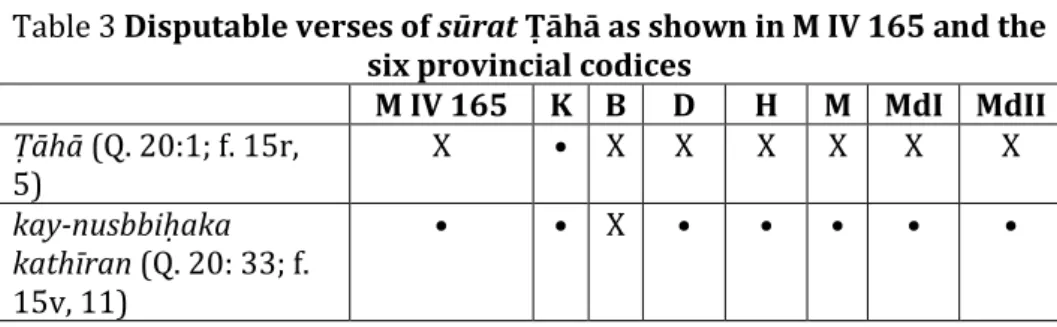
According to the overall verse-numbering provided at the beginning of the sūra, it states that it is 134, exactly like the Hijazi codices. The Kūfan is 135, the Basran is 132, the Damascene is 140 while the Ḥimṣī is 138. The disputable āyāt are 23. The X sign means that the phrase does not mark the end of an āya according to the designated standard while the dot means it is counted as a verse. Adding two signs means that there is a doubt or the sign is not visible at the parchment.
Table 3 Disputable verses of sūrat Ṭāhā as shown in M IV 165 and the six provincial codices
M IV 165 K B D H M MdI MdII Ṭāhā (Q. 20:1; f. 15r,
5) X • X X X X X X
kay-nusbbiḥaka kathīran (Q. 20: 33; f.
15v, 11)
• • X • • • • •
Al-Bannāʾ, Itḥāf, p. 375.
Wa-nadhkuraka kathīran (Q. 20: 34; f.
15v, 11)
• • X • • • • •
Fī-al-yammi (Q. 20: 39;
16r, 15)
X X X X • X X X
Wa- alqaytu ʻalyka maḥabatan minnī (Q.
20:39; f. 15v, 17)
• X X • • • • •
Kay taqrra ʿaynuha wa-la-taḥzan (Q. 20:
40; f. 16r, 1)
X X X • X X X X
Wa-fatannaka futūnan (Q. 20: 40; f. 15v, 18)
• X • • • X X X
Fī ahli madyana (Q.
20: 40; 16r, 2) X X X • • X X X
Fa-arsil maʿī banī Isrāʾīl (Q. 20: 47; f. 16r, 8)
X X X • • X X X
Wa-laqd awḥayna ila mūsa (Q. 20: 77; f. 17r, 14)
X X X • • X X X
Wa-aṣṭanaʿtuka li- nafsī (Q. 20: 41; f. 16r, 3)
• • X • • X X X
Mina al- yammi mā- ghashiyahumu (Q. 20:
78; f.17r, 17)
X/• • X X X X X X
ghaḍbana asifan (Q.20:86; f. 17v, 9)
• X X X X • • X
Waʿdan ḥasanan (Q.
20:86; 17v, 9) X X X • • X X •
Fa-kadhālika alqa as- sāmirīyu (Q. 20:87; f.
17v, 13)
•/X • • X/• X • • X
Wa-ilāhu mūsa (Q. 20:
88; 17v, 15) • X X X X • • X
Fanasī (Q. 20:88; 17v l.16)
• • • • • X X •
Alla yarjiʿu ilayhim qawalan (Q. 20: 89;
17v, 17)
• X X X X X X •
ṣafṣafa (Q. 20: 106;
18v l.3) X • • • • X X X
78 Mohammad Said Idh raʾytahum ḍallū (Q. 20: 92; 18r, 3)
X • X X X X X X
Fa-ʾimmā
yaʾtiaynnakum minnī hudan (Q. 20: 123;
19r, 9)
• X • • X • • •
maʿīshatan ḍankan (Q.
20: 124; 19r, 11) • X X X •/X X X X
Zahrata al-ḥayāta ad- dunyā (Q. 20: 131;
19v, 5)
• X • • X • • •
By comparing the parchment detailed verse numbering with the early Medinan system, we could reach the conclusion that out of 23 disputable cases, 16 are consistent with the earlier Medinan codex, 5 are inconsistent and 3 are invisible. Let us compare these results with ten verse cluster. The first cluster mark is set after yā-mūsā (Q. 20:11; f. 15r, 14) and the second after al-ūlā (Q. 20:21; f. 15v, 5). They confirm consistency of numbering with all systems except the Kūfan, which regularly counts disjoined letters at the beginning of sūras an āya. The mark for thirty is added after fī-amrī (Q. 20:32;
f. 15, 11). It is, however, inconsistent with all systems. The mark for forty is added after futūnan (Q. 20:40; f. 16r, 1), which confirms that Q. 20: 33 (f. 15v, 11), Q. 20: 34 (f. 15v, 11), Q. 20: 39 (f. 15v l. 17) and Q. 20: 40 (f. 16r, 1) are all counted as full verses. The fifth is presumed to be drawn at the end of the page, but there is a lacuna which makes it missing, yet there is no disputable āya in this part. The parchment shows a red mark after suwan (Q. 20:58; f.
16v, 4) which seems an error from the transcriber who set the number of three verses improperly. Moreover, there is no dispute at all among all standards from Q.20:58 to Q. 20: 58. The seventh mark is added after al-ʾaʿlā (Q. 20:68; f. 16v, 17) and the mark for eighty stands after wa-mā hadā (Q. 20:
79; f. 17r, 18) which confirms that Q. 20: 78 (f. 17r, 17) is counted a verse.
The ninth mark is added after fanasiya (Q. 20: 86; f. 17v, 9). It is consistent with the detailed numbering which counts Q. 20: 86 (f. 17v, 9) as a verse. The
tenth mark stands after nasfan (Q. 20: 97; f. 18r, 11), and therefore, considers Q. 20: 92 (18r, 3) as an āyā, though it does not have dots at the parchment.
The 100-verse cluster is added after wa-lā-amtān (Q. 20: 107, f. 18v, 4) and thus Q. 20: 106 (18v l.3) must be counted as a full verse, though no trace of a mark is shown in the parchment. The 110 mark is added after fa-tashqā (Q.
20:117; 19r, 2) without showing any discrepancy with detailed numbering of those ten verses. The 120 cluster is tunsā (Q. 20:126; f. 19r, 14) and thus (Q. 20: 123; 19r, 9) is regarded a verse as the detailed verse numbering confirms. The 130 cluster is added at the last word of the sūra; ihtadā (Q.
20:135; f. 19v, 13). It means that Q. 20: 131 (19v, 5) is counted as a verse.
The sūra, according to these ten-verse marks is only 130 verses. It emphasizes the existence of an error in setting ten-verse clusters as mentioned earlier. The missing gap is 3 āyāt from (Q. 20:56; f. 16v, 1) to (Q.
20: 58; f. 16v, 4). We can safely conclude that the overall, detailed and ten- verse marks do not accord with one consistent system as described in Muslim traditional sources. This confirms our preliminary supposition that overall, detailed and ten-verse numberings were all later additions, which were gradually and independently attached to the text.
5. Sūrat Al-Anbiyāʾ Q. 21; ff. 19v -24r)
At the beginning of this sūra, we are told that it contains 111 ayāt (f. 19v, 17), which is the numbering of all systems except the Kūfan (see Table 2 above). It has only one disputable āya' (Q. 21:66; f. 22, 11); mā lā yanfaʻukum shay̕an wa lā yaḍḍurukum, which is not the end of an āya according to all systems except the Kūfan. The parchment is consistent with the first Medinan codex50 even by reviewing the ten-verse marks which is added after lil ʻālāmīn (Q. 21: 71; f. 22r, 16) which is the 7th āya according to the Kūfan codex.
50 Al-Bannāʾ, Itḥāf, p. 313.
80 Mohammad Said
6. Sūrat Al-Ḥajj (Q. 22; ff. 24r -29r)
At the beginning of this sūra the overall verse numbering tells us it is 76 verses51. It is consistent with the first and second Medinian codices but does not comply with the Meccan (77), Ḥimṣī (75); Baṣran (75), Damascene (74) and Kūfan (78). Disputable āyāt are five. They are included at the following table:
Table 4 Disputable verses of sūrat al-Anbyāʾ as shown in M IV 165 and the Six Provincial Codices
M IV 165
K B D H M MdI MdII Yuṣabbu min fawqi ru̕usimu
al-ḥamīm (Q. 22: 19; f. 25v, 3)
X/• • • X X X X X
Yuṣharu bi hī mā fī buṭūnim wa al-julūd (Q. 22:20; f. 25v, 4)
X/• • X X X X X X
Wa ʻādun wa thamūd (Q. 22:
42; 27 r, 1)
•/X • • X X • • •
Wa qawmu lūṭ (Q. 22: 43; 27
r, 2) •/X • X X X • • •
Huwa sammakum al-
muslimīna min qal (Q. 22: 78;
f. 29r, 3)
• X X X X • X X
By reviewing ten verse marks it is evident that Q. 22: 19 and 20 are not counted as verses in M IV 165 since the mark for twenty is added after wa dhūkū ʻadhāba l ḥarīq. (Q. 22:22; f. 25v, 6). It keeps this numbering for the mark indicating thirty verses which is added after min taqwa al-qulūb (Q.
22:23; f. 26r, 12). The parchment is thus consistent with Hijazi a