INTRODUCTION
INTERPRETATION OF REQUIREMENTS
GUIDELINES TO THE CRITERIA
Organisation and Resources
The teaching staff must be sufficient in number and capacity to ensure the quality of the ICT programs and the achievement of their stated outcomes. There should be adequate arrangements for the supervision and guidance of both regular and sessional staff. There must be sufficient numbers of qualified and experienced technical and administrative staff to provide adequate support to the educational programmes.
Program Design and Content
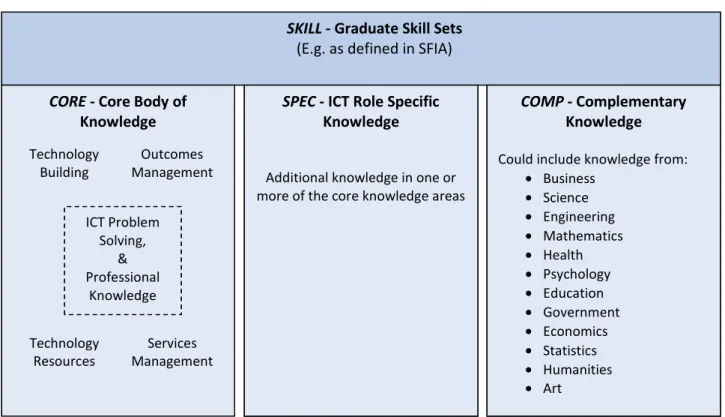
4see Appendix 7, Section 1 for an extract of the relevant section from the ICT Profession Body of Knowledge. The program should provide adequate coverage of the Core Body of Knowledge (CBOK), and is further explained in Section 3.2.4 below. Note that the extent to which some aspects of CBK are covered depends on the context, as shown in the ICT Profession Body of Knowledge (September 2013) (See Annex 7: Extract from the ICT Profession Body of Knowledge).
Quality Assurance
There should be evidence of the systematic use of feedback along with other quantitative measures to determine, monitor and audit outcomes at the program and academic unit level. Direct involvement of the students as partners in the processes for ongoing quality improvement is strongly encouraged. Systematic review processes should include all staff involved in the delivery of the program (including those involved in the delivery of programs at regional and offshore campuses and by partners), and involve ongoing input from external constituencies as well as feedback and input. from the student body.
At the unit level, the learning design process should continue by developing the appropriate learning activities and the formative and summative assessment approaches that monitor and measure the delivery of the learning outcomes. A mapping of the learning outcomes from individual study units to the targeted graduate competencies for the program as a whole should be a primary reference tool arising from this. Subsequently, tracking this aggregation of learning outcomes and assessment measures from individual units to close the loop on the delivery of graduate capabilities at the program level is a key component of the ongoing review and improvement process.
Again, the educational design, review, and ongoing quality process must include all program teaching staff through regular interactions, and involve the ongoing input and feedback of the student body. The overall aim of the learning design process is to ensure that the curriculum as a whole addresses the educational outcomes set for the program in a substantial, coherent and explicit manner. The development of assessment and performance monitoring systems should be an integral part of the overall educational design process for any particular program.
Accreditation of the program requires that the program be accredited at all locations and in each form of delivery.
INTRODUCING NEW PROGRAMS
New Program Implementation on the Home Campus
For a new program in a well-established school of good standing, provisional accreditation of a new program can sometimes be given based on a desk assessment of the submitted documentation. In most circumstances, the Accreditation Committee will require a Panel Visit to consider a new program for provisional accreditation. This will normally take place in the first year of operation, where a significant group of students is enrolled.
The Accreditation Committee has the authority to determine whether a visit is required and when provisional accreditation is appropriate. Key considerations for the transition to full accreditation will be the school's documented response to recommendations made in the report of the interim accreditation evaluation panel and the quality of assessed student work in the final academic years of the program. Assessment can be carried out as early as during the last semester of study of the first graduating cohort, provided that sufficient access can be given to representative examples of assessed last year's student work, and also to a representative group of graduating students.
Full accreditation should be sought at the latest at the next scheduled general assessment following the emergence of the first graduates. If full accreditation is being considered between general audit visits and the school is in good standing, a visit from one senior panel member (or the relevant Visit Manager acting on behalf of the panel) may be sufficient to recommend full accreditation.
New Program Implementation for a Regional or Offshore Campus
Where a new regional campus or foreign operation is first established and provisional accreditation is to be considered for the first program offerings, then the submitted. The submitted documentation in this case will have to respond to all aspects of the accreditation criteria, with particular attention to the sections dealing with the quality systems and the operating environment. It is critical that the submission analyzes all aspects of the development, delivery and management of the program and in particular the distinguishing features associated with the new operating environment.
PROGRAM AMENDMENT
POLICY ON DISTANCE EDUCATION
The bandwidth, performance and accessibility of electronic communication systems must be sufficient to ensure the quality and effectiveness of learning support. Academic staff must be committed, equipped and adequately trained to support the distance learning mode. There should be an overarching quality system that includes distance learning and involves the students as a key stakeholder in the process.
POLICY ON TWINNING AND OFFSHORE CAMPUSES
If more than one year of the program is not completed overseas (or at another Australian institution), they rely heavily on the second and third years of the institution. The accreditation policy should still require the institution to explain what mechanisms are in place to ensure quality in the overseas component (and/or other Australian institution) and that the required ACS outcomes are achieved. If the Australian institution can confirm that the first two years of the overseas program substantially follow the Australian curriculum, if there are significant formal examinations that are set and marked jointly between the Australian and overseas programs, if other forms of assessment can be demonstrated to be substantially identical and if if all these aspects are part of a formal twinning agreement, then there will usually not be a need to visit an overseas institution.
In all cases the Company will receive the documentation from the Institution and organize an accreditation visit to the offshore location according to normal procedures. It is particularly important that the documentation is obtained well in advance of the proposed visit so that any apparent difficulties can be identified in advance of the visit. The institution concerned will be expected to reimburse the Society for all costs associated with an offshore accreditation visit.
The institution will be kept fully informed of such negotiations and be involved to the maximum extent appropriate. In all cases, the onus rests on the institution awarding the degree to demonstrate that the accreditation criteria are met. The Committee is interested in learning more about the structure and operation of the partnership campuses of the Institution.
In general, the Board will want to be satisfied that the campus offers educational experiences, facilities and standards comparable to those of the Institution's home campus, and that quality assurance mechanisms are in place to ensure that the Institution maintains control over the educational program.
POLICY ON CAPSTONE UNITS
Grades should be based on authentic project artifacts students have developed over a period of time, and generally not on tests and exams. The Capstone unit must be of significant size, with student effort at least equivalent to 25% of a full-time semester load. Projects in Capstone Units that require additional effort or span multiple semesters are strongly encouraged, but not required.
POLICY ON AN INTRODUCTION TO PROFESSIONAL PRACTICE
POLICY ON ADVANCED STUDY UNITS
Note that the unit offered in the third year of a program is not sufficient to identify it as advanced; on the other hand, some units taught in the second half of second year may qualify as advanced in exceptional circumstances.
POLICY ON COMPLEX COMPUTING
Extract from ICT Profession Body of Knowledge
Building Blocks for ICT Programs of Study
Core knowledge areas were identified by the Professional Standards Board through workshops and an analysis of the content overlap in international curriculum documents for information systems, computer science, software engineering, information technology and computer engineering (IS2002, CS 2001, SE 2004, IT 2005, CE2004). See Appendix A for a more in-depth discussion of the methodology and data used in this analysis. They only include those areas where there is broad agreement that some knowledge of the material is essential for any ICT professional.
However, the definitions of the subject area as understood by the different ICT disciplines should be followed by the relevant curriculum (see Appendix B). It is important to recognize this field because it encompasses some of the creativity and innovation that is required of computer professionals and the excitement that is present in their jobs. Other authorities have provided in-depth treatment of this issue and this paper should be read against this background.
This includes an understanding of the basic constructs of a programming language, the behavior of simple programs, the analysis of efficiency and effectiveness. All phases of the life cycle of an information system must be understood including: requirements analysis (systems analysis) and. There are many frameworks to guide the management of ICT services, eg the Information Technology Infrastructure Library (ITIL) and Control Objectives for Information and Related Technology (CobiT).
This area includes an understanding of the factors necessary to successfully manage systems development projects. This would typically be at an advanced level that is beyond the simple data storage and retrieval requirement defined in the CBOK. Use assessments that demonstrate knowledge at the Application Level (Level 3) or higher in Bloom's Taxonomy; however, they should also require elements of analysis, evaluation and synthesis (levels 4, 5 and 6) of the taxonomy.