In the New York Times article, Bennett expressed concern that financial aid has the unintended consequence of enabling higher education institutions to raise tuition. Currently, there are discussions on Capitol Hill about the reauthorization of the Higher Education Act, which could potentially change the landscape of higher education and financial aid. To understand the relationship between financial aid and the cost of higher education, I begin in Chapter I with a discussion of the benefits and consequences of a post-secondary degree.
In Chapter III, through a collection of data and literature review, I evaluate the drivers behind the rising costs and review what is currently known about the causal relationship between financial aid and tuition.
IS HIGHER EDUCATION WORTH IT?
Trends in College Enrollment
In the case of education, since students are taught by individuals with high academic credentials, universities are forced to increase their compensation due to increased opportunity costs and consequently increase the prices charged to students. After the recession, as the SREB Commission on College Affordability in the South concluded, "the responsibility to pay for college has clearly shifted to students and families and away from the state." (Southern Regional Education Board, 2016). The Commission on College Affordability in the South defines affordability as "the relationship of the price required to attend higher education—or the net price—to family income." Thus, according to
Current eligibility for MTAG—the state's largest financial aid program—is one of the factors that contribute to the income distribution of financial aid awards. Retrieved form: https://studentaid.ed.gov/sa/repay-loans/understand/plans/income-driven. 2016) Price Discrimination and Public Policy in the United States The Philosophy and Objectives of the National Defense. 2002). The Texas challenge in the 21st century: Implications of population change for the future of Texas.
The Returns of Higher Education
Consequences of Student Debt
OVERVIEW OF FEDERAL FINANCIAL AID
History of Financial Aid
The Office of Financial Aid determines individual student eligibility and the amount that can be borrowed based on the student's Free Application for Federal Student Aid (FAFSA). A common explanation for the rise in tuition among economists is the "cost disease," the theory proposed by William Baumol that explains why prices in some industries are what they are. Federal student aid policies do not cause college price inflation, but there is little doubt that they help make it possible.” The phenomenon is widely known as the Bennett Hypothesis and has been debated for the past 30 years.
Tuition is just one of the ways higher education institutions can capture the increase in federal aid. In her paper "The Impact of Federal Tax Credits for Higher Education Expenses" (2004), she argues that, in response to federal tax credit programs, states have reduced their allocations and increased their prices, undermining the policy's purpose. Figure 15, taken from National Association of State Student Grant and Aid Programs, compares state financial aid programs in the South.
In the first model, I regressed federal financial aid on the log of in-state and out-of-state tuition in the second model. They suggest that the lack of correlation between out-of-state tuition and financial aid can be attributed to reasons for the increase in out-of-state enrollment. In this case, it is possible that reverse causation is involved: financial aid may increase in response to an increase in the price of higher education.
The findings of Lucca et. 2012) present some evidence in support of the Bennett hypothesis, indicating that financial aid policies partially contribute to the rise in the cost of education and rising student loan balances. In the final chapter, I conducted the empirical analysis of federal and state financial assistance programs in the state of Mississippi.
The Structure of Financial Aid
Trends in Financial Aid
WHY EDUCATION IS SO EXPENSIVE
- Trends in Tuition and Fees
- Drivers of Rising Cost
- Price Discrimination
- Financial Aid and College Tuition
In this chapter, after detailing the trends in tuition and fees, I discuss the research literature on the drivers of the rising cost of education with special attention to the effectiveness of financial aid programs and the relationship between financial aid and tuition. Baumol points out that increases in productivity are not possible in several sectors of the economy, including performing arts and education. Based on the analysis of spending at public research universities from 1987 to 2008, economist Robert Martin and Carter Hill estimated that the cost disease explained only sixteen percent of the total increase in higher education spending (Martin and Hill, 2014).
In the context of higher education, the students do not compare the offered financial package with the average net price (the information available online but not widely advertised by the universities), but with the quoted price, and may therefore overestimate the value . of the education. Institutions that would likely offer higher financial aid to the student and result in a lower net price than the net price of the less selective institutions the student ultimately attends. The authors of Market Power and Price Discrimination in the US Higher Education Market conducted an empirical analysis to determine the extent of the effect price discrimination has on private university tuition (Epple et.al., 2019).
The one standard deviation increase in the student's academic performance reduces tuition by an average of $920 to $1960. In the New York Times article (1987), entitled "Our Greedy Universities," he pointed out that "in 1978, grants became greatly expanded to the number of students. The relationship between tuition and demand for higher education is complex, and decades of research on The Bennett hypothesis has produced polemical results.
Private institutions are able to capture the majority of the increase in Pell Grants because of their selectivity and significant market power. The majority of public funds for these programs are distributed among middle and upper middle income families. Economist Robert Kelchen (2017) expanded the discussion among higher education economists by studying the effects of the increase in limits for Grad PLUS loans on law school costs.
The study found a negligible increase of one to two percent in tuition due to the availability of loans.

EVIDENCE FROM MISSISSIPPI
Financial Aid in Mississippi
To meet the demand for an educated workforce, states create financial aid programs aimed at increasing affordability for its residents and graduation rates among high school graduates. Similar to national trends, post-Great Recession state appropriations increased significantly in Southern states, as shown in Figure 13, taken from the Higher Education Policy Institute (2014). Figure 14 shows the percentage of family income needed to cover the net cost of education in southern states.
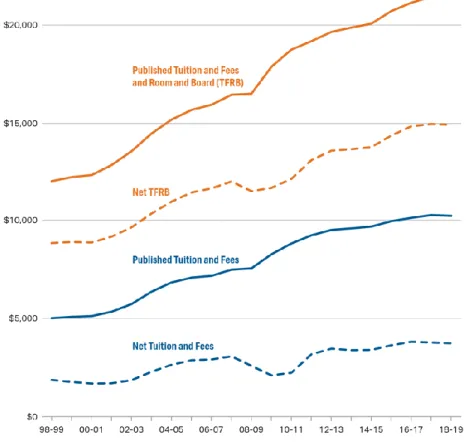
The net price is calculated by subtracting federal and state financial aid from published tuition and fees. 500 per academic year in the first and second year of undergraduate degree and $1,000 in years three and four. Source: Institute of Higher Learning, Postsecondary Education Financial Assistance Board and Mississippi Office of Student Financial Aid “2017 Annual Report of the State-Supported Student Financial Aid Programs”.
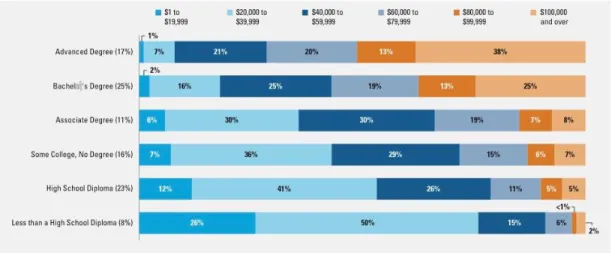
According to the 2017 report from the Mississippi Office of Student Financial Aid, the total amount awarded to students was $38 million, more than half of which went to students without financial aid. Figure 16, taken from the annual report of the Mississippi Office of Financial Aid, shows the distribution of financial aid recipient income, 18 percent of receipts come from families with household incomes of less than $30,000. In the state that has one of the lowest median incomes, the effort of state financial aid programs should be focused on making education more affordable for students who would otherwise not be able to attend postsecondary institutions.
In an interview with Mississippi Today, Senator David Blount, D-Hinds, emphasized the demand for need-based financial aid programs, but also noted that, "In the current budget climate, I don't think you will see any dramatic increase in funding. The Office of Financial Aid proposed removing this restriction, but was rejected by the Mississippi Senate and House, citing the policy analysis that determined the policy change would cost the state $28 million annually (Allin, 2015).

Empirical Part
- Data
- Model Specifications
- Results
- Limitations of Findings
This study aims to test the Bennet hypothesis and examine the relationship between federal financial aid and education in the state of Mississippi. The Integrated Postsecondary Education Data System (IPEDS), Title IV and the Mississippi Office of Student Financial Aid. IPEADS is the most comprehensive data set on higher education, including enrollment, intuitive characteristics and resources, admissions, degrees and certificates awarded, student persistence and success, institutional awards, and student financial aid.
State financial aid data were taken from annual reports published by the Mississippi Office of Student Financial Aid. In the case of this study, the correlation between federal aid and tuition may be overestimated due to endogeneity bias in the form of omitted variable bias. The decision to include lagged dependent variables in my model was based on the expectation that institutions would respond to an increase in financial aid in the following academic year, since tuition is set by universities before students receive their financial aid.
In the 2016-17 academic year, 63 percent of Pell Grant recipients had zero expected family contributions (College Board, 2018). In model 3, I regressed the log of state aid on the log of published in-state tuition costs. In an effort to understand the effects of financial aid on tuition, researchers found equivocal evidence due to limitations in data.
The primary variable of interest in determining college affordability is the net price of attending an institution of higher education, but due to price discrimination, students receive financial aid on a case-by-case basis. This paper was largely motivated by my interest in understanding the drivers behind the rising costs of education in the United States. Student Debt: A Current View of Student Loan Borrowing and Repayment in the United States” Nitro College.
Real median household income in the United States [MEHOINUSA672N], obtained from FRED, Federal Reserve Bank of St. https://fred.stlouisfed.org/series/MEHOINUSA672N, 2017.