This research addresses the effects of chemical composition on the visual appearance and texture of glazes. The smoothness of the surface was also favored by the presence of BaO and ZnO in the glaze. The UMF approach normalizes the oxide moles to the sum of the flux moles (R2O and RO) in the glaze.
I NTRODUCTION
Rough glazes are typically used in most white goods applications: sanitary ware, tiles, electrical porcelain and tableware. On the other hand, it is rare to find raw glazes used in a rapid-fire tiling process.7. The ceramic manufacturer will consider the reasons why a fried glaze might be used in their process.
C OMPONENTS OF A G LAZE
U NITY M OLECULAR F ORMULA (UMF) A PPROACH – S EGER F ORMULA
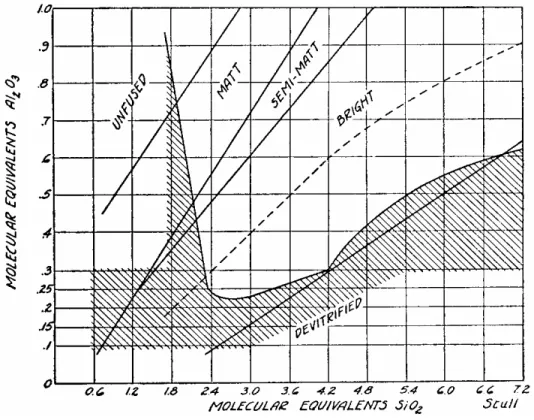
Stull's diagram plots gloss texture as a function of alumina and silica levels (on a molar basis) with a constant flux ratio of 0.3K2O:0.7CaO. Recent work by Carty, et al.10 has shown that the results of a series of KNaO group glazes are consistent with Stull's14 observations. Quinlan13 extended the experimental-glaze composition matrix in the same respect, showing that Stull's diagram is very consistent and reproducible.
T HE F UNCTION OF THE O XIDES IN G LAZES
Vitreous silica has a low CTE, and for this reason its presence in the glaze helps control the fit of the glaze to the body. Alumina (Al2O3) can be added to the glaze batch through materials such as burnt alumina, alumina trihydrate, feldspar, nepheline syenite, ball clay/kaolin and frit.21 Although alumina is used in relatively small amounts in glazes, it contributes greatly to the working properties of the glaze. It reduces the tensile strength and elasticity compared to the effect of the other bases commonly used in glaze formulation.
T RANSPARENT AND O PACIFIED G LAZES
The difference in refractive index between the glaze and the opaquer will give rise to scattering of the incident light at the interface between the glaze and the opaquer particle. Voevodin24 reports that the optimum size of the crystal grains of the opacifier that provides maximum dullness is 0.2-1.0 µm. According to Rayleigh's law, the scattering coefficient for extremely small particles must differ as the fourth power of the particle diameter.2.
O PACIFYING A GENTS
It has been found that a threshold amount of zirconium is required before opacity is observed, and that large amounts are required to achieve sufficient opacity.25 It is not possible to directly replace tin oxide with zirconium in a formulation because zirconium has a higher has solubility. in glazes than the tin oxide. Therefore, larger amounts of zircon are needed to match the opacity of a glaze prepared with tin oxide. When processed in a frit, a coarser grade of zircon can be used than when added as a grinding additive.
CHARACTERIZATION OF VARIOUS COMMERCIAL SANITARYWARE GLAZES
Qualitative Characterization
- X-Ray Diffraction Analysis
- Microstructure
Flat sections of the samples were cut with diamond cutting tools to fit the sample chamber of the X-ray diffractometer. SEM coupled with energy dispersive X-ray spectrometry (EDS) (Evex v 2.0.653, Evex Analytical, Princeton, NJ) was used to generate images and perform qualitative compositional analysis of the glazes. Cross-sections of glazes were analyzed to determine the thickness of the coating and to observe the distribution of possible defects, e.g. bubbles.
Quantitative Characterization
- Gloss Measurements
- Color Measurement
- Surface Roughness
In this study, a commercial gloss meter (Photovolt G-3 Gloss, ASTM 2457, UMM Electronics Inc., Indianapolis, IN) was used to measure the gloss of glazes. The CIELAB• color system is currently used in the white goods industry,32 so it was used in this research to evaluate the color parameters of glazes. The roughness of the fired glaze surfaces was quantified using an optical interferometer (NewView 5032, Zygo Corporation, Middlefield, CT).
EXPERIMENTAL APPROACH
Experimental Matrices
- Transparent Series (Tran Series)
- Opacified Series (Op Series)
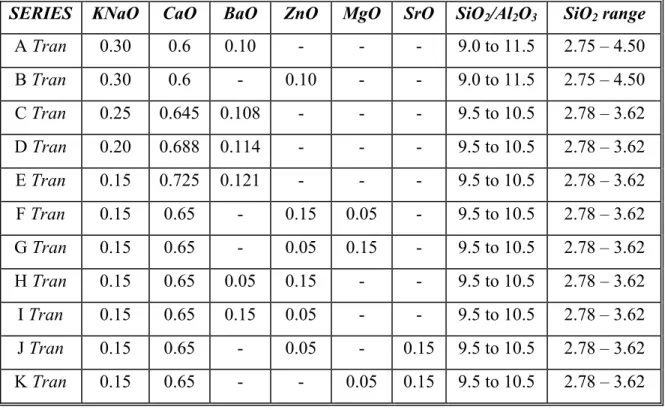
CaO, BaO, ZnO, MgO and SrO were used in various combinations in the glaze as RO oxides. All the oxides mentioned above are typically used in the preparation of a raw composition of sanitary ware glazes, with the exception of SrO; the high price of SrO when compared to similar flux oxides such as BaO makes the presence of SrO atypical in sanitary ware glaze compositions. These values were chosen as a starting point because they are typical of those currently used in the sanitary ware industry.
The SiO2 range under study, in UMF terms, varied from 2.75 to 4.50 molecular equivalents for the A Tran and B Tran series and from 2.78 to 3.62 molecular equivalents for the C Tran to K Tran series. The experimental region in terms of the SiO2/Al2O3 region used in each series is illustrated in Figure 3.3 and Figure 3.4. Selected endpoints were batched on a molar basis and then line blended on a weight basis to obtain intermediate points at 0.5 SiO2/Al2O3 intervals within the respective experimental range.
In Figure 3.3, which corresponds to both series A Tran and B Tran, the glaze compositions lie along the mixing lines A-B, G-H, C-H, I-J and E-F. Note that in both figures the experimental region lies within the clear region boundary predicted by Stull (see Figure 2.1). Also note that the experimental area in Figure 3.4 corresponds to a fraction of the area illustrated in Figure 3.3, due to the fact that preliminary results in series A Tran and B Tran showed a deterioration of the surface quality for SiO2 values . higher than ~3.6 (on UMF basis).
The experimental region in terms of the SiO2/Al2O3 range used in series A Op and B Op, and C Op to K Op (including series F1 Op and H1 Op) corresponds to the same regions used for series A Tran and B Tran, and respectively for series C Tran to K Tran. see Figure 3.3 and Figure 3.4 for illustrations in this regard).
Glaze Characterization
- Quantitative Analysis of Zircon in Opacified Glaze
C OMMERCIAL S ANITARYWARE G LAZES
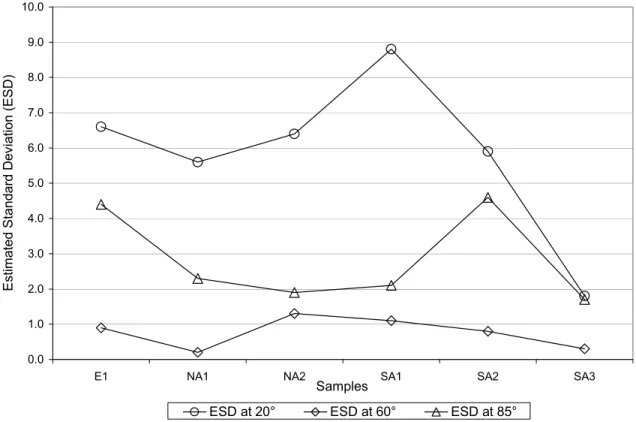
For each location, two readings were taken, the second one after the instrument was rotated 90°; the two readings are averaged, accounting for ten data points for each sample in each of the geometries. It is likely that the particles visible in Figure 4.3 are due to the opacifier used in these glazes. All the tested glazes belong to the alkali-alkaline-earth-aluminosilicate glass composition group.
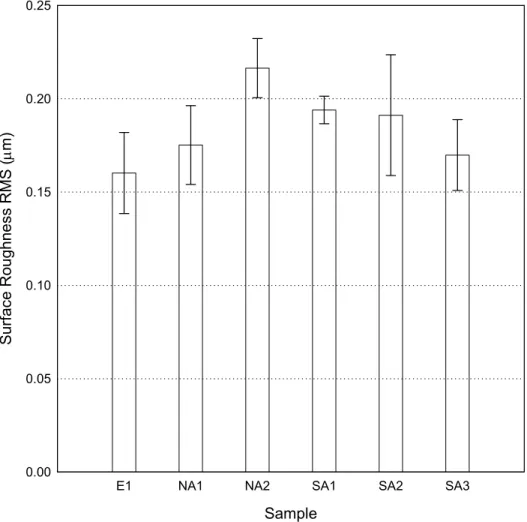
Castilone, et al.25 referred to the aggregation of zircon particles on the glaze surfaces, similar to those observed in Figure 4.3, stating that “It is common to observe the aggregation of zircon particles on the glaze surface... Temperature microscopy other glaze samples have shown that, during the heat treatment process, bubbles migrate to the glaze surface, displace the zircon particles and then burst, leaving a circular object of their passage. Although this aggregation and an apparent disorder in the distribution of zirconium particles on the glaze surface actually occurs on a microscopic scale, the general perception to the human eye is that of continuity in the way light is scattered from the surface. The surface roughness of the different glazes was measured using optical interferometry generating RMS roughness values ranging from μm for sample E1 to μm for sample SA1. The pink color corresponds to the highest point on the surface; blue represents depressions in the glaze.
Qualitative analysis of the surfaces, performed as described above, provided a ranking of the samples according to their visual appearance as reported in Table VI. Sample E1 exhibited a virtually flawless glaze with a smooth surface to the touch, consistent with the fact that the same sample had the lowest surface roughness value in the six-sample series (Table V) and the second highest gloss value ( Figure 4.1 ). However, sample SA3 exhibited the highest gloss and the second lowest surface roughness (see Figure 4.1 and Table V respectively) in the series.
Although there are some differences in the appearance of the glaze results when examined as a whole, these differences are not so extreme, and therefore a general picture of the appearance of the series is summarized in Table VII.
E XPERIMENTAL G LAZES
Development of a Transparent Glaze (Tran Series)
- A and B Transparent Series
- C to E Transparent Series
- F to K Tran Series
- Variables Controlling the Gloss
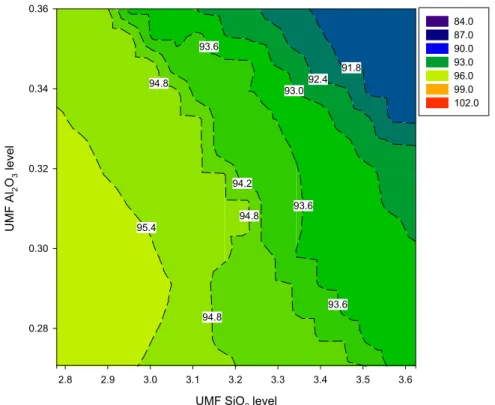
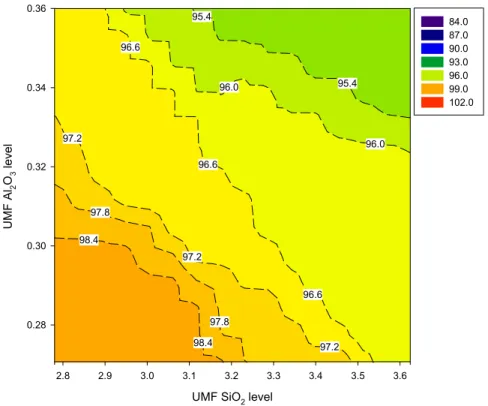
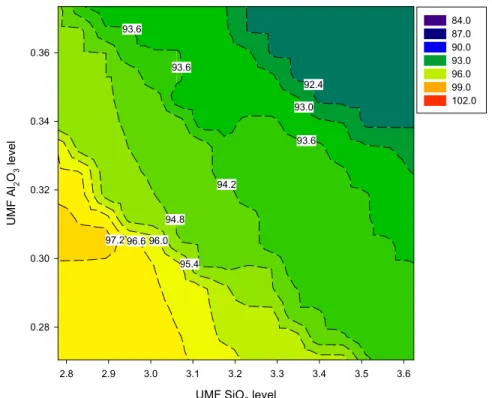
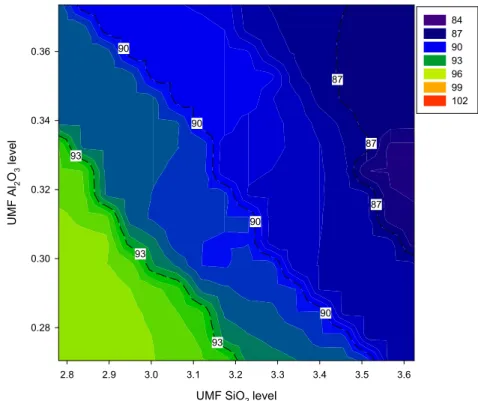
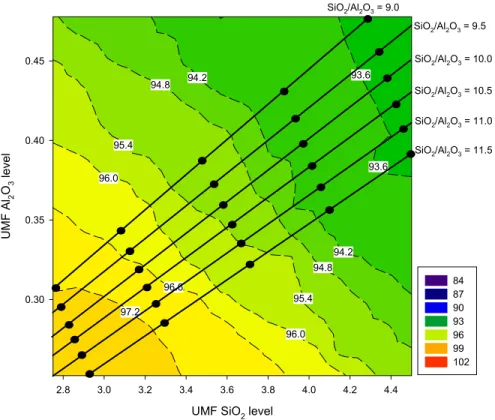
Recalling Figure 3.3, where the test region for glazes belonging to the series A Tran and B Tran is shown, contour plots for the same region based on gloss values of the glazes are depicted in Figure 4.7 and Figure 4.8. As the normalized amount of SiO2 and Al2O3 decreases, the relative amount of the fluxes (R2O and RO oxides) increases. The rest of the glazes of the three series, viz. C, D and E Tran series, showed negligible defects in terms of the presence of pits, pinholes or eggshell-like surface.
21 Since the highest gloss readings were found in the E Tran series where the KNaO level was 0.15 molecular equivalents, this value was chosen as a formulation parameter for the rest of the transparent glaze series in this research. The CaO level was kept at 0.65 molecular equivalents to reduce the CTE of the glaze. The mismatch between glaze and body can again be explained on the basis of the presence of a relatively high amount of BaO (0.15 molecular equivalents), which increases the thermal expansion coefficient of the glaze.
Within the tested SiO2 and Al2O3 levels, the lower the amount of SiO2 for a given SiO2/Al2O3 ratio, the higher the gloss of the glaze surface becomes due to an increase in the relative flux concentration (oxides R2O and RO ). In the case of magnesia, when used at levels higher than ~0.1 molecular equivalents, MgO degrades smoothness and decreases surface gloss. The quality of gloss in a glaze is a function of surface texture and refractive index.
Based on the conclusions of the study of Priven and Mazurin37 and because the Priven method is well known within the glass research community,41 the Priven method was chosen to calculate the refractive index of H Tran and I Tran series glazes.
Development of an Opacified Glaze (Op Series)
- Gloss Measurements
- Whiteness of the Opacified Series
- Effect of the Opacifier on Surface Roughness
- Correlation between Zircon Content, Whiteness, and Surface Roughness in the M Op Series
K 2 O:0.7CaO
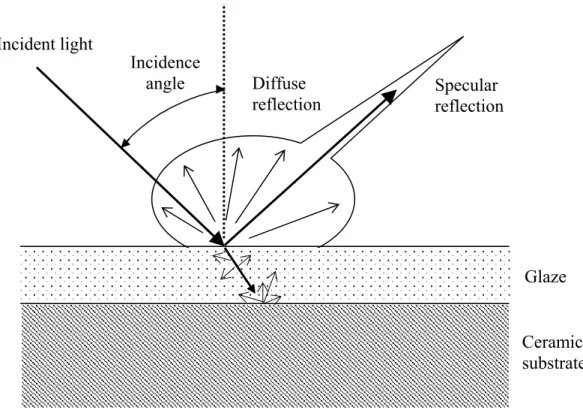
To reduce light scatter and maximize mirror shine, the surface roughness of the glaze must be reduced, leading to a less wavy texture. Because zirconium (added as an opacifier) reduces the CTE of the enamel, only one composition in the J Op series showed crazing due to the presence of SrO; therefore,. It was observed that as the SiO2 level decreases for a given SiO2/Al2O3 ratio, the higher the gloss of the enamel surface becomes.
Increasing the relative concentration of flux (R2O and RO oxides) is believed to decrease melt viscosity, favoring surface smoothing. Unlike many glazes obtained in the transparent series, only one composition within the opaque series containing SrO showed cracking. Glazes with a higher zirconium crystal content are assumed to have a higher surface roughness (RMS) due to the presence of zirconium crystals on the surface.
Castillone et al.25 addressed the issue of the morphology of zircon particles in the enamel as a function of zircon dissolution. Measurements of the whiteness (L*) and surface roughness (RMS) of the glazes were made and plotted in Figure 4.61 through Figure 4.61. This approach seems appropriate because it then displays the SiO2 and Al2O3 levels as a ratio of the fluxes in the glaze.
In the case of magnesium, when used at levels higher than ~0.1 molecular equivalents, it impairs smoothness and reduces surface gloss. Glaze gloss is a function of surface roughness and the refractive index of the glaze.