+ (,1 1/,1( 2
Citation: 155 U. Pa. L. Rev. 1657 2006-2007 Content downloaded/printed from
HeinOnline (http://heinonline.org) Thu Aug 9 13:14:50 2012
-- Your use of this HeinOnline PDF indicates your acceptance of HeinOnline's Terms and Conditions of the license
agreement available at http://heinonline.org/HOL/License -- The search text of this PDF is generated from
uncorrected OCR text.
-- To obtain permission to use this article beyond the scope of your HeinOnline license, please use:
https://www.copyright.com/ccc/basicSearch.do?
&operation=go&searchType=0
&lastSearch=simple&all=on&titleOrStdNo=0041-9907
Retrieved from DiscoverArchive, Vanderbilt University’s Institutional Repository
This work was originally published in 155 U. Pa. L. Rev. 1657 2006-2007
ALLOCATING RESPONSIBILITY FOR THE FAILURE OF GLOBAL WARMING POLICIES
JONI HERSCHt & W. KIP VISCUSI"
INTRODUCTION
A recent series of climate change lawsuits has sought to mimic the
"regulation through litigation" approach of the claims brought by the states against cigarette manufacturers.' What is distinctive about the cigarette cases relative to conventional tort claims is that they were not brought on behalf of individual smokers, but rather sought to recoup the Medicaid-related costs of smoking. A parallel climate change liti- gation approach seeks payments from public utilities, energy produc- ers, and other parties responsible for greenhouse gas emissions to re- flect the long-term societal damages that the plaintiffs claim will be caused by this pollution.
While environmental litigation of this type is unprecedented, the cigarette cases were novel as well. The cigarette litigation did not es- tablish legal precedents because the cases were settled without any court verdicts, but the threat of the suits was sufficiently real that it led to damages payments of close to $250 billion.2 Here we examine the similarities and differences between lawsuits seeking to recoup the value of financial externalities caused by smoking and lawsuits tar- geted at the value of environmental damages due to global warming.
The climate change litigation may not be only about money; it may have a policy purpose as well. Depending on how the damages payments are structured, this litigation may also be viewed as an at-
t Professor of Law and Economics, Vanderbilt University.
t University Distinguished Professor of Law, Economics, and Management, Van- derbilt University.
E.g., Connecticut v. Am. Elec. Power Co., 406 F. Supp. 2d 265, 274 (S.D.N.Y.
2005) (dismissing on justiciability grounds the complaints in a major environmental public nuisance lawsuit). For a general discussion of climate change litigation, see Vin- cent S. Oleszkiewicz & Douglas B. Sanders, The Advent of Climate Change Litigation Against Corporate Defendants, 27 Int'l Env't Rep. (BNA) No. 936 (Nov. 17, 2004).
2 W. Kip Viscusi, SMOKE-FILLED ROOMS: A POSTMORTEM ON THE TOBAccO DEAL 4 (2002).
(1657)
1658 UNIVERSITY OFPENNSYLVANIA LA WREVIEW [Vol. 155:1657 tempt to use the incentives created by the court system to generate the policy changes needed to curb the risks of global climate change. In this Article, we examine whether current policies have failed, the sources of any such failure, and the overall context of climate change litigation and policy design more broadly.
In order to identify what market failure might be addressed by climate change litigation, we begin in Part I by exploring whether emissions controls are currently at efficient levels. Even apart from emissions related to climate change, there is a shortfall in the strin- gency of regulation. This failure is one of inadequate policy responses to air pollution externalities. Recognition of the expected costs of global warming bolsters the case for more stringent regulation.
In Part II we explore whether litigation can play a constructive role by comparing the proposed climate change litigation approach to the cigarette litigation. There are fundamental differences in the economic structures of smoking and climate change externalities and in the nature of their associated risks. Careful comparison with the cigarette litigation indicates that the situations are not analogous.
Empirical evidence presented in Part III traces the main short- coming of climate change policy to the public's unwillingness to incur substantial costs to reduce global warming risks. Given the lack of de- tailed U.S. data and the prominence of Europe in the climate change debate, this Article examines two large European data sets reporting information on individual beliefs about climate change and the ac- tions that Europeans are willing to take to address their concerns.
This exploration of the public's risk beliefs and policy preferences highlights many of the pitfalls that could impede support for climate change policies-notably, the failure of people to properly under- stand the risks associated with global warming and the presence of substantial self-interest across generational lines that is important given the long time periods over which the risks of climate change will materialize.
In addition to these political economy rationales affecting support for climate change policies, there are also a variety of sources of irra- tionality that influence the public's preferences and, in turn, govern- ment policy. First, people may not properly understand what factors lead to climate change or the importance of climate change risks.
Second, there is substantial uncertainty about these risks, which may lead to a failure to view the risks as being real. Third, because the risks are very distant, all the anomalies associated with failure to make rational intertemporal choices will come into play.
ALL OCA TING RESPONSIBILITY
Overall, the problems associated with current policies and market operations with respect to the risks of climate change are attributable to factors that are much broader than possible wrongful conduct on the part of the defendants in these suits. Although the mismatch be- tween the policy failure problem and the pending litigation is substan- tial, damages remedies along the lines of those implemented in the cigarette litigation conceivably might play a constructive role. How- ever, there is no assurance that the plaintiffs' incentives will mirror so- ciety's broader interests or that the damages structure that emerges from the litigation will create appropriate incentives to reduce emis- sions in an efficient manner. Regulation through litigation is a less desirable climate change policy approach than a sound regulatory pol- icy that reflects society's broad interests.
I. THE FAILURE OF GOVERNMENT ACTION
Climate change and global warming are classic examples of stan- dard economic textbook externalities situations. Private actions gen- erate harms that are not adequately addressed by incentives in the marketplace. The solution for such inadequacies is to impose gov- ernment regulation or implement some kind of pollution tax that will align the private incentives with socially efficient incentives. 3
As an economic principle, the efficiency objective should be to maximize the spread between benefits and costs.4 In the usual situa- tion, in which marginal benefits are declining as pollution control be- comes more stringent and marginal costs are rising, the maximization of the net social benefits occurs where marginal benefits equal mar- ginal costs. If there is a policy shift that leads to a higher level of mar- ginal benefits for any given level of policy stringency, then the optimal level of pollution control is increased. For the purposes of our discus- sion, we assume that there are additional benefits to reducing climate change.
With this background information, it is useful to consider the ex- ternal costs of emissions. Table 1 presents the summary of the social
3 See W. KIP VISCUSI, JOSEPH E. HARRINGTON, JR. & JOHN M. VERNON, ECONOMICS OF REGULATION AND ANTITRUST 745-50 (4th ed. 2005) (identifying environmental regulation as one way to mitigate externalities).
4 This basic principle of benefit-cost analysis is articulated in a variety of texts, such as EDITH STOKEY & RICHARD ZECKHAUSER, A PRIMER FOR POLICY ANALYSIS 137-38
(1978).
2007] 1659
1660 UNIVERSITYOFPENNSYLVANIALAWREVIEW [Vol. 155:1657 costs associated with different energy sources. The first column of the table indicates the tax rate per unit (gallon, cubic foot, or ton) for the different energy sources (e.g., for gasoline, the tax is per gallon).
The second column lists the current tax as a percentage of the price.
The third column is the externality cost as a percentage of the price, where these externality cost estimates are based on a variety of gov- ernment assessments, including regulatory impact analyses under- taken by the U.S. Environmental Protection Agency (EPA). These ex- ternal costs do not include impacts on global climate change.
For gasoline, the tax rate and the externality cost are almost iden- tical, as they are each 17%. If these average cost values are also indica- tive of the level of costs, then that would suggest that the current tax structure is efficient, excluding climate change effects. However, if there is an additional marginal benefit associated with environmental regulation through reduction of the risks of climate change, then the externality cost estimate would be greater than the current tax. This would be a rationale for increasing the tax.
The emissions component of particular pertinence to global warming is carbon. The final column in Table 1 indicates the relative carbon tax that would be appropriate given the carbon emissions per unit of each type of fuel. Each of the energy sources is rated accord- ing to its carbon content relative to natural gas. Natural gas is the cleanest of these energy sources and, consequently, serves as the nu- meraire in rating the different energy sources. The carbon emissions burden is presented in relative terms rather than in absolute dollar cost terms because of the difficulty in monetizing the costs associated with carbon emissions. As indicated, this relative carbon tax amount for gasoline is fairly substantial, but it is below that of coal, diesel fuel, and heating oil.
5 This tabulation is as of 1986 and, unfortunately, no update exists. Consequently, for the purposes of our analysis, we will assume that the same relationships embodied in this table hold true today.
6 For a more general discussion of the appropriate role of carbon taxes, see Roy Boyd, Kerry Krutilla & W. Kip Viscusi, Energy Taxation as a Policy Instrument To Reduce CO, Emissions: A Net Benefit Analysis, 29J. ENVrL. ECON. & MGMT. 1 (1995).
ALLOCATING RESPONSIBILITY * Table 1: Summary of Energy Externalities and Taxes Assuming Compliance with Existing Environmental Standards7
Current
Current Tax as a Externality Cost Relative Tax per Percent of Estimate as Carbon Unit' Price Percent of Price' Tax'
Gasoline 0.15 16.60 16.74 27.89
(gal)
Diesel Fuel 0.12 12.90 50.40 52.88
(gal)
Aircraft Fuel 0.10 15.50 12.94 n.a.
(gal)
Natural Gas 0.25 6.40 1.11 1.00
(1000 cu. ft.)
Heating Oils 0.10 14.60 63.69 47.99
(gal)
Wood 0,00 0.00 152.43 0.00
(tons)
Coal 11.95 35.90 528.01 104.87
(tons)
Current tax per unit includes federal, state, and local excises, severance taxes, public utility taxes, and windfall profits taxes. It excludes taxes designated for particu- lar uses, the Federal Highway Trust Fund, Super-fund Tax, and Black Lung Tax. Vis- cusi et al., supra note 7, at 32.
h These figures are based on midpoint environmental damage estimates. Id.
' These figures are based upon carbon emissions per unit of fuel. Relative carbon tax values are normalized with natural gas equal to 1. Id.
Diesel fuel is the second energy source listed in the table. The current tax rate of 13% is comparable to that of gasoline. However, diesel fuel is much more polluting than gasoline, as diesel fuel's ex- ternality cost estimate is just over 50% of the price. Even when con- sidering only those pollution emissions unrelated to global climate change, the tax on diesel fuel is inordinately low. Moreover, if one were to take into account the carbon emissions per unit of diesel fuel, then the appropriate tax rate would be even higher, given that the relative carbon tax value in the final column of Table 1 is almost 53.
Two other major energy sources in Table 1 are related to the pro- duction of electricity by coal-fired electric power and heating plants:
heating oils and coal. In each instance, the externality cost estimate is
' Table I is from W. Kip Viscusi, Wesley Magat, Alan Carlin, & Mark Dreyfus, Envi- ronmentally Responsible Energy Pricing, 15 ENERGYJ. 23, 32 tbl.2 (1994). All cost estimates are based on 1986 damages estimates.
20071
1662 UNIVERSITY OFPENNSYLVANIA LAWREVIEW [Vol. 155:1657
considerably greater than the current tax per unit price. Moreover, the relative carbon tax value is considerable, particularly compared to that for gasoline, which often is the focus of policy discussions about global warming.
In brief, for these energy sources, even if we ignore the externality costs of climate change, there is still a strong rationale for increasing the tax values above their current levels. Moreover, if the climate change consequences of these energy sources are accounted for, the additional marginal benefit derived from reducing these emissions warrants even more aggressive policies to control the emissions sources.
Notwithstanding the failure of the United States to ratify the Kyoto Protocol, the scientific evidence suggests that there are, in fact, significant benefits associated with reducing emissions related to cli- mate change.8 There is, of course, a probability distribution associ- ated with these benefit values at different points in time, but there seems to be little dispute that there are nonzero benefits associated with reducing emissions related to global warming.9
A broad range of options is available to address the risks associ- ated with climate change. These include carbon taxes, cap-and-trade policies, command-and-control types of interventions, and various forms of remediation.'l What is noteworthy is that, despite the avail- ability of a variety of policies to address climate change hazards, to date there has been very little initiative of any type specifically target- ing this environmental threat. Thus, from the standpoint of policy as- sessment, the failure in dealing with global warming hazards includes a government or regulatory failure rather than simply a failure of pri- vate markets.
8 See INTERGOVERNMENTAL PANEL ON CLIMATE CHANGE [IPCC], WORKING GROUPS I, II & II1, CLIMATE CHANGE 2001: SYNTHESIS REPORT 19-23 (Robert T. Watson ed., 2001) [hereinafter IPCC, 2001 SYNTHESIS REPORT] (assessing the effects of emissions reduction on climates, environments, and economies).
9 See id. at 8-13 (analyzing the consequences of present emissions policies over the next 25, 50, and 100 years).
10 For examples of the kinds of policy options that could be mustered to address the risk of climate change, see Joseph E. Aldy, Scott Barrett & Robert N. Stavins, Thir- teen Plus One: A Comparison of Global Climate Policy Architectures, 3 CLIMATE POL'Y 373
(2003); Alan Carlin, Global Climate Control: Is There a Better Strategy than Reducing Green- house Gas Emissions?, 155 U. PA. L. REV. 1401 (2007). For an examination of cap-and- trade policies, see Ted Gayer & John K. Horowitz, Market-Based Approaches to Environ- mental Regulation, 1 FOUND. & TRENDS MICROECONOMIcS 201 (2005).
ALL OCA TING RESPONSIBIIJTY
In view of this government failure, the use of litigation to address the consequences of climate change might be viewed as being under the general purview of the overall regulation through litigation movement." To the extent that litigation can replicate what a mean- ingful government policy can do, it will do so by establishing appro- priate incentives to control emissions related to global warming at ef- ficient levels. What is missing from the litigation process is any internal check to ensure that an efficiency-based pollution control ob- jective is being fostered and that the preferences reflected in the in- centives created by the litigation coincide with those of society more generally. It is likely, for example, that the private gain that the litiga- tors stand to reap from such litigation is a strong motivation. There is no assurance that these private gains are in line with societal benefits and costs.
It is also relevant that the mix of activities that leads to carbon emissions is quite diverse and may not encompass all of the defen- dants named in any particular case. Gasoline, for example, is quite different from heating oil and electricity produced in coal-fired plants. Wholly apart from the problem of allocating responsibility among potentially responsible parties, there is the additional difficulty that any comprehensive litigation-based approach to addressing global warming problems must encompass a broad set of activities that gen- erate these emissions rather than focusing on a single component alone.
II. THE CIGARETTE LITIGATION MODEL
It is instructive to examine the cigarette litigation model in detail and to compare the components of that litigation to those of the cli- mate change cases. The main similarity is that the cases involve exter- nal harms of various types, for which there is an attempt to recoup damages. In addition, in each instance the financial stakes involved in the litigation are at an unprecedented high level. But these similari- ties mask many fundamental differences.
In 1998, the major cigarette manufacturers settled a series of law- suits filed by states to recoup the Medicaid costs associated with smok- ing. Four states-Florida, Texas, Mississippi, and Minnesota-settled separately with the industry, and the remaining states settled in what is
11 See generally REGULATION THROUGH LITIGATION (W. Kip Viscusi ed., 2002).
2007] 1663
1664 UNIVERSITY OFPENNSYLVANIA LAWREVIEW [Vol. 155:1657 known as the Master Settlement Agreement.12 The overall stakes asso- ciated with the settlement were close to $250 billion.
The structure of the cigarette lawsuit was novel in several respects.
As with the climate change lawsuits, the probability of success for such cigarette litigation initially seemed low. In contrast to earlier tobacco suits, these claims did not seek damages for the personal health costs and income losses suffered by individual smokers. Instead, the claims were for the financial costs incurred by the states because of smoking behavior. The mere existence of financial costs due to a product does not trigger liability. For example, over 40,000 people a year die in motor vehicle accidents, yet the automobile companies are not liable for all of the medical expenses attributable to these fatal accidents.
3
The litigation landscape for climate change lawsuits is quite dis- similar to that of cigarettes. To begin, consider the evidence on the health risks of smoking in comparison to evidence on the health risks of global warming. What is distinctive about our knowledge of the risks of smoking relative to climate change risks is that many smoking risks are known with substantial precision. Beginning with the 1964 report by the U.S. Surgeon General that concluded that smoking in- creased the risk of lung cancer,14 there has been a steady stream of studies by the Surgeon General and other government entities docu- menting the risks associated with smoking. The 1989 report of the Surgeon General summarized much of this evidence with respect to a broad range of health risks. '5 Under the usual criteria for statistical significance, there is firm evidence of large and statistically significant risks of smoking for a broad range of ailments, including coronary heart disease, hypertensive heart disease, ulcers, influenza and pneu- monia, bronchitis and emphysema, and a wide variety of cancers. 16
12 For a discussion of the Master Settlement Agreement and the associated costs, see VISCUSI, supra note 2, at 40-45.
13 Statistics on the number of people killed in motor vehicle accidents each year are from NAT'L SAFETY COUNCIL, NATIONAL SAFETY COUNCIL INJURY FACTS 2005-2006, at 86 (2006). For a discussion of the limitations on generalizing the cigarette litigation precedent, see Gary T. Schwartz, Cigarette Litigation's Offspring: Assessing Tort Issues Re- lated to Guns, Alcohol, & Other Controversial Products in Light of the Tobacco Wars, 27 PEPP.
L. REV. 751 (2000).
14 U.S. DEP'T OF HEALTH, EDUC. & WELFARE, SMOKING AND HEALTH: REPORT OF THE ADVISORY COMMITTEE TO THE SURGEON GENERAL OF THE PUBLIC HEALTH SERVICE 31 (1964).
15 U.S. DEP'T OF HEALTH & HUMAN SERVS., REDUCING THE HEALTH CONSE QUENCES OF SMOKING: TWENTY-FIVE YEARS OF PROGRESS: A REPORT OF THE SURGEON GENERAL 100 (1989).
16 See id. at 148 (comparing health risks to current and former smokers).
ALL OCA TING RESPONSIBILITY
To understand the difference between our knowledge of cigarette health risks versus climate change health risks, consider why we know so much about the hazards to individuals from smoking. The main reason is that we have available substantial information from numer- ous scientific studies based on a large number of observations. With over one-fifth of the adult U.S. population continuing to smoke,17 and an even higher smoking prevalence rate in earlier decades, there are millions of people who have smoked, and a substantial scientific litera- ture has documented the quite serious health consequences of smok- ing based on epidemiological studies and other statistical evidence.
The precision of our knowledge is not attributable to large num- bers alone. The long time period over which we can observe the con- sequences of smoking is relevant as well. Many of the ailments associ- ated with smoking have a latency period. Smoking a cigarette on one's eighteenth birthday will not give one lung cancer tomorrow, but a commitment to continuing smoking behavior after one's eighteenth birthday will generate a substantial risk of lung cancer in one's later years. The availability of data over a long time period as well as in- formation on personal histories with respect to smoking enable us to obtain a retrospective and relatively precise assessment of the risks of smoking.
In contrast, the risks associated with climate change are based on substantially weaker information. While there are millions of individ- ual decisions that may affect the risks of climate change, there are not millions of independent experiments. Pollution emissions have broader effects, so the effect of different emissions on climate change is measurable only at the level of large regions. Thus, our effective sample size with respect to assessing how pollution exposures cause climate change is much more limited than for smoking.
A second difference in the risk information base concerns the time period. Most of the risks and potential damages of climate change are prospective. Thus, we are not making a judgment with re- spect to levels of pollution emissions that were present in the 1940s and 1950s and the harms they have caused. Rather, we are in com- paratively uncharted territory in which we are attempting to assess the future consequences of current pollution emissions that are at a much
17 U.S. CENSUS BUREAU, STATISTICAL ABSTRACT OF THE UNITED STATES: HEALTH AND NUTRITION 130 tbl.190 (2006), available at http://www.census.gov/compendia/
statab/2006/health_nutrition/health.pdf.
20071 1665
1666 UNIVERSITY OFPENNSYLVANIA LAWREV1EW [Vol. 155:1657 higher level than they were decades earlier.18 Making these linkages is not entirely guesswork, but it does lack the same level of experimental evidence that we have regarding the harms attributable to smoking.
Both the risks of smoking and the risks associated with climate change have a latency period. What differs is that, in the case of ciga- rettes, the time period that has elapsed since people have begun smoking cigarettes is sufficiently long that the risks can be manifested.
In contrast, it may not be until much later in the twenty-first century that the consequences of continuing our current emissions practices will be manifested in climate outcomes.
The natures of the harms resulting from smoking and from emis- sions that cause climate change are quite different as well. Smoking poses substantial risks to the health of the individual product user.
The health consequences of smoking are clearly adverse. These health impacts then lead to financial costs that can be well docu- mented. In contrast, the risks associated with climate change cause worldwide climatological shifts of uncertain magnitude and of uncer- tain desirability that may vary regionally. Climate change does not necessarily imply climate-related damages. As an extreme example, perhaps Finland may benefit by being a bit warmer than it is today.
An additional difference between the risks of smoking and those of climate change is the potential for adaptation. In the case of many ailments associated with smoking, such as lung cancer and emphy- sema, there are medical treatments available, but there are few behav- ioral changes that one can adopt to make life with a fatal form of can- cer as lengthy and as enjoyable as life without the disease. In contrast, global warming may lead to a shift in the types of crops that are pro- duced and other behavioral responses that will mute much of the damages as compared to what would occur if there were no behavioral adaptive responses.19
The context of the decision involving the alleged wrongful con- duct is quite different for cigarettes than for emissions that generate greenhouse gases. In the case of the consumer choice for cigarettes, the issue is whether consumers are adequately informed of the health risks to themselves and the addictive properties of cigarettes that will affect their future smoking behaviors. If consumers are not ade-
18 See IPCC, 2001 SYNTHESIS REPORT, supra note 8, at 30-34 (listing the "robust findings" and "key uncertainties" in current projections about the consequences of pollution).
19 The possibility of adaptive responses to climate change is discussed in id. at 12.
ALLOCATING RESPONSIBILITY
quately informed, the question arises whether the wrongful conduct by the cigarette industry defendants led people to misperceive the risks in a way that influenced smoking decisions that people would not have made had they possessed sound information. Note that in the cigarette context, the company is directly involved in providing in- formation about the product and selling the product to consumers, and the product itself generates health risks for its users.
The market analog in the case of greenhouse gases does not have a parallel structure. Consider, for example, automobile emissions.
Should the counterpart for a cigarette industry defendant be a manu- facturer of automobiles and trucks? Alternatively, should the perti- nent defendant be a company that produces and sells gasoline? From an economic standpoint, the decisions people make regarding how much they will drive and how much they commute will be guided by the economic incentives that they face, which will include the price of gasoline and the cost of fuel-efficient cars. The risks posed by one's personal greenhouse emissions are negligible for the owner and op- erator of the automobile, whereas the individual who smokes ciga- rettes is exposed to considerable risks. From the standpoint of indi- vidual decision making, unless a person has a substantial altruistic interest in protecting the environment, gasoline usage decisions will be governed by the private payoffs to the individual user.
How could the potential corporate defendants have reduced these environmental damages? Unlike in the case of cigarettes, providing accurate information to consumers would not have sufficed, as the risks involved are external to the individual decision maker. At most, providing information might have generated some altruistic interest in the environment. Similarly, if a particular seller of gasoline chose to market its gasoline at an extra fifty cents a gallon to discourage us- age and to curb greenhouse emissions, then consumers would simply buy gasoline from competitors, driving it out of business. Ultimately, the world market price for oil will be the main force influencing do- mestic gasoline consumption, not firm-specific pricing that seeks to set a price above the market price.
In a similar vein, automobile companies could also choose to pro- duce cars that achieve high gas mileage. Thus, for example, Toyota could abandon its diverse product line and sell only the Prius, a fuel- efficient, gas-electric "hybrid." However, if it did so, it would lose sub- stantial market share to manufacturers of automobiles that are less fuel efficient but provide other offsetting advantages to the consumer, such as more horsepower.
2007] 1667
1668 UNIVERSITY OFPENNSYLVANIA LAWREVIEW [Vol. 155:1657 Public utilities likewise do not have complete leeway to address the climatological consequences of their activities. Public utilities, such as electric power plants, are natural monopolies that are subject to stringent regulation of their price structures.2 ° In some instances, rigid legislative price caps may impose an upper bound on the retail price of electricity.2' As a result, utilities cannot simply raise the price of electricity to encourage conservation. Nor can they engage in unlimited investments in emissions reductions, as these costs ulti- mately must be covered through higher price levels, which are con- strained.
It may be more appropriate to frame the potential defendants of the climate change litigation in terms of tobacco farmers rather than cigarette manufacturers. In much the same way that Shell sells gaso- line that is used in cars, tobacco farmers grow tobacco for use in ciga- rettes. Each of these parties could choose to exit the market alto- gether. Tobacco farmers could replant their fields with soybeans or other crops, and Shell could stop selling gas. The exit of any particu- lar farmer or gasoline retailer will not affect prices because the market is large. The manufacture of tobacco is worldwide, as is the produc- tion of oil.
It may also be more appropriate to compare the risks that emis- sions pose for global warming to those associated with environmental tobacco smoke rather than to primary cigarette smoking risks. Envi- ronmental tobacco smoke creates externalities that affect people ex- posed to the smoke. 22 The cigarette industry itself has no control over where people smoke, so the absence of smoking restrictions or the failure of smokers to smoke in areas that will not expose others to the risks is not under company control. In addition, the risks associated with environmental tobacco smoke are highly uncertain and much debated, much like the continuing controversy with respect to the so- cietal harms caused by climate change. Perhaps because of these vari- ous externalities, all of which bear a strong resemblance to the climate change litigation, there has been very little litigation activity with re-
20 See Viscusi, HARRINGTON & VERNON, supra note 3, at 429-62 (presenting various regulatory models for the electric power industry).
21 Id. at 441, 458.
22 For an exploration of the literature on these externalities, see U.S. EPA OFFICE OF HEALTH & ENVTL. ASSESSMENT, RESPIRATORY HEALTH EFFECTS OF PASSIVE SMOKING:
LUNG CANCER AND OTHER DISORDERS (1992). For a critique of this evidence, see Gary L. Huber, Robert E. Brockie & Vijay K. Mahajan, Smoke and Mirrors: The EPA's Flawed Study of Environmental Tobacco Smoke and Lung Cancer, 1993 REGULATION 44, 45-47.
ALLO CA TING RESPONSIBILITY
spect to environmental tobacco smoke . Instead, there has been a major surge in regulation of the risks posed by environmental tobacco smoke. The preferability of a regulatory solution rather than a litiga-
tory solution to climate change risks also parallels the trajectory of in- terventions affecting environmental tobacco smoke.
Cigarette litigation does, however, provide a blueprint for think- ing about damages associated with actions by defendants in climate change cases, should such litigation occur. The central question in the state attorneys' general suits, and in cigarette litigation more gen- erally, is what the harms to the smokers would have been without the alleged wrongful conduct of the cigarette manufacturer. Smoking causes well-established and identifiable harms that are both financial and health related. In the states' lawsuits, the harms were financial; in cases brought by individuals, the harms also included the health loss to the individual smoker. The harms caused by global climate change are diverse, but the distribution of possible effects is much more dif- fuse and uncertain.
It can be difficult to link the harms to the actions of the defen- dant. For individual cigarette lawsuits, the questions often are what brand the plaintiff smoked and for what time period. The state ciga- rette litigation focused more on a market share approach to account for the share of medical expenses attributable to each brand. As a general rule, market share liability and various proportional liability approaches remain controversial, but if there is going to be any link- age of the damages associated with climate change to the defendants in such cases, there must be some mechanism for allocating damages.
Whatever harms are accounted for in these damages tallies should be attributable to the wrongful conduct of the defendant. The under- lying economic reasoning behind linking damages payments to the harms generated by the defendant's actions is that doing so will create incentives for efficient behavior, as indicated by the full social cost en- ergy framework in Table 1. By imposing costs that reflect the social damages on the generator of pollution, the level of pollution gener- ated will be at the socially efficient level, taking into account the full value of the harms associated with the polluting activity. This ap-
23 Perhaps the most prominent environmental tobacco suit was brought on behalf of the flight attendant Norma Broin for damages she suffered from exposure to smoke in airplane cabins. VISCUSI, supra note 2, at 133-34. The case was Broin v. Philip Mor- ris, Inc., No. 91-49738 (Fla. Cir. Ct. Feb. 5, 1998) (unpublished mem.).
20071 1669
1670 UNIVERSITY OFPENNSYLVANIA LAWREVIEW [Vol. 155:1657 proach is the well-known Pigovian tax methodology in the economics externalities literature 24
Even after accepting this overall approach, there remains the mat- ter of how to calculate damages that occur over a long period of time.
In the case of cigarettes, the appropriate approach for calculating economic losses is the net present value of the costs over the lifetime.
Thus, one calculates a trajectory of costs year by year, where these costs are calculated assuming smoking behavior and then compared with a situation in which the same individual is not a smoker. The cal- culation of damages associated with global warming should likewise be on a year-by-year basis. Moreover, such damages must be net damages amounts. For example, even if global warming leads to hurricane damages in any given year, the appropriate measure is the net in- crease in the hurricane damages, because even in the absence of global warming, we face hurricane risks.
The financial costs of smoking are quite diverse, with both positive and negative effects. In much the same way, climate change may also have positive and negative effects. According to Viscusi's estimate of the financial costs of smoking, the net present value of the financial externalities associated with smoking are negative, not positive.2' The largest cost imposition consists of the medical care cost increase, which is $0.58 per pack. Next in terms of order of magnitude are the foregone contributions to Social Security and Medicare that smokers would have made had premature mortality not shortened their work lives. The offsetting financial components are those that represent cost savings resulting from smokers' premature mortality, notably the reduced costs for Social Security, pensions, and nursing homes. On balance, there are net financial savings to society of $0.32 per pack.
Thus, from the standpoint of financial externalities alone, there is no cost imposition associated with smoking.
Given that, on balance, cigarettes do not impose net financial costs, what was the rationale for damages in the state attorneys' gen- eral lawsuits? The state litigation focused on one component, the Medicaid segment of the medical cost share, which is necessarily posi- tive. However, if one were to design an optimal tax strategy for ciga-
24 See DAVID A. ANDERSON, ENVIRONMENTAL ECONOMICS AND NATURAL RESOURCE MANAGEMENT 298-99 (2004).
25 These and other statistics cited below are from ViScUSi, supra note 2, at 73.
These calculations use a 3% discount rate in bringing the costs back to their present value.
ALLOCATING RESPONSIBILITY
rettes, it would reflect the overall net costs, not the isolated compo- nent amount. Whether there are costs and how great they are depend on which costs get counted.
The cigarette litigation approach could be applied in the context of global warming. Suppose that the task is to calculate the financial externalities associated with gasoline. One could assess the different components of the costs, such as the effects on agriculture, flooding, hurricanes, and more general harms to the ecosystem, and then calcu- late their total. In each instance, the costs calculated should be the net costs for each component.
The appropriate remedy for market failures is also quite different for cigarettes than for climate change. In the case of cigarettes, it is sufficient for manufacturers to provide accurate information to con- sumers about the product so that buyers can make rational decisions.
If people are fully informed of the risks and take all these risks into account when making their smoking choices, then there is no need to tax the product or undertake any other actions associated with the private risks of smoking. For environmental tobacco smoke, matters are quite different. Regulation or smoking restrictions of some kind may be the appropriate remedy. There remains the issue of financial externalities associated with smoking, but whether these are positive or negative depends in large part on what costs are counted.
That the Master Settlement Agreement (MSA) was driven by po- litical factors rather than by efficiency concers is reflected in the struc- ture of the MSA proposals. Ideally, a state's share of the MSA should correspond to its share of the medical cost damages that were the ob- ject of the litigation. However, wide disparities exist.26 The state of
Washington received 1.396 times its medical cost share, perhaps be- cause its attorney general, Christine Gregoire, brokered the MSA.
New York and California each received 13.0% of the MSA payments despite quite different medical cost shares of 15.2% for New York and 8.6% for California. The four leading tobacco-producing states- North Carolina, Virginia, Kentucky, and Tennessee-each received considerably less than their medical cost share.
Litigatory solutions to problems that should be governed by regu- latory policies also entail substantial transactions costs. Although data are not available for the costs incurred by the defendants in the state smoking lawsuits, the plaintiffs' legal fees were quite substantial. For
26 See Viscusi, supra note 2, at 46-47, for the supporting data below.
2007] 1671
1672 UNIVERSITY OFPENNSYLVANIA LAWREVIEW [Vol. 155:1657 example, the attorneys received $1.43 billion or 35% of the Mississippi settlement, $3.43 billion or 26% of the Florida settlement, and $3.3 billion or 19% of the Texas settlement.27 The substantial payoff amounts for these and other states not only indicate the high level of transactions costs, but also highlight the potential opportunities for rent-seeking behavior on behalf of these attorneys, who are paid on a contingency fee basis.
III. IGNORANCE AND THE GENERATIONAL DIVIDE: PERCEPTIONS
Why have government policies failed to meet the challenge posed by climate change? Our hypothesis that the shortcomings of global climate change policies can be traced to citizen preferences can best be explored by examining the patterns of these citizen beliefs and choices that are made with respect to global climate change.
Because of the prominence of climate change policies in Europe, where there has been widespread support for the Kyoto Protocol, there is substantial data available on how Europeans perceive the risks of global warming and what actions they have taken to address these risks. These data are far more comprehensive than survey evidence for the United States.
We primarily use data from Eurobarometer 57.0: Agriculture, Energy, and Discrimination Issues, February-April 2002. 281 We also use data from Eurobarometer 51.1, described in Part IV. The Eurobarometer surveys have been conducted since 1970 and currently query about 1000 re- spondents in each of the fifteen European Union (EU) member countries in the spring and fall of each year.29 The surveys are used to monitor social and political attitudes, especially attitudes toward the EU, and include special topics in different waves. The Agriculture, Energy, and Discrimination Issues survey asks respondents a number
27 Id. at 51.
28 THOMAS CHRISTENSEN, INTER-UNIV. CONSORTIUM FOR POLITICAL & SOC. RE- SEARCH, EUROBAROMETER 57.0: AGRICULTURE, ENERGY, AND DISCRIMINATION ISSUES, FEBRUARY-APRIL 2002 (2d ed. 2005).
29 These fifteen countries are Austria, Belgium, Denmark, Finland, France, Ger- many, Greece, Ireland, Italy, Luxembourg, the Netherlands, Portugal, Spain, Sweden, and the United Kingdom. East Germany and West Germany are identified separately, as are Ireland and Northern Ireland, and we analyze them as separate countries, bring- ing the total number of countries to seventeen for the purposes of our analysis. Nor- way has occasionally been included in the surveys, but did not participate in the survey we use here.
ALL OCA TING RESPONSIBILITY
of questions about their perceptions of energy use and the actions they take to curb energy use.
The 2002 Eurobarometer survey provides a detailed perspective on how a large sample of 16,032 respondents perceives different con- sequences of energy use. The results considered in this Part pertain to the public's perceptions of energy use, while the next Part exam- ines the data regarding the public's actions.
We hypothesize that there are two factors that lead to inadequate public support for global warming policies. First, ignorance may play an important role. If people are not aware that there are substantial risks associated with global warming, this lack of awareness will subse- quently influence their willingness to support policies addressing risks of climate change and to incur costs personally to address these risks.
Second, because the time frame embodied in climate change policies extends far into the future, we hypothesize that older generations will be more reluctant to support climate change policies than younger generations.' People who are 15 years old have a considerably longer life expectancy than those 65 or older. Ignoring the risk of premature mortality, having an additional half century of life gives one a substan- tial advantage in experiencing directly the effects of climate change policies and in having one's children experience those effects. Thus, our hypothesis is that there will be a substantial decline in support for climate change policies among those whose motivation is the altruistic concern for future generations, as opposed to a self-interest in reap- ing the benefits of these policies.
Table 2 reports answers to a series of questions regarding people's perceptions of various risks associated with climate change.3' The first column of perception results is the percentage of the sample that agrees with the following statement: "Global warming and climate change are serious issues which need immediate action." While the overwhelming majority of respondents agree with that statement, the lowest figure observed is that for the ages-65-and-over group, of whom 81.6% agree. This level of agreement is significantly lower than the group average for ages 15-64, which is 88.6%.
" For a discussion of this hypothesis, see Joni Hersch & W. Kip Viscusi, The Genera- tional Divide in Support for Environmental Policies: European Evidence, 77 CLIMATIC CHANGE 121 (2006).
31 These questions are all subparts of the following question from the Euro- barometer survey: "For each of the following, please tell me if it is the case or not."
CHRISTENSEN, supra note 28, at 5.
2007] 1673
1674 UNIVERSITYOFPENNSYLVANIA LAWREVIEW [Vol. 155:1657 Table 2: Percentage Agreeing with Global Warming Statements, by Age Group
Global Transport Nuclear
Warming Fossil Fuels Largely Power Needs Contribute Responsible Contributes Age Immediate to Global for Global to Global
Group N Attention Warming Warming Warming
15-24 2505 88.9 78.1 73.5 51.4
25-34 2830 89.4 78.2 71.6 49.5
35-44 2976 88.2 76.2 72.1 45.2
45-54 2569 90.3 78.0 74.5 44.5
55-64 2207 85.8 76.5 72.1 43.3
65+ 2945 81.6* 69.7* 69.8* 40.4*
All Ages
15-64 13,087 88.6 77.4 72.7 46.9
Source: Authors' calculations are based on Eurobarometer 57.0. CHRISTENSEN, supra note 28. Asterisks indicate statistically significant differences between the ages-15-64 and ages-65-and-over groups, 1% level, two-tailed test.
The second question, indicated in the second column of percep- tion results in Table 2, is whether respondents agree with the follow- ing statement: "The use of fossil fuels (coal, oil, gas, etc.) contributes significantly to global warming and climate change." Once again, the same type of pattern is exhibited, as just under 70% of those ages 65 and over agree with this true statement that fossil fuels contribute to global warming, compared to over 77% for younger age groups. Very similar results appear for the third statement: "Transport is largely re- sponsible for global warming and climate change."
The final question indicated in Table 2 attempts to assess the ac- curacy of the public's risk beliefs. It elicits opinions regarding a statement that is incorrect: "Nuclear power contributes significantly to global warming and climate change." This statement is not correct because there are no pollution emissions from nuclear power that contribute to global warming, and indeed, nuclear power is often sug- gested as an alternative mechanism for reducing the risks of climate change. Yet almost half of all respondents agree with this incorrect
ALL OCA T1NG RESPONSIBILITY
statement. The perception that nuclear risks contribute to global warming is highest among the youngest age groups, and this pattern may reflect a general skepticism of nuclear power among the young.
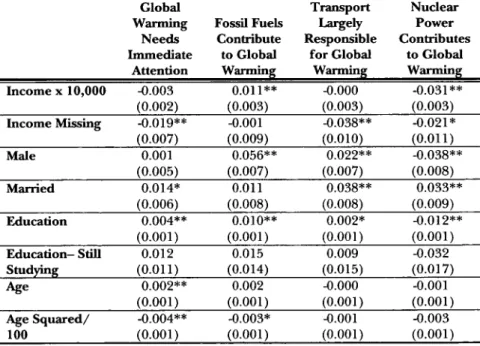
To examine the contribution of personal characteristics to the dif- ferent preferences, we report multivariate probit regressions in Table 3. The continuous variables pertain to income levels, which have been converted to dollars; education in years; and individual age in years. The categorical variables include whether the respondent is male, married, or still attending school.
Let us focus on the first of our two hypotheses: lack of risk knowl- edge and individual ignorance come into play and affect global warm- ing beliefs. Education is the main variable reflecting knowledge, and this variable has a consistently significant effect in the expected direc- tion. In particular, people with more education are more likely to agree with the first three true statements regarding global warming and are less likely to agree with the false statement regarding nuclear power. Income levels, which are highly correlated with education, have similar directional effects.
Table 3: Probit Regressions for Agreement with Global Warming Statement
Global Transport Nuclear
Warming Fossil Fuels Largely Power Needs Contribute Responsible Contributes Immediate to Global for Global to Global
Attention Warming Warming Warming
Income x 10,000 -0.003 0.011"* -0.000 -0.031**
(0.002) (0.003) (0.003) (0.003)
Income Missing -0.019** -0.001 -0.038** -0.021*
(0.007) (0.009) (0.010) (0.011)
Male 0.001 0.056** 0.022** -0.038**
(0.005) (0.007) (0.007) (0.008)
Married 0.014* 0.011 0.038** 0.033**
(0.006) (0.008) (0.008) (0.009)
Education 0.004** 0.010** 0.002* -0.012**
(0.001) (0.001) (0.001) (0.001)
Education- Still 0.012 0.015 0.009 -0.032
Studying (0.011) (0.014) (0.015) (0.017)
Age 0.002** 0.002 -0.000 -0.001
(0.001) (0.001) (0.001) (0.001)
Age Squared/ -0.004** -0.003* -0.001 -0.003
100 (0.001) (0.001) (0.001) (0.001)
Source: Authors' calculations are based on Eurobarometer 57.0. CHRISTENSEN, supra note 28. Standard errors are in parentheses. Asterisk (*) indicates significance at 5%
level; double asterisks (**) indicate significance at 1% level.
2007] 1675
1676 UNIVERSITY OFPENNSYLVANIA LAWREVIEW [Vol. 155:1657 Our second hypothesis pertains to age and the differential atti- tudes of older respondents toward global warming. The first column of regression results in Table 3, which concerns whether global warm- ing needs immediate attention, reflects the nonlinear age effect that rises and then falls with age. The second column of results, which pertains to fossil fuels, yields a negative effect of the quadratic age variable, which once again indicates that those 65 and older are less likely to agree with the global warming statement. The final two col- umns of results exhibit no statistically significant age effects, as the in- clusion of the other variables in the analysis accounts for the signifi- cant age differences that were exhibited in the overall mean values in Table 2.
Closely related to the age effect is that people who are married, and consequently are more likely to have children with a stake in fu- ture global warming policy benefits, are more likely to agree with the various statements regarding global warming. That relationship is in fact borne out, with the only exception being fossil fuels, for which the coefficient is positive but not statistically significant.
The other variables have more mixed effects. Men seem to have a stronger belief that fossil fuels and transport contribute to global warming than do women, and they are also less skeptical of the dan- gers of nuclear power.
Exploration of the perceptions of global warming risks conse- quently indicates that ignorance, as captured by the education vari- able, is perhaps the most dominant factor in the difference in beliefs.
Generational issues arise as well with respect to risk beliefs, but they are dampened and in some instances eliminated by the inclusion of the influence of a full set of demographic variables.
IV. IGNORANCE AND THE GENERATIONAL DMDE: ACTIONS
This Part continues the exploration of the roles of ignorance and generational interest with respect to global warming, but it does so within the context of individual actions as opposed to perceptions.
Do education and age affect pollution-reducing actions directly? Do risk beliefs also affect actions so that there is an additional indirect ef- fect of the demographic variables via risk beliefs?
One of the most prominent policy remedies that has been advo- cated with respect to global climate change is a gasoline tax, which will reduce gasoline consumption and automobile emissions. To what ex- tent are our hypotheses regarding attitudes toward climate change
ALLOCA TING RESPONSIBILITY
borne out in people's support for gas taxes? An earlier wave of the Eurobarometer, undertaken in 1999, included questions asking re- spondents how much more they were willing to pay for petrol that would be less harmful to the environment. 3 Rather than simply ask- ing respondents if they thought that gasoline was harmful to the envi- ronment, the question actually elicits an additional amount that peo- ple would be willing to pay for gasoline if doing so would be protective of the environment.
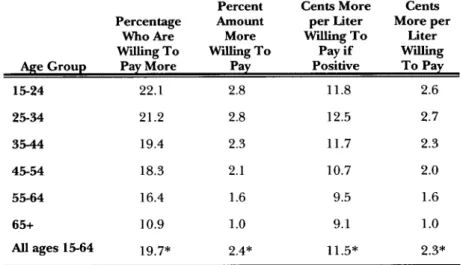
Table 4 summarizes the distribution of these willingness-to-pay amounts per liter of petrol.
Table 4: Willingness To Pay for Petrol That Is Less Harmful to the Environment, by Age Group
Percent Cents More Cents Percentage Amount per Liter More per
Who Are More Willing To Liter
Willing To Willing To Pay if Willing
Age Group Pay More Pay Positive To Pay
15-24 22.1 2.8 11.8 2.6
25-34 21.2 2.8 12.5 2.7
35-44 19.4 2.3 11.7 2.3
45-54 18.3 2.1 10.7 2.0
55-64 16.4 1.6 9.5 1.6
65+ 10.9 1.0 9.1 1.0
All ages 15-64 19.7* 2.4* 11.5* 2.3*
Source: Authors' calculations are based on Eurobarometer 51.1. MELICH, supra note 32.
Asterisk (*) indicates statistically significant differences between the ages-15-64 and ages-65-and-over groups, 1% level, two-tailed test.
The first column gives the percentage who are willing to pay more for petrol; the second column presents the percentage amount more they are willing to pay; the third column presents in dollar terms the cents more per liter that people are willing to pay provided that the response is a nonzero value; and the final value is the cents more per liter that people are willing to pay including the zero responses. What is striking about these statistics is that almost invariably there is a
32 ANNA MELICH, INTER-UNIV. CONSORTIUM FOR POLITICAL & SOC. RESEARCH, EUROBAROMETER 51.1: ENVIRONMENTAL ISSUES AND CONSUMER ASSOCIATIONS, APRIL-
MAY 1999 (2001).
2007] 1677
1678 UNIVERSITY OFPENNSYLVANIA LA WREVIEW [Vol. 155:1657 steady decline in willingness to pay with age. The starkest drop occurs when we move from the ages-55-64 group to the ages-65-and-over group. In terms of the percentage who are willing to pay more and the percentage amount more they are willing to pay, the ages-65-and- over group expresses roughly half of the willingness to pay as com- pared to all people ages 15-64. The existence of this pattern supports our hypothesis that there is a generational divide in support for cli- mate change policies.33
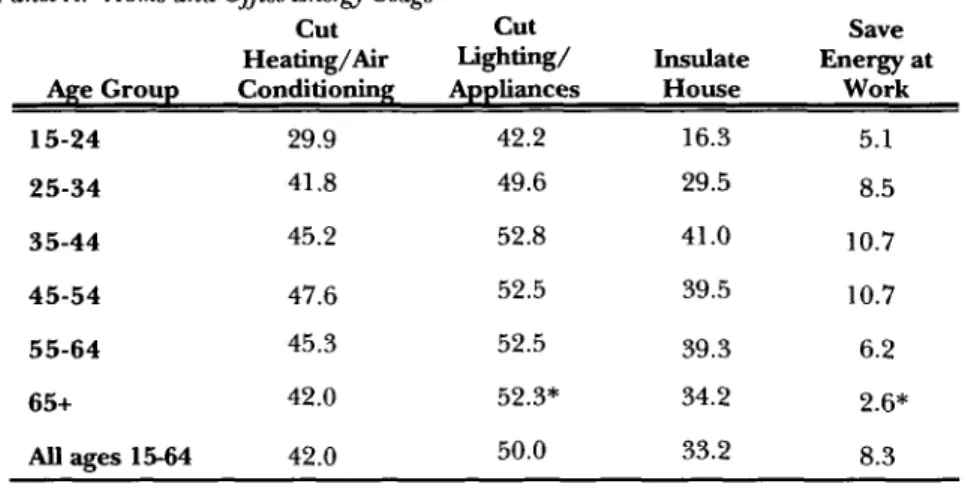
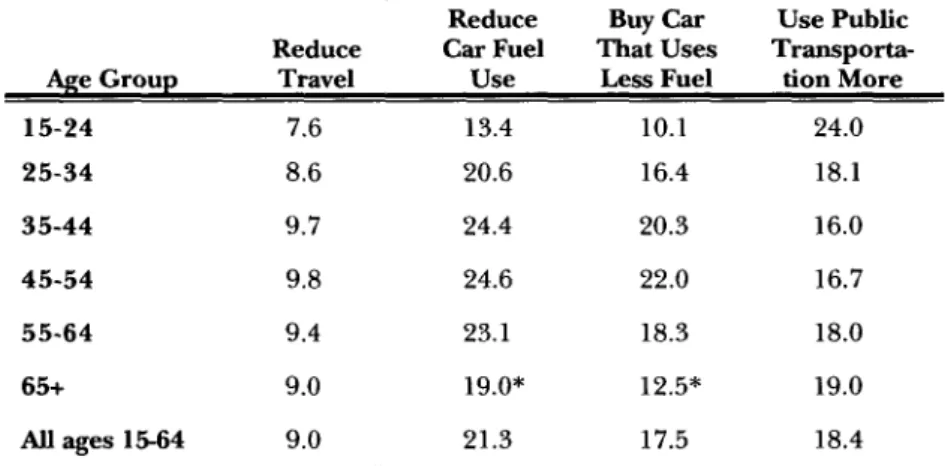
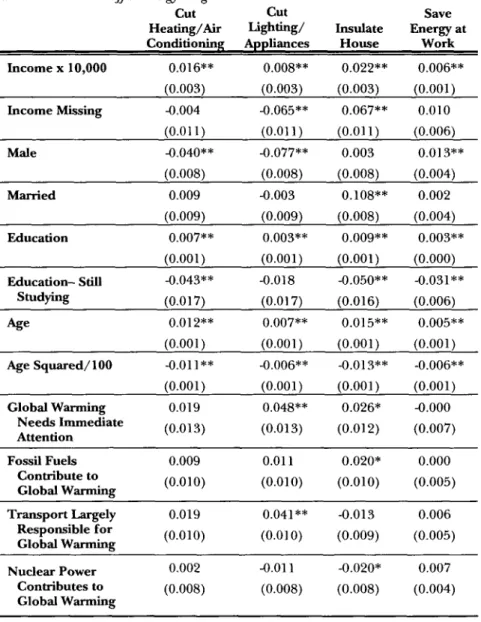
The 2002 Eurobarometer survey does not repeat the gas price question but does include a diverse set of questions pertaining to ac- tions that people are taking to save energy that are likely to affect global climate change.4 The first set of questions presented in Table 5, Panel A, pertains to actions that people could take at home and at work. The home-related behaviors are the following: "Cut down on heating and/or air conditioning," "Cut down on lighting and/or the use of domestic electrical appliances," "Insulate (d) my house (walls, windows, etc.)," and "Taking initiatives to save energy at work."
Roughly one-third to one-half of all respondents have undertaken one or more of these actions, where the main outlier is saving energy at work. Many people do not work, and those who do may not have con- trol over energy savings.
In terms of the age distributions of the patterns in Table 5, Panel A, there is an inverted U-shaped relation. Precautions rise with age until middle age and then subsequently decline. For two of the four categories, there is a statistically significant difference between the precautions taken by the ages-65-and-over group and those taken by all those ages 15-64, with a somewhat greater percentage of the oldest group undertaking the precaution of cutting lighting/appliances.
33 Hersch & Viscusi, supra note 30, at 121. This paper provided the mean values' counterpart regression results, but did not include the statistics presented in Table 4.
The questions in Table 5 are based on Eurobarometer 57.0 question 24. CHRIS- TENSEN, supra note 28, at 11.