i
IN ACADEMIC YEAR 2019/2020.
By:
DESNILA SAHARA Student Number : 1501070239
Tarbiyah And Teacher Training Faculty English Education Department
STATE INSTITUTE FOR ISLAMIC STUDIES OF METRO 1441 H/2019 M
ii
Presented as Partial Fufillment of the Requirements For the Degree of Sarjana Pendidikan (S.Pd)
English Education Study Program
By:
DESNILA SAHARA Student Number : 1501070239
Tarbiyah and Teacher Trainning Faculty English Education Department
Sponsor : Dr. Widhiya Ninsiana, M.Hum Co. Sponsor : Ahmad Subhan Roza, M.Pd
STATE INSTITUTE OF ISLAMIC STUDIES OF METRO
1441H / 2019 M
iii
iv
v
vi
vii
MIFTAHUL ULUM BRAJA SELEBAH EAST LAMPUNG
By:
DESNILA SAHARA
This research intended to present that the narrattive writing ability can be improved through applying journalistic question strategy at the tenth graders of MA Miftahul Ulum Braja Selebah.
This research was Classroom Action Research (CAR). The data were taken from the writing test to figure out the students‘ knowledge in writing narrative text. Furthermore, the writer used the observation technique to get the data about student‘s comprehension in writing, students‘ activities while writing, and students‘ participation in the learning process. The researcher also used the documentation method to support and to obtain the information concerning on the learning English in general.
The results of the research show that, from two cycles, the average scores of students‘ narrative writing are (a) 57,88 in pre-test, and (b) 68,60 in post-test 1 as well as (c) 76,08 in post-test 2. It appeared to be increased 18,20 point. The students‘ activities remained the same way. The students‘ activities in cycle 1 can be reported that there are (a) 18 students pay attention of teacher explanation (72%), 15 students ask/answer question (60%), 19 students able do the task (76%), 20 students active in the class (80%). Moreover, the students‘ activities in cycle 2 can be reported that there were (a) 20 students pay attention of teacher explanation (80%), 18 students ask/answer question (72%), 21 students able do the task (84%), 22 students active in the class (88%).This conclusionof this research isP that journalistic question strategy was able to improve the students‘
narrative writing ability at the tenth graders of MA Miftahul Ulum Braja Selebah.
Keywords: Narrative writing, Journalistic Question Strategy, Writing Ability.
viii TIMUR
By:
DESNILA SAHARA
Penelitian ini dimaksudkan untuk menyajikan bahwa kemampuan menulis naratif dapat ditingkatkan melalui penerapan strategi pertanyaan jurnalistik di MA Miftahul Ulum Braja Selebah.
Penelitian ini adalah Penelitian Tindakan Kelas (PTK). Data diambil dari tes menulis untuk mencari tahu pengetahuan siswa dalam menulis teks naratif.
Selanjutnya, penulis menggunakan teknik observasi untuk mendapatkan data tentang pemahaman siswa dalam menulis, kegiatan siswa saat menulis, dan partisipasi siswa dalam proses pembelajaran. Peneliti juga menggunakan metode dokumentasi untuk mendukung dan mendapatkan informasi mengenai pembelajaran bahasa Inggris secara umum.
Hasil penelitian menunjukkan bahwa, dari dua siklus, skor rata-rata penulisan narasi siswa adalah (a) 57,88 pada pre-test, dan (b) 68,60 pada post-test 1 serta (c) 76,08 pada post-test 2. Tampaknya meningkat 18,20 poin. Aktivitas siswa tetap sama. Aktivitas siswa pada siklus 1 dapat dilaporkan bahwa ada (a) 18 siswa memperhatikan penjelasan guru (72%), 15 siswa bertanya / menjawab pertanyaan (60%), 19 siswa mampu mengerjakan tugas (76%), 20 siswa aktif di kelas (80%). Selain itu, kegiatan siswa pada siklus 2 dapat dilaporkan bahwa ada (a) 20 siswa memperhatikan penjelasan guru (80%), 18 siswa bertanya / menjawab pertanyaan (72%), 21 siswa mampu mengerjakan penelitian (84%) ), 22 siswa aktif di kelas (88%) . Kesimpulan bahwa strategi pertanyaan jurnalistik mampu meningkatkan kemampuan menulis narasi siswa di MA Miftahul Ulum Braja Selebah.
.
Kata Kunci : Penulisan naratif, Strategi Pertanyaan Jurnalistik, Kemampuan Menulis
ix
x
“O you who have believed, seek help through patience and prayer. Indeed, Allah is with the patient.”
(Q.S. Al-Baqarah: 153)
“Lead from the back and let others believe they are in front.”
(Nelson Mandela)
xi
truly understanding friends, to those who love me and those whom i love.
xii
blessing especially to the writer so that she able to accomplish this undergraduate thesis. Shalawat and salaam be always given to our holy world leader Muhammad SAW, the man of true goodness of everything.
This undergraduate thesis is entitled ―Improving Narrative Writing Ability By Using Journalistic Question Strategy at Tenth Graders of Ma Miftahul Ulum Braja Selebah East Lampung in Academic Year 2019/2020, to Improve The Students‘ Narrative Writing Ability at The Tenth Graders of MA Miftahul Ulum Braja Selebah.
The researcher cannot stay alone, there are many people who contribute their meaningful hands in accomplishing this an undergraduate thesis, so the researcher would like to express her gratitude thanks to :
1. Prof. Dr. Hj. Enizar, M.Ag as the rector of of State Institute for Islamic Studies of Metro.
2. Dr. Akla, M.Pd., as the Dean of Tarbiyah and Teacher Training Faculty IAIN Metro.
3. Ahmad Subhan Roza., M.Pd as the Head of English Education Department of IAIN Metro and the second advisor, thank you so much for your kindness and valuable knowledge and for your guidance in finishing this undergeaduate thesis.
4. Dr.Widhiya Ninsiana, M.Hum., as the first advisor, thank you so much for your kindness and valuable knowledge and for your support in finishing this undergeaduate thesis.
5. Lectures and Administration Staff of English Education Department of IAIN Metro.
xiii this undergraduate thesis.
The researcher feels that it is really pleasure for her to receive criticisms and suggestions to make this undergraduate thesis better. She also hopes that this undergraduate thesis would be beneficial, particularly for her and for who are interested in it.
Metro, November 25th, 2019 The Researcher
DESNILA SAHARA
Student Number. 1501070239
xiv
APPROVAL PAGE ... iii
NOTIFICATIN LETTER ... iv
RATIFICATION PAGE ... v
ABSTRACT ... vi
ABSTRAK ... vii
STATEMENT OF RESEARCH ORIGINALITY ... viii
MOTTO ... x
DEDICATION PAGE ... xi
ACKNOWLEDGMENT ... xii
TABLE OF CONTENTS ... xiv
LIST OF TABLES ... xvii
LIST OF FIGURE ... xviii
LIST OF GRAPHS ... vix
CHAPTER I INTRODUCTION ... 1
A. Background of the Study ... 1
B. Identification of the Problem ... 5
C. Limitation of the Problem ... 5
D. Formulation of the Problem ... 5
E. Objective and Benefits of the Study ... 6
1. Objective of the Study ... 6
2. Benefits of the Study ... 6
F. Prior Research ... 7
xv
2. Characteristics of Writing ... 11
3. The Types of Writing ... 13
a. Expository ... 13
b. Description ... 13
c. Persuasive ... 14
d. Narrative ... 14
4. The Process of Writing ... 14
5. The Concept of Narrative Text ... 15
B. The Concept of Journalistic Question Technique ... 22
1. The Definition of Journalistic Question Technique ... 22
2. The Benefit of Journalistic Question Technique ... 24
3. The Implementation of Journalistic Question Technique ... 24
C. Action Hypothesis ... 25
CHAPTER III RESEARCH METHOD ... 26
A. The Variables and Operational Definition of Variables ... 26
1. Variables of Research ... 26
2. Operational Definition of Variables ... 26
B. Research Setting ... 28
C. Research Subject ... 28
D. Research Procedures ... 29
1. Cycle I ... 30
2. Cycle II ... 32
xvi
4. Field Note ... 36
F. Research Instrument ... 36
G. Data Analysis ... 36
H. Indicator of Success ... 38
CHAPTER IV RESULT OF THE RESEARCH AND INTERPRETATION ... 39
A. Result of The Research ... 39
1. Description of Research Location ... 39
2. Description of the Research ... 46
B. Interpretation ... 72
1. Result of Students Learning ... 73
2. Comparison of Score in Pre-Test, Post-Test I in cycle I, and Post-Test II in Cycle II... 74
C. Discussion ... 78
CHAPTER V CONCLUSION AND SUGGESTION ... 79
A. Conclusion ... 79
B. Suggestion ... 80 BIBLIOGRAPHY
1 A. Background of the Study
Teaching English is a great effort that aims not only to transfer the knowledge of English theoretically but also to familiarize language learners to be able to use English in their daily live both written and oral.
In Indonesia, English is a foreign language that is not obtained from the beginning of birth. Therefore, teaching English in Indonesia plays an important role in formal institution and non-formal institutions. Teaching English includes of four language skills consisting of listening, speaking, reading and writing.
In addition, as part of the English language teaching process, teaching writing is very useful in conveying the message effectively.
Writing is the ability to show ideas and to transfer the information for the reader through the written text. Moreover, writing is a peculiar activity, both easy and difficult. The writers‘ idea can be expressed in a series of word by writing them down on a piece of paper. Therefore, writing is one of language skills used to convey meaningful information from the writer to the reader in written form. By writing, learners can express their feelings, ideas, thoughts, emotion, attitudes, etc. In writing the writers have to produce words, phrase, sentences, and paragraphs at the same time.
Moreover, writing narrative text will help the writers in recoveringmemories. The writers will be surprised at how writing is able to bring back old and almost forgotten memories. When the writers are writing something down, they become more careful in choosing the right words. This means that the writing result will be more eloquent, concise, and elegant than the actual speech. It is a good rule of thumb to always write down ideas that pop up out of nowhere because the writers will be less likely to forget about them that way. Therefore, the writers should improve their verbal and written skills.
One of the efforts to improve the writing skills is by applying the right teaching strategy. One of the teaching strategy that is suitable for improving the ability of writing is the journalistic question strategy.
Journalistic Question is one of the strategy to teach narrative text. It consists of 6 words (who, what, where, when, why and how) which are use by reporters to ask interviewees. Those words can stimulate the students to generate their ideas in writing narrative texts.
Journalistic Question strategy is a strategy that can help the students to explore their idea in writing to cover the content of the narrative text. It is as an invention strategy that ensures all of the students to cover all the major points. Furthermore, using the journalistic questions automatically organizes information as the students generate it, whereas a brainstorming list would need to be analyzed and reorganized. This research that aims to investigate the effectiveness of Journalistic Questions
strategy to improve students‘ writing ability in narrative text. In addition, the ability to write in English is influenced by various aspects which can be categorized as linguistic aspect and non-linguistic aspect. Aspects that affect writing include vocabulary mastery, grammar mastery, reading ability, punctuation and writing mechanic. Meanwhile, the ability to write in English is also influenced by non-linguistic aspects which include of psychological aspect, learning media, environment support, teaching strategy and writing habits.
Morever, the researcher condacted pre-surveyto investigate the writing problems of the tenth graders at MA Miftahul Ulum. The pre- survey was done on March 1st2019 to find out students'problems in writing narrative . The data of pre-survey is related with the narrative text writing that is catagorized based on Minimum Mastery Criteria( MMC). MMC of English subject is 70. The pre-survey results are illustrated in the following table
Table 1
The data of pre survey in Writing of narrative text at the Tenth Graders at the MA Miftahul Ulum
no Grade Frequency Percentage Criteria
1 ≥70 2 students 8% Complete
2 <70 23 students 92% Incomplete
Based on the results of the pre-survey above, it is known that the number of students who did not complete MMC are 23 students (92%).
While the number of students capable of complete MMC is only 2 students (8%) it means that the percentage of students who are able to complete MMC is less than the number of students who are unable to complete MMC. Thus it can be concluded that the writing ability of teen grade students is very MMC.The researcher assumes that narrative writing problems of the tenth grade students are caused by limited English vocabulary they have, weak grammar mastery, low reading ability, difficulty in determining the context of the situation to be written in the right grammar. In addition, the weak ability to read writing in teen grade students is also caused by the low motivation to write in English, the limited interesting learning media used in the learning process of writing.
Furthermore, the meaningfull effort to improve the writing skills of the tenth graders will be carried out by implementing classroom action research using journalistic technical questions. Journalistic question strategy is expected to improve the writing ability of the tenth graders.
Therefore, the researcher will conduct a classroom action research entitled
"Improving Narrative Writing Ability by Using Journalistic Question strategy at tenth grade students at MA Miftahul Ulum Braja Selebah East Lampung.
B. Identification of the Problem
Based on the background of the problem, the problem of the research identified as follows:
1. The students have limited English vocabulary 2. The student have inadequate grammar mastery
3. The students get difficulties in developing of the idea in the process of narrative writing
4. The studentshave limited interesting learning media used in the learning process of narrative writing.
C. Limitation of the Problem
Based on the problems that have been identified, the researcher limited the problems on insufficiency of students‘ narrative writing ability.
The researcher focus on journalistic question strategy in narrative writing text at the MA Miftahul Ulum Braja Selebah East Lampung in Academic Year 2019/2020.
D. Formulation of the Problem
After limiting the research, the researcher formulates the research problem, as follows:
"Can journalistic question strategy improve Narrative Writing Ability at tenth graders of MA Miftahul Ulum Braja Selebah East Lampung in Academic Year 2019/2020.
E. Objective and Benefits of the Study 1. Objective of the Study
This study aims to determine whether the use of the journalistic question strategy can improve narrative writing ability of the tenth graders at Braja Selebah MA Miftahul Ulum East Lampung.
2. Benefits of the Study
This research has various benefits not only for researchers but also for students, English teachers, and the school.
a. For the students
This research is expected to make a significant contribution in improving students' writing abilities. Through the implementation of a journalistic question strategy,the students are expected to be helped in the process of writing learning with effectively. In addition, through this research the students‘ interest in writing learning is expected to increase.
b. For the english teachers
This research is expected to be an inspiration for teachers in choosing and implementing the right strategies in teaching writing. Implementation of this strategy is expected to help English teachers in guiding students in the process of learning writing effectively. In addition, the teacher will be more creative in creating a learning atmosphere that is not monotonous.
F. Prior Research
This study will be conducted by considering several previous studies related to the use of the journalistic question strategy in writing teaching.The first prior research is Titled The Effectiveness Of Journalistic Question Technique To Improve Students Writing Skill In Narrative Text done by Kurniyasari, and Puspa Dewi Ayu. The first prior research applied Jurnalistic Question strategy in teaching writing. The first prior research sample is junior high school. In addition, the research method implemented by an experimental research. The results of the first prior research prove that there was significant of Journalistic Question strategy in teaching writing.
The first prior research has similarity and differences with this study. The similarities between the first prior research and this research include the language skills, teaching strategy. The language skill investigated is writing; while teaching strategy is the strategy of journalistic questions. The differences between the first prior research with this research include of research samples and research methods. The sample from the first prior research is class students‘ senior high school.
While the sample of this study is the tenth graders at the first prior
research method is classroom action research method while the research method is in the first.1
The second prior research will be conducted by considering several previous studies related to the use of the journalistic question strategy in writing teaching.The second prior research is titledTeaching Writing By Combining Journalistic Questions and Exit Slips Strategies done by Humairah. The first prior research applied Jurnalistic Question strategy and ExitSlips Strategiesin teaching writing. The second prior research sample is junior high school. In addition, the research method implemented by an experimental research. The results of the second prior research prove that there was significant of Journalistic Question strategy in teaching writing.2
The first second research has similarity and differences with this study. The similarities between the second prior research and this research include the language skills, teaching strategy. The language skill investigated is writing; while teaching strategy is the strategy of journalistic questions. The differences between the second prior research with this research include of research samples and research methods. The sample from the second prior research is class students‘ senior high school. While the sample of this study is the tenth graders at the second
1Kurniyasari, Puspa Dewi Ayu.The effectiveness of journalist question technique to improve students writing skill in narrative text.ELT Forum: Journal of English Language Teaching Vol 5 1 (2016)
2Humairah.Teaching Writing By Combining Journalist Questions And ExitSlips Strategies For Eigh Grade Of Junior High School. Vol 2, 2 (2013)
prior research method is qualitative research method while the research method is in the first.
Based on all of the explanation of all prior researchs, it is known that the similarity between this research and all prior researchs lies on the same dependent and independent variabels. The diffrences between this research and all prior researces are the diffrent sample and the location of the reseach. Therefore, by considering the content of all prior reseach the researcher will take a position as a person who want to improve students‘
writing by using jurnalistic question strategy.
from the prior reseach above, the reseacher would like to conduct a research about improving narrative writing ability by using journlistic question strategy in teaching of MA Miftahul Ulum Braja Selebah East Lampung.
CHAPTER II LITERATURE REVIEW A. The Concept of Writing
This subtitle entails the basic definition of writing and types of writing proposed by the experts on the field.
1. The Definition of Writing
According to Ken Hyland, writing is a way of sharing personal meanings and writing courses emphasize the power of the individual to construct his or her own viewes on a topic.3 It means that writer develop an idea and expand it into written.
Moreover, Vicki Urquhart highlights writing is a process of exploration that offers benefits to students and content area teachers alike. 4 As the students write to make their ideas clear and comprehensiple, they experience the fun of discovery, and so do their teachers.
R.R Jordan states that ―Writing is method of human intercommunication by means of conventional visible marks‖.5 It means that writing is a medium communicate one‘s thought, feeling, wanted, and opinion by nonverbal means.
3Ken Hyland, Second Language Writing, (USA: Cambridge University Press2003), p.9
4 Vicki Urquhart and Monette Mclver, Teaching Writing in The Contest Areas, (Virginia USA: Mid-continent Research for Education and Learning McREL, 2005), p.3
5R.R Jordan, Academic Writing Course, (Longman: England,2003), 3rd.ed., p.41
Furthermore,Sharples assumes that writing is a primarly mental activity, but it relies on physical tools and resources from pens and paper to word processors.6 It means that when someone wants to write something, he/she must know what he/she intend to write about based on their thought.
Based on the quotations above, the researcher can put forward that writing is not only in form of writing something information in the written text form and developing ideas but also in form of thinking creatively including about the information and the idea put in the written text with the good writing and the suitable rules of writing.
2. Characteristics of writing
There are some characteristics of writing, from perspective from a reader. They are as follows:7
a. Permanence.
Once something is written down and delivered in its final from its intended audience, obviously the researcher abdicates the power. The work is written in the paper, become a permanence work. Therefore, the teacher can do as a guide and facilitator to help students to revise and to refine their work.
6Mike Sharples, How we Write: Writing as Acreative Design, (New York: Rouledge,1999), p.6
7H. Douglas Brown, Teaching by Principle: An Interactive Approach to Language Pedagogy. (San Franscisco: Longman,2001), Second Edition, p. 353-354
b. Production time.
The good writing is that, given appropriate stretches of time, a researcher can indeed become a good researcher by developing efficient processes for achieving the final product. The bad writing is that many educational context demand student writing within time limits or writing for display as noted in the previous section (examination writing, for example).
c. Distance.
The good researcher can read their own writing from the perspective of the mind of the targeted audience. The researchers need to predict the audience‘s general knowledge, cultural, and literacy schemata, specific subject-matter knowledge, and very important, how their choice of language will be interpreted.
d. Complexity.
Researchers must learn how to remove redundancy, how to combine sentences, how to make references to other elements in text, how to create syntactic and lexical variety, and much more.
e. Vocabulary.
Written language places a heavier demand on vocabulary use than does speaking. Good writing will learn to take advantage of the richness of English vocabulary.
3. The Types of Writing
To decide kind of strategy that will be used in the act of writing, Robin Jeffreyproposes four types in writing, they are as follows:8
a. Expository
Expository writing is one of the most common types of writing. When an author writes in an expository style, all they are trying to do is explain a concept, imparting information from themselves to a wider audience. Expository writing does not include the author‘s opinions, but focuses on the accepted ―facts‖
about a topic, including of statistics or other number based evidence.
b. Description
Descriptive writing is often found in fiction, though it can make an appearance in nonfiction as well, mostly memoirs, first- hand accounts of events, travel guides, etc. When an author writes in a descriptive style, they are trying to ‗paint a picture‘ of a person, place, or thing for their audience. It can be very poetic, employing metaphor and other such devices, while relying heavily on describing the author‘s impression of things via their five senses (what they hear, see, smell, taste, or touch).
8 Robin Jeffrey,About Writing, (Oregon: Klamath Community College, 2015),p.3
c. Persuasive
Persuasive writing is the main style of writing the writers will employee in academic papers. When an author writes in a persuasive style, they are trying to convince the audience of a position or belief held by the author. Persuasive writing contains the author‘s opinions and biases, as well as a series of justifications and reasons given by the author as evidence of the correctness of their position. Any ―argumentative‖ essay the people write in school should be in the persuasive style of writing.
d. Narrative
Narrative writing is used in almost every novel, book, or longer piece of writing, whether fiction or nonfiction. When an author writes in a narrative style, they are not just trying to impart information, they are trying to construct and communicate a story, complete with characters, conflict, and settings.
4. The process of writing
According to harmer, there are four stages in the process of writing, as follows:9
1) Planning
In the process of planning, writers have to think about three main issues. In the first, place they have to consider the purpose.
9 Jeremy Harmer. How To Teach Writing. ( Harlow: Longman Group, 2007).P. 4-5.
Secondly, experienced writers think of the audience they are ariting for. Thirdly, writers have to consider the content structure.
2) Drafting
The first version of a piece of writing as a draft. As the writing process proceeds onto diting, a number of drafts may be produced on the way to the final version.
3) Editing (reflecting and revising)
The writers tend to look at issues of general meaning and overall structure before concentrating on detailed features such as individual words and grammatical accuracy.
4) Final version
The writers is now ready to send the written text to its intended audience.
5. The Concept of Narrative Text 1. The concept of narrative text
Tarra states that narrative is kind of text which tells about story.10 It means that the content or message of narrative text is about past event in sequences which is delivered from the writer to the readers. In conclusion, narrative writing is text which tells about fiction story in the sequences of events that purposed to seek the readers‘ attention and interest.
10 Tara Mccarty, Narrative Writing, (New York: Scholastic Professional Books, 1998), p.5
2. The Generic Structure of Narrative Text
1) Narrative writing has three points related to the elements or generic structure of the text. There are three elements of narrative text as follows
1) Orientation
In this part, the writer focuses on the setting or location of the story and introduces the main characters of the story and maybe even some of the minor characters. The plot is usually begun here and the theme is also introduced.
2) Complication
Complication is the essential point in narrative writing.
The story follows a series of events where some problem or complication occurs. This sproblem usually involves the main characters. The problem also has a climax point in this part of the text.
3) Resolution
Resolution is the solution to the problem. It tells about how the problem is solved. It may be a happy or unhappy ending. In some text, there is more than one complication/resolution before the final resolution.
Some narrative writings contain a coda in which the writer provides a final commentary, going beyond the retelling of events.
3. Kinds of narrative text
Narrative writing is a kind of literary text. Therefore, there are some kinds of narratives writing which can be discussed as follows:11
1) Fairytale
Fairytale is story about imaginary beings possessing magical powers. The examples of fairytale areCinderella, Snow White, Pinocchio, and Beauty and The Beast.
2) Science fiction
Science fiction is a kind of narrative writing that explores unexpected possibilities of the past or the future by using scientific theories or data and imagination. The example of science fiction is To the Moon from the Earth by Jules Verne.
3) Fable
A fable is a story making a moral point, traditionally by means of animal characters which speak and act like human beings. The examples of fable in narrative text are The Ants and The Grasshopper, The Story of Monkey and Crocodile, and The Bear and The Rabbit.
4) Legend
A legend is a story of human actions that are perceived both by teller and listeners to take place within human history.
11 Ibid
Typically, a legend is a short, traditional and historicized narrative performed in a conversational mode. Some define legend as folktale. The examples of legend in narrative text are The Legend of Surabaya, Sangkuriang, and Malin Kundang.
In conclusion, there are some kinds of narrative writing which should be known by the students. Therefore, they can identify the characteristics of each kind of narrative writing
4. Grammatical features of narrative text
In the process to produce the good narrative writing, there are some abilities which should be concerned as follows:12
1) Content
Content is the essential part in narrative writing. Related to this point, students are expected to have some abilities as follows:
a) Students should be able to write and relate the ideas.
b) Students should be able to develop the ideas through illustration, facts, opinions, or personal experience.
c) Students should be able to use the appropriate description, to explain the events.
d) Students should be able to concern to the focus point of the writing.
12 H. Douglas Brown, Teaching by Principles Second Editions: An Interactive Approach to Langueage Pedagogy, (New York: Addison Wesley Longman. Inc, 2001), P. 357-358
2) Organization
Organizing is also important ability which should be mastered to write the narrative text. The students are expected to have some abilities as follows in order to organize the narrative writing:
a) Students should be able to write an effective introduction.
b) Students should be able to arrange the ideas in logical sequence.
c) Students should be able to draw the conclusion.
3) Language Use/Grammar
Grammar is also the key of writing. The students should comprehend the knowledge about Syntax to compose the good sentence structure.They are expected to have abilities about syntax as follows:
a) Students should be able to understand the word order.
b) Students should be able to understand the phrase structure.
c) Students should be able to mastery the subject-verb agreement.
d) Students should be able to use the tenses for narrative writing.
4) Vocabulary
Vocabulary mastery is needed in order to create an understandable narrative writing. The students are supposed to select the most suitable vocabulary based on the context of the sentences. The detail abilities about vocabulary to write narrative writing are mentioned as follows:
a) Students should be able to mastery the list of noun, adjective, verb, and adverb.
b) Students should be able to use the plural and singular noun in sentences.
c) Students should be able to use regular and irregular verb.
5) Mechanics
Mechanics is also the significant part of writing. The abilities which should be comprehended by students about mechanics are mentioned as follows:
a) Students should be able to write the correct spelling.
b) Students should be able to use the correct punctuation.
c) Students should be able to use the correct capitalization.
d) Students should be able to write neatly.
In conclusion, based on the explanation above there are a number of abilities which should be comprehended and applied well especially by the tenth graders to write narrative writing.
To measure students writing ability, the teachers should use writing rubric. The writing rubric is illustrated in the table bellow, as follows:
Table.1 Writing Assesment13
Aspect Score Performance Description Weighting
Content (C) 4
The topic is complete and clear and the details are relating to the topic
3x
30% 3
The topic is complete and clear but the details are almost relating to the topic
- Topic 2
The topic is complete and clear but the details are not relating to the topic
- Supporting Details 1
The topic is not clear and the details are not relating to the topic
Organization (O)
4
The generic structure is complete and the sentences are arranged with proper connectives
2x 20%
- Orientation 3
The generic structure is complete and the sentences are arranged with almost proper connectives - Complication 2
The generic structure is not complete and the sentences are arranged with few misuse of connectives
- Resolution 1
The generic structure is not complete and the sentences are arranged with misuse of connectives
Grammar (G) 4 Very few grammatical or agreement inaccuracies
2x
20% 3
Few grammatical or
agreement inaccuracies but not affect on meaning.
13 Weigle. S. Cushing, Assesing Writing, (Cambridge: Cambridge University Press, 2002),p.
- Past Tense 2 Numerous gramatical or agreement inaccuracies - Agreement 1 Frequent grammatical or
agreement inaccuracies Vocabulary (V) 4 Effective choice of words
and word forms
1,5x
15% 3
Few misuse of vocabularies or word forms but not change the meaning
2 Limited range confusing
words and word forms
1
Very poor knowledge of words, word forms, and not understandable
Mechanics (M)
4
It uses correct spelling, punctuation, and capitalization
1,5x 15%
- Spelling 3
It has occasional errors of spelling, punctuation, and capitalization
- Punctuation 2
It has frequent errors of spelling, punctuation, and capitalization
- Capitalization 1
It is dominated by errors of spelling, punctuation, and capitalization
Score =
X 100
B. The Concept of Journalistic Question Strategy 1. The definition of Journalistic Question Strategy
Journalistic question is one of the strategies that can improvestudents‘ writing. It is also one of the parts of prewriting strategies. Vicki Urquhart and Monette Mclver state that journalistic question is the questions that are referred to as the five Ws and one H (Who? What?Where? When? Why? or How?). These questions have
not lost their valuein classroom instruction, regardless of the content area. Students can alsouse these questions to explore the topic they are writing about for anassignment. The students answer these questions by focussing their attention onthe specifics of a given topic.14 By using this strategy, the students canorganize their writing.
A skilled journalistic can write a lead the answers all six of those questions, and then write the reminder of the news story simply by unpacking, or describing point by point, the details about each of those six points. It is not only for writing but also is useful device forcomprehending clearly what students read. Robert Weber says that just asthe journalistic questions can be used systematically to take an inventory ofwhat a writer does to achieve a purpose, so we use them when we areplanning to write15
Atlthought the journalistic question strategy use 5W and 1H questions but not all of the questions need to be answered for example;some of the questions might be irrelevant to the topic. Such as thecertainly topic that focuses on weather trends of the past 10 years, the Whoelement will probably not be particularly important. By using these questions, it will help students to generate ideas in writing.
Besides, answering these questions about our topic will help us
14 Vicki Urquhart & Monette McIver. Teaching Writing in the Content Areas[ElectronicBook]. Alexandria, VA: ASCD/McRel. 2005. p. 82
15 Robert Weber. Using the Five Traditional Canons of Rhetoric (pdf). The New YorkerCollection, 1992. p38
togenerate details and give us a context for writing about the topic you haveselected.Here, the questions are related to the topic.
Furthermore, JunePreszler states that called the Journalistic Questions or the 5 Ws and an H,these simple questions help writers identify important information about topic. Only after the questions have been answered, can writers organizetheir news stories—or in the case of your students—their summaries.16Dealing with the explanation above, Michelle Gatz says thatJournalistic question is a great strategy because it is already has thequestions prepared. This strategy is designed to help students to generateand focus on specific ideas while writing. The students should be informedthat they do not have to fully answer every question. In answering thequestions, it will help the students to discover informationand focus thestudents thinking on their topic.
2. The Benefit of Jurnalistic Question Strategy
1. Journalistic question is one of the ways to generate ideas in writing.
2. Journalistic question consists of 5W+1H. Is very effective in guiding the students to write.
3. Journalistic question is very beneficial in helping the students to develop their critical thinking.
16 June Preszler. On Target: Bringing Writing into Content Area Classrooms Grades 4- 12, 2006. Alexandria: ESA 6&7. p. 17
4. Asking questions can help identify ideas and focus assignments such
as narration and description.
3. The implementation of Jurnalistic Question Strategy
1. Teacher divides the students into some groups, and each group will make question based on 5W+1H (what,why, when, who, where and how).
2. The students in each group will answer the questions of another groups.
3. After answering the questions of another group, the students in each group continue to compose a text based on the questions of 5W+1H.
C. Action Hypothesis
The action of hypothesis of this reseach is stated, as follows:
―The implementation of jurnalistic question improves narrative writing ability at tenth graders of MA Miftahul Ulum Braja Selebah East Lampung in Academic Year 2019/2020.
CHAPTER III RESEARCH METHOD
A. The Variables and Operational Definition of Variables 1. Variables of Research
This research consists of two variables; they are independent and dependent variables. The independent variable in this research is journalistic question will be implemented to improve the students‘
writing ability in simple way. This strategy is useful to make their writing is excellent in paragraphs of sentences.
The dependent variable of this research is writing as one of the four of language skills that has to be mastered by the students in order to be able to write their ideas effectively.
2. Operational Definition of Variable
Operational definition is the definition that based on characteristic of the things that will be defined, and it can be observed or measured. Meanwhile, variable can be defined as an attribute of a person or a subject which varies from object to object.17 According to Raymond mark the definition an operational tells us what activities or operation we need to perform to measure a concept or variable.18
17 John creswell, Research Design Qualitative, Quantitative, and Mixed Method Approaches, (Lincoln: SAGE Publications,2002), 24.
18 Allen Rubin & Earl R Babie, Esential research Method for Social Work, ( Engaged Learning: United State of America,2010), 70.
Based on the statement, the definition operational of the variable in this research are:
a. Dependent Variable
According to Evelyn Hatch, Dependent Variable is the major variable that will be measure in the research. Dependent variable is a variable that can improve by an independent variable.19 The dependent variable of this research is students‘ writing ability that focuses on the students‘ ability.
To measure writing ability of students, the writer took the writing test by composing narrative text. The students made narrative text in 25 minutes about their favorite things. It was a simple test as a sample to know about the students‘ writing ability.
The indicators of a written test in this variable are:
1) The students are good in content of writing. The content should be relevant to the topic.
2) The students are good in organization of writing. The students are able to compose narrative text based on the appropriate generic structure of narrative text.
3) The students are able to write narrative text by using good mechanics writing.
19 Ibid,.63
b. The independent Variable
According to Evelyn, Independent Variable is variable that the researcher suspects may relate to or improve the dependent variable.
In a sense, the dependent variable ―depends‖ on the independent variable. 20
This variable will be measured by observation. To observe this variable the writer will use observation sheet. The measurement of this variable is 1- 4 score. The indicators of this variable are:
1) The students are good respond to learn writing using journalistic question.
2) The students have more concentration to write the narrative text in English.
B. Research Setting
The researcher conducted the research at MA Miftahul Ulum Braja Selebah, Lampung Timur.
C. Research Subject
The subjects of this research are the students of the tenth grade of MA Miftahul Ulum Braja Selebah. Thestudents consist of 16 boys and 9 girls, so the total is 25 students.
20Evelyn Hatch and Anne Lazaraton, The Research Design and Statistics For Applied Statistic,( USA: Heinle Publisher, 1991), p.64
D. Research Procedures
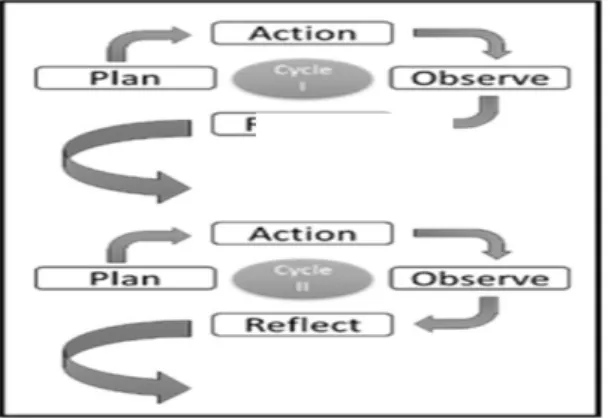
Kind of this research is Classroom Action Research (CAR). Anne Burns states that classroom action research is kind of research which is done by the teacher as a researcher in order to bring improvement on the result of teaching learning process.21 Therefore, the main purposes in classroom action research are to solve the problems in teaching learning process and to improve the students‘ learning result. In addition, Kemmis and McTaggart in Anne Burns explain that CAR typically involves four steps in a cycle of classroom action research. They are planning, acting, observing, and reflecting. The first cycle has a possiblity to be the next cycle until the implementation of research achieve increasing outcome.
Accordingly, the cycle of this research will become a spiral process. The cyclical classroom action research is presented as follow:22
Figure 1: Cyclical Classroom Action Research by Kemmis and McTaggart From the design above, here are the explanations about procedures that will be conducted by the researcher in classroom action research.
21Anne Burns, Doing Action Research in English Language Teaching, (New York:
Routledge, 2010), 2.
22Ibid, p. 8-9
1. Cycle I a) Planning
Planning is the first step in each activity. Without planning, the learning activity will not activethe main goal. Here are the steps that the researcher did in planning:
1) Preparing the lasson plan.
2) Preparing the material of narrative text.
3) Preparing the source in the form of learning book for the tenth grade.
4) Preparing the media of learning in the form of worksheet.
b) Acting
The second step in the action research is acting. It is the implementation of the planning. The general steps that conducted by the researcher are pointed as follows:
1) Pre Teaching Activities
(a) Greeting the students and asking them to pray.
(b) Checking the attendance list.
(c) Choosing the appropriate material taught.
2) While Teaching Process (a) Applying the lesson plan.
(b) Explaining the concept of journalistic question in narrative writing.
(c) The researcher asked the students into some groups, and asking each group to make question based on 5W+1H (what,why, when, who, where and how).
(d) The researcher asked the students in each group to answer the questions of another groups.
(e) The researcher asked the students in each group to compose a text based on the questions of 5W+1H.
(f) The researcher asked the students in each group to give the result of composition back to the previous group that makes the questions.
3) Post Teaching Activities
(a) Asking the students to ask the question related to unclear material mastery.
(b) Answering the students‘ questions.
(c) Giving feedback.
a) Observing
The third step is observing. In observing the researcher must be able to analyze the learning process, the students‘ activities, the material and the result of acting. The important things in teaching learning process are noted by observer.
b) Reflecting
Reflecting is the last step in this process. The researcher analyzed the observation result during the teaching process. The
researcher used data from the evaluation to make improvement for the second cycle. The researcher would conduct decide that the next cycle focuses to solve the problems and weakness in previous cycle.
1. Cycle II a) Planning
Planning is the first step in each activity. In cycle II, the researcher focuses on repair the weakness in the cycle 1. Here are the steps that the researcher will do in planning:
(1) Preparing the lesson plan based on the reflection of cycle I.
(2) Preparing the material of narrative text.
(3) Preparing the source in the form of learning book for the tenth grade.
(4) Preparing the media of learning in the form of worksheet b) Acting
The second step in the classroom action research is acting. It is the implementation of the planning. The general steps that does by researcher are pointed as follows:
(1) Pre Teaching Activities
(2) Greeting the students and asking them to pray.
(3) Checking the attendance list.
(4) Choosing the appropriate material taught.
.
(5) While Teaching Process (a) Applying the lesson plan.
(b) Explaining the concept of journalistic question in narrative writing.
(c) Divided the students into some groups, and asking each group to make question based on 5W+1H (what,why, when, who, where and how).
(d) The researcher asked the students in each group to answer the questions of another groups.
(e) The researcher asked the students in each group to compose a text based on the questions of 5W+1H.
(f) the researcher instructs the students in each group to giving the result of composition back to the previous group that makes the questions.
(6) Post Teaching Activities
(a) Asking the students to ask the question related to unclear material mastery.
(b) Answering the students‘ questions.
(c) Giving feedback Observing c) Observing
In this step, the researcher observed the process of teaching learning by using instrument of observation. The researcher conducted the activities in this step, such as: the students‘ activities,
vocabulary, grammar, and content of the students‘ narrative writing result.
d) Reflecting
The researcher corrected and analyzed the result of the action.
The researcher knew the weakness and strength of the action. In the step the researcher compare the score distribution of pre-test and post-test. The researcher reviews and reflects on the students‘ attitude whether it is positive or negative. The researcher abled to stop this research until cycle II.
E. Data Collection
The researcher used many strategy to collect the data in this research. They are observation, test, documentation, and field note.
Each strategy is explained below, as follows:
1. Observation
The researcher used this strategy to get the data about students‘ activities such as students‘ writing activity and students‘
participation in learning process. The learning activities will be observed and noted by the observer.
2. Test
The researcher used pre-test and post-test form to see their ability before and after give the treatment.
a. Pre-test
The pre-test conducted before implementing journalistic questionin preparations study. Pre-test of this research will be in the form of essay test that ask the students to write a short composition of narrative text in English.
b. Post-test
Post-test given in the last meeting after implementing the strategy, in order to know whether the strategy gives good contribution to improve narrative ability by using journalistic question strategy at tenth grade of MA Miftahul Ulum Braja Selebah East Lampung. The improvement could be known if the score of post-test is higher than pre-test and the score achieved the passing grade.
3. Documentation
Documentation is needed to get the information from writing source or documents such as book, regulation, notes or meeting and daily report. The researcher used this strategy to get data about students‘ writing daily score, history of the school, the sum of the teachers, official employed and the students of MA Miftahul Ulum Braja Selebah East Lampung.
4. Field Note
Field note refers to qualitative note recorded by the researchers in the course of field research, during or after their observation of a specific phenomenon they are studying. The notes are intended to be read as evidence that gives meaning and aids in the understanding of the phenomenon. It used by the researcher to observe the students in identify all condition that happened during the teaching learning process.
F. Research Instrument 1. Composing Test
To identify the students‘ writing ability of the tenth grade of MA Miftahul Ulum Braja Selebah, the writer would apply writing test. The test is measuring the ability of the students narrative text.
The test consists of pre-test and post-test, this research was a composition of narrative.
G. Data Analysis
The data analysis in classroom action research can be done by the qualitative and quantitative analysis. The analysis of learning result will be taken from the average score of pre-test and post-test in cycle I and cycle II. Furthermore, the researcher will compare the score of pre-test and post- test after giving implementation treatment. Then, the result will match by
the minimum standard in this semester that is 70. In cycle I, there are many students who are not successful, so the researcher will conduct the next cycle, cycle II.
The minimum cycle in CAR (Classroom Action Research) is two cycles. In cycle II most of the students are successful, so the cycle will be stopped until cycle II.
Furthermore, Donald Ary states that the average score or mean of pre-test and post-test were calculated by using the following formula:23
M = ∑
Note: M = Mean
= Sum of x = Raw Score
N = Number of Cases
To calculate the percentage of the students‘ score, the researcher uses the formula as follows:
Note: P : Rate Percentage
F : Frequency of the Correct Answer N : The Total Number of Students
23Donald Ary, Introduction to Research in Education, (USA: Wadsword. 2010), 108- 109.
H. Indicator of Success
The indicator of success is needed to know the success of the process and learning result. In this research, students are called successful if the students get 70 score or more, so this research would be stopped.
CHAPTER IV
RESULT OF THE RESEARCH AND INTERPRETATION A. Result of The Research
1. Description of Research Location
The general description that was assessed is as the complementary data. It is concerned in condition of school namely history of school, geographical of school, building condition of school, and structure of organizational school.
a. The History of MA Miftahul Ulum Braja Selebah
MA Miftahul Ulum Braja Selebah was established on 18 February 1992 under the auspices of the Miftahul Ulum Foundation, established to assist the government in human development in the field of intelligent human resources as mandated by Article 31 of the 1945 Constitution and government regulations on child education and child protection. And National Education System Number 20 of 2003 concerning the national pendidian system. In accordance with the analysis so far it is considered unable to produce graduates who are ready to face the challenges of life in the community. This is because curricular glued are always assessing the success of a secondary education.
Quality improvement which measures only see the value of graduates, this has never been achieved satisfactorily, this is because of the many challenges, among others, quality improvement.
Especially MA Miftahul Ulum Braja Selebah, whose position in the rural area of the Way Kambas National Park challenges, is always there so that quality improvement is very heavy and the results are not the hope of most parents of students.
Seeing the reality from year to year, the people around MA Miftahul Ulum Braja Selebah need a variety of guidance and motivation. Guidance in improving achievement continues to be improved, direction and improvement of teaching and learning support facilities.
In addition, Madrasah Library Room Development Assistance as one way to improve education in the MA. Miftahul Ulum Braja Selebah is very necessary, considering the enthusiasm of the community to send their children to MA. Miftahul Ulum Braja Selebah is very high. At each admission new students experience constraints in the availability of adequate building facilities and operational costs for schools / madrasas only sourced from the Government. The lack of fulfillment of other supporters is due to the low participation rates of parents of guardian students due to the tidal majority economy of agriculture.
b. Vision and Mission of MA Miftahul Ulum Braja Selebah 1) Vision of School
―Discipline, Excellent, and Religious‖
2) Mission of School
a) Doing the responsibility with discipline.
b) Developing the curriculum.
c) Developing the innovative, creative, and fun learning process.
d) Completing the learning media.
e) Improving the scoring system.
f) Improving the activities to support the achievement of the students.
g) Improving the organization system, administration, and teachers‘ competence.
c. The Condition of Teachers and Official Employers of MA Miftahul Ulum Braja Selebah
Condition of teachers and official employers in MA Miftahul Ulum Braja Selebah, the numbers of teachers and official employers in MA Miftahul Ulum in the academic years of 2019/2020 could be identified as follows:
Table 2
The Condition of Teachers and the Official Employers of MA Miftahul Ulum Braja Selebah
No Education Teacher Official Security
1. S1 13 2 -
2. PGA 1 - -
3. SMP - - -
Total 14 2
Source: Documentation in MA Miftahul Ulum Braja Selebah in academic year2019/2020
d. The Quantity Students of MA Miftahul Ulum Braja Selebah There are 739 students of MA Miftahul Ulum Braja Selebah.
The tenth grade consists of 251 students, the eleventh grade consists of 250 students, and the twelfth grade consists of 238 students. The Quantities of the students at MA Miftahul Ulum Braja Selebah could is as follows:
Table 3
The Students Quantity of MA Miftahul Ulum Braja Selebah
No Year
X XI XII
Total
M F M F M F
1 2012/2013 26 22 48 18 21 39 16 21 36 123 2 2013/2014 24 22 46 26 22 48 14 21 35 122 3 2014/2015 26 23 49 24 22 46 23 20 43 138 4 2015/2016 21 28 49 21 16 37 16 21 37 123 5 2016/2017 24 22 48 21 17 38 20 16 36 122 6 2017/2019 24 25 49 22 23 45 16 12 28 122 Source: Documentation of MA Miftahul Ulum Braja Selebah in academic
year 2019/2020.
e. The Organization Structure of State MA Miftahul Ulum Braja Selebah
The organization Structure of MA Miftahul Ulum Braja Selebah in the Academic Year of 2019/2020 could be shown in the figure as follows:
Figure 6
The Organization Structure of MA Miftahul Ulum Braja Selebah.
Source: Documentation of MA Miftahul Ulum Braja Selebah in academic year 2018/2019.
f. Building Condition and The Sketch of MA Miftahul Ulum Braja Selebah
To support teaching and learning process, MA Miftahul Ulum Braja Selebah has many buildings and other supporting facilities.
These buildings and facilities can be seen on the following table:
HEADMASTER ALI IMRON ROSYADI,
S.Ag.
Vice of Curriculum
MUSLIMAH NUR, S.Ag.
Commitee Drs. Hi. IMAMA
SAKRONI
Vice of Students
AGUS AMINUDIN,
S.Pd.
TEACHER Chief of Library
MISBAT
Chief of Administration IMAM MUTTAQIN
Chief of Laboratory NAJIB BAIKUNI, S.Pd.I.
STUDENTS Vice of
Infrastructure MAHRUS ALI,
M.Sy.
Vice of Public Relation Nadiawati. N
Table 4
Facilities in MA Miftahul Ulum Braja Selebah in academic year 2019/2020
No Name of Room Number
of Unit
Area M2
Condition Good
R. Lght in Weight
R.
Weight
1 Classroom 4 224 - - √
2 Office 1 56 √ - -
3 Library 1 24 - - √
4 Mosque 1 20 - - -
5 Sport room 1 1250 √ - -
6 Students Toilet 4 20 √ - -
7 Teacher Toilet 2 12 √ - -
8 Yard 1 1000 √ - -
9 Parking Area 1 500 √ - -
Source: Documentation of MA Miftahul Ulum Braja Seebah in the academic year 2019/2020 on Oct 19th 2019.
The Sketch Location of MA Miftahul Ulum Braja Selebah was illustrated as follow:
Figure 7
The Sketch Location of MA Miftahul Ulum Braja Selebah
Source: Documentation of State MA Miftahul Ulum Braja Selebah in the academic year 2019/2020 on Sept 19th 2019.
EXPLANATION :
A. TEACHER ROOM, ADMINISTRASI B. TEACHER ROOM, GUIDANCE AND
COUNSELING ROOM & SCHOOL MEDICAL CENTER
C. CLASSROOM D. STUDENTS TOILET E. CLASSROOM F. CLASSROOM G. CLASSROOM
H. LIBRARY AND OSIS ROOM I. TOILET MOSQUE
J. MOSQUE K. PARKING AREA L. YARD