AN UNDERGRADUATE THESIS
IMPROVING THE STUDENTS SPEAKING ABILITY THROUGH MATCHING GAMES OF THE EIGHTH GRADERS OF SMP
MUHAMMADIYAH SEKAMPUNG LAMPUNG TIMUR
By:
KEVIN PRADHANA PUTRA Student Number: 13107527
Tarbiyah and Teacher Training Faculty English Education Department
THE STATE INSTITUTE FOR ISLAMIC STUDIES OF METRO 1439 H / 2018 M
2
IMPROVING THE STUDENTS SPEAKING ABILITY THROUGH MATCHING GAMES OF THE EIGHTH GRADERS OF SMP
MUHAMMADIYAH SEKAMPUNG LAMPUNG TIMUR
Presented as a Partial Fulfillment of the Requirements for the Degree of Sarjana Pendidikan (S.Pd)
in English Education Study Program
By:
KEVIN PRADHANA PUTRA Student Number: 13107527
Tarbiyah and Teacher Training Faculty English Education Department
Sponsor : Ahmad Subhan Roza, M.Pd Co-Sponsor : Syahreni Siregar, M.Hum
THE STATE INSTITUTE FOR ISLAMIC STUDIES OF METRO 1439 H / 2018 M
4
6
8
MOTTO
―He created man, Taught him good a speaking‖
(Q,S Ar-Rahman: 3-4)
10
DEDICATION PAGE
From his deepest heart, he dedicates this thesis to:
1. His beloved advisors and lecturers who give guidance and contructive idea.
2. His beloved the Head of English Education Department, Mr. Ahmad Subhan Roza, M.Pd
3. His beloved parents, Mr. Siswoyo and Mrs. Juniati who never stop praying for my succcess.
4. His beloved brother and sisters, Aldi Cahya Dwi Saputra, Lutfia Rahma Putri and Khusnul Khotimah who always support me both moral and financial.
5. His almamater, The State Institute For Islamicof Metro Lampung.
6. His beloved partner, Athis Linanti always by my side.
7. His beloved Bolokurowo, There are Ahmad Fuad Shidiq, Dhoni Aditya, Rian Febrianto, Febri Sursam Putra, Dwi Rizal Aziz, and Toni Alfian who always support me.
ACKNOWLEDGEMENT
Praise only to Allah SWT, the Lord and inspiration of life that the researcher finally could complete this thesis entitled Improving The Student Speaking Ability Through Matching Game at eighth grade of SMP Muhammadiyah Sekampung East Lampung in the academic year of 2017/2018. Realizing that this thesis would not be able take accomplished without any helps and supports from many helpful individuals. In this lovely chance, the researcher would like to sincerely acknowledge his gratitude. His deepest gratitude would be addressed to :
1. Prof. Dr. Hj. Enizar, M.Ag as the Rector of State Institute For Islamic Studies of Metro Lampung.
2. Dr. Hj. Akla, M.Pd as the Dean of Tarbiyah and Teacher Training Faculty.
3. Ahmad Subhan Roza, M.Pd as the Head of English Education Department and also as the Sponsor who has given the researcher a lot of suggestions, comments, and ideas in completeness this undergraduate thesis.
4. Syahreni Siregar, M.Hum as the Co-sponsor who has given the researcher a lot of suggestions, comments, and ideas in completeness this undergraduate thesis.
5. Lecturers and Administration Staff of The State Institude For Islamic of Metro Lampung.
6. Nisaul Khoiriyah, S.Pd as the English Teacher in SMP Muhammadiyah Sekampung.
7. Teachers, Staff, and Student of Junior High School Muhammadiyah Sekampung
12
TABLE OF CONTENT
COVER ... i
PAGE OF TITTLE ... ii
NOTA DINAS ... iii
RATIFICATION PAGE ... iv
APPROVAL PAGE ... v
ABSTRACT ... vi
STATEMENT OF RESEARCH ORIGINALITY ... viii
MOTTO ... x
DEDICATION PAGE ... xi
ACKNOWLEDGEMENT ... xi
TABLE OF CONTENT ... xiv
LIST OF TABLE ... xvi
LIST OF FIGURE ... xvii
CHAPTER I INTRODUCTION A. Background of Study ... 1
B. Problem Identification ... 6
C. Problem Limitation ... 6
D. Problem Formulation ... 6
E. Objective and Benefit of Study ... ... 7
1. Objective of the Study ... 7
2. Benefit of the Study ... 7
CHAPTER II THEORITICAL REVIEW A. The Concept of Speaking Ability ... 8
1. The Definition of Speaking Ability ... 8
2. The Element of Speaking Ability ... 10
3. Micro and Macro Skill of Speaking Ability ... 12
4. The Difficulties in Speaking Ability ... 14
5. Assessing Speaking Ability ... 16
B. The Concept of Matching Game ... 19
1. The Definition of Matching Game ... 19
2. The Implementation of Matching Game ... 20
3. The Advantages and Disadvantages of Matching Game ... 21
C. Action Hypothesis ... 23
14
CHAPTER III RESEARCH METHODOLOGY
A. The Operational Definition of Variable ... 24
B. Research Setting... 25
C. Subject of Study ... 25
D. Research Procedure ... 26
1. Classroom Action Research ... 26
2. Action Plan ... 28
E. Data Collection Technique ... 33
F. Research Instrument... 34
F. Data Analysis Technique ... 36
G. Indicator of Success ... 36
CHAPTER IV : RESULT OF THE RESEARCH AND INTERPRETATIONS ... 38
A. Description of The Research Location ... 38
1. The History of Junior High School MuhammadiyahSekampung ... 38
2. Building Condition And School Fasilities ... 39
3. The total of the teachers and the students in Junior High School MuhammadiyahSekampung ... 39
4. The vision and mission of Junior High School MuhammadiyahSekampung ... 40
5. The condition of Junior High School MuhammadiyahSekampung ... 40
B. Description Of Research Data ... 42
1. Cycle 1 ... 42
a. Planning ... 42
b. Acting ... 43
c. Observing ... 48
d. Reflecting ... 52
2. Cycle 2 ... 53
a. Planning ... 53
b. Acting ... 54
c. Observing ... 57
d. Reflecting ... 61
C. Interpretations ... 62
1. The Result Of Students Learning ... 62
2. The Result Of The Students‘ Observation Activity ... 68
CHAPTER V : CONCLUSION AND SUGGESTION ... 70
A. Conclusion ... 70
B. Suggestion ... 71 REFERENCES
APPENDICES
LIST OF TABLES
No. Tables Pages
1. Table 1 The students pre-survey score 3
2. Table 2 The the result of the students‘ pre- survey score
4 3. Table 3 The analytic speaking criteria 17 4. Table 4 The number of VIII B students
SMPMuhammadiyah Sekampung
25 5. Table 5 The Number of The Students
SMP Muhammadiyah Sekampung
39 6. Table 6 The number of the teachers SMP
Muhammadiyah Sekampung 40
7. Table 7 The students score at pre-test 44 8. Table 8 The Frequency of the Students‘ Score
in Pre-Test
45 9. Table 9 The students‘ score in post-test 1 47 10. Table 10 The Frequency of the Students‘ Score
in Post-Test I
48 11. Table 11 The Result of the Students Activity in
the Teaching and Learning Process in Cycle I
50
12. Table 12
The Result of the Teacher Activity in the Teaching and Learning Process in Cycle I
52 13. Table 13 The result of the students‘ speaking
score Post- test II
57 14. Table 14 The Frequency of the Students‘ Score
in Post-Test II
57 15. Table 15 The Result of the Students Activity in
the Teaching and Learning Process in Cycle II
59 16. Table16 The Result of the Teacher Activity in
the Teaching and Learning Process in Cycle II
61 17. Table 17 The Result of Students Speaking Score
in Pre Test and Post Test I
63 18. Table 18 The Result of Students Speaking Score
in Post-Test and Post Test II
65 19. Table 19 The Recapitulation of Students‘
Improvement in Speaking Ability Score
66 20. Table 20 The result of the Students‘ Activity in
Cycle I and Cycle II
69 21. Table 21 The result of the Students‘ Activity in
Cycle I and Cycle II
69
16
LIST OF FIGURE
No. Figure Pages
1. Figure 1 The classroom action research
design 27
2. Figure 2 Result of the Students at the pre-
test cycle I Pre Test 46
3. Figure 3
Result of the Students at the pre-
test cycle I Post-Test 1 49
4. Figure 4
Result of the Students Activity in the Teaching and Learning Process in Cycle I
51
5. Figure 5
Result of the Teacher Activity in the Teaching and Learning Process
in Cycle I 53
6. Figure 6
Result of the Students Speaking
Score in the Post Test II Cycle II 58 7. Figure 7
Result of the Students Activity in the Teaching and Learning Process in Cycle II
60 8. Figure 8
Result of the Students Activity in the Teaching and Learning Process in Cycle II
62 9. Figure 9
Result of Students Speaking Score
in Pre Test and Post Test I 64
10. Figure 10 Result of Students Speaking Score
in Post Test I and Post Test II 66 11. Fgure 11
Result of Students Speaking Score inPre-Test, Post Test I and Post Test II
68
CHAPTER I INTRODUCTION A. Background of Study
In Indonesia, English is one of the compulsory subjects taught in junior high school. There four skills that should be mastered namely listening, speaking, reading and writing. Speaking is considered as an important skill to be accomplished by students.
Language is very important in our lives, because it is always used in our daily activities to communicate to others. The function and the role of language is an important element in communication, we cannot communicate each other without language, because it is one of the communication tools applied by people in interacting each other. We can used language to convey our message or to express our ideas through oral, written, or signal language.
As stated before speaking is one of the language skills that must be learn by the students in the school. Therefore, students need to practice their speaking in the school. Speaking is fundamental to human communication. In our daily lives, most of us speak more than write. So that, speaking skills should be taught and practiced in the language classroom. To make the students learn to speak English, each student must have many opportunities to speak during the lesson. They need practice in the classroom.
Furthermore, English is an international language which is widely spoken by people in most countries in the world, because of the importance of
18
it, nowadays English should be learned by the students from elementary school until university.
English is one of the international languages that used many people in the world and in many areas of everyday life. Therefore, using English is the easiest way to communicate with people from others countries about many aspects in human life such as science, technology, economy, social, and politics.
Therefore, the researcher founded some problems when the process of teaching and learning happened in class. The student‘s native language causes them difficult to use English. They often use Indonesian or Javanese language in the speaking class. They are also shy and afraid when they have to speak in front of their classmates. The lack of motivation given from their selves and environment make them look English is difficult subjects to learn. They seem not interest in studying English. Next, they have lack opportunities to practice speak in English. These reasons make that students lack capability in speaking. So, the researcher did pre-survey that followed by 24 students in eighth grade of SMP Muhamnadiyah Sekampung as the base of this research.
The test that use in pre-survey is speaking test. The pre-survey conducted at May 10th, 2017. The data of speaking score of students can be seen below:
Table 1
The Data of Pre-Survey at the Eighth Graders B of SMP Muhammadiyah Sekampung
No Name
Speaking test Score Category
1 Ahmad Nur Huda 60 Incomplete
2 Aldo Dhepri Yanto 50 Incomplete
3 Amelia Andini Putri 90 Complete
4 Annisa Yunita. S 60 Incomplete
5 Enjel Agustin 40 Incomplete
6 Febri Kurniawan 60 Incomplete
7 Fena Ayu Lestari 40 Incomplete
8 Gita Cahyani 60 Incomplete
9 Jimmy Aryatama 60 Incomplete
10 M. Zidane Al Gofur 50 Incomplete
11 Novita Rahayu 60 Incomplete
12 Pandu Yonanta 80 Complete
13 Rahma Nur Lita 50 Incomplete
14 Ratih Meiliyana 70 Complete
15 Risa Tri Wulan. D 60 Incomplete
16 Riyan Lukas Arapenta. S 90 Complete
17 Rizka Dewi Aulia. Y 40 Incomplete
20
18 Rizki Prandanda 60 Incomplete
19 Farhan 60 Incomplete
20 Salsa Meri Anggraini 60 Incomplete
21 Silvia Miranda 50 Incomplete
22 Siti Achika 60 Incomplete
23 Dilla Ayu Septiana 70 Complete
24 Herninda Safira 70 Complete
Total of Score 1410
Average 58,7
Table 2
Students result in speaking (Pre-survey on May 10th, 2017)
No Score Category
Number of student
Percentage
1 ≤ 70 Complete 6 25%
2 > 70 Incomplete 18 75%
Total 24 100 %
The minimum mastery criteria (MMC) of English in the eighth grade of SMP Muhammadiyah Sekampung is 70. Based on pre-survey done in pre-research, the researcher found the fact that the eighth grade of SMP Muhammadiyah Sekampung had a problem with a speaking that was
the students‘ speaking ability was still low. It can be seen that just 6 students or 25% have complete score in speaking, and 18 students or 75%
have not complete. On the other hand 50% of the students do not reach the minimum requirement yet.
Based on explanation above, students need a solution to overcome the problem so that their speaking ability can improve. One of activities to improve student speaking ability is by using game. To help the student‘s difficulties in speaking the Researcher used matching games to improve their speaking ability.
The Matching game is a game that involves a transfer of information. These involve matching corresponding pairs of cards or pictures, and may be played as whole class activity, where everyone must circulate until they find a partner with a corresponding card or picture, or a pairwork or small group activity, played as a card game on either the
‗snap‘ or the ‗pelmanism‘ principle. Matching game is one of linguistic and communiative games can used to help students learn their lesson in English easily, especially in speaking.
Based on the statements above the Researcher assumed that Matching Games seems to be good alternative way to improve students speaking ability. So that, the researcher like to conducted the research under the title ―Improving the Student Speaking Ability through Matching Games of the Eighth Graders of SMP Muhammadiyah Sekampung in
22
academic year 2017/2018‖. Hopefully, by applying this game students‘
speaking ability can improve.
B. Problem Identification
Based on the background of study above, the problems can be identified as follow:
1. The students often use their native language.
2. The students have lack motivation in speaking English.
3. The students are not confident to speak in front of the class.
4. The students assumed that English is a difficult subject.
5. They have lack of opportunities given to practice speaking.
6. The students are not interested in studying English, especially in speaking.
C. Problem Limitation
Based on the problem identification above, the researcher limited only on the problem which is the students are not interested in studying English, especially in speaking.
D. Problem Formulation
Based on the problem above, the researcher formulated problem in the research as follows ― Can Matching Games improve the student speaking ability of the eighth graders of SMP Muhammadiyah Sekampung?‖
E. Objective and Benefits of the Study 1. Objective of the Study
The object of study is to show that the used of matching game can improve students‘ speaking ability at the eighth graders of SMP Muhammadiyah Sekampung.
2. Benefits of the Study a. For the Students
As motivated the students in learning English and it is hoped that the students will be more interested so that, they can achieve their competence in speaking ability.
b. For the Teacher
This study hopefully able to overcome the problem that faced by English teacher in their class and given an information and as an inspiration for the other teacher in learning English that the teacher can choose appropriate speaking media using a matching games.
c. For the School
The result of the research is expected to improve the quality of English teaching and learning especially in developing media in order to more active, creative and innovative to improve students speaking ability.
8 CHAPTER II
THEORITICAL REVIEW
A. The Concept of Speaking Ability 1. The Definition of Speaking Ability
There are so many experts that define speaking. Scott Thorn bury stated speaking is interactive and requires the ability to co-operate in the management of speaking turns. Speaking is skill, and such as needs to be developed and practiced independently of the grammar curriculum.1 Then, Turk stated that speaking is the direct route from one mind to another, and is the way we usually choose when we want to ask a question, or give an explanation.2
Moreover, David Nunan said that speaking is single most important aspects of learning a second of foreign language, and success in measured in terms of ability to carry out conversations in the language.3
Meanwhile Lewis and Hill state that speaking is process that covers many things addition to the pronunciation of individual sound.
Then Widdowson believes that speaking is simply the physical embodiment of abstract system or of the grammatical system of language or both. Burtkart says speaking is an activity which involves the area of knowledge, there are the mechanics (pronunciation, grammar, and
1 Scott Thornbury, How to Teach Speaking, (Longman, 2005), p.1
2 Turk, C. , Effective Speaking: Communicating in Speech, (London: Spon Press Taylor and Francis Group, 2003), p. 9
3 David Nunan, Language Teaching Methodology, (New York, Prentice Hall Oxford University Press,1991),p.39
vocabulary); it is the use of the right words in the right order with the right pronunciation. Furthermore defines the speaking is an oral expression that involves not only the use of the right pattern of rhythm and intonation but also right order to convey the right meaning. While Clark and Clark said that in speaking, a speaker expresses his thought and feeling in words, phrases, and sentences following a certain structure which regulates the meaningful units and meaning of sentences. 4
Then, Taster defines is speaking is psychophysical process led by the movement of the muscles. Liddicoat state that speaking is an important skill for people to build and develop strong social relations. Next, according to Temizkan, speaking is the verbal expressions of plans, wishes, feeling and thoughts. In other words, it is a verbal transfer of subject after it has been planned in the main.5
Furthermore, Clinton said that speaking is the language ability which allows human to express what they know, think, and feel in the shortest way. The speaking ability is an inborn talent, it is also possible to learn and develop it in time. This possibility is both psychological and physical. Harmer states speaking ability is the ability to speak fluently
4 Munther Zyoud, “Theoritical Perspective on How to Develope Speaking Skill among University Students” in Pune Research Scholar an International Multidisciplinary Journal, (Palestine: Al Quds Open University), Vol. 2, Issue 1, p.3
5 Oguzham, “Effects of Drama Method on Speaking Anxieties of Pre-service Teacher and Their Opinion about the Method” in Academic Journals, (Turkey: Ataturk University), Vol. 9(18)/
September 2014, p.734
10
presupposed not only knowledge of language features but also the ability to process information and language.6
In conclusion, speaking ability is very important to have good communication, especially in international communication. It covers the ability to speak fluently and ability transfer the information in oral form.
2. The Elements of Speaking Ability
Jeremy Harmer states that the ability to speak English presupposes the elements necessary for spoken production as follows:7
a. Language features
The elements necessary for spoken production, are the following:
1) Connected speech: in connected speech sounds are modified (assimilation), omitted (elision), added (linking r), or weakened (through contractions and stress patterning). It is for this reason that we should involve students in activities designed specifically to improve their connected speech.
2) Expressive devices: native speakers of English change the pitch and stress of particular parts of utterances, vary volume and speed, and show by other physical and non-verbal (paralinguistic) means how they are feeling (especially in face- to–face interaction). The use of these devices contributes to the ability to co nvey meanings.
6 Jeremy Harmer, The Practice of English Language Teaching 3rd Edition, (London:
Longman, 2001), p. 269
7 Ibid, p. 269-271
3) Lexis and grammar: therefore supply a variety of phrases for different functions such as agreeing or disagreeing (I think so, yes of course, I doubt (/d٨υt/), I am afraid of. . .), expressing surprise (I am surprised.. . ,I don‘t believed it. . .), shock (you are joking me. . . ., you are kidding me .. .), or approval (I allow you to. . .)
4) Negotiation language: effective speaking benefits from the negotiator language we use to seek clarification and show the structure of what we are saying. We often need to ask for clarification when we are listening to someone else talks and it is very crucial for students, for example, asking unclear some words or name that have pronounced by someone.
b. Mental / Social Processing
Success of speaker‘s productivity is also dependent upon the rapid processing skills that talking necessitates
1) Language processing: language processing involves the retrieval of words and their assembly into syntactically and propositionally appropriate sequence.
2) Interacting with others: effective speaking also involves a good deal of listening, an understanding of how the other participants are feeling, and knowledge of how linguistically to take turns or allow others to do so.
12
3) (On the spot) information processing: quite apart from our response to other‘s feelings, we also need to be able to process the information they tell us the moment we get it.
In conclusion, the elements of speaking are consist of two elements. There are language freatured and mental/social processing.
Each elements is necessary to be known by the students. In language features, there are Connected speech, expressive devices, lexis and grammar and negotiation language then in mental/social processing there are language processing, interacting with others, on the spot information processing.
3. Micro and Macro Skill of Speaking Ability
Brown suggests a list of micro- and macro skills of speaking to help determine test maker as what to assess as follows:8
a. Micro skills
1) Produce differences among English phonemes and allophonic variants.
2) Produce chunks of language of different lengths.
3) Produce English stress patterns, words in stressed and unstressed positions, rhythmic structure, and intonation contours
4) Produce reduced Forms of words and phrases
5) Use an adequate number of lexical units (words) in order to accomplish pragmatic purposes.
8 H. Douglas Brown, Language Assessment: Principles and Classroom Practices.(New York, Longman, 2004, p.142-143
6) Produce fluent speech different rates of delivery.
7) Monitor one‘s own oral production and use various strategic devices pauses, fillers, self-corrections, backtracking—to enhance the clarity of the message.
8) Use grammatical word classes (nouns, verbs, etc.), systems (e.g., tense, agreement, pluralization), word order, patterns, rules, forms.
9) Produce speech in natural constituents in appropriate phrases, pause groups, breath groups, and sentences
10) Express a particular meaning in different grammatical forms.
11) Use cohesive devices in spoken discourse.
It can be conclude that micro skills in speaking cover the specific competencies should be learn by the students for communicating with others.
b. Macro skills
1) Appropriately accomplish communicative functions according to situations, participants and goals.
2) Use appropriate styles, registers, implicature, redundancies, pragmatic conventions, conversation rules, floor –keeping and – yielding, interrupting, and other sociolinguistic features in face to face conversations.
3) Convey links and connections between events and communicate such relations as focal and peripheral ideas, events and feelings,
14
new information and given information, generalization and exemplification.
4) Convey facial features, kinesics, body language, and other nonverbal cues along with verbal language
5) Develop and use a battery of speaking strategies, such as emphasizing key words, rephrasing, providing a context for interpreting the meaning of words, appealing for help, and accurately assessing how well your interlocutor is understanding you.
From the explanations above, it can be concluded that macro skills in speaking refer to the largest function of speaking skill in particural context
4. The Difficulties in Speaking Ability
According to Brown, there are eight characteristics that make speaking difficult as follow:9
a. Clustering
Fluent speech is phrasal, nor word by word. Learners can organize their output both cognitively and physically (in breath groups) through such clustering.
9 H. Douglas Brown. Teaching by Principles an interactive Approach to Language Pedagogy 2nd Edition. (San Fransisco. Longman. 1994)., p.270.
b. Redundancy
The speaker has an opportunity to make meaning clearer through the redundancy of language. Learners can capitalize on this feature of spoken language.
c. Reduce forms
Contraction, elisions, reduced vowels, etc. All form special problems in teaching spoken English (see the section below in teaching pronunciation). Students who don‘t learn colloquial contractions can sometimes develop a stilted, bookish quality of speaking that in turn stigmatize them.
d. Performance Variables
One of advantages of spoken language is that the process of thinking as you speak allows you to manifest a certain number of performance hesitations, pauses, backtracking and corrections.
Learners can actually be taught how to pause and hesitate.
e. Colloquial Language
Make sure your students are reasonable well acquainted with the words, idioms, and phrases of colloquial language and those they get practice in producing these forms.
f. Rate of delivery
Another salient characteristic of fluency is rate delivery. One of your tasks in teaching spoken English is to help learner‘s achieve an acceptable speed along with attributes of fluency.
16
g. Stress, Rhythm, Intonation
This is the most important characteristics of English pronunciation, as will be explained below. The stress-timed rhythm of spoken English and it is intonations patterns convey important messages.
h. Interactions
As needed in the previous section, learning to produce waves of language in a vacuum without interlocutors would rob speaking skill of its richest component: the creativity of conversational negotiation.
In conclution, speaking is a difficult skill to be mastered. There are some characteristics in speaking that shoud be warned by the students.
Those characteristic can make speaking easy as well as or difficult in other way.
5. Assessing Speaking Ability
Brown stated the key of assesment is to specify a set of criteria and a reasonably practical and reliable scoring method.10 In order to measure the quality of spoken performance, we first need to establish criteria of assessment. Weir porposed an analytic rubric for assesing speaking as follow :
10 Ibid p.176
Table 3.
Analytic Speaking Criteria11
Aspect Category Indicators
Fluency 4 (excellent) Generally natural delivery, only occasional halting when searching for appropriate words / expressions.
3 (good) The student hesitates and repeats himself at times but can generally maintain a flow of speech, although s/he may need an occasional prompt.
2 (adequate) Speech is slow and hesitant. Maintains speech in a passive manner and needs regular prompts.
1 (fair) The student speaks so little that no
‗fluent‘ speech can be said to occur.
Pronunciation 4 (excellent) Occasional errors of pronunciation a few inconsistencies of rhythm, intonation and pronunciation but comprehension is not impeded.
3 (good) Rhythm, intonation and pronunciation require more careful listening; some
11Cyril.J. Weir, Language Testing and Validation: An Evidence-based Approach.
(Houndgrave, Hampshire: Palgrave MacMillan, 2005), p. 195-196
18
errors of pronunciation which may occasionally lead to incomprehension.
2 (adequate) Comprehension suffers due to frequent errors in rhythm, intonation and pronunciation.
1 (fair) Words are unintelligible.
Vocabulary 4 (excellent) Effective use of vocabulary for the task with few in appropriacies.
3 (good) For the most part, effective use of vocabulary for the task with some examples of in appropriacy.
2 (adequate) Limited use of vocabulary with frequent in appropriacies.
1 (fair) In appropriate and inadequate vocabulary.
Grammatical accuracy
4 (excellent) Very few grammatical errors evident.
3 (good) Some errors in use of sentence structures and grammatical forms but these do not interfere with comprehension.
2 (adequate) Speech is broken and distorted by frequent errors.
1 (fair) Unable to construct comprehensible sentences.
Interactional 4 (excellent) Interacts effectively and readily
strategies participates and follows the discussion.
3 (good) Use of interactive strategies is generally adequate but at times experiences some difficulty in maintaining interaction consistently.
2 (adequate) Interaction ineffective. Can seldom develop an interaction.
1 (fair) Understanding and interaction minimal.
B. The Concept of Matching Game
1. The Definition of Matching Game
According to Hadfield, Matching game are games that involve a transfer of information. These involve matching corresponding pairs of cards or pictures, and may be played as whole class activity, where everyone must circulate until they find a partner with a corresponding card or picture, or a pairwork or small group activity, played as a card game on either the ‗snap‘ or the ‗pelmanism‘
principle. 12
Moreover, Matching game is fairly common in most educatioal CD-ROMs. User see two list of of word, names, or phrases. If they
12 Hadfield, J. Intermediate vocabulary games,... p.4-5
20
were working on paper, they would then draw lines between the two list, matching up those items that related.13
Meanwhile, Matching game is one of the most important combinatorial optimization games and has attached much from researchers.14 Tamir and Mitchell said that Matching game also called roommate games.15 Furthemore, Jacobs said that, Matching game is game that ask the participants to find a match for a word, picture or card.16
In conclusion Matching game is one of linguistic and communiative games can used to help students learn their lesson in English easily, especially in speaking.
2. The Implementation of Matching Game in Teaching Speaking Ability
a. The procedure of Matching Game in Teaching Speaking Ability 1) Divide the class into groups of about four and give each group
a set of cards
2) The first player starts with one card, merely identifying it with a word or phrase. They can then choose any other picture card
13 Rosenzweigh, G. Special Using director 8.5, ( United States of America, QUE. 2001), p.526
14 Chinchuluun, A. Pardalos, PM. Migdalas, A. and Pitsoulis, L. Paretto Optimality, Game Theory and Equilibria, ( New York, Springer Science. 2008), p.174
15 Ibid, p.175
16 Ying-Jian, W. Hui-Fang, S. and Briody, P. Investigating the Impact of Using Games in Teaching Childern English an International Journal of Learning and Development, (Taiwan, Macrothink Institute.2011), p.129
and keep it if they can argue a connection between the first card and the other one.
3) The group must decide if the idea is reasonable.
4) The game finisihes when there are no cards`
5) The group must then try to argue why all the cards are related in one way or another to all the other cards.17
b. The Step of Matching Game in Teaching Speaking Ability 1) Instruct the group to take a closed card, then look for an open
card that the group thinks matches with the card they previously took.
2) After group take the card, students may return to their seats, so until the whole member of group takes the whole card.
3) When all group have taken the cards provided, give the students time to discuss their opinion, why the card that they are takes is match.
4) After the time runs out, all member of group must provide the reasons orally.
5) The last, group who dare to advance first, are the winners.18 3. The Advantages and Disadvantages of Matching Game
Language learning is hard work especially foreign language. Game is one of choice. According to Lee Su Kim in Endang Kusrini, games have some advantages. Those are:
a. Games are welcome break from the usual routine of the language class.
17Wright, Andrew.,Betteridge, David., &Buckby, Michael. Games for language learning.Third edition. (Cambridge, UK: Cambridge University Press. 2006), p.35
18 Ibid, p.37
22
b. Games are motivating and challenging
c. Game can encourage students to increase and communicate.
d. Games create meaningful context for language use.
e. It provides language practice in the various skills; speaking, listening, reading and writing.
f. It is a good way for practicing language.19
Meanwhile, Wright explains advantages of using games, one most an effort to understand, to repeat accurately, to manipulate newly understood language and to use the whole range of known language in conversation or written composition. Effort is required at every moment and must be maintained over a long period of time. Game can help and encourage the students to sustain their interest and work.20
Game also can help teachers to created context in which the language is useful and meaningful. Next, the students will take part, in order to they must understand what others are saying or have written, and they must speak or write in order to express their own point of view or give information. Games involved the emotions, and the meaning is more vividly experienced.
Besides the advantages of using matching games, there are also some disadvantages in applying matching games in the class. To prepare a matching game, the teacher needs more time, energy, money and preparation than usual. It is because the teacher needs to prepare the
19 Endang, Kusrini. Teaching Vocabulary for Junior High School StudentsUsing Snake and Ladder Game,(Jurnal Aktif, Desember 2012, Volume XIX, Nomor 4 ), p.4
20 Wright, Andrew.,Betteridge, David., &Buckby, Michael.. Games for language...p.2
board, dice, cards, etc in order to make sure the activity runs well.
Besides the disadvantages of a matching game is more crowded classroom setting and not as usual.
C. Action Hypothesis
Based on the theories and the assumption of above, the researcher proposes the hypothesis as follows:
By using matching game, the students can improve their speaking ability in eighth graders of SMP Muhammadyah Sekampung.
24 CHAPTER III
RESEARCH METHODOLOGY
H. The Operational Definition of Variable 1. Variable of reseach
This research consist of two variables. The independent variable is the one that believe may cause the results and the dependent variable is the one that measure to see the effects the independent variable has on it.21 The two variables can be explained as follow :
b. Independent Variable (X)
Independent variable is a variable which functions to influnce the other variable. The independent variable in this research is Matching Game. The Matching game introduces an effective way to make the students speak during the speaking class. This game is used in a small group. They will speak according to the two different card but interconnected. The Matching game gives opportunity to the students to practice speaking. This research will be investigate in the eighth grade of SMP Muhammadiyah Sekampung.
The writer hoped to investigate the improving of students‘
speaking ability through matching games.
21Alison Mackey and Susan M. Gass,Second Language Research Methodology and Design, (Mahwah, New Jersey: Lawrence Erlbaum Associates Publisher, 2005) ,p.103
c. Dependent variable (Y)
Dependent variable is a variable that can be influenced by an independent variable. The dependent variable in this research is the students‘ speaking ability. The improving of student speaking ability can the seen after using Matching Game. The subject of research consists of five criterias: fluency, pronounciation, vocabulary, grammatical, and interactional strategies.
I. Research Setting
This research conducted at the eighth grade of SMP Muhammadiyah in the academic 2017-2018, which consist of 24 students. SMP Muhammadiyah located in Girilopomulyo, Sekampung, Lampung Timur.
The research held at the eighth grade because most of students are still low in their speaking ability.
J. Subject of Study
The subject of this research is the eighth grade students of SMP Muhammadiyah Sekampung. In this research the researcher choosed VIII B class. The number of VIII B student as follows:
Table 4
The number of VIII B student
No
Students
Total
Male Female
9 15 24
26
The researcher choosed this class because of several reasons and one of them is this class has the lowest score in English subject among the other class especially in speaking.
K. Research Procedure
1. Classroom Action Reseach
The research is aimed to improved students‘ speaking ability Through matching game so the researcher used classroom action research. According to Donald Ary, Action Research is about taking action based on research and researching the action taken.22 Furthermore Kumar state that action research is a research method which is aimed for improving and modifying the working system of a classroom in school or institution.23
Next, Anne explains that Action Research is to intervene in a deliberate way in the problematic situation in order to bring about changes and, even better, improvements in practice. It means that action research is given by teacher with directive from teacher that is done by students.24 Meanwhile, Creswell states that action research provides the opportunity for educators or teachers to reflect their own practices.25 From those statements, it can be inferred that action research emphasizes
22 Donald Ary, et.al, Introduction to Research in Education, Eighth Edition, (USA:
Wadsworth Cengage Learning, 2010) p.512
23Yogesh Kumar Singh, Fundamental of Research Methodology and Statistics, (New Delhi: New Age International Publisher, 2006) ,p.261
24 Anne Burns , Doing Action Research in English Language Teaching, (Roudledge: New York and London, 2001) p.1
25John Creswell, Educational Research: Planning, Conducting, and Evaluating Quantitative and Qualitative Research, (Boston: Pearson Education, 2012), p.577
on the reflection and improvement teaching and learning process in the classroom.
Concerning about the type of action research, researcher will use collaborative action research so that it needs the collaborator or another participants which is English teacher to assist the writer in this research.
Therefore the researcher will be assisted by Mrs. Nisaul Khoiriyah, S.Pd.
She is an English teacher of SMP Muhammadiyah Sekampung.
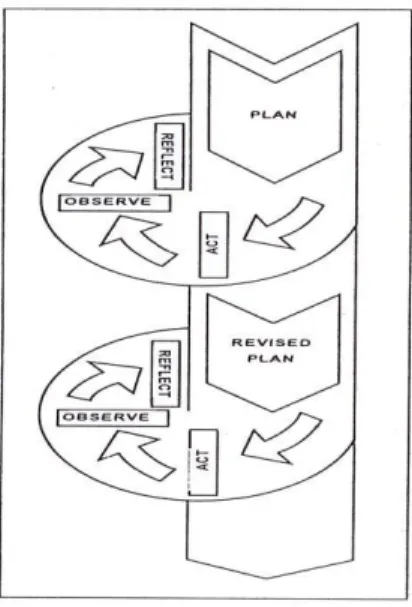
Classroom action research (CAR) has various models but in this research the writer will use Kemmis and McTaggart (1988) research design. According to Kemmis and McTaggart as cited by Anne Burns, action research is dynamic and complementary process which consists of four essential phases such as planning, action, observation, and reflection in spiral system.26 Those phases can be seen by following figure:
Figure 1. The ‗action research spiral‘ (based on Kemmis and McTaggart).
26Anne Burns, Collaborative Action Research for English Language Teacher, (Cambridge: Cambridge University Press, 1999), p.32
28
2. Action Plan
Based on Kemmis and MacTagart‘s research design, the steps of the research cover four phases in each cycle. They are the following:
a. Cycle 1 1) Planning
In the first phase, after analyzing the finding of the preliminary study such as identifying and diagnosing student‘s problem in speaking ability that occurred in the classroom and concluding the finding in preliminary study. Then the writer and the collaborator (teacher) prepare some plans to conduct the classroom. They are the following:
a) The researcher prepared the lesson plan including teaching procedure, media, and relevant material to be applied in acting phase.
b) The researcher prepared learning resource for students.
c) The researcher used Matching Game to be applied in acting phase improve students‘ speaking ability.
d) The researcher prepared observation format and also evaluation format to evaluate the student‘s activity after teaching and learning process.
e) The researcher and the collaborator designed the criteria of success.
2) Acting
Doing action is the second step in activity. It is implementation in a planning about action in the class.
Without the action the planning just imagination that never can be real. In this phase, the researcher applied the planning of strategy and scenario learning as follows ;
a) Giving explanation about the material.
b) Asking the students to make a pair.
c) The teacher gives explanation of the procedures of Matching game.
d) Then asks the students to complete the task.
e) The teacher gives scored of student‘s speaking ability personally and observes their problems. So, it can be references to improve the action in next meeting.
f) Giving guidance and task to the students for next meeting..
3) Observing
In the third phase, the researcher observed the student‘s activity, their participations, class situation during teaching and learning process, and teacher (researcher) performance by using structured observation form and makes note the overall activities. Furthermore, the researcher also collected the data from the post test and the result of student‘s activity. The
30
researcher observed the overall activities to find out the effectiveness of teaching and learning process which has been occurred and the result concluded and discussed in reflecting phase.
4) Reflecting
In the fourth phase, the researcher and the collaborator discussed about the data that have been collected from all the activities from the acting phase until observing phase. In this phase, the researcher and the collaborator also analyzed the teacher performance during teaching and learning process and students‘ speaking ability to find out whether the implementation of Matching game run successful or unsuccessful by identifying strength and weakness. If there still found the problems the researcher and collaborator conducted the next cycle and use the collected data in cycle one as the reference by repairing all the problems or weaknesses in previous cycle.
b. Cycle 2
1) Re-planning
In the first phase, before conducted the action in the next phase, the researcher repaired the problem found in cycle one. It will be explained as follow:
a) The researcher analyzed the reflection result to obtain the solving problem.
b) The researcher revised and prepared the lesson plan based on the problem appears in the previous cycle including teaching procedure, media, and relevant material to be applied in acting phase.
c) The researcher rearranged observation format and also reforms the evaluation format to improve the planned indicators that have not been achieved yet in the previous cycle.
2) Acting
Doing action is the second step in activity. It is implementation in a planning about action in the class.
Without the action the planning just imagination that never can be real. In this phase, the researcher applied the planning of strategy and scenario learning as follows ;
a) Giving explanation about the material.
b) Asking the students to make a pair.
c) The teacher gives explanation of the procedures of Matching game.
d) Then asks the students to complete the task.
32
e) The teacher gives score of student‘s speaking ability personally and observes their problems. So, it can be references to improve the action in next meeting.
f) Giving guidance and task to the students for next meeting.
3) Observing
In the third phase, the researcher observed the student‘s activity, their participations, class situation during teaching and learning process, and teacher (researcher) performance by using structured observation form and makes note the overall activities. Furthermore, the researcher also collected the data from the post test and the result of student‘s activity.
4) Reflecting
In the fourth phase, the researcher and the collaborator discussed about the data that have been collected from all the activities from the acting phase until observing phase. In this phase, the researcher and the collaborator also analyzed the teacher performance during teaching and learning process and students‘ speaking ability to find out whether the implementation of Matching game run successful or unsuccessful by identifying strength and weakness. If there still found the problems the researcher and collaborator conducted the next cycle and use the collected data in cycle
one as the reference by repairing all the problems or weaknesses in previous cycle.
L. Data Collection Technique
For this research, there are three techniques which will be used by the researcher to collected the data such as observation, documentation, and test.
They can be explained as follows:
1. Observation
Observation is data collection technique which is carried out by observing each occurrence is taking place and making notes using observation instrument about the matter which will be observed or researched. In this case the researcher used observation to obtain the data about students‘ activity or participation and teacher performance in the classroom which is observed by observer.
2. Documentation
Documentation is data collection method that is used for getting information from the written source or document, for instance books, magazines, notes, and other. The researcher will use documentation to obtain the data about the school profile such as history of the school, the number of teacher and staff officer and students at SMP Muhammadiyah Sekampung. Besides, the documentation is used to visualize the classroom activity in the form of photograph.
34
3. Test
The test that will be used in this research is oral test of speaking ability. The test consists of two kinds of test, they are Pre-test and Post- test. The two tests are as follow
a. Pre test
After observing the subject‘s activities, the researcher gives pre test to know the level of the students‘ speaking ability before giving treatments. The pre-test is done to find out how the students can speak up in the class,
b. Post test
Second, post-test is examined to the students after they are taught speaking through matching game as the treatment. To find out the improvement before and after giving treatment. It can be seen by comparing the result between pre-test and post-test.
M. Research Instrument
Instrument is a mechanism for measuring, which is used to gather and record information for assessment, decision making, and ultimately understanding.27 In this research, the research instrument designed by the researcher. There are 3 kinds of instrument they are observation sheet, documentation guidance, and test guidance. Farther more, the three kinds of instrument can be explained as a follow:
27 David Colton & Robert W.Covert, Designing and Constructing Instrument for Social Research and Evaluation. (San Francisco: Jossey, Bass, 2007), p.5.
1. Observation Guidance
a. The students learning activity
b. Teacher performance in the classroom 2. Documentation guidance
a. The history of the school
b. The condition of teachers and official employee c. The condition of students
d. Learning facilities
e. Organization structure and
f. Location sketch at SMP Muhammadiyah Sekampung.
3. The Test Guidance a. Instrument Blueprint
The test is oral test which has some indicators as follows: the indicator of matching game is the students are able to communicate orally and actively with the teachers, and other students. The last, the indicator of Students‘ speaking ability is the students can be good speakers in comprehension, grammar, vocabularies, pronunciation, and fluency.
b. Instrument Calibration
Instrument calibration is used to know the validity. In that case validity has three distinct aspects; they are content validity, criterion validity and construct validity. Content validity refers to the content
36
of the manifest variable is right to measure the talent concept that the writer tries measure.
The researcher will use content validity in order the instrument has a good quality and the instrument will be relevant to the focus of the research. Therefore, the researcher used content validity based on the syllabus and materials at the eighth grade of SMP Muhammadiyah Sekampung in academic year 2017 / 2018.
G. Data Analysis Technique 1. Formula
Data analysis will be taken from the average score of the pre-test and post-test in cycle 1 and cycle 2. The formula to get the average as follow:
X = Note
X = Average score
∑x = Total Score of the Students N = Total of Students.28
28 Donald A ry, et.al, Introduction to Research., p.108
N. Indicator of Success
This research would take success indicator to know improving students‘
speaking ability through matching games. The researcher compared between pre-test, tests, and post-test. If 80% the students can get the score ≥ 70 it means that Matching game is success to be used as a strategy in teaching and learning process, especially in speaking subject.
38 CHAPTER IV
RESULT OF THE RESEARCH AND INTERPRETATION A. Description of The Research Location
The general description that assessed as the complementary data. It is subjectively concerned in condition of school namely the history of the school, geographical of school, building condition of school, and structure of organization.
1. The History of SMP Muhammadiyah Sekampung
SMP Muhammadiyah Sekampung is located on Jl. Raya Sekampung No.57, Giri Klopomulyo village that has wide about 5790 m2. It is having a distance about 1 km from district office of Sekampung. SMP was founded in 1973. However, it began operating in 1974.
Since it was established the leader headmaster of the school had been changed as follow :
a. Drs. Jaidun Danu Wikarso (1973-1980) b. A. Misbah Abu Hanafi (1980-1985) c. M. Ali A.S. (1985-2002)
d. Drs. Sukri (2004-2007) e. Tugino, S.Pd (2007-20011)
f. Eko Hariyanto, S.Pd (2011 until now)
SMP Muhammadiyah Sekampung has a satisfy facilities to support both the learning process and extracurricular program it provides some extracurriculars such as :
1) Sport programs like futsal, football, and volleyball 2) OSIS, UKS, and Scouting Movement
Specifically, the facilities in SMP Muhammadiyah Sekampung as follows :
1) The headmasters‘ room 2) The administration room 3) The teachers‘ room
3. The total of the teachers and the students in SMP Muhammadiyah Sekampung
Junior High School Muhammadiyah Sekampung has 16 teachers, staff teachers, and 105 students. The total of the students devided some classes that can be identified as follow :
Table 5
The number of SMP Muhammadiyah Sekampung East Lampung
No Class Sex
Total Male Female
1. VII (Seven) 16 24 40
2. VIII (Eight) 20 24 44
3. IX (Nine) 8 13 21
Total 105
Source : Documentation of SMP Muhammadiyah SekampungEast Lampung
40
Table 6
The number of teachers SMP Muhammadiyah Sekampung East Lampung
NO NAME
EDUCATIONAL BACKROUND
YEAR
1 EKO HARIYANTO, S.Pd S 1 2004
2 ADAM ROFANI, S.Pd S 1 2008
3 SUGONDO, S.Pd.I S 1 2001
4 TUGINO, S.Pd S 1 1996
5 Dra. SITI AMINAH S 1 2001
6 FATIMAH S.Pd S 1 2001
7 AMBARWATI, S.Kom S 1 2004
8 ABDI WAHYUDHI, S.Pd S 1 2005
9 RICA AGUSTINA, S.Pd S 1 2007
10 AHMAD ZAINUDDIN, S.Pd.I S 1 2012
11 HENDRO YATMOKO, S.Pd S 1 2012
12 NISAUL KHOIRIYAH, S.Pd S 1 2012
13 DINA PRISTIANI, S.Pd S 1 2012
14 ISMAIL S.Pd.I S 1 2012
15 KASTIMAN, S.Pd S 1 2014
16 PUTRI TRI HARSARI S 1 2015
Source :Documentation of SMPMuhammadiyahSekampungEast Lampung
4. The vision and mission of SMP Muhammadiyah Sekampung a. The vision of SMP Muhammadiyah Sekampung
―The formation of students who excel, have a noble character, smart, achievement, and responsible.‖
b. The mission SMP Muhammadiyah Sekampung
1) Increasing the appreciation and practice of Islamic teaching
―Amar Ma’ruf Nahi Munkar‖.
2) Implementing effective and efficient learning and guidance.
3) Improving the academic and non academic skills.
4) Improving the discipline and high work ethic and excellent service.
5) Establishing harmonious cooperation between the school community and the related environment.
5. The condition of SMP Muhammadiyah Sekampung a. Schools‘ name : SMP Muhammadiyah Sekampung
b. Schools‘ address : Jl. Raya Sekampung No.57, Giri Klopomulyo, Sekampung, East Lampung
c. The status : Accredited of B d. Schools‘ map :
42
K.VIII 2K.VIII 1K.VIIK.IX
R.GURU
PERPUSTAKAAN
KANTIIN KANTIN
SALURAN IRIGASI
R.KEPSEK DAPUR GUDANG
BANGUNAN SMK MUHAMMADIYAH
JALAN RAYA SEKAMPUNG
JEMBATAN JEMBATAN
LAPANGAN FUTSAL
PARKIR MOTOR
KANTIN
PAGAR KELILING
DENAH SEKOLAH SMP MUHAMMADIYAH SEKAMPUNG
GERBANG SEKOLAH
Source : Documentation of Junior High School Muhammadiyah Sekampung
This research used classroom action research. The purpose of this research was to improve the students‘ speaking ability and the students result among the eighth graders of SMP Muhammadiyah Sekampung. The research was conducted in two cycles where the researcher did pre test before the treatment. The researcher used the use of Matching game to improve the students‘ speaking ability. The research result was gotten through test that conducted in the end of each cycles while the data of students‘ activity was gotten from the observation during the learning process.
a. Cycle 1 1) Planning
The researcher and the collaborator/English Teacher (Mrs.
Nisaul Khoiriyahi, S.Pd) prepared some plans to conduct the classroom, as follow:
a) The researcher prepared the lesson plan including teaching procedure, media, and relevant material to be applied in acting phase.
b) The researcher prepared learning resource for students.
c) The researcher used Matching Game to be applied in acting phase improve students‘ speaking ability.
d) The researcher prepared observation format and also evaluation format to evaluate the student‘s activity after teaching and learning process.
44
e) The researcher and the collaborator designed the criteria of success.
2) Acting
The action in the cycle 1 consist of three meetings, one meeting for the pre-test, one meetings for the action, and one meeting for the post test, there are:
a) The first meeting
The first meeting was held on Wednesday, November 8th, 2017 carried out for 2 sessions (2 x 40 minutes). This meeting was started by praying and greeting, and checking the attendance list. This meeting was used for conducting pre-test. The test was about the students‘ speaking ability.
Kind of test was spoken test where the students should give the opinion about two picture that is supermarket and traditional market. Some students were enjoying the task and others looked so worry. The score of students speaking skill in pre-test, as follow:
Table 7
The Table of Students’ Speaking Score (Pre Test)
No Name
ASPECT* Total
S c o re
Score Category F P V G I
S
1 ANH 4 2 3 2 3 14 70 Complete
2 ADY 4 3 3 2 2 14 70 Complete
3 AAP 3 2 3 2 3 13 70 Incomplete
4 AYS 2 2 3 2 3 12 60 Incomplete
5 EA 2 2 3 2 3 12 60 Incomplete
FK 4 3 3 2 3 15 75 Complete
7 FAL 2 2 3 2 3 12 60 Incomplete
8 GC 3 2 3 2 2 12 60 Incomplete
9 JA 3 3 3 3 3 15 75 Complete
10 MZAG 2 2 2 3 2 11 55 Incomplete
11 NR 2 1 2 2 2 9 45 Incomplete
12 PY 2 1 2 2 1 8 40 Incomplete
13 RNL 3 3 4 2 3 15 75 Complete
14 RM 2 2 3 3 2 12 60 Incomplete
15 RTWD 3 3 3 2 3 14 70 Complete
16 RLAS 3 3 2 3 2 13 65 Incomplete
17 RDAY 2 1 2 1 2 8 40 Incomplete
18 RP 2 2 3 1 2 10 50 Incomplete
19 F 2 2 3 3 2 12 60 Incomplete
20 SMA 2 2 3 1 3 11 55 Incomplete
21 SM 2 2 2 2 3 11 55 Incomplete
22 SA 2 2 3 2 2 11 55 Incomplete
23 DAS 2 2 3 2 2 11 55 Incomplete
24 HS 1 2 2 2 2 9 45 Incomplete
Total 1425
Average 59,375
Highest Score 75
Lowest Score 40
Table 8
The Frequency of the Students’ Score in Pre-Test No Students’
Score Percentage Frequency Explanation
1 ≥70 25% 6 Complete
2 <70 75% 18 Incomplete
Total 100% 24
The result of the pre-test showed that there were 18 students incomplete to achieve the minimum mastery of criteria (MMC). There were only 6 students (25%) who gained score 70 or above, and 18 students (75%) who gained