Animal Feed Mill
(Inclusive of Urea Molasses Block Preparation)
Small and Medium Enterprise Development Authority Government of Pakistan
www.smeda.org.pk
HEAD OFFICE
3rd Floor, Aiwan-e-iqbal complex, Egerton Road, Lahore Tel 042- 111 111 456, Fax 6304926-7 Website www.smeda.org
REGIONAL OFFICE PUNJAB 4th Floor, Aiwan-e-iqbal
complex, egerton road Lahore, Tel: (042) 111-111-456
Fax: (042)6304926-7 [email protected]
REGIONAL OFFICE SINDH 5TH Floor, Bahria Complex II, M.T. Khan Road,
Karachi.
Tel: (021) 111-111-456 Fax: (021) 5610572 [email protected]
REGIONAL OFFICE NWFP Ground Floor State Life Building The Mall, Peshawar.
Tel: (091) 9213046-47 Fax: (091) 286908 [email protected]
REGIONAL OFFICE BALOCHISTAN Bungalow No. 15-A Chaman Housing Scheme
Airport Road, Quetta.
Tel: (081) 831623, 831702 Fax: (081) 831922 [email protected]
June, 2017
Table of contents
1 DISCLAIMER……….2
1 DISCLAIMER ... 4
2 EXECUTIVE SUMMARY ... 5
3 INTRODUCTION TO SMEDA ... 6
4 PURPOSE OF THE DOCUMENT ... 6
5 BRIEF DESCRIPTION OF PROJECT AND PRODUCT ... 7
5.1 PROJECT BRIEF ... 7
5.2 PROJECT LEGAL STATUS ... 7
5.3 PROJECT INSTALLED AND OPERATIONAL CAPACITY ... 7
5.4 PROJECT PROPOSED LOCATION ... 7
5.5 PRODUCTION PROCESS FLOW FOR COMPOUND FEED ... 8
5.6 PRODUCT RAW MATERIAL REQUIREMENT ... 8
A) CLASSIFICATION OF FEED INGREDIENTS: ... 8
B) PROTEIN FEEDSTUFFS: ... 9
C) CARBOHYDRATE/ENERGY FEEDSTUFFS: ... 9
D) MINERAL SUPPLEMENTS: ... 9
E) FATS AND OILS: ... 9
F) FEED FORMULA FOR CATTLE/BUFFALOES: ... 9
5.7 PRODUCT RAW MATERIAL REQUIREMENT (UMB) ... 10
a) Protein Sources: ... 11
b) Carbohydrate Sources: ... 11
c) Mineral supplements: ... 11
5.8 PRODUCTION PROCESS OF UREA MOLASSES BLOCK (UMB) ... 12
A) PROCESS FLOW OF UMB ... 12
B) PREPARATION OF FEED INGREDIENTS ... 12
c) Molasses ... 12
d) Urea ... 13
e) Salt... 13
f) Cement or quicklime ... 13
g) Bran ... 13
h) Equipment for mixing: ... 13
i) Introduction of the Product components ... 14
j) Molding ... 14
k) Cutting the blocks ... 15
2
A) SPECIES OF LIVESTOCK ... 16
B) FEEDING PERIOD ... 16
C) MINIMUM ROUGHAGE REQUIREMENTS ... 16
D) ADAPTATION OF ANIMALS ... 16
E) FEEDING SYSTEM ... 16
F) ESTABLISHING PRIORITIES ... 17
5.10PROJECT ESTIMATED TIME FOR COMPLETION ... 17
5.11PRODUCT LEGAL REQUIREMENTS ... 17
5.12PRODUCT PACKAGING COST ... 17
6 CRITICAL FACTORS ... 17
7 GEOGRAPHICAL POTENTIAL FOR INVESTMENT ... 18
8 POTENTIAL TARGET CUSTOMERS / MARKETS ... 18
9 PROJECT COST SUMMARY ... 19
9.1 PROJECT ECONOMICS... 19
9.2 PROJECT FINANCING ... 20
9.3 PROJECT COSTS ... 20
9.4 LAND REQUIREMENT ... 21
9.5 COVERED AREA REQUIREMENT ... 21
9.6 MACHINERY REQUIREMENT ... 22
9.7 FURNITURE & FIXTURES REQUIREMENT ... 24
9.8 OFFICE EQUIPMENT REQUIREMENT ... 24
9.9 VEHICLE REQUIREMENTS ... 25
9.10HUMAN RESOURCE REQUIREMENT ... 25
9.11UTILITIES AND OTHER COSTS ... 25
9.12REVENUE GENERATION ... 26
10 CONTACT DETAILS ... 26
11 USEFUL WEB LINKS ... 27
12 ANNEXURES ... 28
12.1INCOME STATEMENT ... 28
12.2BALANCE SHEET ... 29 12.3CASH FLOW STATEMENT ... 30 13 KEY ASSUMPTION ... 31
1 DISCLAIMER
This information memorandum is to introduce the subject matter and provide a general idea and information on the said matter. Although, the material included in this document is based on data/information gathered from various reliable sources; however, it is based upon certain assumptions, which may differ from case to case. The information has been provided on as is where is basis without any warranties or assertions as to the correctness or soundness thereof. Although, due care and diligence has been taken to compile this document, the contained information may vary due to any change in any of the concerned factors, and the actual results may differ substantially from the presented information. SMEDA, its employees or agents do not assume any liability for any financial or other loss resulting from this memorandum in consequence of undertaking this activity. The contained information does not preclude any further professional advice. The prospective user of this memorandum is encouraged to carry out additional diligence and gather any information which is necessary for making an informed decision; including taking professional advice from a qualified consultant/technical expert before taking any decision to act upon the information.
For more information on services offered by SMEDA, please contact our website:
www.smeda.org.pk
Document Control
Document No. PREF-85
Revision No. 2
Prepared by SMEDA-Punjab Revision Date June, 2017
For information [email protected]
2 EXECUTIVE SUMMARY
Livestock production is an integral part of Pakistan's agriculture sector and plays a vital role in national economy. At present, livestock is contributing about 52% to the agricultural sector and 10.9% to the GDP. The role of livestock in rural economy may be assessed by the fact that 30 to 35 million of the total rural population is engaged in livestock farming, having 2 to 3 cattle/buffalo and 5 to 6 sheep/goats per family deriving 30 to 40 per cent of income from it. Pakistan's livestock population is supported by feed resources derived from the crops sector, rangelands, grazing areas and agro industrial by-products. The type, availability and utilization of these feed resources vary greatly in the country's different agro ecological zones.
The purpose of this document is to facilitate potential investors in for investing in a
“Animal Feed Mill” by providing them with a general understanding of the business with the intention of supporting potential investors in crucial investment decisions. This pre-feasibility suggests production of 12,000 tons of animal feed and 60,000 Urea Molassis Blocks (UMB) annually. However the proposed project will be started with an initial capacity of 60% i.e. 7,200 tons of animal feed and 36,000 UMB. This production capacity justifies the running cost of the project.
Animal feed and UMB Mill can be designed with a wide range of processing capacity and product mix depending upon the demand, according to availability of feed stuffs and their storage capacity. However, it is suggested that the viable economic unit should have a capacity of preparing 5 tons of compound feed and 25 UMB per hour respectively.
The total project cost is estimated at Rs. 90.42 million including a capital cost &
working capital of Rs. 46.02 million and Rs. 44.40 million respectively. Projected IRR, NPV and Payback period for the proposed project are 38%, Rs. 213.60 million and 4.10 years respectively.
3 INTRODUCTION TO SMEDA
The Small and Medium Enterprises Development Authority (SMEDA) was established in October 1998 with an objective to provide fresh impetus to the economy through development of Small and Medium Enterprises (SMEs).
With a mission "to assist in employment generation and value addition to the national income, through development of the SME sector, by helping increase the number, scale and competitiveness of SMEs", SMEDA has carried out ‘sectoral research’ to identify policy, access to finance, business development services, strategic initiatives and institutional collaboration and networking initiatives.
Preparation and dissemination of prefeasibility studies in key areas of investment has been a successful hallmark of SME facilitation by SMEDA.
Concurrent to the prefeasibility studies, a broad spectrum of business development services is also offered to the SMEs by SMEDA. These services include identification of experts and consultants and delivery of need based capacity building programs of different types in addition to business guidance through help desk services.
4 PURPOSE OF THE DOCUMENT
The objective of the pre-feasibility study is primarily to facilitate potential entrepreneurs in project identification for investment. The project pre-feasibility may form the basis of an important investment decision and in order to serve this objective, the document/study covers various aspects of project concept development, start-up, and production, marketing, finance and business management.
The purpose of this document is to facilitate potential investors in for investing in
“Animal Feed Mill” by providing them with a general understanding of the business with the intention of supporting potential investors in crucial investment decisions.
The need to come up with pre-feasibility reports for undocumented or minimally documented sectors attains greater imminence as the research that precedes such reports reveal certain thumb rules; best practices developed by existing enterprises by trial and error, and certain industrial norms that become a guiding source regarding various aspects of business set-up and it’s successful management.
Apart from carefully studying the whole document one must consider critical aspects provided later on, which form basis of any investment decision.
5 BRIEF DESCRIPTION OF PROJECT AND PRODUCT
5.1 Project Brief
The proposed project will have a total production capacity of 12,000 tons of compound animals feed and 60,000 no. of Urea Molasses Block (UMB). This feed and UMB will be supplemented to livestock in addition to green fodder and libitum (Freely available to animals) for high production. Different formulae may be used to prepare compound feed such as calf fattening formula and dairy animal formula etc. to facilitate the customers nationwide. The proposed business will be manufacturing compound animal feed and Urea Molasses Block (UMB) for meeting the demand of dairy and livestock farmers.
5.2 Project Legal Status
The proposed legal structure of the business entity is either sole proprietorship or partnership. Although selection totally depends upon the choice of the entrepreneur but this financial feasibility is based on a Sole Proprietorship.
5.3 Project installed and operational Capacity
This pre-feasibility suggests production of 12,000 tons of animal feed and 60,000 UMB annually. However the proposed project will be started with an initial year capacity of 60% i.e. 7,200 tons of animal feed and 36,000 UMB. This production capacity justifies the running cost of the project.
5.4 Project Proposed Location
Feed mill should be in an area where there is more product demand e.g. near the areas where dairy and livestock farming is already being done. These areas include:
Karachi
Lahore
Rawalpindi
Multan
Faisalabad
Sahiwal
Jhang
Okara
Bahawalpur
Sargodha
Gujranwala etc.
5.5 Production process flow for compound feed The compound feed preparation process requires:
a) high accuracy and precision of weighing b) feed ingredient handling and processing c) crushing / grinding
d) mixing e) packing f) labeling
Figure 1 Process Flow Diagram
A liquid storage and a direct-weight system for adding fat, molasses, and water is required. Grain processing is done through hammer mill grinding. Mixed feed is delivered in bags or bulk load out to livestock farms.
5.6 Product Raw Material Requirement
Cattle are ruminant animals with four compartment stomach, capable of utilizing fibrous feedstuffs (forages, roughage, and by product feeds) and Non-Protein Nitrogen (NPN) source like urea that humans cannot utilize. By producing a high- quality protein from these resources otherwise unusable by humans, cattle make a positive contribution to human nutrition in terms of meat and milk.
a) Classification of feed ingredients:
Feeds or feedstuffs are composed of several distinctly different groups of substances, known as nutrients e.g. proteins, carbohydrates, fats, minerals, vitamins and water. These have definite functions in body. For intelligent ration formulation, nutrients, nutrient composition and palatability of feedstuffs are important. These feedstuffs are grouped as follow,
Storage or Exit
Feed ingredients
(Trucks)
Feed Analysis in laboratory
Acceptance of feed ingredients
Separators and conveyors
Hoppers
Crushing by hammer mill
Dosage bin (separate for
each feed) Mixer
Conditioning (Molasses,
Minerals) Packing
b) Protein feedstuffs:
Common protein feedstuffs from plant origin are residues of oilseed after expeller or solvent extraction or products of wet milling of maize in starch making process.
Nutritive value of protein feedstuffs depend upon their available amino acid composition, toxic materials and the changes brought during processing if any.
Rape seed cake/meal
Canola meal
Cotton seed cake/meal
Sunflower cake/meal
Corn gluten meal (30 or 60%)
Sesame cake/meal
Urea
Milk by products
Maize oil cake
c) Carbohydrate/energy feedstuffs:
These are the products with less than 20%crude protein and 18% crude fiber.
Molasses
Rice polish
Corn by products such as, Corn glutens; Corn steep liquor and enzose.
d) Mineral supplements:
Salt (white/black)
Bone meal
Dicalcium phosphate (DCP) e) Fats and oils:
This source of energy can be obtained from meat processing industry, refining of vegetable oils or vegetable oils itself.
f) Feed Formula for Cattle/Buffaloes:
These feed ingredients when mixed according to feed formula will provide adequate energy according to type, breed and physiological status of animal.
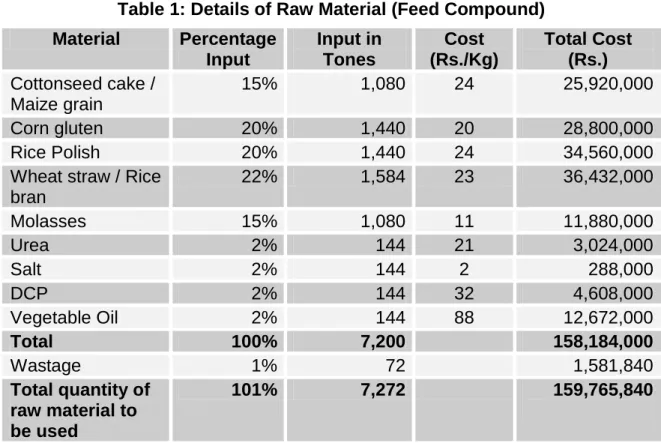
Table 1: Details of Raw Material (Feed Compound) Material Percentage
Input
Input in Tones
Cost (Rs./Kg)
Total Cost (Rs.) Cottonseed cake /
Maize grain
15% 1,080 24 25,920,000
Corn gluten 20% 1,440 20 28,800,000
Rice Polish 20% 1,440 24 34,560,000
Wheat straw / Rice bran
22% 1,584 23 36,432,000
Molasses 15% 1,080 11 11,880,000
Urea 2% 144 21 3,024,000
Salt 2% 144 2 288,000
DCP 2% 144 32 4,608,000
Vegetable Oil 2% 144 88 12,672,000
Total 100% 7,200 158,184,000
Wastage 1% 72 1,581,840
Total quantity of raw material to be used
101% 7,272 159,765,840
Note: There are seasonal fluctuations in the prices; hence the formula has to be changed accordingly keeping the feed cost competitive to compete the market.
The information useful here is the composition of the feed ingredients. The feed mill owner can hire a technical person to formulate a least cost ration, as formulation of ration is a technical job. The basic feed ingredients can be procured from local mandies.
5.7 Product Raw Material Requirement (UMB)
As the name suggests, Urea Molasses Blocks (UMB) are lick blocks containing urea, molasses, vitamins and minerals. The feeding of the blocks is a convenient and inexpensive method of providing a range of nutrients required by both the rumen microbes and the animal, which may be deficient in the diet. The main justification for using the blocks depends on their convenience for packaging, storage, transport and ease of feeding.
A standard UMB consists of:
a) Molasses 30-50 %
b) Urea 5-10 %
c) Rice/wheat/maize bran 15-25 %
d) Salt 3-5 %
e) Lime or cement 5-7 %
f) DCP 2-4 %
g) Minerals 1-2 %
Table 2: Details of Raw Material (UMB) Description Percentage
Input
Input in Kgs Cost (Rs./Kg)
Total Cost (Rs.) Rice / Wheat Bran 25% 45,000 24 1,080,000 Molasses 50% 90,000 11 990,000
DCP 3% 5,400 32 172,800
White Salt 3% 4,500 2 9,000 Black Salt 3% 4,500 5 22,500
Urea 9% 16,200 21 340,200
Cement 7% 12,600 21 264,600 Calcium Oxide 1% 1,800 5 9,000
Total 100% 180,000 2,888,100
Wastage 1% 1,800 28,881
Total Raw Material (UMB)
101% 181,800 2,916,981
The manufacture of UMB is done in advance of their proposed use. If they are to be used as a supplement during the dry season, when the quality of forage is very low, their production should start before this period in order to have sufficient numbers of blocks available when required. But in view of the hygroscopic nature of the components, as well as of the blocks, it is better not to start production before the onset of the dry season and use it maximum after 3 months of their manufacturing.
a) Protein Sources:
For urea molasses blocks (UMB), these are;
Cotton seed cake/meal
Corn gluten meal (30 or 60%)
Urea
b) Carbohydrate Sources:
These are the products with less than 20% crude protein and 18% crude fiber.
Molasses
Corn by products such as corn cobs or other corn by products c) Mineral supplements:
Salt (white/black)
Bone meal
Dicalcium phosphate (DCP)
be changed from time to time keeping in view the cost of ingredients used in the formula. And the cost of feed ingredient is never static.
5.8 Production Process of Urea Molasses Block (UMB) a) Process Flow of UMB
The requirements are:
a) Accuracy and precision of weighing (the standard scale should be OK) b) Ingredient handling and processing
c) Premixing of salts d) Mixing
Figure 2 Process Flow of UMB
Urea-molasses blocks (UMB) may be manufactured either on a small or on a larger scale depending on the number of uses and the expected length of the feeding period. Whatever scale of production is applicable the method of manufacture will be the same; the difference being the quantities of feed ingredients and the implements used in the manufacturing process. Industry experience shows that blocks weighing 5 kg are most appropriate for feeding dairy cattle under smallholder situations. Assuming a daily intake of around 700 g/cow, each block will last for 7 days. Therefore, blocks can be replaced once a week on a specific day, making it a regular activity for the farmer.
b) Preparation of feed ingredients
All components should be weighed out before mixing. A standard volume or weight can be adopted for each component which would correspond with the weight of the block desired.
c) Molasses
For the molasses no preparation is necessary apart from measuring the quantity.
Even if handling the molasses is a little difficult it should not be diluted with water.
When ordering molasses from the sugar factory specify 'undiluted' molasses and check the BRIX value when the molasses is received. Molasses can be stored in the same tank as that used for transporting it. If the quantity of blocks manufactured is large enough, it might be preferable to have two tanks in order to avoid running out of stock. Molasses is a thick, viscous material, which is a by- product of the sugar industry. Being a concentrated by-product, it provides a range of trace minerals and a complete mixture of vitamins. It is high in soluble
carbohydrates. Although a cheaper source of energy, it is not commonly used by farmers due to difficulty in handling. Molasses can be included in ration by mixing it with other concentrates in the form of licks. Molasses increases the palatability and consumption of poor quality roughage and is a good carrier for urea as Non- Protein Nitrogen (NPN) source for livestock (ruminants).
d) Urea
The introduction of urea in the form of lumps in the mixture must be avoided in order to eliminate chances of urea toxicity in livestock. It may be necessary to crush the lumps, either by hand or by passing the urea through a hand mill and sieve. Urea contains 46% nitrogen, which is equivalent to 87% crude protein and is rapidly digested by ruminants. Urea provides the small amount of extra nitrogen required, for utilization of the dry matter, in addition to that present in the forage.
The UMB, therefore, provides the nutrient requirements of both the microbes and the host animal. The ingredients are designed to provide a wide rage of nutrients to cover all potential deficiencies. But the UMB should be fed only in limited quantities. The UMB is designed in such a way that animals can only lick it but not chew it. Because by chewing the animals will eat more urea per unit of time than they can handle and can result in urea toxicity in the animals
e) Salt
As with the urea it is better to avoid lumps. The salt could be mixed with cement and then water added to improve the setting of the blocks.
f) Cement or quicklime
Cement should be mixed with water and salt. The quantities are:
3-4 liters of water
2.5 kg of salt per 10 kg of cement.
If quicklime is used it should be finely ground and it's reaction to the addition of water tested.
g) Bran
Bran does not need any preparation. However, bran is replaced by another fiber source such as peanut hulls or straw, these materials should be ground before mixing. Experience show that sometimes coarse grinding of fibrous material gives a better consistency to the block than fine grinding, especially if polishing are being included. Cereal brans are high in phosphorus, trace minerals and also a range of vitamins. In addition they provide a slow release amino acid source from the relatively insoluble proteins to the microbes.
(say 150-200 UMB) are needed then manual mixing is possible. With 2 laborers, approximately 200 blocks of 5 kg each could be made over a period of 8 hours shift. However, for producing larger numbers of blocks, a concrete mixer is recommended. The cylinder of this concrete mixer should turn horizontally and as slowly as possible, to avoid the molasses, which is highly viscous, sticking to the side of the mixer. Spillage of the mixture should also be avoided. For bigger units it is recommended that a horizontal paddle mixer is installed (the ribbon mixer used in feed manufacture is not suitable) with one or two axles and a discharge valve.
i) Introduction of the Product components
It has been found that the order of introduction of the components plays an important role in the mixing process. The recommended order is as follows:
Molasses
Urea
Salt, minerals etc.
Cement or quicklime
Bran
Following this order a homogenous mixture of the urea, salt and gelling agent in the molasses is assured. Any other components (e.g., minerals, and drugs) to be included are introduced together with the salt. When using a concrete mixer the bran must be introduced in small quantities at a time, in order to ensure a homogenous mix. After a few minutes, when the mixture appears homogenous like peanut butter, the mixer is emptied (e.g. into wheelbarrows if large-scale production is being undertaken) and transported to the molding area.
j) Molding
Moulds are necessary to set the blocks in an acceptable shape. Once set, the frame can be removed for reuse and to allow the drying process to continue.
Moulds can be of different types. The size of the mould(s) will depend on the preferred size of the block(s). The one recommended by the FAO is made out of 4 wooden planks with slots sawn in order to be able to assemble the frame easily.
The dimensions of the frame can vary depending on the expected rate of production and size of blocks. The most appropriate for small scale manufacture of blocks are frames made out of a number of wooden planks with slots cut out to enable easy assembly and removal. Each compartment measures 12 x 10 x 8 inches.
It can hold a urea-molasses block weighing 4.5-5.0 kg. This type of mould is most suitable when drying and storage area is limiting. Since the frames are removable they can be re-used as soon as the urea-molasses mixture has started setting-in.
Small plastic containers have been used successfully in Indonesia for preparing urea-molasses blocks. They produce blocks with acceptable solidity and are suitable for use in small units. An advantage of this type of mould is that the block can be offered to the animal while it is in the plastic container and once the block has been consumed the container can be re-used.
k) Cutting the blocks
Turning out and cutting is necessary when using large moulds. The board can be taken away the day after molding in order to facilitate drying. The cutting will take place later with a flat spade. The spade should be wetted in a bucket between each cut to avoid the mixture from sticking to it. With small plastic moulds, the blocks can be offered to animals while in the mould or the blocks may be removed simply by turning the containers upside down and tapping on the bottom of the container.
l) Drying
After removal of the moulds and cutting up, blocks are arranged on a drying area.
Blocks must not be exposed to direct sunlight, but placed under a shade with good ventilation. After 24 to 72 hours the blocks are dry enough to be transported.
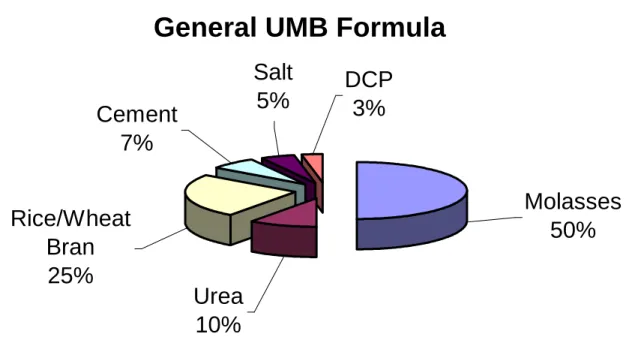
Figure 3: UMB Formula
5.9 Product Utilization guidelines (UMB & FEED)
Some important guidelines towards the optimum utilization of UMB as supplements for forage based diet are described below. Urea molasses blocks should not be fed alone but only as a supplement. It requires a minimum amount of roughage to ensure that the animals are not over fed and thereby avoid urea toxicity.
General UMB Formula
DCP 3%
Urea 10%
Rice/Wheat Bran 25%
Cement 7%
Salt 5%
Molasses
50%
a) Species of livestock
Since the blocks contain urea, therefore, these must only be fed to ruminants (buffalo, cattle, goats and sheep) and never to mono gastric (Single Compartment Stomach) species like chicken, donkeys, horses, pigs, and rabbits or to young, especially pre-ruminant calves, kid and lambs.
b) Feeding period
The aim of the UMB is to improve the utilization of low quality roughage, especially during and at the end of the dry season, when livestock are often dependent on crop residues or low quality dry season grazing, which are low in crude protein and high in fiber. Therefore, the production and distribution of UMB should be limited to these critical periods. There is no advantage in offering blocks when green forage is available, as during the wet and early dry seasons. To avoid wasting resources these should not be made available at these times.
c) Minimum Roughage Requirements
Since Urea Molasses Blocks are supplements, therefore, these should not be fed alone. A minimum quantity of roughage is needed to ensure that the animals do not consume too much urea, possibly leading to urea toxicity. One should remember that the purpose of the block is to improve the utilization of roughage and not to substitute it.
d) Adaptation of animals
The full daily ration of the block (e.g. ±700 g/day per adult cow) should not be offered as soon as the feeding period starts but should be built up to over a period of at least 7-10 days. This is particularly important when animals have suffered a degree of underfeeding, as intake can be more rapid than usual. Animals not used to urea and also eating rapidly are the most likely to suffer from urea toxicity. After the adaptation period, animals will adjust their intakes to around those recommended, i.e., cattle: 700 g/day & small ruminants: 100 g/day. An easy way to restrict intake during the adaptation period is to limit the amount of time the blocks are accessible to an animal. A thumb rule is to offer UMB for one hour per day (about 200g for cattle and 30g for sheep/goat) during the first 3-4 days, then 3 hours per day (about 400 g for cattle and 60 g for sheep/goat) during the next 4-6 days. Thereafter, UMB along with ample supply of drinking water can be offered to them 24 hrs a day.
e) Feeding system
The distribution of the UMB should be done according to the livestock management system. Blocks can be offered to the animals in the evening when they are in their sheds.
f) Establishing priorities
If a farmer has a limited number of blocks available, he must also establish an order of priority for feeding his animals. Priority should be given to pregnant, lactating cows and draught animal.
5.10 Project Estimated Time for Completion
Three months for completion of initial formalities i.e. formation, registration of the company etc.
One year for purchase of land and construction of building.
Six months for sanction of loan (In case, if financing has to be arranged through bank)
5-6 months for purchase of machinery, its installation and testing.
Thirty days for premises furnishing and Labor / Staff appointments.
5.11 Product Legal Requirements
Compound feed is packed in bags of approximately 50 Kgs per bag capacity. The label includes following information:
1) Brand name
2) Date of manufacture
3) Particulars of feed additives
4) Nutritive composition of compound feed
On the other hand, one UMB may be of 5 kgs weight with above information provided on it. It is to be noted that misbranding and adulteration is prohibited according to ‘The Punjab Animal Compound Feed and Feed Stuff Ordinance, 2002’.
5.12 Product Packaging Cost
A 50 kg bag is sold in the market for compound feed which is easily available at a price of Rs. 15. Cost of bags for the first year is approximately Rs. 2,160,000.
6 CRITICAL FACTORS
The feed industry should aim at fully utilizing all low cost feed ingredients available in country such as molasses, urea, by products of edible oil and grain milling industries, minerals and vitamins. Following are some of the major critical factors, which contribute towards the success of the Animal Feed Mill. There is a need to launch programs in following areas to achieve the desired targets.
Feed and Urea Molasses Blocks (UMB) formulation according to modern techniques with proper utilization of locally available cheaper feedstuffs leads to success in dairy and livestock farming hence for feed business too.
Establishment of Animal feed mill with UMB preparation in feed ingredients surplus areas such as sugar mills & oil mills to fully utilize the molasses, oil cakes and other by-products of milling industries to prepare cheaper feed.
Introduce the use of urea molasses block feeding for meeting the protein, energy and mineral requirement of the animal. (This is marketing aspect of the UMB)
Formulate the nutritionally balanced but cheaper formula for feeding animals. This is called Least Cost Ration Formulation.
The farmers having large number of animals (more than 100 animals) can prepare compound feed and UMB on their own farms (Optional) but Animal feed and UMB Mill is an independent enterprise and should not be linked with livestock farming.
The agro industrial by products can be better utilized in formulated compound feed.
In order to meet the rapidly increasing demand for the various kinds of livestock products (Milk & meats), the better rations with improved feed formula are needed to get more meat and milk, for the same feed supplies. By increasing livestock numbers, rather than their average weight, the feed requirements are much larger.
7 GEOGRAPHICAL POTENTIAL FOR INVESTMENT
At present, Pakistan has 215 feed mills1, but only few are preparing compound feed for livestock. Generally, mixed compound feeds are prepared at home by farmers. Feed accounts for almost 70% of total cost of production of milk or meat.
Hence a balanced feed will positively affect milk and meat production of livestock.
The cake is a by-product from oil mills and is a valuable raw material for animal feed. Since animal keeping is worldwide, hence animal feeding is an important component.
Feed mill can be ideally setup in the major surroundings of cities like Multan , Lahore, Faisalabad, Rawalpindindi, Khanewal, Karachi, Peshawar, etc.
8 POTENTIAL TARGET CUSTOMERS / MARKETS
Compound animal feed and UMB is used in all class of livestock throughout the year that the demand never gets affected with seasons. So the proposed business can be started at any time of the year. At the commencement of the proposed
1 Pakistan feed mills association
business, it is important that the entrepreneur must have good knowledge of the production and have contacts with the farmers.
There are few numbers of animal feed mills, which are in operation both in organized sector and informal sector in Pakistan. Livestock sector is utilizing many different feed resources of varying quality and availability. Most small-scale farmers base their livestock enterprises on the use of crop residues, resulting in a low output of milk and meat per animal. The need to make better use of crop residues has prompted considerable research and many promising technologies are now available. New avenues for research and policy development may lie in the adjustment of livestock types and numbers, increased production of fodder, the tapping of new or non-conventional feed resources, and the strategic movement of fodder.
This pre-feasibility study suggests that compound feed bags and UMB will be sold to livestock farmers. Following are some of the target clients for a manufacturer of compound feed.
Dairy farmers
Calf fattening farmers
Sheep farmers
Goat farmers
The price of compound feed per kg and that of one UMB should be lower than that of simple cakes so that farmer could feel it economical. The cheaper the product more will be its use in livestock feeding. To avoid risk of price fluctuations, the feed ingredients should be stored in season of availability.
9 PROJECT COST SUMMARY
9.1 Project Economics
All the figures in this financial model have been calculated for estimated sales of Rs. 244.80 million in the year one. The capacity utilization during year one is worked out at 60% with 10% increase in subsequent years up to the maximum capacity utilization of 100 %.
The following table shows internal rate of return, payback period and net present value of the proposed venture.
Table 3: Project Economics
Description Details
Internal Rate of Return (IRR) 38%
9.2 Project Financing
Following table provides details of the equity required and variables related to bank loan
Table 4: Project Financing
Description Details
Total Equity (50%) Rs. 45,208,702
Bank Loan (50%) Rs. 45,208,702
Markup to the Borrower (%age / annum) 12%
Tenure of the Loan (Years) 5
9.3 Project Costs
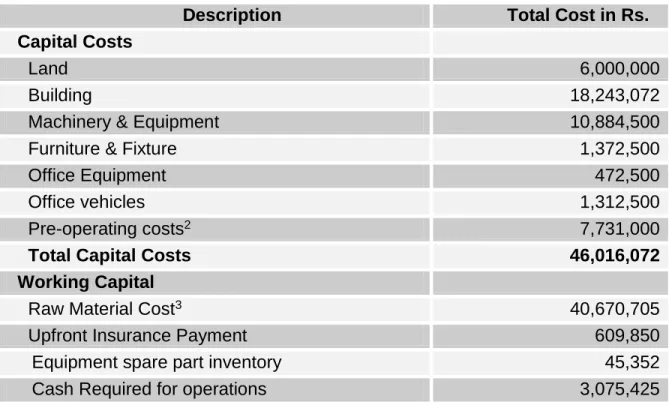
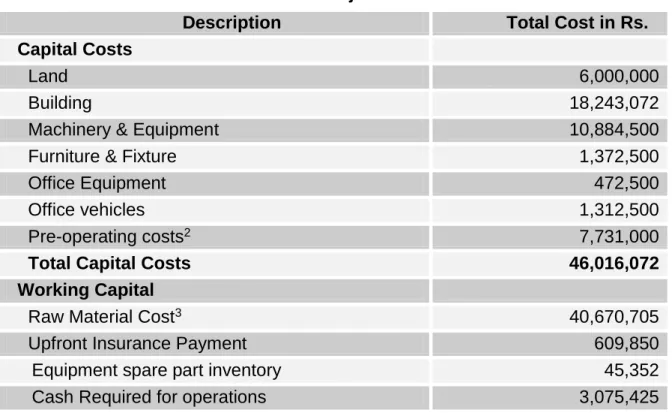
Following fixed and working capital requirements have been identified for operations of the proposed business.
Table 5: Project Cost
Description Total Cost in Rs.
Capital Costs
Land 6,000,000
Building 18,243,072
Machinery & Equipment 10,884,500
Furniture & Fixture 1,372,500
Office Equipment 472,500
Office vehicles 1,312,500
Pre-operating costs2 7,731,000
Total Capital Costs 46,016,072
Working Capital
Raw Material Cost3 40,670,705
Upfront Insurance Payment 609,850
Equipment spare part inventory 45,352
Cash Required for operations 3,075,425
2 These include salaries of administration staff during the period of construction; incorporation charges and interest accrued during first year.
3 This represents all the ingredients and products used to formulate the feed items, and feed packing materials.
Total Working Capital 44,401,332
Total Project Costs 90,417,405
9.4 Land Requirement
The recommended size of Animal Feed & UMB mill is approximately 18,000 square feet (4 kanal) area is required and the Cost of land in the proposed areas is taken to be Rs. 1,500,000 per Kanal. It is recommended to purchase land on preferred locations provided already in this pre-feasibility.
Table 6: Land Cost
Description No. of
Kanal
Rate per Kanal (Rs.)
Total Cost in PKR
Total Land 4 1,500,000 6,000,000
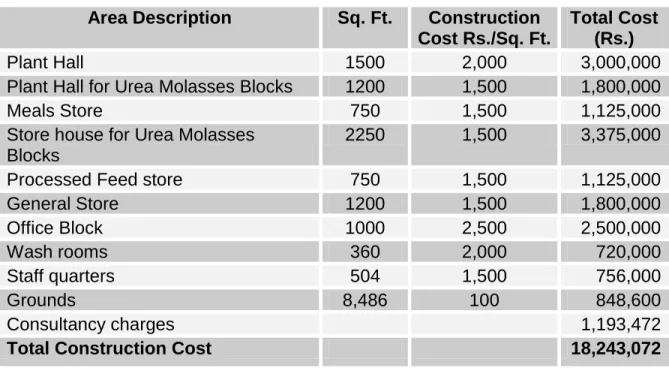
9.5 Covered Area Requirement
Building for the proposed project comprises of two major blocks i.e. office block and factory block. Areas and construction cost for the said blocks are listed in the table below:
Table 7: Covered Area Details
Area Description Sq. Ft. Construction Cost Rs./Sq. Ft.
Total Cost (Rs.)
Plant Hall 1500 2,000 3,000,000
Plant Hall for Urea Molasses Blocks 1200 1,500 1,800,000
Meals Store 750 1,500 1,125,000
Store house for Urea Molasses Blocks
2250 1,500 3,375,000
Processed Feed store 750 1,500 1,125,000
General Store 1200 1,500 1,800,000
Office Block 1000 2,500 2,500,000
Wash rooms 360 2,000 720,000
Staff quarters 504 1,500 756,000
Grounds 8,486 100 848,600
Consultancy charges 1,193,472
Total Construction Cost 18,243,072
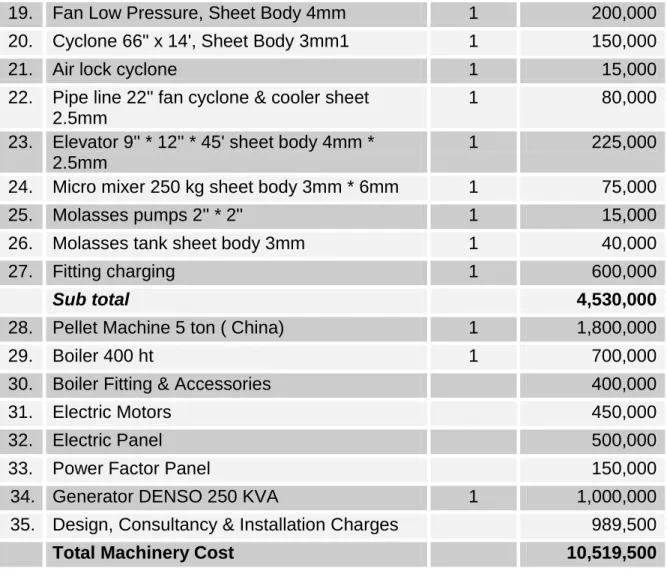
9.6 Machinery Requirement
Following machinery will be required for the proposed project:
Table 8: Machinery Details (Animal Feed Mill)4 Sr.
No.
Machinery Description Quantity Total Cost (Rs.) Grinding Section
1. Hopper Elevator, Sheet Body 3mm 1 25,000
2. Elevator 9"x11"x30" sheet body 3mm Pipe 14G
1 150,000
3. Hammer Mill 16", Sheet Body 10mm 1 250,000
4. Hopper hammer mill, sheet 3mm 2 40,000
5. Packing Wall 1 10,000
6. Hopper Elevator, Sheet 3mm 1 40,000
7. Elevator 12"x9"x45', Sheet Body 4mm Head Boot
1 225,000
8. Rootry Separator, Sheet Body 6mm x 3mm 1 150,000
Mixing Section 0
9. Hopper Mixer 1 Ton, Sheet Body 3mm 2 140,000
10. Mixer 1 Ton, Sheet Body 4mm x 10mm, Shaft 7", Ribbon 50mm x 12mm
1 500,000
11. Molasses Mixer 16", Sheet Body 4mm Shaft 3"x3" with Conveyor
1 150,000
12. Separator (Mash Feed), Sheet Body 3mm Shaft 3"
1 150,000
13. Packing Hopper & Value 1 35,000
14. Separator Pelt, Sheet Body 3mm Shaft 3" 1 200,000
15. Hopper Pelt Mill 5 Ton 1 175,000
16. Air Lock 14", Sheet Body 4mm x 5mm 1 40,000
Pelleting Section 0
17. Center Flow Cooler 10 Ton CPM copy, Sheet Body 3mm with moving grill
1 350,000
18. Crumbles Body 8"x55", Sheet Body 4mm x 6mm with Auto silt
1 500,000
4 UNIVERSAL INDUSTRIES, Opp. Al-Rehmat Filling Station, G.T. Road Gujranwala. Contact Person: Mirza Maqsood Ahmad, Cell: 0300-6400442, Tel: 055-3891318, Fax: 055-3893437.
19. Fan Low Pressure, Sheet Body 4mm 1 200,000 20. Cyclone 66" x 14', Sheet Body 3mm1 1 150,000
21. Air lock cyclone 1 15,000
22. Pipe line 22'' fan cyclone & cooler sheet 2.5mm
1 80,000
23. Elevator 9'' * 12'' * 45' sheet body 4mm * 2.5mm
1 225,000
24. Micro mixer 250 kg sheet body 3mm * 6mm 1 75,000
25. Molasses pumps 2'' * 2'' 1 15,000
26. Molasses tank sheet body 3mm 1 40,000
27. Fitting charging 1 600,000
Sub total 4,530,000
28. Pellet Machine 5 ton ( China) 1 1,800,000
29. Boiler 400 ht 1 700,000
30. Boiler Fitting & Accessories 400,000
31. Electric Motors 450,000
32. Electric Panel 500,000
33. Power Factor Panel 150,000
34. Generator DENSO 250 KVA 1 1,000,000
35. Design, Consultancy & Installation Charges 989,500
Total Machinery Cost 10,519,500
Following machinery will be required for the preparation of UMB:
Table 9: Machinery Details (UMB) Sr.
No.
Machinery Description Quantity Total Cost (Rs.)
1 Mixer Machine 1 80,000
2 Molasses Pump 1 20,000
3 Molasses Pipeline 1 20,000
4 Motor 1 15,000
5 Donkey Pump 1 15,000
6 Flat Spades 4 32,000
10 Molasses Tank 1 120,000
Total cost 365,000
9.7 Furniture & Fixtures Requirement
To furnish the admin block, and other areas of Animal feed mill, the following furniture and fixtures is required:
Table 10: Furniture & Fixture Details
Description No. Unit Cost
(Rs)
Total Cost (Rs.)
Tables with Chairs 5 30,000 150,000
Chairs for visitors 15 7,500 112,500
Sofa set for office 2 35,000 70,000
Energy savers for store, Plant hall and parking area
300 500 150,000
Electric fittings and installation 250,000 250,000 Security cameras with DVR
recording + installation
30 10,000 300,000
Sign board for outside 1 30,000 30,000
Ceiling fans 20 3,500 70,000
Air conditioners (1.5 ton) 4 60,000 240,000
Total 1,372,500
9.8 Office Equipment Requirement
Following is detail of office equipment required for the Animal Feed Mill:
Table 11: Office Equipment
Description No. Unit Cost
(Rs)
Total Cost (Rs.)
Lap Tops 01 125,000 125,000
Computers 05 40,000 200,000
UPS for computers 05 12,500 62,500
Printers 02 15,000 30,000
Scanner 01 10,000 10,000
Telephones 10 2,500 25,000
Fax machines 01 20,000 20,000
Total 472,500
9.9 Vehicle Requirements
Along with the above mentioned machinery and equipment, the proposed Animal feed mill will also be using following vehicle for marketing the feed.
Table 12: Vehicle Requirements Sr. No Description No. Unit Cost
(Rs)
Total Cost (Rs.) 1 Shehzor Truck with
registration fees 1 1,312,500 1,312,500
9.10 Human Resource Requirement
For the proposed size of Animal feed mill, the following manpower is required:
Table 13: Human Resource Requirement Employee
Designation
No. of Employees
No. of Shifts
Monthly Salary (Rs.)
Annual Salary (Rs.)
CEO 1 1 200,000 2,400,000
General Manager 1 1 150,000 1,800,000
Production Manager
1 1 100,000 1,200,000
Mechanic / Technician
1 1 40,000 480,000
Electrician 1 1 40,000 480,000
Sales officer 6 1 30,000 2,160,000
Accounts officer 2 1 30,000 720,000
Supervisor 1 1 30,000 360,000
Labors 20 1 18,000 4,320,000
Driver 1 1 16,000 192,000
Security Guard 4 16,000 768,000
Sweepers 3 1 15,000 540,000
Total 42 15,420,000
9.11 Utilities and other costs
An essential cost to be borne by the project is the cost of electricity, water and gas. The electricity expenses are estimated to be around Rs. 3.6 million per
essential for marketing of Animal feed mill is estimated as 1% of feed sales revenue.
9.12 Revenue Generation
Based on the Animal Feed mill capacity utilization of 60%, with the feed sales annual growth rate of 10 % the sales revenue during the first year of operations is estimated as Rs 250.20 million.
10 CONTACT DETAILS
In order to facilitate potential investors, contact details of Animal Feed Mill Machinery & Equipment manufacturers / suppliers relevant to the proposed project be given.
Table 14: Major Civil Contractor of Feed Mill Construction Name of Contractor Address of Supplier Contact Person Zurr Engineering HNO:20, St # 39, G 13/2,
Islamabad Tel: (051) 2323600, 0333-5179844
M. Zaka ullah (Chief Executive)
Table 15: Major Suppliers of Machinery5
Name of Supplier Address Contact Person
Universal Industries
Opp. Al-Rehmat Filling Station, G.T. Road Gujranwala. Tel: 055- 3891318, Fax: 055-3893437
Mirza Maqsood Ahmad (CEO)
Jadeed group of companies
53-C Satelite Town, Murree.
Tel: 092-51-4927471-7, Fax: +92- 51-4927480 [email protected] www.jadeedgroup.com
Mian Jan Muhammad Javed
Hanan Hexie machinery co.Ltd
Address: Jicheng Industrial Zone, Xinxiang, Henan, China TEL: 0086-371-55932562 Email: [email protected]
5 www.jamals.com , www.lcci.com.pk
11 USEFUL WEB LINKS
Small & Medium Enterprises Development Authority (SMEDA)
www.smeda.org.pk
Government of Pakistan www.pakistan.gov.pk
Ministry of Industries & Production www.moip.gov.pk Ministry of Education, Training & Standards in Higher
Education
http://moptt.gov.pk
Government of Punjab www.punjab.gov.pk
Government of Sindh www.sindh.gov.pk
Government of Khyber Pakhtunkhwa www.khyberpakhtunkhwa.gov.pk
Government of Balochistan www.balochistan.gov.pk
Government of Gilgit Baltistan www.gilgitbaltistan.gov.pk
Government of Azad Jamu Kashmir www.ajk.gov.pk
Trade Development Authority of Pakistan (TDAP) www.tdap.gov.pk Security Commission of Pakistan (SECP) www.secp.gov.pk Federation of Pakistan Chambers of Commerce and Industry
(FPCCI)
www.fpcci.com.pk
State Bank of Pakistan (SBP) www.sbp.org.pk
Punjab Small Industries Corporation www.psic.gop.pk Sindh Small Industries Corporation www.ssic.gos.pk
Jadeed Group of companies www.jadeedgroup.com
Punjab Vocational Training Council (PVTC) www.pvtc.gop.pk Technical Education and Vocational Training Authority
(TEVTA)
www.tevta.org
Lahore Industry Poultry Feed www.lahoreindustry.com
Sharif Group of Companies www.sharifgroup.com.pk
Pakistan Poultry Association www.pakistanpoultrycentral.com
Cattle Feed Mills www.pakdairyinfo.com.pk/feedmills