The first mention is found in Castaiiedara's account of the Coronado^in expedition in the Relacion del Suceso. This undoubtedly constituted a barrier to much of the country from the west, although access to the valley is possible. Small heavily eroded house sites occur along the base of the foothills for a distance of five miles to the south.
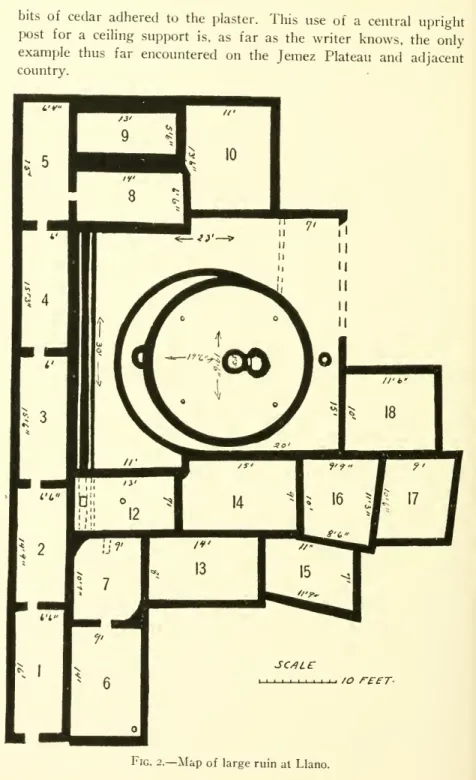
South of the town of Llano, on the mesa, there are many low mounds, but no indications of walls. The ruin to which this name has been given is one of the largest adobe-walled remains that the writer has seen in the Southwest. In the center of the site is an enormous circular mound, which is bisected by the central arm of the E.
At the southwest corner of the group is a compact mass of buildings that almost surrounds a kiva. The entire surface of the ground is covered with countless potsherds and broken stone artifacts.
NO. 12 ARCHEOLOGY OF TAOS VALLEY — JEANCON 7
CEREMONIAL CAVE
THE EXCAVATIONS AT LLANO
A quantity of charred and decayed roofing material of the usual type was found in room 7. The walls were extremely well mixed and bricked, and the thickness of the plaster indicated a long residence. The following account of the construction of the walls, as given in Castaneda's account of the Coronado expedition*, applies to the construction of the walls at Llano.
Another difference noted at Taos was that the checking of the walls, after they had dried, occurred in irregular masses. No attempt was made to determine the outlines of the first occupation, except in five or six places where they were accidentally encountered. The entire surface of the mound was scraped until the walls were exposed, at a depth varying from six to eighteen inches.
Very little windblown sand from the mesas or valleys appeared in the soil, and most of the debris removed was from decayed wall material. These upright poles were located in the center of the room, the only exception occurring in room 6 where the pole was in the southeast corner.
NO. 12 ARCHEOLOGY OF TAOS VALLEY — JEANCON II
ROOMS
STORAGE ROOM
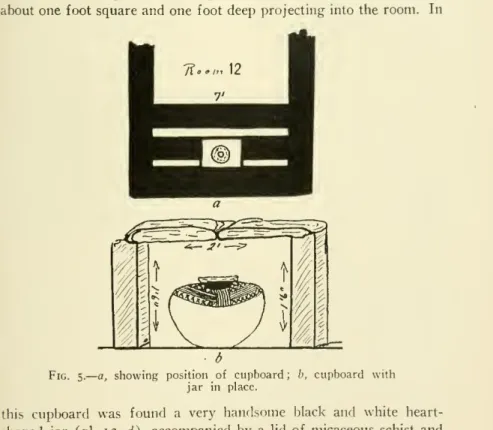
The walls of the large mound were built in the same way as those of the smaller mound, the only difference being their marked variation in thickness. The tops of these pots came within two or three inches of the floor; they may have been used for storing food. At the west end was a kind of cupboard running under the wall, with an entrance about a foot square and a foot deep, projecting into the room.
KITCHEN
The fill between the walls consisted of soft dirt, rubble from roofing materials, river pebbles, bits of pottery and a few artefacts in poor condition, although a very fine pipe was found in the rubbish. A curious feature found only in the kiva are the horizontal lines that run along the inside of the walls. It appears that these walls were built in regular courses, but examination of shattered fragments shows that the wall was built in the same way as all the others. in the group, and that the horizontal lines do not indicate the use of fungi, as would be suggested by their appearance. Three feet above the floor, in the rubble that filled the room, was a deposit of two and a half feet of drifting sand, and between the sand and the floor were the remains of the roof beams, but these were in such a bad state that nothing could be learned from the roof construction.
There were two points of pillars raised above the kiva, and in similar positions were two holes in the floor, where additional suf)orts had stood. These four pillars served to support the roof and show an interesting method of roof construction which was continued in later structures in the region. Young people live in estufs, which are in the courtyards of the village.
Some were seen with twelve pillars and four in the middle, as tall as two men could stretch themselves. To the east of the fireplace stood a flat river stone about a foot wide and five feet high; next to it (east) was a small pit, oval in shape and measuring 3.5 by 3.5 centimeters, with a depth of 25 centimeters. Four feet east of this, in the wall, was a doorway two feet high and one foot wide, from which a passage, covered with posts four inches in diameter, led through the wall for a distance of five feet.
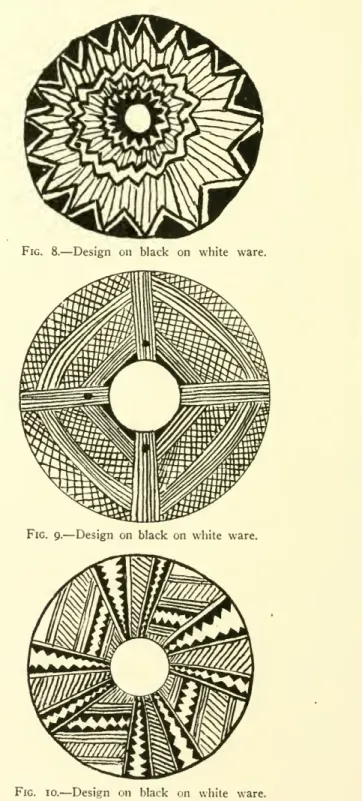
Most of the stone artefacts were of a common character, the Manos and metates were of some form, the unusual depth of the latter indicating a long period of use (p. 6, b). It showed scuff marks on the trough and on the top, bottom and sides. Fragmentary ware.—Quite common forms and workmanship were shown in the fragmentary ware (pis. 8 and 9), the only exception being the object shown in the upper left corner of plate 8,.
Although only one entire pipe was found, fragments of several others are sufficient to indicate that the common form was that of the tubular pipe or cloud blower. The last fragment shown (pi. ii, e) has a gray paste and is decorated with 7 incised horizontal lines that are not visible in the image. It is possible that their presence in the ruins indicates that such a clan lived there.
INDICATIONS OF BASKETRY
POTTERY
NO. 12 ARCHEOLOGY OF TAOS VALLEY — JEANQON 21
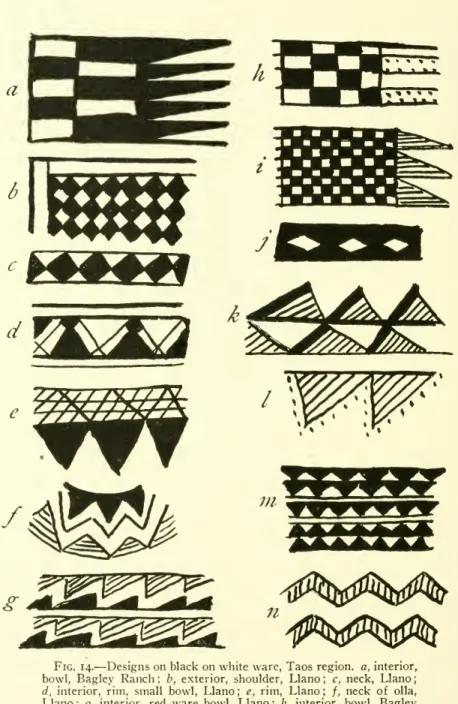
On the shards that are buried, the white shp is not crazy, but where the shards were lying exposed on the ground, it seems to be. As far as could be determined from the rim fragments found, the rims were so thin that they could not be decorated. Dots, ticks or zigzag lines were found on the rims; in many cases the external and internal decorations extended to the brim.
The principal ornament appears to have been in the form of a broad band encircling the interior of the bowl and teaching small empty spaces at the bottom.
NO. 13 ARCHEOLOGY OF TAOS VALLEY — JEANQON 23
NO. 12 ARCHEOLOGY OF TAOS VALLEY — JEANQON
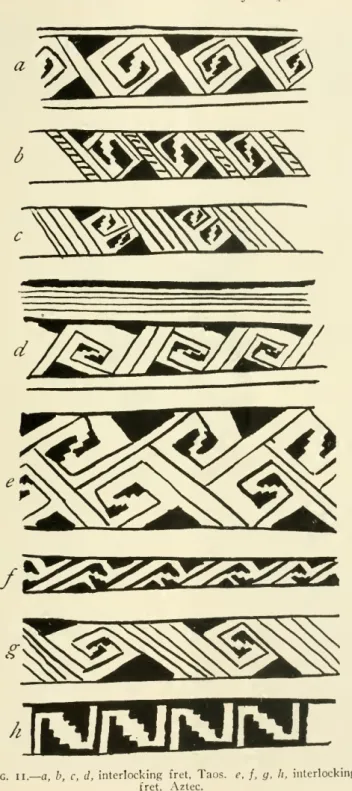
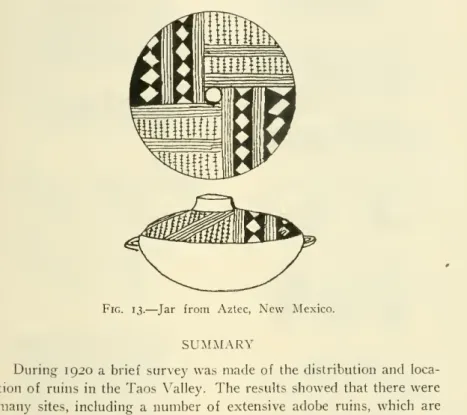
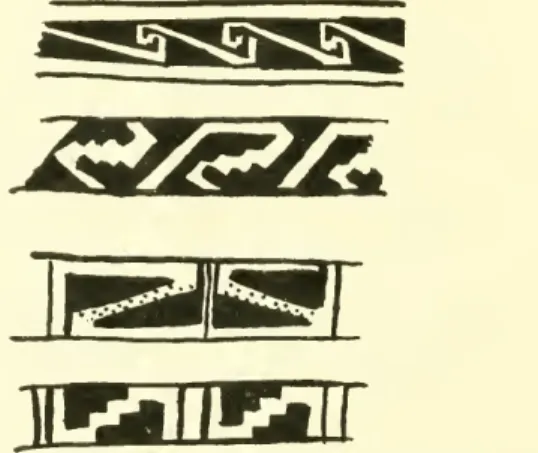
As can be seen from the figures drawn from the fragments, no curved shapes were found at all, they were all strictly rectilinear; only one life. Two were found, one intact and the other in such a condition that it could be restored. The interlaced bar shown in many instances on Taos black-and-white ware is nearly identical to that found in Aztec ruins.
From Oak Tree House, Mesa Verde National Park, Southwest Colorado. fig. 11), and illustrated by Earl Morris in the AmericanAnthropologist, Vol. The diverse designs of the Taos region include zigzags, triangles, checkerboards, and many other shapes (fig.
NO. 12 ARCHEOLOGY OF TAOS VALLEY JEAN^ON 27
SUMMARY
Llano; g, interior, red shell, Llano; h, interior, bowl, Bagley Ranch; /, interior,bowl, BagleyRanch;;', neck, Llano; k, interior, small bowl, Llano; /, edge, Llano; m, shoulder, Llano; n, shoulder and neck, Llano. The kiva appeared to be placed in the center of a compact mass of rooms rather than in an open plaza separate from the main building. The sites in general can be considered late phase of the Black and White period, perhaps just before the beginning of glazed wares in the Rio Grande.