First published in Great Britain and the United States in 1994 by Kogan Page Limited as Performance Management. The Armstrong handbook of performance management : an evidence-based method for delivering high performance / Michael Armstrong.
Introduction
The process of performance management
An organization's choice of where to focus its attention in relation to performance management can partly determine its future and can certainly guide its culture. This means they need to determine the best ways to set goals, evaluate work, and distribute rewards in such a way that performance can improve over time.
Themes
Performance management works within a context to influence behavior in directions that will meet the needs of stakeholders in the organization. The performance management objectives as stated by CEMEX and Hitachi are set out in Appendix B.
Plan of the book
Research is summarized on how people respond to performance management (more favorably than some commentators think) and the evidence for research on the impact of performance management (often equivocal) is reviewed in Chapter 16. It also covers performance management training and, importantly , performance management evaluation, another strangely neglected topic.
Further reading
This refers to the research that has been done recently through a number of surveys and how performance management can be modeled (a valuable way to convey to those involved how it works). Appendix A contains a comprehensive toolkit that provides practical guidance on analyzing current performance arrangements and developing, implementing, operating and evaluating performance management systems.
The Background to Performance Management
THIS PAGE HAS BEEN INTENTIONALLY LEFT BLANK
The Foundations of Performance Management
Performance management defi ned
As Mohrman and Mohrman (1995) emphasize: 'Performance management is managing the business.' It is what line managers do on an ongoing basis, and not an annual HR-driven procedure. As this book will explain, performance management is a natural process that can be improved if it is carried out systematically and those involved have and use the required demanding skills.
A short history of performance management
Results-based performance appraisal emerged in the 1970s and still exists today. The term performance management was first used in the 1970s, but did not become a recognized process until the second half of the 1980s.
Merit rating
They seemed to have been plucked from some shelf (or drawn from a 'competency dictionary') without any research into the extent to which they were appropriate in the context of the organisation. In short, the main factor in managing individual performance should be the analysis of the behavior required to achieve agreed results, not the assessment of personality.
Management by objectives
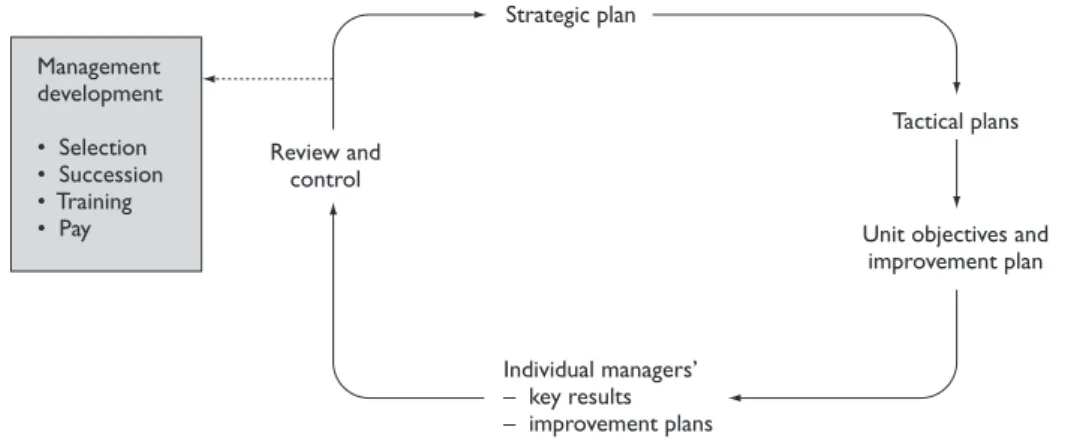
The performance management cycle as it is commonly described today (see Chapter 4) certainly derives from its objective management cycle. One of the first and most powerful attacks on management by objectives was made by Levinson (1970) in the Harvard Business Review.
Developments in assessment techniques
Performance appraisal (1970s version)
He stated that: “Work performance appraisal should not be viewed as a technique but as a process involving both people and data, and as such the entire process is inadequate.” He also emphasized that appraisal is not usually recognized as a normal function and that individual goals were rarely linked to business goals. The problem was that appraisal was too often seen as the preserve of HR.
Enter performance management
However, one of the first books devoted exclusively to performance management was not published until 1988 (Plachy and Plachy). That is essentially performance management: the organization of work to achieve the best possible results.
Why performance management?
Fundamentals of Performance Management 25 Emphasis is on employee development rather than performance-related pay. A further development was the realization that performance management should focus on organizational and individual effectiveness.
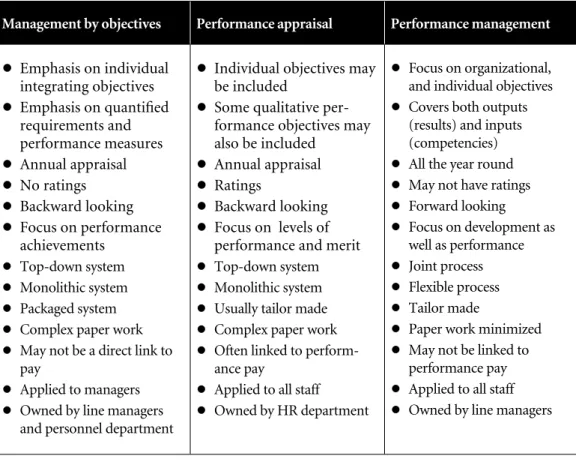
Comparison of different approaches
The Conceptual Framework of Performance Management
Underpinning theories
This suggests that what people believe they can or cannot do greatly affects their performance. Developing and strengthening the positive self-esteem of employees is therefore an important goal of performance management.
Performance management values
As people receive feedback on their behavior, they appreciate the discrepancy between what they are doing and what they are expected to do and take corrective action to overcome it. It should be debated with managers, employees and employee representatives to gain general agreement and to understand that these are the things that matter.
The meaning of performance
Performance could therefore be thought of as behavior – the way in which organizations, teams and individuals perform work. Conceptual framework 33 A study conducted by Bailey, Berg and Sandy (2001) in 45 institutions focused on another factor affecting performance – the possibility of cooperation.
Contextual factors
From the perspective of performance management, one of the most important phenomena of organizational culture is leadership style. Organizations that operate as bureaucracies, appropriately or inappropriately, are more likely to have a formalized performance management system.
Performance management and motivation
Expectancy theory supports performance management processes that are designed to provide intrinsic motivation by providing opportunities for growth and the extent to which skills are used and developed. An important goal of performance management is to increase self-efficacy by allowing individuals to reflect on how they can do more and to discuss with their managers.
Performance management and the psychological contract
If success or failure is explained in terms of effort, high motivation may follow. If, on the other hand, non-achievement is explained in terms of task difficulty, unfavorable circumstances or accidents, the result may be a loss of motivation.
Critiques of Performance Management
The critical arena
It is true that performance appraisal, the old style, does not work in the ways described above. Managements tend to adopt a singular frame of reference (we are all in this together, our interests .. coincide) when, in reality, organizations are more likely to be pluralistic in the sense that there are divergent interests that need to be acknowledged.
Views of commentators
Assessment is defined as a managerial activity - 'the provision of data designed to ensure that resources are used effectively to achieve organizational objectives'. One of the inherent paradoxes of assessment is that 'the information required to ensure effective work organization will not be forthcoming if it is believed that this will put the individual at risk'.
Implications
This is a form of 'Taylorism' - in the perception of judges it can be 'related to a. It is suggested that a stakeholder perspective should be adopted in the design of performance management systems that provide a wider role for individuals as 'creators' rather than 'victims'.
The Practice of Performance Management
Performance Management Systems
An important goal of performance management is to support the achievement of business strategy. Performance management is a systematic approach to improving business and team performance to achieve business objectives (Strebler, Bevan and Robertson, 2001).
Performance management as a system
These definitions often refer to performance management as a process of aligning or integrating organizational and individual goals to achieve organizational effectiveness. The following definition of the concept of a performance management system takes into account the considerations discussed above.
Objectives of performance management
Performance Management Systems 59 this book consists of goal setting, feedback, performance appraisals, performance analysis and assessment, and coaching. A performance management system is a set of interrelated activities and processes that are treated holistically as an integral and key component of an organization's approach to managing performance through people and developing the skills and capabilities of its human capital, thereby improving organizational capability and achieving sustained competitive advantage .
Principles of performance management
Characteristics of performance management
It is based on the principle of management by contract and agreement rather than management by command. Performance management focuses on future performance planning and improvement and personal development rather than on retrospective performance appraisal.
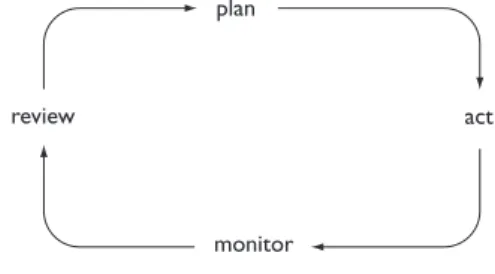
The performance management cycle
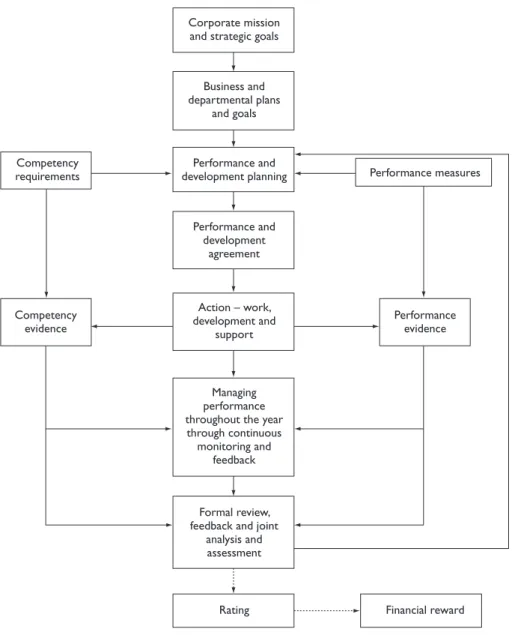
Within this sequence, the main performance management activities are performance and development planning, setting performance measures, concluding performance agreements, managing performance throughout the year, and reviewing and analyzing and formally evaluating performance. Examples of the performance management cycle as it exists at CEMEX, DHL and the Royal College of Nursing are provided in Appendix B.
Performance and development planning
It also sets priorities - the key aspects of the work that need attention. To develop a role profile, it is necessary for the line manager and the individual to come together and agree key result areas, define what the role holder needs to know and be able to do, and ensure that there is a mutual understanding of the behaviour. .
Performance measures
Therefore, it is important to answer the question: 'How will we know that this goal has been achieved?' However, when evaluating performance, it is also necessary to take into account inputs in the form of the level of knowledge and skills achieved and behavior that is demonstrable in accordance with the standards set out in the competence frameworks and statements of core values.
The performance and development agreement
Managing performance throughout the year
Performance Management Systems 71 A personal development plan that sets out what individuals need to do with support. It leads to the completion of the performance management cycle with performance communication and development agreements.
Analysing and assessing performance
Although performance management is an ongoing process, it is still useful to have a formal review once or twice a year. The performance review meeting is a means by which the five basic elements of performance management such as agreement, measurement, feedback, positive reinforcement and dialogue can be put to good use.
The ethical dimension
Folger, Konovsky, and Cropanzano (1992) presented the benefits of procedurally just performance management based on the components of due process. Organizational researchers such as Taylor et al (1995) have amassed a large body of evidence showing that employees care deeply about the fairness of performance management and recruitment practices.
Issues in performance management
However, there is a reluctance in organizations to evaluate the effectiveness of performance management systems and to exploit research results. When a performance management system doesn't deliver results, it's likely to show.
Effective performance management
As Lawler, Mohrman, and Resnick (1984) emphasized, performance management must focus on the process of performance evaluation and on the organizational context in which the event takes place, not on the form or system. Strebler, Bevan and Robertson (2001) suggested that the following principles were necessary for performance management to work effectively.
Managing Performance Management
How should performance management be managed?
He suggested that the extent of integration or convergence depends on the organization's business model: 'If the company is basically a McDonald's where there are only limited local variations but the product is largely the same worldwide, then the approach is likely to be different from a company such as Unilever whose products and processes tend to be much more responsive to the local market.'.
What needs to be managed?
The approach to managing performance management
Performance management is not a filler exercise as many traditional merit or performance appraisal schemes appeared to be. They could be encouraged to record their consent and the conclusions of their reviews on blank sheets of paper to be used as working documents during the ongoing performance management process throughout the year.
Performance management documentation
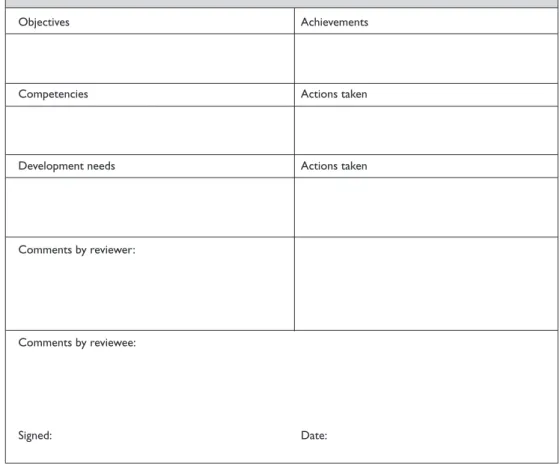
It is important to establish the principles of performance management and ensure that everyone agrees with them, but administrative and control procedures should be carried out with a light touch. When designing performance management forms, the aim should be to keep them as simple and short as possible, while leaving plenty of 'white space' for comments.
Web-enabled performance management
They can set their goals so that they are aligned with the goals of other managers, and they can see how those goals fit with the company's goals.” The system provides “the ability to take information from multiple sources and combine it to drive activity by interacting with users and make information accessible and visible in truly meaningful ways. HR supports the performance management process by providing training and coaching for managers and employees.
The role of HR
Their role becomes that of encouraging and facilitating the kind of performance management processes described in this book. More specifically, they organize training events and conduct surveys to evaluate the effectiveness of performance management.
Managing Under-performance
The problem of under-performance
Dealing with under-performers
The goal should be for the manager and the individual to jointly identify the facts that contributed to the problem. All factors within the control of the individual and/or manager can then be taken into account.
Performance Management Processes
INTENTIONALLY LEFT BLANK
Goal Setting
Principles of goal setting
Goals and feedback
Types of goals
Good role or job objectives will clearly define the activity in terms of the results and standards to be achieved. They can be expressed in a performance improvement plan that specifies the actions to be taken by role holders and their managers.
Smart objectives
Good objectives
Goal setting 101 can include lack of resources (money, time, equipment, support from other people), lack of experience or training, external factors beyond the individual's control, etc. Focused on teamwork: emphasize the need to work as an effective member of a team as.
Integrating goals
Ensure goals align with and support functional and corporate strategic goals. Agree on functional standards for customer service and improvement goals that support the achievement of team goals.
How to set goals
Using the information above, managers ask their employees to develop concepts of their performance goals, strategies and tactics, and development goals. Managers meet with each of their employees to review and discuss their goals, strategies, and tactics.
Feedback
Feedback defi ned
Systems engineers design self-regulating systems that generate their own feedback and respond to that information at will. The same principle can be applied to performance management – individuals can be encouraged to understand the performance measures available to them to use, to provide their own feedback and to develop their own plans for developing and improving performance.
The nature of feedback
Such self-generated feedback is a highly desirable feature of a complete performance management process, but there will always be a need for managers, colleagues and, sometimes, internal or external advisors to provide feedback based on their own observations and understanding.
Use of feedback
Accurate descriptions of the nuances of performance can help the employee better understand how his or her past actions or activities influenced performance results and how future efforts are likely to contribute to future performance. Accurate descriptions or diagnoses of performance are critical, because understanding and improvement are only possible through timely feedback.
How effective is feedback?
They may be effective in documenting some performance parameters, but they are unlikely to be effective in managing, regulating and. DeNisi and Kluger (2000) commented that feedback interventions are more likely to be effective if they keep the employee's attention focused on goals at the task performance level, and least likely to be effective if they cause a shift of focus to a personal level . .
Guidelines on providing feedback
It is a waste of time to concentrate on areas about which the individual can do little or nothing. People are more likely to work positively to improve their performance and develop their skills if they feel empowered by the process.
Feedback expert systems
Provide feedback on the things the individual did well, in addition to areas for improvement. The advantages of expert feedback systems are that: 1) they provide immediate practical expert advice for providing feedback that fits the situation facing the manager;
360-degree Feedback
360-degree feedback defi ned
360-degree Feedback 113 Coaching for individuals as a result of the feedback can be provided by a member of the HR department or an external consultant. 360-degree feedback or a variant thereof was used by 30 percent of respondents to the 2005 e-reward survey.
The rationale for 360-degree feedback
Use of 360-degree feedback
360-degree feedback: methodology
The feedback is often anonymous and can be presented to the individual (most often), to the individual's manager (less commonly) or to both the individual and the manager. Although data only goes to the individual, it can be discussed in a results follow-up meeting so that joint plans can be made, and there is much to be said for taking this approach.
360-degree feedback and appraisal
360-degree Feedback 115 Graphical presentation is preferable as a way to facilitate the process of assimilating the data. According to Fletcher, incorporating 360-degree feedback into evaluations seems to offer a solution to some of these problems.
Effectiveness of 360-degree feedback
On an individual level, some individuals believed that they achieved little from the process overall. What they found more important in predicting uptake of development activity was a work environment in which employees were supportive of skill development, and the extent to which those involved believed they could improve their skills.
360-degree feedback: advantages and disadvantages
The findings were that at the organizational level, the use of 360-degree feedback as a performance management tool failed to develop the expected awareness. It was also not found to be aligned with other development plans or core competencies of the organization.
Introducing 360-degree feedback
360-degree Feedback 119 The disadvantages can all be minimized, if not completely avoided, through careful design, involving stakeholders in the development program, communication, training and follow-up. Most organizations that install 360-degree feedback do purchase a package from a consulting or software house.
Performance Reviews
The process of reviewing performance
This includes a review and analysis of performance since the last review, comparing results with agreed expectations and plans. Reference may be made to events that illustrate achievement as discussed during the year (they should not be brought up for the first time at a formal meeting).
The formal performance review meeting
Performance reviews 125 Other examples of how performance reviews are carried out in DHL, Hitachi UK and the Royal College of Nursing are given in Appendix B.
Problems with formal performance reviews
It is a means of considering the future in the light of an understanding of the past. Information can be given about significant events and changes in the organization that will affect the role of the department and its members.
Preparing for formal review meetings
The manager should discuss with the individual the purpose of the meeting and the points to be addressed. The manager should also suggest that the individual prepare for the meeting along the lines described below.
Self-assessment
Individuals should prepare for the meeting by completing a self-assessment process as described below. Self-evaluation can give employees the opportunity to take the lead, but the aim of the review meeting is still to achieve an agreed joint assessment and a development plan.
Conducting a formal performance review meeting
Performance feedback should be immediate; it shouldn't wait until the end of the year. Agree measurable objectives and an action plan – the goal should be to end the evaluation.
Analysing and Assessing Performance
Evidence-based performance management
Analysing performance
Managers may jump to conclusions or make snap judgments if they are only asked to rate and evaluate people instead of doing a proper performance analysis. The analysis leads to some form of evaluation, which is usually carried out by evaluation as described below, although there are other approaches considered later in the chapter.
The process of rating
Even when performance is assessed against defined standards, the ratings do not provide sufficient detail about what the employee did or did not do. One of the issues in assessment is the extent to which recipients accept what the reviewer says about them.
Rating scales
For example, as illustrated in Figure 11.1, top performers would be placed in category A – the first 15 percent of the curve. The middle 70 percent will be placed in the B category in the center of the curve and the bottom 15 percent will be placed in the C category.

Behaviourally anchored rating scales
Behavioural observation scales
Arguments for and against rating
Ratings are not a good idea because of the "unintended consequences": the insidious, destructive, and counterproductive effects of giving people ratings on their job performance. This is also called 'frame of reference training' (Bernardin et al, 2000). The goal of frame of reference training is to calibrate trainers to agree on: 1) how to match the specific behaviors of those they are assessing with appropriate performance; 2) the effectiveness levels of alternative behavior; and 3) the rules for combining individual judgments into a summary evaluation for each performance dimension.
Alternatives to rating
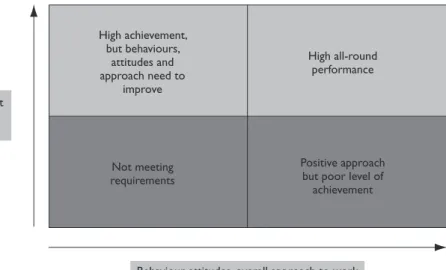
It is not a 'rating assessment'; the purpose of the matrix is to help individuals focus on what they are good at and also any areas for improvement. This is achieved visually: the individual is placed in the relevant position in the matrix based on the two dimensions.
Conclusion
Performance Analysis and Appraisal 165 may actually tell an individual that he/she has done exceptionally well and that therefore he/she will be included in the talent management program, or they may inform another individual that he/she has not done very well and that they should discuss what should be done about it. Others can be told that they are doing a perfectly good job and discussions can take place about how they can build on their strengths or on some learning activity (preferably self-directed) that can help them to also better.
Coaching
Coaching defi ned
The two work together to help the subordinate perform at his or her best.' Coaching involves short-term interventions designed to correct problems that interfere with the employee's performance, but it is also concerned with long-term development and continuous learning. It is usually performed by trained counselors and involves short-term interventions designed to correct problems that interfere with the employee's job performance.
The process of coaching
Every time a manager delegates a new task to someone, a coaching opportunity is created to help the individual learn any new skills or techniques needed to get the job done. Every time a manager provides feedback to an individual after a task is completed, there is an opportunity to help that individual do better next time.
Approach to coaching
Employees who perform well should be eager to learn more to do even better. Individuals should be given guidance on what to learn and feedback on how they are doing, and because learning is an active and not a passive process, they should be actively involved with their coach, who should be constructive and build on strengths and experiences .
Techniques of coaching
Managers are advised to focus on the individual's behavior and what the individual needs to do differently, but are told that this should not relate to their personality. What is important at this stage, the company says, is to involve the individual in developing the solution to make it more likely that they will commit to the action plan.
Coaching skills
In addition, managers should identify potential barriers and agree what can be done about them, as well as agree what support the individual will need and how it will be provided through coaching and training. This stage can also involve explaining fully and specifically what the individual needs to do, while taking examples of when people have done well in the past can sometimes be helpful and can be built on.
Developing a coaching culture
This type of culture is self-reinforcing because it leads to better performance, which encourages employees to seek more feedback and drives managers to see the value of coaching as the most important requirement of their job. They can act as mentors (or build a team of mentors) to provide guidance and highlight the added value that can be gained from coaching, to the benefit not only of the individual, but also of the manager and the organization.
Performance Management in Action
Performance Management Surveys
CIPD
Formal training for line managers was provided by 86 per cent of respondents, 45 per cent used coaching and 46 per cent of respondents offered formal training for both line managers and staff. A relatively small number of respondents (16 percent) used online performance management methods.
Houldsworth and Jirasinghe (2006)
Lawler and McDermott
The Institute of Employment Studies
The Work Foundation
The role of culture and clarity of purpose: to what extent an approach to performance.
Performance Management Models