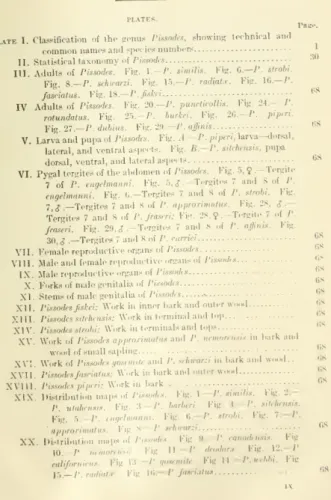
Sir: I have the honor to transmit herewith the manuscript of the first part of a hole in the technical series entitled ""Technical Papers on Miscellaneous Forest Insects. Contribution to a Monograph of the Bark Weevils of the Genus Pissodes," by Dr. Altiough Bark Weevils are among the most important enemies of conifer trees, especially of the young growth, comparatively little has hitherto been known of the species; permission for the special need of this contribution as a basis for economic studies and publications. It embodies the results of extensive systematic work by Doctor Hopkinson new material-.rial contained in the collections of the Bureau of Entomology and the I'nited States NationalMuseumami inches the descriptions of twenty-three species new to science.
T1:CH\ICAL PAPERS OX MISCELLANEOUS FOREST INSECTS
CONTRIBUTIONS TOWARD A MONOGRAPH OF THE BARK- WEEVILS OF THE GENUS PISSODES
INTRODUCTORY
The material which has served as the basis of this bulletin, which was collected by the writer between 1S90 and 1902, and which was collected by him and the Assistants for Forest Insect Surveys, Bureau of Entomology, between 1902 and 1907, and which is in the collections of the United States National Agriculture and the United States Department of the United States Agriculture and Schwarz collections. ion. Kolbe, from the RoyalZoological Museum of Berlin, and 3 European species represented in the United States National Museum Collection.
HISTORICAL REFERENCES
COPY OF ORIGINAL DESCRIPTION OF THE GENUS
TRANSLATION OF ORIGINAL DESCRIPTION.]
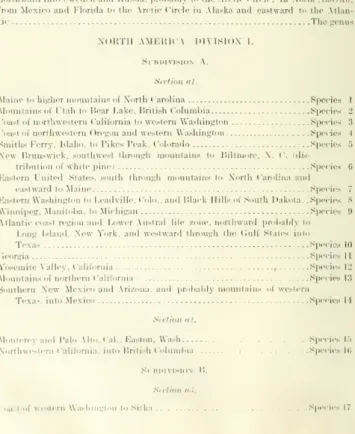
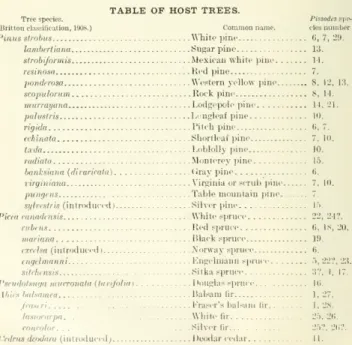
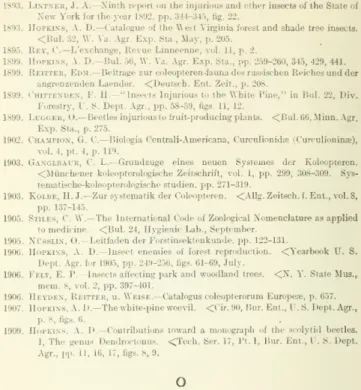
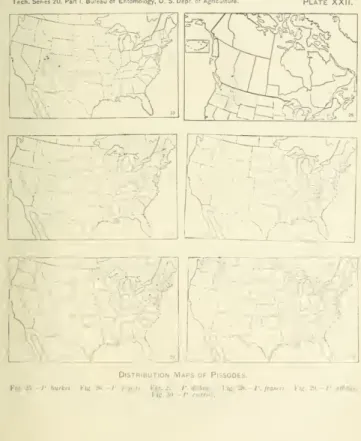
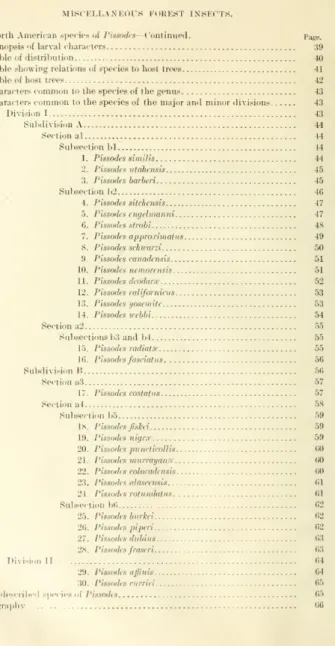
Therostrum not quite equal to or longer than the thorax, thin, curved, cylindrical, somewhat flattened towards the top, scrobelinear, noticeably bent below, in close proximity to the base of the lower therostrum. AntemiiB inserted posterior to the middle of the bill, short, clavate, shell flat, somewhat clavate, funiculus 7-parted, segments lenticular, 1 and TAXONOMY CHARACTERS ITSED BY DIFFERENT AUTHOR^ SUBORUINAL AND FAMILY CHARACTERS REVISIONAL NOTES The five segments, also called the first through fifth, are the sternites of the third through seventh abdominal segments, with the first and second parts hidden from view by the coxal cavity (Hopkins, 1909 , Fig. 3S). Therefore, they should be referred to either in their own numerical order or as the visible abdominal muscles. Pronotiiii variable; wider than long, rarely as long as wide, narrowed in front of the middle and usually constricted towards the head; .. rear corners round-d, rectangular or sharp; ]) images of the dorsal surface with intermediate borders or raised contiguous spaces which are sometimes (djsciu'e the punctures. Eli/travariable, again more than equal in length, with the ba.seas slightly wider than the pronotum, the sides parallel or narrowed slightly posteriorly, and slightly constricted on each side of the de - height; interspaces convex to flat, alternately softer and higher; punctures of stria*, regular or irregular in size. They are slender, cylindrical, perforated, as long as the prothorax or is longer, with the sides parallel or slightly narrowed towards the center, or slightly wider towards the base of the mandibles. ANATOMICAL DETAILS OF THE ADULT." 14 MISCELLANEOUS FOREST INSECTS Tliestemcllum is represented by a small but distinct interco.xal piece and the poststernellum ("epimerum"' of outliors) by the narrow posteiiorarea which includes the coxa>. The coxal cavities are large, with tlie inner margins but slightly sei)aratc(l. The episternum forms an isosceles triangle with the anterior dorsal margin narrowly produced and disappearing below it. lies dilated end of the jiree|)istermun. The epimerum is narrow, oblique and broad .. ill its junction with the anterior dorsal angle of the metei)ist(>rnal. 20 MISCELLANEOUS FOREST INSECTS 21 others diminish shghtly in size to and including the seventh. Spiracle 22 MISCELLANEOUS FOEEST INSECTS INTERNAL ANATOMY SKCONDAUY SEXUAL CHAUACTERS THE EGGS It is usually darker in color, with the anterior margin divergent and almost straight, and the lateral angles slightly produced and raised where they support the dorsal articulation of the mandibles. The labrum (fig. 5) is more chitic, about three times as wide as the apex of cljjjeus, the ventral j)osterior margin angular and extending beyond the edge of the cl3rpeus. The last has characters of some divisional and subdivisional value, but the characters have not been .. sufficiently studied to suggest the coin table form for the identification of the species. 25 hairs on the upper part and lip, as shown in figure 6, hairs on the upper part and lip, as shown in figure 6, are distinctive and quite permanent. The clvpeus (Fig. 5) is broad at the base, the sides tapering to the parietal angles and slightly!}- to distinctly longer than the labrum. An examination of the larvae of 14 countries has shown that there are considerable specific differences in the form and proportion of the frontal region, ch^ieus, labrum, and man. dibbles. The lateral region of the eutergite is armed with two spmes, and the epipleural lobes are each also ilidistinctly or obscurely armed with one or two spines, and the ninth segment is, as usual, armed with two prominent pleural spines. 27 excavate transformation cells or pupal cases in the outer part of the wood or, rarely, in the inner bark. These cells are surrounded by a dense coating of remarkably similar woo GENERAL LIFE HISTORY GENERAL DISTRIBUTION THE NORTH AMERICAN SPECIES OF PISSODES NATURAL CLASSIFICATION OF THE SPECIES 2S MISCELLANEOUS FOREST INSECTS 29 no matter what difi'eienccs there may be in the length of the body 30 MISCELLANEOUS FOREST INSECTS MORPHOLOGICAL AND PHYSIOLOGICAL CHARACTERS AND CHARAC- TERISTICS KEY TO THE SPECIES Length 5 to 5.3 mm.; Brown; pronotum not distinctly narrower than elytra, shining, and the punctures rough; posterior patches of elytrause with faint dark margin; punctures are indistinct, especially on the lateral area. Length 4.3 to 6.7 mm.; Brown; pronotumnot distinct and narrower tanelytra, punctures moderately coarse; elytral interspace3 broad, flattened, moderately rugose, and posterior white and yellow spots usually separated, (hebrownone smaller, but not very small than in species10, and the white one extends eartliesecond interspace. Length 5.2tofi.7 mm.; brown; pronotumene -ligtraline-narrower than 5. tlyraised and robust, the holes of stria; coarse, endiej) anterior white and yellow spots fused, no texts running over this concl interspace. thick bark on base, stems, tops and ends of.-aplings. Length 6.2 to 7 mm; brown; pronotum as wide as elytra, rounded at sides; elytra with sides barely narrowed posteriorly, interspaces 3 and 5 wide, raised, wrinkled, hind side spots fused and yellow one large; the bill in males is not longer than the prothorax. Length 4.9 to 7.7 mm; brown; pronotum with sides not strongly rounded; elytra with sides narrowed posteriorly from base, posterior spots usually separate, one yellow very small and white extending to first interspace; bill usually longer than prothorax in both sexes. Ex])eriment, Ga., in stems, branches and tops of Cedrusdeodana.. Length 8.6 mm.; brown; pronotum broad, with sides broadly rounded; elytra with sides markedly narrowed posteriorly, interspace 3 very wide, not coarsely edged 3 as in Yosemite; hind spots separate, brown very small; beak distinctly longer than prethorax. Length 5.1 to 7.7 mm.; brown; pronotal punctures very coarse, not dense; elytra with sides nearly parallel, interspaces 3 and 5 strongly elevated, acutely ridged, punctures of stria coarser, and posterior spots fused on lateral area.. iteValley, Siskiyou County, and Lakr?Tahoe, Cal. Length 4.8 to 6.8 mm.; Brown; pronotal punctures very coarse and dense; elytra nearly jjarallel, interspaces 3 and 5 elevated and rugose, punctures of stria or coarser, and posterior spots prominent and fused on sides. Length 5.1 to 7.4 mm.; brown; pronotum broader towards base, angles acute, sides converging anteriorly, slightly narrowed towards head, j)ecting coarsely?, distinct; elytra with anterior]) not small, yellow, andthj])oteriorbaiid mainly of white scales. Length 5.1 to 8.3 mm; coffee; iminotumors narrower than litra, laterally rounded and slightly narrowed anteriorly, lunate not weakly narrowed towards head; elytra with conspicuous lateral spots, obli(|Uc, yellow, posterior distinct l) and composed of white and yellow spots. 36 MISCELLANEOUS FOREST INSECTS SYNOPSIS OF PRIMARY SEXUAL CHARACTERS SYNOPSIS OF SECONDARY SEXUAL CHARACTERS 38 MISCELLAKEOUS FOREST INSECTS SYNOPSIS OF PUPAL CHARACTERS SYNOPSIS OF LARVAL CHARACTERS THE WORLD NORTH AMERICA— DIVISION I 42 MISCELLANEOUS FOKEST INSECTS 43 CHARACTERS COMMON TO THE SPECIES OF THE GENUS CHARACTERS COMMON TO THE SPECIES OF THE MAJOR AND MINOR DIVISIONS Variation.i.— Specimens vary in length from 3.7 to 4 mm., and color from light brown to dark bro\m, with slight variations within the points. Distinctive characters.-This species is closely allied to para-. cetiing, from which it is distinguished by the coai-serj)ronotal punctures and the smaller posterior spots, which do not extend anteriorly to the middle of the elytra, and have no distinct dark border. I>inttinctive characters.—'i'liisspecii's is at once decomposed fiom .. nil from the other sjiecie.s of the first subdivision by darkii-coIih-, . until' vci'\' coar.se |)nncliM'es of (lie prniiiiliini and elytrnl '~li'i:i', the. Distinctive cliaric characters.-This species is closely related to P. engtl- .. manni and P.strohi, from the first of which is distinguished by the subopaque pronotum, in the absence of a dark band on the posterior spot of the elj'tra, and the more gross punctures of it; .. from the latter distinguished by its average smaller size and narrow-rothorax, as well as by its distribution and habits. This species differs from the preceding disease in that the j)ronotum is shining, the posterior spot of the elytra has a dark border, and punctures of the elytral stria are indistinct, especially on the lateral region. From P. strohi it is distinguished by its generally smaller size, coarse ])unctures of the prnnotiun, and more obscure punctures of the elytral stria?, as well as by its distribution, habits, and host. Pronotine and elytra punctures vary considerably in size and shape. 48 MISCELLANEOUS FOREST INSECTS THE GENUS PISSODES. 49 Bibliography and Stnoxymy This, with two other specimens, a male and a female, was found in the Wickham collection .. in the United States National Museum under I', sfrobi. It is easily distinguished from P. nemorensis by its relatively shorter bill and thicker body and fused posterior spot on the canopy, as well as by its distribution. Variations.—There is not much variation in tiiree specimens .. except that the alternate raised interspaces are less sharply wrinkled in one specimen than in the other two specimens. The species is offered again in the collection by a typical Inbeleil specimen with a rectangular red label; name; "/'ihi/«.- Calhoun, Ala.;. It is also distinguished from its closest ally (P. deodarse), the only other species known to inhabit the Gulf States region, by its average larger size and shorter bill, and by the posteriorly narrowed elytra and more clearly raised third and fifth interstices. There is also so much variation in all the structural and sculptural characters and in the size, density and color of the spots. Variations.—There is considerable variation in size, the length varying from 4.2 to 5.8 mm., but no great variation in grajosh-brown color or in shape, sculpture, and vestiture. It is also easily distinguished from P. yosemite by the l)est, closely punctured i)ronotum with ridged anterior margin, and by the broad, flattened, third and fiftieth elytral inter|)aces. Indeed, it differs so markedly from any other Western form that we feel justified in basing our conclusion on its difference on a single specimen. This sjjecies is more closely related lo /' wehhi, from which it is distinguished by the smalei- |)ro)ioiuni with the punctureIcsjsdig placed, ami by its distribution. Adults.—ElytraA with a transverse patch of white and yellow scales instead of a clear patch near apex of lobe; the bill is shorter than the prothorax. Variations.—There is considerable variation in size, the length being from 5.1 to 7.4 mm., but not much in colour, markings, &c. specimens from Monterey and Palo Alto, but (a single specimen from Kaston, Washington is small, dark brown, the elytracoarser dots and (he posterior angles i)ronotumvery ncule. 57 Distiihution.-Section a3, coast from western Washington to Sitka;. sectiona4, Canadian zone, eastern United States from the mountains of North Carolina to Canada, and northern Rocky Mountains and Pacific Coast region northward in Alaska. Adults.—Basal angles of pronotum subrectangular and bill rather strong and moderately long; apical margin of this ventabdominal sternite of male without apical process, but faintly course. It evidently comes nearer to Mannerheim's species than anything yet recognised, and the fact that it is found in the Sitka Spruce is inconclusive evidence. Distinctive features. - Tins is only representative of the first section (aS) of subsector B and is therefore not closely related to . one of the other types of the subdivision. It is distinguished by the closely spaced punctures of the pronotum, which become coarser and more pronounced towards the posterior lateral part, by the moderately rounded posterior corners of the pronotum. friend. i) the indistinct spots of reddish-brown and white scales. Different looks. The three mature adults range in length from 5.5 to 7.1 mm, and in color from dark brown to black. Distinctive features. It is a very distinct species, and perhaps known from its nearest, P.nigrse, by the strongly raised third and fifth elytral interstices, and the larger yellow posterior spot of closely spaced scales, without a trace of an anterior spot. similis, which can be associated with both species in the bark of the same tree, because of its large size, short pronotum and long bill. Variations. There is not much variation in size, the length ranging from 4.2 to 5.2 mm, nor in other characters. ffo.tttrees.—PicearubensanilPiceamariana, intliick bark of tree trunks and trunks of small standing trees. Distinctive features. This species is distinguished from P.Ji.ikci. by the iiuicli, i.e. selevated and less rugoseintei spaces, longer l)cak, and siiiail to conceal the anterior white shjot on the elytra. 60 MISCELLANEOUS FOEEST INSECTS Special characters.—This species is closely related to P. fraseri, from which it differs in the size of the me 64 MISCELLANEOUS FOREST INSECTS LIST OF DESCRIBED SPECIES OF PISSODES." 66 MISCELLANEOUS FOKEST INSECTS BIBLIOGRAPHY 68 MISCELLANEOUS FOREST INSECTSGENERIC CHARACTERS
REVISED CLASSIFICATION
16 MISCELLANEOUS FOREST INSECTS
THE LARVA."
THE PUPA
HOST TREES
GENERAL HABITS
SYNOPSIS OF ADULT CHAKACTERS, WITH DESCRIPTIONS OF NE'W SPECIES.'
44 MISCELLANEOUS FOREST INSECTS
46 MISCELLANEOUS FOREST INSECTS
50 MISCELLANEOUS FOKEST INSECTS
54 MISCELLANEOUS FOREST INSECTS
56 MISCELLANEOUS FOREST INSECTS
58 MISCELLANEOUS FOEEST INSECTS
62 MISCELLANEOUS FOEEST INSECTS