Biosystematic Studies of Ceylonese Wasps, XIX: Natural History Notes in Several Families (Hymenoptera:
Eumenidae, Vespidae, Pompilidae, and Crabronidae)
KARL V. KROMBEIN
I
W
9\
SMITHSONIAN CONTRIBUTIONS TO ZOOLOGY • NUMBER 515
Emphasis upon publication as a means of "diffusing knowledge" was expressed by the first Secretary of the Smithsonian. In his formal plan for the Institution, Joseph Henry outlined a program that included the following statement: "It is proposed to publish a series of reports, giving an account of the new discoveries in science, and of the changes made from year to year in all branches of knowledge." This theme of basic research has been adhered to through the years by thousands of titles issued in series publications under the Smithsonian imprint, commencing with Smithsonian Contributions to Knowledge in 1848 and continuing with the following active series:
Smithsonian Contributions to Anthropology Smithsonian Contributions to Astrophysics
Smithsonian Contributions to Botany Smithsonian Contributions to the Earth Sciences Smithsonian Contributions to the Marine Sciences
Smithsonian Contributions to Paleobiology Smithsonian Contributions to Zoology
Smithsonian Folklife Studies Smithsonian Studies in Air and Space Smithsonian Studies in History and Technology
In these series, the Institution publishes small papers and full-scale monographs that report the research and collections of its various museums and bureaux or of professional colleagues in the world of science and scholarship. The publications are distributed by mailing lists to libraries, universities, and similar institutions throughout the world.
Papers or monographs submitted for series publication are received by the Smithsonian Institution Press, subject to its own review for format and style, only through departments of the various Smithsonian museums or bureaux, where the manuscripts are given substantive review.
Press requirements for manuscript and art preparation are outlined on the inside back cover.
Robert McC. Adams Secretary
Smithsonian Institution
S M I T H S O N I A N C O N T R I B U T I O N S T O Z O O L O G Y • N U M B E R 5 1 5
Biosystematic Studies of Ceylonese Wasps, XIX: Natural History Notes in Several Families (Hymenoptera:
Eumenidae, Vespidae, Pompilidae, and Crabronidae)
Karl V. Krombein
SMITHSONIAN INSTITUTION PRESS Washington, D.C.
1991
Krombein, Karl V. Biosystematic Studies of Ceylonese Wasps, XIX: Natural History Notes in Several Families (Hymenoptera: Eumenidae, Vespidae, Pompilidae, and Crabronidae).
Smithsonian Contributions to Zoology, number 515, 41 pages, 59 figures, 1991.—Behavioral, ecological, and distributional data are provided for 40 species of Sri Lankan wasps in the families Eumenidae, Vespidae, Pompilidae, and Crabronidae. All species are solitary except the subsocial vespid, Eustenogaster eximia (Bingham), which rarely exhibits primitive eusociality.
Behavioral data on Eumenidae, Pompilidae, and Crabronidae may include the following aspects: nest construction and architecture; prey hunting or capture; prey transport to nest;
natural enemies; and adult behavior.
An extended section on E. eximia provides detailed information on the following: nest architecture, materials used, the bonding role of hyphae of a species of Polyporaceae or Telephoraceae (Basidiomycetes, Aphyllophorales) in carton composition, and construction;
brood development with analyses of larval food (Araneae and Hymenoptera); nature of the cocoon, initially fine silken threads overlain by a glistening film; nest associates including natural enemies (Hymenoptera) and associated or commensal organisms (Isoptera, Collembola, Diptera, Lepidoptera, Acaridei, and Fusarium species (Hyphomycetes)); and adult behavior and limited eusociality.
The range of each species is given as well as detailed locality records of its occurrence, insofar as possible, in Sri Lanka. Additional data include the ecological zone(s) in which each species is found in Sri Lanka, and the ranges in altitude and average annual rainfall. The text is supplemented by a map delineating the ecological zones and average annual rainfall, as well as photographs of the nests of a few species, and scanning electron micrographs of cell wall composition and cocoon fabric in E. eximia.
OFFICIAL PUBLICATION DATE is handstamped in a limited number of initial copies and is recorded in the Institution's annual report, Smithsonian Year. SERIES COVER DESIGN: The coral Montastrea cavernosa (Linnaeus).
Library of Congress Cataloging-in-Publication Data (Revised for volume 19)
Krombein, Karl V.
Biosystematic studies of Ceylonese wasps.
(Smithsonian contributions to zoology ; no. 515)
Vol.16: Authors: Karl V. Kxombein and Wojciech J. Pulawski.
Vol. 17: Authors: Karl V. Krombein and J. van der Vecht.
In vols. place of publication appears as: City of Washington.
Includes bibliographical references.
Contents: — 2. Scoliidae (Hymenoptera: Scolioidea) — 19. Natural history notes in several families (Hymenoptera:
Eumenidae, Vespidae, Pompilidae, Crabronidae) SupL of Docs, no.: SI 1.27:374
1. Wasps—Sri Lanka—Classification. I. Pulawski, Wojciech J. II. Vecht, J. van der (Jaco- bus) III. Title. IV. Series: Smithsonian contributions to zoology ; no. 283, etc.
QL1.S54 no. 283 591s [QL567.5.S72] [595.79'8 82-600154
® The paper used in this publication meets the minimum requirements of the American National Standard for Permanence of Paper for Printed Library Materials Z39.48—1984.
Contents
Page
Introduction 1 Acknowledgments 1 Zonation of Sri Lanka 2 Political Subdivisions 4 Localities 4 Source Material 5 EUMENIDAE 6 Zethus (Zethus) ceylonicus Saussure 6 Delta Saussure 6 Delta campaniforme esuriens (Fabricius) 6 Delta emarginatum conoideum (Gmelin) 8 Delta pyriforme pyriforme (Fabricius) 8 Paraleptomen.es humbertianus (Saussure) 8 Paraleptomenes mephitis (Cameron) 9 Anterhynchium abdominale (Illiger) 9 VESPIDAE 10 Eustenogaster eximia (Bingham) 10 Nest 10 Brood Development 15 Nest Associates 22 Adult 22
POMPILIDAE 2 3 PEPSINAE 23
Hemipepsis Dahlbom 23 Hemipepsis convexa (Bingham) 23 Hemipepsis indiana Wahis 24 Dipogon kandiensis (Turner) 24 Auplopus Spinola 25 Auplopus bimaculatus (Smith) 25 Auplopus blandus (Guerin) 25 Auplopus cyanellus Wahis 26 Auplopus funerator Wahis 26 Auplopus gnomus (Cameron) 26 Auplopus himalayensis (Cameron) 26 Auplopus laeviculus (Bingham) 27 Auplopus nitidiventris (Smith) 27 Auplopus tinctus (Smith) 27 POMPILINAE 27 Agenioideus (Schizanoplius) smithii (Ritsema) 27 Pompilus mirandus (Saussure) 28 Aporinellus hecate (Cameron) 28 Dicyrtomellus Haupt 29 Dicyrtomellus species 1 29 Anoplius (Orientanoplius) canifrons (Smith) 29 Anoplius (Arachnophroctonus) alteratus Priesner 31 Episyron Schi0dte 31
111
Episyron novarae (Kohl) 31 Episyron praestigiosum Wahis 32 Episyron tenebricum Wahis 33 Batazonellus annulatus (Fabricius) 33 Tachypompilus analis (Fabricius) 34 Microcurgus Haupt 34 Microcurgus species 1 35 CRABRONIDAE 35 Encopognathus (Encopognathus) districtus Leclercq 35 Encopognathus (Encopognathus) lankanus Leclercq 36 Encopognathus (Bihargnathus) itinerus Leclercq 37 Encopognathus (Karossia) argentatus (Lepeletier and Brulle) 38 Crossocerus (Ablepharipus) weeratungei Leclercq 38 Crossocerus (Crossocerus) hasalakae Leclercq 38 Eupliloides sinharajae Leclercq 38 Piyuma prosopoides (Turner) 39 Literature Cited 40
Biosystematic Studies of Ceylonese Wasps, XIX: Natural History Notes in Several Families (Hymenoptera:
Eumenidae, Vespidae, Pompilidae, and Crabronidae)
Karl V. Krombein
Introduction
The present contribution details natural history data on the several families of wasps that were not included in revisionary studies comprising previous parts of the series, "Biosystematic Studies of Ceylonese Wasps." The groups treated here are those for which identifications of wasps were furnished by other specialists as listed below in the section Acknowledgments.
The groups already covered in my revisionary studies, which also incorporated behavioral information, are as follows:
Scoliidae (1978b); Mutillidae—Kudakrumiinae (1979a); Am- pulicidae (1979b); Sclerogibbidae (1979c); Chrysididae—
Amiseginae (1980); Philanthidae (1981a); Tiphiidae (1982);
Chrysididae—Amiseginae and Loboscelidiinae (1983a); Crab- ronidae—Oxybelinae (1983b); Nyssonidae—Stizinae (1984a);
Sphecidae—Sphecinae (1984b); Pemphredonidae—Carinos- tigmus Tsuneki (1984c); Nyssonidae—Alyssoninae, Nysson- inae, and Gorytinae (1985); Larridae—Gastrosericus Spinola (Krombein and Pulawski, 1986); Nyssonidae—Bembix Fabricius (Krombein and van der Vecht, 1987); Bethylidae—
Trachepyris Kieffer (1987); and Larridae—Tachysphex Kohl (Krombein and Pulawski, in prep.)
The preceding number in this series was "XVIII: The Species of Trachepyris Kieffer (Hymenoptera: Bethylidae: Epyrinae),"
Pan-Pacific Entomologist, 63:135-144, 27 figures.
The primary objective of the Smithsonian Insect Project in Sri Lanka was to collect arthropods from the numerous varied habitats available in that country (Krombein, 1981b). Our survey teams, headed by specialists in various groups went from one area to another, rarely staying at one locality for more Karl V. Krombein, Department of Entomology, National Museum of Natural History, Smithsonian Institution, Washington, D.C. 20560.
than three or four days, and occasionally for a shorter period.
The limited time at each site, and the priority for collection of all kinds of arthropods, meant that my observations on wasps were necessarily opportunistic and frequently fragmentary.
ACKNOWLEDGMENTS.—Field work in Sri Lanka was funded by Smithsonian Research Foundation Grant SFG 0-6955,
"Biosystematic Studies of the Insects of Ceylon," and travel funds were provided in part by grants from former Secretary Ripley's Fluid Research Fund.
Within Sri Lanka I am grateful to co-principal investigator W.T.T.P. Gunawardane, now Director, Department of National Museums, for planning itineraries and arranging accommoda- tions for our field parties in Government Circuit Bungalows. I am particularly indebted to P.B. Karunaratne, former Curator of Insects at the Colombo Museum, who accompanied me on many of the field trips that resulted in the behavioral data presented here, and for making available his personal observa- tions on some species during periods when I was not in residence. I thank also the following technicians employed by the Smithsonian "Ceylon Insect Project" for assistance in the behavioral observations: D.W. Balasooriya, V. Gunawardane, L. Jayawickrama, D. Perera, and T. Wijesinhe.
I am indebted to the following specialists for providing identifications of wasps or nest materials and contents, or of wasp prey and associated arthropods found in the nests as indicated in parentheses following their names: E.W. Baker (Acarina), R.J. Gagne (larval Miltogramminae), R.W. Hodges (Microlepidoptera), P.M. Marsh (Braconidae), D.A. Nicklc (nymphal Acrididae), C.W. Sabrosky (Chloropidae, Mili- chiidae), M.E. Schauff (larval Chalcidoidea), D.R. Smith (Formicidae), F.C. Thompson (Dolichopodidae), W.W.
Wirth (Ceratopogonidae), all Systematic Entomology Labora-
tory, U.S. Department of Agriculture (USDA), Washington, D.C.; P.M. Brignoli, Universita dcgli Studi di L'Aquila, Italy (immature Argiopidae and Heteropodidae); W.L. Brown, Jr., Cornell University, Ithaca, New York (Formicidae); J.C.
Carvalho, Museu Nacional de Historia Natural, Rio de Janeiro, Brazil (Miridae); D.J. Christensen, Forest Products Laboratory, USDA, Madison, Wisconsin (nest fragments of Eustenogas- ter); J.A. Coddington (Araneae, fragments), W.N. Mathis (Ephydroidea) and WE. Steiner, Jr. (male spider pedi- palp), Department of Entomology (Ent), Smithsonian Institu- tion; M.C. Day (Pompilinae except Episyron Schi0dte), P.
Hillyard (Araneae, in part), K. Sattler (Lyonetiidae), and F.R.
Wanless (Araneae, in part), British Museum (Natural History), London, Great Britain; R.H. Eyde, Department of Botany, Smithsonian Institution (nest fragments of Eustenogaster); J.
Leclercq, Liege, Belgium (Crabroninae); B. Petersen, Zoolo- gisk Museum, Copenhagen, Denmark (Mutillidae); W.J.
Pulawski, California Academy of Sciences, San Francisco, California (Larridae); C.K. Starr, University of Georgia, Athens, Georgia {Eustenogaster); K. Tsuneki, Mishima, Japan (Trypoxylon); J. van dcr Vecht, Putten, Netherlands (all Vespoidea); Yu.G. Verves, Kiev University, Kiev, USSR (adult Miltogramminae); and R. Wahis, Chaudfontaine, Bel- gium (Pepsinae, Episyron).
I am particularly grateful to L.R. Batra, Microbiology and Plant Pathology Laboratory, USDA, Beltsville, Maryland, for culture and identification of fungi from nests of Eustenogaster eximia, and for elucidation of the role of a species of Polyporaceae or Thelephoraceae in formation of the carton.
I thank also M.H. Hansell, University of Glasgow, United Kingdom, J.P. Spradbery, Commonwealth Scientific and Industrial Research Organization, Canberra, Australia, and C.K. Starr, University of Georgia, Athens, Georgia, for information from their unpublished observations on Stenogas- trinae in Malaysia, New Guinea, and the Philippines respec- tively. M.C. Day kindly sent information on nests of Eustenogaster eximia described by Green and Bell, and comments on the systematics of Dicyrtomellus Haupt and Microcurgus Haupt. R. Wahis sent helpful data on the ranges of previously described species of Pepsinae.
I am grateful to the following personnel in the Smithsonian Institution for assistance as follows: S.G. Braden, Scanning Electron Microscope Laboratory (SEM), made the microgra- phs; J.A. Coddington and S.F. Larcher (Ent.) provided information on spider classification and names; V.E. Krantz, Photographic Services Unit, made photographs of whole nests and of cocoon tissue from microscope slides; B.B. Nordcn and M.J. Mcllo (Ent.) prepared mounts from nesting material for SEM study, and the latter also made stained slide mounts from cocoon tissue; K. Ruetzler, Invertebrate Zoology, made helpful suggestions on identification of puzzling elements of nest composition in Eustenogaster, and G.L. Venable prepared Figure 1 using computer graphics, drew Figures 40 and 41, and mounted the micrographs.
I thank the following for reading and commenting on an earlier draft of the manuscript or sections thereof: A. Norden, Maryland Department of Natural Resources, Annapolis, Mary- land; W.J. Pulawski, California Academy of Sciences; C.K.
Starr, University of Georgia. I am also grateful for the comments of two anonymous reviewers.
I dedicate this contribution to my cherished wife, Dorothy C.
Buckingham (1910-1984), who provided constant encourage- ment and support during the many periods of my fieldwork in Sri Lanka, as she did at all other times throughout our life together.
This number also celebrates the quinquagenary, 10 March 1991, of my natural history studies at the Smithsonian Institution.
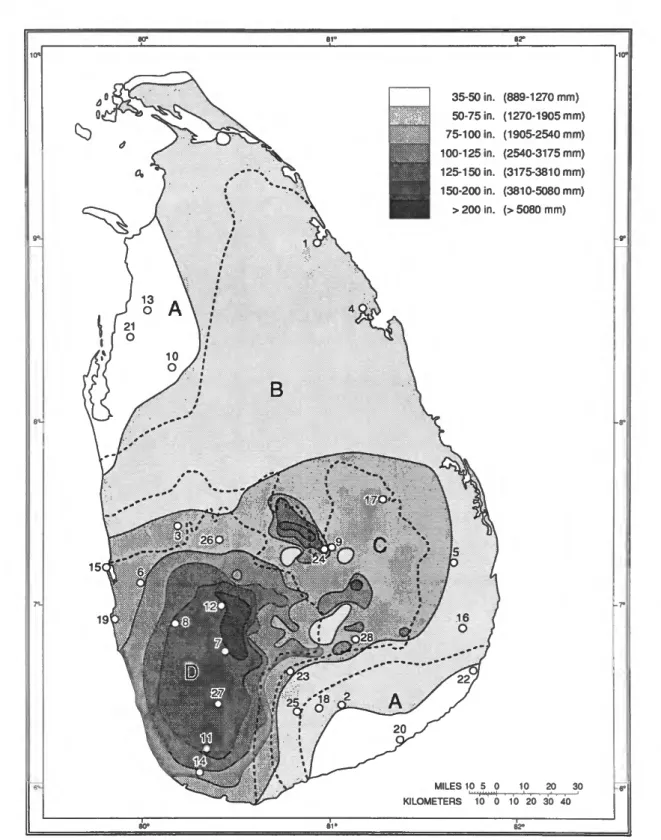
ZONATIONOF SRI LANKA.—The accompanying map (Figure
1) shows the partition of Sri Lanka into areas based on average annual rainfall, and the division into ecological areas.
The delineation into areas of average annual rainfall is based on de Silva (1980, map II), which used averages for a period of 30 years, 1931-1960. Brinck et al. (I971:ix, fig. 7) based their delineation of areas of rainfall on the Ceylon Survey Department's rainfall map for 1955, so their map differs in details of the boundaries.
The ecological zones, indicated by the letters A through D, are those adopted by plant and mammal ecologists (Mueller- Dombois, 1969, and Crusz, 1986). The botanists characterize these zones as follows: (A) the Manilkara-Chloroxylon series of plants, found in both northwestern and southeastern Sri Lanka; (B) the Chloroxylon-Berrya-Vitex-Schleicheria series of plants; (C) the Filicium-Euphoria-Artocarpus-Myristica series; and (D) includes the three rain forest areas, lowland, mid, and high altitude, each dominated by different plant series.
The mammalogists use the following terms: (A) monsoon scrub jungle; (B) monsoon forest and grassland; (C) intermon- soon forest; and (D) rain forest and grassland, subdivided into areas below 914 m, between 914 and 1524 m, and above 1524 m.
Areas with rainfall of less than 2000 mm annually, A and B, are considered to be the Dry Zone, and areas above 2000 mm annually the Wet Zone, D. Zone C is commonly designated as the Intermediate Zone, where rainfall may be above 2000 mm at times. Thirteen of our localities were in the Dry Zone, ten in the Wet Zone, and only five in the Intermediate Zone. Our localities in the Wet Zone were in the lowland rain forest below 914 m.
Brinck et al. (1971) provide helpful information on climate and habitats in Sri Lanka in their account of the Swedish collecting expedition in Ceylon.
NUMBER 515
35-50 in.
50-75 in.
75-100 in.
100-125 in.
125-150 in.
150-200 in.
> 2 0 0 in.
(889-1270 m m ) (1270-1905 m m ) (1905-2540 m m ) (2540-3175 m m ) (3175-3810 m m ) (3810-5080 m m ) (> 5080 m m )
KILOMETERS 10 0 10 20 30 40
FIGURE 1.—Map of Sri Lanka showing average annual rainfall, 1931-1960, and ecological zones (A-D, dashed lines), key localities numbered as in text. (Adapted respectively from de Silva, 1980, and Mueller-Dombois, 1969.)
Several words, or their usage in Sri Lanka, may be unfamiliar. These are:
aru, ara—stream
bund—more or less narrow flattened area on earthen embankment surrounding a tank
damana—open sandy loam area in Dry Zone jungle with sparse tufts of grass and a few small shrubs
ganga—stream, river
tank—artificial impoundment of water behind earthen embankment
villu—pond, lake
POLITICAL SUBDIVISIONS.—As of 1974 Sri Lanka was
divided into nine provinces each with two or three districts. In labeling our specimens we used district rather than province names. This avoided confusion because there are occasionally two villages with the same name in a province, but each is in a different district. In the following accounts I have given the range for each species and detailed records within each district in the following order:
Northern Province—Jaffna, Mannar, and Vavuniya Dis- tricts.
North Central Province—Anuradhapura and Polonnaruwa Districts.
Eastern Province—Trincomalee, Batticaloa, and Amparai Districts.
Central Province—Matale, Kandy, and Nuwara Eliya Districts.
North Western Province—Puttalam and Kurunegala Dis- tricts.
Western Province—Colombo and Kalutara Districts.
Sabaragamuwa Province—Kegalla and Ratnapura Districts.
Uva Province—Badulla and Monaragala Districts.
Southern Province—Galle, Matara, and Hambantota Dis- tricts.
I have also provided ecological information for each species including the zones in which each occurs, the ranges in altitude, and average annual rainfall.
LOCALITIES.—The approximate siting of the locations where our natural history observations were made is also shown in Figure 1 by numbers 1 through 28. The following tabulation lists these localities by district and furnishes information on elevation, average annual rainfall, and assignment to the appropriate zone.
1. Amarivayal, Trincomalee District.—A small village on the margin of a coastal lagoon in the Dry Zone with an average annual rainfall of about 1500 mm.
2. Angunakolapelessa, Monaragala District.—Ob- servations were made along a dry sandy stream bed that carries seasonal runoff. The area is in the Dry Zone at an elevation of approximately 60 m. The average annual rainfall at Embilip- itiya, about 22 km SSW, is 1500 mm.
3. Badegamuwa Jungle, Kurunegala District.—
Intermediate Zone jungle near Kurunegala at an elevation of 140 m, and an average annual rainfall of 2075 mm.
4. China Bay Ridge Bungalow, Trincomalee, Trincomalee District.—Observations were made in Dry Zone jungle adjacent to the bungalow at an altitude of about 25 m with an average annual rainfall of 1725 mm.
5. Ekgal Aru Reservoir, Amparai District.—Behavioral data were obtained in Dry Zone jungle about 18 km SSW of Amparai at an altitude of about 27 m and with an average annual rainfall of about 1650 mm.
6. Gampaha Botanic Garden, Colombo District.—
Observations were made along garden paths in this Wet Zone locality about 23 km NE of Colombo. It is at an altitude of 20 m and has an average annual rainfall about 2400 mm.
7. Gilimale, Induruwa Jungle, Ratnapura District.—Wet Zone rain forest 10 km NNE of Ratnapura at an elevation of about 200 m and with an average annual rainfall of 5000 mm.
8. Handapangoda Timber Reserve, Colombo District.—A second growth jungle in the Wet Zone about 35 km ESE of Colombo at an altitude of about 60 m with an average annual rainfall of about 4000 mm.
9. Hasalaka, Kandy District.—A sloping bank along a road 5 km W of Mahiyangana in the Intermediate Zone at an elevation of 90 m and with an average annual rainfall about
1925 mm.
10. Hunuwilagama, Anuradhapura District.—Along a roadside in the Dry Zone 30 km WSW of Anuradhapura at the entrance to Wilpattu National Park. The elevation is about 100 m and there is an average annual rainfall of about 1200 mm.
11. Kanneliya, Galle District.—Wet Zone rain forest in the Sinharaja Jungle 25 km NNE of Galle at an elevation about 150 m and with an average annual rainfall of over 4000 mm.
12. Kitulgala, Kegalla District.—Wet Zone rain forest south of the Kelani Ganga, 21 km N of Ratnapura at an elevation about 200 m and with an average annual rainfall of about 5000 mm. This is the site for the jungle scenes in the motion picture, "The Bridge on the River Kwai."
13. Kokmotte Bungalow, Wilpattu National Park.—
Because of collecting restrictions in the Park, our observations were made 0.8 km NE of the bungalow, on the north side of the Moderagam Aru in Mannar District. This is Dry Zone jungle at an altitude of about 30 m with an average annual rainfall of about 1200 mm.
14. Kottawa Forest Reserve, Galle District.—Wet Zone rain forest 13 km NNE of Galle at an elevation of about 65 m and with an average annual rainfall about 2540 mm.
15. Kurana, Colombo District.—A small coastal village in the Wet Zone about 20 km N of Colombo with an average annual rainfall about 2000 mm.
16. Lahugala Sanctuary, Amparai District.—Our observa- tions were made on the bund of the tank near the Wildlife and Nature Protection Society bungalow. This is a Dry Zone habitat at an elevation of about 33 m and with an average annual rainfall of about 1750 mm.
17. Maha Oya Tank, Amparai District.—This is in the Intermediate Zone at an altitude of about 35 m, and an average
NUMBER 515
annual rainfall of about 1900 mm.
18. Mau Aru, Monaragala District.—Our observations were made on the sandy banks along the stream in this Dry Zone area about 16 km E of Uda Walawe Reservoir. The elevation is about 60 m and the average annual rainfall is about 1500 mm.
19. Museum Garden, Colombo, Colombo District.—This is in the Wet Zone. Observations were made on hard-packed sand paths with admixture of some fine gravel on the Museum grounds. The altitude is about 15 m and the average annual rainfall is 2400 mm.
20. Palatupana Tank, Hambantota District.—This locality is just outside the entrance to Yala National Park. It is in the Dry Zone at an elevation of a few meters above sea level and an average annual rainfall of about 920 mm.
21. Panikka Villu, Wilpattu National Park, Puttalam District.—This is Dry Zone jungle surrounding a villu at an elevation of about 30 m and with an average annual rainfall of about 1000 mm.
22. Radella Tank, Amparai District.—This is in the Dry Zone 5 km W of Panama at an altitude of 15 m and with an average annual rainfall of about 1500 mm.
23. Rajawaka, Ratnapura District.—This is in the Dry Zone at 450 m and with an average annual rainfall of about 1550 mm.
24. Thawalamtenne, Kandy District.—Data were obtained along the roadside in the Intermediate Zone about 30 km E of Kandy at an elevation of about 1050 m with an average annual rainfall of about 3000 mm.
25. Uda Walawe Reservoir, Ceylon Electricity Board bungalow, Ratnapura District.—The bungalow is on the western edge of the Reservoir in the Dry Zone at an altitude of about 60 m. The average annual rainfall is 1500 mm at Embilipitiya, 10 km to the south.
26. Udawattakele Sanctuary, Kandy, Kandy District.—The Royal Jungle of the capital of the last native kingdom in the Wet Zone. Observations were made at altitudes ranging from 510 to 610 m in unlogged rain forest with an average annual rainfall of 2032 mm.
27. Weddagala, Ratnapura District.—This is a village in the Wet Zone 22 km S of Ratnapura. Our observations were made about 5 km south of the village in rain forest in the Sinharaja Jungle at an elevation of about 400 m with an average annual rainfall about 4900 mm.
28. Wellawaya, Monaragala District.—This locality is in the Intermediate Zone about 30 km S of Badulla. We made a brief stop at lunchtime in a small ravine along the roadside at an elevation of 175 m with an average annual rainfall of about 2500 mm.
SOURCE MATERIAL.—The field notes and voucher speci- mens of wasps, nests, and associated arthropods are in the National Museum of Natural History, Smithsonian Institution.
The behavioral data are condensed from the following field notes.
EUMENIDAE
Zethus (Zethus) ceylonicus Saussure: 32076 A; 61978 A.
Delta campaniforme esuriens (Fabricius): 92577 C.
Delta emarginatum conoideum (Gmelin): 92577 D.
Delta pyriforme pyriforme (Fabricius): 52676 A.
Paraleptomenes humbertianus (Saussure): 62076 B, C, D; 91277 D; 91577 A, B; 91080 A, B.
Paraleptomenes mephitis (Cameron): Summarized from my detailed paper on this species (Krombein, 1978a).
Anterhynchium abdominale (DJiger): 52476 A, B, C; 61376 B, C.
VESPIDAE
Eustenogaster eximia (Bingham): Unnumbered notes in 1972; 11175 A, B, C, D, E; 11375 B, E, F; 11475 A; 11575 L; 102677 A; 12579 A; 10280 A;
10380 A, B, C, D; unnumbered nests from Morapitiya, 1990.
POMPILJDAE
PEPSINAE
Hemipepsis convexa (Bingham): 92280 A; 32781 B, F; 41681 A.
Hemipepsis Indiana Wahis: 92877 A.
Dipogon kandiensis (Turner): 101480 A; 32281 A.
Auplopus bimaculatus (Smith): 11275 K; 32181 B.
Auplopus blandus (Guerin): 91377 B; 101080 A.
Auplopus cyanellus Wahis: 9977 B.
Auplopus funerator Wahis: 41581 A.
Auplopus gnomus (Cameron): 61576 B; 21777 F.
Auplopus himalayensis (Cameron): 11575 G.
Auplopus laeviculus (Bingham): 52376 E; 61878 E.
Auplopus nitidiventris (Smith): 10777 B.
Auplopus tinctus (Smith): 10777 A; 22779 A.
POMPIUNAE
Agenioideus (Schizanoplius) smithii (Ritsema): 11177 D.
Pompilus mirandus (Saussure): 2875 B; 61476 A.
Aporinellus hecate (Cameron): 11875 A; 22277 F; 32181 A.
Dicyrtomellus new species: 11177 C.
Anoplius (Orientanoplius) canifrons (Smith): 21777 E; 6778 A, C; 9180 A;
9280 A, C; 9380 A, B, C, E, H; 92480 A, B.
Anoplius (Arachnophroctonus) species, possibly alteralus Priesner: 61576 A.
Episyron novarae (Kohl): 61376 D; 12377 B; 22077 A; 4677 B; 12379 D;
21679 I; 32781 G, H.
Episyron praestigiosum Wahis: 9977 F; 71578 B.
Episyron tenebricumWahis: 21075 B; 41975 H.
Batazonellus annulalus (Fabricius): 12277 B.
Tachypompilus anal is (Fabricius): 52576 A; 11677 C.
Microcurgus new species: 11177 B.
CRABRONIDAE
Encopognathus (Encopognathus) districtus Leclercq: 62176 C; 62276 B;
2577 A; 2677 A, B, C, D; 3877 A; 3977 A; 31177 A; 31477 A. B, C;
31677 A, B, C, D; 31877 C, D, E, F; 32177 A, B, C; 32277 A, C; 32377 A, B; 32477 A, B; 32877 A, E, G, H; 32977 E; 33077 A, G, H; 33177 C;
4177 A, C; 41477 B; 41577 A; 41877 A, B, C, D; 41977 A; 42177 A;
42277 A, B, C; 42777 A, B, C; 42877 A, B, C; 12379 B.
Encopognathus (Encopognathus) lankanus Leclercq: 12775 A; 12875 A, B, C; 13175 A; 22775 A; 3475 A; 31275 A, B; 31775 A, B, C, D, E; 31875 B, C, D; 31975 A; 32075 A; 32475 A, B; 31777 A; 32577 B; 32877 B;
32977 A, D, F, G; 4177 B; 4577 A, B; 4677 C; 41177 A, B, C, D, E; 41477 A; 42177 B; 12379 A.
Encopognathus (Bihargnathus) itinerus Leclercq: 32277 B.
Encopognathus (Karossia) argentatus ( Lepeletier and Brulle): 3479 A.
Crossocerus (Ablepharipus) weeratungei Leclercq: 32081 A.
Crossocerus (Crossocerus) hasalakae Leclercq: 21777 G.
Eupliloides sinharajae Leclercq: 10480 A, B.
Piyuma prosopoides (Turner): 21177 A; 21277 A; 22077 B.
EUMENIDAE
Zethus (Zethus) ceylonicus Saussure
This rather uncommon wasp, 13-19 mm in length, occurs mostly in Dry Zone localities, but we collected it once in the Wet Zone as well. It was taken from near sea level to an altitude of 610 m in areas with an average annual rainfall ranging from 1500 to 2032 mm. Our records from Sri Lanka are as follows.
Trincomalee District: Amarivayal Matale District: Kibissa near Sigiriya Kandy District: Udawattakele Sanctuary
Monaragala District: 6 km NE of Buttala and Angunakola- pelessa
NEST ARCHITECTURE.—The wasp nests in abandoned borings of beetle larvae in twigs or exposed roots. P.B.
Karunaratne collected a female on 20 March 1976 at Amarivayal. She was beginning a nest in a longitudinal tunnel tightly packed with powdery frass in a dead twig 15 mm in diameter. The wasp was captured when she emerged from a hole in the side of the twig. She had excavated a cavity about 25 mm long in the frass-fillcd tunnel that ran in both directions from the entrance hole.
I collected another female on 19 June 1978 at Angunakola- pelessa. She was hovering at the underside of a dead exposed tree root on the edge of a dry stream bed. She alighted twice on a chimney composed of the tips of plant stems bearing tiny leaves up to 10 mm long. The trumpet-shaped chimney was 15 mm long, flared outward to about 20 mm diameter from a base about 10 mm in diameter and was lined with dried resin. At the base was an oval hole in the root, 9 x 6 mm, leading inward for 22 mm to a longitudinal boring 50 mm long, 12 mm wide, and 6 mm high. This tunnel contained a linear series of three cells each about 15 mm long. The partitions capping the cells were 1-2 mm thick and composed of bits of leaf gummed together.
The cell walls were not lined with leaves or dried resin. The innermost cell was empty but there was a thin layer of leaf bits gummed together at the inner end of the boring. The middle and outermost cells each held a colored pupa almost ready to eclose with the head end directed toward the entrance, a male in the middle and a female in the outermost. There was a thin partition of bits of leaf gummed together capping an empty vestibular cell 5 mm long at the juncture of the entrance tunnel and the longitudinal boring. The nest was probably in an old buprestid tunnel for I found a live buprestid larva in a similar burrow elsewhere in the root.
DISCUSSION.—Bohart and Stange (1965) summarized the known nesting behavior in Zethus, noting that the less specialized solitary species use old insect burrows in twigs,
wood, or in the ground, and that the more specialized species construct nests of masticated vegetable matter, sometimes by cooperating females in a subsocial manner. Some species use a resinous material mixed with leaf particles, but none was noted as making a chimney at die entrance as described for ceylonicus.
Delta Saussure
FIGURE 10
These wasps resemble large Eumenes, and the two genera are closely related. Some members of both genera build the familiar mud cells that resemble earthen pots. The species of Delta are known collectively as kumbala in Sri Lanka, the Sinhalese word for potter. Four species of Delta occur in that country, and we found nests of the three species detailed below.
J. van der Vecht provided specific identifications based either on reared adults or fully colored pupae. We did not obtain a nest of the fourth species, flavopictum (Blanchard) (Figure 10).
Delta campaniforme esuriens (Fabricius) This common wasp reaches the southeastern part of the Palaearctic Region in Iraq and Iran, but it is widely distributed in the Oriental Region where it ranges from the Indian subcontinent eastward through Burma, Thailand, Borneo, Java, and the Philippines. My records from Sri Lanka are as follows.
Anuradhapura District: Padaviya and Galkadawala Polonnaruwa District: Polonnaruwa
Trincomalee District: Trincomalee, China Bay
Amparai District: Inginiyagala, Uhana, and Lahugala Sanc- tuary
Matale District: Kibissa near Sigiriya Kandy District: Udawattakele Sanctuary
Colombo District: Papiliyana, Colombo, and Ratmalana Ratnapura District: Uda Walawe
Monaragala District: Mau Am Hambantota District: Palatupana
The species is much more common in the Dry Zone, but it is found also in the other two ecological zones. It occurs from sea level to an altitude of 610 m at localities where the average annual rainfall ranges from 920 to 2032 mm.
NEST.—A mud nest was found at the bungalow on the west bank of Uda Walawe Reservoir on 25 September 1977. The nest was constructed in a gap between mortar and two bricks in the bungalow wall. There was a row of eight cells in a space of 10.5 cm. The tops of the pots were more or less obscured by mud that had been plastered over them after construction. The first cell at the left contained a fully colored teneral female in a delicate white opaque silken cocoon. Cells 2 and 3 each had an emergence hole and remnants of the same kind of cocoon;
presumably each contained a male that had already emerged.
Cells 4 through 8 each contained a female pupa, the one in 4 fully colored and ready to eclose, those in 5-8 successively less mature.
NUMBER 515
10
FIGURES 2-11.—Nests and adults, Vespoidea: 2-4, nests of Paraleptomen.es humbertianus (Saussure), x2; 2-3, one tube with two cells, 3, tube broken open with pupa in basal cell; 4, nest with 2 lubes; 5-7, nests of P. mephitis (Cameron), x2; 5, cluster of two-celled tubes on wood fibers; 6-7, three two-celled tubes from flat substrate; 8-9, nest of Delta p. pyriforme (Fabricius), xO.88; 9, with deep cleft on upper half where nest was attached to twig;
10, female D.flavopictum (Blanchard), xl.75; 11, Eustenogaster eximia (Bingham), xl.75.
Delta emarginatum conoideum (Gmelin)
I have seen specimens from India, Burma, and Thailand as well as Sri Lanka. Within Sri Lanka it is more common in the Dry Zone, but it is found also in the other two zones. It occurs from near sea level to an altitude of 610 m, in areas where the average annual rainfall ranges from about 1200 to 2032 mm.
Our records from Sri Lanka are as follows.
Anuradhapura District: Cheddikulam and Padaviya Polonnaruwa District: Pimburettawa
Trincomalee District: Amarivayal, Tennamaravadi, and Trincomalee, China Bay
Matale District: Kibissa near Sigiriya
Kandy District: Hasalaka and Kandy, Udawattakele Sanctu- ary
Colombo District: Colombo, Papiliyana, Labugama, Rat- malana, and Gampaha
Ratnapura District: Uda Walawe
NEST.—This wasp nested on the brick wall of the same bungalow where the preceding wasp was nesting. The nest was an irregular T-shaped mass, 7.6 cm high and 3.8 cm wide at the top, so plastered over with mud that it was difficult to distinguish the individual pots. There were five cells in the lower perpendicular section, each containing a male pupa, and two cells in the horizontal upper section, each with a female pupa. The degree of development of the pupae as indicated by their coloration showed that the lowest cell was constructed first, followed successively by those above. The cells were about 20 mm wide and 14 mm high and the cell walls were 1 mm thick.
Delta pyriforme pyriforme (Fabricius)
FIGURES 8-9
I have seen this species from India, Thailand, and China, as well as Sri Lanka. It is widely distributed in Sri Lanka in the three ecological zones, in areas from near sea level to an altitude of 610 m with an average annual rainfall from 1200 to 4000 mm. Our Ccylonese records are as follows.
Anuradhapura District: Hunuwilagama, Cheddikulam, and Padaviya
Trincomalee District: Trincomalee, China Bay
Amparai District: Ekgal Aru Reservoir and Lahugala Sanctuary
Kandy District: Thawalamtenne and Kandy, Udawattakele Sanctuary
Colombo District: Colombo Kegalla District: Kitulgala Ratnapura District: Wcddagala
NEST.—A rounded clump of mud cells (Figures 8-9), 7.5 x4.5 x4.0 cm, was found on a stout twig of a bush at Hunuwilagama on 26 May 1976. Two of the cells contained wasp pupae but the others contained a number of large dipterous puparia. A pair of wasps and five females and nine
males of the miltogrammine (Sarcophagidae) parasite had emerged by 6 June. The parasite was Amobia auriceps (Baranov); this is the first host record for that species.
Paraleptomenes humbertianus (Saussure)
FIGURES 2-4
This species is known only from Sri Lanka where it occurs mostly in the Dry Zone, but it is found occasionally in the other two zones, from near sea level to an altitude of 450 m at localities with an average annual rainfall of 1200 to 2400 mm.
We collected it as follows.
Anuradhapura District: Padaviya, Galapitawewa, and Hunuwilagama
Trincomalee District: Tennamaravadi and Trincomalee, China Bay
Amparai District: Maha Oya and Ekgal Aru Reservoir Matale District: Kibissa near Sigiriya
Kurunegala District: Badegamuwa
Colombo District: Papiliyana, Gampaha, and Labugama Ratnapura District: Rajawaka
Monaragala District: Angunakolapelessa Hambantota District: Palatupana Tank
This species, 6.5-9.0 mm long, is less common than its smaller congener, mephitis (Saussure). We found only eight nests of humbertianus, three at Rajawaka in 1976, one at Ekgal Aru Sanctuary Jungle in 1977, two at Maha Oya Tank in 1977, and two in Badegamuwa Jungle in 1980.
NEST.—This is a spiral mud tube coiled around a grass stem or rootlet beneath an overhanging or on a vertical bank. The tube usually contains two cells (Figures 2-3), and the entire nest may consist of two or three such tubes (Figure 4). One two-celled tube is about 20 mm long with an external diameter of 5-7 mm. The mud walls of the tube are about 1.3 mm thick.
We found no nests at an early stage of their construction, but the wasp makes the mud tube from the bottom upward, thus preventing the prey from dropping out of the cell.
A two-celled nest (Figures 2-3) was on a rootlet beneath an overhanging bank on 10 September 1980.1 broke off the upper end and discovered a mature wasp larva spinning its cocoon cap. There had been no emergence by the following June, at which time the nest contained two dead, fully colored adults that had not been able to shed the pupal exuviae, a female in the lower (innermost) cell and a male in the outer.
Another nest beneath this bank consisted of three spiral mud tubes, all open at the top. The female was inside the uppermost tube which was otherwise empty. The middle tube had silk on the wall and the meconium of a wasp larva, but the occupant had transformed and emerged. The lowest tube had not been provisioned.
I captured a female on a nest on a grass stem (Figure 4) on a vertical bank. She had just begun the second spiral tube at the
NUMBER 515
top of the sealed first tube. Subsequently, a male emerged from this nest.
I was unable to ascertain whether humbertianus practices progressive provisioning of its nests as does mephitis (Came- ron) (Krombein, 1978a), or whether it is a mass provisioned
PREY.—We obtained only one prey record, a small caterpil- lar, 2.3 mm long, probably a species of Carposinidae, in a cell with a mature wasp larva at Rajawaka.
ASSOCIATES.—Two species of parasites and two renters are associated with humbertianus. We found a newly emerged female mutillid, Promecilla metallica (Cameron), 7.5 mm long, in a nest at Rajawaka; this wasp was reared also from nests of mephitis. A 2-celled nest at Ekgal Aru contained a well-colored female pupa of humbertianus in the inner cell, and a parasitic bombyliid larva about ready to pupate in the outer cell. The latter failed to pupate perfectly, but it was very similar to the pupa of a species of Toxophora Meigen that I found also in nests of mephitis.
Another two-celled nest at Rajawaka contained a full grown larva of humbertianus in the inner cell, and a white cocoon in the outer cell from which a female renter, Trypoxylon errans Saussure emerged later. A male of T. thaianum Tsuneki was reared from a nest at Maha Oya; this renter also uses nests of mephitis.
Paraleptomenes mephitis (Cameron) FIGURES 5-7
This smaller wasp occurs primarily in Sri Lanka, but it has been recorded also from a few localities in eastern and southern India. It may be only subspecifically distinct from miniatus (Saussure) from more northern areas in India (J. van der Vecht, personal communication). It has much the same distribution as humbertianus within Sri Lanka, with the same altitudinal and rainfall ranges. Our specific records, mostly from nesting sites, are as follows.
Anuradhapura District: Hunuwilagama and Cheddikulam Trincomalee District: Trincomalee, China Bay
Amparai District: Ekgal Aru Reservoir Kandy District: Hasalaka
Colombo District: Colombo Ratnapura District: Uda Walawe
Hambantota District: Palatupana Tank and Wildlife and Nature Protection Society Bungalow
LIFE HISTORY, NESTS, AND ASSOCIATES.—Earlier (Krom- bein, 1978a) I published a detailed account of this small wasp.
It constructs mud nests in sheltered situations such as beneath covered walkways, house eaves, and verandah roofs. The nests consist of tubes placed side by side against a flat surface, with the outer end of the tubes curved away from the substrate (Figures 6-7). Even when the tubes are constructed on a narrow surface, such as a group of wood fibers (Figure 5), the tubes are aligned along the substrate, not coiled around it as in
humbertianus. The nests may be built on substrates that are horizontal, at an angle, or vertical. On the latter two surfaces, the tubes are always placed with the outer end upward. The tubes are 19-25 mm long, 4-5 mm wide, and the walls except at base are only 0.2-0.4 mm thick. A tube usually contains two cells, but shorter tubes have only a single cell.
This species practices progressive provisioning, usually providing two or three small prey before the egg hatches, and then rapidly bringing in more prey after the larva begins to feed.
The prey are microlepidopterans, 2-6 mm long, belonging to several families, and, rarely, small geometrid or noctuid larvae.
I estimated that the egg stage was 2-3 days and the feeding larval stage 4-5 days. The larva then spends 2-3 days spinning a tough white cocoon against the cell walls and partitions, and then 3-4 days in the prepupal stage before pupation. Eclosion of adults occurs in about 11 days, and they leave the cells 12-14 days after pupation. A female developed in the inner cell of the tube, and a male in the outer, in the majority of 2-celled tubes.
Paraleptomenes mephitis has a large number of nest associates because large populations of the wasps are available at times. The parasites included: Mutillidae, Promecilla metallica (Cameron), P. hesitata (Cameron) and Smicromyrme ludovica (Cameron); Chrysididae, Chrysis (Chrysis) n. sp.;
Perilampidae, Krombeinius eumenidarum Boucek; Eulophidae, Melittobia clavicornis (Cameron) and M. new species; and Bombyliidae, Toxophora new secies. Pharaoh's ant, Monomo- rium pharaonis (Linnaeus) (Formicidae) infested one nest and carried off the lepidopterous larvae. Two species of Trypoxylon (Larridae), pileatum Smith and thaianum Tsuneki, used empty tubes as nesting sites. Scavenging dermestid larvae were found in one cell.
Anterhynchium abdominale (Illiger)
This species occurs in the Indian subcontinent, and several color phases are recognized in India. Within Sri Lanka it appears to be restricted to rather dry areas at low altitudes in the Dry Zone. Our limited observations suggest that this wasp nests in the ventilation shafts of the large termitaria of species of Odontotermes. The few localities where we collected it in Sri Lanka are as follows.
Mannar District: 0.8 km NE of Kokmotte Bungalow, Wilpattu National Park
Anuradhapura District: Hunawilagama Trincomalee District: Trincomalee, China Bay Amparai District: Lahugala Sanctuary Puttalam District: Tabbowa
The elevations are 25-100 m, and the average annual rainfall is 1200-1750 mm.
NEST.—We observed abdominale during May and June 1976 near Kokmotte Bungalow, and in Lahugala Sanctuary.
We saw several females of nominotypical abdominale, 13-17 mm long, entering ventilation shafts of Odontotermes sp. at
both localities, and remaining inside for periods ranging from 1 to more than 10 minutes. We did not excavate nests, but Batra (1979) reared the dark color phase, abdominale bengalense (Saussure) from cells off the inner surface of ventilation shafts of Odontotermes obesus (Rambur) in Amritsar District, Punjab, India. She found that a nest consisted of 1 to 11 individual cells 36-79 cm below the top of the shaft. The cells were 19-20 mm long, 11-12 mm maximum width and were lined with a chestnut brown flexible material with embedded soil particles. I presume that the lining was a secretion applied by the larva in lieu of spinning a typical cocoon, a behavioral trait exhibited by the North American eumenid, Monobia quadridens (Linnaeus) (Krombein, 1967:51). Batra's individ- ual cells were capped by an earthen plug 5.5-6.0 mm wide and 4-10 mm long that connected the cell to the inside of the shaft.
Her diapausing larvae began to pupate in mid-June and the first adult wasps emerged in about 24 days.
ASSOCIATE.—I saw a female chrysidid, Chrysis schioedtei Dahlbom, 11 mm long, alighting upon a shaft that had been entered by a female of abdominale; presumably it is parasitic upon the eumenid. Batra found a large parasitic wasp larva in a cocoon in one cell, and small dipterous puparia and remains of the caterpillar prey of the wasp in two other cells.
VESPIDAE
Eustenogaster eximia (Bingham)
FIGURES 11-47,49-57
Members of the Stenogastrinae are unique among the Vespidae in the facility with which they hover in the air like a dragonfly, a capability that led Carpenter (1988) to christen them "hover wasps." The female uses this ability to hover in front of a spider web, and delicately pick off small insects trapped in the outer strands, or small commensal spiders on the periphery of the web of a larger host spider.
Eustenogaster eximia is the only member of the Stenogastri- nae that occurs in Sri Lanka. The female is a relatively large, slender wasp (Figure 11), 19-21 mm long, superficially resembling a large eumenid such as Delta flavopictum (Blanchard) (Figure 10).
The species was described as Ischnogaster eximius Bingham (1890) from a male reared by E.E. Green from a nest obtained near Galle, Sri Lanka. Bingham also included a few notes and a figure of the nest which had been furnished by Green.
Stenogaster eximioides Dover and Rao from southern India was synonymized as only a color variant of eximia by Dover (1925).
It is, however, currently recognized as a subspecies of eximia by Das and Gupta (1983), who also synonymized Paravespa eva Bell (1936) under eximioides. There is a slight difference in coloration between eximia and eximioides, a character that J.
van der Vecht (personal communication) thinks is probably not constant. J. van der Vecht, and later, C.K. Starr, confirmed that my specimens from Sri Lanka are all eximia. The reported occurrence of eximia in Thailand and Malaya (Dover, 1931) is
questionable and needs confirmation. Pending a revisionary study of Eustenogaster, it seems preferable to recognize eximia as a single taxon of disjunct distribution restricted to quite humid areas of southwestern Sri Lanka and southern India.
Within Sri Lanka eximia occurs in densely shaded areas of lowland rain forest. It was collected at the following localities by personnel associated with the Smithsonian's Ceylon Insect Project, 1972-1980.
Kalutara District: Morapitiya Kegalla District: Kitulgala
Ratnapura District: Gilimale and Weddagala, Sinharaja Jungle
Monaragala District: Wellawaya
Galle District: Kottawa and Kanneliya, Sinharaja Jungle These localities have elevations that range from 65 to 610 m and an average annual rainfall of 2600-5000 mm. There are specimens from Kandy in the Colombo Museum collected in 1909 and 1917, but I did not find it during my frequent visits to Kandy, although I collected in Udawattakele Sanctuary and Kandy Reservoir jungles. We obtained most of our data and nests in the Kanneliya section of the Sinharaja Jungle, and lesser numbers in Kottawa, Kitulgala, and Wellawaya (Figures 16-30). These localities are all in the Wet Zone except for Wellawaya in the Intermediate Zone, where we found a single nest in a wooded ravine beneath an overhanging stream bank.
NEST
ARCHITECTURE.—Nests are constructed in sheltered spots in the rain forest, usually beneath earth or rock overhangs along a stream (Figures 12-15) where they are protected from rain.
The nest is suspended from a slender exposed rootlet or stem of a fern frond at some distance from the tip. The top of the comb is attached firmly to the substrate which does not penetrate into the cells.
The distinctive completed nest is a more or less pear-shaped structure constructed from masticated bits of rotten vegetative matter that dry to form a thin, brittle carton that is normally 0.24-0.36 mm thick on the exterior surface.
L.R. Batra* analyzed the composition of carton in fresh nests collected by P.B. Karunaratne in Morapitiya, June 1990. Using three samples, about 1 mm3, from different sites of the pseudenvelope, he found that microscopically they contained about 10% by volume of masticated fungal hyphae of a species of Polyporaceae or Thelephoraceae (Basidiomycetes, Aphyllo- phorales). Members of those families cause wood rots which make the wood soft, friable, and workable by many species of insects that feed upon it, bore into it, or use it in nest-making.
The fungi may remain viable in the wood for several years. He identified the fungus from the clamp connections of brown vegetative hyphae.
He found two additional kinds of hyphae, skeletal and
*L.R. Batra, Microbiology and Plant Pathology Laboratory, U.S. Department of Agriculture, Beltsville, MD, 20705.
NUMBER 515 11
16
FIGURES 12-18.—Nests, Eustenogaster eximia (Bingham): 12-15, habitats beneath overhanging banks; 12-13, Kanncliya, arrow in 12 indicates nest, 13, same nest as 12 and 18; 14-15, Kottawa, 14, nest, xO.38, 15, another nest, x0.44; 16-17, Wellawaya, x l ; 16, surface facing outward, 17, surface facing bank; 18, Kanneliya, x l , same nest as 12-13.
binding, which may or may not belong to the same basidiomycetous species.
The skeletal hyphae were thick walled, usually branched, unseptate, and straight except for being slightly bent or flexuous with the thin apices. He stated that these hyphae develop from the vegetative cum generative hyphae. They are called skeletal hyphae because they are characteristic of genera and species whose fruiting bodies are hard and tough, as contrasted with soft and fleshy fruiting bodies of commercial mushrooms such as Agaricus.
The binding hyphae were similar to the skeletal hyphae but had much thicker walls, and, thus, narrower lumens. He found them intertwined and mixed with the vegetative and skeletal hyphae. The binding hyphae in the Basidiomycetes further strengthen the fruiting body. The vegetal hyphae of many Basidiomycetes, such as the entire genus Termitomyces Heim, are known to act as a bonding agent for the rotting wood fibers that constitute the bulk of the carton, i.e., material that has passed through worker guts, in nests of fungus-growing subterranean termites such as Odontotermes obesus (Rambur) and 0. gurdaspurensis (Holmgren and Holmgren) in India (Batra and Batra, 1966).
Batra stated that the relatively large volume of fungal matter in the carton of the wasp nest was intriguing, and that the wasp was certainly using wood that was rotted by fungi. He said that rotting wood has only vegetative or generative hyphae in its interior. However, toward the exterior, where the wasp would have obtained the wood, skeletal hyphae or even binding hyphae would be found as the fruiting body primordia appeared. Thus, it is quite possible that the wasp incorporated into the carton pieces of fruiting bodies of the Aphyllophorales that grew on the surface of the wood. He stated that the fungus did not form a regular mass which would have indicated that it developed after the nest carton was assembled.
He took three additional samples of carton of the same size, and cultured them on 2% water agar, and potato dextrose agar.
He found two common soil-inhabiting saprophytes in each sample—Cunninghamella elegans Matruchot (Phycomycetes, Mucorales), and a species of Cephalosporium (Hyphomycetes, Moniliales). These saprophytic fungi are presumably chance contaminants, and have no essential role in carton formation.
The pseudenvelope is frequently covered by numerous, short erect hyphae (Figures 43, 44, 52, 53) that occur also on the inner cell walls (Figures 54, 55). Batra identified this fungus as a species of Fusarium (Hyphomycetes, Moniliales, Tubercular- iaceae) by finding its spores on the carton of these recently collected nests.
The nest shape is rather variable (Figures 16-23) and depends basically on the number and arrangement of cells, which range from 4 to 26 in eximia with an average of 13.3 cells per nest (n = 34). The peripheral cells are rounded on the outer surface, so that the upper 10 to 15 mm of the nest has distinct longitudinal grooves between adjacent cells (Figure 19, g). Below this area of peripheral cells the pseudenvelope narrows toward the terminal spout. There are often thin,
sometimes denticulate ridges on the carton, extending down- ward from the peripheral cells (Figure 17, r, and 35).
Sometimes there are thin elongate wings or teeth on top of the nest, and the peripheral cells are not so clearly demarcated (Figure 17, w, t). Occasionally there are one or more aborted cells up to 12 mm long on the outer surface of the pseudenvelope which the female did not include within the completed nest (Figure 23).
The nest narrows below the cells to form a slender spout with the nest entrance on the surface toward the bank (Figure 17).
The wall of the spout surrounding the entrance is perforated by a lacy network of carton through which the wasp may peer while remaining hidden. The perforated area is margined by a narrow flange of carton giving the spout a lanceolate appearance (Figure 18, f). The spout is extremely fragile because of the perforations. The perforations are made from larger masses of masticated material (Figures 31-34), 0.6-1.0 mm thick. One wasp included in the perforated area a large chunk of unworked vegetative matter 2.4 mm long and 0.4-0.8 mm thick (Figure 34). The spout must frequently be broken during storms as the nest is buffeted by the wind or driving rain.
Many of the active nests that we found in the field had the spout broken off. The spout apparently is not replaced if it is damaged.
We found a single anomalous nest at Kanneliya in 1979. The pseudenvelope divided into two spouts with entrance holes at the bottom, each giving access to the comb. The older spout had the tip broken off, the other was complete. The single female escaped from the nest. Pagden (1958, fig. 7a) described a similar nest of an unidentified species of Eustenogaster (his Group I of Stenogaster in Malaya). These two nests may possibly be rare examples of spout replacement following supersedure of one female by another.
Bell (1936) found nests of eximia in areas of high rainfall in the Western Ghats near Bombay. His nests were located in the same kinds of habitats and were as variable in shape as those I found in Sri Lanka.
The profound variation of nest architecture in eximia nests creates doubt about the validity of the elaborate scheme of nest architecture proposed by Ohgushi and his colleagues (1983) for four species of Sumatran Eustenogaster which they designated as Ej_4. Nests of types Ej_3 are all found in eximia. The nest types which they designated as E4, and later as E5 (Ohgushi et al., 1986), could be variation within calyptodoma. Critical taxonomic study of wasps associated with nest variations is required to substantiate any system of nest architecture. It seems probable that there may be considerable plasticity in nest architecture within a single species of Eustenogaster.
Some species of Eustenogaster, including eximia, do not construct an ant guard on the support above the nest. However, Pagden (1958, fig. 8) found an unidentified species of this genus in Malaya that provided such a guard, and C.K. Starr (personal communication) also found ant guards in several species of Eustenogaster in the Philippines.
MATERIALS USED.—I did not observe eximia gathering
NUMBER 515 13
FIGURES 31-35.—Structure from nests preserved dry, Eustenogaster eximia (Bingham), Kanneliya: 31-34, fragments of perforated area of spout; 31, fragment without fungi; 32, fragment from another nest with Fusarium hyphae; 33, edge of perforated section, same fragment as 31; 34, unworked fragment of wood from perforation in a third nest; 35, serrations of rib in profile of a fourth nest.
NUMBER 515 15 decaying vegetative material for nest construction, but scan-
ning electron micrographs (SEM) of fragments from about a dozen nests provide some knowledge. Some sections were made principally of decayed xylem fragments with some intermixed amorphous vegetative matter (Figure 36). I also found occasional pieces of decayed hardwood with profuse vessel-pitting as seen from inside of a vessel element (the many tiny perforations) (Figure 37), mixed in with xylem fragments.
Small particles of mud occurred rarely (Figures 38-39, m).
Some of my nests (Figures 16, 17, 19, 23, 24) are mostly unicolorous, the pulp apparently coming from a single source.
Other nests are prettily patterned (Figures 18, 20, 21, 27) with alternating bands in two colors, undoubtedly made from pulp from different sources. SEMs of banded sections of carton showed no appreciable difference in composition. Still other nests (Figure 22) are irregularly blotched, suggesting that a damaged nest might have been patched with pulp from a different source.
Green (1924) erred in stating that the nest of eximia in Sri Lanka is "built of earthy matter." Bell (1936) mentioned the extreme fragility of the Indian nests, but he, too, was mistaken in stating that they were built of mud mixed with saliva. Nest or nest fragments from both Bell and Green in the British Museum (Natural History) are of carton (personal commnunication, M.C. Day).
Williams (1919) published a brief account of the Philippine luzonensis (Rohwer). He observed females gathering nest material from the trunk of a fallen tree and reported that the
"moist, and well-decayed wood [was] chewed into a pulp and formed into a delicate paper which is not rainproof." He made no notes on application of the pulp to the nest, but mentioned that the pulp-gathering trips were made at intervals of about 15 minutes. The presumption is that the actual processing of a load of pulp and its application to the nest is a reasonably prolonged process.
Pagden (1958) stated that several unidentified species of Eustenogaster (his Group I of Stenogaster) in Malaya constructed their nests of "triturated vegetable matter."
Hansell (1981) analyzed pieces of nest material from three nests of another stenogastrine in Thailand, Parisehnogaster mellyi (Saussure). He found the carton composed principally of plant fragments with very little intermixed soil. The plant material was of two types, woody xylem fragments possibly from rotten stems, and pieces of cuticular cell layer of plants, some of which bore discernible hairs.
Ohgushi et al. (1983) found a small amount of mud mixed with the carton in some of the nests made by several unidentified species of Eustenogaster in Sumatera Barat, Indonesia. Neither Williams nor Pagden mentioned any admixture of mud in their nests, and Hansell and I found it infrequently. I believe that any inclusion of mud in Eustenogas- ter nests is accidental. It probably occurs when the wasp collects leaf fragments or pulp from decaying wood lying on the forest floor.
CONSTRUCTION.—The wasp initiates the nest by construct-
ing a comb of shallow cells beneath the supporting substrate (Figure 26). The cells are about 6.5 mm wide, and hexagonal in cross section except for those on the periphery which have the outer surface rounded (Figures 29, 30). When the cell walls reach 5-10 mm in length, she may begin to lay eggs, one in each cell beginning at the center of the comb. We found a 25-celled comb with cell walls about 10 mm long in which eggs or tiny larvae were present in five of the central cells. Oviposition and brood rearing apparently proceed at a leisurely pace. During this period the cell walls are extended downward to their full length of 13-15 mm.
Occasionally, though, the entire pseudenvelope including spout may be completed before eggs are laid, or very soon after the first eggs are deposited. I found one such nest with completed pseudenvelope in which the 17 cells were very short, and six of the central cells, 5-8 mm long, each contained an egg or tiny larva.
The interior cell walls are 0.13-0.28 mm (n = 13) thick, while the pseudenvelope is 0.24-0.36 mm (n = 12) thick. If ribs are present on the lower exterior of the pseudenvelope, that wall and the rib are 0.69-0.75 mm (n = 6) thick.
There is no true envelope of carton separated from the comb in most species of Eustenogaster. The single known exception is calyptodoma (Sakagami and Yoshikawa) from Borneo and Malaya. In this unusual species the cells are attached directly to a flat surface such as a slanting rock or piece of wood, and the envelope is separated from the comb by as much as 5 mm.
Exceptionally the envelope may be partially in contact with the comb. The nest has a terminal spout as in other species of the genus.
BROOD DEVELOPMENT
EGG.—The egg of eximia is short, sausage-shaped, 1.8-2.1 mm long and 0.8-0.9 mm wide (n = 6) (Figure 40). The wasp begins to lay eggs in the central comb cells first, placing each at the inner (i.e., upper) end of the cell. All eggs and young larvae that I observed were immersed in a globular mass of thick, sticky, milky-white substance. This is consistent with conditions reported in nests of other species of Stenogastrinae.
I did not observe oviposition in eximia, but Turillazzi (1985a) studied it in several species of Parischnogaster. He noted that the female secreted a drop of viscid, milky-white substance from the tip of her abdomen, collected it in her mouthparts, touched the drop to the egg as it was extruded from the abdomen, and then deposited the egg and substance in the cell. Additional droplets of substance were placed in the cell after the larva hatched. Hansell (1982) suggested that the drops were secreted from Dufour's gland. Carpenter (1988) com- mented that the oviposition sequence of the Stenogastrinae is unique in the Vespidae.
Turillazzi also noted that the abdominal substance, possibly mixed with oral secretions, was used to form the ringlike ant guard placed on the rootlet a short distance above the nest of Parischnogaster.
FIGURES 36-39.—Composition of cell walls, Eustenogaster eximia (Bingham), Kanneliya, 36, 38, 39, of psuedenvelope from dry nests, 37 from comb preserved in alcohol: 36, vascular tissue and some amorphous material; 37, fragments of decayed hardwood with profuse vessel pitting inside of a vessel element (the numerous tiny perforations), a little vascular material and a few strands of Fusarium hyphae; 38, fragment from another nest than 36 with scattered particles of mud, one indicated by arrow; 39, mud particle from 38 enlarged.
NUMBER 515 17
Larval head width 0.9 mm 0.9 mm nearly mature
Code number
none none 113751
1.8 mm 11375 B
LARVAL FOOD.—I examined the gut contents of eight larvae from Kanneliya preserved in alcohol in 1975. The larvae ranged from about a third grown to fully mature. The results were as shown below.
Gut contents
many tiny unidentifiable chitinized fragments araneoid fang, 0.23 mm long
numerous unidentifiable chitinized fragments 2 araneoid fangs, 0.3 and 0.53 mm long
many fragments of araneoid legs, none with tarsal claws numerous unidentifable chitinized fragments 2 araneoid fangs, 0.28 and 0.3 mm long araneoid spermatheca, 0.38 mm long
many fragments of araneoid legs, none with tarsal claws braconid stigma, 0.5 mm long
fragments of braconid or ichneumonid wings, 0.23-1.06 mm long
3 ichneumonoid ocelli, 0.1 mm wide, in head capsule fragments, 0.23-0.4 mm wide
numerous unidentifiable chitinized fragments numerous unidentifiable chitinized fragments 4 fragments basal segment araneoid chelicerae 6 araneoid fangs, 0.2-0.68 mm long
many sections of araneoid legs, 0.5-0.7 mm long, 2 with terminal tarsal claws
terminal segment pedipalp, female araneoid, 0.31 mm long
5 araneoid spermathecae, ca 0.15x0.23 mm 3 ichneumonoid wing fragments, 0.35-0.43 mm long numerous unidentifiable chitinized fragments 2 araneoid fangs, 0.4 and 0.58 mm long numerous unidentifiable chitinized fragments 4 araneoid fangs, 0.35-0.63 mm long numerous unidentifiable chitinized fragments 1.9 mm
1.9 mm none 11175 A
2.0 mm 2.0 mm
I also obtained some data from the cell contents of several nests at Kanneliya in 1975 and 1980. The contents from one cell in each of three nests in 1975 were negative for larval food;
each contained only the globule of abdominal substance and an egg or newly hatched larva. One cell of another nest from 1975 contained the following: the head and abdominal integument of a worker minor of a small myrmicine ant, possibly Oli- gomyrmex Mayr, the modified pedipalp of a male spider, 0.25 mm long, and the head of a small coleopterous larva, all of these parts having been fed upon by the wasp larva. There was also a whole, tiny collembolan, 0.44 mm long; this will be discussed in the section, Nest Associates. Another cell from the same nest contained only a globule of the abdominal substance and an egg.
Each of two cells in the 1980 nest contained a small larva and some food. I recovered the following food items from these cells. (1) Two workers of a myrmicine ant, 2.4 mm long, a species of Crematogaster Lund possibly belonging to the biroi group. One ant had been malaxated, possibly by the foundress, and partially embedded in a small mass of abdominal substance, and one ant had the thorax and abdomen hollowed
FIGURES 40-41.—Eustenogaster eximia (Bingham), Kanneliya: 40, eggs, embryo second from right distorted; 41, pupal position in cell.
out, presumably by the larva of eximia. (2) A small fragment of chitin, 0.25 mm long, from an unidentified arthropod. The lower pseudenvelope of this nest was damaged, thus allowing easy access by casual visitors. In one of these two cells there was an adult ephydrid fly, 2 mm long, attracted to some of the larval food, a small dipterous maggot, 1.8 mm long, a worker termite, 2.5 mm long, and an adult mite, 0.25 mm long; these arthropods will be discussed in the section, Nest Associates.
It was not surprising to find identifiable parts of spiders in many of the guts and in one cell. Williams (1928) figured a female of P. depressigaster (Rohwer) hovering before a spider web suspended over a stream. She picked small midges from a strand of the web, using her mandibles and legs. Pagden (1958) reported that unidentified species of Eustenogaster (his Group I of Stenogaster) in Malaya hovered in front of spider webs and plucked small flies from the web with the forelegs. He noted that the spider was not disturbed by the wasp's activities, and
FIGURES 42-47.—Cocoons, Euslenogaster eximia (Bingham), Kanneliya: 42, inner surface of section of pupal cell with glistening cocoon fabric covering strands of Fusarium hyphae; 43, outer surface of same section covered by hyphae; 44, edge of same cell section, outer surface at left; 45-47, edge of cocoon showing varying degrees of thickness as denoted by scale lines.