This article examines the effects of birth order on the incidence of child labor and schooling for Brazilian children. However, in the context of child labor, the effects of birth order may be confounded by the fact that earlier-born children are able to earn higher wages than their younger siblings. This article presents both a theoretical discussion and an empirical investigation of the relationship between birth order and child labour.
This choice may depend on the size of the family and the birth order of the child. Therefore, the empirical question is how birth order affects the incidence of child labor and children's schooling in developing countries. The fact that a worker's labor market wage is positively related to a child's age is an important factor in the effects of birth order on family decisions about children's work and schooling.
6 We could also assume that this wage is also a function of the child's human capital, which would make the effect of birth order on wages indeterminate. In other words, the birth order effect will depend on the preferences of the parents, the human capital accumulation technology of the children and the difference in the wage rate. Since the net effect of birth order depends on the relative magnitudes of the various counteracting forces in the model, the actual effect is an empirical problem.
We search for empirical regularities of birth order effects on child labor and schooling in Section IV.
Data Set and Sample Selection
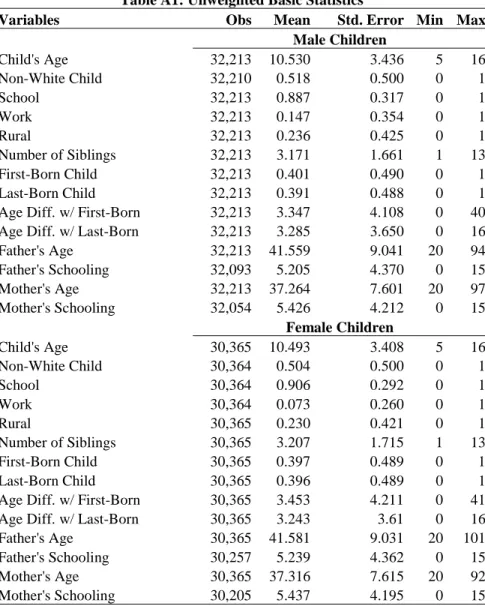
But past fertility decisions are related to current family size and may in turn be correlated with decisions about time allocation for the children. Therefore, we also construct another sub-sample of all children from families where there are exactly three siblings. We choose three-child families to provide an appropriate sample size, since the average number of children in the data set is 3, as well as to conduct the analysis of first-born and last-born coefficients in relation to second-born children, which is useful.
Finally, since parents from completed families with the same number of siblings are more likely to have faced similar constraints and/or had a similar set of preferences, we construct a subsample that includes all children from families where their mothers are forty years old. senior or older and where there are exactly three siblings.
Empirical Results
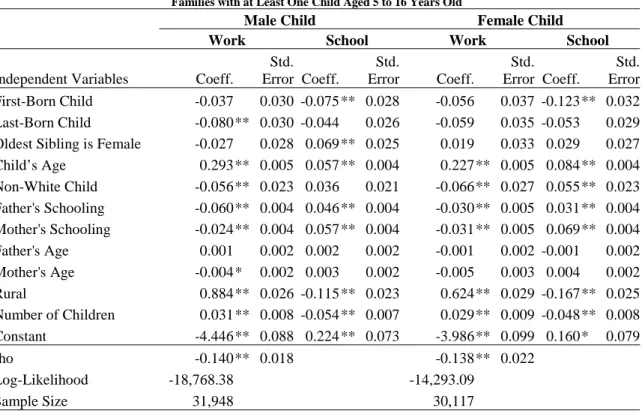
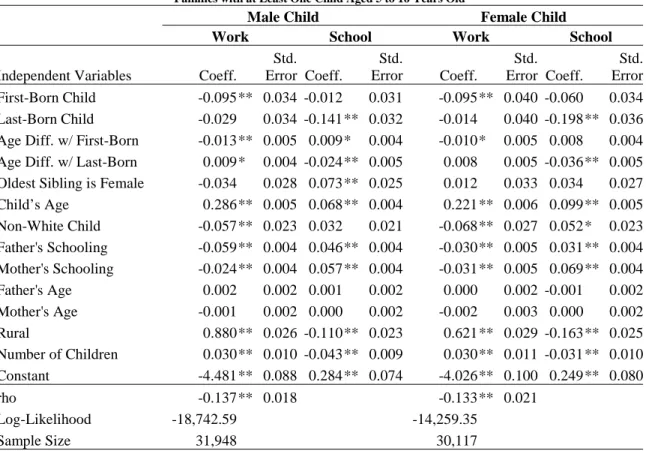
We construct two birth order variables: The first is an indicator variable that is equal to one if the child is the firstborn child in the family. The second is an indicator variable that is equal to one if the child is the last child born in the family. 11 We also construct a variable that equals the age difference between the observed child and the first-born in the family, and another that equates to the age difference between the observed child and the last-born in the family, as the theoretical model suggests.
For the first two estimates, we include a variable equal to the number of children in the family. Note that we control for the age of the child, so this is not age difference between observations. 12 One of these will be equal to zero if the child happens to be the first- or last-born child in the family.
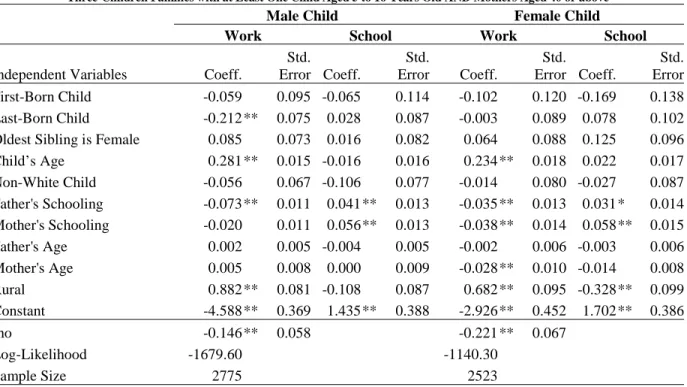
The father's age has no effect on any of the categories, and the mother's age is negative and significant for the male child's propensity to work. The female oldest child indicator variable is now positive and significant for female schooling. The mother's age is no longer relevant to the male work equation.
Another interesting difference is that the family size variable is no longer significant for the male and female work equations. The indicator variable of female oldest child is now not significant for the male schooling equation. Maternal age is again no longer significant for the men's work equation, but it is positive and significant for the men's school attendance equation.
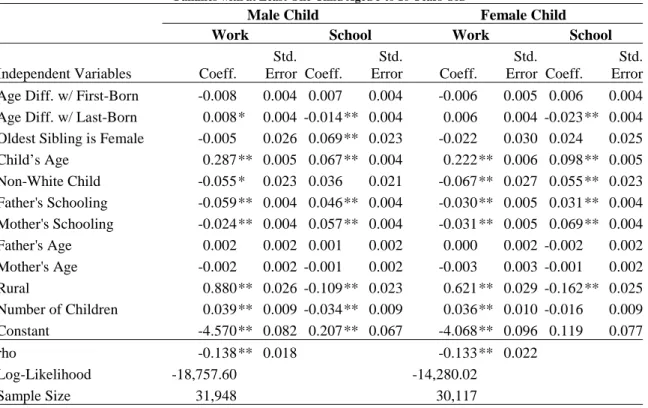
This last limitation is again to minimize possible bias due to the potential endogeneity of the family size variable in the previous two regression estimates. In the first estimation, we include the two age difference variables and drop the indicators for first and last born child. Here, the age difference with the first-born child is significant for men, but not for women in the labor equation.
Conclusion
At first glance it may seem that some of these results are inconsistent with the results presented above, however we can no longer interpret the coefficients on the birth order indicator variables and the age difference variables separately. For example, a firstborn child will always have a zero value for the age difference relative to the oldest, while a non-firstborn child will always have strictly positive values. So, to interpret these results we obtained a set of predicted probabilities for two representative families: one with sons and the other with only daughters.
In both cases the families are white, urban, have three children, and the mother and father are both 40 years old and have 5 years of schooling. We then varied the age difference between firstborns and lastborns from 3 to 15 years in three-year increments. In Figures 1 to 4 we plot the predicted probabilities of working and attending school for the first and last born children, first for the family with only sons (Figures 1 and 2) and then for the family with only daughters (Figure 3 and 4).
Both sets of plots reveal the same basic pattern: that there appears to be no real birth order effect when the age difference is 3 years, but that there appears to be a large birth order effect for age differences of 6 years or more, and that the effect increases with the age difference. Regarding the direction of the birth order effect, it is as expected: first-borns are more likely to work and less likely to go to school than last-borns. Baland, Jean-Marie and James A. 2001) "Gender and Say: A Model of Household Behavior with Endogenously-determined Balance of Power," Cornell University, mimeo.
Cambridge, MA: Harvard University Press). 1973) "On the Interaction between the Quantity and Quality of Children," Journal of Political Economy, 81:2, pp. 1976) "Child Endowments and the Quantity and Quality of Children," Journal of Political Economy, 84:4, pp. 1988) "Voeding, Gesondheid, Geboorteorde en Seisoenaliteit: Intrahuishoudingtoewysing onder Kinders in Landelike Indië," Journal of Development Economics, 28:1, pp. 2001) "Bargaining Over Sons and Daughters: Child Labor, School Attendance and Intra- huishoudelike geslagsvooroordeel in Brasilië,” Vanderbilt University Department of Economics Working Paper.
1988) "Birth order and child nutritional status: evidence from the Philippines", Economic Development and Cultural Change, 36:2, p. 1991) "Birth Order, Family Size, and Achievement: Family Structure and Wage Determination", Journal of Labor Economics, 9:4, p. Lopez-Calva, Luis Felipe (2001) “A model of the social stigma of child labor”, El Colegio de Mexico, mimeo. 1975) "Birth order and intellectual development". Three-child family with at least one child aged 5 to 16 and mother aged 40 or over.