Volume 13 • Number 2 • 2023
OTORITAS : Jurnal Ilmu Pemerintahan
Published by the Department of Government Studies,
Faculty of Social and Political Sciences, Muhammadiyah University of Makassar For further information, please visit: https://journal.unismuh.ac.id/otoritas
ISSN: 2088-3706 (Print) | 2502-9320 (Online) | DOI : 10.26618
Firstpublished in April 2011
Please send all articles, essays, reviews, and documents to:
Regular Mail:
Department of Government Studies Faculty of Social and Political Sciences
5th Floor of Menara Iqra, Muhammadiyah University of Makassar Jl. Sultan Alauddin No.259 Makassar, 90221
South Sulawesi, Indonesia E-Mail:
OTORITAS : Jurnal Ilmu Pemerintahan is an internationally peer-reviewed open access journal published triannual in April, August and December, aims to publishes significant
and cutting-edge research drawn from all areas of politics and governmental studies and promotes scholarly, theoretical, pragmatic, and contemporary research, which makes a clear conceptual and methodological contribution to existing international
literature.
OTORITAS : Jurnal Ilmu Pemerintahan indexed by :
OTORITAS : Jurnal Ilmu Pemerintahan have been double blind-reviewed by international peer reviewers. The decision on whether the scientific article is accepted
or not in this journal will be the Editorial Board’s right based on peer reviewer's recommendation.
About the Journal
OTORITAS : Jurnal Ilmu Pemerintahan, with registered number ISSN 2088-
3706 (Print), ISSN 2502-9320 (Online), is an internationally peer-reviewed open access journal published triannual in April, August and December by Department of Government Studies, Faculty of Social and Political Sciences, Universitas Muhammadiyah Makassar in collaboration with Muhammadiyah’s College Association of Government Studies (AIPPTM) and Asia Pacific Society for Public Affairs (APSPA).
OTORITAS : Jurnal Ilmu Pemerintahan aims to publishes significant and
cutting-edge research drawn from all areas of politics and governmental studies and promotes scholarly, theoretical, pragmatic, and contemporary research, which makes a clear conceptual and methodological contribution to existing international literature.
OTORITAS : Jurnal Ilmu Pemerintahan Starting from 2015 it is available in e-
journal version and has been currently indexed by both national and international indexer institutions such as: ESCI Web of Science (International), DOAJ (International), ASEAN Citation Index (International), Dimensions (International), Garba Rujukan Digital (National), Google Scholar (International), Crossref (International), BASE (International), SINTA (National), and Indonesia One Search (National).
OTORITAS : Jurnal Ilmu Pemerintahan Starting from 2016 and for the
upcoming years, the process of manuscript submission and other management processes will be conducted online through Otoritas : Jurnal Ilmu Pemerintahan website and for the betterment of the quality and quantity of Otoritas : Jurnal Ilmu Pemerintahan qualified reviewers and editors are recruited. Besides that in the same year we collaborated with Muhammadiyah's College Association of Government Studies (AIPPTM) on the publication of this journal.
OTORITAS : Jurnal Ilmu Pemerintahan Starting from 2018, we collaborated
with Asia Pacific Society for Public Affairs (APSPA) on the publication and has
been accredited by National Journal Accreditation (ARJUNA) Managed by Ministry
of Research, Technology, and Higher Education of Republic Indonesia.
Focus and Scope
Otoritas: Jurnal Ilmu Pemerintahan (Journal of Political Science and
Government) promotes scholarly, theoretical, pragmatic, and contemporary research, making a clear conceptual and methodological contribution to existing international literature. Its spesific aim is to enhance the broad scholarly understanding of governance, public administration, public law, religion and politics, comparative politics, international studies, and democratic institutions in emerging countries.
Otoritas : Jurnal Ilmu Pemerintahan (Journal of Political Science and
Government) is committed to disseminating rigorous, high-quality research and
debate with a scientific influence on the international society. To that purpose,
the Editorial team follows a meticulous editorial procedure, bringing the most
sophisticated research on modern politics and governance to the academic
community and policymakers. The journal is online and has open access, and its
internal publication procedure enables it to distribute its research findings
internationally promptly.
Editorial Board
EDITOR-IN-CHIEF
Andi Luhur Prianto, Scopus ID: 57208214401, Universitas Muhammadiyah Makassar, Indonesia
MANAGING EDITORS
Nur Khaerah, Scopus ID: 57708938300, Universitas Muhammadiyah Makassar, Indonesia
ACCOCIATE EDITORS
Abel Kinyondo, Scopus ID: 55293738000, University of Dar Es Salaam, Tanzania Abel Polese, Scopus ID: 57201804952, Dublin City University, Ireland
Ilyas Mohammed, Scopus ID: 57221933986, University of Liverpool, United Kingdom Michael Hatherell, Scopus ID: 56433408300, Deakin University, Australia
Nursaleh Hartaman, Scopus ID: 57395318100, Universitas Muhammadiyah Makassar, Indonesia Riccardo Pelizzo, Scopus ID: 6507727385, Nazarbayev University, Kazakhstan
INTERNATIONAL EDITORIAL
Adam Tyson, Scopus ID: 35337925000, University of Leeds, United Kingdom
AKM Ahsan Ullah, Scopus ID: 10043791400, Universiti Brunei Darussalam, Brunei Darussalam Ahmad Harakan, Scopus ID: 57203222670, Universitas Muhammadiyah Makassar, Indonesia Andreas Ufen, Scopus ID: 24280605600, German Institute of Global and Area Studies, Germany
Farida Tadjine, Scopus ID: 57678049100, University of Kasdi Merbah Ouargla, Algeria Mergen Dyussenov, Scopus ID: 57190342068, National University of Singapore, Singapore
Mohd Afandi Salleh, Scopus ID: 55582821500, Universiti Sultan Zainal Abidin, Malaysia Mubashar Hasan, Scopus ID: 45861188500, Oslo University, Norway
Muh Firyal Akbar, Scopus ID: 57210750267, Universitas Muhammadiyah Gorontalo, Indonesia Ni Putu Tirka Widanti, Scopus ID: 57970637000, Universitas Ngurah Rai, Indonesia Nuryanti Mustari, Scopus ID: 57395318000, Universitas Muhammadiyah Makassar, Indonesia
Önder KUTLU, Necmettin Erbakan Universitesi, Turkey
Rudi Hardi, Scopus ID: 57395626900, Universitas Muhammadiyah Makassar, Indonesia Wolfgang Drechsler, Scopus ID: 36840148600, University College London, United Kingdom
EDITORIAL ASSISTANTS
Abdillah Abdillah, Scopus ID: 57697035900, Universitas Muhammadiyah Makassar, Indonesia Hamrun Hamrun, Scopus ID: 57395116400, Universitas Muhammadiyah Makassar, Indonesia
Table of Contents
How does the government improve the competitiveness of SMEs?
lesson learned from Thailand
Andrie Elia1, Basrowi2, Buncha Chinnasri3
1Departement of Sociology, Faculty Social and Political Science, Universitas Palangka Raya, Indonesia
2Department of Management Studies, Graduate Program, Universitas Bina Bangsa, Indonesia
3Faculty of Agriculture Kasetsart University, Thailand
182-202
Indonesia’s pro-people foreign policy: the protection of Indonesian women migrant workers in Malaysia in 2022
Arie Kusuma Paksi1, Pebria Prakarsa Renta2
1,2Department of International Relations, Universitas Muhammadiyah Yogyakarta, Indonesia
203-216
The insignificance of GDP growth rate to people’s welfare: a political economy analysis of China’s impressive GDP
Asmarawati Handoyo1, Yuli Isnadi2
1Graduate Institute of Political Economy, College of Social Sciences, National Cheng Kung University, Taiwan.
2Department of Management and Public Policy, Universitas Gadjah Mada, Indonesia.
217-232
Policy process in Indonesia during COVID-19: a cross-sectoral policy Perspective
Evi Satispi1, Ma’mun Murod2
1Department of Public Administration, Universitas Muhammadiyah Jakarta, Indonesia
2Deparment of Political Science, Universitas Muhammadiyah Jakarta, Indonesia
233-245
How does buy service-based policy attract public transportation customers in Yogyakarta, Indonesia ?
Fitriani1, Achmad Nurmandi2, Muhammad Lutfi3, Mujizatullah4, Abu Muslim5
1,2 Department of Government Affairs and Administration, Jusuf Kalla School of Government,Universitas Muhammadiyah Yogyakarta, Indonesia
3Department of Government Studies, Universitas Muhammadiyah Sinjai, Indonesia
4,5Research Center for Religious Treasures and Civilizations, National Research and InnovationAgency, Indonesia
246-260
Local government strategy in managing traditional markets in The City of Pariaman, Indonesia
Herza Netti1, Erianjoni2
1,2 Department of Public Administration, Universitas Negeri Padang, Indonesia
261-276
Disputing land: argumentative turn in local land policy conflict in Central Java, Indonesia
Laila Kholid Alfirdaus1, Dzunuwanus Ghulam Manar2, Teguh Yuwono3
123Department of Politics and Governance Studies, Faculty of Social and Political Sciences,Universitas Diponegoro, Indonesia
277-288
Policy and innovation network: a study of inter-agency collaboration in post-disaster rehabilitation and reconstruction in the Central Sulawesi, Indonesia
Mohammad Rusli Syuaib
Department of Public Administration, Universitas Sintuwu Maroso, Indonesia
289-301
Local government innovation model in Pekanbaru City, Indonesia: a study of public service mall
Ranggi Ade Febrian1, Khairul Rahman2, Ahmad Fitra Yuza3, Zainal4
1234Department of Government Studies, Faculty of Social and Political Sciences, Universitas Islam Riau, Indonesia
302-314
Civil Service Police Unit principle : no punishment and no taxation without representation
Sarip1, Diana Fitriana2, Absori3, Khudzaifah Dimyati4, Harun5
1 Faculty of Law, Universitas Muhammadiyah Cirebon, Indonesia
2 Faculty of Law, Universitas Bhayangkara Jakarta Raya, Indonesia
3,4,5Faculty of Law, Universitas Muhammadiyah Surakarta, Indonesia
315-332
Declining democracy: autocratization in Indonesia during the Jokowi years
Taufik1,2, Muhamad M.N. Nadzri3, Jamaie Hj. Hamil4
1,3,4 Center for Research in History, Politics and International Affairs, Faculty of Social Science and Humanities,
Universiti Kebangsaan Malaysia, Malaysia
2Department of International Relations, Faculty of Social and Political Sciences, Universitas Pasundan, Indonesia
333-351
The Bretton Woods institutions and the quest for development in Africa
Zekeri Momoh
Department of Political Science, Faculty of Social Sciences, Veritas University, Nigeria
352-363
Article Guidelines
Article Title: Segoe UI, 14pt Bold, alignment centered, single-line spacing and All Caps. Article title should be written briefly and clearly. It shows exactly the issue to be discussed and should not create misinterpretations. Article title is written in capital letters symmetrically and does not contain unusual abbreviations. Express the main idea of a new article and followed by another explanation.
Author Details: Segoe UI, alignment centered, Article title, author's name (without academic degree(s)), and author's affiliate address are written in the center on the first page under the article title. The distance between title and author's name is double-spacing; meanwhile the distance between author's affiliate address and abstract title is single-spacing. Keywords should be written under abstract for each language. It is arranged alphabetically and separated by a semicolon consisted of 3-5 words. For Indonesian article, the title is translated into English at the beginning of English abstract (see the example above).
Corresponding Author should be marked with an asterisk and followed by a comma "*)" as the example above. At the bottom of the left column on the first page/abstract, it is written the Corresponding Author’s mark and his/her email address (see example). Article revisions and final decisions will only be communicated through the Corresponding Author’s email.
If there is more than one author, write the authors’ names separated by a comma (,). If the author's name consists of two words, the first name should not be abbreviated. If the author’s name consists of only one word, write his/her actual name in one word. However, the online version (HTML) will be written in two words consisting of the same name (repeatedly) for metadata indexation purpose (Camdali & Tunc, 2006; Fridman, 2008).
Introduction: Introduction consists of (in sequence) general background, state of the art as the basis for the scientific novelty statement of the article, scientific novelty statement, and research problem or hypothesis. In the end, introduction should mention the purpose of article review.
Literature review is not allowed in the scientific article format, so it is replaced by the state of the art to prove the novelty of the article.
Research Methods: Method is implemented to solve problems, including analytical method.
The method used to solve the research problems is described in this section.
Results and Discussion: This section consists of results and discussion. Every result should be supported by sufficient data. Then, result should be able to answer the research question or hypothesis stated earlier in the introduction.
Conclusion: Conclusion states the answer of the hypothesis and/or research objective or scientific finding. Conclusion is not the repetition of findings and discussion, but it is the summary of findings as expected in the objective or hypothesis. If necessary, conclusion can also be ended with the next idea to be implemented to the study.
Acknowledgment: Acknowledgment are primarily addressed to research funders or donors.
Acknowledgment can also be dedicated to people who contribute in the study.
References: All references used in the article should be listed in the References section.
References should contain reference literature originating from primary sources (scientific journals at least 80% of the entire references) published in the last 10 (ten) years. Each article contains at least 10 (ten) references. It is better to write the reference system in the article and in the references section using the reference management programs such as Mendeley, EndNote, Zotero, or others.
Publication Ethics
Otoritas : Jurnal Ilmu Pemerintahan, with registered number ISSN 2088-3706 (Print), ISSN 2502-9320 (Online) is a peer-reviewed journal, available in print and online and published tri-annual. This statement clarifies ethical behaviour of all parties involved in the act of publishing an article in this journal, including the author, the chief editor, the Editorial Board, the peer-reviewer and the publisher (Department of Government Studies, Faculty of Social and Political Sciences, Universitas Muhammadiyah Makassar in collaboration with Muhammadiyah’s College Association of Government Studies (AIPPTM) and Asia Pacific Society for Public Affairs).
This statement is based on COPE’s Best Practice Guidelines for Journal Editors.
ETHICAL GUIDELINE FOR JOURNAL PUBLICATION
The publication of an article in a peer-reviewed Otoritas : Jurnal Ilmu Pemerintahan is an essential building block in the development of a coherent and respected network of knowledge.
It is a direct reflection of the quality of the work of the authors and the institutions that support them. Peer-reviewed articles support and embody the scientific method. It is therefore important to agree upon standards of expected ethical behaviour for all parties involved in the act of publishing: the author, the journal editor, the peer reviewer, the publisher and the society.
Department of Government Studies, Faculty of Social and Political Sciences, Universitas Muhammadiyah Makassar in collaboration with Muhammadiyah’s College Association of Government Studies (AIPPTM) and Asia Pacific Society for Public Affairs as publisher of Otoritas : Jurnal Ilmu Pemerintahan takes its duties of guardianship over all stages of publishing seriously and we recognize our ethical and other responsibilities. We are committed to ensuring that advertising, reprint or other commercial revenue has no impact or influence on editorial decisions.
PUBLICATION DECISIONS
The editor of the Otoritas : Jurnal Ilmu Pemerintahan is responsible for deciding which of the articles submitted to the journal should be published. The validation of the work in question and its importance to researchers and readers must always drive such decisions. The editors may be guided by the policies of the journal's editorial board and constrained by such legal requirements as shall then be in force regarding libel, copyright infringement and plagiarism.
The editors may confer with other editors or reviewers in making this decision.
FAIR PLAY
An editor at any time evaluate manuscripts for their intellectual content without regard to race, gender, sexual orientation, religious belief, ethnic origin, citizenship, or political philosophy of the authors.
CONFIDENTIALITY
The editor and any editorial staff must not disclose any information about a submitted manuscript to anyone other than the corresponding author, reviewers, potential reviewers, other editorial advisers, and the publisher, as appropriate.
DISCLOSURE AND CONFLICTS OF INTEREST
Unpublished materials disclosed in a submitted manuscript must not be used in an editor's own research without the express written consent of the author.
DUTIES OF REVIEWERS:
Contribution to Editorial Decisions
Peer review assists the editor in making editorial decisions and through the editorial communications with the author may also assist the author in improving the paper.
Promptness
Any selected referee who feels unqualified to review the research reported in a manuscript or knows that its prompt review will be impossible should notify the editor and excuse himself from the review process.
Confidentiality
Any manuscripts received for review must be treated as confidential documents. They must not be shown to or discussed with others except as authorized by the editor.
Standards of Objectivity
Reviews should be conducted objectively. Personal criticism of the author is inappropriate.
Referees should express their views clearly with supporting arguments.
Acknowledgement of Sources
Reviewers should identify relevant published work that has not been cited by the authors. Any statement that an observation, derivation, or argument had been previously reported should be accompanied by the relevant citation. A reviewer should also call to the editor's attention any substantial similarity or overlap between the manuscript under consideration and any other published paper of which they have personal knowledge.
Disclosure and Conflict of Interest
Privileged information or ideas obtained through peer review must be kept confidential and not used for personal advantage. Reviewers should not consider manuscripts in which they have conflicts of interest resulting from competitive, collaborative, or other relationships or connections with any of the authors, companies, or institutions connected to the papers.
DUTIES OF AUTHORS Reporting standards
Authors of reports of original research should present an accurate account of the work performed as well as an objective discussion of its significance. Underlying data should be represented accurately in the paper. A paper should contain sufficient detail and references to permit others to replicate the work. Fraudulent or knowingly inaccurate statements constitute unethical behaviour and are unacceptable.
Originality and Plagiarism
The authors should ensure that they have written entirely original works, and if the authors have used the work and/or words of others that this has been appropriately cited or quoted.
Multiple, Redundant or Concurrent Publication
An author should not in general publish manuscripts describing essentially the same research in more than one journal or primary publication. Submitting the same manuscript to more than one journal concurrently constitutes unethical publishing behaviour and is unacceptable.
Acknowledgment of Sources
Proper acknowledgment of the work of others must always be given. Authors should cite publications that have been influential in determining the nature of the reported work.
Authorship of the Paper
Authorship should be limited to those who have made a significant contribution to the conception, design, execution, or interpretation of the reported study. All those who have made significant contributions should be listed as co-authors. Where there are others who have participated in certain substantive aspects of the research project, they should be acknowledged or listed as contributors. The corresponding author should ensure that all appropriate co- authors and no inappropriate co-authors are included on the paper, and that all co-authors have seen and approved the final version of the paper and have agreed to its submission for publication.
Disclosure and Conflicts of Interest
All authors should disclose in their manuscript any financial or other substantive conflict of interest that might be construed to influence the results or interpretation of their manuscript. All sources of financial support for the project should be disclosed.
Fundamental errors in published works
When an author discovers a significant error or inaccuracy in his/her own published work, it is the author’s obligation to promptly notify the journal editor or publisher and cooperate with the editor to retract or correct the paper.
352 Otoritas : Jurnal Ilmu Pemerintahan Vol. 13, No. 2, 2023
DOI: https://doi.org/10.26618/ojip.v12i2.11938
The Bretton Woods institutions and the quest for development in Africa
Zekeri Momoh*)
Department of Political Science, Faculty of Social Sciences, Veritas University, Nigeria Abstract
.
Keywords: Bretton Woods institution, debt, poverty, policies
*) Corresponding Author
Email : [email protected] Introduction
The global economic depression of 1920–1921 or the Post–World War I recession are common names for the post–World War I era of economic hardship. It was a period when the world economy, particularly that of the United States, saw a steep drop as a result of things like reparations, protectionism, and war debts.
Additionally, it prepared the world for the Great Depression, which occurred in the 1930s.
Hence, there is the need for "a set of multilateral institutions" to rebuild, to act as a safety net, and to organize the post-war economy resulted from the World War (1914– 1918), the start of the Second World War, and the inability of the so-called world superpowers to salvage the economic predicaments at that time. The United States and the United Kingdom led a meeting in July 1944 in Bretton Woods, New Hampshire, that established the International Monetary Fund (IMF), the International Bank for Reconstruction and Development (IBRD), later renamed the World Bank, and the International Trade Organization (ITO), which was later replaced by the World Trade Organization. Following the end of World War II, the World Bank and the IMF were established. Their foundation was the theories of three important experts: British The role of the Bretton Woods Institutions in Africa has been subjected to intense debate in the literature of International Relations. This is so particularly because of the implications of the Bretton Woods Institutions on the political and economic activities in Africa. The data for this study were collected from secondary sources such as textbooks and journal articles while content analysis was used to analyse the data collected. The "False Paradigm Model,"
propounded by Michael Todaro which is a variant of the Dependency theory, was used for this study. This study revealed mechanisms put in place by the Bretton Woods Institutions in its relationship with African states and it also undertook a critique of the Bretton woods institutional approach to Africa’s development using the false paradigm model. The study further revealed that in spite of experimenting with external development methods and initiatives by the Bretton Wood Institutions, African Economies have not advanced much in terms of development. It implies that African nations must turn within to find it rather than focusing on the Bretton Woods Institutions requirements
353 economist John Maynard Keynes, US Treasury Secretary Henry Morganthau, and his main economic advisor Henry Dexter White (Bardo et al, 1993).
A post-war economic system founded on ideas of consensus decision-making and collaboration in the area of trade and economic ties was what they sought to establish. Leaders of the Allied nations, especially those from the United States and Great Britain, believed that a multilateral framework was necessary to address the destabilizing consequences of the previous global economic downturn and trade conflicts (Kwagyang, et. al,. 2015). In his opening speech at the Bretton Woods conference, Henry Morganthau said: “bewilderment and bitterness” resulting from the Depression became “the breeders of fascism, and finally, of war”. Proponents of the new institutions felt that global economic interaction was necessary to maintain international peace and security. The institutions would facilitate, in the creation of a dynamic world community in which the peoples of every nation will be able to realise their potentialities in peace” (Keynes, 1971).
For instance, the IMF would provide a stable environment for international trade by coordinating its members' monetary policies and maintaining exchange stability. It could be able to provide short-term financial support to countries who are experiencing balance of payments issues. The World Bank, on the other hand, would help to increase countries' ability to trade by giving money to war-torn and underdeveloped nations for development and rehabilitation projects.
However, the Bretton Wood institutions like the World Bank Groups, the International Monetary Fund (IMF), and the World Trade Organization (WTO) launched and designed development frameworks to help African governments from their different challenges. The Berg Report, also known as the Agenda for Accelerated Development in Sub-Saharan Africa, which advocated the Structural Adjustment Programme (SAP) for Africa by the World Bank in 1981, is one of the policies (Momoh, 2016). Other frameworks for development include the African Charter for Popular Participation in Development (ACPPD) in 1990, the United Nations Programme for Africa's Economic Recovery and Development (UN-PAARED) 1986–1990, the Africa Alternative Framework to Structural Adjustment Programme for Socio-economic Recovery and Transformation (AAF-SAP), and Africa's Priority Programme for Economic Recovery and Development (APPER) in 1986 and 1990, which later became the United Nations Programme for Africa's Economic Recovery and Development (APPER (Saka et.
al,. 2015).
All of these frameworks for development have not been able to solve the problems of poverty, inequality, and underdevelopment, which constitute a serious danger to the lives of Africans. It is against this background; this study seeks to examine the implications of the Bretton Woods Institutions on development in Africa.
Research Methods
The research aims to explore the role of the Bretton Woods Institutions (International Monetary Fund and World Bank) in the development process of African countries. The research will adopt a qualitative descriptive research design utilizing content analysis to analyze secondary sources including textbooks, journal articles, and internet sources. By examining these sources, the study seeks to gain insights into how the Bretton Woods Institutions have influenced development in Africa. The research design will follow a qualitative descriptive approach, aiming to provide a comprehensive overview and understanding of the research topic. Content analysis will be employed to systematically analyze textual and contextual information from
354 secondary sources. A purposive sampling strategy will be used to select relevant secondary sources, including textbooks, journal articles, and internet sources. These sources should cover a diverse range of perspectives, time periods, and geographical contexts related to the Bretton Woods Institutions and their impact on African development. The qualitative descriptive research design with content analysis of secondary sources will provide a comprehensive understanding of the role of the Bretton Woods Institutions in the development of African countries.
Results and Discussion
In the literature of International Economic relations, there are various theories for the study of International Financial Institutions. One of these theories is the dependency theory. The dependence theory, an offshoot of Marxist theory that emerged in the 1940s as a response to the issue of underdevelopment in Third World Countries of Latin America, Asia, the Pacific, and Africa, is one of many theories that explain solutions to African problems. It emphasises internal factors and the classical liberal economic theories of modernization. It highlights world affairs generally and Africa's reliance on the leading superpowers for its developmental requirements (Kegley et. al,. 2011). In addition, Andre Gunder, whose work is closely related to the Dependency theory, is among the prominent proponents of the theory, which contains the erroneous paradigm model as one of its versions. Raul Prebish, Furtado, C. Dos Santos, Cardoso, F.H., Frank, A.G., and others are also supporters (Momoh, 2016).
This work, however, uses the "False Paradigm Model," propounded by Michael Todaro a variation of dependency theory that dates back to the late 1960s in part because of American participation in Vietnam, the dissolution of consensus politics as a result of the Civil Rights Movement, and the stale state of social science. The progressive movement associated with the battles of developing nations, notably Africans, against the chains of colonialism, imperialism, and neo-colonialism gave rise to what is now known as the "New leftists" (Potter, et al 2004).
Todaro calls the “false paradigm” model that the underdevelopment of the countries of Asia, Africa and Latin America is result of the inappropriate and faulty advice provided to them by the assisting agencies like UNESCO, ILO, UNDP, IMF etc.
The intentions of the advisers may not be doubted as they are well-meaning experts but they are often ignorant of the existing situations of the target countries. The policies based on their meticulous expert advice proves inappropriate and reinforce the existing power structure and cater to the interests of powerful groups as these countries are beset with the acute problem of social, economic and landed inequalities.
In addition, the false paradigm model posits that the underdevelopment of Africa is due to the Global North and their international financial allies, such as the World Bank Group, International Monetary Fund (IMF), and World Trade Organization (WTO), who do not understand the continent's problems and instead make recommendations for African states that do not have the same political or economic structures. Kenneth Rogoff, an economist with the International Monetary Fund (IMF), asserted in 2003 that nations would suffer greatly if they cut themselves off from the world economy. Perhaps the IMF's specialised macroeconomic competence is not what impoverished countries will want, but they will require something quite similar.
The False Paradigm Model asserts that after the developed countries had taken a myopic study of the African economy through the World Bank Groups, International Monetary Fund (IMF), and World Trade Organization (WTO), they will assume that they understand the problems and on the basis of that generalise or draw conclusions about
355 the solutions to the problems. This clarifies the causes of African policy failure (Momoh, 2016). Again, Momoh (2016) asserts that the World Bank Groups, International Monetary Fund (IMF), and World Trade Organization (WTO) typically have no foundation for such generalisations or conclusions because each African nation has unique issues. As a result, it would be incorrect for any organisation to presume that because of differences in culture, poverty levels, and development metrics, problems in Africa are similar to those in affluent nations.
Therefore, the Bretton Wood Institutions encourage the training of Africans in Global North countries through the World Bank Groups, International Monetary Fund (IMF), and World Trade Organization (WTO), where the political and economic institutions have no bearing or relationship with African institutions. This is done in the hopes of helping African states solve their problems. Additionally, these African trainees who received training from the World Bank Groups, the International Monetary Fund (IMF), and the World Trade Organization (WTO) abroad were exposed to a large number of foreign concepts, principles, and theories as well as development frameworks like the Structural Adjustment Programme (SAP), which destroyed African economies, even though the Structural Adjustment Programme for Socio-economic Recovery and Transformation (AAF-SAP) was intended as a balm (Momoh, 2016).
In light of this, the false paradigm model views African solutions to the continent's problems with poverty, inequality, underdevelopment, and insecurity. It makes the case that the problems in Africa are a result of the wrong policies being prescribed. It calls for African solutions to African problems because the Global North countries, represented by the Bretton Wood Institutions, do not comprehend the nature of African problems. Instead, Africans are the better option in offering solutions to their problems as years of experimenting with foreign strategies/approaches have produced little or no policy results that are primarily negative or detrimental to Africans.
Therefore, the false paradigm model is used in this study rather than the model that was initiated or developed by Global North countries through the Bretton Wood Institutions for developmental assistance such as NEPAD, because it was developed by theorists who understand the situation of their respective countries (developing countries) and on the basis of that wanting to find solutions to their problems.
Background to the formation of the Bretton Woods Institutions
What is known today as "Bretton Woods Institutions" is a compound word composed of the terms "Institutions" and "Bretton Woods." The former refers to a location in the US state of New Hampshire. Despite the fact that the latter has no accepted definition, for the purposes of this study, it refers to any structure or process of social order regulating the behaviour of a group of people inside a particular community. In other terms, an institution is a group, place, foundation, society, or the like committed to advancing a certain purpose or plan, particularly one with a social, educational, or philanthropic focus.
However, in a more technical sense, the term "Bretton Woods Institutions"
refers to the International Economic Organizations, namely the World Bank (1944) established to provide long term developmental project, the International Monetary Fund (IMF) (1944) established to provide to stabilize the exchange rates and finance the short-term desperate straits of international payments, the International Financial Cooperation (1960) established to support private enterprises, the International Development Agency (1964) established to provide loans to newly independent
356 nations, and the Multilateral Investment Guarantee Agency (1987) established to assist developing countries to attract Foreign Direct Investment and to insure such as investment against non-commercial risk. The International Centre for Settlement of Investment Disputes (ICSID) was established as an arbitration and conciliation organization for the promotion of the flow of Foreign Investment to developing countries.
The first idea of establishing The World Bank was put forward in the United Nations Monetary and Financial Conference held in Bretton Woods, town of New Hampshire, the US between the 1st and 22nd July. This meeting commonly known as Bretton Woods Conference in literature review was conducted with the attendance of experts representing 44 countries including USSR or governments unofficially. In the conference, a project was prepared proposing not only the establishment of International Monetary Fund (IMF), which would provide to stabilize the exchange rates and finance the short-term desperate straits of international payments, but also the establishment of IBRD to be able to make up for the destruction of the World War II on various countries especially Europe. After the Project was approved by the government, the World Bank was founded at the end of 1945.
Scholars and political leaders from 44 countries including John Maynard Keynes and Harry Dexter Whites laid down the structure and objectives of these two Organizations.
While the main objective of the IMF was to maintain stability of the global financial markets, the World Bank focused on investing and channelling funds for reconstruction and development projects of devastated, post-Second World War Europe.
It is pertinent to note that the scarcity of private capital in the 1950s and 1960s came to an end and Private sector financial flows overshadowed public development financial assistance (Zoellick, 2012). Moreover, since the United States wanted to have direct control over Europe's reconstruction funds, the funds were moved to the Marshall Plan. The World Bank then focused on assisting development of the developing countries (Gerber 2014). The programs, loans and operations of both the World Bank and IMF then ended up in the developing countries, mostly in Asia, Africa and Latin America. Developing countries, here and many other literatures in international political economy, are those countries characterized by low levels of living standards and other development drawbacks. They are always found in Asia, Africa, Middle East, Latin America, Eastern Europe and the former Soviet Union (Todaro et. al,.
2012).
Since their establishment, the functions and scope of the two organizations have been evolving. For IMF, Implementation of flexible exchange rate that most of the countries adapted during 1970s and 1980s and regional monetary arrangement like European Monetary System created in 1979 decreased its role in international macroeconomic policies, limiting its functions to poor countries in the developing world, mostly in Africa and Asia which were not creditworthy as Commercial Banks believed (Bird, 1994).
The International Monetary Fund (IMF) (French: Fonds monétaire international) is an international organization that was initiated in 1944 at the Bretton Woods Conference and formally created in 1945 by 29 member countries. The IMF’s stated goal was to assist in the reconstruction of the world’s international payment system post–World War II. Countries contribute money to a pool through a quota system from which countries with payment imbalances can borrow funds temporarily. Through this activity and others such as surveillance of its members’ economies and the demand for self-correcting policies, the IMF works to improve the economies of its member countries.
357 The World Bank is an international financial institution that provides loans to developing countries for capital programs. The World Bank’s official goal is the reduction of poverty. According to its Articles of Agreement (as amended effective 16 February 1989), all its decisions must be guided by a commitment to the promotion of foreign investment and international trade and to the facilitation of capital investment.
Plans for an International Trade Organization (ITO) were also part of the original Bretton Woods agreement, but they were dormant until the World Trade Organization (WTO) was established in 1995.
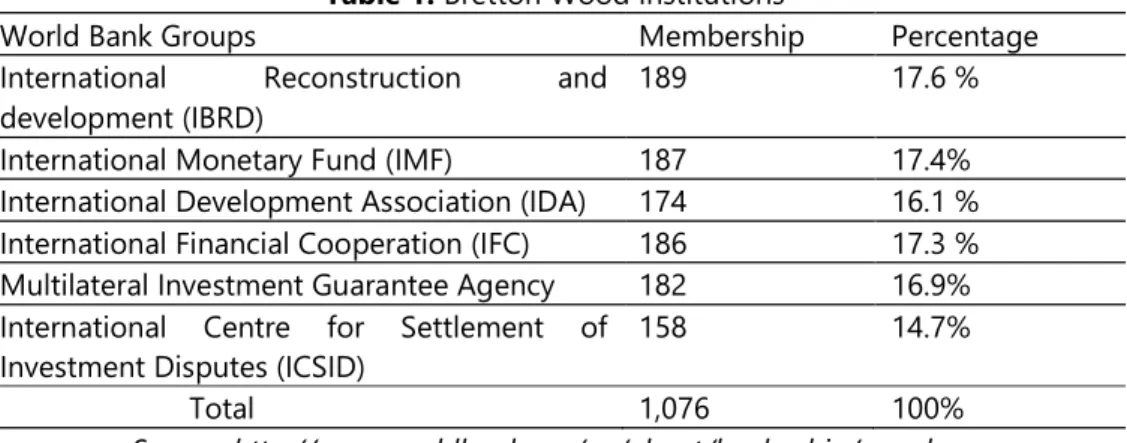
Table 1. Bretton Wood Institutions
World Bank Groups Membership Percentage
International Reconstruction and development (IBRD)
189 17.6 %
International Monetary Fund (IMF) 187 17.4%
International Development Association (IDA) 174 16.1 % International Financial Cooperation (IFC) 186 17.3 % Multilateral Investment Guarantee Agency 182 16.9%
International Centre for Settlement of Investment Disputes (ICSID)
158 14.7%
Total 1,076 100%
Source: http://www.worldbank.org/en/about/leadership/members
Table 1 above shows that the International Reconstruction and development (IBRD) has 187 member state with 17.6%; the International Monetary Fund (IMF) has 187 member state with 17.4%; International Development Association (IDA) has 174 member state representing 17.3%; International Financial Cooperation (IFC) has 186 member state with 16.9%; Multilateral Investment Guarantee Agency has 182 member state with 16.9%; International Centre for Settlement of Investment Disputes (ICSID) has 158 member state with 14.7%. On the whole, the membership of the Bretton Wood Institutions has continued to increase over the years as countries continue to gain independence as well as meeting the conditions of becoming membership of these institutions.
Bretton Woods Institutions and Development in Africa
The World Bank Group comprises five organizations: The International Bank for Reconstruction and Development (IBRD), The International Development Association (IDA), The International Finance Corporation (IFC), The Multilateral Investment Guarantee Agency (MIGA) and The International Centre for Settlement of Investment Disputes (ICSID). Today, the World Bank is a union of 189 member countries. Member countries are represented by the Governors’ Council that makes the policies in the World Bank. These governors generally consist of the finance and development ministers of the countries. The Governors’ Councils of the World Bank group and IMF meet once a year. While France, Germany, Japan, the UK and the US creating the biggest five members of the bank are represented by one fulfilment director, other countries are represented by 19 fulfilment directors.
The credit loans offered by the World Bank are investment credits basically used for infrastructure projects like highway, dam and telecommunication systems construction, along with health and education investments (Woods, 2006). The organizational structure of the World Bank has the chairman, who acts as board chairman, and rules the bank. Traditionally, the chairman is American as the biggest investor is the USA. The fulfilment directors chairman acts for 5 years. The board of
358 directors is composed of fulfilment directors. These people meet twice a week to discuss the new policies, administrative budget, country helping strategies, and financial decisions. The World Bank is administered by vice chairmen’s leadership and facilitation (Gilberts et. al,. 2006).
A new source has been proposed under the name of “Structural rapport programs' ' to finance the countries that have trouble in paybacks in 1980. The loans offered under this program are given to national financial and justice institutions to fulfil the social, structural and sectoral reforms. (Gavin et. al,. 1995). However, the bank conditions the countries in terms of paying back the loans to ensure the hastiness of the action. When this cycle is examined, the structural problems of underdeveloped countries are solved by the efforts of the World Bank and the premonition and precautions are taken with the contributions of the World Bank (Shihata, 1995; Fox et.
al, 1998: 7-12).
The integration of African economies into the global economy as exporters of primary commodities and importers of manufactured goods, resulting in a balance of trade deficit, is also one of the main characteristics of the hostile global order. The second argument relates to the unsound bundle of macroeconomic policies enforced by structural adjustment conditionality of the Bretton Woods Institutions, as well as the policies of privatisation, liberalisation, and deregulation. To the detriment of African governments, all of these have been institutionalised through WTO rules, agreements, and processes (Codesria-Twn-Africa report 2002). In addition, the Bretton Woods Institutions internal and external policies and structures together produced a
"unsustainable and unjustifiable debt burden that has crippled Africa's economies and undermined the capacity of African states to own their developmental strategies, thereby making African states perpetually dependent on and subservient to the Global North (Momoh, 2016).
Furthermore, the neo-liberal structural adjustment policies, inequalities socio- economic and political structures, and external obstacles imposed on African states as a result of the hostile international economic and political order have exacerbated the internal structural imbalances of Africa's economies, increased social inequalities, and destroyed emerging industries and agricultural production capacity. As a result, disadvantaged and oppressed groups in Africa, especially women, children, peasants, and small-scale producers, have paid a disproportionate share of the price for these (Codesria-Twn-Africa Report 2002).
In the literature, various studies underlined the negative effect of Bretton Woods Institutions programs on growth and inequality particularly in the developing countries of the world. For instance, Przeworski et al (2000) in his study of the effect of IMF programs on economic growth concluded that “program participation lowers growth rates for as long as countries remain under a program. Once countries leave a program, they grow faster than if they had remained. But not faster than they would have without participation. Barro et. al,. (2003) reached a similar conclusion saying that the larger loans a country takes from Bretton Woods Institutions, the more its economic growth declines. Not only that, but IMF programs have strong effects on inequality and it increases the gap between economic classes (Gilbert et. al,. 2009).
On the whole, the level of inequality today caused by Bretton Woods Institutions programs in Africa is the price paid to reach economic efficiency, but these projects as Gilbert et. al, (2009) insisted that there is no such “trade-off” between two variables – inequality and economic efficiency. In their words, they expressed that “IMF involvement not only reduces the size of the pie but also causes it to be split in more
359 unequal ways”. Likewise, Eiras (2003) noted that “An examination of the record of IMF and World Bank performance in developing countries shows that, far from being the solution to global economic instability and poverty, these two international institutions are a major problem”.
Mechanism of Bretton Woods Institutions in the Management and Conduct of its Relationship with African States
The World Bank Group has been working independently and inter dependently in their approach to African Problems. Some of the policies adopted to further deepen debt crisis and underdevelopment of African states includes: elimination of subsidies;
commercialization and privatisation of parastatals; rationalisation of the public sector;
liberalisation of the foreign trade sector in line with free trade doctrine; deregulation of key relative prices (interest rates and exchange rates). The deregulation of the exchange rates has taken the form of devaluation (Obiazor, 2008).
The Bretton institutions operate under the tenet of "Framework for cooperation" in the execution of their own independent mandates. In other words, they complement one another and collaborate while working together. The Bretton institutions constantly cooperate with one another at various levels to support member nations and carry out a number of initiatives. For instance, the conditions of their cooperation were outlined in a concordat in 1989 to guarantee successful cooperation in areas of shared responsibility like:
High-Level Coordination
The Boards of Governors establish the organisations' goals as well as how to deal with global economic and financial concerns. The Governors consult and give their nations' perspectives on current challenges in international economics and finance during the Annual Meetings of the Boards of Governors of the IMF and the World Bank in 1987 (Kwagyang et. al., 2015). The Development Committee has sessions that coincide with the Spring and Annual Events of the IMF and the World Bank, and these meetings include a gathering of the Governors of the IMF and the World Bank. This committee was created in 1974 to provide guidance to the two organisations on important development concerns and the funding needed to support economic growth in low-income nations.
Management consultation and staff collaboration
Regular meetings are held between the President of the World Bank and the Managing Director of the IMF to discuss important problems. Along with visiting several locations and nations together, they occasionally produce collaborative articles and issue joint statements (Kwagyang, et. al., 2015).
The Bretton Wood Institutions staff work closely together on nation aid and policy problems that are pertinent to both organisations. In addition, the staff from the two universities frequently travel to other countries at the same time. The Bank's evaluations of possible development projects or reforms are influenced by the IMF's assessments of a country's overall economic status and policies (Kwagyang, et. al., 2015). Similar to this, the IMF incorporates Bank recommendations for structural and sectoral reforms into its policy recommendations. The World Bank Group staff collaborate on the conditions associated with each loan program.
360 Criticisms of the operational mechanism of the Bretton Wood Institutions in Africa
Despite the achievements of the Bretton Wood Institutions that has been subjected to intense debate in contemporary times. The Bretton Wood Institutions have occasionally fallen victim to other novel forms of crises such as the debt crisis (Mahnaz, 1998), the environmental crisis (Action against Bretton Woods, 1994), the crisis of governance (Bardo, 1995; Bardo et. al., 1993), the crisis brought on by governments failing to respect human rights, the crisis brought on by tumultuous political upheavals and international conflicts, and most importantly the crisis presented by aggressive legalism (Pekkanen, 2010). More problematic crises fall within this group, and handling them has occasionally generated debate (Morais et. al., 1996).
The Bretton Wood Institutions are subject to a wide range of critiques, although they are primarily focused on the methods used by the institutions to develop their policies.
This covers the social and economic effects these policies have on the citizens of the nations that use these institutions' financial assistance. The following is the focal point:
a. That certain countries' human rights are violated by the Bretton Wood institutions when they carry out their missions through multilateral businesses and disregard the rule of law.
b. That the conditions put in place as part of the terms or covenants for the loan's approval were successful in increasing widespread unemployment and poverty in the receiving countries.
c. That developed nations benefit more from the standards and norms established by the institutions and those that followed them than less developed ones.
d. That the international institutions' membership does not fairly represent the nations of all of its members.
e. That the conventional notions of sovereignty have been eliminated via the application of the rules and principles of international economic law with regard to the monetary and investment issues for which these two organisations established the fundamental standard.
Given the numerous strong arguments against their efforts elucidated in the previous sections, their positive contributions seem insignificant. Although they operated over half-a-century in developing countries, what the Bretton Woods Institutions messed up is much more enormous. Apparently, the structures of these institutions, which are western designed and dominated, show that they were not intended to help the developing world, but serve for the west. The developing countries have a clear minority in the administration and they are marginalised in power sharing, decision making, designing projects and policies, problem solving and even operating in the field.
Not only do they protect the interests of the west, but they are also used as imperialism tools. The Bretton Woods Institutions replicated the dominance- dependence system and enabled the foreign capital to get easy and safe access to the markets and investment fields of developing countries. The Bretton Woods Institutions gave odious loans to developing countries. These loans have a condition that the projects invested by them should be run by US companies, and thus, most of the funds returned to the USA. We can say that the road map of these institutions is the Washington Consensus – policy instruments and reforms agreed by Bretton Woods Institutions and the US government. It is clear that the mission and vision of these institutions are predetermined, and developing countries have no chance either to alter or to improve. With these flaws and criticism in mind, a complete revamp of the
361 institutions is necessary in terms of their structures, policies, and operational processes to address these complaints and grievances from the states involved and to improve global macroeconomic management.
Conclusion
The presence of the Bretton Woods Institutions in developing countries dates back as early as the 1960s, when many nations in the developing world, Africa in particular, became independent. The World Bank aims at assisting the development of developing countries by providing technical and financial assistance. Likewise, the IMF aims to enhance economic growth and stability by providing technical support and financing to member countries with economic difficulties. Having similar structure, and membership, they attempt to provide more stability and certainty for the globalised economy. Since globalisation influences the developing economies through trade in goods, flows of capital and migration of people, the Bretton Woods Institutions are heavily involved in the second process. This study argues that the interventions of the Bretton Wood Institution in the developmental process in Africa has been treated with mixed reactions because of the consequences of such policies and programme on the economy of Africa. This study suggested similar submissions that the Bretton Wood Institution policies and programmes has further widened the level of inequality and poverty on the African continent. Hence, African countries should seek for alternative path to development.
Based on the fact that externally focused methods to development throughout the years have not been beneficial to the African continent, our stance in this research is that pragmatic response by African leaders to the challenges of the continent is essential. It is suggested that African governments could model their growth on that of the Newly Industrialised Countries (NICs) or the Global East, which handle issues such as corruption, poor governance, poverty, political instability, and reliance among other things. At the regional levels, however, achieving the AU agenda 2063 will only be a myth if African leaders lack the political will to combat corruption, poverty, inequality, dependence, debt, bad governance, and political instability, as well as to direct the necessary resources to the continent's productive sectors.
Moreover, it's vital to stress that the failure of the aforementioned frameworks by Bretton Woods Institutions to alter the African continent was due to flaws in their formulation and execution, which resulted from the failure to accurately diagnose African problems prior to the prescription of these frameworks. Besides, because Africa and the Global North have different political and economic features, the frameworks were flawed at the implementation level owing to political economics incompatibility.
Also, because these frameworks do not take into account the uniqueness of African culture, community life, and solidarity, adapting them to fit African contexts is challenging. Therefore, any framework that would deal with the issues facing African states must, among other things, be created by Africans since they are aware of the nature of their issues, and it must also take into account the unique characteristics of African civilizations. In addition to being welfare-oriented, it must be people-oriented or people-driven. Goals and objectives must also be time-bound and reachable. For example, the African Union Agenda 2063 is a positive step forward, but there is concern that if the current crop of African leaders has the political will and economic means to implement it, it will address issues with governance, resource allocation, instability, and furthered regional integration of the continent.
362 Acknowledgement
I wish to acknowledge the support of Mr. Usman Momoh, Global Network for Advancement of Integrity Transparency and Accountability, (GNAITA) Abuja-Nigeria for assisting us in sorting out the materials for this study.
References
Action against Bretton Woods, (1994). Women for a just and healthy planet. Economic and Political Weekly. 29(27),16-18.
Arie Reich. (2010). Bilateralism versus multilateralism in international economic law:
Applying the principle of subsidiarity. The University of Toronto Law Journal. Vol.
60(2), 263-287. DOI: 10.3138/utlj.60.2.263
Bird, G. (1994). “Changing Partners: Perspectives and Policies of the Bretton Woods Institutions”.Third World Quarterly, 15(3), 483–503.
https://doi.org/10.1080/01436599408420392
Bordo, M. D. & Eichengreen, B. (1993). A retrospective on the Bretton Woods System.
Chicago and London. The University of Chicago Press. p.9
Bordo, M.D. (1995). Is there a good case for a new Bretton Woods international monetary system? The American Economic Review, Vol. 85, No. 2, Papers and Proceedings of the Hundredth and Seventh Annual Meeting of the American Economic Association Washington, DC. pp. 317-322
Codesria-Twn-Africa Report (2002) Africa and Development Challenges of 21st Century being a Conference on Africa’s Development Challenges in the Millennium Accra 23-26 April 2002. (Council for Development and Social Science Research in Africa) and the Third World Network-Africa (TWN-Africa)
Cohn, T.H. (2000). Global political economy: Theory and practice. New York: Longman.
Eiras, A. (2003). “{IMF} and World Bank Intervention: A Problem, Not a Solution”. The Heritage Foundation: Leadership for America, 4999(1689)
Fox, J. A., & Brown, L. D. (Eds.). (1998). The struggle for accountability: The World Bank, NGOs, and grassroots movements. Cambridge, MA: MIT Press.
Gavin, M., & Patrick, D. (1995). The World Bank in historical perspective. The American Economic Review, 85(2), 329–334. https://www.jstor.org/stable/2117942
Geoffrey M. Hodgson (2006) What Are Institutions?. Journal of Economic Issues, 40(1),1- 25, DOI: 10.1080/00213624.2006.11506879
Georg Schwarzenberger. (1948). “The province and standards of international economic law” The International Law Quarterly, 2(3), 402-420
Gerber, J. (2014). “International Economics (6th ed.)”. Boston: Pearson
Helleiner. G. K. (1984). An agenda for a new Bretton Woods. World Policy Journal, 1(2), 361-376
Herbert Morais and Alvaro de Soto. (1996). The Bretton Woods Institutions: Coping with crises. The Proceedings of the Annual Meeting American Society of International Law, 90, 433-442
John W. Pehle. (1946). Bretton Woods institutions. The Yale Law Journal, 55(5), p1128 Joseph J. Norton. (2009). Comment on the Developing Transnational Network(s) in the
Area of International Financial Regulation: The Underpinnings of a New Bretton Woods II Global Financial System Framework. The International Lawyer, 43(1), 175-204
363 Karsten Nowrot. (2011). Transnational corporations as steering subjects in international economic law: Two Competing Visions of the Future?. Indiana Journal of Global Legal Studies, 18(2), 803-842.
Keynes, J. M. (1971). The collected writings of John Maynard Keynes. London: Macmillan p.10
Kunibert R. (2008). Bretton Woods Institutions and the rule of law. Economic and Political Weekly, 43(38),49-55. https://www.jstor.org/stable/40277976
Kwagyang, U.G., Ghide, B.H., & Haruna, L. A (2015). Bretton Woods Institutions: Their evolution and impacts on the field of international economic law. Journal of Law, Policy and Globalization, 35,42-55.
Mahnaz, F, (1998). Alternatives to dependence on Bretton Woods Institutions (BWIs):
Pakistan Horizon, 51(3), 21-32
Moggridge, Donald. (1980). Activities 1941 - 1946: shaping the post-war world, Bretton Woods and reparations. London: Macmillan Pp.12 -13.
Momoh, Z. (2016) African Solutions to African Problems: A Critical Appraisal Journal of
African Union Studies Volume, 5(1), 39-62.
https://hdl.handle.net/10520/EJC188637
Obiozor, A.G. & Ajala, A. (2008). Africa and the UN system: The first fifty years Lagos.
NIIA
Potter, R.B., Binns, T., Elliott, J.A. and Smith, D. (2004). Geographies of Development.
Harlow: Pearson Education Limited
Rogoff, K. (2003). “IMF Strikes Back”. Foreign Policy 134 (Jan/Feb): 38-46
Saka, L. and Momoh, Z. (2015). New partnership for Africa’s development and Africa’s development. Presented at the International Multi-Disciplinary Academic Conference on African Transformation and Development organized by Cambridge Publications and Research International at the University of Ilorin March 12th-13th 2015
Shihata, I. F. I. (1995). The World Bank in a changing world. London: Martinus N.
Publishers.
Todaro, M. P., & Smith, S. C. (2012). “Economic Development” (11th ed.). Boston:
Addison-Wesley.
Woods, N. (2006). The globalizers: The IMF, the World Bank and their borrowers. Cornell University.
Zoellick, R. B. (2012). “Why We Still Need the World Bank: looking beyond aid”. Foreign Affairs, 91(2), 66–78.