
The same characteristics can be attributed to the Buddhism of Japan, which it entered from Korea in the sixth century AD. In the fifteenth century, the monk Tsong-khapa adopted a form of Buddhism to liberate Tibet. Below, on the base, the goddess of the earth is depicted in high relief wringing her hair.
308 PROCEEDINGS OF
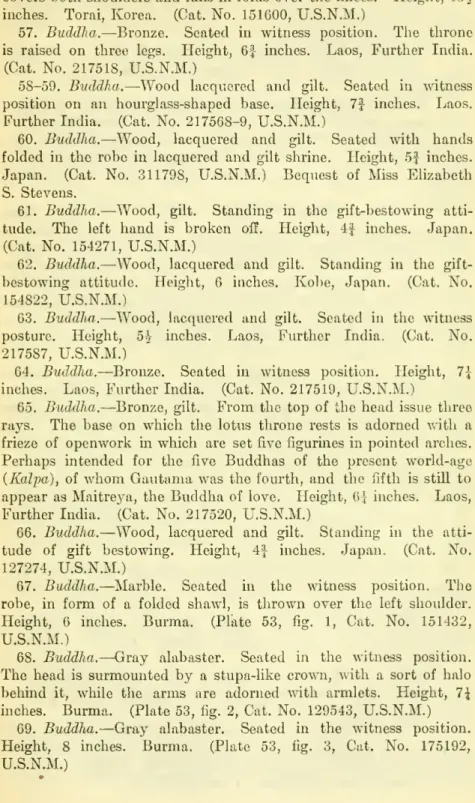
The base on which the lotus throne rests is decorated with an openwork frieze in which five statues are placed in pointed arches. Perhaps intended for the five Buddhas of the present world age (Kalpa), of whom Gautama was the fourth, and the fifth is yet to emerge as Maitreya, the Buddha of love. The head is crowned by a stupa-like crown, with a kind of halo behind it, while the arms are decorated with bracelets.
310 PROCEEDINGS OF
Bronze relief representing the Buddha seated in the posture of witness on a double throne with a halo in the form of a figleaf. From a statue found in the ruins of the Wat-Pra-Shan-Tan temple, near Lakawu Lampang. Head of Buddha in terracotta.— From a statue found in the ruins of Wat-Yaphra-Khaw, "the temple of the women in the white robe." Nice work.
314 NATIONAL MUSEUM
THE BUDDHIST SCRIPTURES (DHARMA)
The sacred books believed to embody the word of Buddha are considered by Buddhists to be the second member of the Triratna – the Three Precious Books – for the devout Buddhist. In the case of the scriptures, it figuratively expresses the long line of teachers who have passed it on. Printed edition in 39 parts, in the Pali language (the sacred language of the southern Buddhists) and in the Siamese alphabet.
THE BUDDHIST CONGREGATION (SANGHA)
CATALOG OF BUDDHIST ART — CASANOWICZ 323 philosopher to Buddhism who lived possibly in the second century AD. Manuscript written on strips of palm leaf, written on both sides in the Pali language in Lao characters. The first incarnation of Vishnu was in the form of a fish (the matsya avatar) and generally the fish is regarded as a symbol.
326 PROCEEDINGS OF MUSEUM
The prayer wheel is used primarily by the Buddhists of Tibet, and the most common invocation engraved on the scrolls of prayer wheels consists of the words: “Om.” In it is placed a collection of canonical books of Lamaism (ka-gyur, see 322). and by means of rods fixed in the lower end of the shaft of the barrel, it is set in motion. The number 108 is said to correspond to an equal number of mental conditions, or sinful tendencies, that must be overcome through the recitation of the beads.
In Japan, during the festival of the dead (Jbommatsuri or honku), which is celebrated from July 13 to 15, 108 welcome fires (mukaebi) are lit along the shore of the sea or lake or river along which the city or village is located. These pendants are used as counters to count .. the number of recitations of the rosary. The bead of one hanging cord slides down at the completion of one recitation of the rosary, while the beads of the other register every 10 repetitions.
Besides the full rosary of 108 beads, used by the monks, there are in vogue rosaries of 18 and 16 beads, representing respectively the 18 lohans or chief disciples of Buddha as counted by the Chinese, and the 16 rohans of the Japanese. The material of the Buddhist rosaries varies according to the taste, wealth and rank of the owner. Such an oval bead is also at the end of each of the three counter-strands, each 1| inches long.
34; regents of the four heavens." They typify the emperor, father, mother, and teacher to whom a Chinese subject owes reverence and obedience.
330 PROCEEDINGS OF NATIONAL MUSEUM
Before tying, pull the ends of the string through 2 mother beads, which have a third opening for this purpose. Once again, there are 5 more beads on each pendant, which then end with an elongated bead called a dewdrop (tsuyu-dama). From the lower parent bead extend 3 cords, on 2 of which are 5 small beads called sMma-desToi, or lower pupils, each ending in a dew-drop, while the third has 10 small beads without a dew-drop.
On the main strand, at an interval of 7 beads on each side from the top superior bead, are 2 beads, smaller than the others, and again at an interval of 14 beads from. They indicate where a special invocation is to be recited while the rosary is raised to the forehead with reverence. The invocations repeated by the Lao b}T mean the pearls: Sabbesangkaraanicca, 300 times; sabbesangkara dukkha, repeated 400 times; sabbe sangkara anatta, repeated 500 times.
In an open work bag, fashioned from cotton strips, the ends of which serve as handles. Hanging from the bottom are models of ammonia accessories, namely (1) a water strainer used to exclude small.
332 MUSEUM
The top of the dome was usually surmounted by a disk placed horizontally, on which an umbrella (tee) rose as a terminal. To the roofs of the different stories are attached small bells and tinkling leaves of brass, which are waved and rung by the wind, to signify the eternal music of the spheres, and the carved balustrades and projecting eaves are emblems of the dwellings of the fortunate. beings who live in the upper world. . 3, portion of a hair rope, 32 inches long and 4h inches in diameter, used in erecting the temple;.
Nios or Niokongas ("two bold golden kings") are usually placed on either side of the lofty portal to a Buddhist temple. A miniature copy of a Lao Buddhist temple, carved and erected by a priest, with carvings, wood placement and several of its parts, such as the throne for the Buddha image, the pulpit from which the scriptures are read, the Nagas on each side of the entrance, which in every detail they represent a copy of a Buddhist temple in Laos. The edges are embroidered in silk with floral motifs, and an inscription in Chinese characters is affixed to the case.
Pair of candlesticks. Made of pewter in the shape of the Chinese character for longevity {sheu). The candles are glued to the points at the top of the candlesticks and are lit when a ceremony takes place. The cover, in openwork form, is crowned by a mythical bird sitting on a mythical animal.
It consists of the figure of an emaciated ascetic holding a long dragon, the head of which rests on the base, while the tail ends in a bowl for inserting a candle.
336 PROCEEDINGS OF THE NATIONAL MUSEUM
They are placed on the altar during the recitation of prayers for the souls of the dead, especially for the souls of those who failed to receive burial. The lower end of the scabbard and the head of the shaft are framed in a sea animal (lobster?) of bronze. Temple sword.- On one side of the blade is incised a dragon coiling around a vajra (dorje), on the other side a vajra.
The temple is a resort for the invalid, especially for those with sore eyes, and the prayers contained in this book are for special use in the temple. On the flattened surfaces are painted three comma-shaped segments, the Japanese modification of the Chinese (and Korean) tah-gook, formed of two segments, the joint representation of theang and yin, the two first causes and great principles of the universe, or opposite influences, such as darkness and light, male and female, good and evil, etc. The figure also represents the Japanese magatama, or "crooked jewel," one of the emblems of sovereignty in Japan. As for the roosters placed on top of the drums, Dr.
The well-known Japanese or Chinese design of the phakoconadrum was intended to suggest a well-known story of the famous Emperor Yao, who is said to have ascended the throne of China in 2357 BC. It is therefore an emblem of wakefulness and vigilance in striving for perfection. Inverted bell (Chinese, cJi'm'g to).— Made of copper in the form of a pot or cauldron, rung on the outer surface with a stick in the Budd-.
Drum with skulls (Tibetan, damaru). - Made of two skulls attached together by a wooden disk cemented to them.
340 PROCEEDINGS OF NATIONAL MUSEUM
no. 154982, U.S.N.M.) Sir James Emerson Tennent gives the following explanation and description of the Devil's Dance in Ceylon: "Therefore, on every domestic event, as well as on every domestic calamity, the katadias or devil's priests must be officiated. Especially in cases of sickness and danger implicit reliance is placed on the help of devil dancers: an altar decorated with garlands is placed in front of the patient, and on it is an animal, often a rooster.
The dying man is ordered to touch and dedicate to the evil spirit the wild flowers, the rice, and the meat, which are prepared as the pidaneys, or sacrifices to be offered at sunset, at midnight, and at dawn; and in the intervals the dancers perform their incantations, dressed in masks and disguises, presenting the demon whom they impersonate, as the mediator of the patient's suffering. In the frenzy of these orgies, the Jcatadia, after feigning access to inspiration from the spirit he invokes, is consulted by the friends of those afflicted, and makes known the nature of the disease, and the probability of a favorable or fatal termination thereof. The upper surface bears in the center a small compass, around which run 17 inscribed concentric circles, containing the various geomantic factors, such as the 8 permutations of the trigram, the 12 signs of the zodiac, the 24 celestial constellations, and so on.
Geomancy, or, as the Chinese call it, "wind and water," rules (fung-sltui), is much used by the Chinese to divine future events, or to ascertain the fortune or misfortune of any event, or to select sites for houses, cities and especially burial sites, which are supposed to have important results for the prosperity of the living. A skilled observer (fung-shui siensang, or "doctor of wind and water") can detect and describe such currents by means of the compass, also the direction of streams, the form of the male and female earth and their relationship, rivers, the position of trees, and mountains , the color of the earth and the changes of the elements. The person who wishes to know the will of the gods or his fortune shakes the pipe and, with a turned face, pulls out a slip of paper and reads the answer.
The supplicant throws them into the air in front of the altars of the gods he is supplicating.
344 PROCEEDINGS OF
She is also regarded as the wife of the demon general Tamdrin (Hayagriva, see no. 158), and is believed to have incarnated in the embassy of the Lake Palti convention in Tibet. 34; The owner of this stone is protected from wounds by bullets, knives, swords and remains good and happy." influences.
It is to "protect against all kinds of evil and bodily harm and, kept in the house, protects against fire." Length, 48 inches; width, 36 inches.
346 PROCEEDINGS OF THE NATIONAL MUSEUM
NATIONAL
S. NATIONAL
S. NATIONAL MUSEUM
