International
Perspectives on CLIL
Edited by
Chantal Hemmi Darío Luis Banegas
ENGLISH LANGUAGE TEACHING
Teaching
Series Editors Sue Garton Aston University
School of Languages and Social Sciences Birmingham, UK
Fiona Copland University of Stirling
Stirling, UK
on English Language Teaching. This innovative series is truly international, with each volume providing the opportunity to compare and learn from expe- riences of researchers and teachers around the world; is based on cutting edge research linked to effective pedagogic practice; shows how developing local pedagogies can have global resonance. Each volume focuses on an area of current debate in ELT and is edited by key figures in the field, while contributors are drawn from across the globe and from a variety of backgrounds.
More information about this series at http://www.palgrave.com/gp/series/14843
Editors
International
Perspectives on CLIL
International Perspectives on English Language Teaching
ISBN 978-3-030-70094-2 ISBN 978-3-030-70095-9 (eBook) https://doi.org/10.1007/978-3-030-70095-9
© The Editor(s) (if applicable) and The Author(s) 2021
This work is subject to copyright. All rights are solely and exclusively licensed by the Publisher, whether the whole or part of the material is concerned, specifically the rights of translation, reprinting, reuse of illustrations, recitation, broadcasting, reproduction on microfilms or in any other physical way, and transmission or information storage and retrieval, electronic adaptation, computer software, or by similar or dissimilar methodology now known or hereafter developed.
The use of general descriptive names, registered names, trademarks, service marks, etc. in this publication does not imply, even in the absence of a specific statement, that such names are exempt from the relevant protective laws and regulations and therefore free for general use.
The publisher, the authors and the editors are safe to assume that the advice and information in this book are believed to be true and accurate at the date of publication. Neither the publisher nor the authors or the editors give a warranty, expressed or implied, with respect to the material contained herein or for any errors or omissions that may have been made. The publisher remains neutral with regard to jurisdictional claims in published maps and institutional affiliations.
Cover illustration: CLEMENTE LASALA PARRILLA / Alamy Stock Photo
This Palgrave Macmillan imprint is published by the registered company Springer Nature Switzerland AG.
The registered company address is: Gewerbestrasse 11, 6330 Cham, Switzerland Center for Language Education and Research
Sophia University Tokyo, Japan
School of Education University of Strathclyde Glasgow, UK
v
There are a number of topics that cause lively discussions in ELT circles, and we suspect that CLIL is often top of the list. Some of the questions we know which are discussed include, what exactly is CLIL? Is it about teaching lan- guage or about teaching content? Is it elitist? Isn’t it just the latest in a long line of language teaching methods? Who should teach it? The answers can lead to heated debate and disagreement, as well as to developing understand- ing. In taking a global perspective on current CLIL teaching and learning, this volume responds to these and many other questions and greatly enhances our knowledge of how CLIL is implemented around the world.
In 2012, Pérez-Cañado described CLIL as “the increasingly acknowledged European approach to bilingual education” (p. 316). Since then, CLIL has rapidly spread, especially to Latin America (see for example, Banegas, Poole,
& Corrales, 2020), and to Asia (see for example, Wei & Feng, 2015), where it has naturally been adapted to the local conditions. In chapter “CLIL: An Overview”, the editors of the volume trace this development as well as give an overview of the origins of CLIL, its theoretical underpinnings and the multi- plicity of definitions that now exist. However, the editors maintain that despite the competing views of what CLIL is—which have inevitably arisen because of the diaspora—the dual approach of language and content remains (Coyle et al., 2010); it is certainly not the case that ‘anything goes’.
The evolution of theoretical understandings can, however, be a source of controversy. One of us, working on a CLIL project in Ukraine, was con- fronted with the very strong conviction by a European partner that language- driven CLIL is not CLIL. However, it is important to recognise and accept the different versions of CLIL as examples of contextually appropriate
pedagogy (Holliday, 1994), which is a fundamental tenet of language teach- ing and indeed of education in general. One of the real strengths of the chap- ters in this volume is that they show how CLIL has grown and developed, adapting to the contexts in which it is implemented. The volume reinforces the message of the strength-in-diversity of CLIL by presenting a range of con- texts, both geographical and educational. Thus, we have chapters from Argentina, Australia, Austria, Brazil, Colombia, Japan, Spain, Taiwan, and the United States, a focus on primary, secondary, and tertiary contexts and chap- ters written from the perspectives of both language and content teachers.
However, as is perhaps to be expected in a volume in this series, it is language- driven CLIL which dominates.
The volume is divided into two parts, the first on practices and the second on professional development, reflects two of the areas that are key to success- ful CLIL implementation. The chapters on practices enrich our knowledge of contextual contingencies which affect how CLIL is both understood and implemented. Although there are notable exceptions, such as Spain, CLIL is generally still not well-established in national education systems and remains mainly a bottom-up movement, and this reality is also evident in these chap- ters. Chapters on practice include motivating students, assessment, language use in CLIL classrooms and developing intercultural competence.
In the chapters on professional development, there is a focus on how teach- ers who want to introduce CLIL into their work, or who have to follow a CLIL approach—most of whom are language teachers—could do so. Even where national education policy establishes CLIL as the approach to be fol- lowed, lack of specific teacher training can be an obstacle to successful imple- mentation (Sylvén, 2013). The chapters in this section demonstrate a concern with both pre- and in-service teacher education, specifically, identifying teach- ers’ needs, course content and curricula, materials, quality provision, and pedagogical enhancement.
The volume therefore represents a timely, useful and welcome addition to the series.
Birmingham, UK Sue Garton
Stirling, UK Fiona Copland
References
Banegas, D. L., Poole, P. M., & Corrales, K. A. (2020). Content and language inte- grated learning in Latin America 2008–2018: Ten years of research and practice.
Studies in Second Language Learning and Teaching, 10(2), 283–305.
Coyle, D., Hood, P., & Marsh, D. (2010). Content and language integrated learning.
Cambridge, UK: Cambridge University Press.
Holliday, A. (1994). Appropriate methodology and social context. Cambridge, UK:
Cambridge University Press.
Pérez-Cañado, M. L. (2012). CLIL research in Europe: Past, present, and future.
International Journal of Bilingual Education and Bilingualism, 15(3), 315–341.
Sylvén, L. K. (2013). CLIL in Sweden–Why does it not work? A metaperspective on CLIL across contexts in Europe. International Journal of Bilingual Education and Bilingualism, 16(3), 301–320.
Wei, R., & Feng, J. (2015). Implementing CLIL for young learners in an EFL con- text beyond Europe. English Today, 31(1), 55–60.
ix
We would like to thank our families, colleagues, IPELT series editors Sue Garton and Fiona Copland, and Palgrave associate editor Alice Green for their guidance and support.
xi
This volume offers critical accounts of CLIL practices and professional aware- ness from 9 different countries and 12 educational contexts: Argentina, Australia, Austria, Brazil, Colombia, Japan, Spain, Taiwan, and the United States. Each chapter in Section I offers insight into how CLIL has been imple- mented around the world in different ways, and offers an insight into CLIL theory and approaches applied in practice. Section II shares different experi- ences in the training of CLIL at different levels and types: masters and under- graduate level, CLIL applied in EMI and in-service training on CLIL. This section ends with a critical account of coursebooks and an insightful chapter on how CLIL has taken off as a commercial commodity, leaving a number of methodological and educational challenges for practitioners and learners.
This volume leaves the reader with a number of insightful pedagogical goals for the future to alter and navigate our approaches to CLIL in diverse educa- tional developments.
xiii
CLIL: An Overview 1
Chantal Hemmi and Darío Luis Banegas
The Start and Development of CLIL 1
CLIL Underpinnings 2
CLIL Features and Frameworks 6
CLIL Research 8
Structure of the Volume 12
References 15
CLIL Practices 21
Authenticity and Motivation in CLIL: Creating a Meaningful
Purpose by Experiencing the Language in Use 23 Richard Pinner
Introduction 23
Language and Authenticity (and Thus Motivation) 25
CLIL and Authenticity of Purpose 26
The Authentic Motivation Assumption in CLIL 27 How Educational Authenticity Relates to CLIL 28 Practical Strategies for Calibrating Authenticity Through
Metacognition and Negotiation 30
Conclusion and Pedagogical Implications 37
Suggested Further Reading 38
Engagement Priorities 39
References 39
Assessing Students’ Learning of History Content in Spanish CLIL Programmes: A Content and Language Integrated Perspective 43 Elena del Pozo and Ana Llinares
Why a Chapter on Assessment in CLIL History? 43 The Challenge of Teaching and Learning History in CLIL 44
The Importance of Writing in History 46
Translating Educational Learning Objectives into Levels of Complexity
and Specificity: The CDF Model 48
A Proposal of a Framework for an Integrated Analysis 49
Application of the Proposed Framework 50
Implications of the Study 54
Suggested Further Reading 55
Engagement Priorities 56
Appendix A: Rubric for Assessing History Content and Language
Integration 56
Appendix B: Example of Assessment Through T/F Statements 58
References 59
Current Practice and Challenges of Assessment in CLIL in a
Japanese University Context 63
Takanori Sato, Katsuya Yokomoto, and Graham Mackenzie
Introduction 63
Assessing Content and Critical Thinking 64
The Studies and Educational Context 68
Study 1: CLIL Practitioners’ Assessment Practices 69 Study 2: Student Perceptions of Assessment in CLIL Courses 74
Pedagogical Implications 80
Suggested Further Reading 82
Engagement Priorities 83
References 83
Translanguaging in Science Lessons: Exploring the Language of Science in L2 Low Achievers in a Public School Setting in
Colombia 85
Edgar Garzón-Díaz
Introduction 85
Why Translanguaging in CLIL? 86
CLIL in Colombia 88
Translanguaging in Science Lessons 90
Translanguaging in the Language of Science 98
Concluding Remarks 101
Suggested Further Reading 102
Engagement Priorities 103
References 103
The Role of the Essential Question in Eliciting Critical
Thinking in CLIL Classes at a Japanese University 107 Hiroko Aikawa, Emi Fukasawa, and Chantal Hemmi
Introduction 107
Classroom Interaction 108
Types of Questions in Classrooms 109
The Learning Context 110
How we Analysed the Interactions 111
Dialogue in Teacher–Student Interactions 112 Dialogue in Student–student Interactions 118
Lessons Learnt from This Study 121
Conclusions and Way Ahead 124
Suggested Further Reading 124
Engagement Priorities 125
References 125
Developing Intercultural Competence: A Comparison of CLIL
and Language Majors Before and After Industrial Placements 129 Wenhsien Yang
Is (Inter)Cultural Awareness Missing from the CLIL Approach? 129 What is the CQS, and Why is CQ Important in CLIL Education? 130 Expanding Internationalisation at Home or Abroad for
CLIL Learners 132
The Experience 133
CQ Performance in the Language-Driven and Content-Driven CLIL
Programmes Pre- and Post-Internship 135
Pedagogical Implications for Internationalisation at Home 139
Wrapping up 141
Suggested Further Reading 141
Engagement Priorities 142
Appendix A: CQS (Adapted from Ang et al., 2007) 143
References 145
CLIL Professional Development and Awareness 149 The Role of CLIL in Learning About TESOL: Reflections
from an Australian Master of TESOL Course 151 Marianne Turner
Introduction 151
CLIL 152
Context 153
The Role of CLIL in Framing TESOL as Bilingual Education 154
The Role of CLIL in Pedagogy 158
Discussion 164
Implications 165
Suggested Further Reading 166
Engagement Priorities 166
References 167
CLIL-ising EMI: An Analysis of Student and Teacher Training
Needs in Monolingual Contexts 171 María Luisa Pérez Cañado
Introduction 171
Why a Study into Training Needs? 172 Which Topics are Covered in Previous Research? 174 How has the Study been Conducted? 176
What are the Results? 177
Where are we Headed in the Future? Mapping out Future
Pathways for Progression 183
Conclusion 186
Suggested Further Reading 187
Engagement Priorities 188
References 189
Top-Down and Bottom-Up CLIL Teacher Development: Lessons
Learned from Austrian In-Service CLIL Teacher CPD 193 Andreas Bärnthaler and Keith Kelly
Introduction 193
The Aims of the CLIL CPD Initiative in Austria 194
Factors in Austrian CLIL CPD 195
Content, Methodology and Materials of Austrian CLIL CPD 199 Delivering Austrian CLIL in Schools and Colleges 205
Austrian CLIL: What makes it Successful 211
Implications 213
Suggested Further Reading 214
Engagement Priorities 214
References 215
Developing the C in Content and Language Integrated Learning:
Teacher Preparation That Builds Learners’ Content Knowledge and Academic Language Through Teacher Collaboration and
Integrated Pedagogical Training 217 Margo DelliCarpini
Introduction 217
The US Context: Roles and Responsibilities 219 Teacher Development and ENL Student Success 220 A Better Way to Prepare Teachers for CLIL Settings? 222 Teacher Collaboration: Promising Ways to Bring Teachers Together 223 Long-Term Benefits of Developing Collaborative Practices in the
Teacher Preparation Setting 224
Research Questions 225
Findings and Discussion 227
Pedagogical Implications 232
Suggested Further Reading 233
Engagement Priorities 234
Appendix A: Course Structure 234
References 235
Language-Driven CLIL in Primary Education: An Analysis of
General English Coursebooks in Argentina 239 Darío Luis Banegas and Gabriela Tavella
Introduction 239
CLIL and Coursebooks 240
The Study 242
General Features 243
Content 244
Culture 248
Communication 249
Cognition 252
Key Learnings from the Analysis 253
Conclusion 255
Suggested Further Reading 255
Engagement Priorities 256
References 256
Sistemas Educacionais (SE) and CLIL Developments in Brazil:
From Promises to Prospects 259 Julia Landau, Raul Albuquerque Paraná, and Sávio Siqueira
Introduction 259
SE and CLIL in Brazil: Some Background 261
Looking into SE Discourse on CLIL 263
Lessons from Brazil’s SE in the Expansion of CLIL 271
Conclusion 274
Suggested Further Reading 276
Engagement Priorities 276
Appendix A 277
References 277
CLIL: Present and Future 281 Darío Luis Banegas and Chantal Hemmi
Introduction 281
Contexts 282
Lessons Learnt 284
The Way Forward 288
Conclusion 293
References 293
Index 297
xix
Hiroko Aikawa is a Lecturer at Sophia University in Tokyo, where she teaches English language courses. Her research interests include sociolinguis- tics and TESOL, with a particular focus on intercultural interaction in the workplace and CLIL classroom discourse.
Raul Albuquerque Paraná is a teacher and educational consultant with the University of Jaén. He holds an MA from the University of Jyväskylä, Finland, and a BA from the Federal University of Bahia (UFBA), Brazil. He focuses on CLIL-based education and is particularly interested in stakeholder perspec- tives, especially as they relate to CLIL conceptualisation, curriculum develop- ment, and equity.
Darío Luis Banegas is a Lecturer in TESOL in the University of Strathclyde, UK. He is an associate fellow with the University of Warwick, UK, and an online teacher educator for Argentina. He has published articles and volumes on CLIL, initial English language teacher education, diversity and inclusion, and action research. Darío is an active member of teacher associations in Argentina and the Research SIG (IATEFL).
Andreas Bärnthaler teaches at a technical college in Upper Austria. He heads the CLIL department at CEBS, a national in-service teacher training centre specializing in vocationally oriented language education and think- tank and advisory board affiliated to the Austrian Federal Ministry of Education, Science, and Research. Andreas has been a driving force behind the implementation of CLIL in the national curricula for technical colleges.
Visit www.cebs.at/clil
Margo DelliCarpini is the Chancellor at Abington College, The Pennsylvania State University. Her prior appointments include Vice Provost for Strategic Educational Partnerships, Dean of the College of Education and Human Development, and Professor of TESOL at the University of Texas at San Antonio, Dean of the College of Education at Morehead State University, and Professor of TESOL and Chair of the Department of Middle and High School Education, CUNY. She received a Ph.D. in Linguistics from Stony Brook University. Her professional career and engagement focus on TESOL educa- tor preparation. Her research interests include academic language develop- ment, teacher collaboration, educator preparation, and administrative issues in K-12 and higher education.
Elena del Pozo is Deputy Director at the Madrid Region Teacher Training Centre (CRIF). She has degrees in English Language, Geography, and History (UCM), and holds a master’s degree in International Education (Endicott College, Massachusetts). She is a PhD researcher at the Universidad Autónoma de Madrid. Her interests include research on bilingual programmes evalua- tion and CLIL teaching. She writes articles, does teacher training based on her teaching experience and cooperates with some publishers engaged in bilingual education.
Emi Fukasawa is a Lecturer at Sophia University, where she teaches English language courses. Her research interests are in interlanguage pragmatics and classroom interaction in CLIL. For the past five years she has been teaching as an EAP and CLIL practitioner and has been actively involved in participating in training and developing symposia in these areas.
Edgar Garzón-Díaz is a lecturer at University of Los Andes in Bogotá, Colombia, and a member of the Commission on Education and Communication. He is also a tutor and consultant for SED Bogotá and the British Council. His research interests revolve around CLIL, bilingualism and multilingualism, action research, scientific citizenship, science teaching, envi- ronmental education, and global environmental change.
Chantal Hemmi is an Associate Professor at Sophia University in Tokyo. She works for Center for Language Education and Research and is presently devel- oping EAP, CLIL, and EMI courses as a member of the English Curriculum Committee. Her research interests are in initial teacher education and critical thinking in CLIL.
Keith Kelly is a freelance CLIL consultant and teacher-owner of Anglia School, a CLIL school in Plovdiv, Bulgaria. Keith delivered the initial Austrian CLIL CPD at the University of Education in Vienna and works closely with
ongoing CLIL initiatives throughout Austria. Keith is co-author of OUP’s Putting CLIL into Practice and is coordinator of the international Forum for Across the Curriculum Teaching (FACTWorld). Visit www.factworld.info Julia Landau is a master’s student at the Federal University of Bahia (UFBA) and a programme coordinator at Girassol Bilingual School. She focuses on CLIL-based education, the role of first language in second language acquisi- tion, translingual practices, and critical perspectives in language education.
Ana Llinares is Professor in the English department at the Universidad Autónoma de Madrid. She teaches second language acquisition and content and language integrated learning (CLIL), at both undergraduate and post- graduate levels. She coordinates the UAM-CLIL research group (http://www.
uam- clil.org), and has published widely on content and language integrated learning, mainly applying systemic functional linguistic models.
Graham Mackenzie is a Project Associate Professor at the Center for Language Education and Research at Sophia University in Tokyo. As well as Japan, he has taught English in the Czech Republic and Thailand over a 22-year career. His research interests include English-Medium Instruction and Content and Language Integrated Learning.
María Luisa Pérez Cañado is Full Professor at the Department of English Philology of the University of Jaén, Spain, where she is also Rector’s Delegate for European Universities and Language Policy. Her research interests are in Applied Linguistics, bilingual education and new technologies in language teaching. She is currently coordinating the first intercollegiate MA degree on bilingual education and CLIL in Spain, as well as four European, national, and regional projects on attention to diversity in CLIL. She has also been granted the Ben Massey Award for the quality of her scholarly contributions regarding issues that make a difference in higher education.
Richard Pinner works for the Department of English Literature at Sophia University as well as teaching with the Graduate School of Languages and Linguistics. He has over 15 years of experience as a language teacher and teacher trainer, and is the author of three research monographs, as well as having published articles in journals such as TESOL Quarterly, EFL Journal, English Today, and Language Teaching Research. He is particularly interested in the areas of authenticity and motivation in ELT and Content and Language Integrated Learning. His website is www.uniliterate.com
Takanori Sato is an Associate Professor at the Center for Language Education and Research at Sophia University, Japan. His research interests include lan- guage assessment and English as a lingua franca. His work has appeared in
Applied Linguistics, Language Testing, Journal of English as a Lingua Franca, Papers in Language Testing and Assessment, and Language Testing in Asia.
Sávio Siqueira is an Associate Professor of English and Applied Linguistics at Federal University of Bahia (UFBA) in Salvador, Brazil, with many years of experience in ELT and teacher education. He has conducted postdoctoral studies at the University of Hawaiʻi at Mānoa, Honolulu, HI, USA, and among his research interests are English as a Lingua Franca, Critical Language Pedagogy, Decolonial studies, CLIL and Bilingual Education, Translanguaging, and Intercultural Education.
Gabriela Tavella is an Associate Professor in English for Specific Purposes and Director of Research Projects at Facultad de Lenguas, Universidad Nacional del Comahue, (Argentina). Her main research interests are ELT methodology, CLIL, and intercultural matters in ELT.
Marianne Turner is a Senior Lecturer in TESOL and Bilingual Education at Monash University, Australia. She researches context-sensitive approaches to the integration of language and content. Her interests include the leveraging of students’ linguistic and cultural resources for learning, the language pro- duction of students from different language backgrounds in contexts of bilin- gual education, and teacher collaboration.
Wenhsien Yang is Associate Professor of the Department of Applied English at National Kaohsiung University of Hospitality and Tourism, Taiwan. His main research and teaching interests are English for specific purposes, corpus analysis, and content and language integrated learning.
Katsuya Yokomoto is a Project Associate Professor at the Center for Language Education and Research at Sophia University, Japan, and holds an EdD TESOL/Applied Linguistics degree from the University of Bristol. He has been teaching ESL and EFL in the United States, China, and Japan for over 15 years. His research interests include needs analysis in language teach- ing, teacher cognition, and second language speech.
xxiii 4 Cs Communication, Content, Cognition, and Culture
AE Applied English
BICS Basic Interpersonal Communicative Skills
BMBWF Bundesministerium für Bildung, Wissenschaft und Forschung BMUKK Bundesministerium für Unterricht, Kunst und Kultur CALP Cognitive Academic Language Proficiency
CDF Cognitive Discourse Functions CEBS Center für berufsbezogene Sprachen
CEFR Common European Framework of Reference for Languages CIC Cultural Intelligence Centre
CLIL Content and Language Integrated Learning COOP Cooperation
CPD Continuing Professional Development CQ Cultural Quotient
CQS Cultural Intelligence Survey DQ Display Question
EAL English as an Additional Language EAP English for Academic Purposes EFL English as a Foreign Language ELLS English Language Learners ELT English Language Teacher EMI English-Medium Instruction ENL English as a New Language ESP English for Specific Purposes FFI Form-Focused Instruction FL Foreign Language
FLBE Foreign Language Bilingual Education FLE Foreign Language Education
HEIs Higher Education Institutions HOTS Higher-Order Thinking Skills HTL Höhere Technische Lehranstalt IaH Internationalisation at Home IB International Baccalaureate
ICLHE Integrating Content and Language in Higher Education
ILIAS Integriertes Lern-, Informations- und Arbeitskooperations-System IRF Initiate-Response-Feedback
ITM International Tourism Management L1 First Language
L2 Second Language
LGBT Lesbian, Gay, Bisexual, and Transgender LOTS Lower-Order Thinking Skills
MATESOL Master of Arts in Teaching English to Speakers of Other Languages Meta-c. RQ Meta-Cognitive Referential Question
MLA Modern Language Association MOE Ministry of Education
MTESOL Master of Teaching English to Speakers of Other Languages NES Native English-Speaking
NNES Non-Native English-Speaking
ÖSZ Österreichisches Sprachen-Kompetenz-Zentrum PBL Project-Based Learning
QIBB Qualität in der Berufsbildung RQ Referential Question
SCHILF Schulinterne Lehrer/innenfortbildung SE Sistemas Educacionais
SFL Systemic Functional Linguistics SLA Second Language Acquisition
STEM Science, Technology, Engineering, Mathematics T/F True/False Test
TBLT Task-Based Language Teaching
TESOL Teaching English to Speakers of Other Languages TLA Teacher Language Awareness
TOEIC Test of English for International Communication USR University Social Responsibility
VET Vocational and Educational Training VET Vocational Education and Training ZPD Zone of Proximal Development
xxv
CLIL: An Overview
Fig. 1 The 4Cs of CLIL (Adapted from Mehisto, Marsh, & Frigols, 2008, p. 31) 6 Fig. 2 The language triptych. (Coyle, Hood, & Marsh, 2010, p. 36) 7 Authenticity and Motivation in CLIL: Creating a Meaningful
Purpose by Experiencing the Language in Use
Fig. 1 Authentic motivation equation in CLIL 25
Assessing Students’ Learning of History Content in Spanish CLIL Programmes: A Content and Language Integrated Perspective
Fig. 1 Students’ score distribution in the T/F test and the essay 53 Current Practice and Challenges of Assessment in CLIL
in a Japanese University Context
Fig. 1 Perceived methods of assessment in CLIL 76 Fig. 2 Students’ opinions on evaluation methods for content in CLIL 77 Fig. 3 Students’ opinions on evaluation methods for language in CLIL 78 Translanguaging in Science Lessons: Exploring the Language
of Science in L2 Low Achievers in a Public School Setting in Colombia
Fig. 1 Causes of global warming 94
Fig. 2 Global warming and the greenhouse effect 94
Fig. 3 Calling for action 95
Fig. 4 Students’ reflections 95
Fig. 5 Definition of global warming 96
Fig. 6 Factors influencing global warming 96
Fig. 7 Visual aid supporting monologue 97
The Role of CLIL in Learning About TESOL: Reflections from an Australian Master of TESOL Course
Fig. 1 A mind map by Fan Chen on teaching mathematics at a primary
school in China 162
Top-Down and Bottom-Up CLIL Teacher Development: Lessons Learned from Austrian In-Service CLIL Teacher CPD
Fig. 1 Marketing mix card sorting 202
Fig. 2 The filter process diagram 203
Fig. 3 Sales and profits graph for a product life cycle 204 Fig. 4 Language for explaining movement in a sales and profits graph 205 Fig. 5 Sample of components of an inset training scheme 208 Fig. 6 Sample components of a local on-site programme 208 Fig. 7 Teachers’ questionnaire: CLIL lessons 210
xxvii
Authenticity and Motivation in CLIL: Creating a Meaningful Purpose by Experiencing the Language in Use
Table 1 Words and citations 36
Assessing Students’ Learning of History Content in Spanish CLIL Programmes: A Content and Language Integrated Perspective
Table 1 Students’ scores in the T/F test and essay 52 Current Practice and Challenges of Assessment in CLIL
in a Japanese University Context
Table 1 Content-related abilities, assessment tasks, and criteria 68
Table 2 Participants and their CLIL courses 70
Table 3 Essay and presentation tasks in the teachers’ CLIL courses 70 Table 4 Essay and presentation assessment criteria in the teachers’
CLIL courses 72
Translanguaging in Science Lessons: Exploring the Language of Science in L2 Low Achievers in a Public School Setting in Colombia
Table 1 Project planning sheet 93
The Role of the Essential Question in Eliciting Critical Thinking in CLIL Classes at a Japanese University
Table 1 Distribution of teachers’ question types 112 Table 2 Distribution of students’ question types 118 Developing Intercultural Competence: A Comparison of CLIL
and Language Majors Before and After Industrial Placements
Table 1 Overall CQ scale in AE and ITM students before/after internship 135 CLIL-ising EMI: An Analysis of Student and Teacher Training
Needs in Monolingual Contexts
Table 1 Statistically significant differences across cohorts 182 Top-Down and Bottom-Up CLIL Teacher Development: Lessons
Learned from Austrian In-Service CLIL Teacher CPD
Table 1 The filter process description matching 203 Developing the C in Content and Language Integrated Learning:
Teacher Preparation That Builds Learners’ Content Knowledge and Academic Language Through Teacher Collaboration and Integrated Pedagogical Training
Table 1 Complementary objectives for the math and ENL classroom 226 Language-Driven CLIL in Primary Education: An Analysis
of General English Coursebooks in Argentina
Table 1 General features of series A–D 244
Table 2 Comparison between topics in the series and the Argentinian
curriculum 246
1
© The Author(s), under exclusive license to Springer Nature Switzerland AG 2021 C. Hemmi, D. L. Banegas (eds.), International Perspectives on CLIL, International Perspectives on English Language Teaching, https://doi.org/10.1007/978-3-030-70095-9_1
Chantal Hemmi and Darío Luis Banegas
The Start and Development of CLIL
Content and language integrated learning (CLIL) emerged in the mid-1990s as a product of a European multilingual policy with the original aim of enabling each citizen to use three European languages (L1 + 2 objective) (Council of Europe, 2007). The policy was driven by the necessity to promote economic advances, cooperation within the European Union (EU), and the EU readjustment to migration flows and globalisation (Ruiz de Zarobe, 2017). However, the contemporary practice of integrating content and lan- guage learning dates back to bilingual and immersion programmes in the 1960s and 1970s in Canada (Eurydice, 2006; Spanos, 1989) as well as European settings such as the Netherlands, Finland, or Sweden which have usually favoured multilingual education (Hanesová, 2015).
According to Mehisto, Marsh, and Frigols (2008), the term CLIL was first coined in 1994, and between 1995 and 2006 it appeared in plans and papers released by the European Commission to promote CLIL as a conducive approach to attain their multilingual policy (e.g., European Commission, 2005; Eurydice, 2006). Initially, it was implemented as micro-experiences in
C. Hemmi (*)
Center for Language Education and Research, Sophia University, Tokyo, Japan D. L. Banegas
School of Education, University of Strathclyde, Glasgow, UK
secondary schools in different European countries such as Austria, Italy, and Spain, and it consisted of teaching one or two school subjects, or units within a subject, through an additional language. CLIL provision began as part of mainstream school education or within pilot projects (Eurydice, 2006; Marsh, Maljers, & Hartiala, 2001; Marsh et al., 2009).
While the primary aim of CLIL was to encourage citizens to become equipped with an additional language such as a foreign language, heritage, or community language (Coyle et al., 2010), it has more recently become a methodology connected to teaching and learning English. This is partly because CLIL has flown its European nest and landed in many different coun- tries globally, where the English is the language most often studied in schools.
As Tedick (2020) says, “CLIL programmes have become synonymous with teaching English in mainland Europe, South America, Asia and elsewhere”
(p. xi).
As language is a “symbolic resource” (Norton, 2013, p. 49) providing access to higher level education, increased mobility, and ultimately, higher positions in society, it would not be too much to say that CLIL enhances the hegemony of English (Dalton-Puffer, Llinares, Lorenzo, & Nikula, 2014). The issue of which children and teachers have access to CLIL and which do not deserve further research. However, as the chapters in this volume show, the original principles and approaches of CLIL have been locally adapted and new prac- tice models have emerged to ensure they are relevant to their new contexts.
While these changes do not diminish the social justice issues with English, they do suggest that CLIL is flexible and adaptable and could potentially make learning and teaching more effective even in resource poor areas. This volume celebrates these new perspectives drawing together recent interna- tional research to examine how CLIL supports English language learning globally.
CLIL Underpinnings
In this section, we discuss the theories underpinning CLIL; we start with Vygotsky’s sociocultural theory then go on to the development of thinking skills (Anderson & Krathwohl, 2001) and finally examine how systemic func- tional linguistics (Halliday & Matthiessen, 2014) has influenced CLIL.
Firstly, sociocultural theory, often referred to as a key tenet of CLIL meth- odology, is built on the notion that learning occurs through collaboration.
Learners pass through the zone of proximal development (ZPD), that is, “the distance between the actual development level as determined by independent
problem solving and the level of potential development as determined through problem solving under adult guidance or in collaboration with more capable peers” (Vygotsky, 1978, p. 80). In CLIL it is in the ZPD that the content is scaffolded through the use of language (Jäppinen, 2005; Mahan, 2020), tak- ing into account where the learners are in their learning, and the possible next step to maximise their potential to their learning goal. Thus, the role of the teacher is in the mediation of content through language to encourage student learning through interactions amongst student peers and student–teacher and teacher–student interactions. Llinares, Morton, and Whittaker (2012) there- fore consider CLIL to be a “social process” (p. 11).
Secondly, cognitive development and critical thinking skills are at the heart of learning in CLIL. In view of this, CLIL practices are expected to help learn- ers’ transition from lower-order thinking skills such as remembering, under- standing, and applying to higher-order thinking skills such as analysing, evaluating, and creating. (Coyle et al., 2010, p. 31). In CLIL, both the lower- order thinking skills such as remember and understand (Anderson & Krathwohl, 2001, p. 5) are important in that one could not apply or evaluate their knowl- edge without understanding and remembering new content. Furthermore, it might be noted that create, which is at the top of the higher-order thinking skills, can be applied even with younger students at primary level, as they will be using their knowledge at their level to create a poster or a presentation in a project, for example. So, this transitioning from lower-order to higher-order thinking skills is certainly not a linear process; rather it is more of a cyclical process in which the building up of knowledge and skills are encouraged so as to help learners develop their thinking through CLIL.
Thirdly, systemic functional linguistics (SFL), a theory of how language works in real-world contexts (Halliday & Matthiessen, 2014; Martin & Rose, 2007), can be applied to analyse the relationship between the learning of con- tent and the language used to learn it (Coffin, 2017). This field of language teaching research often uses corpora (Frankenberg-Garcia, 2020)—collec- tions of spoken and written texts—from teachers, students, materials writers, and academics to investigate how language is used in learning contexts. SFL can be applied to these corpora to examine how the language is used in differ- ent fields of studies in the process of learning of content and language, and how the content is processed through the language to convey meaning, both verbally and through written discourse. For example, SFL and corpora can contribute to understanding classroom language use in CLIL settings (chapter
“The Role of the Essential Question in Eliciting Critical Thinking in CLIL Classes at a Japanese University”, this volume).
Definitions of CLIL
In this section we explore the definitions of CLIL. A commonly known gen- eral definition of CLIL states that it is “a dual-focused educational approach in which an additional language is used for the learning and teaching of both content and language” (Coyle, Hood, & Marsh, 2010, p. 1) and it is often thought of as an efficient way in which to teach subject content and language together (Tedick, 2020). This is supported by the idea that learning a lan- guage through a school subject produces better results in terms of proficiency in the language as well as scholastic achievement than learning the language on its own (Verspoor, de Bot, & Xu, 2015).
Definitions of CLIL tend to depend on the emphasis that practitioners give to either content or language, or both. Definitions with a content-driven CLIL focus include the following:
CLIL is related to all forms of education in which subjects are learned through L2 or through two languages simultaneously. (Ball, Kelly, & Clegg, 2015, p. 1) Although the label CLIL stands for content and language integrated learning, the term seems to be mainly used to describe bilingual educational contexts where content classes are taught through an additional language but where little integration of content and language actually happens. (Morton & Llinares, 2017, p. 2)
When content is the focus, CLIL is often in the hands of subject teachers and portions of the school curriculum are delivered in an L2 (e.g., Mahan, Brevik,
& Ødegaard, 2018) or through translanguaging practices (e.g., Garzón-Díaz, 2018). Translanguaging practices may derive from the teachers’ belief that the learners’ L1 supports the learning of their L2 (chapter “Translanguaging in Science Lessons: Exploring the Language of Science in L2 Low Achievers in a Public School Setting in Colombia”, this volume). In classes delivered by con- tent rather than language specialists, translanguaging may be the natural expression of teachers and students drawing on their linguistic repertoires to make meaning and understand the subject which is the focus.
The second author of this chapter refers to an Argentinian context where language-driven CLIL is common and is defined as follows:
CLIL lessons are in the hands of foreign language teachers while the emphasis is on language learning through school content. (Banegas, 2020, p. 244)
According to Cenoz (2013), as a language teaching approach, CLIL has become a pedagogical opportunity through which foreign language teachers can contextualise language teaching in topics which are familiar to learners and part of the school curriculum. In so doing, learners may revise content learnt in their L1 and acquire new content while learning more English (e.g., Banegas, 2020; Porto, 2018; Ravelo, 2013). While translanguaging may also be common in these contexts, it is usual for language teachers to try to con- duct as much of the class as possible in the target language.
Both approaches—content-driven and language-driven—seem to presup- pose a formal educational context where the emphasis is on topics and themes that orient the curriculum. This is how it has been understood in Japan, for example, where the content included in high school textbooks is used to pro- mote interest in students. Whereas in Argentina, the content is a conduit for language proficiency development.
Here are two examples of definitions with a broader focus that foster integration:
We use CLIL to refer to instruction that integrates the development of profi- ciency in an additional language in school contexts where authentic non- language content (such as Science and Mathematics) serves as a vehicle for language teaching and learning. (Genesee & Hamayan, 2016, p. 27)
Content and language integrated learning (CLIL) needs to articulate substantial links between the pedagogies of different subjects like mathematics, history, or economics and the pedagogy of language teaching in order to fulfil its promise of dual focus. (Dalton-Puffer, 2016, p. 29)
The point made here by Dalton-Puffer (2016) highlights the importance of creating opportunities for content teachers and language teachers to come together to consider what needs to be learnt in the subject and to map out the language that needs to be taught together with the content. Although this may be ideal, the resource this requires in terms of staff time may be one rea- son it is not always achieved.
The variety of conceptualisations has drawn criticism from scholars, as Pérez Cañado (2018a) has recently summarised. They claim that the variety masks confusion, that there is no clear methodology in CLIL, and that research findings are sometimes tainted by implementing CLIL with high achievers. If CLIL is to thrive, it needs to acknowledge and address these chal- lenges and perhaps not be afraid of allowing different approaches to jostle for position as long as they are leading to successful learning experiences for students.
CLIL Features and Frameworks
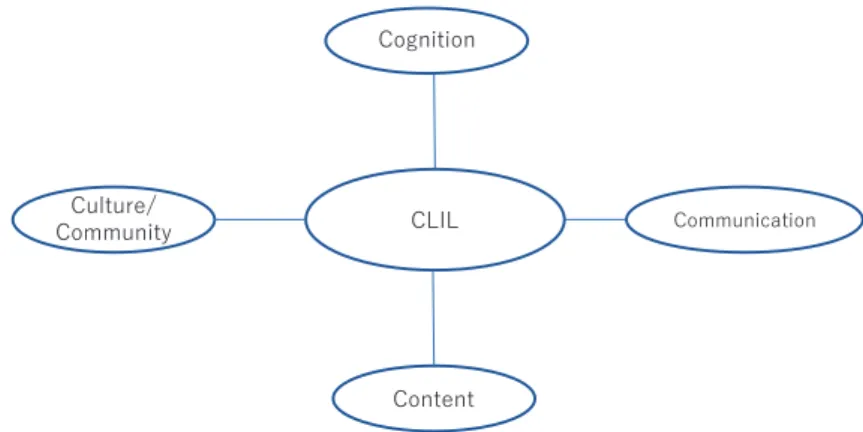
In terms of the features and frameworks of CLIL, the 4Cs (content, commu- nication, cognition, and culture) of CLIL outlined by Coyle et al. (2010) are helpful in understanding how CLIL can be conceptualised from a broader perspective. In Mehisto, Marsh, and Frigols’ (2008) model, community is one of the four Cs, but in Coyle et al.’s (2010) publication, it is replaced by cul- ture. Culture here refers to “developing intercultural understanding and global citizenship” (Coyle et al., 2010, p. 41), whereas community refers to being part of a learning group and local and global community (Mehisto et al., 2008). These two concepts are interrelated, as being part of the community requires one to have an awareness of intercultural understanding and sense of belonging to the world. In this volume, as can be seen in Fig. 1, we incorpo- rate both culture and community as our view is that it is important to make both visible in our discussions of CLIL.
The 4Cs framework places equal emphasis on each of the four Cs advocat- ing an approach to learning where content is considered inter-twinned with and inseparable from communication, culture and cognition. One of the strongest features of CLIL is in the emphasis put on thinking and processing information/content rather than merely remembering and repeating.
Therefore, cognition is central. Another underlying principle is that students process their understanding of content through communication, being scaf- folded in this process by the teacher and other learners. Classrooms are con- sidered cultures in which students exist in communities in order to learn through this scaffolding process.
Fig. 1 The 4Cs of CLIL (Adapted from Mehisto, Marsh, & Frigols, 2008, p. 31)
While constructivism is not one of the four Cs, it underpins the approach as tying together the content, communication, community/culture, and cog- nition. CLIL focuses on the development of the learners’ knowledge and skills (including the language used) through meaningful tasks that stimulate the learners to build knowledge together within a particular learning context.
Through this collaborative work, learners develop their knowledge actively (Cupchik, 2001). As Aikawa et al. in this volume describe, this integration of the four Cs is adaptable for both inside and outside the classroom, so that concepts learnt inside can be challenged and tested outside.
The Language Triptych
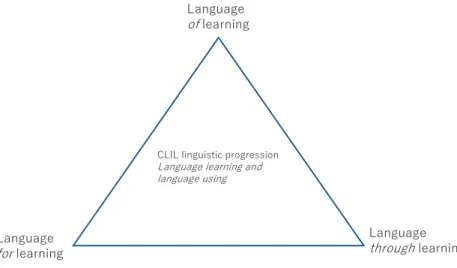
In this section we consider how language is used in connection to the learning of content, and how language is learnt in that process. When conceptualising ways in which language is used as an essential tool for learning, the language triptych provides a useful visual tool for us to consider “the need to integrate cognitively demanding content with language learning and using” (Coyle et al., 2010, p. 36). Figure 2 shows the ways in which language is used in CLIL.
It can be seen that the three dimensions, language of learning, language for learning, and language through learning, are interrelated in the progression of learning in CLIL. According to Coyle et al. (2010), language of learning is the language needed to learn core concepts and notions related to a particular subject. This includes the structure and functions used to talk about the topics
Fig. 2 The language triptych. (Coyle, Hood, & Marsh, 2010, p. 36)
belonging to the subject. Language for learning is used in pair and group work activities, and includes the strategies that are used by the learners in coopera- tive group work in order to make learning happen. Language through learning is used in the interaction that takes place and refers to the dialogic activity that helps learners to think and co-construct new knowledge.
The triptych not only offers an insight into lesson planning in CLIL in con- nection to its learning outcomes but is also helpful in considering learner training in CLIL, supporting students so that they can interact and make new knowledge collaboratively. It also highlights the role of language in critical thinking, both through the dialogues that take place in classroom context and in terms of the language students use to think. The pedagogical challenge is in introducing relevant language systematically and this can be supported through observing and reflecting on the outcome of learner talk observed/
recorded in class.
In this section, we have reflected on the features of CLIL and theoretical frameworks that underpin CLIL as an educational approach to the learning of content and language. In the next, we consider current research in CLIL to situate the work in this volume.
CLIL Research
Since the publication of Mehisto et al. (2008) and Coyle et al. (2010), CLIL research has mushroomed and appeared in books, book chapters, disserta- tions, research articles, reflective pieces, projects and lesson plans. This comes to show that CLIL is appealing to researchers as well as teachers and that it is growing not only in its theoretical rationale but also in systematised informed practice. It also reveals that CLIL can become stronger if practitioners and researchers work collaboratively and strive for integrating practice and theory (Anderson, McDougald, & Cuesta Medina, 2015). The intersection between theory and implementation can be evidenced through the different research frameworks utilised as we can find action research (Banegas, 2018), experi- ments (Piesche, Jonkmann, Fiege, & Keßler, 2016), and quantitative/quasi- experimental studies with large samples (Pérez Cañado, 2018b), comparative (Jiménez Catalán & Agustín Llach, 2017), and longitudinal studies (Pérez Cañado, 2018c).
The CLIL research agenda is varied and includes areas such as curriculum development (e.g., Carrió-Pastor, 2020), assessment (e.g., chapters “Assessing Students’ Learning of History Content in Spanish CLIL Programmes: A Content and Language Integrated Perspective” and “Current Practice and
Challenges of Assessment in CLIL in a Japanese University Context”, this volume; Otto & Estrada, 2019), scaffolding (e.g., Mahan, 2020), classroom discourse (e.g., chapter “The Role of the Essential Question in Eliciting Critical Thinking in CLIL Classes at a Japanese University”, this volume; Li
& Zhang, 2020), policy for and challenges in implementation (e.g., chapter
“Sistemas Educacionais (SE) and CLIL Developments in Brazil: From Promises to Prospects”, this volume; Pimentel Siqueira, Landau, & Albuquerque Paraná, 2018), materials (e.g., chapter “Language- Driven CLIL in Primary Education: An Analysis of General English Coursebooks in Argentina” 12, this volume; Moore & Lorenzo, 2015), interculturality (e.g., chapter
“Developing Intercultural Competence: A Comparison of CLIL and Language Majors Before and After Industrial Placements”, this volume; Porto, 2018), teacher development (e.g., chapters “The Role of CLIL in Learning About TESOL: Reflections from an Australian Master of TESOL Course”, “CLIL- ising EMI: An Analysis of Student and Teacher Training Needs in Monolingual Contexts”, “Top- Down and Bottom- Up CLIL Teacher Development: Lessons Learned from Austrian In- Service CLIL Teacher CPD”, and “Developing the C in Content and Language Integrated Learning: Teacher Preparation That Builds Learners’ Content Knowledge and Academic Language Through Teacher Collaboration and Integrated Pedagogical Training”, this volume; He
& Lin, 2018), psychological factors such as identity, motivation or emotions (e.g., Talbot, Gruber, & Nishida, 2021) and teachers’ and learners’ percep- tions and attitudes (e.g., Fazzi & Lasagabaster, 2020; McDougald & Pissarello, 2020) among other topics that attract research attention.
These areas mentioned above share a common aim: understanding how learners can successfully develop subject-matter knowledge in an additional language and L2 language systems (e.g., grammar, vocabulary) together with linguistic and cognitive skills (Pérez Cañado, 2020) through the CLIL approach(es). The research agenda covers this interest across all levels of for- mal education: kindergarten (Riera Toló, 2017; Švecová, 2011), primary (Martín-del Pozo & Rascón-Estébanez, 2021; Otwinowska & Foryś, 2017;
Pladevall-Ballester & Vallbona, 2016), secondary (Bellés-Calvera, 2018;
Gallagher & Colohan, 2017; Ikeda, 2013), and higher education (Fortanet- Gómez, 2013; Ruiz de Zarobe & Lyster, 2018; Sendur, van Boxtel, & van Drie, 2021; Yang, 2016). These studies agree that CLIL contributes to adding meaningfulness to the learners’ experience as they can use an additional lan- guage to talk about curriculum content and make sense of their practice at different levels and contexts.
Below, we discuss CLIL research in more detail regarding the following areas: (1) motivation, (2) translanguaging, (3) genre and language awareness, and (4) explicit and implicit language learning.
Motivation has been one of the most researched areas in CLIL, whether it is content-driven (e.g., chapter “Authenticity and Motivation in CLIL:
Creating a Meaningful Purpose by Experiencing the Language in Use”, this volume; Doiz, Lasagabaster, & Sierra, 2014) or language-driven (e.g., Banegas, 2013). According to Lasagabaster (2019), studies coincide in that learners achieve better results in foreign language learning when it is integrated with content instruction. According to learners, their motivation is enhanced because they can contribute to the CLIL lesson and they build new knowl- edge in an L2 based on what they have learnt in their L1 in mainstream lan- guage of instruction. In this regard, it has been highlighted (Coyle et al., 2010) that CLIL does not mean learning the same content twice; on the contrary there should be an element of newness and therefore they suggest that lessons move from familiar language to familiar content and new lan- guage to new content and that all activities are contextualised in the content in focus. Therefore, scaffolding and attention to ZPD enhance learner moti- vation in a CLIL environment.
While the content element in CLIL is straightforward (as there is general consensus that it must come from the school curriculum, see above), language is more complex an element to tackle. For example, from a content-driven perspective, Ball et al. (2015) argue that CLIL is not for all and that it works best with learners with higher L2 levels. The reason is, quite understandably, that if language needs to be simplified to match learners’ elementary level of English, content is also simplified, thus running the risk of becoming too simple and therefore demotivating. On the other hand, one could also argue that the students’ interest in the content could be a motivator even for stu- dents with limited L2 proficiency or basic knowledge of the content, creating an opportunity to focus on vocabulary and language connected to the learn- ing of concepts in the subject, language of learning (Coyle et al., 2010).
Translanguaging as an approach goes beyond code-switching and it involves multiple discursive practices in which bilinguals engage in order to make sense of their bilingual worlds (García, 2009). In translanguaging, speakers treat the languages they use as one. In the CLIL literature, Nikula and Moore (2019) summarise the origin and development of the term and observe that in CLIL lessons translanguaging has evolved from being a pedagogical strat- egy to becoming a generalised discursive practice. Recent studies (e.g., Karabassova & San Isidro, 2020; Wu & Lin, 2019) show that a positive effect of translanguaging in CLIL is that the main languages spoken in the
classroom have equally high status and therefore the first language or language of schooling becomes a useful tool for learning and developing cognitive skills.
Researchers have also been interested in genre and language awareness in CLIL and both content and language teachers, and learners are directed to pay attention to these two areas (Llinares, Morton, & Whittaker, 2012; Ruiz de Zarobe, 2017). Studies (e.g., Llinares & Pascual Peña, 2015; Lo & Jeong, 2018) have demonstrated that when learners are guided to identify and follow the specific genres, grammar and lexis of an academic discipline such as his- tory or art, they exhibit an improvement in the transition between Basic Interpersonal Communication Skills (BICS) and Cognitive Academic Language Proficiency (CALP) (Cummins, 1979), CALP (Cummins, 1979), between oracy and literacy, and between subject-specific language and general academic language. For example, Lo and Jeong (2018) report that genre- based pedagogy, which includes systematic guided discovery and inductive teaching strategies based on real-life texts and examples, has a positive effect on learners’ understanding of how languages operate according to functions and purposes. In addition, language awareness promotes learners’ own reflec- tions on their progress in language learning (Lasagabaster & Doiz, 2016).
Research has also demonstrated that having clear language aims and an explicit linguistic component in CLIL lessons helps learners develop their language skills and become proficient L2 users (e.g., Arias, 2021; Genesee &
Hamayan, 2016). To ensure the presence of systematic and explicit language learning, Ball et al. (2015) suggest that a CLIL syllabus can be constructed by paying attention to three dimensions: concepts, procedures, and language.
According to recent studies (e.g., Banegas, 2020; Martín-del Pozo & Rascón- Estébanez, 2021), this model may help teachers become aware that language cannot be accidental or peripheral; it deserves careful planning in the CLIL lesson. In addition, the model allows the incorporation of the language trip- tych as it enables teachers to attend to different dimensions of language learn- ing together with the procedures and activities that will scaffold content and language instruction.
All in all, this section shows that even a cursory review of CLIL research shows that CLIL has been examined from a whole array of educational, lin- guistic, and psychological perspectives, given the spread and ramified devel- opment of CLIL across diverse settings around the world. In this volume, we have only included a small number of CLIL research areas since it would be almost impossible to illustrate all of them.
Structure of the Volume
In line with other volumes in the series (e.g., Kuchah & Shamim, 2018;
Ushioda, 2013), what makes this current volume distinctive is that it respects the local teaching–learning contexts and it is from these starting points that CLIL departs. The volume is international in coverage as it includes chapters set in Argentina, Australia, Austria, Brazil, Colombia, Japan, Spain, Taiwan, and the USA. Content-driven as well as language-driven models are repre- sented through the hands of both internationally well-established authors and early-career researchers in the international arena. As mentioned at the begin- ning of this chapter, the contributions are organised in two parts: (1) CLIL practices (chapters “Authenticity and Motivation in CLIL: Creating a Meaningful Purpose by Experiencing the Language in Use”, “Assessing Students’ Learning of History Content in Spanish CLIL Programmes: A Content and Language Integrated Perspective”, “Current Practice and Challenges of Assessment in CLIL in a Japanese University Context”,
“Translanguaging in Science Lessons: Exploring the Language of Science in L2 Low Achievers in a Public School Setting in Colombia”, “The Role of the Essential Question in Eliciting Critical Thinking in CLIL Classes at a Japanese University”, and “Developing Intercultural Competence: A Comparison of CLIL and Language Majors Before and After Industrial Placements”) and (2) CLIL professional development and awareness (chapters “The Role of CLIL in Learning About TESOL: Reflections from an Australian Master of TESOL Course”, “CLIL- ising EMI: An Analysis of Student and Teacher Training Needs in Monolingual Contexts”, “Top- Down and Bottom- Up CLIL Teacher Development: Lessons Learned from Austrian In- Service CLIL Teacher CPD”, “Developing the C in Content and Language Integrated Learning:
Teacher Preparation That Builds Learners’ Content Knowledge and Academic Language Through Teacher Collaboration and Integrated Pedagogical Training”, “Language- Driven CLIL in Primary Education: An Analysis of General English Coursebooks in Argentina”, and “Sistemas Educacionais (SE) and CLIL Developments in Brazil: From Promises to Prospects”). Each of these contributions includes suggested further reading and a list of questions called engagement priorities to extend the discussion in the readers’ contexts.
Below we present summaries of each chapter.
In chapter “Authenticity and Motivation in CLIL: Creating a Meaningful Purpose by Experiencing the Language in Use” Pinner explores how complex and philosophical aspects of authenticity relate to CLIL in terms of generat- ing a sense of congruence through teaching and learning in meaningful
contexts. Whilst keeping an emphasis on materials and content, Pinner exam- ines how the target language is experienced in use, through what in CLIL is known as ‘authenticity of purpose’.
In chapter “Assessing Students’ Learning of History Content in Spanish CLIL Programmes: A Content and Language Integrated Perspective”, del Pozo and Llinares position their study at the intersection between learning language and history content and explore an empirical model to assess the acquisition of content and language while fostering students’ written produc- tion (Llinares, Morton, & Whittaker, 2012).
In chapter “Current Practice and Challenges of Assessment in CLIL in a Japanese University Context”, Sato, Yokomoto, and Mackenzie discuss CLIL practitioners’ approaches to assessing productive language performance and learners’ perception of being evaluated on language and content, based on empirical research conducted in a Japanese private university. The authors compare teachers’ assessment approaches in language-focused instruction, addressing the unique features and challenges of classroom-based assessment practice in CLIL.
In chapter “Translanguaging in Science Lessons: Exploring the Language of Science in L2 Low Achievers in a Public School Setting in Colombia”, Garzón- Díaz aims at depicting how students from a public school setting in Colombia have developed scientific competencies while building scientific literacy through Spanish and English as vehicular languages. The insights gained through this pedagogical intervention may serve as reference in CLIL contexts as it focuses on the key role that translanguaging may play while learners are constructing knowledge in bilingual and multilingual settings.
In chapter “The Role of the Essential Question in Eliciting Critical Thinking in CLIL Classes at a Japanese University”, Aikawa, Fukasawa, and Hemmi discuss how interaction is conducted in a Japanese context, focusing on the development of learners’ critical thinking skills and interactional competence through a dialogic exchange. They discuss data analysed from five CLIL classes at a private Japanese university in Japan and identify what opportunities for content and English language learning are created in teacher–learner and learner–learner interactions.
In chapter “Developing Intercultural Competence: A Comparison of CLIL and Language Majors Before and After Industrial Placements”, Yang investi- gates learners’ cultural awareness quotient gained from a Taiwan tertiary degree-based CLIL programme and compared it to a non-CLIL English department. The results demonstrate that the CLIL learners obtained slightly higher CQ scores than their non-CLIL English-majored peers, implying that
CLIL seems to equip learners with a better ability to function successfully in diverse cultural settings.
In chapter “The Role of CLIL in Learning About TESOL: Reflections from an Australian Master of TESOL Course”, Turner focuses on an educational context in an Australian masters in TESOL course where the participants of the course have a diversity of different linguistic backgrounds. In this chapter, Turner advocates a content-centred approach, offered in connection to actual teaching and showing that different kinds of content-based pedagogies in teaching CLIL are crucial elements for the learners.
In chapter “CLIL- ising EMI: An Analysis of Student and Teacher Training Needs in Monolingual Contexts”, Pérez Cañado addresses the research gap in pre- and in-service teacher development programmes for English medium instruction (EMI) at a tertiary level. While the author understands EMI as the curricular decision/institutional strategy of teaching an academic subject through the medium of English, she approaches CLIL as an educational approach that can support EMI. She focuses on evidence-based practice, and based on the outcomes of her research, sets forth a specific teacher-education proposal to address the chief areas in need of attention. The author addresses the need to include a language focus in the training for both students and teachers. There is a pedagogical implication to further develop CLIL approaches in EMI.
In chapter “Top- Down and Bottom- Up CLIL Teacher Development:
Lessons Learned from Austrian In- Service CLIL Teacher CPD”, Kelly and Bärnthaler describe the content of the Austrian CLIL CPD programmes and highlight the need for a clear balance between course input and participant practice. Examples of lesson materials developed from a range of upper sec- ondary curriculum subjects are presented and feedback from teachers and students about their experiences both in training and as learners are discussed.
In chapter “Developing the C in Content and Language Integrated Learning: