Sociolinguistic Fieldwork
Looking for an easy-to-use, practical guide to conducting fieldwork in sociolinguistics? This invaluable textbook will give you the skills and knowledge required for carrying out research projects in“the field,”
including:
how to select and enter a community how to design a research sample
what recording equipment to choose and how to operate it how to collect, store, and manage data
how to interact effectively with participants and communities what ethical issues you should be aware of
Carefully designed to be of maximum practical use to students and researchers in sociolinguistics, linguistic anthropology, and related fields, the book is packed with useful features, including:
helpful checklists for recording techniques and equipment specifications
practical examples taken from classic sociolinguistic studies vivid passages in which students recount their own experiences of
doing fieldwork in many different parts of the world
n a t a l i e s c h i l l i n g is an Associate Professor of Linguistics at Georgetown University. She has conducted and directed sociolinguis- tic fieldwork projects in communities ranging from isolated island villages to neighborhoods in the heart of urban Washington, DC, and has taught courses in sociolinguistic fieldwork for more than fifteen years.
Series editor: Rajend Mesthrie
This new series focuses on the main topics of study in sociolinguistics today. It consists of accessible yet challenging accounts of the most important issues to consider when examining the relationship between language and society. Some topics have been the subject of sociolinguistic study for many years, and are here re-examined in the light of new developments in the field; others are issues of growing importance that have not so far been given a sustained treatment. Written by leading experts, the books in the series are designed to be used on courses and in seminars, and include useful suggestions for further reading and a helpful glossary.
Already published in the series:
Politenessby Richard J. Watts Language Policyby Bernard Spolsky Discourseby Jan Blommaert
Analyzing Sociolinguistic Variationby Sali A. Tagliamonte Language and Ethnicityby Carmen Fought
Styleby Nikolas Coupland
World Englishesby Rajend Mesthrie and Rakesh Bhatt Language and Identityby John Edwards
Attitudes to Languageby Peter Garrett Language Attritionby Monika S. Schmid
Writing and Society: An Introductionby Florian Coulmas Sociolinguistic Fieldworkby Natalie Schilling
Forthcoming titles:
Speech Communitiesby Marcyliena Morgan
Sociolinguistic Fieldwork
NATALIE SCHILLING
Cambridge, New York, Melbourne, Madrid, Cape Town, Singapore, São Paulo, Delhi, Mexico City
Cambridge University Press
The Edinburgh Building, Cambridge CB2 8RU, UK Published in the United States of America by Cambridge University Press, New York www.cambridge.org
Information on this title:www.cambridge.org/9780521127974
#Natalie Schilling 2013
This publication is in copyright. Subject to statutory exception and to the provisions of relevant collective licensing agreements, no reproduction of any part may take place without
the written permission of Cambridge University Press.
First published 2013
Printed and bound in the United Kingdom by the MPG Books Group A catalogue record for this publication is available from the British Library Schilling, Natalie.
Sociolinguistic fieldwork / Natalie Schilling.
pages cm.–(Key topics in sociolinguistics)
ISBN 978-0-521-76292-2 (Hardback)–ISBN 978-0-521-12797-4 (Paperback) 1. Sociolinguistics–Fieldwork. 2. Sociolinguistics–Methodology. I. Title.
P40.S295 2013 306.4407201–dc23
2012039594 ISBN 978-0-521-76292-2 Hardback
ISBN 978-0-521-12797-4 Paperback
Cambridge University Press has no responsibility for the persistence or accuracy of URLs for external or third-party Internet websites referred to in this publication, and does not guarantee that any content on such websites is, or will remain, accurate or appropriate.
For my grandfathers: H.C. William Schilling, artist (1905–1964) and Anatol I. Zverev, scientist (1913–1983)
Contents
List of figures ix Acknowledgements x 1 Introduction 1
1.1 Foregrounding field methods 1
1.2 Sociolinguistic field methods: A brief history and overview 3 1.3 Enriching quantitative sociolinguistics with qualitative
data / methods 8
1.4 How this book is organized 11 2 Designing the study 17
2.1 Selecting the population: What is a“speech community”? 18 2.2 Sampling the population 31
2.3 Stratifying the sample 45
2.4 Investigating language change in real time 54 2.5 Summary 62
3 Data-collection methods 66 3.1 Sociolinguistic surveys 66 3.2 The sociolinguistic interview 92
3.3 Ethnography / participant-observation 113 3.4 Summary: Combining methods and embracing the
observer’s paradox 126 4 Designing research on style 134
4.1 Researching style as attention to speech 135 4.2 Researching style as audience design 141 4.3 Current approaches to stylistic variation 155 4.4 Summary 172
5 In the field: Finding contacts, finding a place 177 5.1 Initial contacts 177
5.2 Finding participants 191 5.3 The role of the fieldworker 194 5.4 Summary 212
vii
6 Recording and record-keeping 216
6.1 Recording equipment and techniques 217 6.2 Record-keeping and data management 248 6.3 Preserving confidentiality 263
6.4 Summary 265
7 Giving back to the community 268
7.1 Operationalizing advocacy: Labov’s principles for community involvement and their implementation 269 7.2 From advocacy to empowerment: Wolfram’s Principle
of Linguistic Gratuity and its implementation in informal education 276
7.3 Passing the torch: Students giving back 280 7.4 Summary 283
References 287 Index 303
Figures
2.1 Dialect areas of the Eastern United States as revealed in the Linguistic Atlas of the Middle and South Atlantic States portion of the Linguistic Atlas of the United States and Canada (from Kurath, Hans, 1949,Word Geography of the Eastern United States, Ann Arbor: University of Michigan Press, p. 91, fig. 3) 37 2.2 Dialect areas of the U.S. as revealed in the Atlas of North
American English project (adapted from Labov, William, Sharon Ash, and Charles Boberg, 2006,The Atlas of North American English: Phonetics, Phonology and Sound Change, Berlin/New York:
de Gruyter, p. 148, map 11.15) 39
3.1 Class and style stratification for postvocalic r (from Labov, William, 1968,“The reflection of social processes in linguistic structures,”in Fishman, Joshua (Ed.),Readings in the Sociology of Language, Berlin/New York: de Gruyter, p. 244, fig. 2) 99 3.2 Labov’s“decision tree”for delimiting casual and careful
style in the sociolinguistic interview (from Labov, William, 2001,
“The anatomy of style shifting,”in Eckert, Penelope, and John R. Rickford (Eds.),Style and Sociolinguistic Variation, Cambridge/New York: Cambridge University Press, p. 94, fig. 5.1) 100
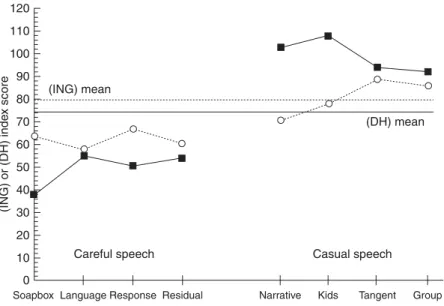
3.3 Stylistic differentiation for (dh) and (ing) for the eight
categories of Labov’s Decision Tree (from Labov, William, 2001,
“The anatomy of style shifting,”in Eckert, Penelope, and John R. Rickford (Eds.),Style and Sociolinguistic Variation, Cambridge/New York: Cambridge University Press, p. 104, fig. 5.7) 103
6.1 Interview Report Form for the Language and
Communication in the Washington, DC, Metropolitan Area (LCDC) project 261
ix
Acknowledgements
I am deeply indebted to countless people without whom I could not have learned so much about sociolinguistic fieldwork or written this book. I cannot possibly thank everyone individually in the space of a page or two, but I want everyone involved to know that I value each person’s unique contribution.
First, I thank my professors, especially my linguistics and sociolin- guistics professors. I am particularly grateful to Walt Wolfram, who took me on my first fieldwork adventures and taught me not only how to do a good study but, more importantly, how to do good deeds, though giving back to the communities we study in any way we can, linguistic, non-linguistic, big or small. Thanks also to the other members of my first-ever fieldwork team, especially Kirk Hazen, who is still out in the field and still giving back to the community.
Second, I thank all the community members with whom I have had the good fortune to work in my various fieldwork projects, in particu- lar the people of Ocracoke, NC; Robeson County, NC; Hyde County, NC;
Smith Island, MD; and various neighborhoods in Washington, DC.
Thank you for sharing your voices, your homes, and your lives with us. I have been immeasurably enriched academically and personally by getting to know you, and I cherish all of you. I would like to mention a couple of the special friends I made over the course of my fieldwork experiences, some of whom are no longer here to read these words but who live on in our hearts–and sometimes in our recordings: Adolph Dial, Hayes Alan Locklear, and Georgia Locklear from Robeson County;
Frances Dize, Pastor Rick Edmund, Janet Evans, Craig Evans, and Melanie Guy from Smith Island (and also my re-found friends Dana Insley and Chris Parks); and my many, many friends on Ocracoke, far too numerous to mention. But thanks at least to Dave and Jen Esham, Melinda Jackson Esham, James Barrie Gaskill and Ellen Gaskell, Candy Gaskill, Chester Lynn, Kenny Ballance, Alton Ballance, and of course Rex and Miggie O’Neal. Here’s to all of you:“It’s hoi toid on the sound soid.”
x
Third, I have to thank each and every one of my students of sociolin- guistic fieldwork, past, present, and future. I have learned just as much from you as you have from me, and I treasure our mutual learning endeavors. Heartfelt and enduring thanks to my first-ever students in sociolinguistic fieldwork at Stanford University, including Angie Kortenhoven, Sarah J. Roberts, Devyani Sharma, and Andrew Wong.
I am so proud of all of you, and so profoundly grateful for our enduring collegiality. And of course thank you to all of my students at George- town University. I would particularly like to acknowledge the following for sharing their insights, thoughts, and feelings about their sociolin- guistic fieldwork experiences: Leslie Cochrane, Jinsok Lee, Jia Jackie Lou, Jermay Jamsu Reynolds, Sakiko Kajino, Jason Sanderson, Corinne Seals, Sheena Shah, Amelia Tseng, Mark Watson, Cala Zubair, and especially Anastasia Nylund and Jen McFadden. Thanks to Barbara Soukup for her generous help with information on and insight into language attitudes and perceptions, and to Janet Fuller for her fieldwork- related insights – and her continuing friendship. Thanks also to my Georgetown University colleagues for their friendship and moral sup- port. Particular thanks to Roger Shuy, Ralph Fasold, Deborah Tannen, Heidi Hamilton, Rob Podesva, Anna Marie Trester, and especially Debby Schiffrin, for her longstanding collaboration in our Sociolin- guistic Field Methods classes and for being the inspiration behind our Language and Communication in the Washington, DC, Metropolitan Area (LCDC) project.
I owe many personal thank yous, especially to my family. In particu- lar, I thank Mom and Dad, and my brothers Ron and Rick, for always believing in me. Special thanks also to Aunt Bonny and Uncle Haydon, without whom I would never have gotten to launch my sociolinguistic fieldwork journey in North Carolina.
Finally, I extend my enduring thanks to those who, above all others, truly saw me through this book, from beginning to middle to end, from vague idea to what I hope is a tangible, useful contribution to all who embark on the journey of sociolinguistic fieldwork. Thanks to my very dear friend Jim, for hanging in there with me through even the most difficult times; to Jen McFadden, student, editor, colleague, and friend;
to Otto Santa Ana, my writing partner and professional and personal inspiration; and to Chris, who has believed in me, and in this book project, from day one.
Acknowledgements xi
1 Introduction
1.1 FOREGROUNDING FIELD METHODS
Empirical data on language in its social context is at the heart of sociolinguistic study. Nonetheless, researchers have lamented that the field methods whereby such data are gathered have always been rather “inconspicuous” (Feagin 2013: 37). Write-ups of research pro- jects focus on results and interpretations –not on how the data from which the findings are drawn were actually obtained. Indeed, Tagliamonte (2006a: 17) maintains that“fieldwork methods may be the best-kept secret of sociolinguistics.”In addition, the few publica- tions that do focus on sociolinguistic field methods (e.g. Bailey and Tillery 2004; Bailey, Wikle, and Tillery 1997b; Feagin 2013; Labov 1972a,1984; Macaulay2009; Milroy and Gordon2003; Schilling-Estes 2007; Tagliamonte2006a; Wolfson1976) all point to the crucial role that research design and method play in shaping the data and, hence, the conclusions we derive. Further, sociolinguistic research foci have both broadened and become more nuanced, and data-related tech- nology of course continues to transform itself every day. Correspond- ingly, research methods have become more varied and sophisticated and continue to evolve at a rapid pace.
The purpose of this book is to at last reveal the “secrets”of socio- linguistic fieldwork. It is both a how-to for students and researchers who need to design and conduct studies on language in its social context and a thoughtful exploration of the chief methods in sociolin- guistic data collection, including examination of which methods work best for which purposes; evaluation of the strengths and weaknesses, advantages and disadvantages of each approach; and consideration of the theoretical assumptions underlying different methodological approaches. The book covers both quantitative and qualitative meth- odologies, as well as small- and large-scale studies. However, its chief focus is on how a range of methods and perspectives can be applied to variationist sociolinguistics, or quantitative sociolinguistics, the 1
subfield that has dominated modern sociolinguistic study since its inception in the early 1960s. Thus, in addition to providing practical guidelines, the book also explores several recent and ongoing“turns” in current variationist sociolinguistics, including integrating ethno- graphic study into traditional survey-based methods; and reconsider- ing traditional conceptualizations of and methods for studying stylistic variation, including investigating variation as it unfolds in interaction.
Also of crucial importance throughout the book are questions of field- work ethics, including not only consideration of how to ensure that your research causes no harm but also how your research can actually be of benefit to the communities you study.
The book is intended to be general enough for use by researchers on spoken, signed, and written language variation. However, where research methods become more specialized (e.g. in considering issues of obtaining high-quality recordings and preserving the confidentiality of identifying information), the emphasis is on methods in spoken language research, since sociolinguistics has been most closely focused on spoken language since its inception and since the“secular,”every- day linguistic usages that sociolinguists seek have traditionally been concentrated in spoken registers (though, naturally, this has been changing in recent decades as written electronic communications has become increasingly commonplace). In addition, although human communication encompasses not only the linguistic signal per sebut also gesture, position, facial expression, etc., this book follows the mainstream of variation study in focusing on the verbal channel, though of course it is necessary to concurrently consider the extra- linguistic context that shapes and is shaped by the linguistic signal.
Throughout the book, methodological and theoretical approaches and issues will be illustrated with examples from sociolinguistic studies ranging from the first foundational studies in the field, to later ground- breaking and paradigm-shifting works, to important ongoing work in the early decades of the twenty-first century. Illustrations will also come from a range of languages and sociolinguistic fieldwork locales from across the globe. At the same time as I provide breadth, however, I will provide depth of detail by drawing many examples from studies with which I have some degree of personal connection, whether through direct involvement with the research project, through direct contact with the project directors or project team, or in my role as advisor to researchers and students who have sought my guidance in designing and conducting projects on language variation in its social setting.
The necessity for a limited scope is obvious, given the sheer impossi- bility of representing all of the many types of peoples and places that
have been studied since the inception of modern sociolinguistics. But my personal focus is also driven by personal convictions: first, that sociolinguistic research is best conducted from a dual insider–outsider (i.e. participant–observer) perspective, as I discuss inChapters 3,5, and 7; and second, that our best reflections upon fieldwork methods are drawn from projects with which we have at least some degree of
“insider”involvement during the fieldwork process. I believe our best insights about field methods come not from reading neat and polished accounts, where process almost always takes a back seat to the final analytical product, but rather from the “messy”and necessarily per- sonal experience of fieldwork itself. My insights have been greatly enriched by connection with a wide array of projects throughout the US and the world, and my hope is to share these insights with the range of readers who stand to benefit from this book as they plan, conduct, and consider their own sociolinguistic and related studies.
As a special aid to the beginning researchers who are one of the chief audiences for this book, I highlight the research experiences of students at Georgetown University in a series of insets on “Students in the field.”These students have conducted research on a wide range of communities throughout the world, and they have plenty of know- ledge to share, including insight into what worked well, what did not work, and what surprises they encountered. They also share with us their emotional experiences. Sociolinguistic fieldwork can be daunting, but it can also be the most rewarding part of being a researcher, in terms of how much we learn about language and life, and in terms of the personal connections we forge as we engage with communities in a mutual learning process.
The text presumes grounding in introductory sociolinguistics, though it will also be useful for any scholar who wishes or needs to gather data on language in its social context; for example, those working in applied linguistics, linguistic anthropology, historical linguistics, and language endangerment.
1.2 SOCIOLINGUISTIC FIELD METHODS: A BRIEF HISTORY AND OVERVIEW
Variationist field methods have their roots in several traditions of empirical language study, including historical / comparative linguis- tics; the traditional dialectology (dialect geography) that stems from comparative linguistics; and the American descriptivist / structuralist linguistics of the early twentieth century (Chambers and Trudgill1998:
Introduction 3
13–54; Milroy and Gordon 2003: 1–22). In addition, qualitatively oriented approaches to the interrelation between language and society, namely, linguistic anthropology, the ethnography of communication, and interactional sociolinguistics, have played an important role in shaping quantitative sociolinguistics and have exerted increasing influ- ence as variation analysis has developed over the past four decades (e.g.
Milroy and Gordon2003: 1–22).
The first systematic dialect studies were a natural outgrowth of his- torical linguists’ interest in the interrelations between modern lan- guages and language varieties and what these relations could reveal about historical connections and developments. The earliest dialect geo- graphic studies were Wenker’s survey of German dialects (1876–1887), Guillieron’s survey of French dialects (1896–1900), and Jaberg and Jud’s surveys of the Italian dialects of Italy and southern Switzerland in the first decades of the twentieth century. These studies served as the inspir- ation for the systematic study of American English dialects, initiated with the inauguration of the Linguistic Atlas of the United States and Canada project in 1930. Concurrently, in the early decades of the twentieth century, American descriptivist linguists inaugurated their own tradition of empirical linguistics with their investigations of the structures of Native American languages. (See Chambers and Trudgill 1998: 13–53 for a detailed discussion of the development of variationist sociolinguistics out of traditional dialectology.)
Because of their interest in linguistic history (i.e. diachronic linguis- tics), early dialectologists concentrated on obtaining data from speakers whose speech was believed to be most reflective of older speech forms–non-mobile, older, rural males with little formal educa- tion. And whereas the focus of American structuralist linguists was chiefly on the interrelation of the elements of language at a given moment in time (i.e. synchronic linguistics), they shared with dialect- ologists a focus on empirical data and linguistic fieldwork, as well as an interest in how similarities across current languages can be revealing of historical linguistic relationships.
However, it was not until the latter half of the twentieth century that diachronic and synchronic linguistics were truly brought together, with the pioneering work of Uriel Weinreich and William Labov and the advent of modern variationist sociolinguistics (Weinreich, Labov, and Herzog1968). Like historical linguists and traditional dialect geog- raphers, variationists are keenly interested in language change; how- ever, their focus is not typically on long-completed changes but rather on ongoing language change. The pioneering study in this regard is Labov’s 1963 study of Martha’s Vineyard, an island off the coast of
Massachusetts (New England, USA), in which Labov demonstrated that, contrary to prior belief, it is indeed possible to observe language change in progress, through studying the synchronic patterning of community variation (1963,1972c: 1–42). Crucially, in order to fully understand language change (and linguistic systematicity), we must investigate variation as it patterns according to both linguistic and social factors.
And the social context of language variation is not limited to its patterning across geographic space but extends also to its patterning across social groups (e.g. age groups, social class groups, ethnic groups) as well as to its social meaning for both groups and individuals (e.g. a particular linguistic feature may be seen as a marker of regional identity or associated with a particular character trait).
Because variationists recognize that language variation must be studied across the entire social spectrum, their target populations are much broader than those of traditional dialect geographers, encompassing a full range of age, gender, socioeconomic, and ethnic groups. In addition, because they are focused on ongoing change rather than historic language forms, variationists often center their studies in urban rather than rural locations and may focus on younger populations as well. Some of the many important studies of language variation in urban settings include such pioneering works as Labov’s(1966) study of New York City English; Wolfram’s(1969) study of African American English in Detroit, Michigan; Cedergren’s(1973) study of Spanish in Panama City; Trudgill’s (1974) study of Norwich, England; and Macaulay’s (1977) work in Glasgow, Scotland. In add- ition, there have been important ongoing studies of, for example, Montreal French (Sankoff, Sankoff, Laberge, and Topham 1976;
Thibault and Vincent 1990; Vincent, Laforest, and Martel 1995) and Philadelphia English (Labov 1994), as well as re-studies of Martha’s Vineyard (Blake and Josey 2003; Pope, Meyerhoff, and Ladd 2007), Panama City (Cedergren 1973, 1984), Norwich (Trudgill 1988), and New York City (r) (Labov 1994), among others. Finally, recent and ongoing studies of language variation and change in urban settings increasingly are taking language and dialect contact into account, as evidenced, for example, in Horvath’s (1985) study of the socioethnic varieties in Sydney, Australia; Kerswill’s studies of dialect contact, dialect leveling, and new dialect formation in southeast England (Kerswill 1996,2013; Kerswill and Williams2000,2002); and Walker and Hoffman’s ongoing studies of the highly multiethnic and multi- lingual city of Toronto, Canada (e.g. Hoffman and Walker2010).
Variationist sociolinguistics also differs from traditional dialectology and American descriptivist linguistics in terms of what type of speech
Introduction 5
data is sought, and hence on primary methods of data collection.
Dialectologists traditionally relied on lengthy questionnaires designed to elicit information on the use of a variety of lexical, phonological, and grammatical features, sometimes directly (e.g. “Have you ever heard the term‘snap beans’used for the beans that you break in half to cook?
If yes, how often would you use that term. . .?”) but more often indir- ectly (“What word would you use for the beans that you break in half to cook?”; see Bailey, Tillery, and Wikle 1997a). Questionnaires were distributed by mail or by traveling fieldworkers across very large areas (often across a whole country), and there tended to be very few respondents (often a single respondent) from each location within the wider survey area. And again, the social spectrum was typically narrow, with most informants being those who presumably repre- sented the oldest speech forms, especially in European dialect surveys.
The American structuralists also relied on elicited language forms, though their interest was in piecing together the linguistic systems of undocumented or little-studied languages rather than in areal or social variation within well-known languages. Thus, their elicitations focused on obtaining information on the interrelation between linguistic elem- ents rather than isolated items, through such tasks as judgments of
“same”or“different,”to determine minimal pairs, and sentence per- mutation tasks, to determine interrelations such as the subject and verb forms constituting the person–number paradigm. Again, though, the number of informants was limited–not just per location but per entire language –and there was typically little or no information on intra-language variation.
Again, because their focus is on intra-language variation, including social variation within populations as well as social and geographic variation across social groups, variationists gather data from many speakers in each community of study. In addition, their data must include many tokens of each of the variable linguistic features they are interested in, not just one or two examples of each, in order to gain a full picture of the linguistic and social factors that condition regu- larly patterned variability. Finally, variationist methodology has long been rooted in Labov’s vernacular principle, which states:
the style which is most regular in its structure and in its relation to the evolution of the language is the vernacular, in which the minimal attention is paid to speech (Labov1972a: 112).
To fulfill the need for long stretches of connected, unselfconscious speech, Labov devised the so-calledsociolinguistic interview–a casual interview designed to approximate the flow of an everyday relaxed
conversation, as well as to focus speakers’attention on what they are talking about rather than on their speech itself (Labov1972a; Wolfram and Fasold 1974). Interviewer questions are kept brief, and interview- ees are encouraged to talk at length about topics of interest to them rather than asked to provide concise information on particular lan- guage features. Many researchers have modified the basic format of the sociolinguistic interview, and everyone tailors it to suit each individual community under study. In addition, some variationists have ques- tioned the focus on vernacular, unselfconscious speech and have dem- onstrated how more selfconscious styles lend valuable insight into the patterning of variation and change (Coupland 2001a, 2001b, 2007;
Eckert2000: 213–228; Milroy and Gordon2003: 49–51; Schilling-Estes 1998). Nonetheless, the sociolinguistic interview as originally con- ceived remains the most important item in the variationist sociolin- guist’s fieldwork toolkit. This vital tool will be discussed at length in Chapter 3, including its strengths and limitations in terms of investi- gating a range of speech styles.
Case study: Investigating change through studying systematic variation – Labov’s pathbreaking study of Martha’s Vineyard
In the early 1960s, Labov conducted a pioneering study of Martha’s Vineyard, an island off the coast of Massachusetts, in the Northeastern US (1972c: 1–42). His focus was on the appar- ent increase in the production of the /ay/ and /aw/ diphthongs with centralized rather than low nuclei, a development which seemingly was taking place at the same time as the island was being transformed from a traditional, self-sustaining maritime community to a magnet for vacationers and new residents from mainland communities. An increase in centralization would be unusual, since historically the centralized forms developed into today’s diphthongs with low central nuclei, and we do not typically expect a community to reverse a language change, or
“turn its back on the history of the English language” (Labov 1972c: 25).
In order to investigate whether the suspected movement away from [aɪ] and [aʊ] toward increasing [əɪ] and [əʊ] was indeed taking place, Labov conducted tape-recorded interviews with numerous islanders, representative of important community social groups. Through subsequent quantitative analysis (i.e. counting all tokens of centralized and non-centralized /ay/
and /aw/ in the recordings and noting the linguistic contexts and
Introduction 7
social factors surrounding each occurrence), Labov was able to demonstrate that the centralization of /ay/ and /aw/ showed regular patterning according to linguistic factors such as following environment. For example, speakers were more likely to produce centralized nuclei for /ay/ before voiceless than voiced obstruents, so that [rəɪt] is more likely than [rəɪd].
In addition, he demonstrated that younger speakers showed more centralization than older speakers. This observation, coupled with data from earlier dialect geographic studies (and general information on the history of English), confirmed that the centralization of /ay/ and /aw/ was indeed on the rise in the island community.
Finally, Labov noted a correlation between speakers’ orienta- tion to Martha’s Vineyard and usage levels for centralized /ay/
and /aw/: Those who positively valued the local community and its traditional ways showed higher usage levels for the central- ized variants than those with more neutral or negative feelings toward the island and its traditional inward focus and isolation from outside forces.
Labov’s study thus illustrates several key elements of variation theory and its inhering methodology:
1) We can investigate language change in progress through investigating the systematic patterning of language variation in a given population at a single moment in time.
2) To fully investigate the patterning of language variation, we must take into account both the linguistic and social factors that con- dition and / or correlate with the variable features in question.
3) The social factors that correlate with / condition language change include not only readily observable demographic factors such as age, occupation, and ethnicity, but also, and perhaps most importantly, attitudinal and identificational factors such as orientation toward one’s local community.
1.3 ENRICHING QUANTITATIVE SOCIOLINGUISTICS WITH QUALITATIVE DATA / METHODS
Though essentially quantitative in nature, variationist sociolinguistics shares much in common with the qualitatively oriented disciplines of linguistic anthropology, the ethnography of communication, and inter- actional sociolinguistics, since all are focused on the interrelation of
language and society / culture. Central to anthropological / ethno- graphic approaches is a concern for coming to understand cultures and communities from the perspectives of their members, through long-term participant-observation in community life. In addition to gathering copious amounts of language data, variationists too seek community understandings, though often the variationist focus is more linguistic than cultural, since language change and linguistic systematicity remain central concerns. Labov’s Martha’s Vineyard study is a model not only in its careful linguistic analysis but also in its concern for uncovering the sociocultural meanings of the linguistic features under study for the people who use them. Other, larger scale sociolinguistic studies in urban contexts have sometimes sacrificed sociocultural depth for linguistic and social breadth, as well as for replicability across communities, and relied on pre-imposed social categorizations and meanings, for example by dividing the community into “typical” socioeconomic groups based on “typical” measures of income, education, occupation, etc., rather than uncovering more nuanced local categorizations (e.g. Eckert2000: 16–25,2005; Rickford 1986). However, variationist sociolinguistics has never really strayed far from its ethnographic roots and its focus on the local as well as the global, as evidenced, for example, as early as Labov’s studies of the local meaning of features of African American Vernacular English among Harlem youth in the 1960s and continuing with Milroy and Milroy’s studies of the local meanings connoted by use of traditional vernacular forms among members of various types of social networks in Belfast, Northern Ireland, in 1975–1981 (1985). As our studies have progressed, there has been ever-increasing recognition that the social meaning and hence regular patterning of language variation (and the course of language change) is best understood by combining broad-brush surveys using sociolinguistic interview methods with in-depth ethnographic analysis of local sociocultural meanings, practices, and categories.
A model study exemplifying the synergistic union of quantitative variationist and qualitative ethnographic methods is Penelope Eckert’s Linguistic Variation as Social Practice(2000). Eckert’s work on adolescent language patterns in a suburban Detroit (Michigan) high school is a thorough and careful quantitative analysis of language variation and ongoing change utilizing the best practices (including field method techniques) of variationists. Crucially, though, it is grounded in exten- sive ethnographic observation of the high school under study and of American high school and adolescent culture more generally, and so Eckert is able to insightfully examine interrelations between patterns of variation and change and local social categories, meanings, and
Introduction 9
practices. For example, she is able to show that particular features associated with a current change in progress correlate more closely with kids’ own social categories (i.e. the school-oriented “jocks” and street-oriented “burnouts”) than their parents’ socioeconomic class groups, as defined by“objective”measures imposed from outside com- munity perspectives. In addition, she shows how language variation may play a greater role in demarcating which practices the kids engage in than the groups to which they belong. Thus, for example, among the jock and burnout boys in her study, usage levels for the newest vowel pronunciations are more closely correlated with the activity of
“cruising”(i.e. traveling frequently to potentially risky areas of Detroit) than with membership in the jock or burnout social categories (pp. 150–153).
At the same time that variationists are broadening their language studies by including solid ethnographic studies of community sociocul- tural perspectives, they are also looking more deeply into their data by investigating how variants pattern in unfolding discourse. In this way, they gain understanding not only of the local community meanings of language features but of individual and interpersonal meanings as well. In addition, through such study we come to understand that linguistic variants are not simply reflective of membership in certain social groups or of particular attitudinal postures but that people actively utilize particular features to create and shape individual and group identities and (language) styles, as well as project particular stances – that is, relationships to what is being said and to one’s interlocutors (see Section 4.3 for more on the notion of“stance”).
Further, just as identities and styles are not fixed but fluid, so too are the meanings of variables malleable and multifaceted. For example, in order to examine the patterning and meaning of one of the most noticeable features of one of the most distinctive dialects of the US,
“Pittsburghese,”the variety associated with Pittsburgh, Pennsylvania, and the immediate vicinity, Johnstone and Kiesling (2008) combined quantitative study of the production and perception of monophthongal vs. diphthongal /aw/ with analysis of how /aw/ was used in connected speech (interviews and other data-gathering tasks), as well as how people talkedabout/aw/. (They also conducted historical investigation of the rise of Pittsburghese as an entity in its own right.) Their findings revealed that, far from remaining fixed, the meaning of /aw/ has changed drastically– from a highly localized but quite unnoticeable feature of Pittsburgh speech, to a marker of regionality to be avoided in
“correct” speech, to a stereotype that can be used to perform the Pittsburgh dialect or Pittsburgh personas.
In addition to having changing meanings, a feature can have more than one meaning at a time, whether across communities, within a single community, or even for an individual speaker. Often, these meanings are related. That is, rather than point to or “index” one particular stance or facet of identity (whether a character trait or demographic category), a variant is often associated with an“indexical field,” “a constellation of meanings that are ideologically linked” (Eckert 2008: 464). For example, Eckert (2008: 467–471) discusses how quantitative sociolinguistic studies of practice groups as disparate as Orthodox Jews (Benor 2001, 2004), high school girls who pride themselves on their intelligence and purposeful nonconformity to mainstream social groups (i.e. ‘nerds’; Bucholtz 1996, 1999, 2001), and gay men (Podesva 2004, 2006; Podesva, Roberts, and Campbell- Kibler2002) all show high usage levels for released /t/ in word positions where the usual American English variant would be unreleased or flapped (or possibly also glottalized, deleted or palatalized). All of these studies also include important discourse analytic components that show that these different groups capitalize on many of the same ideologically linked meanings associated with released /t/ in American English: In the US, /t/-release is considered to be hyperarticulate and so can be used to index such qualities as intelligence, carefulness, and precision, all of which are important to all the groups listed above, at least in particular situations, at particular moments in conversational interaction. At the same time, the stances and qualities associated with released /t/ may be associated with different local meanings in each different community of practice – for example, it is associated with nerdgirlsin one context and learned Jewishmenin another.
1.4 HOW THIS BOOK IS ORGANIZED
This book presents readers with a step-by-step guide to designing and conducting field research on language in its social context, with an emphasis on methods used in variationist sociolinguistic research.
Along the way, the various methods, as well as underlying concepts, constructs, and theoretical assumptions are examined and assessed.
In Chapter 2, we start by considering just what constitutes a socio- linguistic study, beginning with what types of linguistic, social, and sociolinguistic questions we might ask, what types of populations we might study (e.g. by considering the question of what constitutes a
“speech community”), how to select speakers from within the popula- tion (i.e. what type of sample to construct), what types of categories we
Introduction 11
should group our speakers into, and finally, how to design a re-study of a population previously studied via sociolinguistic methodologies. The latter question is of great importance since variationist sociolinguistic study now has a long enough time depth that current researchers can return to sites investigated decades ago in order to enhance early studies of language change conducted chiefly via the synchronic study of different age groups (i.e. change in“apparent time”) with informa- tion on change in real time.
Intimately connected to what types of research questions we are asking is the question of what types of data-collection methods will best suit our needs. InChapter 3, we examine a range of data-collection techniques, including questionnaire-based surveys (whether adminis- tered face-to-face, by phone, or online); rapid and anonymous surveys;
ethnographic study / participant-observation; and of course the socio- linguistic interview. Again, the focus is on how the various methods can be applied to variationist sociolinguistic study, and each method is both outlined and assessed. For example, we consider how surveys can be used to complement interview-based studies by allowing for broader population coverage, as well as providing information on linguistic features not likely to arise in sociolinguistic interviews. In addition, we consider the pros and cons of different types of surveys – for example, the breadth of Internet-based surveys vis-à-vis those adminis- tered face-to-face, as weighed against the decreasing amount of verifi- able social information we can obtain from participants as we move from in-person communications to the telephone to Internet-based surveys. We also discuss how to integrate ethnographic methods into sociolinguistic study, since, as noted above, thorough understanding of the perspectives of those we study greatly enriches our knowledge of what linguistic variants and patterns of variation mean to the people who use them, as well as how these meanings arise and are sustained, shaped, and re-shaped in conversational interaction and ongoing community life. Further, we consider the many advantages of the staple of sociolinguistic field methods, the sociolinguistic interview, as well as the criticisms that have been leveled against it, whether in terms of its “unnaturalness” as a speech event (Wolfson 1976), the asymmetrical social and discoursal relations it may foster (e.g. Milroy and Gordon2003: 61–65), and its perhaps somewhat narrow focus on
“vernacular,” “unselfconscious”speech (Schilling-Estes2008).
Since this book is on sociolinguistic field methods and centers on gathering one’s own data, it does not treat quantitative (historical) sociolinguistic studies whose chief source of data is pre-existing data from the historical record, or quantitative sociolinguistics relying on
pre-existing computerized corpora (e.g. Bauer 2002; Schneider2013).
Such data sources can indeed be invaluable in sociolinguistic and historical sociolinguistic study, but their compilation and analysis is beyond the scope of this book, though we do consider the rudiments of basic database design in Chapter 6. We also consider the use of pre- existing variationist sociolinguistic datasets (as well as analyses and interpretations) in Section 2.4, when we consider methods and issues in conducting real-time studies–that is, re-studies of communities inves- tigated decades ago via sociolinguistic techniques.
Chapter 4picks up whereChapter 3leaves off by focusing on stylistic variation, including how to study it and how important it is to obtain data on a full range of speech styles and their social and conversational correlates, as well as to treat stylistic variation as an object of study in its own right, not just as a means to obtaining and recognizing ver- nacular speech. For example, researchers increasingly are recognizing that styles at the other end of the continuum from unmonitored speech, including even highly selfconscious, overtly performative speech, have a lot to tell us about meanings and perceptions of linguis- tic features, since in performing variants and varieties we may exagger- ate those features or styles that we perceive as most salient and / or most socially meaningful. In addition, it is likely that language changes are carried forward when novel forms are highlighted in individual speech, in ongoing discourse, perhaps in exaggerated performance or through their positioning or function in discourse (e.g. Eckert 2000:
216–219), rather than through the mechanistic workings of linguistic systems that somehow take on momentum apart from human agency.
Further, a focus on style reveals that group styles (e.g. dialects) are not mere reflections of pre-existing social meanings and social group mem- berships (e.g. ethnic, gender, social class groups) but rather are grounded in individual and interindividual stylistic choices in unfolding conversational interaction. Hence, no investigation of the interrelation between language and its social setting, or of language variation and change, can be complete without close examination of the intra-speaker variation through which individual and group iden- tities, styles, and stances are created, sustained, shaped, and changed (Coupland2007; Eckert2000; Johnstone1996,2000b).
Sociolinguists’views on stylistic variation have changed dramatically since the inception of variation analysis, and so have the means whereby data on different speech styles are gathered. In Chapter 4, we examine how to design research on style from a variety of approaches. The earliest is Labov’s (1972c: 70–109) “attention to speech” approach in which style is seen primarily as a reflection of
Introduction 13
how much attention speakers are paying to their speech itself as they converse, and data from different styles is obtained chiefly in order to identify where true vernacular speech lies. The next main approach is Bell’s(1984)“audience design”model, in which style is held to be shaped chiefly by who is in one’s audience, or perhaps imagined audience.
Crucially, though, style is now seen not only as a reactive phenomenon (i.e. as a reaction to one’s audience) but also as proactive to a degree, and it is recognized that speakers sometimes (or often) shift styles to effect changes in interlocutor relations or other situational factors, not simply in response to extralinguistic changes that have already occurred.
Finally, we look at current approaches in which speaker agency is primary, and in which speakers use stylistic resources for a host of interactional, social, and identificational reasons–not simply to con- form to audience members or to the expectation that they should speak more standardly when speaking more carefully (i.e. when paying greater attention to their speech).
Because earlier views on stylistic variation are rather unidimensional, research design grounded in those approaches can be quasi-experimental and can be confined to the relatively controlled sociolinguistic interview setting, where the researcher can vary the factor of interest (attention to speech, audience) while keeping other situational factors at least fairly constant. When we move into more current approaches, however, we begin looking at data from a range of interactional types, from everyday conversational discourse to stylized public performances, and so the same level of control is not always possible. At the same time, though, we recognize that even the most creative styles make use of pre-existing features with pre-set social associations, and today’s researchers in stylis- tic variation often combine methods that seek to control for and hence isolate various situational factors with investigations into the multifa- ceted situational and speaker-internal factors underlying even seemingly reactive style shifts. A full array of methods for studying style is thus investigated inChapter 4.
In Chapters 5 and 6, we move from consideration of underlying research questions and study design to the actual act of entering the field and conducting the study. InChapter 5, we address such practical issues as how to make initial contacts in the community and how to find study participants, as well as more subtle issues connected with what role(s) the researcher should adopt in the community and in interview interactions. For example, we consider how to gain accept- ance into the community while still recognizing that the researcher inevitably remains at least something of an “outsider” (or becomes something of an outsider in researching one’s own community). We
also consider issues of power inequity underlying the relationship between researcher and research“subject”and urge budding research- ers to follow Labov (e.g. 1984: 40–41) in seeking to minimize power differences by stressing their role as learners and community members’status as experts.
Chapter 6has an even more practical focus and is centered on the crucial issue of ensuring that the data one works so hard to obtain is of excellent audio (and often also video) quality and is subsequently cataloged and stored in an organized manner amenable to variation analyses. Given the rapid pace of technological advances, we outline general specifications for audio and video recording equipment rather than providing specific recommendations. We also offer guidelines for recording techniques that have proven over the years to reliably yield high-quality data. Issues of data accessibility are addressed as well. In particular, we discuss the Internet as something of a double-edged sword. Granted, advances in Internet-based data storage and manage- ment technologies make cataloging and sharing data among research- ers far easier than ever before. However, the advantages do not come without cost, and researchers must be increasingly careful to guard against unauthorized access to confidential information.
The concluding chapter of this book further explores the role of the researcher in the field by considering how much and what kinds of involvement the researcher should have in the community of study.
We consider the question of whether minimal (yet always ethical) involvement is sufficient (or perhaps best, in the interest of scientific objectivity and respect for the research community), or whether researchers should assist the community in various ways, for example in correcting linguistic misinformation when there is a clear need (e.g.
Labov1982), or even actively seeking ways in which the researcher’s linguistic knowledge can benefit the research community (e.g. Wolf- ram1993).Chapter 7presents a variety of linguistic outreach programs involving varying levels of community engagement, including early and ongoing efforts by linguists to seek greater educational equity in the classroom for native speakers of non-mainstream varieties of Eng- lish, linguistic involvement in the legal arena (e.g. identifying dialect discrimination in the courtroom, analyzing language evidence), and current efforts to effect widespread educational reform by working with educators and policy makers to add units on language variation to standard elementary and middle school curricula.
As one increasingly involves oneself in working with communities to effect change through spreading (socio)linguistic knowledge, one inevit- ably confronts a variety of practical and ethical questions, including
Introduction 15
issues of power (e.g. who holds the power–the linguistic“experts”or community members who are experts in localized ways of life and ways of understanding) and issues of perspective (e.g. whose viewpoint should we espouse–that of the academic expert, the official community expert, or “ordinary” community members). Finally, we question whether sociolinguists’ community engagement must necessarily involve lin- guistic matters at all. After all, simply lending a listening ear goes a long way, and sociolinguistic researchers, as well as those in related discip- lines involving gathering naturalistic data in its natural setting, ideally must be caring listeners, attuned to the nuances not only of how com- munity members talk but also, crucially, what they have to say.
Suggested readings
C h a m b e r s , J . K . a n d P e t e r T r u d g i l l 1 9 9 8.D i a l e c t o l o g y. 2 n d e d n . C a m b r i d g e U n i v e r s i t y P r e s s. See especially Chapters 2–4.
This classic text provides a comprehensive presentation of the develop- ment of dialectology and variationist sociolinguistics, and it presents an insightful discussion of the relationship between the two closely tied subfields of linguistics.
M i l r o y , L e s l e y a n d M a t t h e w J . G o r d o n 2 0 0 3. S o c i o l i n - g u i s t i c s : M e t h o d a n d I n t e r p r e t a t i o n. M a l d e n , M a : B l a c k - w e l l. See especially Chapters 1–3.
Milroy and Gordon’s essential textbook in sociolinguistics provides a thorough and highly accessible overview of the field, including methods and issues in sampling and data collection. A range of tech- niques is outlined, including sociolinguistic surveys, sociolinguistic interviews, and participant-observation.
L a b o v , W i l l i a m 1 9 7 2. S o m e P r i n c i p l e s o f L i n g u i s t i c M e t h o d o l o g y . L a n g u a g e i n S o c i e t y1 : 9 7 – 1 2 0.
This foundational article on linguistic methods outlines a variety of approaches to gathering data for linguistic study, including methods used by historical linguists, anthropological linguists, psycholinguists (and others working primarily in laboratory settings), formal linguists, and sociolinguists. Labov argues against formal linguists’ reliance on the linguistic intuitions of isolated individuals (often the researcher him- or herself) and advocates instead for conducting research on community language as it is used in everyday life in order to gain an accurate picture of language in its full heterogeneity across geographic and social space, as well as over time.
2 Designing the study
As with any project, completing a successful sociolinguistic research project involves a good deal of pre-planning. Fieldwork is time- consuming, emotionally demanding, and often expensive, and there is nothing worse than spending time and energy in the field only to return home realizing that you should have delimited your population differently, obtained data from different groups or individuals, or perhaps more or fewer speakers, or obtained better quality data, whether in terms of recording quality or in terms of what people said or how they said it. I have taught courses in sociolinguistic field methods and supervised students’sociolinguistic research projects for a number of years, and I cannot count how many times students have included in their field reports the phrase,“If only I had . . .”
In this chapter, we take the first steps toward eliminating the “if onlys”by stressing the importance of carefully selecting one’s comm- unity of study, choosing which speakers to study from within that community, and appropriately categorizing the selected speakers. We also discuss the extra care that must go into planning a re-study of a community previously subjected to sociolinguistic study, for the pur- poses of obtaining data on language change in real time. While seem- ingly a re-study would involve a simple replication of previous methods, in actuality replication is by no means“simple”; indeed, exact replica- tion is not really even possible, since even if one manages to record all the same speakers (or the same groupings of speakers, including age, gender, ethnic, and social class groups), using the same interview ques- tionnaire or other survey instrument, the same recording locations, etc., the data-gathering situation will necessarily be different, since the times have changed, and the interviewer and speakers are either different people who were not a part of the original study, or they have aged and changed; hence interviewer and speakers will necessarily inter- relate in different ways than in the original study. Obtaining good quality language data are the subjects ofChapters 3and4, while good recordings–and record-keeping–are discussed inChapter 6.
17
It is very important to know from the outset that before you begin your study, you will be required to apply for and receive approval from your institution’s Institutional Review Board (IRB). In addition, projects involving more than one institution will need approval from each entity’s IRB, including perhaps IRBs from different countries whose requirements are sometimes surprisingly different from those of one’s home culture. IRBs exist to ensure that research conducted on or with human subjects is ethical and will not adversely affect research partici- pants and their communities. They are comprised of experts with experience, knowledge, and wisdom regarding the ethical conduct of research. The requirements they establish are grounded in the careful scrutiny by the scientific community at large of a full range of research studies reaching back for decades, and so their requirements are to be respected and heeded. Researchers who fail to apply for and receive IRB approval prior to data collection will probably not be allowed to use their data in any academic venue, with the possible exception of prac- tice research in the classroom setting. Further, failing to apply for and follow IRB guidelines can have serious implications for all research being conducted at your institution, not just your own project, since one researcher’s breaches of protocol can result in the revoking of the entire institution’s right to do research. Because IRB requirements vary from university to university, they will not be discussed in detail in this book. It is incumbent upon you, a researcher planning to conduct research on human subjects, to research your IRB and its specific requirements. Regardless of IRB requirements, a good researcher is always an ethical researcher, and the topic of fieldwork ethics is recur- rent throughout this book.
2.1 SELECTING THE POPULATION: WHAT IS A “SPEECH COMMUNITY”?
When you start thinking about conducting a sociolinguistic research project, chances are that you already have some sort of community in mind that you would like to study. Perhaps you are captivated by the distinctive dialect of a small, rural community or a large urban area, or by how a particular social group relies on creative linguistic usages as a part of its distinctive group identity. Or perhaps you are interested in learning more about a particular community, perhaps a geographically defined neighborhood or a community who comes together for par- ticular social reasons, and you would like to learn in detail how that group uses language, whether particular languages, language varieties
or elements of different varieties. There are many different types of communities that you can study, and who and what you decide to study depends on your research interests and, in most cases, helps shape your research questions as well.
As we think about what communities or types of community we as sociolinguists are interested in studying, we must ask ourselves how we define “community” in the first place. Sociolinguists have for decades talked about their studies of various speech communities, but exactly what constitutes a speech community has been the subject of much debate. As sociolinguists, we are of course interested in lan- guage and linguistic systematicity, but at the same time we maintain that language resides in social space and not simply in the cognitive space of any given individual. Our dual focus means that we have different ideas regarding what the proper object of linguistic study should be. For some of us, it is something chiefly linguistic, perhaps a particular dialect; for others, the object is chiefly social, for example the linguistic usages of people who reside in a particular neighborhood, regardless of whether they all share the same dialect or language.
Hence, we find such radically different definitions of the “speech community” as Patrick’s “socially-based unit of linguistic analysis” (2002: 577) and Bucholtz’s “language-based unit of social analysis” (1999: 203). Researchers who take the former approach focus on lin- guistic questions, and they use social factors to help them find their answers. For example, many variationists investigate how language changes spread through different types of social groups, in seeking insights into the nature of language change and the language change process. Under the latter approach, researchers’ main questions are social in nature, perhaps having to do with social groups, social inter- actions, or social and individual identity, and they investigate linguistic patterns to help them gain greater social understandings. For example, a researcher may be interested in how people use language in display- ing and shaping gender identity.
These seemingly diametrically opposed approaches in reality are simply starting points, for sociolinguists are united in their agreement that language and society are inextricably intertwined and that no study of language could be complete without thorough investigation of its social embedding, nor any question about human society or identity society adequately answered without consideration of the role language necessarily plays in all human interactions and institutions.
Related to the question of whether to start from the linguistic or the social in defining the speech community is the question of how people should be united in order to constitute a community. Do our study
Designing the study 19
participants need to interact with one another, or is sharing a common language variety or another sort of social bond sufficient (e.g. living in the same city, attending the same university)? If we deem interaction to be necessary, must it be of a certain type or quality? Is frequent interaction enough, or must there be some sense of social cohesiveness?
Another major question that arises in considering what constitutes a speech community concerns homogeneity vs. heterogeneity: How uniform must a speech community be in terms of linguistic and / or social characteristics, and in what ways? Given the sociolinguistic focus on linguistic variability, it is not useful to conceive of a speech commu- nity as being united in terms of rigid uniformity of language produc- tion, since every group of people, and every individual speaker, is linguistically heterogeneous. More useful is the classic Labovian defin- ition, in which a speech community is defined by shared patterns of variability in terms of linguistic production and, equally importantly, shared norms forevaluatinglinguistic usages:
The speech community is not defined by any marked agreement in the use of language elements, so much as by participation in a set of shared norms. These norms may be observed in overt types of evaluative behavior, and by the uniformity of abstract patterns of variation which are invariant in respect to particular levels of usage (Labov1972c: 120–121).
For example, Labov (1966) showed that whereas residents of New York City’s Lower East Side had quite different usage levels for several defining features of the New York City dialect (e.g. r-lessness, /æ/
raising, /ɔ/ raising) depending on such factors as socioeconomic status, they were united in their common patterns of stylistic variation, with members of all social class groups using lower levels for the dialectal features (vs. their standard counterparts) in more formal, selfconscious speech. These patterns indirectly reveal that residents of the Lower East Side shared an evaluation of the dialect features as less “proper” or
“correct”than standard features, regardless of each group or individ- ual’s particular usage levels for the New York City features. This evaluation was confirmed in various tasks Labov conducted to gain more direct information on his subjects’ language attitudes; for example, soliciting people’s overt self-evaluations of their linguistic behavior and conducting interviews focused on language attitudes.
Labov’s conception of the speech community has been highly influ- ential –so much so that it is often held to be synonymous with the term “speech community” in sociolinguistics. However, it has also
come under criticism, most often because it seems to imply a uniform orientation toward language standards that real communities do not seem to share. For example, does it seem likely that all people in New York’s Lower East Side truly devalue their local accent in favor of widely accepted American standards for “correct” speech? Perhaps some people are proud of their New York City dialect, with its conno- tations of urban savvy and“street smarts,”while for some the dialect may have strong positive associations with community identity. Fur- ther, a “consensus” model of social class stratification, in which all groups orient toward mainstream norms (e.g. toward higher social class standing, greater material wealth, and more standard English) may be more or less applicable in different settings. For example, Rickford (1986) demonstrated that the community of Cane Walk, Guyana, was better characterized in terms of interclass conflict with respect to social and linguistic attitudes than intergroup agreement.
This conflict manifested itself in a sharp linguistic divide between the superordinate and subordinate classes: Those who owned the planta- tions that formed the backbone of the local economy used a fairly standard variety of English, and those who worked the plantations spoke a variety of English characterized by heavy use of features of the local creole.
However, as Patrick (2002) points out, Labov never intended“shared norms”to mean rigid adherence to a single set of linguistic evaluations but simply orientation toward the same norms. Hence Labov himself highlights the case of Steve K., a young man who overtly rejected the devaluation of the New York City dialect he had begun to internalize in college and purposely chose tonotspeak standard English. Despite his oppositional attitude, Steve K.’s patterns of stylistic variation nonethe- less fall right in line with everyone else’s. Despite his best efforts, he too produces more standard features in formal contexts than in infor- mal. Hence, he is a member of the Lower East Side speech community, since his patterns of language variation reveal his underlying evalu- ation of standard English as “better”than the New York City dialect, despite his avowed orientation to the contrary.
Other questions arise as well: for example, there are questions of scale (e.g. Can a country constitute a speech community? What about two people?), contiguity (Must a community be geographically contigu- ous? What about a virtual community?), and separateness or insularity. Hence, whereas early dialect geographers and anthropolo- gists often focused on populations they deemed to be relatively self- contained and remote from outside influence, in the belief that such communities and their language varieties are more “authentic” and
Designing the study 21
“pure”than those of populations in which there is more intermingling and intercommunication with “outsiders,” as the twentieth century has passed into the twenty-first, there has been increasing recognition among social scientists that not only are the world’s peoples becoming increasingly interconnected, but in reality there has never been any such thing as a completely insular,“pure”population or language in the first place (Montgomery2000; Trudgill1989). Thus, while sociolin- guistic investigations of relatively insular, “exotic” or“quaint” com- munities and their speakers are part of the sociolinguistic canon and have contributed greatly to our understanding of the interrelation between language, society, and identity, a narrow focus on such popu- lations is very limiting since so many populations arenotinsular, and since communities characterized by intermixing and intercommuni- cation are more linguistically dynamic than relatively remote commu- nities and so have more to tell us about language change.
Again, despite the many questions concerning the definition of
“speech community,”many researchers follow Labov’s definition or a close approximation thereof. In addition, for many researchers the default version of a speech community-based approach to sociolinguis- tic study is the investigation of a fairly large geographically defined population stratified by various demographic characteristics such as socioeconomic class, age, gender, and ethnicity. Such studies are often classified as “Labovian,”though Labov has never confined himself to investigating only one particular type of community. Thus, for example, whereas his investigation of the Lower East Side of New York City indeed is focused on a large geographically defined community, his earlier study of Martha’s Vineyard (Labov1963) centers on a much smaller population. Further, both studies move beyond correlations between linguistic and demographic features into such matters as language attitudes and orientation to the local community.
Another angle from which sociolinguists study smaller populations is in terms of individuals’ interactional ties or social networks. Social- network-based approaches were introduced into sociolinguistics by Milroy and Milroy in the mid-1970s in their studies of Belfast, Northern Ireland (L. Milroy1980; Milroy and Milroy1985). Although their studies were grounded in a particular geographic location, the groups Milroy and Milroy studied within Belfast (and the three geographically defined neigh- borhoods within Belfast upon which they were more narrowly focused) were based on people who interacted with one another rather than simply those who fitted into particular demographic categories. Crucially, too, their analyses of the social embedding of language variation and change were focused not on demographic correlates but on the types of network