
LETTER OF TRANSMITTAL
CONTENTS
X ILLUSTRATIONS ^
EXPLANATION OF ILLUSTRATIONS
EXPLANATION OF ILLUSTRATIONS XIII
Knives and scrapers from Black Rock Cave, a, Knife with pit in back of cave, b, Knife from Trench B, deep from surface to 4" o-i, from Trench A. Projectile points from Black Rock Cave, a, Obsidian arrowhead with digging in the back of the pit, b-g, j, I, m, quartzite arrowheads from Trench A.
ANCIENT CAVES OF THE GREAT SALT LAKE REGION
INTKODUCTION
4 BUREAU OF AMERICAN ETHNOLOGY [bull, i. Cave No. 1 is located on the west shore of Promontory Point, about 16 miles north of the Lncin turn of the Southern Pacific Hailroad, which touches the point where one crosses the Great Salt Lake. 8 is a rock shelter, rather than a cave, located just below the Stansbury Terrace about 2 miles north of the highway on the east side of Little Mountain north of Bear River Bay.
STEWARD] CAVES OF GREAT SALT LAKE REGION 5
Barnum Brown, of the American Museum of Natural History, for accompanying him to the Black Rock Cave. 1, to investigate its geological features; to Miss Elizabeth Ryan, of the University of Utah, for her assistance in the laboratory study of the specimens; to mr.
STEWARD] CAVES OF GREAT SALT LAKE REGION 7
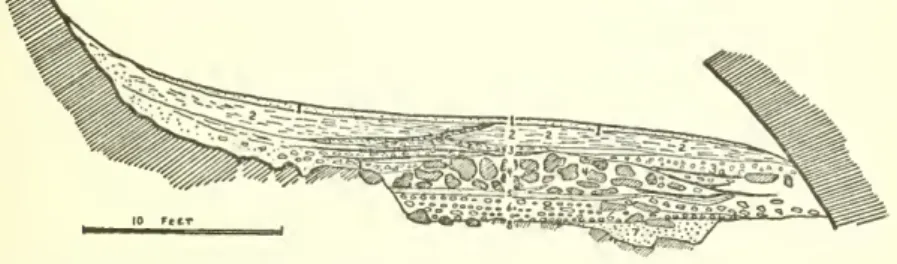
The rest of the cave floor is strewn with enormous boulders, so that only here and there traces of habitation can be seen. For completeness, a cross-section of the deposits found in trench A is given here (Fig. 2).
STEWARD] CAVES OP GREAT SALT LAKE REGION H
12 BUREAU OF AMERICAN ETHNOLOGY [BDLL. 116
STEWARD] CAVES OF GREAT SALT LAKE REGION ]^3
BXBWAED] CAVES OF GREAT SALT LAKE REGION 15
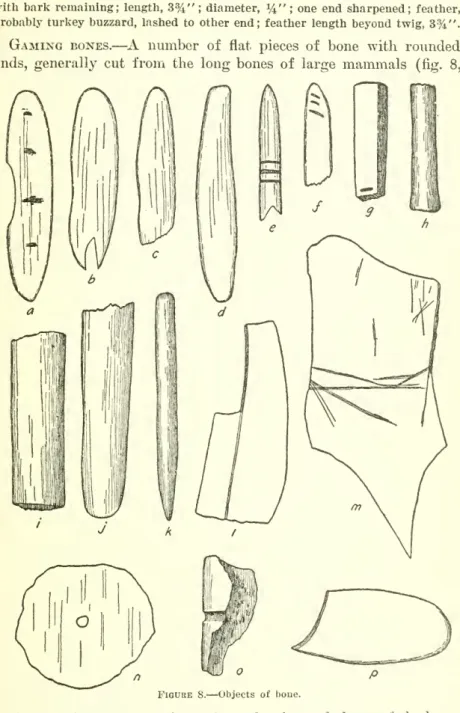
It is likely that they were cut from arrows, although it is conceivable that some were used in games.
STEWAUD] CAYES OF GREAT SALT LAKE REGION 17
BUREAU OF AMERICAN ETHNOLOGY
The main shaft is hardwood, y^g" in diameter, and is decorated with agroove running lengthwise down one side to within 2" of the butt. 10621, ofelder};>erry (Samhucus), may once have been the lower end of a fire drill shaft with the socket for the foreshaft, but was cut later.
20 BUREAU OF AMERICAN ETHNOLOGY [BOLL. 116
SiNEW-WRApPKD WOOD SLIPS.— A series of rough pieces are wrapped, usually at one end, with a small amount of slips. Various wooden objects.- Below are various shaped wooden objects, the use of which is not known.
24 BUREAU OF AMERICAN ETHNOLOGY [BDLL. 118
One end is cut at right angles: theotlier was notched, then irregularly broken off, the notch remaining Vs" from the end. Three edges and one end are notched with small notches, as shown in the illustration.
STEWARD] CAVES OF GREAT SALT LAKE REGION 29
It has two double tule chains per inch, which is twisted at intervals of IY2" to 1%" with a pair of lugs. This specimen has 4i/(> chain links per inch and is tv-framed with a pair of 1 ply juniierbark cords at %" intervals.
32 BUREAU OF AMERICAN ETHNOLOGY [BOLL. 118
Each warp is a bundle of tulle that runs down one side of the bag. Basketry.— The Promontory Caves yielded 12 specimens of coiled baskets (pi. Q,d,e),oi all but 2 of which were found in Cave No.
34 BUREAU OF AMERICAN ETHNOLOGY [BULL. 116
STEWARD] CAVES OF GREAT SALT LAKE REGION 35
36 BUREAU OF AMERICAN ETHNOLOGY [BULL. 113
STEWARD] CAVES OF GREAT SALT LAKE REGION 37 Square or reef knot. A strip of buffalo hide (11675), 4' long with
Thirty-six, or exactly half, of the specimens are rotated clockwise, the other half counterclockwise. The direction of rotation therefore appears to have some relationship with the size of the cord.
STEWAKU] CAVES OF GREAT SALT LAKE REGION
FEATHER BANDS AND BODIES.-13 stuffing* or featliei bodices were found, which were in all probability parts of blankets, woven like those of the modern and prehistoric peoples of the Southwest and the Great Basin. 970It is a strip of rabbit skin, approximately 1%" wide, the ends of which are tied together with pipe in a ring 7" in diameter.
STEWAUD] CAVES OF GREAT SALT LAKE REGION
2.-11531, from a rat's nest in a pit in the northwest corner of the cave, is the only fragment of a human skeleton found in any of the Promontory caves. Thus, Shoshoni pottery, as it is currently known, differs greatly from cave pottery in the lack of a thickened, perforated rim and coarse quartz.
44 BUREAU OF AMERICAN ETHNOLOGY [BULL. 118
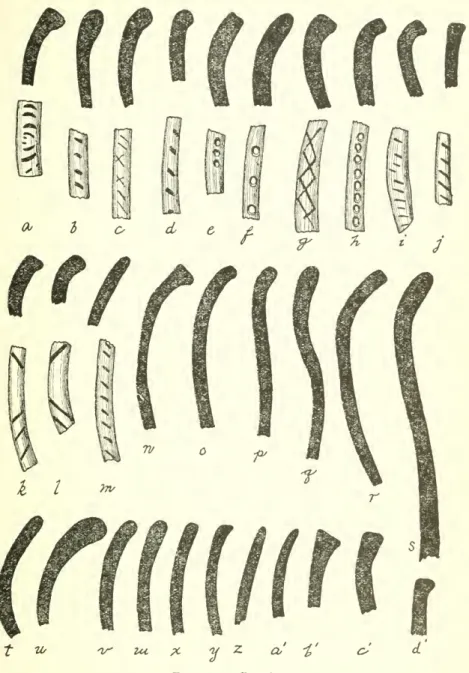
The curvature of the edge sherds is simple and regular, with the sole exception of 10349 (fig. IS, i), from Cave No. The most distinguishing feature of these is the edge, which is slightly thickened in almost every sherd.
CAVES OF GREAT SALT LAKE REGION 47
The paste and temperature are slightly finer than those of the ollas, although several sherds (9510 and 11512) are tempered with quartz. Furthermore, some of these sherds may at least simply be variations on the standard ware that happen to resemble pueblo ceramics.
STBWAKD] CAVES OF GREAT SALT LAKE REGION
49 Although this was mixed with refuse bearing the usual cave type
50 BUREAU OF AMERICAN ETHNOLOGY [BULL. 118
It is sewn with twisted tendons, stitch 1 (see Fig. 21), seven stitches per inch, with the seam turned inward. Another specimen (9534) is made of buffalo hide with most of the hair removed.
STEWAKD] CAVES OF GREAT SALT LAKE REGION 53
54 BUREAU OF AMERICAN ETHNOLOGY [BDLL. 116
STEWARD] CAVES OF GREAT SALT LAKE REGION
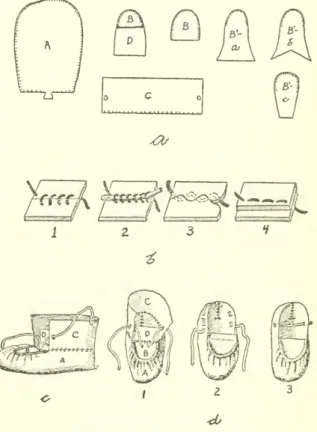
The insert, part B, is usually of the same material as part A, but in some examples it is of thinner material. In type B'-c, which is found at least on 5 specimens and probably on 1 other specimen, the tongue tapers towards the top, which is square-cut.

STEWARD] CAVES OF GREAT SALT LAKE REGION 59
Heel.— The heel is usually a perpendicular seam which binds the edges of A together and which has a short cross or T-seam at the bottom, from which a small tab projects (p. 7, c). Repair.- Most specimens' soles are repaired with whole, half or heel patches (pi.
STEWARD] CAVES OF GREAT SALT LAKE REGION 63
The usual procedure was to pass the rope through several vertical slits near the upper edge of part A, leaving the free ends at the front, near the stitch, to tie over the instep. Of these only 2 have the top present and 1 has the top edge of A plain and unstitched.
CAVES OF GREAT SALT LAKE REGION 65
66 BUREAU OF AMERICAN ETHNOLOGY
68 BUREAU OF AMERICAN ETHNOLOGY
STEWAKD] CAVES OF GREAT SALT LAKE REGION AQ
The resemblance of the Promontory specimens to these is especially noticeable in those which lack the upper part. Hatt considers such specimens as possibly derived from sandals woven from vegetable material, such as those found in the prehistoric Southwest, and as ancestral to the turned-soled moccasins found in the Southwest and Great Basin.-*^ Although the latter type is not represented in the Promontory collection, the special style does bear a slight resemblance to sandals.
71 mal serves as handle. A piece of white flint is lashed to the end of thi^ by
72 BUREAU OF AMERICAN ETHNOLOGY [BULL. 118
Although none of these contained flint flakes, several of the blades shown in Fig. 31 fit nicely (Fig. 6, j). 1, with a blade and handle corresponding to those described here, indicating that the blades in Fig. 31 were probably fitted into handles such as these.
74 BUREAU OF AMERICAN ETHNOLOGY [BULL. 116
STEWAKD] CAVES OF GREAT SALT LAKE REGION 75
2%"; butt broken, but was probably diagonal, to set in the handle with either a notch with a sloping base or with a notch on the side of the handle as figure32, f; width, I lie"; thickness, %".
STEWAUD] CAVES OF GREAT SALT LAKE REGION 77
11553-4 (fig. 33, fir), thin slab of pebble with irregular surface: 3%" long; lower part of surface decorated with diagonal lines nearly converging lower edge; short, fine scratches running upwards from these, fringe-like ; a short horizontal line near lower edge joining diagonal lines is similarly frayed; plate also has spots of red paint. 11573-2 (fig. 33, e, showing obverse and reverse), plate, 2%" long , 14" thick; obverse decorated with three horizontal rows of triangles, each filled with parallel lines; top row has four triangles with points down; nest row, blank; third row, six triangles with points on all but one up; fourth row has 5 triangles with points up;.

STEWAKDJ CAVES OF GREAT SALT LAKE REGION
Specimens of animal remains from the higher levels of the Pottery Culture period of the Promontory Caves include bones, horn, skin, fur and feathers. 1, no artifacts from BasketMaker or other recognized cultural complexes are represented at the sites on which the Cape stands.

STEWARD] CAVES OF GREAT SALT LAKE REGION QQ
However, the double-pointed laurel leaf of Lovelock Cave^'' does not occur in any of the Promontories. JSTon-Shoshonean characteristics*^ of the Promontory culture are: the exclusive use of single rod or rod-and-bundle coiled basketry (some single-rod winding was introduced among many Shoshoni in very recent post-Caucasian times); the characteristic pottery (the nature of modern Ute pottery is not known); the four-piece moccasin; the.
STEWARD ] CAVES OF GREAT SALT LAKE REGION
A group of red petroglyphs is located on the east side of Promontory Point, about 9 miles north of the railway station and 200 meters from the highway. They are unlike petroglyphs commonly found in Utah, but have some similarities to Columbia River petroglyphs.^°.
STEWARD) OAVES OF GEEAT SALT LAKE REGION 89
Anthropomorphic figures are extremely variable, but do not include any resembling Basket Maker kachina-like beings, with the possible exception of the double-horned figure in Figure 38, a and possibly two or three on Plate 9. Others are more elaborate, some representing types , which is known elsewhere in the Great Basin, e.g.
CAVE NO. 2
STEWABD] CAVES OF GREAT SALT LAKE REGION
91 half of the cave lies close to the cliff face; in fact, there is a tiny
92 BUREAU OF AMERICAN ETHNOLOGY [BULL. 126
STEWARD] CAVES OP GREAT SALT LAKE REGION
93 than the comparable material in Cave No. 1 because water has washed
In its place is a comparatively large, broad, more or less irregular point (Fig. 41, a-I), which has the notches cut from the lower corners to leave a broad tang and often barbs.

STEWARD] CAVES OF GREAT SALT LAKE REGION 95
By "knives" are meant blades, usually of flint or obsidian, that are too large and wide to be projectile points, and/or that lack notches. One edge has been retouched on both surfaces to serve as a knife or scraper.
98 BUREAU OF AMERICAN ETHNOLOGY [BULL 11
11119-5 (fig. 42, h) is an obsidian blade, or perhaps an uncarved projectile point, broken off on both surfaces to form a blade-shaped point. 11128 also includes two irregular flakes of brown flint, the edges of which have not been touched up but do show wear.
STEWARD] CAVES OF GREAT SALT LAKE REGION IQJ
If, as it turns out, this has happened .. in the past, many of the mixed breeds may have been kept as pets. In short, human beings used the cave when the water recession made it habitable.
108 BUREAU OF AMERICAN ETHNOLOGY [3DLL. 114
Contained a number of animal bone fragments (10997, including a small rodent jaw at the level of the lib, and a fragment of a skull at the level of the supine side), a flint point in hard ash on the lid, and other artefacts. The charcoal continued into the lake gravel and was cemented into hard lumps in places with dust (sample, 11021), probably by an ancient drop of water loaded with lime from the ceiling.
STEWARD] CAVE? OF GREAT SALT LAKE REGION 111 Against the southeastern wall of trench B, 35 feet from the cave
The only discernible layering of these is a preponderance of beautifully carved leaf-shaped jioints or blades in the latest culture, over 18 inches deep. The leaf-shaped blades resemble the knives associated with the Cape pottery culture. caves, except that their ends are rounded rather than straight.

STEWAKD] CAVES OF GREAT SALT LAKE REGION
Trench C is of little stratigraphic importance, but between the surface and 25 cm deep occurred two unworked flakes of gray quartzite (11052) the edges of which show abrasion. Then, through the main part of the deposit, trench A, 10" to 36" deep, the predominant shape is a quartzite dart point with a more or less flat base and notches cut from the corners of the butt.
115 Between trenches A and B, 20" deep, was a small dart or arrow
One end has the joint cut to be square; the other falls to a long, very sharp point; the whole is very smooth. STEWARD] GREAT SALT LAKE REGION CAVE H'JN Trench B with the burial was a well-worked bone lintel (11067),.

STEWARD] CAVES OF GREAT SALT LAKE REGION H'J In trench B with the burial was a well-made bone awl (11067),
Near the upper edge of the fragment, instead of the usual pair of tvvining elements, three strands are interlaced. Specimen identifications made b}^ Dr. Mr. S. Miller, of the United States National Museum, shows that the mountain sheep {Ovis canadensis) and the deer {Odoco'deus hemionus) were the largest, and specimens of the former occurred in Trench A to the depth.
119 Fauna : Birds.— The following species of birds, identified by Dr
120 BUREAU OF AMERICAN ETHNOLOGY [BOLL.116 mate to the antiquity of the oldest cultures is reduced by as much.
120 BUREAU OF AMERICAN ETHNOLOGY [BOLL. 116 mate of the antiquity of the oldest cultures be reduced by as much
STEWARD] CAVES OF GREAT SALT LAKE REGION 121 mentioned from the lower strata and include a few small points of
Third, there is little similarity in the early cultures of Black Rock and Promontory Caves, despite reasonable assurance that the two sites were occupied to some extent contemporaneously. Although only 3 of the latter have been found, they are very distinct and resemble some of the early Lovelock Pit points^' and the Pinto Basin points.
LITERATURE CITED
INDEX
128 INDEX
130 INDEX