Tea had long been known and used in the East before being introduced to Europe in the early 17th century. The Marquis de C'hastellux confirms his compatriot's statement about tea time and mentions that the Americans take tea and punch in the afternoon. Take a seat at a spotless mahogany table, and the eldest daughter of the household or one of the youngest married women makes the tea and gives a cup to everyone in the party.'' Family Group.
72 BULLETIN 225: CONTRIBUTIONS FROM THE MUSEUM OF HISTORY AND TECHNOLOGY
TEA DRINKING IN 18TH-CENTURV AMERICA
The painter saw, arranged, and gave a visual image—sometimes. richly informative, as in TeaPartyinthe TimeofGeorgeI. fig. 5)—of the different tea time items and how they. Throughout the 18th century, the well-appointed tea table would have displayed most of the items seen in this painting: a teapot, slop bowl, container for milk or cream, teapot, sugar bowl, tongs, teaspoons and cups and saucers. These pieces were basic to the tea ceremony and, with the addition of a tea urn that came into use during the latter part of the 18th century, have remained the established tea equipment to this day.
The simple designs and unadorned surfaces of the plump pear-shaped teapot at the George I Tea Party (fig. 5) and the spherical one seen on the Susanna Truax portrait mark (fig. 2). these pieces as examples of the late baroque style popular in the early 18th century. The fact that a teapot was chosen as an example of Revere. craftsmanship, of all the objects he made, shows that such a vessel was valued as highly by its maker as by. The restrained decoration and linear outlines of the teapot illustrated in the print entitled The Old Maid. Fig. 14) and the straight sides and oval shape of the teapot belonging to a late 18th-century group of children (fig. 6) of Chinese export porcelain are characteristic of the neoclassical style that was in vogue at the end of the c.
Further verification of the types and types of equipment used is provided by archaeological investigations of colonial sites. The inventory of Joseph Blake of Boston, recorded in 1746, mentions a "tea-table with a set of Chinese furniture" in the back room of the.
BULLETIN 225: CONTRIBUTIONS FROM THE MUSEUM OF HISTORY .-XND TECHNOLOGY
The well-known artist of this painting, made about 1725, has carefully illustrated every device considered appropriate for the tea ceremony and used to drink the tea in the glasses so gracefully held by the gentleman and the child. Even a cursory examination of some 20 inventories—detailed lists of the goods and possessions of deceased persons required by law—reveals that in New York between 1742 and 1768 teapots, cups and saucers, teaspoons and . . . tea canisters were possessed ) as low and high in-. Or of this form is depicted in the portrait of Paul Revere, painted about 1765 by John Singleton Copley and owned by the Museum of Fine Arts, Boston.
The teapot was a sign of prestige for both the craftsman and the hostess. Blacksmith and patriot were still working on the piece, for the nearby tools suggest that the teapot would have had engraved and chased decorations, perhaps of flowers, scrolls and other motifs typical of the rococo style. Tea drinkers were very aware of fashion changes and wherever possible set their tea tables with stylish equipment in the prevailing fashion. Newspaper advertisements, magazines, letters and other written materials indicate that utensils in the "best and latest taste" were available, desired, purchased and used in this country.
This type of tabic is seen again and again in the prints and paintings (fig. Square or round, tripod or quadruped, the taljles are usually against the wall of the.

BULLETIN 225: CONTRIBUTIONS FROM THE MUSEUM OF HISTORY .AND TECHNOLOGY
Square or round, tripod or quadruped, the taljles are usually against the wall of the. room until teatime, in the words of Ferdinand Bayard, "a mahogany table is worked forward and. In the midst of a domestic scene full of homely details, the artist depicted the tea table and its furniture with care, including a fashionable tea urn symbolically covered with some loving details. birds. This practice is depicted in a number of 18th-century pictures, with the tea table well outside the room, often in front of a fireplace, and with seated and standing figures. which can be next to the ground (fig. 1).
In the sketch (fig. 8), a floor plan of the Shippen saloon, we can see the sofa against the \\al between the windows, while chairs and tea table have been moved out into the room. In the 18th century, such an arrangement was primarily one of comfort, and perhaps also one of taste. However, as can be seen in Family Group (fig. 1) and An English Family at Tea (frontispiece), it was perfectly acceptable to serve tea.
In this scene of domestic confusion and happiness, a tray or tea is placed on the cloth, illustrating Franklin's commentary on English morning customs. Fabrics can also be seen in photographs in which the time of day cannot be determined.

78 BULLETIN 225: CONTRIBUTIONS FROM
We drank our coffee in the big house very sociably, around a nice fire, the house and the air feel like winter again."".
THE MUSEUM OF HISTORY AND TECHNOLOGY
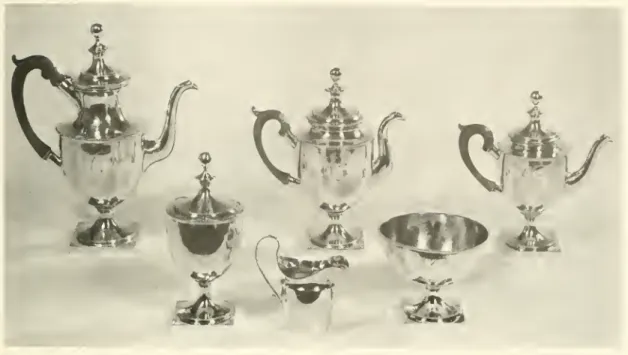
34;The servant brings the cups, the sugar cup, the cream jug, the butter, and the smoked meat, which are offered to each." By the end of the century, however, wealthier ladies were able to purchase from. of metal, sets of teapots (fig. 11) usually consisted of a teapot, container for sugar and cream or milk, and possibly a sloping bowl, while ceramic sets.
These and other newspaper references are variously taken from the following sources: GeorgeFrancisDow, TheArtsandCrafts in Xew England Topsfield, Massachusetts, 1927;. Little Miss Livingston must have been happy indeed when her uncle °° wrote that he had sent .. a complete tea maker for her baby [doll]. The painted decoration of black floral pattern on the side of the cup is touched with gold; the edges are of intersecting black vines and ribbons.
Blue-and-white porcelain was perhaps the most popular type known, as it appears regularly in newspaper advertisements and inventories and among sherds from colonial sites (Fig. 7). Regarding the tea, Aljbe Robin went so far as to say that "there is not a single person to be found who does not drink it from cups and saucers." ^- How-.
BULLETIN 225: CONTRIBUTIONS FROM THE MUSEUM OF HISTORY AND TECHNOLOGY
TEA DRINKING IN 18TH-CENTURV .^MERIC.^
The teapot stands on a tray and the tea kettle stands on its own special stand, a smaller version of the tripod tea table. The cup and saucer (or bowl), possibly hand-decorated Staffordshire earthenware or Chinese export porcelain, are decorated with dark blue bands and dots, a wavy brown band and a pink rose with green leaves. Phnio courtesy of Chicago Historical Society.). in reality a cup of tea, for the word "saucer" meant a cup or vessel used for drinking, as well as a utensil for holding food at meals. The word is evident in the following exchange.
May I help you, Mr. Fithian, to a cup of coffee? - I choose a deep plate, if you please .. common among the general public, was rejected by polite society. The fact that Americans preferred and "used to eat everything hot" further explains why tea was generally drunk from the cup instead of the saucer. According to Peter Kalm, "when the English women [that is, of English descent] drank tea, they never poured it from the cup into the saucer to cool it, but drank it as hot as from the teapot come."^ ^ Later in the century, another naturalist, C. F. Volney, also noted that "very hot tea" was "loved by Americans of English descent."
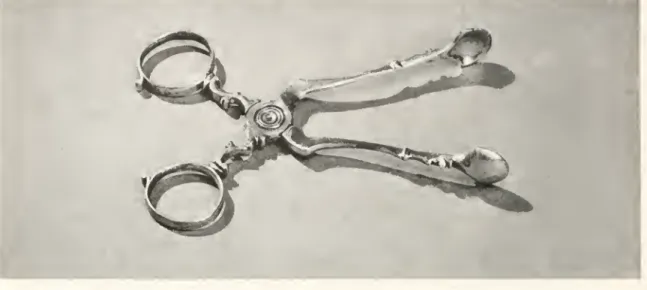
Teaspoons, when used, can be placed on the saucer or left in the cups. The early curved tongs were round in diameter, as were the pair illustrated in Tea Parly in the Tiiiiroj GeorgeI (fig. 5).
84 BITLLETIN 22.S: CONTRIBUTIONS FROM THE MUSEUM OF HISTORY AND TECHNOLOGY
Some containers were sold with covers, and it is suggested that the saucer-shaped lid of the hemispherical sugar dish or bowl, which was fashionable in the first half of the 18th century, also served as a spoon tray. Containers for cream or inlk can be seen in some of the 18th century tea pictures and are found under a variety of names in advertisements of the period. It has been suggested that the perforated bowl of the spoon was used to flush foreign particles from the tea into the cup and the tapered pointed stem of the tip to clear the clogged strainer of the teapot spout.
The tea drops can then be discarded in the slop file. each one rested on the bowl. The teapot was, of course, the very center of the social custom of drinking tea; so it was usually found in the center of the tray or table. These teapot stands served as insulation by protecting the surface of the table or tray from the harmful heat of the teapot.
Both photos and advertisements reveal that by the 1770s, the tea urn was a new form appearing at tea time in place of the hot water kettle. 34; Roman tea urns in Japanese, red and gold stripes" imported from Europe were among the fashionable teas advertised in the late 18th century."^ The urn can be placed on its own stand by the table or on a tray. or table in the middle of other equipment as in paint; titled The Honeymoon.

88 BULLETIN 22.S: CONTRIBUTIONS FROM THE MUSEUM OF HISTORY' AND TECHNOLOGY
TEA DRINKING IN 18TH-CENTURY AMERICA
34;tea" motifs for shop signs in the 8th century included "The Teapot," used by the Philadelphia goldsmith in 1757, and "The Tea Ketde and Stand," which marked the Charleston shophouse goldsmith of 1766. On the floor , close to the fairy tale, with an open jar, The lady of the house, sitting at the tea table, is measuring dry tea leaves from her box to its lid.
In the background is the tripod kettle stand with a lamp, where the kettle will be placed until it is necessary to rinse the cups or dilute the tea. These two other social drinks of the 18th century were kept in cups of a deeply cylindrical shape, like the three at the end of the table.
CHRONOLOGICAL LLST OF PICTURES CONSULTED
90 BULLETIN 225: CONTRIBUTIONS FROM THE MUSEUM OF HISTORY AND TECHNOLOGY