This article is the fifth part of a work aimed at describing and illustrating the foraminifera of the Atlantic Ocean, in particular those species occurring in the waters adjacent to the coast of the United States, including the whole of the Atlantic Ocean. Gulf of.
THE FOMMOIFEEA OF THE ATLANTIC OCEAN
CHILOSTOMELLIDAE AND GLOBIGERINIDAE
INTRODUCTION
SYSTEMATIC PART
CHILOSTOMELLIDAE
2 BULLETIN 104, UNITED STATES NATIONAL MUSEUM
6 added, the last formed the largest and covers most of the added, the last formed the largest and covers most of the previous ones; sutures not pressed, rather unclear; wall smooth, translucent, usually very thin and noticeably pointed; opening an arched, slightly arched opening between the base of the chamber and the preceding one, often with a slightly thickened opening. This species appears to have a very wide distribution in both tropical and temperate seas and at considerable depths. It is a very thin-walled species compared to Chilostomella grandis Cushman, which is certainly a bottom-dwelling form.
The geological range of the genus appears to be somewhat greater than that of Chilostomella, going back to the Upper Cretaceous. Test consisting of several ovate, coiled chambers, each chamber making 120° of volution and embraced so that only three chambers are visible externally; chambers longer than wide, inflated; seams somewhat distressed; wall smooth, with conspicuous dots, usually thin and translucent; opens a narrow curved opening at the base of the ventral margin of the chamber between it and the previously formed adjacent chamber. The records for this genus are all from recent seas, but are widely distributed in different oceans.
FOKAMINIFERA OF THE ATLANTIC OCEAN. 5 SEABROOKIA EARLANDI (Wright)
GLOBIGERINIDAE
6 BULLETIN 104, UNITED STATES NATIONAL MUSEUM
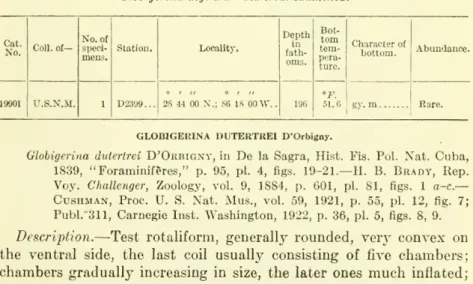
The species of Glohigerina can hardly be confused with any other, as the shape of the specimen, together with the peculiar reticular surface, should at once distinguish them. From a study of vrestern-Atlantic albatross material the problem of what to refer to G. There are very few specimens in all the albatross stations examined which can even be attributed to this species as defined by D'Orbigny in his Modele.
8 BULLETIN 104, UNITED STATES NATIONAL MUSEUM
FOKAMINIFERA OF THE ATLANTIC OCEAN
BULLETIN 104, UNITED STATES NATIONAL MUSEUM
05 27 SOW
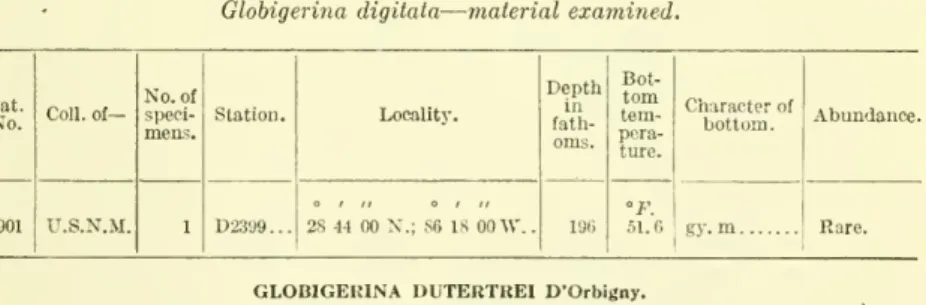
Description: — Prove regularly spiral, trochoid, consisting of two or three volutions; early chambers inflated, subspherical, later chambers very elongate, apex usually rounded; wall mesh; the opening of the opening in the central opening of the navel; or in elongated, raised chambers that make up most of the base of the chamber, the mounting area is greatly reduced. Flint recorded a single specimen from the Gulf of Mexico, Albatross station D2377, and I have another specimen from the same material.
12 BUIXETIN 104, UNITED STATES NATIONAL MUSEUM
There are three records for the Caribbean, two in the Gulf of Mexico, three off Florida, one off the coast of Georgia and, except for one off Brazil, the rest of the nearly one hundred records are off the northeast coast. of the United States of America. This species is therefore clearly mostly a bottom-dwelling species, otherwise its distribution would probably be similar to that of G.
63 31 SOW
14 BULLETIN 104, UNITED STATES NATIONAL MUSEUM
Test coiled into a depressed spire, the general form subglobose, the last formed whorl consisting of four chambers, the sutures somewhat depressed; orifice an arched opening along the ventral margin of the inside of the last formed chamber. According to Brady, it is common within the Arctic Circle, but occurs only in bottom depressions, not in the pelagic assemblages. Pearcey records it from the Faroe Islands, and Heron-Allen and Earland from a single station west of Scotland and in the Clare Island region.
I haven't been able to find it even in the colder areas along the northeast coast of the US. Egger records it from several stations in various parts of the world, and there are a few other scattered records, but it may be questioned whether it really occurs in its typical form except in the arctic or subarctic regions, with occasional occurrences in cold water somewhat further south.
16 BULLETIN 104, UNITED STATES NATIONAL MUSEUM
OOW.,
18 BULLETIN 104, UNITED STATES NATIONAL MUSEUM
FOEAMINIFERA OF THE ATLANTIC OCEAN. 19
20 BULLETIN 104, UNITED STATES NATIONAL MUSEUM
77 53 OOW
87 03 SOW
87 42 OOW
88 01 SOW
87 27 OOW
87 02 OOW
86 48 OOW
86 26 OOW
86 18 OOW
79 07 OOW
66 24 OOW
22 BULLETIN 104, UNITED STATES NATIONAL MUSEUM
24 BULLETIN 104, UNITED STATES NATIONAL MUSEUM,
The typical form of this species, which is clearly open with the spiral, is found in abundance in the Caribbean and generally in the path of the Gulf Stream. Further north there are soil specimens that have the more complex character of variety I. The typical shape develops to a considerable size and in some specimens it is possible to see in lateral view between the last whorl and the previous one.
In early development, the test is somewhat trochoid, but this soon leads to a planospiral arrangement of the chambers. Under this name Egger-^ records and figures specimens from many localities in the eastern Atlantic, between Madeira and the Cape Verde Islands, Cape Verde, West Africa, South West Africa, &c. flatter than the typical G.
There is little in the western Atlantic that I would feel justified in referring to as this species. EggeK* records and describes specimens from the eastern Atlantic Ocean and elsewhere as ''Glooierina (Rotalia) ocellata Ehrenberg.'' Egger's data are from the eastern Atlantic Ocean, from the coast of Portugal southward along the coast of Africa.
The ventral side of a specimen referred to this species is represented by Egger." He gives an Atlantic record from West.
28 BULLETIN 104, UNITED STATES NATIONAL MUSEUM
FOEAMINIFERA OF THE ATLANTIC OCEAN. 29
30 BULLETIN 104, UNITED STATES NATIONAI. MUSEUM
32 BULLETIN 104, UNITED STATES NATIONAL MUSEUM
Test consisting of numerous chambers generally arranged in a simple spiral, the chambers themselves gradually increasing in size as they are added and the sutures strongly depressed; wall finely perforated, almost smooth, except for long rod-like spines with parallel sides, the edges of which are serrated, especially towards the base; aperture very.
34 BULLETIN 104, UNITED STATES NATIONAL MUSEUM
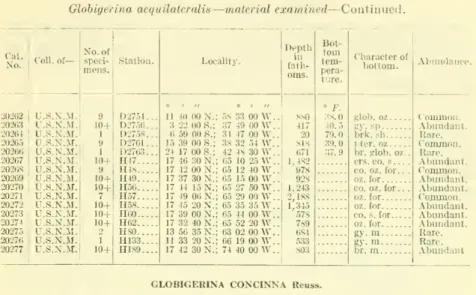
Test consisting of numerous inflated chambers in a trochoid spiral, which increase in size quite rapidly on addition; wall smooth, finely punctured; attachments depressed; opening consisting of a series of rounded elliptical openings at the intersection of the chambers along the sutures. Specimens occur at stations south of the equator in tropical waters off the coast of Brazil. Very few specimens have also come from scattered stations along the Florida coast and north to the Carolina coast, but no specimens have been observed north of Cape Hatteras.
An adaptation of an almost spherical shape and instead of one large opening, a large one. There are numerous records of this species from other parts of the world, but the general region of the West Indies appears to be its typical habitat.
36 BULLETIN 104, UNITED STATES NATIONAL MUSEUM
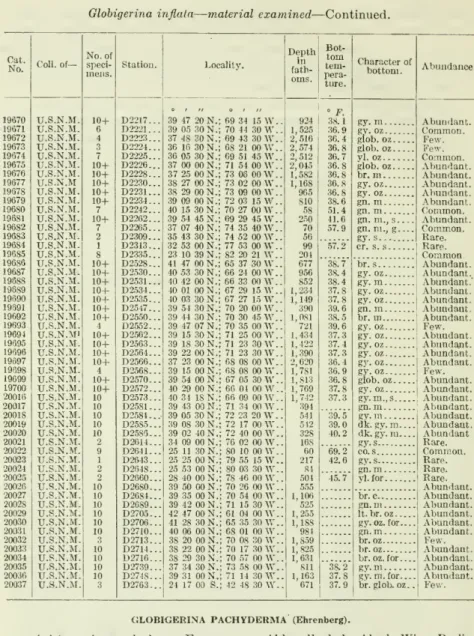
While specimens of this species occur in the Albatross dredge from the coast of Brazil to the latitude of Cape Cod, the main. There are scattered specimens, as the table shows from Brazil, the Caribbean Islands, and the Gulf of Mexico; but the great mass of records are in the region between Cape Hatteras and Cape Cod, on the northeastern coast of the United States. Although generally spherical in shape, there are no secondary openings and the single opening is almost closed by a large flat tooth.
This does not correspond to the character of free accessibility of the protoplasm to the surface which is seen in most pelagic species.
38 BULLETIN 104, UNITED STATES NATIONAL MUSEUM
Those from other regions are usually less developed and in many cases represent young individuals. The young is generally in the form of a trochoidal awl, but soon acquires an irregular shape. The smooth surface and very coarse spots will distinguish the juveniles from any Globigerina species.
40 BULLETIN 104, UNITED STATES NATIONAL MUSEUM,
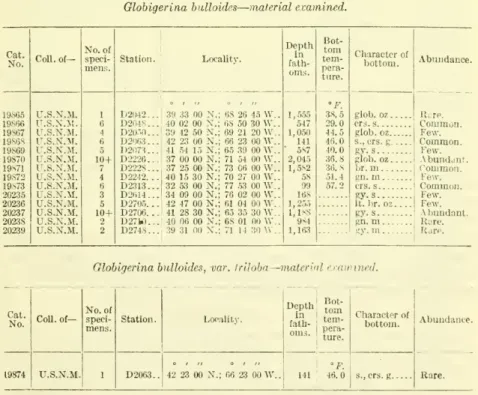
Several stations in the accompanying table representing the Albatross record indicate that it usually occurred as single specimens in the material examined. The only station at which it has occurred in any number is in cold water, and as this is not recognized as a pelagic species, nor does it show any special adaptations to pelagic life, it can at most be inferred from thathit at home.
42 BULLETIN 104, UNITED STATES NATIONAL MUSEUM
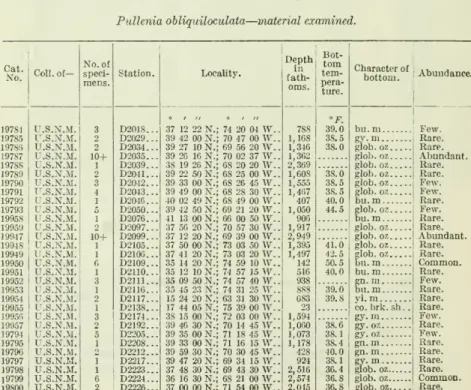
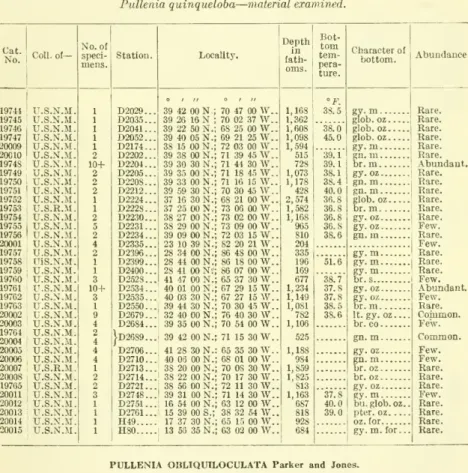
As in the previous species, the distribution appears to be in cold and deep waters as a rule. There is a single record from the Bayaz coast, very few from the Gulf of Mexico and the Caribbean, and one from the southeast coast of the United States. In contrast, there are a large number of stations off the northeast coast of the United States, in cold, deep water.
44 BULLETIN 104, UNITED STATES NATIONAL MUSEUM
FOEAMINIFEEA OF THE ATLANTIC OCEAN. 45
EXPLANATIONS OF PLATES
S. NATIONAL MUSEUM BULLETIN 104, PART 5 PL
INDEX