Explain how natural law is related to the rights that the founders of the American political-legal system considered important. Each of the different legal schools of thought has a specific view of what a legal system is or what it should be.
Basic Concepts and Categories of US Positive Law
In a general way, differentiate contract law from tort law
Consider the role of law in supporting ethical norms in our society
Understand the differing roles of state law and federal law in the US legal system
Know the difference between criminal cases and civil cases
Law: The Moral Minimums in a Democratic Society
The Common Law: Property, Torts, and Contracts
State Courts and the Domain of State Law
Civil versus Criminal Cases
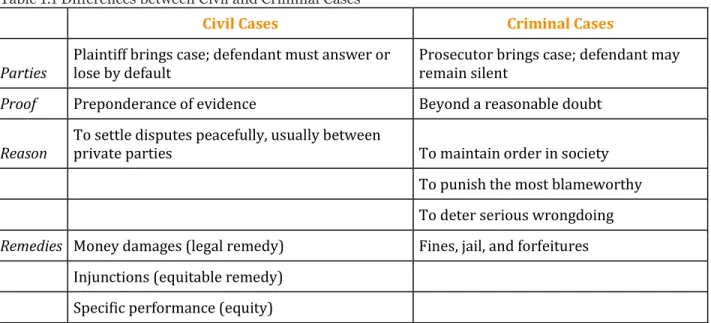
Some of the basic differences between civil and criminal law cases are illustrated in Table 1.1. Lieberman, the United States is likely to prosecute on behalf of the people.
Substance versus Procedure
- Jenna gets a ticket for careless driving after the police come to investigate a car accident she had with you on Hanover Boulevard. Your car is badly damaged through no fault of
- Sources of Law and Their Priority
- Describe the different sources of law in the US legal system and the principal institutions that create those laws
- Explain in what way a statute is like a treaty, and vice versa
- Explain why the Constitution is “prior” and has priority over the legislative acts of a majority, whether in the US Congress or in a state legislature
- Describe the origins of the common-law system and what common law means
In most legal systems, such as the United States, there is a fairly firm distinction between criminal law (for acts that are offenses against society as a whole) and civil law (usually for disputes between individuals or businesses). Describe the various sources of law in the American legal system and the main institutions that create these laws.
Sources of Law
Constitutions
Statutes and Treaties in Congress
Delegating Legislative Powers: Rules by Administrative Agencies
State Statutes and Agencies: Other Codified Law
Judicial Decisions: The Common Law
Priority of Laws
The Constitution as Preemptive Force in US Law
The First Amendment was added to the Constitution, and it is clear that the freedom of speech in the First Amendment did not override existing common law.
Statutes and Cases
Treaties as Statutes: The “Last in Time” Rule
- Give one example of where common law was overridden by the passage of a federal statute
- How does common law change or evolve without any action on the part of a legislature?
- Lindsey Paradise is not selected for her sorority of choice at the University of Kansas. She has spent all her time rushing that particular sorority, which chooses some of her friends
- Legal and Political Systems of the World
- Describe how the common-law system differs from the civil-law system
In addition, the court could rule that employers can fire employees for any reason or no reason. In the case of the general rule, "freedom of choice" could be the main reason.
Comparing Common-Law Systems with Other Legal Systems
Give one example where the common law was overruled by the passage of a federal law. Other legal and political systems are very different from the American system, which derives from the English common law tradition and the framers of the US Constitution.
Civil-Law Systems
- Use the Internet to identify some of the better-known nations with civil-law systems
- A Sample Case
- Is this a criminal case or a civil-law case? How can you tell?
- Is the court concerned with making a procedural rule here, or is the court making a statement about the substantive law?
- Is this a case where the court is interpreting the Constitution, a federal statute, a state statute, or the common law?
- What was the employer’s argument in this case? Do you agree or disagree with it? What if those who legislated Title VII gave no thought to the question of seriousness of injury
- Summary and Exercises Summary
- What is the common law? Where do the courts get the authority to interpret it and to change it?
- After World War II ended in 1945, there was an international tribunal at Nuremberg that prosecuted various officials in Germany’s Third Reich who had committed “crimes
- What does stare decisis mean, and why is it so basic to common-law legal tradition?
In this case, we consider the definition of a discriminatory "abusive work environment" (also known as a "hostile work environment") under Title VII of the Civil Rights Act of 1964, 78 Stat. Certainly, Title VII prohibits conduct that would seriously affect the psychological well-being of a reasonable person, but the statute is not limited to such conduct.
Corporate Social Responsibility and Business Ethics
Moore may pursue the California case if he believes it provides the best rationale for a similar case.
After reading this chapter, you should be able to do the following
- Define ethics and explain the importance of good ethics for business people and business organizations
- Understand the principal philosophies of ethics, including utilitarianism, duty-based ethics, and virtue ethics
- Distinguish between the ethical merits of various choices by using an ethical decision model
- Explain the difference between shareholder and stakeholder models of ethical corporate governance
- Explain why it is difficult to establish and maintain an ethical corporate culture in a business organization
- What Is Ethics?
- Explain how both individuals and institutions can be viewed as ethical or unethical
- Explain how law and ethics are different, and why a good reputation can be more important than legal compliance
- Although morals and ethics are not precisely measurable, people generally have similar reactions about what actions or conduct can rightly be called ethical or moral
- As humans, we need and value ethical people and want to be around them
- Saying that someone or some organization is law-abiding does not mean the same as saying a person or company is ethical
But if I were to say that he was honest, caring, forthright, and diligent, that he volunteered at local soup kitchens, or gave tithes to the church, many people would see Daniel as having certain ethical or moral qualities. But if I were to say that he is "always under control" or "always on top of his game," you would probably not conclude or.
How Do Law and Ethics Differ?
If there are legal prohibitions against cheating the Medicare program, it's because people (legislators or their agents) have collectively decided that cheating Medicare is wrong. Finally, important policy issues facing society are often resolved through legislation, but it is important to understand the moral perspectives that underpin the public debate – as, for example, in the ongoing controversies over stem cell research, the medical use of marijuana and abortion. .
Why Should an Individual or a Business Entity Be Ethical?
- Think of a person who did something morally wrong, at least to your way of thinking
- Think of an action by a business organization (sole proprietor, partnership, or
- Think of an act by an individual or a corporation that is ethical but not legal. Compare your answer with those of your classmates: were you more likely to find an example
- Major Ethical Perspectives
- Describe the various major theories about ethics in human decision making
- Begin considering how the major theories about ethics apply to difficult choices in life and business
That specter was consumers, NGOs and the media, all protesting the company's apparent lack of moral sensitivity. Years later, there are people who won't go near a Sears Auto Center; the customers who lost confidence in the company will never return, and many of their children may also avoid Sears Auto Centers.
Utilitarianism
- Failing to come up with lots of options that seem reasonable and then choosing the one that has the greatest benefit for the greatest number. Often, a decision maker seizes on
- Assuming that the greatest good for you or your company is in fact the greatest good for all—that is, looking at situations subjectively or with your own interests primarily in
- Underestimating the costs of a certain decision to you or your company. The now-classic Ford Pinto case demonstrates how Ford Motor Company executives drastically
- Underestimating the cost or harm of a certain decision to someone else or some other group of people
- Favoring short-term benefits, even though the long-term costs are greater
An individual or company that consistently uses the “What is the greatest good for me or the company?” test. does not follow the utilitarian test of the greatest good in general. Failing to come up with many options that seem reasonable and then choose the one that will bring the greatest benefit to the greatest number of people.
Rules and Duty: Deontology
In fact, lying becomes possible only because honesty works well for society as a whole and is generally practiced. In the gray areas of life as it is lived, the durability test is often difficult to apply.
Social Justice Theory and Social Contract Theory
Rights and duties exist not only between people and their governments but also between individuals. Your right to be free from physical assault is protected by the law in most
Thus, other people have a duty to respect your rights and not to punch you in the nose. Your right in legal terms is only as good as your society's willingness to provide remedies through the courts and political institutions of society.
Your right in legal terms is only as good as your society’s willingness to provide legal remedies through the courts and political institutions of society
Aristotle and Virtue Theory
The use of reason leads to excellence, and so happiness can be defined as the active, rational pursuit of personal excellence, or virtue. Many books have been written over the past twenty years emphasizing the need for businesses to define their values in order to compete in today's global economy.
Josephson’s Core Values Analysis and Decision Process
- Can XYZ’s approach to this problem be justified under utilitarian theory? If so, how? If not, why not?
- What would Kant advise XYZ to do? Explain
- What would the “virtuous” approach be for XYZ in this situation?
- An Ethical Decision Model
- Understand one model for ethical decision making: a process to arrive at the most ethical option for an individual or a business organization, using a virtue ethics approach
These incidents are voluntary to report to the National Highway Traffic Safety Administration (NHTSA), but the company is deciding to wait a while and see if there are more complaints. The company doesn't want to follow this advice because it would be, as one executive put it, "too time-consuming and expensive."
Josephson’s Core Values Model
- Identify several likely or reasonable decisions that could be made
- Consider which stakeholders gain or lose with each decision
- Determine which decision satisfies the greatest number of core values
- If there is no decision that satisfies the greatest number of core values, try to determine which decision delivers the greatest good to the various stakeholders
Understand one model for ethical decision-making: a process of arriving at the most ethical option for an individual or a business organization, using a virtue ethics approach ethical option for an individual or a business organization , using a virtue ethics approach combined with some elements of stakeholder analysis and utilitarianism.
The Core Values
- Corporations and Corporate Governance
- Explain the basic structure of the typical corporation and how the shareholders own the company and elect directors to run it
- Understand how the shareholder profit-maximization model is different from stakeholder theory
- Discern and describe the ethical challenges for corporate cultures
- Explain what conscious capitalism is and how it differs from stakeholder theory
Pursue excellence: Do your best, don't give up easily, persevere, be diligent, make everything you do worthy of pride. Caring: Show that you care for others through kindness, caring, sharing, compassion and empathy; treat others as you would like to be treated; don't be selfish, mean, cruel or insensitive to others' feelings.
Legal Organization of the Corporation
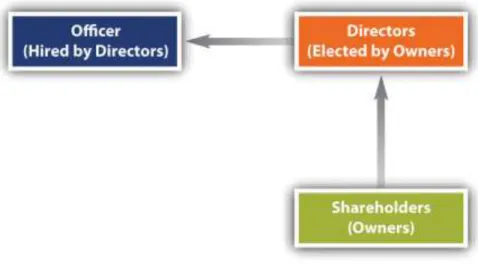
Explain the basic structure of the typical corporation and how shareholders own the company and elect directors to run it. Nor does the law require officers to be shareholders, so that the officer's motivations do not align with the company's best interests.
Shareholders and Stakeholders
Maximizing Profits: Milton Friedman
The Social Responsibility of Business Is to Increase Its Profits”
For example, that he must refrain from increasing the price of the product to contribute to the social objective of preventing inflation, even though a price increase would be in the best interest of the corporation. Or that he must make expenditures to reduce pollution beyond the amount that is in the best interest of the corporation or that is required by law to contribute to the social goal of improving the environment.
Stakeholder Theory
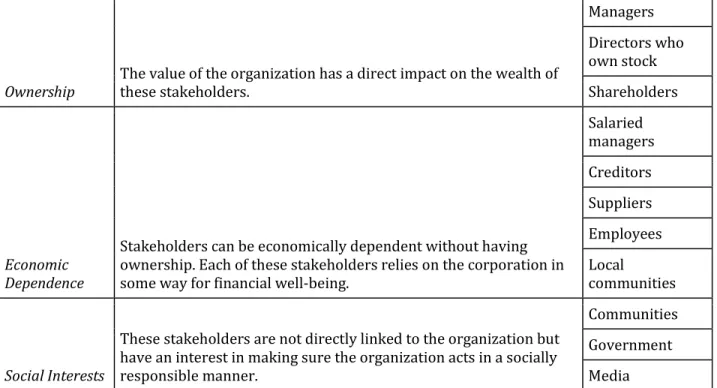
Ownership The value of an organization directly affects the wealth of these stakeholders. Each of these stakeholders relies in some way on the corporation for their financial well-being.
Corporate Culture and Codes of Ethics
Ethical Leadership Is Top-Down
Accountability Is Often Weak
Killing the Messenger
Ethics Codes
Johnson & Johnson's code of ethics preceded the Tylenol scare and the company's oft-celebrated response. If the code is just a document that goes in a drawer or on a shelf, it will not effectively promote good behavior in the company.
Ethics Hotlines and Federal Sentencing Guidelines
If the message is not continually reinforced, or (worse) if the message is undermined by management's actions, the real message to employees is that violations of the code of ethics will not be taken seriously, or that attempts to discriminate against racial or sexual stop harassment. are merely token efforts, and that the important things are profits and performance. The code of ethics at Enron appears to be one of those "3-P" codes that end up sitting on shelves—.
Managing by the Numbers
Managing by Numbers: The Sears Auto Center Story
In the Sears case, it is likely that Sears "insiders" viewed customers as "outsiders" and effectively treated them (in Kantian terms) as means rather than ends in themselves. The long-term losses to Sears are difficult to quantify, while the short-term gains were easy to measure and (at least for a short while) quite satisfying financially.
Conscious Capitalism
Summary and Exercises
Summary
The CEO and the board must have a single-minded focus to deliver maximum value to shareholders of the business. Shareholders, whether traders or long-term investors, are always the first and last consideration for the CEO and the board.
Courts and the Legal Process
- Describe the two different court systems in the United States, and explain why some cases can be filed in either court system
- Explain the importance of subject matter jurisdiction and personal jurisdiction and know the difference between the two
- Describe the various stages of a civil action: from pleadings, to discovery, to trial, and to appeals
- Describe two alternatives to litigation: mediation and arbitration
- The Relationship between State and Federal Court Systems in the United States
- Understand the different but complementary roles of state and federal court systems
- Explain why it makes sense for some courts to hear and decide only certain kinds of cases
- Describe the difference between a trial court and an appellate court
There are actually fifty-two court systems: those of the fifty states, the local court system of the District of Columbia, and the federal court system. In these cases, the federal court is said to exercise "dependent jurisdiction" over the state's claim.
State Court Systems
Another reason there are so many different cases is because plaintiffs' attorneys know that removal is common and that the case will move faster by filing in federal court. In short, the popularity of diversity cases in the federal courts is influenced not only by the law, but also by legal strategy.
Limited Jurisdiction Courts
Federal court procedures are often more efficient than state court procedures, so federal dockets are often less crowded. In some federal districts, verdicts for plaintiffs may be higher on average than in the local state court.
General Jurisdiction Courts
Attorneys are not required to present the case and in some states are not allowed to appear in court.
Appellate Courts
The final type of appeal within the state court system is to the highest court, the state supreme court, which is composed of a single panel of between five and nine judges and is usually located in the state capital. The intermediate appellate courts are usually composed of panels of three judges and are located in various locations around the state.).
The Federal Court System
The final type of appeal within the state court system is to the highest court, the state Supreme Court, which consists of one panel of five to nine judges and is usually located in the state capital. The intermediate appeals courts are typically composed of three-judge panels and are located in various locations throughout the state. In a few states, the Supreme Court goes by a different name: in New York, it is known as the Court of Appeals. In some cases, appellants to the highest court in a state have the right to have their appeals heard, but more often the Supreme Court selects the cases it wants to hear.
District Courts
In a relatively small class of cases—those involving federal constitutional claims—appeal to the U.S. Supreme Court for extradition.
Courts of Appeal
These include the US Tax Court, the Court of Customs and Patent Appeals, and the Court of Claims.
United States Supreme Court
- Why all of this complexity? Why don’t state courts hear only claims based on state law, and federal courts only federal-law-based claims?
- Why would a plaintiff in Iowa with a case against a New Jersey defendant prefer to have the case heard in Iowa?
- The Problem of Jurisdiction
- Explain the concept of subject matter jurisdiction and distinguish it from personal jurisdiction
- Understand how and where the US Constitution provides a set of instructions as to what federal courts are empowered by law to do
- Know which kinds of cases must be heard in federal courts only
- Explain diversity of citizenship jurisdiction and be able to decide whether a case is eligible for diversity jurisdiction in the federal courts
Why don't state courts only hear claims based on state law, and federal courts only hear claims based on federal law. Explain diversity of citizenship jurisdiction and be able to decide whether a case is eligible for diversity jurisdiction in the federal courts.
The Federal-State Balance: Federalism
Note that the only types of cases that federal courts are allowed to hear have strong federal connections. Again, federal courts are courts of limited jurisdiction limited to the types of cases specified in Article III.
Exclusive Jurisdiction in Federal Courts
Suits between states. Cases in which two or more states are a party
Because there are two court systems, it is important that a plaintiff file in the correct court first. Crimes defined or mentioned in the US Constitution or those defined or punished by federal statute.
Concurrent Jurisdiction
Summary of Rules on Subject Matter Jurisdiction
A court must always have subject matter jurisdiction, and personal jurisdiction over at least one defendant, to hear and decide a case
A federal court will have jurisdiction over any case based either on a federal law (statute, case, or US Constitution). A federal court will have jurisdiction over any case based on state law where the parties (1) are from different states and (2) the amount in controversy is at least $75,000.
Legal Procedure, Including Due Process and Personal Jurisdiction
In all cases, the plaintiff – the party who files a claim and initiates a lawsuit (in a criminal case, the plaintiff is the prosecution) – bears the burden of proving his case. If he fails to prove this, the defendant - the party being sued or prosecuted - will win.
How a Case Proceeds
Complaint and Summons
Jurisdiction and Venue
Service of Process and Personal Jurisdiction
If the plaintiff alleges that an out-of-state defendant has injured him in some way, the plaintiff must go to the defendant's home state to serve him. But if out-of-state defendants have some contact with the plaintiff's state of residence, there may be reasons to bring them within the jurisdiction of the plaintiff's state courts.
Summary of Rules on Personal Jurisdiction
- Once a court determines that it has subject matter jurisdiction, it must find at least one defendant over which it is “fair” (i.e., in accord with due process) to exercise personal
- But if the plaintiff loses against defendant 1, he can go elsewhere (to another state or states) and sue defendants 2, 3, 4, or 5
- The court’s decision in the first lawsuit (against defendant 1) does not determine the liability of the nonparticipating defendants
- In order to get a judgment in a civil action, the plaintiff must serve a copy of the complaint and a summons on the defendant
- Domicile. The defendant is a permanent resident of that state
- Service of process within the state will effectively provide personal jurisdiction over the nonresident
The court's decision in the first trial (against defendant 1) does not determine the liability of the non-participating defendants. To obtain a judgment in a civil action, the plaintiff must serve a copy of the complaint and a summons on the defendant.
Choice of Law and Choice of Forum Clauses
Motions and Discovery
Explain how a lawsuit can be dismissed prior to any trial
Understand the basic principles and practices of discovery before a trial
Initial Pleadings, and Motions to Dismiss
If there are no triable issues of fact or law, there is no reason to have a trial.
Discovery
Under contributory negligence, the negligence of any plaintiff that causes or contributes to the injuries a plaintiff complains of will be grounds for dismissal. Suppose that in
- The Pretrial and Trial Phase
Johnson & Johnson (Section 3.9 "Cases") admits that he brought the cigarette lighter dangerously close to his suit, saying, “Yes, you could certainly say I was careless; I had a few drinks on hand.” Also ma'am. If the case is brought in a state where accomplice negligence is the law, on what basis can Johnson do so?
Understand how judges can push parties into pretrial settlement
Explain the meaning and use of directed verdicts
If the plaintiff successfully appeals a summary judgment, the case will return to the high court. Prior to the trial, the judge may also summon the parties in an attempt to explore the possibilities of settlement.
Pretrial Conference
Usually, the judge will explore the strengths and weaknesses of each side's case with the lawyers. Parties may decide that it is more prudent or efficient to settle than risk going to trial.
Trial
If the judge declines to issue a directed verdict, each attorney will then present closing arguments to the jury (or, if there is no jury, to the judge alone). Each attorney will prepare a set of written instructions that they hope the judge will give to the jury.
Posttrial Motions
- What if there was not a doctrine of res judicata? What would the legal system be like?
- Why do you think cross-examination is a “right,” as opposed to a “good thing”? What kind of judicial system would not allow cross-examination of witnesses as a matter of
- Judgment, Appeal, and Execution
- Understand the posttrial process—how appellate courts process appeals
- Explain how a court’s judgment is translated into relief for the winning party
Rule 50(b) of the Federal Rules of Civil Procedure provides the authority for federal judges to render a verdict contrary to the verdict of the jury. In all this the judge will usually make some mistakes; sometimes these will be the kind of errors that seriously prejudice a fair trial for both parties.
Judgment or Order
Appeal
Lower courts must respect the decisions of the Court of Appeals, and courts in one state are not bound by decisions of courts in other states. Federal courts are also bound by decisions of state Supreme Courts within their geographic territory in diversity jurisdiction cases.
Judgment and Order
Why don’t appellate courts need a witness box for witnesses to give testimony under oath?
- When Can Someone Bring a Lawsuit?
He finds several well-reasoned cases, one from New Jersey, one from Michigan, and one from Oregon. He may adopt the reasoning of any of these courts, if he should find that reasoning persuasive.
Explain the requirements for standing to bring a lawsuit in US courts
The Goldbergs asked the judge for an order forcing Penelope to give up the baby, who was five days old when the lawsuit was filed. The baby is now a month old as the judge searches in vain for guidance from any Nevada statute, federal statute or any prior Nevada case that has addressed the issue of surrogacy.
Describe the process by which a group or class of plaintiffs can be certified to file a class action case
Case or Controversy: Standing to Sue
For example, fifteen or more state attorneys general could bring a lawsuit for a declaratory judgment that the health care legislation passed in 2010 is unconstitutional.
Class Actions
- Relations with Lawyers
- Understand the various ways that lawyers charge for services
- Describe the contingent fee system in the United States
- Know the difference between the American rule and the British rule with regard to who pays attorneys’ fees
But a potential plaintiff who is included in the class cannot, after a final judgment has been made, try to raise the issue again if she is not satisfied with the outcome, even if she did not participate in the legal proceedings at all. He is as emotionally distraught over his uncle's passing as anyone else in the family and is especially saddened by the description of the incident and the grainy video one of the cousins took on his cell phone.
Legal Fees
Costs
- Mrs. Robinson’s attorney estimates that they will recover a million dollars from
- Alternative Means of Resolving Disputes
- Understand how arbitration and mediation are frequently used alternatives to litigation
- Describe the differences between arbitration and mediation
- Explain why arbitration is final and binding
Learn the difference between the US and UK rules on who pays legal fees. However, this rule is not infinitely flexible, and courts do not have complete freedom to award attorneys' fees in any amount, but only "reasonable" attorneys' fees.
Arbitration
Second, in complex cases, the quality of the decision can be higher because the parties can choose an arbitrator with specialized knowledge. A declaration that arbitration is favorable means that if you have agreed to arbitrate, you cannot go to court if the other party wants you to arbitrate.
Mediation
- Suppose that there is an agreement between Koster and Automark to arbitrate. It says,
- Cases
- Why did Burger King sue in Florida rather than in Michigan?
- If Florida has a long-arm statute that tells Florida courts that it may exercise personal jurisdiction over someone like Rudzewicz, why is the court talking about the due process
- Why is this case in federal court rather than in a Florida state court?
- If this case had been filed in state court in Florida, would Rudzewicz be required to come to Florida? Explain
IT IS FURTHER ORDERED that judgment be entered for the clerk in favor of defendant JJP. 1] By "prima facie case", the court understands a case in which the plaintiff has presented all the basic elements of the cause of action stated in the complaint.
Constitutional Law and US Commerce
- Explain the historical importance and basic structure of the US Constitution
- Know what judicial review is and what it represents in terms of the separation of powers between the executive, legislative, and judicial branches of government
- Locate the source of congressional power to regulate the economy under the
- Describe the different phases of congressional power over commerce, as adjudged by the US Supreme Court over time
- Explain what power the states retain over commerce, and how the Supreme Court may sometimes limit that power
- Describe how the Supreme Court, under the supremacy clause of the Constitution, balances state and federal laws that may be wholly or partly in conflict
- Explain how the Bill of Rights relates to business activities in the United States
- Basic Aspects of the US Constitution
- Describe the American values that are reflected in the US Constitution
- Know what federalism means, along with separation of powers
- Explain the process of amending the Constitution and why judicial review is particularly significant
2] Note the division of labor here: questions of law are for the judge, while questions of "fact" are for the jury. However, the separation between questions of fact and questions of law is not easy.
The Constitution as Reflecting American Values
For example, arguments still rage over the nature and meaning of "federalism," the concept that there is joint government between the states and federally. The "right" of one person to own another person was specifically affirmed by the Supreme Court in the Dred Scott decision in 1857.[1] A child's "right" to contract freely for long and tedious hours of work was upheld by the court in Hammer v.
General Structure of the Constitution
The Constitution itself speaks of rights in fairly general terms, and judicial interpretation of various rights has been fluctuating. Both decisions were later overturned, just as the decision that a woman has a "right" to an abortion in the first trimester could later be overturned if Roe v.
Federalism
Separation of Powers and Judicial Review
- Suppose the Supreme Court declares that Congress and the president cannot authorize the indefinite detention of terrorist suspects without a trial of some sort, whether
- When does a prior decision of the Supreme Court deserve overturning? Name one decision of the Supreme Court that you think is no longer “good law.” Does the court
- The Commerce Clause
- Name the specific clause through which Congress has the power to regulate commerce
- Explain how early decisions of the Supreme Court interpreted the scope of the commerce clause and how that impacted the legislative proposals and programs of
- Describe both the wider use of the commerce clause from World War II through the 1990s and the limitations the Supreme Court imposed in Lopez and other cases
President Richard Nixon has often said that a Supreme Court justice must "strictly interpret" the Constitution and not add anything to its language. Wade has been so controversial that this chapter includes a groundbreaking "right to privacy" case, Griswold v.
Early Commerce Clause Cases
Once the labor is done and the items have left the factory, the "labour of their production is over, and the mere fact that they were intended for interstate commerce transportation does not make their production subject to federal control under the mercantile power." The fact that something can end up in the channels of interstate commerce later does not make it a suitable subject for national regulation.
From the New Deal to the New Frontier and the Great Society:1930s–1970
The court therefore upheld the result of the city and district court; application of the federal law was mandated. Goods produced by children under the age of fourteen could be shipped anywhere in the United States without violating federal law.
The Substantial Effects Doctrine: World War II to the 1990s
- Why would Congress have power under the Civil Rights Act of 1964 to require
- If the Supreme Court were to go back to the days of Hammer v. Dagenhart and rule that only goods and services involving interstate movement could be subject to federal law,
- Dormant Commerce Clause
- Understand that when Congress does not exercise its powers under the commerce clause, the Supreme Court may still limit state legislation that discriminates against
- Distinguish between “discrimination” dormant-commerce-clause cases and “undue burden” dormant-commerce-clause cases
The medical marijuana users argued that the CSA — which Congress passed using its constitutional power to regulate interstate commerce — exceeded Congress's power over the trade clause. But by a 6-3 majority, the Supreme Court ruled that the commerce clause gave Congress the power to prohibit the local cultivation and use of marijuana, despite state law saying otherwise.
Dealing with Unwelcome Waste
- Suppose that the state of New Jersey wishes to limit the amount of hazardous waste that enters into its landfills. The general assembly in New Jersey passes a law that
- The state of Arizona determines through its legislature that trains passing through the state cannot be longer than seventy cars. There is some evidence that in Eastern US
- Preemption: The Supremacy Clause
- Understand the role of the supremacy clause in the balance between state and federal power
- Give examples of cases where state legislation is preempted by federal law and cases where state legislation is not preempted by federal law
States are constitutionally barred from passing laws that interfere with the achievement of the purposes of federal law. The cigarette warning legislation of the 1960s (where the federal government required warning labels on cigarette packages) effectively prevented state negligence claims based on a failed warning.
The Supremacy Clause
- For many years, the United States engaged in discussions with friendly nations as to the reciprocal use of ports and harbors. These discussions led to various multilateral
- The Federal Arbitration Act of 1925 requires that all contracts for arbitration be treated as any other contract at common law. Suppose that the state of Alabama wishes to
- Business and the Bill of Rights
- Understand and describe which articles in the Bill of Rights apply to business activities and how they apply
- Explain the application of the Fourteenth Amendment—including the due process clause and the equal protection clause—to various rights enumerated in the original Bill of
- The guarantees of the Bill of Rights apply only to state and federal government action
- In some cases, a private company may be regarded as participating in “state action.” For example, a private defense contractor that gets 90 percent of its business from the
Understand and describe which articles in the Bill of Rights apply to business activities and how they apply. Over the years, most of the major guarantees in the Bill of Rights have become applicable to both state and federal action.
First Amendment
Because court precedents allowed government intruders into "open fields," the EPA search was disallowed. Because these rights still do not apply to state governments, it is often said that the Supreme Court “selectively incorporated” the Bill of Rights into the due process clause of the Fourteenth Amendment.
Fourteenth Amendment: Due Process and Equal Protection Guarantees
Larry Reed, majority leader in the Senate, is attacked in his reelection campaign by a series of ads sponsored by a corporation (Global Defense, Inc.) that does not like his
- Cases
The right of association contained in the partial shadow of the First Amendment is one. … The Third Amendment, with its prohibition on the quartering of soldiers “in any house” in time of peace without the consent of the owner, is another aspect of this privacy. The Ninth Amendment provides: "The enumeration of certain rights in the Constitution shall not be construed to deny or derogate from others preserved by the people."
Which opinion is the strict constructionist opinion here—Justice Douglas’s or that of Justices Stewart and Black?
What would have happened if the Supreme Court had allowed the Connecticut Supreme Court decision to stand and followed Justice Black’s reasoning? Is it likely that the
For example, regulations related to safety – especially motorway safety – are those that “the Court has found very reluctant to annul.” Raymond, supra, 434 U.S. Pat. As noted above, the District Court ruled that "the evidence clearly shows that the twins are just as safe as the semi." The file supports this finding.
IV. Omitted]
- Under the Constitution, what gives Iowa the right to make rules regarding the size or configuration of trucks upon highways within the state?
- Did Iowa try to exempt trucking lines based in Iowa, or was the statutory rule nondiscriminatory as to the origin of trucks that traveled on Iowa highways?
- Are there any federal size or weight standards noted in the case? Is there any kind of truck size or weight that could be limited by Iowa law, or must Iowa simply accept
- Was the North Carolina law discriminatory on its face? Was it, possibly, an undue burden on interstate commerce? Why wouldn’t it be?
- What evidence was there of discriminatory intent behind the North Carolina law? Did that evidence even matter? Why or why not?
- What does the case say about disclosure? Corporations have a right of free speech under the First Amendment and may exercise that right through unrestricted contributions of
- Are a corporation’s contributions to political parties and candidates tax deductible as a business expense? Should they be?
- How is the donation of money equivalent to speech? Is this a strict construction of the Constitution to hold that it is?
- Based on the Court’s description of the Austin case, what purpose do you think the Austin court was trying to achieve by limiting corporate campaign contributions?
- Summary and Exercises
- The employees of the US Treasury Department that work the border crossing between the United States and Mexico learned that they will be subject to routine drug testing
- David Lucas paid $975,000 for two residential parcels on the Isle of Palms near
The First Amendment does not permit Congress to make these categorical distinctions based on the corporate identity of the speaker and the content of the political speech. We return to the principle in Buckley and Bellotti that the government may not suppress political speech on the basis of the speaker's corporate identity.
Administrative Law
- Understand the purpose served by federal administrative agencies
- Know the difference between executive branch agencies and independent agencies
- Understand the political control of agencies by the president and Congress
- Describe how agencies make rules and conduct hearings
- Describe how courts can be used to challenge administrative rulings
- Administrative Agencies: Their Structure and Powers
- Explain the reasons why we have federal administrative agencies
- Explain the difference between executive branch agencies and independent agencies
- Describe the constitutional issue that questions whether administrative agencies could have authority to make enforceable rules that affect business
Every day, business must deal with regulations and decisions from state and federal administrative agencies. Describe the constitutional issue that questions whether administrative agencies could have the authority to make enforceable rules that affect business.
Why Have Administrative Agencies?
Informally, such rules are often called regulations, and they differ (only in their source) from laws passed by Congress and signed by the president. If Congress's guidelines are too vague or undefined, it is (in essence) giving away its constitutional power to another group, and it cannot do that.
Why Regulate the Economy at All?
As long as Congress makes these delegation guidelines clear enough, it is not an improper delegation.
Ideal Conditions for a Free Market
- There are many buyers and many sellers, and none of them has a substantial share of the market
- All buyers and sellers in the market are free to enter the market or leave it
- All buyers and all sellers have full and perfect knowledge of what other buyers and sellers are up to, including knowledge of prices, quantity, and quality of all goods being
- The goods being sold in the market are similar enough to each other that participants do not have strong preferences as to which seller or buyer they deal with
- The costs and benefits of making or using the goods that are exchanged in the market are borne only by those who buy or sell those goods and not by third parties or people
- All buyers and sellers are utility maximizers; each participant in the market tries to get as much as possible for as little as possible
- There are no parties, institutions, or governmental units regulating the price, quantity, or quality of any of the goods being bought and sold in the market
By itself, for example, the market would not provide public goods such as education, a highway system, lighthouses, an army for protection. True laissez-faire capitalism—a market free from all regulation—would not attempt to deal with market imperfections and would also allow people to freely choose products, services, and other arrangements that have historically been considered socially unacceptable. .
History of Federal Agencies
Beginning with the Federal Trade Commission (FTC) in 1914, Congress has created numerous other agencies, many of them well-known players in the US government. Most states now have dozens of regulatory agencies, many of them overlapping in function with the federal agencies.
Classification of Agencies
Powers of Agencies
The Constitution and Agencies
- Explain why Congress needs to delegate rule-making authority to a specialized agency
- Explain why there is any need for interference in the market by means of laws or regulations
- Controlling Administrative Agencies
- Understand how the president controls administrative agencies
- Understand how Congress controls administrative agencies
- Understand how the courts can control administrative agencies
However, as noted in Section 5.2 “Controlling Administrative Agencies,” there are both executive and judicial controls over the activities of administrative agencies, as well as ongoing control by Congress through funding and the continued oversight of agencies, both in hearings and through. Administrative agencies are the focus of controversy because they are political decision-making bodies that incorporate facets of legislative, executive, and judicial power in a hybrid form that fits, at best, uneasily within the framework of American government (see Figure 5.1 "Major Administrative Agencies in the United States States").

Executive Control
Judicial Review of Agency Actions
- What has Congress told the CPSC to do in its enabling act? Is this a clear enough
- The Administrative Procedure Act
- Understand why the Administrative Procedure Act was needed
- Understand how hearings are conducted under the act
- Understand how the act affects rulemaking by agencies
What could Congress do if the CPSC does something that may be outside of its scope of authority? At the state level, the Model State Administrative Procedure Act, issued in 1946 and revised in 1961, has been adopted in twenty-eight states and the District of Columbia; three countries adopted the 1981 revision.
Trial-Type Hearings
This opinion is not an agency decision, which can only be made by the commissioners or the agency head. Safety and quality inspections (food grading, aircraft inspection) can be done on site by skilled inspectors.
Rulemaking
- Why would there be a trial by an administrative agency? Describe the process
- Administrative Burdens on Business Operations
- Describe the paperwork burden imposed by administrative agencies
- Explain why agencies have the power of investigation, and what limits there are to that power
- Explain the need for the Freedom of Information Act and how it works in the US legal system
The Commission on Federal Paperwork, established during the Ford administration to consider ways to reduce the paperwork burden, estimated in its final report in 1977 that the total annual cost of federal paperwork amounted to The paperwork involved in licensing a single nuclear power plant, the commission said, costs more than $15 million.
Inspections
It is also possible that inspections take place without a search warrant and without the consent of the company. But the Supreme Court ruled that the areas photographed were "open fields" and not subject to Fourth Amendment protections.
Access to Business Information in Government Files
- Give two examples of a closely regulated industry. Explain why some warrantless searches would be allowed
- Find out why FOIA requests often take months or years to accomplish
- The Scope of Judicial Review
- Describe the “exhaustion of remedies” requirement
- Detail various strategies for obtaining judicial review of agency rules
- Explain under what circumstances it is possible to sue the government
For example, the Environmental Protection Agency (EPA) wanted to inspect parts of the Dow Chemical plant in Midland, Michigan, without the benefit of a warrant. When they were denied, EPA agents bought a fairly sophisticated aerial mapping camera and rented a plane to fly over the Dow facility.
Exhaustion of Administrative Remedies
He or she must have standing—that is, be in some sense directly affected by the decision or regulation. The matter must be ripe for consideration; administrative remedies such as further appeal within the agency must have been exhausted.
Strategies for Obtaining Judicial Review
A somewhat more successful claim is that the agency did not follow its own procedures, nor those imposed on it by the Administrative Proceedings Act. Nevertheless, the rules cannot exceed the scope of authority granted to the agency by Congress.
Suing the Government
- Why would US courts require that someone seeking judicial review of an agency order first exhaust administrative remedies?
- Cases
- State, as briefly and clearly as possible, the argument that Barlow’s is making in this case
- Why would some industries or businesses be “closely regulated”? What are some of those businesses?
- If the Fourth Amendment does not distinguish between closely regulated industries and those that are not, why does the court do so?
- What is byssinosis? Why should byssinosis be anything that the textile companies are responsible for, ethically or legally? If it is well-known that textile workers get cotton
- By imposing costs on the textile industry, what will be the net effect on US textile manufacturing jobs?
He said he was relying on his rights as guaranteed by the Fourth Amendment to the US Constitution. That same year, the director of the National Institute for Occupational Safety and Health (NIOSH) decided, pursuant to the Act, 29 U.S.C.