Hubert Smith of the same organization visited the site with the authors, read this manuscript at intervals and was helpful in many. CharlesStewart, the previous owner and landlord of the place in 1954, was helpful in a number of ways. The artefacts from the site are particularly important as they relate to an early period of fur trade in this area and to a time period of only about 5 years.
It is situated on the north or left bank of the Missouri River about 2 miles above the former mouth of the “Wliite Earth River.
THE HISTORICAL BACKGROUND OF KIPP'S POST
THE COLUMBIA FUR COMPANY
The American Fur Company had competing positions in connection with those of the Columbia Fur Company along the Missouri River, but none were as high as the mouth of the Knife River and the Mandan-Hidatsatrade. The operations of the Fur Company near the mouth of the Knife River are largely extracted from Wied-Neuwied (1906, vol. After the surprise attack of the Arikaras on General Ashley's keelboats, a few miles above the mouth of it.
Until it's excavation, Kipp's Post was one of the least known posts of the Columbia Fur Company and the American Fur Company.
ARCHEOLOGICAL FIELDWORK
Because of the winter, a wintering station was built at the mouth of the White Earth River to trade with the Assiniboins and as a preliminary base for building a post at the mouth of the Yellowstone River. In October 1828, Kenneth McKenzie noted that a fort at the mouth of the Yellowstone was under construction (Chittenden, 1954, vol. Most of the broken earth in the plowing area was then removed by hand and using bulldozers.
The pits and other features were then mapped and a flat table map of the site was created (Fig. 22).
ARCHEOLOGY OF THE SITE STRUCTURES
Photographs of individual features were taken before and after the excavation, and several general images were captured after the site.
THE STOCKADE TRENCH
The posts used in forming the stock ranged in diameter from about 0.3 to 0.8 feet with an average diameter of about 0.5 feet.
THE ENTRANCE
Some of it retained bark on the underside, although the majority of the floor appears to have been cut on both sides. The well was in the western part of the cabin and was oriented east and west. This building was not well defined, probably because the cultivation went deeper into this part of the enclosure.
Feature 22, a trench 10 feet in length, was located in the southwest corner of the westernmost log cabin (F-62).
LARGE TRENCHES
These three trenches were almost devoid of artifacts or other remains, although Feature 21 contained fragments of a clay pipe and part of an inlaid catlinite tap bowl. It is possible that they served as borrow pits, perhaps even as soil for cabin roofs.
SMALL TRENCHES
Three shallow pits (Features 7, 15, and 61) were subrectangular with rounded corners, convex sides, and a flat bottom. Five pits (Features in 60) had steep, nearly vertical walls rounded to a flat bottom and a narrow ridge or septum of earth across the short axis of the pit. They were made at the time when the caves were originally rainbows, they were made of undisturbed native soil (fig. 56, h).
After these pits were abandoned for the storage of trade goods or other valuables, they were evidently used to deposit kitchen waste and other refuse around the post enclosure.
SMALL PITS
ARTIFACTS DEFENSE
A circular piece ly^ inches in diameter and %6 i^^ thick is fastened to the center of the rectangular plate. A small rectangular protrusion extends into the hole on one side, and another protrusion extends from the hole on the other side. This lock could have been used on a door of one of the cabins although it is rather small.
These fragments may postdate the site, as they were found in decayed plant material above ground level in one of the pits (Nos. 149, 151 and 152). But occasionally the rim of the ear would be pierced at intervals, and the ornaments hung in clusters of two or three (Beaubien, MS., p. 30). These designs consist of ridges on the upper part of the stem across the length of the stem, between which are small nodes.
Another brand of pipe is represented by one sample consisting of the base of a bowl, a spur and part of the stem. Examination of the 27 bowl and 138 stem parts shows that there were approximately 12 pipes with fluted bowls and decorated stems. A significant quantity of shale and catlinite pipes made with metal tools were found in the log section of the post.
It is possible that these were once used to attach small chest or drawer handles (no. 27). 62, e). This consists of a wrought iron ring with a diameter of 3.5 cm and a thickness of 3.5 cm. Part of the part that went into the horse's mouth is attached to this ring (no. 146).
CLOTHING AND FOOTWEAR
The aloop is on the back of one shell and the iron plug is on the front of the other. Most of them were found inside building 3, in the area of the log cabin on the pillar, although some were found in caves. Gradations in color are often imperceptible and many of the beads described here are discolored due to changes caused by the chemical actions of the earth and firing.
All the beads discussed, with the exception of the facet and cannon beads, are of the wire-wound variety, as they are made by spinning molten glass or glass frit around a spindle. It is apparently from the stem part of a pipe, as the hole through it is not tapered (No. 254). Only one of these fragments shows any signs of incising or other decoration; it consists of a file mark across the top of the bowl.
It is probably from a short, squat flute of the series of rectangular bowl-shaped clay flutes (No. 85). Only two tap bowls showed signs of use; all the others were apparently broken during manufacture. Miscellaneous Fired Clay Objects (3).— An elongated specimen of fired clay preserves impressions of grass stems; this is probably a piece of a hole from a stick chimney or one of the log houses (No. 191).
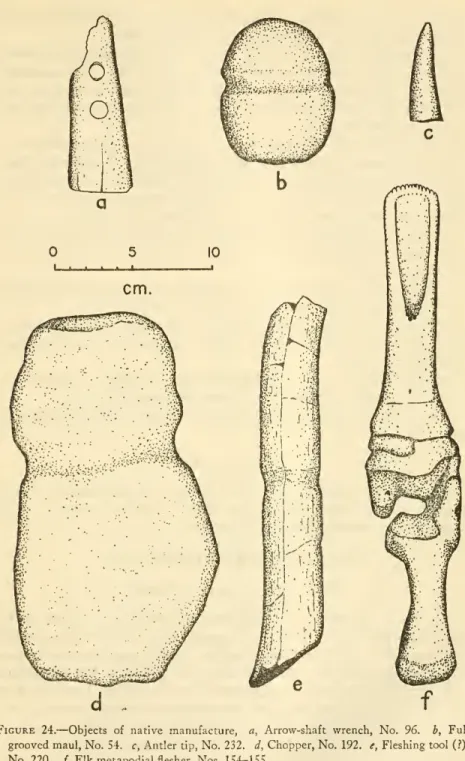
Elk metapodial meat (1) {fig. 24-, /).—It is formed by the articulated metapodia, calcaneus, and astragalus of the moose. The proximal end of the metapodium was reduced in diameter, and a chisel-shaped end bears 13 serrations or small notches.
FAUNAL REMAINS
CONCLUSIONS AND DISCUSSION THE SITE AND STRUCTURES
The Assiniboines were at one time north of the site, and it is recorded that the site.
MAJOR ARCHITECTURAL DETAILS
This river flows into the Missouri from the north and provides an easy travel route for Indian bands as far north as present-day Canada. At the time of construction, the nearest trading post was apparently at the Mandan villages near the Knife River, a distance of about 80 miles. Cracking with baked clay at the site indicated that peeled round logs had been used in construction, and the amount of abrasion suggested extensive use of that material.
The contours of the three log cabins were indicated by six thresholds in the north-south direction, which were surrounded by a kiln made of fired clay. There was no further structural evidence, but some details can be inferred from some of the artefacts. The three buildings, often close together in fur trades, were the kitchen, storehouse, and residence of the merchant or burgher.
It is mentioned that Kipp wintered at the site, but contemporary sources do not mention any further staff nickname. The site may have been burned after being abandoned by the occupants to prevent competitors or local Indians from using it.
WHITE OBJECT MATERIALS
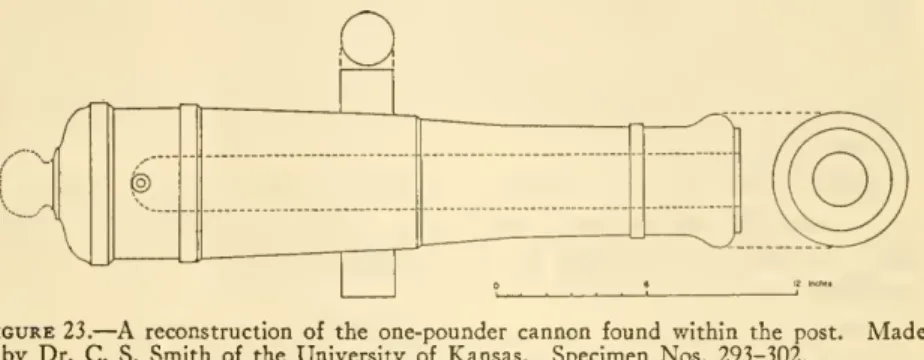
The particular cannon was small and may have been mounted on a heavy block of wood with a swivel, or possibly on a small two-wheeled cart as the "cannon wagon" would indicate. The remains of firearms are scant; indeed, the only definitive gun part is the hammer of a flintlock gun of a pattern manufactured from 1803 to 1807 for US use. Analysis of the perfectly spherical rifle balls reveals that five sizes of bullet shapes were used, ranging from 0.475 inches to 0.584 inches.
Here is evidence that at least five individual guns were probably in use, as it was customary for each gun to have sown an individual mold. This again indicates that waterfowl and local birds, such as the prairie chicken, were likely hunted, an assumption corroborated by bird remains found in Feature20, the kitchen waste area. The fabric and numerous buttons found were probably from commercial clothing brought from manufacturing centers, although the buttons could also have been used on leather clothing made by Indian women.
The doll legs could also have been from the doll of one of the children of a postal worker or an Indian child. Clay pipes were found in large numbers at the post in a broken state, and although they were traded to the Indians, most of them were probably used by the staff of the post. The files and cutting stones are evidence that metal was ground here, as one would assume, and the sawn tips of the inlays in Features46, 47 and 48 reveal that saws were present, although none were recovered.
Other goods may have been transported from the Columbia Fur Company base on LakeTraverse at the headwaters of the Red River of the North (Wied-Neuwied,. A study was made of the various broken materials of the white objects that fitted together and their sources in various features.
OBJECTS OF NATIVE MANUFACTURE
INFANT BURIAL
An Indian woman, or women, living on the grounds, will readily account for some of the articles of. However, a more plausible explanation for the presence of these native artifacts is that Kipp or other employees had Indian wives. The material characteristics of a culture are often surprisingly tenacious, and since the post was located a long distance from the commercial sources of supply, native artefacts were unlikely to suffer.
COMPARISON WITH OTHER FUR TRADE POSTS
LITEKATURE CITED
Domestic Caves and Artifacts at the Site of Fort Berthold I. Report on Excavation Work at Like-A-Fishhook Village in 1954.) MS.
LIST OF FEATUKES AT SITE 32MN1
It was surrounded by four IK)sts in the form of a square; these probably represent the remains of a chimney and grinding stick. It was located in the west central part of the post enclosure and probably served as a site for It was located in the south-west part of the post enclosure and was probably used for smoke-tanning hides.
This is one of the supports for a shed, F-65, in the northeast corner of the enclosure. This cross section is made in the center of the western half of the south line.
GLAZED EARTHENWARE AND GLASS FROM KIPP'S POST
FAUNAL REMAINS FROM KIPP'S POST
BIRD BONE*
The presence of bones of skunks, muskrats, badgers, bobcats, porcupines, dogs, and prairie dogs, mixed with other kitchen wastes, suggests that the inhabitants of this trading post were acculturated through their contacts with the Indians.
FISH BONE*
EXPLANATION OF PLATES