
In 1803 the Arikara were settled in a group of three villages on the west side of the Missouri a few miles above the Grand River. They were the main residence of the Arikara when Bradbury and Brackenridge traveled up the Missouri in 1811.
TREATMENT OF THE DATA
As previously noted, four towns are principally involved—three on the west (right) bank of the Missouri, in what is now Corson County, and one on the east bank, in Walworth County. In the following section I have presented brief descriptions of each of the four main sites and burial grounds from which the present materials were taken, based partly on Stirling's field notes and partly on relevant data from other sources.
SITES AND BURIAL DATA
- AND CEMETERY 1
- This held the remains of three adult males (USNM
- AND CEMETERY 2
- male (USNM 325377); depth of 5 feet; normal
- Adult male (USNM 325385) and young child. A few potsherds scattered through the soil above the bodies
- AND CEMETERY 3
- AND CEMETERY 4
- Adult male (USNM 325341); back of the head were a single perforated Cypraea shell, several shell and glass beads, a turtle
In the hand of one of the men was a fimgus-like mass (tinder?) in which was embedded a white arrowhead (from the knee). Near the head of the second adult were: a piece of silver wire [white metal] about 4 inches long; anoval copper chest ornament about 3 by 1}^ inches; a pierced human tooth (USNIVI 325532);
THE ARTIFACTS POTTERY
Neither fine cord nor fine line cutting techniques appear on any of the sherds from Site 4 or the ElkCreek Mouths. On the imier rim is a row of shallow circular pits 2 to 3 percm in size; the outside of the lifat or three impressions with a cord surrounding the vessel, and these are paralleled by short horizontal lines below the handle.
OBJECTS OF CHIPPED STONE
Very similar examples of the same material have been found at pre-pottery sites near the Black Hills.
OBJECTS OF GROUND STONE
The head is quite similar to a number of club heads in the ethnological collections of the National Museum. None of the unmounted ethnological clubheads resemble the two pieces from the Mobridge sites. Some of the more flattened specimens may be the polishing stones of the field record;^".
There is no indication that the natives here exploited the full potential of the stone. Bone artifacts make up a fairly large portion of the speci-. men in the current collection. Of the 16 specimens assigned to this class, none has left the head of the bone intact.
None of the samples from the Mobridge sites show traces of pigment in the interstices, although two have greenish spots suggesting contact with copper. Slotted knife handles of the general type represented by these specimens have been found at several other sites in the Great Plains (see Strong, 1945, p. 60). As said, these beads are made from practically unaltered shells, except that the spire has been ground away to allow the passage of the string.
OBJECTS OF PERISHABLE MATERIALS
Each bead is on a stitch slightly angled to the general direction of the row, to produce a serrated effect. Pouch Fragments.— Of the various pouches of leather, fur, bison hair, etc., reported in the field notes of various graves in Burial Grounds 2 and 4, there are no definitely identifiable remains now at hand. In what may have been the inside of the bottom, or of one side of the bag, are a number of small glass beads.
There is no indication of how much longer each of the pieces may have originally been, nor do the field notes support the simple statement that a braided barber was present (p. 64, d). They are not pieces suggestive of all the wheel-work bands and rosettes shown in painted costumes by Catlin, Bodmer and others. All available examples are limited to narrow lines of decoration or related to materials that are no longer definable.
Close examination suggests that the only quill here was a simple edge on one side of the ankle flap. There is, of course, nothing to indicate the nature of the material wrapped, but strips of raw hide were frequently used for this purpose among the historic quill workers of the northern plains and adjacent regions. From the "flat piece of wood 3 inches long by % inch wide, wrapped with porcupine quills," recorded in the field notes from Grave 1,.
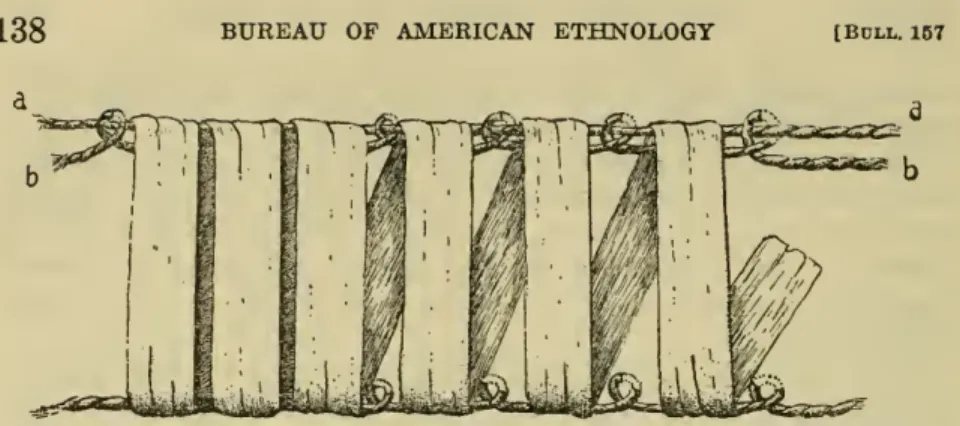
WOODWORK
Samples of this soft, powdery, brown substance (USNM
OBJECTS OP EUROPEAN MANUFACTURE
On the back of each of the five free buttons, two concentric lines encircle the mounting loop. One is a curious teardrop-shaped object, part of the surface of which is completely glazed (pi.68,g; USNM325534). There is nothing to indicate that any of the specimens are made of natural copper; where there is indigenous craftsmanship.
The ends of the loop were fed through a hole in the bell and the ends were then flat. Most of the buttons now in the collection have been detached from their original fabric bases, although many retain fragments of the strap that once secured them in place. 120 mm, with two square and circular perforations, two of which are on opposite edges near the rounded end; the opposite. is somewhat constricted and broken.
When these holes were punched, the metal on the outside of the shoe was bent outwards, creating a sort of jagged effect. Here, too, the oxidation has progressed so much that definitive identification of the original form of the iron material is not possible (Fig. 61, e). Artifacts were present in all but one of the graves, sometimes in considerable variety and quantity.
170 BUREAU OF AMERICAN ETHNOLOGY [B0LL. 167
TIME PERSPECTIVE
The greatest abundance of trade goods was found here, both in absolute quantity and in the number of burials involved. Moreover, the grave goods here included a much larger proportion of perishable items, whether of domestic or commercial origin, than were discovered in any of the other cemeteries. Finally, none of the other three cemeteries, or the villages they were supposed to be with.
Continuing the assumption that the relative abundance of white contact materials from cemetery graves is indicative of the degree of Caucasian influence and thus relative age, the remaining three burial sites. As for individuals, only two, at most, out of about 40, or 5 percent, were associated with trade items; and, incidentally, no perishables were reported. 1, 2, 3 and 4 were associated with village areas occupied at different times and, temporarily, in the same order. Cemetery 1 is the earliest.
We will remember that this sequence has parallels with the village locations that are also believed to be so. 176 BUREAU OF AMERICAN ETHNOLOGY [BoLi-.157] can be associated with the respective burial sites, based on the sherd samples brought by Stir Hng (p. 105).
CULTURAL RELATIONSHIPS
As for the burial data itself, I see no reason to go into Cemeteries. The nearby village site (Nordvold . 1, or 39C031), with which it is thought to be affiliated, superficially resembles many other small fortified communities of the Arikara country. Cultural identity: apparently La Roche Aspect (pottery of the incised technique)." Nordvold 3 he suggests a "mixed site combining Grand River (Arikara) and La Roche Aspect (incised) pottery types.
The foregoing suggestions regarding the cultural links of the two nearby village sites are apparently based in large part on monolithic remains, of which too few were found during the excavations of Cemetery 2. It is certain that a significant portion of the graves opened here represent a post-contact horizon. of their content; but in any case the contact materials are much less abundant than for the burials in cemetery 4, for which an early nineteenth-century Arikara history has been demonstrated. On the other hand, the lower levels at the Ryghsite to which Strongrefers provided no contact material (Strong, 1940, p. 370), in contrast to Stirling's findings at cemetery 2.
It is possible, I suppose, that the contact burials in Cemetery 2 can be considered representative of the occupants of the later nearby village site (Nordvold 3), while the non-contact burials must be assigned to an earlier pre-contact horizon possibly represented by Nordvold 2 . The Grand River Aspect, I. collected, includes historical Arikara material, which is thought to include manifestations such as the Leaven-worth site and Cemetery 4. This may mean that the cultural affiliations of the site with a tradition differ from those represented by Cemeteries 2, 3 and 4;.
SKELETAL MATERIALS
Strong (1940, p. 380) suggested that a nearby village (Mobridge site or 39WW1) may have been "early Hydatsasite", further noting that "the pottery is distinctly. As far as I can learn from conversations with physical anthropologists, there seems to be no good reason why the Arikara skulls cannot be definitively separated from the Mandan and Hidatsa.In the meantime, all that can be said is that there is nothing in the skeletal material from Burial Grounds 2, 3, and 4 to indicate anything other than an Arikara population and that the Cemetery 1 collections are in the US.
In short, Hrdlicka seems to have been on the right track when he diagnosed all this Mobridge material as Arikara.
CONCLUSIONS AND GENERAL DISCUSSION
Discussion. Such reconstructions, local and regional, as have been attempted to date for the Missouri Valley of the Dakotas lean heavily on the evidence of the ceramic remains. In my view, the Stirling assemblages from burial sites at the Mobridge site bear directly on this issue. It may also be significant that the skeletal materials from Cemetery 1, believed to be from the nearby Mobridge site, also suggest an Arikara population.
It is quite clear that on the historical level there were numerous similarities in the material culture of the Arikar and theirs. Frequent exchange of ideas and techniques certainly took place, as archaeologists have pointed out; and while the general distinctiveness of Mandan-Hidatsa pottery in the Heart River region from Arikara pottery below Grand River can be given, one wonders how reliable a clue to tribal identity pottery is in an area such as Mobridge where both Arikara and The Mandan-Hidatsa may have long been in close contact. As Strong (1940, p. 363) has observed with reference to the Upper Missouri region: "The documentation of many sites and the linking of definite archaeological horizons in this area opens a promising field for exact rather than speculative work in physical anthropology." Unfortunately, serious studies of physical anthropology in relation to the archaeological finds have long been neglected here as elsewhere on the Great Plains.
The current data from Mobridge suggests to me that the Arikara may have lived in villages as far north as the Grand even as early as the eighteenth century and perhaps long before. Whether their apparent later concentration in the vicinity of the present Pierre and the Cheyenne River represents a withdrawal from the more northern districts as a result of. In the Upper Missouri region we have to do with tribes of diverse linguistic stocks, of different physical types, and of widely divergent geographical origins.
LITERATURE CITED
A comparison of the cultural manifestations of Burkett (Nance County) and Gray-Wolf (Colfax County). Pierced claws, teeth and finger bones, and metal ear ornaments from burials near Mobridge, S. BUREAU OF AMERICAN ETHNOLOGY BULLETIN 157 PLATE63. Shell plaster and hairpin ornaments, from burials near Mobridge, S. BUREAU OF AMERICAN ETHNOLOGY BULLETIN ISTIT PLATE 64. Miscellaneous hair, leather, wood, and metal articles from Cemetery 4, near Mobridge;e, S. BUREAU OF AMERICAN ETHNOLOGY BULLETIN 157 PLATE 65 .
