6 1. The Concept of Arabic Pronunciation a. Definition of Arabic Pronunciation
Arabic is one of major languages all over the world which uttered by more than two hundred million people. It is used as formal language by countries or more. And as the language of Al-Qur’an, the holy book of Islam, it is taught as the second language in Muslim states throughout the world.1 The purpose of Arabic developing language skills both orally and in writing.2
b. Definition of Tajwid
The word “Tajwid” comes from the Arabic language “Jahada” which means
“Hassana”. Tajwid is the same language as tahsin which means fix or to make good. Whereas according to the term, tajwid have two meanings. The first meaning is usually called al-tajwid al-ilmy (tajwid theoretical) secondly, al-tajwid al-amaly (practical tajwid). That is how the correct pronunciation of hijaiyah especially with regard to the layout of letters in various positions (makhraj). Short lengths and the life of death of the letters in various circumstances.3
Tajwid is a science that study about how to read the Al-Qur’an properly based on the makhraj, with long or short sound buzzing sound or not, rhythm and tone, pull stop and comma that have been teached by Rasulullah SAW. to all
1Azhar Arsyad, Bahasa Arab dan Metode Pembelajarannya (Cet. II; Yogyakarta: Pustaka Belajar, 2004), p.1.
2Choirul Fuad Yusuf, Kemampuan Berbahasa Arab (Cet.I; Ciputat Jakarta: Gaung Persada Press, 2007), p.1.
3Saiful Amien, Mengaji Why Not dan Praktis Untuk Memahirkan Baca Al-Qur’an. Edisi II (Cet. II; Malang: Universitas Muhammadiyah Malang, 2005), p. 99.
his disciples up thus spreading from time to time.4Based on the definition above, we can conclude that Tajwid is a science that explain about the way of reading Al-Qur’an well, orderly and exactly based on the rules of pronunciation on makhrajal huruf. (Place in pronouncing Arabic sound).5 Shawamit (Consosnant sound of Arabic).6
There are 29 Shawamit (Arabic sound) as the point of the tajwid they were:
ﻱ ﺀ ﻫ ﻭ ﻥ ﻡ ﻞ ﻙ ﻕ ﻑ ﻍ ﻉ ﻆ ﻂ ﺾ ﺹ ﺵ ﺱ ﺯ ﺭ ﺫ ﺩ ﺥ ﺡ ﺝ ﺙ ﺕ ﺏ ﺍ
c. Manner of Articulation in Arabic articulation Table 2.1 Manner of Articulation
No Manner of Articulation Arabic Sound
1 Shawamit Waqfiyyah ﺍ ﻕ ﻙ ﺾ ﻁ ﺩ ﺕ ﺏ
2 Shawamit Majziyyah ﺝ
3 Shawamit Ihtikakiyyah ﺥ ﺵ ﻅ ﺹ ﺯ ﺱ ﺫ ﺙ ﻩ ﺡ ﻉ ﻍ ﻑ
4 Shawamit Anfiyyah ﻥ ﻡ
6 Shawamit Janibiyyah ﻝ
4Tombak Alam, Ilmu Tajwid. Edisi I (Cet. I; Jakarta; Amzah, 2009), p.1.
5Sulaeman Milla, Tajwid Qiro’ah Cara Cepat Belajar dan Mengajae Tajwid Tanpa Menghafal (Pinrang: Pondok Pesantren Tassbeh, 2014), p.5.
6Yayan Nurbayan, Metodologi Pembelajaran Bahasa Arab (Bandung: Zein Al-Bayan, 2008), p.34.
7 Shawamit Tikrariyyah ﺭ
8 Shawamit Sibhi Shaitah ﻯ ﻭ
d. Place of Articulation
Table 2.2 Place of Articulation
No Place of Articulation Arabic Sound
1 Shawamit Syafataniyyah
ﻡ, ﻭ, ﺏ
2 Shawamit Syafawiyyah
Asnaniyyah
ﻑ
3 Shawamit Asnaniyyah
ﺕ, ﺩ, ﺽ, ﻁ
4 Shawamit Bainaasnaiyyah
ﺙ, ﺫ, ﺹ, ﻅ
5 Shawamit Latsawiyyah
ﻝ, ﺭ, ﻥ, ﺱ, ﺯ
6 Shawamit Latsawiyyah Ghary
ﺵ
7 Shawamit Ghariyyah
ﺥ, ﻱ
8 Shawamit Tabaqiyyah
ﺥ, ﻍ, ﻚ
9 Shawamit Halqiyyah
ﻉ, ﻕ, ﺡ
10 Shawamit Hanjariyyah
ﺀ, ﺍ, ﻩ
e. Explanation about Place in Pronunciation Arabic Sound 1. Comes from the larynx for (
ﺀ
) and (ﻩ
)2. Comes from center of throat for (ﺡ) and (ﻉ) 3. Comes from front throat for (ﺥ) and (ﻍ)
4. Comes from back tongue and back ceiling for (ﻕ) 5. Comes from the tongue and soft palate for (ﻚ)
6. Comes from the canter of the tongue for (ﺝ), (ﺵ), and (ﻱ) 7. Comes from the blade of tongue for (ﺾ)
8. Comes from the blade of tongue for (ﻝ) 9. Comes from the tip of tongue for (ﻥ)
10. Comes from the nun place but not touching the ceiling for (ﺭ)
11. Comes from the tip of tongue as well as the base of the upper front teeth by pressing the ceiling for (ﻁ), (ﺾ), and (ﻅ)
12. Comes between the tip of tongue near the upper teeth by pressing the ceiling for (
ﺯ
), (ﺱ), and (ﺹ)13. Comes between the tip of tongue and the tip of the upper front teeth for (ﺙ), (
ﺫ
), and (ﻅ
)14. Comes from the low tip and heads straight the tip of the two top incisors for ﻑ
15. Comes from the two lips and lips remain silent for (
ﺏ
) and (ﻡ
) 16. Comes from the two lips and lips are open for (ﻭ
)17. Comes from the oral cavity for (
ﺍ
),72. The Concept of English Pronunciation
Pronunciation is important to learn, because when we have low or poor pronunciation, that is difficult to listen and make it misunderstanding each other.
Pronunciation considered as one of the important aspect of learning English because it affect student’ communication competence. There are some definitions of pronunciation that the write will be given, there are:
1) Oxford, pronunciation is way which a language or particular word or sound is spoken.8 it means that every time we say any words its called pronunciation.
2) Merriam webster states that pronunciation is the act or manner of pronouncing something. As the stated definition above, the researcher concludes that pronunciation is how to pronounce or produce sounds from words well and correctly.
3) Factors Affecting in Pronunciation Learning
These are factors affecting pronunciation in learning, these are follows:
a) The native language. We have already looked in some detail at the influence of the first language on sound system of a sound.
7Tombak Alam, Ilmu Tajwid, p.1.
8Oxford University Press, Learners’ Pocket Dictionary, Fourth Edition, New York: 2008.
p.353.
b) The age, we commanly regard that if someone pronunce a second language like a native, they probably started laerning it is a child. On the other hand, if a person doesn’t begin to learn a second language until adulthood, they will naver have a native-like accent even thought other aspects of their language such as vocabulay or syintax may be indistinguishable from those of native speaker. These belief saem to be supported by the many cases of adults who laern to speak a second language fluently, but still maintain a foreign accent, even when they have-lived in the host country for many years. And also it is mean that, a young students more easily to acquire good pronunciation then adult.
c) Amount of exposure, once again, there are problems with this factor not the least of which involves qualifying “amount of exposure” many people living in the target country hear, little of the target language, while others living in their own native country may have significant exposure to a foreign language. Kenworthy concludes that while amount of exposure is a contributory factor, it is not necessary factor in the development of pronunciation.
d) Phonetic ability. It is refers to whether someone has an “ear” for a foreign language, and test have been developed to measure this factor (which is generally referred to as “phonetic coding ability or auditory discrimination ability”) there is some evidence that good discrimination pronunciation drills, while poor discrimination are not. Kenworthy points out the learning situation, and claims that as a result it is beyond the control of the teacher although this is something with which many would disagree.
e) Attitude and identify. The ability to adapt and develop a foreign pronunciation has also been linked with to extent to which the learner wants
to identify with the target culture. This factor may be cross related to others factor such age and length of residence in the target country.
f) Motivation concern for good pronunciation. This final factors probably also related to personality, some students seem unconcerned about making mistake.9
The explanation above, gives a motivation for every one to learn pronunciation. The six principal factors affecting pronunciation are alternative to making light of learning pronunciation.
3. Part of Pronunciation
There are some parts of pronunciation: sound, stress, and intonation a) Sound
According to Gertrude F. Orion in his book pronouncing American English state that: “The sounds of the language are divided into vowels and consonants. When the vocal cords vibrate, the sound is voiced. When the vocal cords do not vibrate, the sound is voiceless. All vowel are voiced, but consonant may be either voiced or voiceless. In addition all the vowel and some consonant can be held for a shorted or longer period of time, depending on which sound precedes or follows the sound.”10
Oxford University Press written that sound is something you can hear.11 English sound divided into parts namely consonant sound and vowel sound.
9Joanne Kenworthy, Teaching English Pronunciation (New York: Longman, 1987), p.4.
10Gertrude F. Orion, Pronuncing American English : Sound, Stress, and Intonation, p.1.
11Oxford University Press, Oxford Learner’s Pocket Dictionary, Fourth Edition; (United State of America, 2010), p.424.
b) Vowel
Vowel is speech sound in which the mouth is open and the tongue is not touching the top of mouth, the teeth, etc.12 L. Been Crane argue that vowels are voiced continuous sounds involving no interruption in the flow of air through the oral cavity.13
According to Zahra Farmand and Behzad Pourgharib state that:
“A vowel is a sound in spoken language that is characterized by an open configuration of the vocal tract so that there is no built up of air pressure above the glottis. Vowel sound are produced by air from lungs which vibrate when the air in the mouth is not blocked.”14
A vowel sound come from the lung, through the vocal cords, and is not blocked, so there is not friction:
Table 2.3 The list of vowel sounds
The sound
Example How to make
ə
a-go To make it, open your mouth very slightly, your lips should be about 1/8 inch (3 mm) apart; relax your lips; make short sound with your voiceI Big Lower your jaw slightly. The lips are relaxed and about ¼ inch (6 mm) apart.
U Put This vowel formed by keeping the slightly
12Oxford University Press, Oxford Learner’s Pocket Dictionary, p.496.
13L Been Crane, Edward Yeager, Randal L. Whitman, An Introduction to Linguistics, p.64.
14Zahra Farmand, Behzad Pourgharib, “The Effect of English Songs on English Learners Pronunciation (Victorquest 2, no. 9, 2013), p.841. http//www.isicenter. Orgfulltextpaper -169.pdf (Accessedon 22 February 2018).
open. The lips are ¼ inch (6 mm) apart and pushed outward to make an open circle. The sound is short
Iy Honey To make this sound, set your lips 3/8 inch (1 cm) apart. Widen your lips into a smile. This sound is long. Count to two silently to be sure it is long enough.
Uw Choose Keep the mouth slightly open and the lips 3/8 inch (1 cm) apart. The lips are tense, and pushed forward into a small circle. The sound is long.
Iuw Beauty The sound / iuw / sound is combination of the sound /iy/ and /uw/. The lips are 3/8 inch (1 cm) apart. Begin with the lips spread into a big smile. Then push them forward into circle. The sound is short.
ʌ Trouble To make this sound, keep the mouth slightly open. With lips about 3/8 inch (1 cm) apart.
The sound is short.
ɛ Guest Lower your jaw slightly. The lips are tense and spread outward in a half-smile about ½ inch (1,3 cm) apart. The sound is short.
Ow Over To pronounce /ow/, with your lips about ½ inch (1,3 cm) apart. Round them into a circle.
Begin the see sound, then move your lips into
a circle.
Oiy Boy The /oiy/ sound is a combination pf two sounds beginning with /o/ and ending in /iy/.
The lips, set about ½ inch (1,3 cm) apart, begin a circle. Move quickly to form a wide smile, 3/8 inch (1 cm) apart.
Ea Ran To make this sound, keep your jaw halfway open. The lips are ½ inch (1,3 cm) apart.
Tense your lips, and form a wide, downward smile. Begin the sound, then move your lips close together into the /a/ position.
Eiy Day This is a combination of sounds. Begin with your lips in the first position of /ea/, about ½ inch (1,3 cm) apart and with a wide, downward smile. Then, slowly widen them into an upward smile, forming /iy/.
ɔ
Call To make this vowel sound, drop your jaw until the lips are 5/8 inch (1,5 cm) apart.Tense your lips and round them forward halfway.
Ae Back To make this sound, keep your lips 5/8 inch (1,5 cm) apart and form a half-smile, with tense lips.
Aeow How This is a combination of vowel sounds.
Begin with /ae/ by setting your lips 5/8 inch
(1,5 cm) apart; then, glide into /ow/, forming a circle with your lips.
A Father To make this sound, drop your jaw until the lips ¾ inch (2 cm) apart, but relaxed. The sound is short but take a little longer because your mouth is open so wide.
Aiy Dried The /aiy/ sound is a double vowel. Begin sound-ing the /a/, with the lips about ¾ inch (2 cm) apart. Then move your lips to the /iy/
position, forming a big smile. This is a long sound.15
c) Consonant
The principal division of sound it between vowels and consonant. Every language makes this diction. Consonant are sounds produced with a constriction or occlusion in the oral cavity.16Alice Maclin state that consonant are sounds that are not vowels and the letters that stand for these sounds.17
Zahra Farmand and Behzad Pourgharib state that a consonant is a part of speech and a sound that is articulated with consummate or partial closure of the upper vocal tract. Some consonant sounds are voiced and voiceless.18 Voice is sounds made with vocal cords vibrating even though voiceless is sounds made with no vibrating of the vocal cords.19Consonant sound are determined by the position of
15Jeans Yates, Pronounce It Perfectly in English (United State of America: Barron’s Educational Series, 1995), p.54.
16L. Ben Crane, Edward Yeager, Randal L. Whitman, An Introduction To Linguistics, p.59.
17Alice Maclin, Reference Guide to English: a Handbook of English as a Second Language, (Washington, United State Department of State Office, 1992), p.120.
18Zahra Farmand, Behzad Pourgharib, The Effect of English Songs on English Learners Pronunciation, p.841.
19Gertrude F. Orion, Pronuncing America English : Sound, Stress, and Intonation, p.168.
the tongue, lips and teeth, the way air is released, and the use of, or absence of, voice.
Table 2.4 The list of consonant sound
The sound
Example How to make
P Play To make the sound, put your lips together firmly, stop the air completely, then pop the lips open.
Do not make a vocal sound.
B Bag To pronounce /b/, place your lips together firmly;
stop the air completely, and make a voiced sound.
T Tap Place the tip of the tongue against the alveolar ridge, stop the air completely, then release the air.
Do not make a vocal sound.
D Daddy To make this sound, place the tip of the tongue on the alveolar ridge and make a voiced sound.
K Cat To pronounce /k/, bring the back of the tongue to the velum, stop the air completely, then release it with a voiceless sound.
G Game To make this sound, bring the back of the tongue to the velum, stop the air briefly, then release it with a voiced sound.
F Fish To make the sound /f/, place the top teeth firmly
on the inside of the bottom tip; release the air continuously with no voice.
V Vote To make this sound, place the upper teeth against the inside of the lower lip, and release the air with a voiced sound.
Ch Chance To make the sound /ch/, place the center of the tongue on the palate; stop the air completely, then release it abruptly with a voiceless sound.
J Just To make this sound, place the center of the tongue against the palate, stop the air completely, the release it abruptly with a voiced sound.
Sh Sugar To make the sound /sh/ , touch the palate with the sides of the tongue and release the air slowly through the passageway formed down the center of the tongue. Do not stop the air flow. Do not make a sound with your voice.
Zh Usual To make this sound, touch your palate with the sides of your tongue, and release the air slowly through the passageway formed down the center of the tongue. Do not stop the air. Make a sound with your voice.
S Say To make the sound /s/, place the center of your tongue against the palate and release the air slowly, but do not stop the air, and do not make a sound with your voice.
Z Zero To make the /z/ sound, place the center of your tongue against the palate; release the air slowly, without stopping. Make a sound with your voice.
L Lake To pronounce /l/ , curl your tongue up; put the under side of firmly on the back of your top teeth and make a sound with your voice.
R Race To make the sound /r/, keep the tongue back; do not let your tongue touch inside your mouth;
round your lips and push them forward. Make a voiced sound.
M Mother To produce the sound /m/ , press your lips together and make a voiced, humming sound;
release the air through your nose.
n Name To produce /n/, place your tongue against your palate and hold it there; make a voiced sound and release the air through your nose.
Ŋ Long To make this sound, bring the back of your tongue up against the velum, close the air off completely, and release it through the nose.
Ɵ Thing To make the sound /Ɵ/ , hold the tip of your tongue between your top and bottom teeth; force the air out with a voiceless sound.
Ŏ They To pronounce /Ŏ/ , hold the tip of your tongue
between your top and bottom teeth; release the air with a voiced sound.
H Hope To make the sound /h/ , keep your tongue free and force air from the throat with a voiceless sound.
W Way To make the sound /w/, relax your tongue, then round your lips and press them back against the front of your teeth. Make a sound as you release your lips.
Y Yellow To pronounce /y/ , spread your tongue flat and toward the back of your mouth; do not let your tongue touch the palate. Next, make a wide smile with your lips and bring your tongue forward with a voiced sound.20
d) The Nature of Pronunciation
Talking about sound cannot be let loose of phonology and the separate sounds of English have no meaning.21 Phonology is a description of what the possible sounds of the language are, and how they may be combined to form words.22 Phonology has been defined as the study of sound system, that is the study of how speech sound structure and function in language.23
Based on the statement above, phonology covers phonetic. Phonetic is the
20Jeans Yates, Pronounce It Perfectly in English (United State of America: Barron’s Educational Series, 1995), p.61.
21Robert Lado, Teaching English Across Cultures (New York: McG-Hill, 1976), p.115.
22Peter W. Culicover, Syintax (United State of America: Academic Press, inc, 1976), p.2.
23Hyman, Larry M, Phonology Theory and Analysis (United State of America: Holt, Rineheart and Winston, 1975), p.2.
study of speech sound themselves. Phoneticians study both the production of speech sound by the human speech organs (articulatory phonetics) and properties of the sound themselves (acoustic phonetics).24 Meanwhile, according to pike Abdul Haris Sanubi phonemics is the study of the structural arrangement of sound segment in relation to unit of sound in particular language, procedure for the finding of the phonemes of a language, the theoretical problem concern with the setting up of phonetic postulated.25
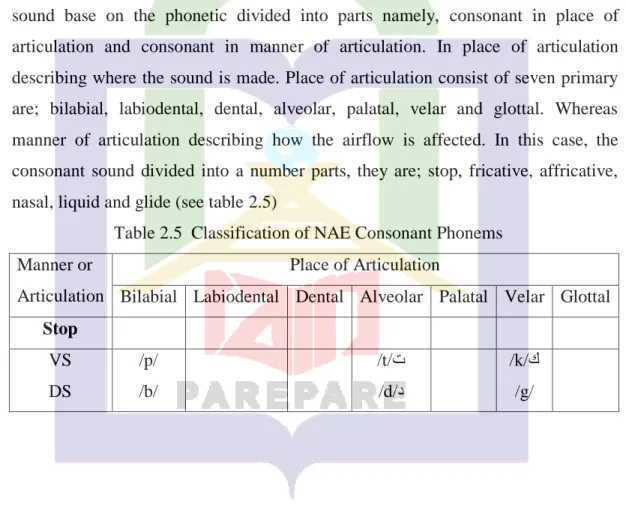
In this case, the writer specified on consonant sound. Whereas, the consonant sound base on the phonetic divided into parts namely, consonant in place of articulation and consonant in manner of articulation. In place of articulation describing where the sound is made. Place of articulation consist of seven primary are; bilabial, labiodental, dental, alveolar, palatal, velar and glottal. Whereas manner of articulation describing how the airflow is affected. In this case, the consonant sound divided into a number parts, they are; stop, fricative, affricative, nasal, liquid and glide (see table 2.5)
Table 2.5 Classification of NAE Consonant Phonems Manner or
Articulation
Place of Articulation
Bilabial Labiodental Dental Alveolar Palatal Velar Glottal Stop
VS DS
/p/
/b/
/t/ﺕ /d/ﺩ
/k/ﻙ /g/
24Abdul Haris Sanubi, Introduction to Linguistics (Soreang Kota Parepare: Dirah, 2016), p.6.
25Abdul Haris Sunubi, Introduction to Linguistics, p.6.
Fricative VS DS
/f/ﻑ /v/
/ѳ/ﺙ /õ/ﺫ /zh/ﻈ
/s/ﺱ /z/ﺯ
/h/
Affricative VS DS
/tf/
/d3/
/sh/ﺵ Nasal
VD /m/ /n/
Liquid
VD /I/ (/r/) /r/ﺭ
Glide VS
DS (/hw/)
/w/
/y/
Type equation here e) Manner of Articulation
Some manner of articulation as follow:
1) Plosive/ stop
Consonant are formed by completely the air passage, the compressing the air and suddenly opening the passage, so that the ears escape making an explosive sound. Stops are sound which are produced by stopping the air somewhere in the mount or vocal passage and realizing it suddenly. When you say /p/ and /b/ your lips are closed together for a moment, stopping the air flow. /p/ and /b/ are bilabial stops: /p/ and /b/ is a voiceless, bilabial stop.
The other consonant are /t/, /d/, /k/, /g/.
2) Fricative
All is forced through a narrow passageway in the mouth or throat, creating continuous friction: /f/, /v/, /h/, /s/, /z/, /0/, /a/, /f/, /3/.26
3) Affricatives
Affricatives sound are a combination of a stop and a fricative. It means that affricatives is a merger two manners of articulation. They are made by briefly stopping the air stream completely and then releasing the articulations slightly so that friction is produced. Has only two affricative: /tf/, /d3/.
4) Nasal
Nasal consonant are formed the mouth passage completely at the same points, so that are free to pad out through the nose. Nasal are sounds whichare produced with the air going out through the nose or nasal cativy. When you make a nasal sound, the soft palate is lowered so that air escapes through the nose. Nasal consonant are normally voiced. English has a bilabial, an alveolar and a velar nasal refresentated by the symbol /m/, /n/, and /ŋ/.
5) Approximant
The airstream moves around the tongue in a relatively unobstructed manner: liquid /I/, /r/, and glides /w/, /y/. There is some obstruction of the airstream in the mouth, but not enough to cause friction. These sound are called liquids, [I] is a lateral sound. The front of the tongue makes contact with the alveolar ridge, but sides of the tongue down, permitting the air to escape laterally through the sides of tongue. The sound [r] is usually formed in English by curling the tip of the tongue back behind alveolar ridge.
f) Place of Articulation
Place of articulation of the consonant phoneme is as follow:
26Marianne Celce-Murcia, Donna M. Brinton, Janet M. Good, with Barry Griner, TEACHING PRONOUNCIATION ( a Course Book and Reference Guide), (New York: Cambridge University Press, 2010), p.60.
1) Labial
Labial is sound produced by moving the tongue, lips, and change the slape of oral cavity word produce different sound. Like [b], [p], [w] or [m].
Bilabial is the sound produced by articulating and mobilizing both lips together.
2) Labiodental
Labiodental is the sound produced by articulating by touching the power lip into top gear like sounds [f] and [v] as smooth and wine.
3) Dental
Produced with the tongue tip on or near the inner surface of the upper teeth. Example; /0/, /a/ as in thick and then.
4) Alveolar
produced with the tongue tip on or near the tooth ridge. Example; /t/, /d/, /s/, /z/, /n/, /l/ as to do, so, zoo, new and light.
5) Palatal
Produced with the tongue blade or body near the hard palate. Example:
/ƒ/, 3, /tƒ/, /d3/, /r/, /y/ as in beige, jim, show, chow, you, and rake.
6) Velar
Produced with the tongue body on or near the soft palate. Example:
/k/,/g/, /n/ as in bang, go, and kite.
7) Glottal
Produced by air passing from the windpipe through the vocal cords.
Example: /h/ as in hi.27
27Marianne Celce-Murcia, Donna M. Brinton, Janet M. Good, with Barry Griner, TEACHING PRONOUNCIATION ( a Course Book and Reference Guide), (New York: Cambridge University Press, 2010), p.57.
B. Some Previous Related Findings
There are many research findings which are related to this research, some of previous research findings which are related to this research are described below:
Dewi Sartika on her research “Pronunciation Error Produced by sixth semester students of English Department Stain Parepare (focused on consonant sound)” found the result showed that the students produced phonological error in pronouncing consonants, those are /g/, /j/, /z/, /tf/, /0/, /o/, /n/, /pj/, and /f/.
Meanwhile, for the consonants such as /k/, /h/, /f/, /m/, /n/, /p/, /r/, /s/, and /t/ are consonant which are error-free in pronunciation. Based on the result, it can be concluded that the sixth semester students have not mastered pronunciation of English language yet because more of them are still influenced by first language pronunciation system.28
Ayu Achmad.s on her research “Improving Pronunciation Skill through Tongue Twister (A Classroom Action Research at Eight Grade of SMPN 2 Kulo Kab.
Sidenreng Rappang)” found that pronunciation skill at eight grade of SMPN 2 Kulo trough tongue twister is successful.29
Hardianti Astuti on her research “The Correlation between A Good Arabic Pronunciation of The Students and Their Pronunciation of Interdental Fricative Sounds” found that there was no significant correlation between a good Arabic pronunciation of the students and their pronunciation of interdental fricative sounds.
28Dewi Sartika, “Pronunciation Error Produced by sixth semester students of English Department STAIN Parepare (focused on consonant sound)” (Unpublish skripsi STAIN Parepare, 2017), p.43.
29Ayu Achmad.s, “Improving Pronunciation Skill Through Tongue Twister (A Classroom Action Research at Eight Grade of SMPN 2 Kulo Kab. Sidenreng Rappang)” (Unpublish Skripsi STAIN Parepare, 2016), p.60.
It might be because of the student who had a good Arabic pronunciation did not know that there are some Arabic pronunciation have the same pronunciation in English.30
Based on the previous related research finding above, the researcher concludes that the relationship of previous research with this research that will be conducted by the researcher is equally discussed about English pronunciation. It diffirence lies in the variable X namely the Arabic sound ability. The researcher took and focus on Arabic pronunciation and English pronunciation of students of MTs At- taqwa Jampue Kab. Pinrang to find out how much influence between the two variables.
C. Conceptual Framework
The conceptual framework of this research is designed as follow:
Based on the conceptual framework above, we can know that, pronunciation is the main factor or purpose of this research. And in this research will get results
30Hardianti Astuti, “The Correlation Between a Good Arabic Pronunciation of the Student and Their Pronunciation of Interdental Precative Sounds (A Study of the Year Students of the Third Year Students of MA DDI Lil-banat Parepare in Academic Year 2012/2013)” (Unpublish Skirpsi: STAIN Parepare, 2012), p.51
PRONUNCIATION
Arabic and English sound
Arabic and English Stress
Arabic and English Intonation
Vocal and Consonant
Primary and Secondary Stress
Rising and Falling Intonation Student’s Pronunciation
in Arabic and English
where, is there any influence of Arabic sounds ability toward students’ English pronunciation skills. To applying the conceptual framework above, the researcher conduct observation in class and dormitory, and then the researcher will give Arabic test to the students, the researcher would gave a some sentence to the students. The sentence were expected as easy for them that made them easer to pronounce every sound. In the process of measuring their pronounce ability. Then, the research will give the lesson of English pronunciation.
D. Hypothesis
H0: There is no an influence of Arabic sound ability toward the student’s English pronunciation ability at MTs At-Taqwa Jampue Kab. Pinrang.
H1: There is an influence of Arabic sound ability toward the student’s English pronunciation ability at MTs At-Taqwa Jampue Kab. Pinrang.
E. Operational Definition of Variables 1) Arabic Sound Ability
Arabic sound ability means a capability processed by a person in pronouncing Arabic latter in accordance with the rules of the rules of Tajwid. And for this research focused on Arabic consonant sound or samitha.
2) English Pronunciation Ability
English pronunciation ability means the ability to understand sound system especially for consonant in English.
28 CHAPTER III
METHOD OF THE RESEARCH
This part describes about the description of the research design, location and duration of this research, population and sample, instrument and procedure of collecting data and technique of data analysis.
A. The Type and Design of the Research
In this research, the researcher try to make detail and systematic explanation in aims to find out between two variables; Arabic sound ability (x) and English pronunciation ability (y). In this research has used the quantitative method and used asosiatif design.
The paradigm is described as follow:
X Where:
X: Arabic sound ability
Y: English pronunciation ability
1) Arabic sound ability is independent variable or variables that affect the symbol X
2) English pronunciation ability at MTs At-Taqwa Jampue Kab. Pinrang is dependent variable is affected by the Y.
According to the explanation above, it can concluded the quantitative research is where the researcher dig up factually and systematic of The Influence of Arabic Sound toward English Pronunciation Skill for Young Learners of Class VII MTs At-
Y
Taqwa Jampue Kab. Pinrang by using the research design above, the researcher expects that the result of this study will be valid.
B. Location and Duration of the Research 1. Location of the Research
The location of this research has taken place at MTs At-Taqwa Jampue Kab.
Pinrang. The location of MTs At-Taqwa Jampue is in Jl. Poros Waetuoe No. 199 Kessie. Kelurahan Lanrisang, Lanrisang, Kab. Pinrang.
2. Duration of the Research
The research has used quantitative research to collect and analyse the data.
Therefore, the researcher will use more than one month for collecting data.
C. Population and Sample 1. Population
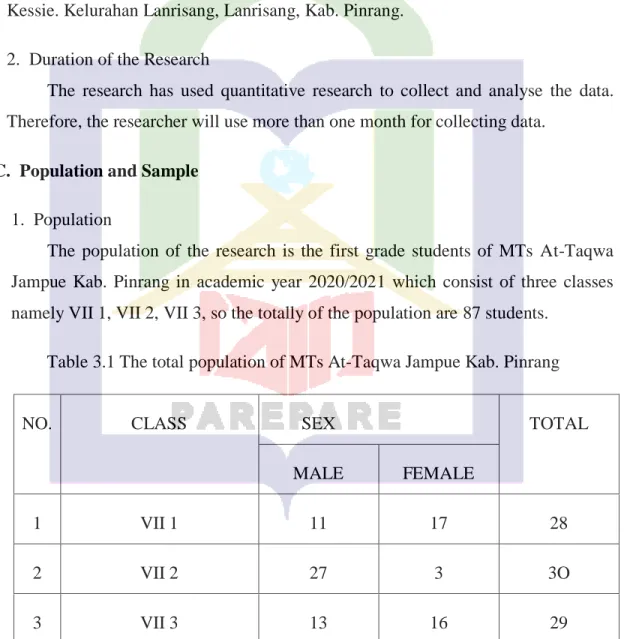
The population of the research is the first grade students of MTs At-Taqwa Jampue Kab. Pinrang in academic year 2020/2021 which consist of three classes namely VII 1, VII 2, VII 3, so the totally of the population are 87 students.
Table 3.1 The total population of MTs At-Taqwa Jampue Kab. Pinrang
NO. CLASS SEX TOTAL
MALE FEMALE
1 VII 1 11 17 28
2 VII 2 27 3 3O
3 VII 3 13 16 29
TOTAL 51 36 87 Source: Administration of MTs At-Taqwa Jampue Kab. Pinrang 2. Sample
Sample is part of population chosen based on certain technique. The researcher have used purposive technique sampling with take students living dormitory therefore the total sample of the research are 20 students.
D. Instrument of Collecting Data
In this instrument to collect the data, the researcher has used observation, test, and observation.
1 Observation
Observation is the most appropriate and affective way to collect the data. As the researcher who will conduct a researcher to see the learning strategy is implemented by the teacher, the information is obtained much more objective by doing observation rather than ask the teacher about the most successful strategy or self-report of the research participant.31 The researcher will conduct a direct observation in the field against the object or research objectives to be researched by looking at the extend of the Arabic sound ability and English pronunciation ability at MTs At-Taqwa Jampue Kab. Pinrang, specially for student’s of living in dormitory. Through in this observation, the researcher will be act as observer who will observe the activities undertaken by the student associated with learning Arabic pronunciation and English pronunciation.
2. Test
The instrument of this research consist of two kinds namely Al-Qur’an and English reading text. Where the Al-Qur’an would be applied to know how the
31L.R Gay, Geoffrey E Mills and Pater W. Airasian, Educational Research: Competencies for Analysis and Application, Tenth Edition (USA: Pearson Educational), p.382
students’ Arabic pronunciation ability, meanwhile the reading text will be given to them to find out whether their Arabic pronunciation toward their way pronounce the English word properly.
3. Documentation
Documents provide valuable information which help the researcher to understand central phenomena. They represent public and private documents. Then the researcher examines the documents from the participants for the accuracy, completeness, and usefulness in answering the research question.32 Researcher will conduct with take value of Arabic and English lesson in report that this given by teacher in Arabic and English lesson trough result of the study, school profile and certificate of student who have followed the MTQ race.
E. Procedure of Collecting Data
In supporting the process of collecting the data and obtaining the data, the research will involve following steps:
1. The researcher will conduct observation in class and dormitory 2. The researcher will give test to the students
3. The researcher would gave a some sentence to the students. The sentence were expected as easy for them that made them easer to pronounce every sound. In the process of measuring their pronounce ability, The researcher will record their voice and score them by using table classification. As the same with pronunciation test.
4. The researcher collect the data 5. The researcher calculating the data
32John W. Creswell, Educational Research: Planning, Conducting, and Evaluating Quantitative and Qualitative Research, Fourth Edition (USA: Pearson Educational), p.233
F. Technique of Data Analysis
The data would be collected through recording and analysing by
quantitatively. In data analysis, the researcher will conduct the following procedure:
1. Scoring the result of the students’ pronunciation as follow:
Score = 𝑆𝑡𝑢𝑑𝑒𝑛𝑡 𝑐𝑜𝑟𝑟𝑒𝑐𝑡 𝑎𝑛𝑠𝑤𝑒𝑟
𝑇ℎ𝑒 𝑡𝑜𝑡𝑎𝑙 𝑛𝑢𝑚𝑏𝑒𝑟 𝑜𝑓 𝑖𝑡𝑒𝑚 x 100 2. Statistic Descriptive
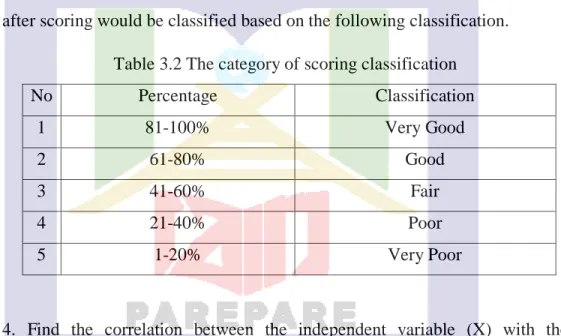
3. The data would be collect from both of Arabic and English pronunciation after scoring would be classified based on the following classification.
Table 3.2 The category of scoring classification
No Percentage Classification
1 81-100% Very Good
2 61-80% Good
3 41-60% Fair
4 21-40% Poor
5 1-20% Very Poor
4. Find the correlation between the independent variable (X) with the dependent variable (Y). The applied formula is correlation product moment technique. The formula of product moment correlation will use as follow:
𝑟
𝑥𝑦=
𝑛 ∑ 𝑋𝑌−(∑𝑋)(∑𝑌)√[𝑛 ∑ 𝑥2−(∑𝑥)2][𝑛∑𝑦2−(∑𝑦)2] Where:
𝑟𝑥𝑦 = Coefficient of correlation product moment
∑x = Total distribution score of x
∑y = Total distribution score of y
∑𝑥2 = Sum of Quadrate distribution of x
∑𝑦2 = Sum of Quadrate distribution of y
∑xy = Total multiplication score of x and y
n
= The number of paired X and Y score.33 5. Quality of CorrelationNo Interval Koefisien Interpretation
1 0.00-0.199 Considered as no correlation
2 0.20-0.399 Low correlation
3 0.40-0.599 Medium correlation
4 0.60-0.799 Strong correlation
5 0.80-1.000 Very strong
6. Find the regression, by applying the formula:
Y = a + b X
Where:
Y’ = Subject in the predicted dependent variable (Variable Dependent)
33Suharsimi Arikunto, Prosedur Penelitian, p.256.
a = Value of Y if X=0 (consonant value)
b = Purpose number of coefficient of regression that shows the number of the increasing and decreasing of dependent variable based on independent variable. If b (+) it means increasing, and if b (-) it means decreasing.
X = Subject in the independent variable which has certain value (independent variable value).34
Find constant value b, by applying the formula:
𝑏 = 𝑛. ∑ 𝑋𝑌 − ∑ 𝑋. ∑ 𝑌 𝑛. ∑𝑋2 − (𝑋)2
Find constant value a, by applying the formula:
𝑎 = ∑ 𝑌 − 𝑏. ∑ 𝑋 𝑛
While:
N = Total of number of sample.35
The basic of the interpretation in regression test refer to two matters, the first matter is by comparing the value of 𝑡𝑐𝑜𝑢𝑛𝑡 and 𝑡𝑡𝑎𝑏𝑙𝑒, and the second matter is by comparing the significant value with the probably value 0.05.
a) Comparing the 𝑡𝑐𝑜𝑢𝑛𝑡 with the 𝑡𝑡𝑎𝑏𝑙𝑒
b) If the 𝑡𝑐𝑜𝑢𝑛𝑡 is bigger than the 𝑡𝑡𝑎𝑏𝑙𝑒 value, it means the independent variable influence the dependent variable.
c) If the 𝑡𝑐𝑜𝑢𝑛𝑡 is not bigger then the 𝑡𝑡𝑎𝑏𝑙𝑒 value, it means the independent variable does not influence the dependent variable.
34Sugiyono, Statistik Untuk Penelitian (Cet: XXVII, Bandung. Alfabeta, 2016), p.261.
35Syofian Siregar, Statistik Parametrik Untuk Penelitian Kuantitatif: dilengkapi dengan Perhitungan Manual dan Aplikasi SPPS Versi 17 (Edisi I.Cet. III; Jakarta: Bumi Aksara, 2015), p.179.
d) Comparing the significant value with the probably 0.05.
d) If the significance value is not more than the probably value 0.05, it means the independent variable influence the dependent variable significantly.
e) If the significance value is more than probably value 0.05, it means the independent variable does not influence the dependent variable significantly.
Conducting the calculation by using the current formula above, it can be realized whether there is a positive influence or not, whether the influence that has be discovered is valid for the population, and has regression equation.