CAPSTONE ELL Portfolio
Taoran Qian
Peabody College, Vanderbilt University
Abstract
This ELL Portfolio demonstrates my philosophy of teaching and my proficiency in teaching English language learners (ELLs) according to the TESOL standards. In this portfolio, I review the artifacts I have accomplished in the two-year ELL program at Peabody College, and reflect upon them about their effectiveness in serving the increasingly diverse ELL population.
The portfolio consists of three parts: (1) my philosophy of teaching, (2) a review of artifacts with regard to the TESOL standards, and (3) my reflection on challenges and implications for future teaching. In the first part, I discuss my overall teaching philosophy based on the theoretical framework of social constructivism, and how this theory shapes my view of culturally responsive teaching. In the second part, I discuss my interpretation of the TESOL standards, present relevant artifacts created during my program of studies, and explain how these artifacts prove my competency in the following seven domains of the TESOL standards: (1) Planning, (2) Instructing, (3) Assessing, (4) Identity and Context, (5) Learning, (6) Content, and (7) Commitment and Professionalism. Each domain is illustrated with an artifact and analyzed focusing particularly on learners and learning, learning environment, curriculum and assessment. In the third part, I discuss the challenges I am facing or about to face concerning teaching ELLs, and explain how I am going to overcome them. I look back on the time spent at Peabody College and reflect on the most important takeaway in terms of ELL education. More importantly, I envision my identity in the future classroom and the lifelong professional development as a teacher.
Table of Contents
Philosophy of Teaching………..………....4 TESOL Standards for ESL/EFL Teachers………....13 Domain 1: Planning………13
Artifact A: Lesson Plan on Humans of New York
Domain 2: Instructing……….15 Artifact B: Lesson Plan on Negative Questions
Domain 3: Assessing………..17 Artifact C: Case Study of a Non-Native English Speaker
Domain 4: Identity and Context………..20 Artifact D: Community Literacies Investigation
Domain 5: Learning………22 Artifact C: Case Study of a Non-Native English Speaker
Domain 6: Content……….24 Artifact E: Lesson Plan on Making a Phone Call
Domain 7: Commitment and Professionalism………27 Artifact F: Term Paper: Making the Syllabus a Two-Way Communication between Teachers and Students in China
Reflection on Challenges and Implications for Future Teaching………..32 References……….40 Appendix………...…45
Philosophy of Teaching
Valenzuela (1999) defines a good teacher as one who cares about students’ life, and one who demonstrates a more complete understanding of both their social and academic milieu. Before I came to Peabody, I have never realized that the sociocultural aspect of students’ life would be an indispensable part of my future teaching. I used to think that their academic success is all I have to work on. Informed and reshaped by Valenzuela’s (1999) definition of a good teacher, the overarching theme of my teaching philosophy now focuses on showing an authentic form of caring that emphasizes relations of reciprocity between teachers and students (Valenzuela, 1999).
As a prospective teacher who is mostly likely going to teach in the EFL setting, I believe culturally responsive teaching (Gay, 2010) is the cornerstone of being a teacher who cares, especially when the students are culturally and linguistically diverse (CLD). According to Gay (2010), culturally responsive teaching is using the cultural knowledge, prior experiences, and performance styles of CLD students to make learning more appropriate and effective for them. In other words, it teaches to and through the strengths of these students (Gay, 2010), and as a result they will be more motivated and thus more committed to learning.
In order to become a culturally responsive teacher, I would create a positive classroom environment where students’ sociocultural identities are valued, their prior knowledge and experiences are utilized, and individual differences among them are addressed. As a whole, the learning theory of social constructivism developed by Lev Vygotsky serves as the theoretical framework of my teaching philosophy.
Known as a sociocultural theorist, Vygotsky (1986) believes that thinking and learning are dependent on social interactions and reflective of cultural values (as cited in Alexander, 2006).
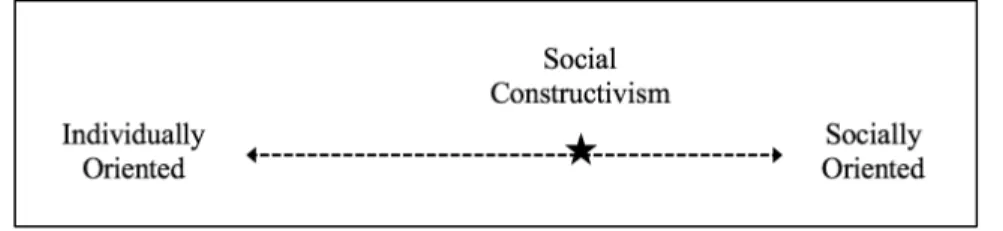
Similarly, second language acquisition derives from sociocultural interactions and the exchange of ideas, and the understanding of that language is deepened in the social context. I love the idea of sharing the knowledge, but, like Vygotsky who is not an extreme socioculturalist, I am not at the far end of the individual-to-social continuum with regard to second language acquisition (see Figure 1). In fact, I believe in social constructivism – that is, learning happens in a social and cultural milieu, but knowledge remains a uniquely personal construction within that milieu (Alexander, 2006).
Figure 1. Social constructivism on a continuum of individual-to-social orientation.
In the following section, I am going to specify the teaching implications from a more social perspective to a more individual one along the continuum. Also, I will illustrate how these teaching practices look like in a classroom with examples.
Learning as a Sociocultural Activity
Building a welcoming, enriching yet challenging learning community (Baker, Terry, Bridger, & Winsor, 1997) is beneficial to CLD students. Specifically, students can learn more effectively and efficiently with the support and guidance of a more proficient other. In other words, peers, instructors, family and community members could all provide students with scaffolding
within their zone of proximal development (Vygotsky, 1978) to help them fulfill their potential – both academically and socially.
In my future classroom, I will definitely include group work, because one thing I love most about collaborative learning is that it fosters empathy, which I believe constitutes a huge part of a student’s emotional development. A group is a society in miniature; working together as a group helps students learn how to get along with people from all walks of life in the future.
Discourse-level input. The ultimate goal of learning a language either in the English as a second language (ESL) or English as a foreign language (EFL) context is to communicate.
However, being able to communicate requires more than linguistic knowledge; it requires communicative competence – knowing when and how to say what to whom (Hymes, 1971), and discourse competence, defined as the ability to process and create coherent discourse, and work with language at the suprasentential level (Bachman, 1990; Canale & Swain, 1980).
One essential benefit of forming a learning community is the accessibility of discourse- level input, which enables learners to be exposed to repeated use of target forms (Nassaji & Fotos, 2011). Discourse-level input is especially necessary for English language learners (ELLs) in the EFL context, because they are not immersed in an English-speaking environment or exposed to English literacy. Information gap activities and task-based activities in interactive contexts are proved to be helpful in that they make sure that meaningful conversations are going on. Whereas students have to communicate with others to construct and negotiate meaning, they are supported in language production by peers while receiving adequate input.
However, teachers should be very careful about finding authentic spoken and written materials and simulating a native-like, input-rich microclimate in the classroom. As Nassaji and Fotos (2011) suggest, learners should receive a mixture of authentic and simplified material, because both types demonstrate multiple uses of the target grammar structures.
Interactional feedback. When students are required to produce output, teacher and peer feedback is essential, as it pushes them to negotiate and reflect on the accuracy of their language use in communicative contexts (Nassaji & Fotos, 2011). In this case, students are not constructing knowledge about language all by themselves. Rather, they are sharing knowledge as a learning community and their knowledge is informed and shaped by interactional feedback (Alexander, 2006).
Although various types of interactional feedback, including recasts, clarification requests, repetition, and direct elicitation, can be employed in output-based tasks, teachers need to be aware that uptake, which means the immediate response to the feedback, does not occur every time (Nassaji & Fotos, 2011). Even if students provide uptake, this does not necessarily mean that they have acquired the forms. However, it does indicate that they have noticed the feedback, and it is facilitators’ responsibility to unlock their potential.
Funds of knowledge. Gaining a more thorough understanding of CLD students, I also came to realize the essential roles that parents and communities play in the teaching process. As teachers, we should take the initiative to involve students’ families and communities, making full use of their funds of knowledge (Moll, Amanti, Neff & Gonzalez, 1992). Specifically, teachers can strategically bring their funds of knowledge (i.e. native language, immigration experience,
family history, household knowledge, etc.) into the classroom and design meaningful class activities.
In order to form a learning community that connect homes and schools, CLD students’
prior knowledge – including both schooled knowledge and unschooled knowledge – should be identified and utilized. As unschooled knowledge is usually something that students are familiar with, interested in and have hands-on experience about, it lays a solid foundation for future instruction. Therefore, it would be more effective for teachers to construct deeper understanding in the classroom by building on funds of knowledge. In particular, teachers can extend the learning environment beyond the walls of the classroom, help students’ make connections between unschooled knowledge and schooled knowledge, and fully develop teachable moments (Alexander, 2006).
On the one hand, I would try to guarantee effective communication with parents apart from regular home visits, thus establishing mutual trust between us. On the other hand, I want to encourage positive dialogues between students and parents. Thus, I will take advantage of activities like home reading journals and creating family keepsakes to engage parents in developing students’ literacy skills (Allen, 2007). Plus, I will use tools like transnational and community literacies (Jiménez, Smith & Teague, 2009) and identity books (De Jong, 2011) to strengthen students’ sociocultural identities.
Learning as a Personal Construction
Students come to the classroom with a broad range of pre-existing knowledge, skills, beliefs, and attitudes, which are going to influence how they participate in the class and process
the in-coming information. How they process and integrate new information will, in turn, affect how they remember, think, apply, and create new knowledge. Since learning is dependent on students’ prior repertoire of knowledge and skills, knowing what students know and are able to do can help teachers craft instructional activities that build off of student strengths and acknowledge and address their weaknesses. Nevertheless, prior knowledge takes different forms. While funds of knowledge can be shared by a collaborative learning community, certain kinds of prior knowledge, such as metalinguistic awareness, exist only in a learner’s mind. Thus, it is important for teachers to bridge the gap between shared knowledge and internalized knowledge.
Connections and transfer. When it comes to a language classroom, CLD students’ prior knowledge becomes increasingly essential. In order to fully comprehend a text, students must do much more than simply decode the words in the class. They have to interact with the text and connect the information with their prior knowledge. In this case, students are engaging in conscious learning rather than rote memorization. However, we as teachers cannot assume that students automatically make these links on their own. Instead, we need to explicitly teach them strategies about building connections.
According to Keene and Zimmerman (1997), form-meaning connections can be viewed from three aspects: text-to-self, text-to-text and text-to-world connections (as cited in Herrera, Perez, & Escamilla, 2014). In my opinion, these three types of connections can serve as a guideline for teachers to activate students’ prior knowledge and experience. Specifically, teachers can make use of students’ academic, sociocultural, linguistic and cognitive knowledge to facilitate the construction of connections (Harvey & Goudvis, 2000).
Metalinguistic awareness. CLD students’ native language is also part and parcel of prior knowledge, especially in language learning. While the languages might be shared within different immigrant communities, bilingual students’ metalinguistic awareness remains a personal and internalized asset. Utilizing the bilingual or even multilingual strengths of CLD students increases their awareness of language diversity and promote a deeper understanding of the structural elements of different languages (Goodwin & Jiménez, 2015).
As a non-native English speaker, I will definitely tap into my bilingual competence and use both English and Chinese in my EFL teaching. In fact, bilingual instruction benefits students in various ways. The common underlying proficiency (Cummins, 1984) helps ELLs transfer their subject matter knowledge, reading strategies, writing composition skills and higher-order thinking skills from L1 to L2. Students who frequently code-switch are more likely to develop metalinguistic awareness, because actively thinking about the relationships between two languages promotes the development of biliteracy. Additionally, when ELLs engage in “languaging”, defined as discussions or self-reflection in the L1 about the L2, they become more conscious of target forms, thus enhancing processing (Nassaji & Fotos, 2011). For bilingual students to promote their metalinguistic understandings, I will integrate meaningful translation tasks in my teaching.
Building on that, I will engage students in a discussion in English that relates the translation to larger understandings about the text, relationships between their two languages, and strategies used during the activity (Goodwin & Jiménez, 2015).
Individual differences. Because no two people have the same life experiences or perceive, interpret, or remember the same event in the same way, personal prior knowledge, especially
unschooled knowledge, is as unique as fingerprints. Therefore, it is teachers’ obligation to recognize and address students’ different learning styles and multiple intelligence to help them perform at a higher level (Gardner, 2006). As a teacher who cares, I want to make sure that every single student – regardless of individual differences in learning styles, modes of thinking, or personalities – feel welcomed, comfortable and confident in my classroom. Because students learn best in an easy and pleasant classroom environment in which their affective filter is lowered and psychological barriers are removed (Krashen, 1985). In other words, students feel more free to produce language when their affective filter is low, with anxiety reduced and self-confidence boosted (Larsen-Freeman & Anderson, 2011).
Admittedly, careful grouping can benefit bilingual learners by providing an enriching environment where their learning can be scaffolded (De Jong, 2011). However, I will consciously set aside some time for students to do independent work. The TED Talk “the Power of the Introverts” given by Susan Cain (2012) has changed my viewpoint on group mentality. In her talk, she appealed for stopping the madness for constant group work, because it is not fair for introverts.
It is much better for introverted people to go off by themselves and generate their unique ideas freed from the distortions of group dynamics (Cain, 2012). When it comes to school where continuous interactions are going on, solitude still needs to be emphasized. It does not mean we should abandon teamwork strategies, but it does mean we should also give students more autonomy and flexibility at work to encourage habitual reflection and contemplation. Therefore, allowing individuality within group work has now become my teaching philosophy with regard to grouping.
Conclusion
We are future teachers, but more importantly we are lifelong learners. Learning to be a culturally responsive teacher is an ongoing process and takes endless efforts. There are certain educational elements that I cannot change on my own, but what I can do is to provide a caring and meaningful classroom environment where CLD students’ language learning is optimized – that is, their different types of prior knowledge are effectively tapped, their sociocultural identities are truly respected, and at the same time their individual differences are carefully addressed. I hope that I, together with my students, could make contributions to the community in return. Having students apply what they have learned in my classroom to the real world would nurture an awareness of community leadership and global citizenship. In this case, everyone is able to get the most out of education.
TESOL Standards for ESL/EFL Teachers
The TESOL standards serve as the guidelines for ESL/EFL teachers to evaluate and adjust their teaching preparation and professional development in order to best serve the ELL population in the United States. In this section, I am going to present artifacts from my program of studies to demonstrate my understanding in the following seven domains of the TESOL standards: (1) Planning, (2) Instructing, (3) Assessing, (4) Identity and Context, (5) Learning, (6) Content, and (7) Commitment and Professionalism. For each domain, I will first discuss my interpretation of the standard and provide a supportive artifact that is highly relevant to this domain. Then, I will give a brief description of the artifact and explain how it proves my competency in this domain by focusing particularly on learners and learning, learning environment, curriculum, and assessment.
Domain 1: Planning
Standard: Teachers plan instruction to promote learning and meet learner goals, and modify plans to assure learner engagement and achievement.
Lesson planning is critical to both a student’s and a teacher’s success. A lesson plan serves as a road map for teachers, as it details what students need to learn and how the objectives can be achieved during the class time. However, lesson planning should not be viewed in isolation, but integrated with learning objectives and learners’ individual differences. Before planning a lesson, an effective ELL teacher should identify the standards students need to meet, specify concrete content and language objectives, and determine the kinds of activities to be used in class accordingly. Also, the lesson should be followed by valid assessments to check whether the goals set at the beginning of the class have been met. Specifically, teachers can employ Backward
Design, defined as a method of designing educational curriculum by setting goals before choosing instructional methods and forms of assessment, as a model of lesson planning (Wiggins &
McTighe, 2005).
For this standard, I am presenting a creative lesson plan based on Humans of New York (see Artifact A), a blog and bestselling book featuring street portraits and interviews collected on the streets of New York City. Generally, students learned descriptive expressions with the help of pictures and other visual tools, which benefited visual learners in particular. By linking descriptive words and phrases to specific visuals, students would be able to use these expressions more accurately and actively, thus facilitating their language learning.
As Humans of New York reflects lives of different people living in the melting pot, students were immersed in a multicultural learning environment in which they felt more related to the content. From this book, learners learned to accept and appreciate their identities, knowing their roles in the world and the cultures they represent. To acknowledge CLD students’ identities, I carefully selected pictures that are culturally relevant to them, with which they can always have something to talk about. Also, the learning environment was cooperative and supportive, as students were grouped according to their sociocultural and linguistic background.
In this class, I asked students to interpret the assigned pictures using their own words and justify their inference to develop a higher level of cognitive thinking. Meanwhile, I provided a list of English expressions that are frequently used to describe a person’s appearance and personality.
By doing so, vocabulary learning was naturally woven into the whole curriculum. Then, after
modeling, I had students name the pictures and add subtitles or write short paragraphs based on what they inferred from the pictures.
Apart from language learning, culture learning is also part and parcel of my planned curriculum. Since the project Human of New York started from a photo blog and spread out through Facebook, I introduced the culture of social media in the United States. Then, I asked students to talk about the impacts of social media on their daily life and elaborate on their points.
They were also encouraged to discuss the social media in their home cultures with their group members.
For the assessment, I encouraged students to develop their own “Humans of ” albums or photo blogs after class. I gave students suggestions on how to conduct an interview in English and, like what the author of Humans of New York did, they would get to explore their communities, interview their family members, neighbors, classmates, teachers, etc., and take photos of them. They would also describe those people using the expressions they learned in class, and eventually share their works with the class via social media. With careful planning, I tried to make learning meaningful and relevant to learners by including appropriate and motivating materials and activities that foster real-life application of concepts introduced in class (Echevarría, Vogt, & Short, 2012).
Domain 2: Instructing
Standard: Teachers create supportive environments that engage all learners in purposeful learning and promote respectful classroom interactions.
CLD students learn best in a supportive yet challenging learning community where their affective filter is lowered. To create such an environment, teachers need to know about their students both academically and socioculturally, and therefore acknowledge students’ identities and view them as a whole. In particular, teachers should have a good knowledge of students’ cultural and linguistic background, which is especially true for ELL teachers who are going to deal with a diverse student population. Besides, teachers should provide plentiful opportunities for peer interactions and teacher-student interactions, because the process of language learning is not one- way but bi-directional. Receiving interactional feedback from more proficient others benefits learners in that they are pushed to negotiate meaning and reflect on the accuracy of their language use in communicative contexts (Nassaji & Fotos, 2011, p. 71, 103).
For this domain, I am presenting a grammar lesson plan on negative questions (see Artifact B) designed for 5th-grade ELLs in China. The reason I chose this topic is that negative questions in English can be really confusing for Chinese ELLs due to the huge differences between two cultures and two languages. As negative questions are frequently used in spoken English, it is necessary to discuss this topic in the grammar curriculum and explicitly introduce some strategies for non-native speakers to avoid misunderstandings.
For maximum learning to occur, instructing must enable students to make connections between their own knowledge and experiences and the new information being taught (Echevarría, Vogt, & Short, 2012). The first thing I did in this lesson is to lower learners’ affective filter by sharing with them my own embarrassed experience of answering negative questions. Once a friendly learning environment was established, students felt more comfortable talking about their
feelings about negative questions. In order to engage CLD students in meaningful grammar learning, we together tried to figure out the underlying cultural reasons that would explain why it is so hard for non-native speakers – Chinese ELLs in this case – to answer negative questions. This warm-up chat in turn helped build up connections between language objectives and learners’ prior knowledge of their native language.
After introducing the two different types of negative questions, students generalized the patterns of contracted and uncontracted negative questions. As a follow-up assessment, I asked them to do a transformation drill, transforming the sentences from negative statements into two types of negative questions.
For the whole group assessment, I posed some negative questions, which were carefully designed according to learners’ background and characteristics. I asked them to give a clear-cut answer in a complete sentence as fast as they can – either affirmative or negative. As the exercise went on, I asked faster and faster so that students had to answer without hesitation. And then I initiated a chain drill with a negative question so that everyone got a chance to practice. As the ultimate purpose of this curriculum was to develop learners’ communicative competence, I did not correct students’ grammatical mistakes if they gave baffling answers. Rather, I gave them opportunities to clarify their answers or self-correct.
Domain 3: Assessing
Standard: Teachers recognize the importance of and are able to gather and interpret information about learning and performance to promote the continuous intellectual and linguistic development of each learner. Teachers use knowledge of student performance to make decisions
about planning and instruction “on the spot” and for the future. Teachers involve learners in determining what will be assessed and provide constructive feedback to learners, based on assessments of their learning.
It is important for ELL teachers to utilize various forms of assessment – both standardized assessment and classroom-based observation protocol – in order to gain a more thorough understanding of a learner’s language proficiency. When administrating a language assessment, teachers need to think critically about the five critical principles of it: practicality, reliability, validity, authenticity, and washback (Brown & Abeywickrama, 2010). They should do their best to rule out potential bias, and make consistent and objective judgments according to the rubrics.
In addition to that, ELL teachers should integrate authentic assessment practices in their everyday instruction as a routine and ongoing process, because they are more sensitive to the natural growth of students acquiring English (Tinajero & Hurley, 2000; O’Malley & Pierce, 1992). More importantly, teachers need to create moments for positive washback in the form of specific feedback on students’ performance or useful diagnoses of their strengths and weaknesses (Brown
& Abeywickrama, 2010). Of course, the information obtained from all types of assessments should be employed to inform future teaching, which is the ultimate purpose of all assessments (Herrera, Cabral, & Murry, 2012).
For this domain, I am presenting a case study of a non-native English speaker (see Artifact C), Tristania (pseudonym). In the case study, I gave a brief introduction of Tristania’s linguistic, cognitive, and sociocultural background. I collected both her speech and written samples and analyzed her second language acquisition based on these materials. In particular, I gave an
elaborate account of her English language proficiency in terms of phonology, phonetics, morphology, syntax, semantics and pragmatics. In response to Tristania’s current stage of development in language acquisition, I also offered an instructional plan for future improvement.
For Tristania to produce language and perform tasks in a stress-free environment, the assessments I conducted in this case study were mostly informal observations. The speaking samples were mainly collected during the interview and the narrative tasks. In order to have a sound understanding of Tristania’s writing abilities, I collected samples from a wide range of writing activities, including informal emails, short letter, academic paper, etc.
From this study, I realized that a learner’s linguistic, cognitive, and sociocultural background all have a huge influence on his/her language learning. As for Tristania, the languages she speaks and uses on different occasions, the curriculum she has gone through, the learning environment she has been exposed to, the learning styles she has formed, the way she perceives the world, and the way she sees the cultural differences, more or less, shape different aspects of her language proficiency. For example, Tristania’s tends to prolong the last syllable in an English word because of the unique Wuhan accent of her L1 Chinese, while her L3 German would also affect her pronunciation in English from time to time. Her belief in that language learning is optimized with real-life experiences contributed to her active participation in all sorts of social activities in which she could receive discourse-level input in an authentic learning environment.
Her experience of studying abroad in Europe increased her motivation to become a multilingual person. These examples reveal that information about a language learner’s background and previous experiences is extremely helpful for knowing him/her as a whole person and designing
language curriculum correspondingly. Therefore, it is legitimate for ELL teachers to carry out both formal and informal assessments of students’ biopsychosocial history, education history and language history (Herrera, Cabral, & Murry, 2012). Effective teachers should make full use of the information to help structure their culturally responsive teaching, make wise decisions about teaching strategies and techniques, and eventually become “teachers who care” (Valenzuela, 1999).
According to the language proficiency levels suggested by American Council on the Teaching of Foreign Language (2012), I characterized Tristania’s speaking skills as “advanced”
while her writing skills as “superior”. Based on analysis of her current stage of English language acquisition using a variety of theoretical frameworks, I provided her with constructive feedback and possible solutions. Considering her linguistic repertoire, prior schooling experiences, cognitive maturity, metalinguistic sophistication and sociocultural background, I developed a specific instructional plan to help Tristania fulfill her potential for language learning. Generally, I focused my curriculum on improving her sociolinguistic competence. I would tailor a socially constructed and culturally enriched learning environment in which she could interact with proficient interlocutors within her zone of proximal development and thus perform at a higher level (Vygotsky, 1978; Lightbown & Spada, 2006). Meanwhile, I would take advantage of Tristania’s L1 and L3 as facilitators of English learning, because experiences with these two languages promote the development of the proficiency underlying all three languages given adequate exposure (Cummins, 1984).
Domain 4: Identity and Context
Standard: Teachers understand the importance of who learners are and how their communities, heritages and goals shape learning and expectations of learning. Teachers recognize the importance how context contributes to identity formation and therefore influences learning. Teachers use this knowledge of identity and settings in planning, instructing, and assessing.
Culturally responsive ELL teachers should be ready to embrace diversity among students.
A prerequisite for improving CLD students’ English proficiency is to identify and utilize their linguistic, academic, cognitive and sociocultural assets (Herrera, Perez, & Escamilla, 2014). Only if their identity is acknowledged and positively strengthened in the classroom will they be more committed to learning. Also, teachers should tap CLD students’ funds of knowledge, bring their native languages, family heritages, household and community knowledge to the foreground.
For this domain, I am presenting a community literacies investigation (see Artifact D).
In that fieldtrip, I explored a South Asian immigrant community in Nashville, and collected multilingual printed and written materials from Central Market and Patel Brothers along Nolensville Pike. Based on these materials, I planed a curriculum on transnational and community literacies that helps bilingual and multilingual learners get fully involved in their literacy learning.
As I found a lot of printed advertisements with imperfect English during the fieldtrip, I tried to create learning opportunities by having students identify and correct the errors in groups.
This assessment activity engages students in a meaningful task that is closely related to their real- life experiences. Taking a close look at the texts, students will be able to reconsider word choice,
idiomatic expression and the cultural values involved in translation and presentation. Multilingual learners would be a great helper in this activity, because it may involve some translation work.
By code-switching back and forth between two languages, students unconsciously engage in
“languaging”, defined as self-reflection in the L1 about the L2 (Nassaji & Fotos, 2011). In other words, this activity has the potential to increase students’ awareness of language diversity as well as promote their metalinguistic understandings and critical thinking ability (Jimenez, Smith &
Teague, 2009). Further, it encourages the open exchange of ideas and reciprocal interactions between students from different linguistic background in a collaborative learning environment.
Translation activities like this are rich sites of “teachable moments”, especially for CLD students who speak different varieties of a language (Goodman, 2003).
In addition, I found a website called Sandhira (www.sandhira.com), which was established with a vision to bring the South Asian community together on a platform globally. Likewise, I would like to use this type of platform to create a nurturing curriculum that strengthens learners’
ethnic identities as well as their literacy skills. Firstly, I would ask students to read South Asian news on Sandhira to their monolingual parents or exchange ideas on recent events in South Asia with parents who have a basic understanding of English. I would recommend students to keep a reflective journal of what they have read to or discussed with their parents so as to ensure frequent and positive communication between generations. Secondly, I would have students, together with their parents, design an electronic advertisement for family business or a poster based on their funds of knowledge as the business listings on Sandhira. This type of activity encourages learners to include consideration of which language(s) to write in, whether or not to include images and, if
so, what kinds and where to place them in relation to the written text (Department of Education, n.d.). Additionally, it is a great opportunity for immigrant families to find authentic South Asian services within the community and promote their own business at the same time. They can reconnect their cultural roots and more importantly discover future possibilities in the United States. By doing so, I am trying to create a learning environment that is welcoming not only to my CLD students, but also to their families and communities.
Domain 5: Learning
Standard: Teachers draw on their knowledge of language and language learning to understand the processes by which learners acquire a new language in and out of classroom settings.
For ELLs to achieve literacy in English and other content areas, teachers need to understand the systematic nature of language, and have a good knowledge of its structural components:
phonology, morphology, syntax, semantics, and pragmatics. More importantly, ELL teachers should apply their theoretical knowledge in second language acquisition (SLA) into practice to promote students’ development of biliteracy. It is also teachers’ responsibility to bridge the gap between students’ mother tongue and target language by encouraging code-switching and translanguaging (Nassaji & Fotos, 2011). As a non-native English speaker, I share similar learning experiences with ELLs: I know what kind of learning strategies might be helpful to them; I understand what challenges they would face; and I can foresee what mistakes they are likely to make. These experiences contribute to my strengths in teaching English in the EFL context and fostering ELLs’ metalinguistic awareness.
I will demonstrate my competency in this domain by, again, presenting the case study of a non-native speaker (see Artifact C), but analyzing from a different perspective. In this case study, I analyzed Tristania’s strengths and challenges across all aspects of language, from phonetics to pragmatics, identified her stage of SLA in terms of speaking and writing abilities, discussed a variety of theoretical frameworks, and designed an instructional plan that would best meet her needs and thus fulfill her potential.
By transcribing and analyzing Tristania’s speech and written materials, I found out typical challenges in English learning that are common among native Chinese speakers as well as nuances that are specific to her, such as the impact of her L3 German on her English pronunciation.
According to my observation, Tristania’s prior schooling has a huge impact on her SLA.
Most of the English curriculum she has gone through employed the Grammar Translation Method, with the belief that language development is based on the formation of habits (Lightbown & Spada, 2006), which is aligned with the theory of behaviorism. She has been immersed in a learning environment where receptive skills and accuracy were prioritized over productive skills and fluency. It is assumed that a person learning a second language would start off with the habits formed in the first language (Lightbown & Spada, 2006). This assumption is similar to Cummin’s theory of common underlying proficiency (CUP) (Cummins, 1984). In Tristania’s case, however, the overlapping triangle in Cummin’s iceberg model not only includes her L1 Chinese and L2 English, but also her L3 German. From my observation, she often does code switching back and forth between Chinese and English, and between English and German. The influences of her L1 and L3, including both positive and negative ones, are particularly obvious in her phonology.
Besides, the sociocultural theoretical framework can also account for Tristania’s SLA. Her earlier experience as an exchange student in Europe has shaped her learning patterns as an ELL.
Exposed to a pure foreign-language-speaking learning environment, she had plentiful opportunities to practice English and German in authentic contexts. As a highly motivated learner, she actively participated in social activities in which she could use multiple forms and functions of language with the goal of understanding and using new discourse appropriately (Pray, 2014).
When it comes to the classroom learning environment, Tristania is frequently engaged in learner-learner interactions where her language production is supported by peers in output-based activities. At the same time, she is able to receive feedback on the correctness of her language use, which works well as a means of self-assessment for her (Nassaji & Fotos, 2011). In other words, Tristania enjoys learning by talking.
Knowing how Tristania’s educational history affects her English learning, I now realize the significance of assessments of ELLs with regard to their linguistic, cognitive, and sociocultural background. Therefore, as a future ELL teacher, I will continually assess learners’ language proficiency and monitor their progress, thus adjusting my techniques, strategies and curriculum to most effectively benefit their learning.
Domain 6: Content
Standard: Teachers understand that language learning is most likely to occur when learners are trying to use the language for genuine communicative purposes. Teachers understand that the content of the language course is the language that learners need in order to listen, to talk about, to read and write about a subject matter or content area. Teachers design their lessons to
help learners acquire the language they need to successfully communicate in the subject or content areas they want/need to learn about.
Effective ELL teachers should focus more on developing students’ communicative and sociocultural competence rather than teaching the structural knowledge of a language, because communication is the ultimate goal of learning a language. For well-rounded communicative competence to be developed, ELLs need instruction on both Basic Interpersonal Communication Skills (BICS) and Cognitive Academic Language Proficiency (CALP) (Cummins, 1984). Despite the distinction between BICS and CALP, both of them equip students with the ability to communicate, conversationally and academically – in other words, the ability to succeed in school.
Therefore, communication, as the overarching theme of language learning, ought to be the content objective as well as the language objective in a language-focused lesson. Nevertheless, the content should never be watered down because of the learning gap between native English speakers and ELLs, or divorced from authentic communicative purposes (Echevarría, Vogt, & Short, 2012). The content is supposed to make the linguistic structures meaningful and reveal how they might be deployed communicatively (Wong Fillmore, 2014).
For this domain, I am presenting a conversation lesson plan about making a phone call (see Artifact E). Target learners in this class are adult ELLs who have been learning English for 2 years or so in the United States, and their English proficiency is at level 2. Since the content of an adult English course is often the language that will help adults participate in their immediate life situation, I decided to teach telephone English, which is highly relevant to adult language learners.
Living in the United States, students will have to make phone calls in English from time to time in order to get certain services. However, non-native speakers may unintentionally sound impolite on the phone. Thus, the learning goal of my conversation lesson is for adult ELLs to develop communicative and sociocultural competence, namely, knowing what to say on different occasions and how to say it appropriately, politely and naturally. Having this goal in mind, I focused my curriculum on giving students tips on telephone etiquette, equipping them with communication strategies, and providing them with useful English expressions in telephoning.
In this lesson, I started with a question to see whether students like making phone calls or not and how they feel about it. Then I shared my embarrassed telephone experiences and explained the reason why non-native speakers have difficulties making phone calls in English. By making connections to their real-life experiences, I wished to lower their affective filter and thus create a friendly learning environment. The curriculum of this lesson is based on four different situations in telephoning that adults would frequently encounter in their everyday life. Useful expressions were introduced and woven into each situation. Meanwhile, I provided a list of corresponding sentence starters in different situations in order to reduce learners’ cognitive load and facilitate their learning.
As for the assessment, I designed a phone-call activity that would provide a variety of ways for students to practice and apply what they were learning. This activity assesses their understanding of the four telephone situations and their mastery of the expressions in telephone English. Also, this assessment is based on the task-based approach that would engage students in communication and social interaction when solving meaningful tasks (Nassaji & Fotos, 2011). To
simulate an authentic phone-call environment, students were paired up and assigned different phone-call tasks, but they were not allowed to see their partners or practice with them in advance.
Yet they had opportunities to prepare on their own using the strategies, expressions and sentence starters they just learned. This addition to the activity creates a learning environment as authentic as possible so that students are engaged in learning for genuine communicative purposes. While receiving discourse-level input, adult learners were also encouraged to produce oral output in a meaningful sociocultural content.
Domain 7: Commitment and Professionalism
Standard: Teachers continue to grow in their understanding of the relationship of second language teaching and learning to the community of English language teaching professionals, the broader teaching community, and communities at large, and use these understandings to inform and change themselves and these communities.
Teaching is indeed a dynamic job and calls for continual learning and updating. Effective teachers not only need to have a good command of content knowledge and instructional techniques, but also need to constantly evaluate and reflect on their teaching practices and pay close attention to education policy issues in the larger society. Specifically, ELL teachers should keep current with the latest research results and advances in the ESL/EFL field, and apply them to inform future teaching and learning. Technology, for example, is one thing that teachers should always keep themselves at the cutting edge of, because it has influenced the educational climate worldwide and changed the way people teach and learn. Additionally, the English language itself is evolving.
Thus, open-mindedness and readiness for unexpected changes have become two critical features of a responsive ELL teacher.
As a student teacher who is most likely going to teach English in China, I feel obliged to apply the knowledge I have learned here in the United States to English education in China.
Therefore, I will demonstrate my competency in this domain by presenting a term paper Making the Syllabus a Two-Way Communication between Teachers and Students in China (see Artifact F) I wrote about the possibilities of using syllabi in China. With this research question in mind, I reviewed and analyzed relevant literature regarding the communicative function of the syllabus.
The syllabus is widely used as an instructional tool in higher education institutions in the United States. Along with providing information about the curriculum of the course, the syllabus can be a means to communicate expectations to learners (McKeachie, 1999). As a contract between teachers and students, it greatly enhances the accountability and commitment of both teaching and learning, and it provides details about the roles of both instructors and learners in the assessment process (Habanek, 2005). However, it is not a common practice among college teachers in China to share syllabi with students. Apparently, they are not making full use of the syllabus as an informative document of two-way communication between teachers and students.
Also, there is a power disparity between teachers and students in China in that students have little control over the curriculum and class policies, and this disparity could be even reinforced by the decisive nature of the syllabus. Therefore, as a symbolic message, how the syllabus is presented speaks volume about the teacher’s perceived identity and set the tone for the learning environment (Habanek, 2005; McKeachie, 2002; Weimer, 2002; Wolcowitz, 1984).
Whereas teachers should be determined about the ground rules, they could allow some flexibility in less restrictive aspects of the syllabus.
There is one particular model of syllabus – negotiated syllabus – that is especially beneficial to learners in the ESL/EFL settings. It suggests that teachers should involve ELLs in the planning process (Kaplan & Renard, 2015). The advent of negotiated syllabus derives from the recognition that learners, rather than teachers, are central to language learning (Clarke, 1991). In other words, learners’ affective, cognitive, and linguistic needs should all play a part in determining the content and implementation of whatever syllabus type is decided upon (Clarke, 1999). Moreover, negotiating the syllabus with students provides teachers with extra opportunities to reflect on their competencies and interests while designing the curriculum (Knowles, 1990).
Also, a learner-centered syllabus helps students develop self-management and self-assessment skills, which is more valuable beyond the course content. Self-regulated students can use the collaborative syllabus to plan and monitor their learning, benchmarking their performance against the objectives identifies by the instructor (Parkes & Harris, 2002).
As a pre-service ELL teacher, I think it is possible and doable to introduce the authentic concept of syllabus into China. A well-designed syllabus can be really helpful to ELLs because it guarantees an optimal learning environment where there is two-way communication going on between teachers and students. Plus, it enhances the predictability of the instruction, thus lowering the affective filter of ELLs. More importantly, the involvement of learners in the syllabus development process maximizes their motivation and empowerment, as they are taking responsibility for their own learning. Given all these benefits of using syllabi, I am committed to
introducing this idea into higher education institutions in China and I can see endless possibilities of it in the field of EFL teaching.
Reflection on Challenges and Implications for Future Teaching
The two-year ELL program at Peabody College has equipped me with an all-embracing repertoire of teacher knowledge, both in the ESL and EFL context. I have gained an in-depth understanding of language learning and getting along with CLD students. While reading academic journals and research papers provided me with the theoretical knowledge base, writing lesson plans and actually implementing them gave me a taste of being a teacher on the practical side.
Furthermore, I have experienced real-world classrooms in the United States thanks to all the fieldtrips and practicums I have accomplished.
Vision of Professional Development
As an educator, I attach great importance to being a lifelong learner. I look forward to all the possible opportunities for professional development, and I envision my future learning to be continual and sustained no matter what form it takes.
Benefiting a lot from the strong Peabody network of professors, researchers and fellow students, I will continue to build professional relationships with my teachers and peers. Meanwhile, I will also do my best to make my own contributions to this learning community. In an increasingly
“flatter” and more globalized world, we can easily bring brand-new techniques and strategies while share the wisdom with educators across the globe. If we all work together in this way, we are on our way to creating a collaborative and reciprocal platform that keeps ourselves updated with the latest advances in the education world. From a more microscopic perspective, I will form teaching- study groups with fellow teachers, both expert and novice, and do lesson study to perfect my teaching methods through interaction with them. I really appreciate the strong group accountability
among teachers in Japan, not in the form of formalized accountability to the bureaucracy, but instead an intimate and genuine accountability to colleagues (OECD, 2010). Indeed, it is the best hope for the collective improvement of teaching practice.
Currently, I am interested in a non-profit organization called the JUMP! Foundation. It is dedicated to using experiential education as a means of youth empowerment, and arousing awareness among youth of community leadership and global citizenship. As JUMP! delivers educational programs worldwide, I cannot wait to see how experiential education looks like in China and other Asian countries. With additional programs, workshops and keynote lectures for educators, it is also a great opportunity for me to think about the greater purpose of education and reflect on my role as an educator in the larger society.
Although I initially considered teaching EFL in China and I still want that, I hope to get a chance to teach abroad while exploring the world some time in the future. I can picture myself working as a volunteer teacher in refugee camps in Thailand, Vietnam or Cambodia, or a social worker at Mother House in Kolkata, India.
Reflection on Challenges and Teaching Implications
One thing I have concluded from my two-year study is that effective teaching is all about finding a balance. Whereas every teacher is striving to reach a state of balance, it is challenging for ELL teacher and even more challenging than ever with an increasingly diverse student population.
I used to agree with the view that teaching should be eclectic. That is to say, teachers are supposed to choose and synthesize the best elements, principles and activities of different
approaches in order to optimize their teaching (Nassaiji & Fotos, 2011). However, after trying to squeeze all the information I thought might be helpful in one single lesson, I found that so-called eclectic teaching could be extremely overwhelming to students. Yet intimidating students with undue information load is the last thing I want to see in my teaching. Currently, my new interpretation of the word “eclectic” centers on balance. For students to benefit most, eclectic teaching has to be principled. It is understandable that teachers need to balance the tension between limited instructional time and excessive learning objectives, but we should keep students’ feelings in mind. Focusing solely on teaching without considering whether learning is occurring does not result in effective education.
There are so many other kinds of balance teachers have to manage in a real-world classroom, for example, the balance between lecturing and practicing, teacher talk and student talk, teacher authority and student choice, students’ cognitive development and language proficiency, etc. One particular type of balance ELL teachers need to deal with is the balance between accuracy and fluency. From my teaching experiences, I found it hard to locate appropriate materials for discourse-level input when developing ELLs’ communicative competence. On the one hand, I want students to have a good command of routinized sentence patterns that can help them reduce cognitive load. More importantly, I hope that they could learn conversational etiquette and social norms from my class, because I believe the secret of speaking native-like English lies in the ability to use English appropriately, politely, and naturally, which appears to be the greatest challenge for many non-native speakers including me. On the other hand, I doubt that materials designed artificially for the sake of language acquisition reflect the authentic discourse of native English
speakers, because their everyday conversations include a great number of incomplete sentences and colloquial expressions, which can hardly be taught in a systematic way. Again, this is a problem of striking a balance between the learnability and authenticity of teaching materials.
Although materials at the discourse of suprasentential level can help ELLs learn about the cohesion and coherence properties of language (Larsen-Freeman & Anderson, 2011), we should provide them with a mixture of authentic and simplified material, with both types supplying multiple uses of the target language structures (Nassaji & Fotos, 2011). It is legitimate that we as ELL teachers constantly revisit our objectives and reflect on our teaching, otherwise what we teach may not be the same as what we think we are teaching.
Teaching is indeed a dynamic job and calls for constant learning and updating. I agree that technology provides both teachers and students with endless resources, thus bringing enhanced teaching and learning experiences (Larsen-Freeman & Anderson, 2011). However, this era of information technology has exerted extra pressure on teachers. Teachers have to keep abreast of the cutting-edge educational technology and the latest trends of students’ learning styles. For instance, language used in online interactions is definitely not considered as authentic discourse several years ago, but it is now so popular among students that teachers feel obliged to take advantage of technological improvement and figure out strategies to integrate this type of language into their teaching. One illustrating example is that icons and emojis can be utilized to teach the concept of writing systems (R. Jimenez, personal communication, November 3, 2015). Although English language is generational (S. Barone, personal communication, December 3, 2015), educational technology keeps it lively. To keep up with the evolving language, ELL teachers will
have to be open-minded and get ready for changes. Nevertheless, teachers need to be cautious about technology, considering it as an added value rather than a must, because overreliance on technology in teaching can be exhausting. As a consequence, teachers may spend too much time on technology integration in teaching, but little on the larger intellectual purpose of education. I would say instead of thinking about what we can do with technology, we should think more about what we can do if we do not have access to it, which is exactly the educational situation in a lot of underprivileged areas. Again, it is all about balancing.
Identity in the Future Classroom
In a social constructivist classroom, students are active learners and are encouraged to be linguistic and cognitive explorers, making connections between new information and their prior knowledge (Carrasquillo, Kucer, & Abrams, 2004). Therefore, I would define myself as a facilitator mediating students’ learning rather than a transmitter of information. The reason why I choose the term “facilitator” instead of “mentor” or “advisor” is that I am committed to creating a learning environment with little power inequality. As a facilitator, I will provide both linguistic and instructional scaffolding within students’ zone of proximal development. However, I will gradually release the responsibility to students using the “I Do – We Do – You Do” model, and empower them to take charge of their own learning.
I love the saying that to teach is to touch eternity. Thus, I wish to be a role model for my students. A role model does not necessarily mean being more knowledgeable or more proficient in a language in the case of language teaching. A role model is a person who inspires others to strive for greatness, live to their fullest potential and see the best in themselves. Apart from
teaching academic knowledge, teachers should do their best to model love, respect, empathy, passion and all the other qualities that contribute to a whole person. Fortunately, I have met several teachers who not only passed along knowledge, but also imparted life’s most important lessons to me throughout my schooling. They are my lifelong role models and, to a great extent, they are the reason why I want to be a teacher. Therefore, I really care about how students perceive me as a teacher and, more importantly, as an individual. Henry Adams said, “A teacher affects eternity; he can never tell where his influence stops”. Hopefully, I can become a teacher who touches eternity.
Last but not least, I will continue to be a learner in the classroom and learn from my students. I enjoy working with students who come from diverse linguistic and cultural backgrounds, and it is thrilling to discover the talents that they bring into the classroom. As we all strive to be lifelong learners, we should recognize that teaching benefits students and teachers alike.
Important Takeaways from ELL Program
The most mind-blowing takeaway from my two years at Peabody College is that teachers, especially ELL teachers, should acknowledge and strengthen students’ identities.
Before studying in the United States, the program title Teaching English to Students of Other Languages (TESOL) simply meant “teaching English” to me, but now I realize the significance of understanding “students of other languages”. I recognize how diverse my future students can be in the light of their linguistic, academic, cognitive, and sociocultural background (Herrera, Perez, & Escamilla, 2014). Most importantly, I have learned to appreciate my identity as a non-native English speaker as well as my students’. I was deeply impressed by our teacher’s words at the beginning of the program, “Accent is totally acceptable, because everyone has an
accent, even native speakers, and it is a part of one’s identity (K. Fagan, personal communication, December 1, 2014).” Further, immigrant experience, both pleasant and unpleasant, contributes to one’s identity. Instead of simply avoiding sensitive topics, I now realize the necessity for teachers to take the initiative to deal with these negative feelings by carefully directing students to find an appropriate emotional outlet (S. Daniel, personal communication, January 20, 2016). These enlightening conversations with my teachers and fellow students at Peabody College greatly moulded my current philosophy of nurturing ELLs.
Indeed, CLD students are a valuable resource that adds to the richness of our schools and classrooms. I like the terms “his-story” and “her-story” as they recognize that every CLD student arrives with a story (Herrera, Cabral, & Murry, 2012), and knowing about them as whole people is one of the most amazing things of being a teacher. A careful examination of the unique characteristics of them helps teachers understand how language, culture, and prior experiences shape the identities of these diverse students (Gottlieb, 2006). Effective teachers should make full use of the information to help structure their culturally responsive teaching and become “teachers who care” in Valenzuela’s words (1999).
However, culturally responsive teaching is far more sophisticated than simply talking about superficial aspects such as traditional food or music. What matters most to ELLs is relating them to universal experiences and global trends that have a direct impact their lives (S. Daniel, personal communication, February 17, 2016). To be truly culturally relevant, we need to find out the answer to the question: what is the larger intellectual purpose (Wiggins & McTighe, 2011)? We should
keep in mind that integrating higher order thinking skills in the instruction is always a must rather than a bonus for ELLs.
References
Alexander, P. A. (2006). Psychology in Learning and Instruction. Prentice Hall: New Jersey.
Allen, J. (2007). Creating welcoming schools: A practical guide to home-school partnerships with diverse families. New York, NY: Teachers College Press.
American Council on the Teaching of Foreign Language. (2012). ACTFL proficiency guidelines 2012. Retrieved, November 10, 2014, from http://actflproficiencyguidelines2012.org.
Bachman, L. (1990). Fundamental considerations in language testing. Oxford: Oxford University Press.
Baker, J., Terry, T., Bridger, R., & Winsor, A. (1997). Schools as caring communities: A relational approach to school reform. School Psychology Review, 26, 586-602.
Brown, H. D., & Abeywickrama, P. (2010). Language assessment principles and classroom practices (2nd ed.). White Plains, NY: Pearson Education.
Cain, S. (2012). The power of introverts. Retrieved, November 26, 2014, from http://www.ted.com/talks/susan_cain_the_power_of_introverts/transcript?language=en.
Canale, M., & Swain, M. (1980). Theoretical bases of communicative approaches to language teaching and testing. Applied Linguistics, 1, 1-47.
Carrasquillo, A., Kucer, S. B., & Abrams, R. (2004). Beyond the beginnings: Literacy interventions for upper elementary English language learners. Clevedon, U.K.:
Multilingual Matters.
Clarke, D. F. (1991). The negotiated syllabus: What is it and how is it likely to work?. Applied Linguistics, 12(1), 13-28.
Cummins, J. (1984). Bilingualism and special education: Issues in assessment and pedagogy. San Diego, CA: College-Hill.
De Jong, E.J. (2011). Foundations for multilingualism in educations: From principles to practice.
Philadelphia, PA: Caslon.
Department of Education. (n.d.). Tennessee state standards for English reading, grades 9–12.
Retrieved, May 8, 2008, from www.state.tn.us/education/ci/english/english1.shtml.
Echevarría, J., Vogt, M., & Short, D. (2012). Making content comprehensible for English learners:
The SIOP model (4th ed.). Boston, MA: Pearson.
Gardner, H. (2006). Multiple intelligences: New horizons in theory and practice. New York: Basic Books.
Gay, G. (2010). Culturally responsive teaching: Theory, research, and practice (2nd Ed.). New York, NY: Teachers College Press.
Goodman, Y.M. (2003). Valuing language study: Inquiry into language for elementary and middle schools. Urbana, IL: National Council of Teachers of English.
Goodwin, A., & Jiménez, R. (2015). TRANSLATE: New strategic approaches for English learners. The Reading Teacher, online ahead-of-print.
Gottlieb, M. (2006). Assessing English language learners: Bridges from language proficiency to academic achievement. Thousand Oaks, CA: Corwin Press.
Habanek, D. V. (2005). An examination of the integrity of the syllabus. College Teaching, 53(2), 62-64.
Harvey, S., & Goudvis, A. (2000). Strategies that work: Teaching comprehension to enhance understanding. York, ME: Stenhouse.
Herrera, S. G., Cabral, R. M., & Murry, K. G. (2012). Assessment accommodations for classroom teachers of culturally and linguistically diverse students (2nd ed.). Boston, MA: Pearson.
Herrera, S. G., Perez, D. R., & Escamilla, K. (2014). Teaching reading to English language learners: Differentiated literacies (2nd ed.). Boston, MA: Pearson.
Hurley, S. R., & Tinajero, J. V. (2000). Literacy assessment of second language learners. Boston, MA: Pearson.
Hymes, D. (1971). Competence and performance in linguistic theory. In R. Huxley and E. Ingram (Eds.), Language acquisition: Models and methods (pp. 3-28). London: Academic Press.
Jiménez, R.T., Smith, P.H., & Teague, B.L. (2009). Transnational and community literacies for teachers. Journal of Adolescent & Adult Literacy, 53(1), 16-26.
Kaplan, D. M., & Renard, M. K. (2015). Negotiating your syllabus: Building a collaborative contract. Journal of Management Education, 39(3), 400-421.
Keene, E. L., & Zimmerman, S. (1997). Mosaic of thought: Teaching comprehension in a reader’s workshop. Portsmouth, NH: Heinemann.
Knowles, M. (1990). The adult learner (4th ed.). Houston, TX: Gulf.
Krashen, S. D. (1985). The input hypothesis: Issues and implications. New York: Longman.
Larsen-Freeman, D., & Anderson, M. (2011). Techniques & principles in language teaching. New York: Oxford University Press.
Lightbown, P. M., & Spada, N. (2006). How languages are learned (3rd ed.). Oxford: Oxford University Press.
McKeachie, W. J. (1999). Teaching tips: Strategies, research, and theory for college and university teachers (10th ed.). Boston, MA: Houghton Mifflin.
McKeachie, W. J. (2002). McKeachie’s teaching tips: Strategies, research, and theory for college and university teachers. Boston, MA: Houghton Mifflin.