48
CAPTION MEDIA TO IMPROVE STUDENTS’
ENGLISH ACHIEVEMENTS
(Classroom Action Research at SMK PGRI 2 Ponorogo)
THESIS
By:
DEVI MARDHATILLA NIM: 210912060
FACULTY OF EDUCATION
ENGLISH EDUCATION DEPARTMENT
STATE INTITUTE OF ISLAMIC STUDIES OF PONOROGO (IAIN PONOROGO)
2017
ABSTRACT
Mardhatilla, Devi. 2017.Caption Media to Improve Students English Echivements(Classroom Action Research in SMK PGRI 2 Ponorogo).
Thesis. English EducationIAIN Ponorogo. Advisor Dr. Ahmadi, M, Ag.
Key Word: Caption Media, Students English Achievements
Schools are having a great challenge in term of realizing students‘ real communication, ability in using the instructional language, English. Many people claim that teaching the language at schools still produces unsastisfactory result. The students‘ English achievemnt still low and it need to repair. This problem also happens at SMK PGRI 2 Ponorogo.
Effort should be done to answer the challenge. One of them is by applying new learning strategy. This study is carried out to find the empirical evidence about caption media to improve students‘ English achievement (classroom action research at SMK PGRI 2 Ponrogo). Is the Caption media be able to improve students‘ English achievement? How is the caption media improve students‘ English achievement?
This research goals is to know that caption media is be able to improve students‘
English achievement and how to applicate it.
Types of research that used in this research is classroom action research. The technique data collecting tyhat used is obsevation, test, and documentation. The subject of this study is the first grade RPL 2 which consist of 15 girls and 15 boys.
This research using two cycles. Every cycle consist of two meetings and meeting consist two meeting periods (2 x 45 minutes). Every cycle have planning, acting, observing, and reflecting.
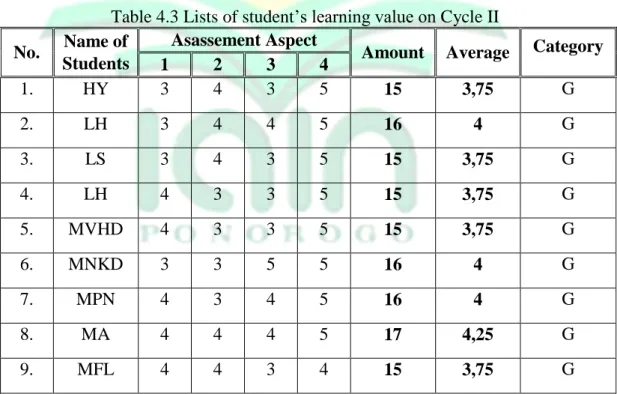
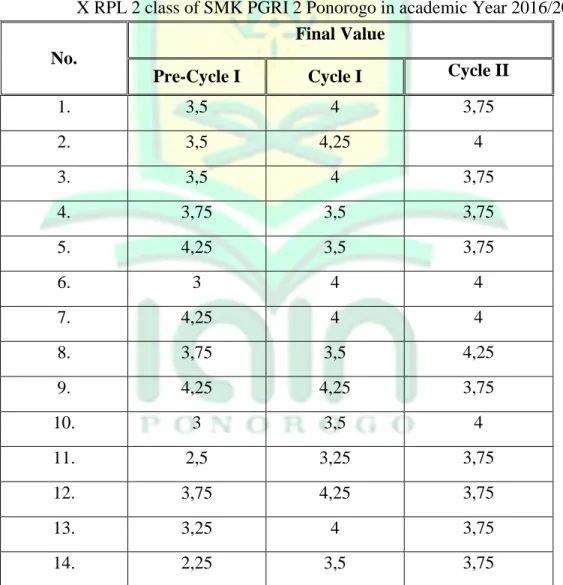
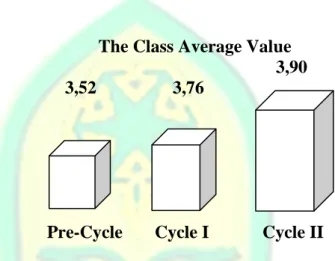
Based on the research result, there is an increase on learning result mastery start from pre-cycle I 3is at 6,67%, on cycle I is at 56,67%, and on cycle II is at 93,33%. Increase on class average value as long as learning process start from pre- cycle I is at 3,52, on cycle I is at 3,76, and on cycle II is at 3,90. The conclusion is that learning process by using caption media can improve students‘ English achievements on SMK PGRI 2 Ponorogo in academic year 2016/2017.
CHAPTER I INTRODUCTION
A. Background of The Study
Indonesian education nowadays has a big challenge to arise and increase students‘ activity and creativity. The latest report by Human Development Resources Research stated that among countries in the world, in term of students‘
active and creativity, Indonesia lies in the bottom of the list. It means that the two points cannot be said good or successful
We cannot blame the students themselves for that because they are only a tiny part of a large and sophisticated system of education. There are so many elements involved that are interconnected and influential to each other. It will be wiser to introspect and review that system instead of blaming them.
Let‘s take a simple example of the sophisticated system, what are the teachers‘ roles and how are the students viewed? In most of our classrooms so far, it seems that teacher is the center on which whether or not learning will be in progress depends. Teachers behave as if they were the King of the class. This can be seen form the way they teach. Learning is the most common monotonous technique chosen by most teachers where the teachers speak and explain a lot and the students only listen much, or teachers explain and write on a blackboard and the students only copy the note to their notebook. It is similar to the situation in a
place meeting between the King and his men where the King gives words and the men only say yes and do what he says. There is a little-if we cannot say there is no chance for the students to ask questions and develope their own hypothesis and creativity. In the same case, even teachers are allergic of students‘ questions.
There are still many facts showing the poor quality of education in the country. Let see the product of the education itself. Some people say that education in the country produce nothing but the increasing number of unemployment. The number gets bigger and bigger on the school graduation each year. What they have learned at school seems to be useless for them in the real life. They are still confused about how to use their knowledge in the real life.
As CORD (2003:56) stated thet the majority of students in our school are unable to make connections between what they are learning and how that knowledge will be used. This is because the way they process information and their motivation for learning are not touched by the traditional methods of classroom teaching. The studnets have a difficult time understanding academic concepts as they are commonly taught (that is, using an abstract, lecturing method), but they desperately need to understand the concepts as they relate to the workplace and to the larger society inwhich they will live and work.
Traditionally, students have been expected to make these connections on their own, outside the classroom.
If we want to have students‘ activity and creativity developed and better education products, we should change the method. Students should not be longer
viewed as the objects of teaching. Instead, they are the subjects of learning.
Instructional method should not be based on merely lecturing abstract concepts either. As we know, there are so many strategy or methods that can be use on learning.
In this case, Caption media is expected to give a bright light in the way taken to meet the demand. It is a strategy that is based on the root of constructivism. It may answer many question that teachers face everyday in dealing with learning method that best meet the demand. A caption, also known as a cutline, is text that appears below an image. Most captions draw attention to something in the image. That is obvious, such as relevance to the text. Caption media is visual, it is very effective to stimulate to the eagerness of students in learning language. By using caption media on class, teacher can help students to improve their achievement. Not only increasing students achievement, but also their motivation, because they interesting to know and understand the meaning from the picture.
At most school, SMK PGRI 2 Ponorogo also faces the some challenges.
Effort must be done to find a better way to equip students‘ English achievements.
In this case, the caption media becomes the choice.
B. Identification and Limitation of The Problem
The researcher take some identification from the discussion and the identification of the problem is the motivation on students. Because the motivation is very correlated in students‘ English achievements. From some identification of the problem above, the researcher determine the limitation of the the problem. The limitation of the problem in this research is students‘ English achievements. Because in this research, the researcher will explain about student‘
achievement that imroved by using caption media.
C. Statement of The Problem
Based on the background of the studey above, the researcher would like to answer the following question below:
1. Is the caption media be able to improve students‘ English achievement inSMK PGRI 2 PONOROGO?
2. How is the caption media improve students‘ English achievement in SMK PGRI 2 PONOROGO?
D. Objectives of The Study
Based on the statements of the problems above, it can be figured out the purpose of the study as following:
1. To know that caption media is be able to improve students‘ English achievement in SMK PGRI 2 PONOROGO.
2. To know how the caption media improve students‘ English achivement in SMK PGRI 2 PONOROGO.
E. Significance of The of The Study
The results of this research are expected to give useful to:
1. Encourage the English teachers to use many kinds of caption medai in teaching English language especially to improve students‘ English achievement.
2. Help students into improve their English achievement.
3. Give more experience or input for readers that caption media can be usedas a technique in teaching English language.
F. Systematic Discussion
This research under tittle ―Caption Media to Improve Students‘ English Achivements‖ is organized into 5 chapter.
CHAPTER I Introduction
This chapter consist of some discussion about background of the study, identification and limitation of the problem, statement of the problem, objectives of the problem, significance of the study and systematic discuccion.
CHAPTER II Review of literature
This chapter explains about theoritical background, writing skill, reading skill, listening skill, speaking skill, previous research finding, theoritical framework, and hypothesis.
CHAPTER III Research methodology
This chapter explains about research object, subject research setting, research variable, research procedures, technique data collected, technique of data analysis, schedule of classroom action reseach.
CHAPTER IV Result and Discussion
This chapter explains about research setting, research process, data analysis, discussion.
CHAPTER V Closing
This chapter explains about conclusion and suggestion.
CHAPTER II
REVIEW OF LITERATURE
A. Theoritical Background 1. Caption Media
a. Definition of Caption Media
On a student‘s textbooks, a caption also known as a cutline, is text that appears below an image. Caption also include a short title or heading of an article in a magazine or newsapaper1. On the other theory, caption is a process that helps the writer figure out what his/her idea are2.
According Morton Ann Gernsbacher (2015 : 195), Captions are like foreign-language subtitles; they translate a spoken language into a written language (Garza, 1991). Like foreign-language subtitles, captions appear at the bottom of the screen. Unlike foreign-language subtitles, captions translate into writing the same language that is heard in speaking, which is why captions are also called same-language subtitles3
1 Bahasa Inggris SMA/MA/SMK/MAK Kelas XII, 2015: pg. 11
2 THE EFFECT OF DRAW LABEL CAPTION STRATEGY TOWARD STUDENTS‘
ABILITY IN NARRATIVE WRITINGFORSENIOR HIGH SCHOOL STUDENTS IN ACADEMIC YEAR 2012/2013A Study at Eleventh Grade Students of SMAN 14 Padang, Afni Salam, STKIP PGRI Sumatra Barat.
3 Morton Ann Gernsbacher, Video Captions Benefit Everyone, Behavioral and Brain Sciences2015: pg. 195
Furthermore, Merriam-Webster's Learner's Dictionary (2016), caption is a sentence or group of words that is written on or next to a picture to explain what is being shown.4
Caption refer to subtitles or translation of the spoken word that were designed to permit those who are deaf or hearing impaired to read what they cannot hear or hear well (Deborah Linebarger, 2001: 288).5
Therefore, we can conclude that caption is brief article that completes a picture. Caption also include a short title or heading of an article in a magazine or newsapaper. Each of us read magazines, we often find a wide rang caption. From that picture, we will know what is the meaning, the message, and the information from that information.
From this strategy, we know every student have an imagination and an idea to the picture that provided..With the caption, we can know how far their creativity on understanding English language learning. Other than that, it will be fun if there the picture and caption.
Media can be a component of active learning strategies such as group discussions or case studies. Media could be a film clip, a song that usually can hear everywhere, newspapper article, and so many more.
Media can be used to motivate discussion or lock in concept. We can
4 Merriam Webster's Learner's Dictionary, http://www.merriam webster.com/dictionary/capti- on, Acces on Friday November 4th, 2016
5 Deborah Linebarger, Learning to Read from Television: The Effects of Using Captions and Narration, Journal of Educational Psychology, Perdue Univercity, 200: pg. 288
bring the media into the classroom through visuals, sounds, smells, and tastes. Because our brins rely heavily on stimulus from the outside for learning, this is one of the reasons that teaching with media is brain friendly.
These are considered instructional when they carry messages with an instructional purpose. The purpose of media is to facilitate communication. 6 Media can be used in almost any discipline to enhance learning both in class and also for out of class assigment. The study of media-produced messages and their effects on mass audiences is the basis for what is broadly called media literacy.7
Media are used as instructional systems. They are used to promote individualization of instrustion in both conventional and nonconventuonal setting. The fiunction of technological media is to supplement the teacher through enhancing his effectiveness in the classroom. Educational media are both tools for teaching and avenues for learning, and their function is to serve these two processes by enhancing clarity in communication, deversity in method, and forcefulness in appeal. Except for the teacher, these media will determinne more than anything else the quality of our educational efffort.8 Nowadays, the purpose and the function of media is
6 Robert Heinich, Instructional Media and Technology for Learning, 1982; pg. 10
7 Steve Goodman, Teaching Youth Media, Amsterdam Avenue, New York, 2003: pg. 13
8 DR. Sunday Taiwo, Teachers‘ Perception of The Role of Media in Classroom Teaching Secondary Schools, The Turkish Online Journal of Educational Technology, 2009: pg. 76
more effective on classroom. The students can use their imagination to learn more in the classroom including on English language learning.
b. Caption as Visual Media
Actually, caption including in visual media. Caption almost same like the picture and have they have same function on visual media. But the distinguish them just the words that included in the picture. If the caption have a cutline, the picture just the picture without the explanation.
Caption or picture are readily available in books, magazine, newspaper, catalogs, and calender. In addition, you can purchase large photographs from educational supply companies to use with groups of students, or you can obtain them from your media center or library. You may includ skill in deciding textbooks pictures in instructional ojectives to motivate learners to use them for study purposes. The quality an d quantity of illustrations are, of sourse, important factors in teextbook choice. You may use pictures from newspapers and periodicals in similar ways.
Students should understand that textbook pictures are not decorations but are intended to be study aids and should be used as such.
Encourage students to give attention to them.9
Every learning media always has advantages and disadvantages, and these are the advantages and disadvantage of caption media as visual media:
9 Robert Heinich, Instructional Media and Technology for Learning, 1982: pg. 142-143
Advantages :
1) Repeatable, caption can read manytimes by saving it or clipping it.
2) The analyze is more sharp, can makes peoples really understand the news content by analyzing more deeply and can makes peoples think more specifically about it.
3) Can resolve the limitation of experience on student
4) Can improving interaction between students with their environment 5) Can awaken new interest and student‘s attention.
Disadavantages :
1) Caption is too slow and less practical
2) There is no audio, it just form of writing that is true can not liste.
Therefore it less detailed the lesson that be delivered
3) Limited visual, this media just can gives visual is an image that represent news content
4) Cost of produstion is quite expensive because media printing must printed and posted before it can be enjoyed by peoples.10
c. Benefits of Caption Media
The use of captions in the classroom provides essential access to the curriculum . Research has highlighted the link between the use of captions and improved literacy benefits for students.
10 Sakinah, 2013, http://sakinahunpak.blogspot.co.id/2013/07/a9.html acces on wednesday, November 9th 2016.
Access to media and technology in schools is a necessity for all students, to ensure that they can learn and interact with the curriculum, and to assist in the meeting of age appropriate learning outcomes.
Captions are generally used by people who are deaf or hard of hearing but they have educational benefits for all students, in particular those who speak English as a second language, have learning disabilities such as dyslexia, attention challenges, sit on the autism spectrum, or any student struggling to read or spell.
After knowing some definiton of caption media, we can see that the caption media is very helpful. And here are some benefits :
1) Learn words and phrases more effectively
2) Improve listening, comprehension, vocabulary, word recognition 3) Helps learn colloquial language\
4) Alternative way to understand and reinforce information 5) Back up for auditory processing difficulties
6) Improves focus and engagement11 d. How to Use Caption Media
Caption differ from foreign language subtittes in that they can be coloured and positioned to indicate who is speaking and provide imformation on music and sound effects wich may be central to the
11 University of Canterbury (2013). Popular movies help children improve literacy.http://www.capthat.com.au/benefits-captions acces on november 8th 2016
understanding of the progra. Subtittles are simply a translation of s foreign language into English which appears on the bottom of the screen.
Captions provide contextual information for students. The use of Caption in classroom is essential for those students who are deaf or have hearing impairment and is also of great benefit for other students, particularly diverse learners. The use of captions can assist in improving learning outcommes by supporting information acquisition.
When students are asked to write an expository textdescribing a sequence of events, teachers often receiveessays that read like lists.
Perhaps the studentshave used some sequence cue words, such as firstand next, but their texts lack voice and fluency. This isoften due to students‘
unfamiliarity with how to structureexpository texts and use vocabulary to guide thereader through the text‘s structure. By studying captionedexpository media, students move from theircomfort zone of comprehending visuals with audioto reading the same material and finally to writing inthe target style.12
When the same information is presented in two modalities (audio and visual), it can enhance young children‘s understanding of content by increasing the number of cognitive paths thst can be followed to retrieve
12 Barbara K. Strassman, Hillary MacDonald, Lindsay Wanko, Using Captioned Media as Mentor Expository Texts, TheReading Teacher Vol. 64, No. 3 November 2010: pg. 199
the information, which can lead to increased learning (Linebrager, Kosanic, Greenwood, & Doku, 2004).
This process is similar with what happens when reading a story book, but can also provide children with a different way to engage when they see the actions and emotions of the story come to life. Although the process of readning captions, which are displayed quickly across the screen, prevents the caption reader from going back to re-read the text the way they would be able to if reading a book, the visual cues in the video seem to contribute important perceptual data that the viewer can use to supplement the information obtained from the captions (Jelinek-Lewis &
Jackson, 2001).13
When writing cutline or caption, the caption must be conveyed clearly to audiens. There are four rules to make a good caption :
1) Accurate: Captions mus match the spoken words in the dialogue and convey background noises and other sounds to the fullest exent possible.
2) Synchronous: Captions must coincide with their correspending spoken words and sounds to the greatest extent possible and must be displayed on the screen at a speed that can be read by viewers.
13 READY, SET, CAPTION: HOW CLOSED CAPTIONS CAPTIONS SUPPORT YOUR CHILD AS A READER, Krywko, Krystyann, EDD, Volta Voices; May/Jun 2014; 21, 3; Family Health Database, pg. 17-18
3) Complete: Captions must run from the beginning to the end of the program to the fullest extent possible.
4) Properly placed: Captions should not block other important visual content on the screen , overlap one a nother, run off the edge of the video screen, or be blocked by other information.14
2. Student’s Achievements a. Writing Skill
Writing is one of the important skills in teaching English. It has always occupied place in most English language course.In the process of writing, the method does not only emphasize the strucure and organization of English texts. Learners‘ attention is not merely called uon the structure, style and the organization of their writing. If so, their works will be very Indonesian although enrolled as English15.
Writing is communication with other in a verbal way. Writing is also an action a process of discovering and organizing your idea, putting them on paper and reshaping and revising them. Writing skills are specific abilities which help writers put their thoughts into words in a meaningful form and to mentally interact with the message.
Writing calls on two skills that are so different that they usually conflict with each other: creating and criticizing. In other words, writing
14 Ibid, pg. 18
15 Dolar Yuwono, Writing 1 from practice to theory: getting smart and creative to write, 2015: pg.
4
calls on the ability to creater words and ideas out of yourself, but it also calls on the ability to citicize them in order to decide which ones to use.
When they do, you find yourself writing words that are at once inventive and rich, yet also shrwed, thoughminded, and well ordered. But such magical sessions are rare.16
From definition above the researcher concludes that writing is a way to product language that comes from our thought. By using writing, we can share our idea, feeling or anything that exist in our mind. It is written on paper or a computer screen. It is influenced both by personal attitudes and social experiences that the writer bring to writing and the impact of the particular political and institutional context. It is also a process that we write is influenced by constraints of genre and has to be present in learning activities.
1) The Open-Ended Writing Process
The open-endee writing process is at the opposite extreme from the direct writing process. It is a way to bring to birth an unknown, unthought of piece of writing-a piece of writing that is not yet in you.
It is a technique for thinking, seeing, and feeling new things. This process invites maximmum chaos and disorientation.
The open-ended writing process as a voyage in two stages: a sea voyag and coming to new land. For the voyage you are trying to lose
16 Peter Elbow, Writing with Power: techniques for Mastering the Writing Process, 1998: pg. 7
sight of land, the place you began. Getting lost in the best source of new material. In coming to new land you develop a new conception of what you are writing about a new idea or vision and then you gradually reshape your material to fit this new vision. The sea voyage is process of divergence, branching, proliferation, and confusion. The coming to new land is a process of convergence, pruing, centralizing, and clarifying.
The open-ended writing process is ideal for the situation when you sense you have something to write but you don‘tt quite know what. Just start writing about anythingat all. If you have special trouble with that first moment of writing, that confrontation a blank page, ask yourself what you don‘t want to write about and start writing about it before you have a chance to resist. First thoughts.
They ar every likely to lead you to what you are needing to write.17 From here we can understand that writing skill is not just to write something. In writing process we need a material to begin writing and the material is our thinking. We have thinking something or everything before we writing.
17 Peter Elbow, Writing With Power: Techniques for Mastering the Writing Process, 1981: pg.
50-51
2) The Social and Cognitive Sides of Writing
Writing is by nature a social process. Writing represents the means by which a message can be communicated to someone else.
Children learn how to become writers through meaningful interactions with more knowledgeable people. In an environment where writing is an everyday occurrence, young children learn important lessons about the writing process. They begin to talk about their transcriptions as signs of meaning. If children come from a writing environment prior to first grade, they have already acquired critical understandings for learning about the writing process.
Writing is a learned skill that is shaped through practice and constructive feedback. It requires motivation, strategies, skills, and knowledge. When children write, they acquire cognitive strategies for attending, monitoring, searching, evaluating, and self-correcting their actions (Clay 2001). A self-regulated writer is one who knows how to guide and monitor her writing actions toward achieving a specific writing goal. This implies that the self-regulated writer understands how to use specific strategies for planning, generating, organizing, and revising the writing process (Harris and Graham 1999).18
18 Dorn, L. J. and Soffos, C. Scaffolding Young Writers. Maine: Stenhouse Publisher, 2001: pg.
2
3) Teaching Writing as a Process
The movement from product to process demands change.
Teachers cannot teach students through process unless the teachers know what the process paradigm embraces. Writing as a process means giving students time to prewrite, write, postwrite, proofread, and edit their papers. It means teaching writing, not just assigning it. It means teaching the various forms of writing so students think through their meaning, their purpose, and the needs of their audience to determine the most appropriate genre. It means encouraging students to collaborate with peers and to discuss their projects with teachers during the writing. It means permitting students to determine to some extent the schedule for completed papers to be submitted to the teacher and subsequently to be published. (At any level, students should experience the delight of publication.) It means teaching grammar and mechanics within the writing process. It means hard work, self- satisfaction, discovery, and making decisions. It means making classrooms joyfully literate places
.
Some teachers might promptly dismiss any training in the strategies of teaching writing as a process with a decisive "No." But these teachers must think again. Process has become the prevailing paradigm. And yes, it is radicalradical in the best sense of the word,
meaning it comes from the root or origin; it comes from teachers who have observed and recorded the way students write. It comes from teachers who have noted that the way writing happens does not match the way some textbooks say it does. It comes from teachers who have questioned, studied, and researched the way writing was handledas if writing could happen on command.19
In teaching writing to young children, we must recognize the complexity of the process. Think a moment about what happens in the mind of a writer as he creates a written piece. The intricacy becomes clear when we apply this concept to our own writing. The first step, that of coming up with the idea, is based on our experiences and knowledge—in other words, our thoughts. These ideas can be spontaneous, elaborated, or general. In either case, the next step, that of finding the right words to express the idea, is a more challenging task. This involves rereading and revising the text, for example, deleting unnecessary words or sections, rearranging sentences and paragraphs, and clarifying concepts.20
19 Acts of Teaching How to Teach Writing Joyce, Armstrong Carroll and Edward E. Wilson, 1993: pg. 12
20 Dorn, L. J. and Soffos, C. Scaffolding Young Writers. Maine: Stenhouse Publisher, 2001: pg.
2
b. Reading Skill
Reading can be defined simply as making meaning from print.
Four key elements combine in the process of making meaning from print:
the reader, the text, reading strategies, and fluency. Reading is a process of readers combining information from a text and their own backgriound knowledge to build meaning. Meaning does not rest in the reader nor does it rest in the text. The reader‘s background knowledge integrates with the text to create the meaning. The goal of readning is comprehension. The fluent reading is defined as the ability to read at an appropriate rate with adequate comprehension. Strategig reading is definad as the ability of the reader to use a wide variety of readning strategies to accomplish a purpose of reading. Good strategic readers knnow what to do when they encounter difficulties. The text, the reader, strategies, and fluency together define the act of reading.21
On the other word, reading is something that you can do on your own and that greatly broadens your vocabulary, thus helping you in speaking (and in listening and writing). Reading is therefore a highly valuable skill and activity, and it is recommended that English learners try to read as much as possible in English.
Reading is the process of looking at a series of written symbols and getting meaning from them. When we read, we use our eyes to receive
21 Neil J. Anderson, Practical English Language Teaching: Reading, 2008: pg. 2-3
written symbols (letters, punctuation marks and spaces) and we use our brain to convert them into words, sentences and paragraphs that communicate something to us. Reading can be silent (in our head) or aloud (so that other people can hear). Reading is a receptive skill - through it we receive information. But the complex process of reading also requires the skill of speaking, so that we can pronounce the words that we read. In this sense, reading is also a productive skill in that we are both receiving information and transmitting it (even if only to ourselves).
1) What Does Skilled Reading Involve?
Pressley (1998) agrees, and suggests that to become competent readers children need to learn two things: word identification strategies and comprehension strategies. These two sets of strategies are very closely interrelated, with comprehension being heavily dependent upon a reader‘s swift and efficient identification of the words on the page. To some extent, word identification and comprehension share a reciprocal relationship. Rapid word identification obviously facilitates and supports understanding, and reading with understanding promotes speed and fluency in processing print (Rayner, Rayner & Pollatsek 1995).
Effective literacy instruction must include a planned program for the explicit teaching of both word identification skills and
comprehension strategies to enable children to read fluently, with enjoyment and understanding (Strickland 1998; Torgesen 2000).22 2) Reading Difficulties and Vision
It is not uncommon to find that a teacher believes a child‘s reading difficulty is due to problems with eyesight but the vast majority of reading difficulties are not caused by vision impairment or by visual perceptual anomalies (McGuinness: 1998). This is not to say that in individual cases of learning failure vision may not be implicated in some way.
Ryan (1999), for example, discusses possible subtle dysfunctions in visual perception that might cause difficulties in rapid processing of sequentially arranged stimuli, such as letters in a word, but this is not suggested as a frequent or common cause of reading failure. Some studies have reported abnormal eye movements in individuals with reading difficulties. The general consensus is, however, that rather than being a cause of reading difficulty, unusual eye movements may be the result of a poor reader‘s limited ability in word recognition and the way he or she is trying to compensate (Critchley 1981; Howell & Peachey 1990). As stated above, poor readers make many more regressive eye movements than do good
22 Peter Westwood, Reading and Learning Difficulties: Approaches to teaching and Assessment, Australia: National Library of Australia Cataloguing, 2001: pg. 13
readers, and they are likely to spend longer in each fixation while they process a word. For most children, these aspects of performance improve as they engage in more reading and writing activities.23
3) Bottom-Up, Top-down, and Interactive Reading
Bottom-up, top-down, and interactive reading are names of different theoritical models that researchers use to discribe how people process print. We will review each of these models and gain an understanding of why an interactive process is the best representation of how people read.
(a) Bottom-Up
Models consist of lower level reading processes. Students start with the fundamental basics of letter and sound recognition, which in turn allows them to move up to morpheme recognition followed by word recognition, building up to the identification of grammatical structure, sentences, and longer texts. Understanding letters, letter clusters, words, phrases, sentences, longer text, and finally is the order in achieving comprehension.
From there students will begin combining letters to read and write words. They then become familiar with spelling patterns an learn to read sentences, paragraph, and longer texts. The bottom-
23 Peter Westwood, Reading and Learning Difficulties: Approaches to teaching and Assessment,Australia: National Library of Australia Cataloguing, 2001: pg. 17
up model uses phonics as its core, believing readers first process and understand sounds in speech and move on to understand letters, then word, then loger sentences.
Eventually, they build comprehension skills as they grow as readers.
(b) Top-Down
Top-Down reading, on the other other hand, begins with the idea that comprehension resides in the reader. The reader use background knowledge, makes predictions, and searches the text to confirm or reject the predicitons that are made. Grade and Stoller (2002) point out that in a top-down model of reading, comprehension is directed by the reader‘s goals and expectations.
Withing a top-down approach to reading, the teaacher focuses on meaning generating activities rather than on mastery of the bttom- up skills of letter, sound, and word recognition.
Top-down models ask readers to sonstruct meaning from text, this knowledge is made from the text to the words. This model does not focus on phonics and decoding, but instead, allows children opportunities to read ‗real‘ books and make sense of them. Finally the top-down method utilizes making sense of grammar and text clues to figure out unknown words.
(c) Interactive Reading
This third type combines elements of botj bottom-up and top-downapproaches. The best readers in any language are those who combine elements of both. For example, most readers begin reading by using top-down readning strategies. Have you ever read something quickly and suddenly come to several new words?
You are required to slow down your reading to decode the new words. When you do this, you are using bottom-up strategies to understand the words.24
Teachers using the interactive model use both instruction methods relying in phonics and a student‘s experiences with text, believing that each is necessaryy for understanding. In classroom using the interactive model, students receive direct instruction on the sound/symbol relationships in phonics alongside instruction in comprehension and reading strategies.
c. Listening Skill
Listening is one of the fourth skill in English learning. In here, the students expected to be able to mastering these ability because from listening, students can processing the words that will be used to respond from what the students hears. Approaches that gave more importance to
24 Neil J. Anderson, Practical English Language Teaching: Reading, 2008 : pg. 5-7
listening were based on different ideas. Nord (1980: 17) expresses this view clearly.
Some people now believe that learning a language is not just learning to talk, but rather that learning a language is building a map of meaning in the mind. These people believe that talking may indicate that the language was learned, but they do not believe that practice in talking is the best way to build up this ―cognitive‖ map in the mind. To do this, they feel, the best method is to practice meaningful listening.
In this view of language learning, listening is the way of learning thelanguage. It gives the learner information from which to build up the knowledge necessary for using the language. When this knowledge is built up, the learner can begin to speak. The listening-only period is a time of observation and learning which provides the basis for the other language skills.25
Listening is the absorption of the meanings of words and sentences by the brain. Listening leads to the understanding of facts and ideas. But listening takes attention, or sticking to the task at hand in spite of distractions. It requires concentration, which is the focusing of your thoughts upon one particular problem. A person who incorporates listening with concentration is actively listening. Listening more refers to
25 Teaching ESL/EFL Listening and Speaking, Jonathan Newton, Routledge, Taylor & Francis, 2009: pg. 38
the hear ability to students. Because after the tudents hear the information or something, they will transfer what they heard to the brain and they will try to express what they heard.
Listening is receiving language through the ears. Listening involves identifying the sounds of speech and processing them into words and sentences. When we listen, we use our ears to receive individual sounds (letters, stress, rhythm and pauses) and we use our brain to convert these into messages that mean something to us. Listening in any language requires focus and attention. It is a skill that some people need to work at harder than others. People who have difficulty concentrating are typically poor listeners. Listening in a second language requires even greater focus.
Like babies, we learn this skill by listening to people who already know how to speak the language. This may or may not include native speakers. For practice, you can listen to live or recorded voices. The most important thing is to listen to a variety of voices as often as you can.
1) Listening Process
In listening skill there are two process that can help student to learn listening in English language.
a) Bottom-up Processes
These are the processes the listener uses to assemble the message piece-bypiecefrom the speech stream, going from the parts to the whole. Bottomupprocessing involves perceiving and
parsing the speech stream atincreasingly larger levels beginning with auditory-phonetic, phonemic, msyllabic, lexical, syntactic, semantic, propositional, pragmatic and interpretive (Field, 2003:
326).
b) Top-down Processes
Top-down processes involve the listener in going from the whole theirprior knowledge and their content and rhetorical schemata to the parts. In other words, the listener uses what they know of the context of communicationto predict what the message will contain, and uses parts of the message to confirm, correct or add to this. The key process here is inferencing.
When we put these two types of processing together we see listening notas a single skill, but as a variety of sub-skills.It is possible to make sense of a spoken message by drawing cues from context and picking up a few key words, but without attending to thegrammatical form of the message. In other words, comprehension is possible without noticing.26
2) Supporting Listening
We can assist our learners by providing them with support when they do an activity (e.g., around the house—add a list of words
26 Teaching ESL/EFL Listening and Speaking, Jonathan Newton, Routledge, Taylor & Francis, 2009: 40-41
or pictures for the learners to see as they listen). This support acts as a temporary bridge which learners use to reach the target. Over time, learners internalise the expertise required to meet the target independently and the bridge can be removed.
a) We can provide this support in four main ways:
1) By providing prior experience with aspects of the text (i.e., withlanguage, ideas, skills or text-type).
2) By guiding the learners through the text.
3) By setting up cooperative learning arrangements (for example,
4) shared reading approaches).
5) By providing the means by which learners can achieve comprehensionby themselves.
b) ProvidingPrior Experience
This can be done by rehearsing the text beforehand, using a simple version first, repeating the listening, using language or ideas already within learners‘ experience while increasing the skill demands of a task, and preteaching items. The topic of the text can come from the learners‘ previous experience and may be based on a first language text. Similarly, working on a theme that continues over several days can provide useful content support
for listening activities, because the learners‘ content knowledge increases as they keep working on the theme.
c) Providing Guidance During Listening
Learners can be guided through the text by using completion activities where part of the text is provided but the learners must fill in the gaps, by using ordering activities where the main points are provided and the learners must put them in the correct order, having questions to answer that cover the main points of the input, and having information transfer diagrams to fill in or pictures to label.
d) Working in Groups to Support Listening
Learners can treat listening as a kind of group work where they are able tonegotiate with the person providing the input. This can allow for negotiationto occur during the activity.
In note-taking activities learners can work in pairs to take notes, and if the lecturer provides time for learners to discuss the input with each other at points during the lecture this can help those who are getting left behind keep up with what‘s going on.27
27 Teaching ESL/EFL Listening and Speaking, Jonathan Newton, Routledge, Taylor & Francis, 2009: pg. 46-47
d. Speaking Skill
Speaking is an interactive process of constructing meaning that involves producing and receiving and processing information. Speaking is such a fundamental human behavior that wee don‘t stop to analyze it unless there is something noticeable about it.28Its form and meaning are dependent on the context in which it occurs, including the participants themselves, their collective experiences, the physical environment, and the purposes for speaking. It is often spontaneous, open-ended, and evolving.
However, speech is not always unpredictable.
1) Reticence and Dominance in Speaking Activities
A group of secondary school EFL teachers in Hong Kong studies their own English classes (Tsui, 1996). They fisrt gathered data through a variety of means (videotaping, audiorecording, surveying tha dtudents) and examinedthe data to see what they could learn about their students‘ oral participation in English. As a result, they found some predictable and some unpredictable reasons for their studnets‘ reticence to speak English.
On examining their data, the teachers learned the students‘
reticence could be attributed to five factors:
(1) The students‘ low English proficiency
28 Kathleen M, Bailey, Practical English Language Teaching: Speaking, 2005: pg. 2
(2) The students‘ fear of mistakes and the derision they thought they would face as a result
(3) The teachers‘intolerance of silence (4) The teachers‘ uneven allocation of turns (5) Incomprehensible input from the teachers.
The first two results were predictable, but th teachers were surprisedby the other three. It seems the teachers themselves were creating conditions that contibuted to the students‘ reticence.29
2) Speaking and Spoken Interaction
Teaching and testing experts often talk about speaking as a technicalterm to refer to one of the various skills that language learners should develop and have. This type of speaking tends to be seen as somethingthat individuals do. It is legitimate, and for educational purposes useful, to see speaking in this way too, because it is true that individuals speak, and an important part of language use is personal. Nevertheless, it is also important to remember that speaking forms a part of the shared social activity of talking.
In a typical spoken interaction, two or more people talk to each other about things that they think are mutually interesting and relevant in the situation. Their aim can be to pass the time, amuse each other, share opinions or get something done, or they can aim to
29 Kathleen M. Bailey, Practical English Language Teacing: Speaking, 2005: pg. 163
do several of these and other things at once. The point in their interaction is that they do these things together. Each participant is both a speaker and a listener; they construct the event together and share the right to influence the outcomes, which can be both shared and individual.30
B. Previous Research Findings
There are previous related study, which is related to be present in this resarch. The first, researcher take the previous research findings from Afni Salam with the tittle of research ―THE EFFECT OF DRAW LABEL CAPTION STRATEGY TOWARDSTUDENTS‘ ABILITY IN NARRATIVE WRITING FOR SENIOR HIGH SCHOOL STUDENTS IN ACADEMIC YEAR 2012/2013(A Study at Eleventh Grade Students of SMAN 14 Padang).‖
The design of this research was anexperimental research and the researcherused Quasi Experimental Design because itinvolved by two equal qualification of sample group. Moreover, in this research, the total population were 100 students. They were XI grade in science program (XI IPA 1, XI IPA 2 and XI IPA 3). In this study, the researcher chose Cluster Sampling. Then, the researcher determined and found means score each classes. Next, the researcher chose two classes which had mean score closely related with each other by also checking normality and homogenity of them. Next, determine which one as
30 Sari Luoma, Assesing Speaking, 2004: pg. 20
experimental class and control class. As a result, XI IPA 3 as experimental class and XI IPA 2 as control class. Then, the researcher gave the treatments to both classes. After that, the data collection was taken from post test. The researcher used writing test in form of narrative essay as instrumentation. In this test, the researcher gave time allocation about 90 minutes.Finally, the result of post test from both classes were compared by using statistic formula of Sudjana. The result of the calculated data shown that the use of draw label caption strategy gives significant effect toward students‘ writing ability in narrative essay.
The differences between previous study and this research are; the research design (the previous study using experimental design while this research using classroom action research), the aimed (the goal of the previous study is to know the effect by using draw label caption strategy to the writing ability on English learning while the goal of this research is to know that caption media can improve students‘ English achievement). The location (the location that used by Afni Salam is SMAN 14 Padang while the location that used by this research is SMK PGRI 2 Ponorogo).
The second, previous study was from a journal of Ching-Kun Hsu, Gwo – Jen Hwang and Chih-Kai Chang with the tittle ―AN AUTOMATIC CAPTION FILTERING AND PARTIAL HIDING APPROACH TO IMPROVING THE ENGLISH LISTENING COMPREHENSION OF EFL STUDENTS‖.
Fostering the listening comprehension of English as Foreign Language (EFL) learners has been recognized as an important and challenging issue. Videos
have been used as one of the English listening learning resources however, without effective learning supports, EFLstudents are likely to encounter difficulties in comprehendingthe video content, leading to frustation and reducing learning interest. In this study, a learning system with an automatic caption filteringand partial hiding mechanism was developed to improve the English listening comprehension of EFL students. An experiment was conducted to evaluate the effects of the proposed approach on students‘ learning achievements and perceptions. The participants were 76 freshmen from two classes of a non language related department of a university. Each class contained 38 students. The two classes of studdents were situated in the proposed learning context and the conventional technology enhanced learning context with a counter balanced experimental design. The experimental results verified that the proposed caption filtering approach effectively improved the listening comprehehnsion of the students in comparison with the conventional approach which provides full captions and an e-dictionary. Moreover, from the data collected by the eye movement tracking device, it was found that more than 76% of the students relied on the captions during the learning activity, reflecting the importance of developing effective caption filtering mechanisms for supporting EFL learners.
The defference between previous study and this research are; the research design ( the previous study using experimental design while this research using classroom action research), the aimed ( the goal of previous study is to evaluate the performance of the proposed approach using an automatic caption filtering and
partial hiding mechanism while this research is to know that caption media can improve students‘ English achievement), technique data collecting ( the previous using including achievement tests, questionaire surveys and an eye-tracking machine while this research using testing, observing and documentation), the location ( the location that used by previous study is National Taiwan Normal University, Taipei City, Taiwan while this research on SMK PGRI 2 Ponorogo, East Java, Indonesia).
C. Theoritical Framework
Learning will be successful if the learning objectives is achieved. One of the components that participate to determine the success is media selection or the right learning resource and how the use of media on learning proses.
To make students easy and interest to learn English, the teacher tries to give interesting material and technique that can make students have motivation to improve their English achievement. Through the material that students understand and hat they must do. Caption media can provide an opportunity for students to work in group discussion and chart their current understanding of keys issue, problems, and concept while recalling fact, beliefs, information and key understanding.
From the explanation above, the researcher can take the theoritical framework, among:
1. If the caption media can applicable, then student‘s English language ability will be increased.
2. If their English language ability increased, then their English achievement will be increased.
D. Hypothesis
Based on the limitation and statement, the researcher proposes action hypothesis as follow: there is an enhancement in students English achievement by using caption media at SMK PGRI 2 PONOROGO.
CHAPTER III RESEARCH METHODS
A. Research Object
On this research, the writer took place as an objrk of reserch in SMK PGRI 2 Ponorogo. This school is located in Soekarno-Hatta Street, Babadan, Cokromenggalan, the District of Ponorogo. The reasons why the reseacher choose SMK PGRI 2 Ponorogo are the location is very strategic. This school is located right on the road to Ponorogo-Madiun. Also, SMK PGRI 2 Ponorogo is famous because the students who excellent. This research was conducted on January 11th 2017 and will end on January 20th 2017.
B. Subject Research Setting
Setting of the research was conducted at SMK PGRI 2 Ponorogo. this school is located in Babadan, Cokromenggalan, Ponorogo. Subject of this research was the first grade of RPL 2 students of SMK PGRI 2 in academic year 2016/2017. The class was dominated by the girls that were 15 and 15 boys. The researcher choose this class because the suggestion of the teacher who teach X RPL 2.
Based on the teacher‘s suggestion, this class has a low achievement on English learning. The students look bored, busy themselves, and always crowded in every leaning because the teacher using monotonous technique on learning.
The researcher‘s hope with the caption media can help students to improves English achievement.
C. Research Variable
This research focused of observing, they were as follow:
2. The first grade of RPL 2 students of SMK PGRI 2 PONOROGO in academic year 2016/2017 had the same ability and comprehensionin English skill.
3. The use caption media effectively can helped the students or improved their English skill in English achievement.
D. Research procedure
In this research, there are two cyclesimplemented by researcher. Every cycle consists of two meetings, and every meeting concsists two meeting periods (2 x 45 minutes). In cycle I, researcher gives information about the caption media and the benefit in learning. Caption media is also plays into improving writing skill and students English achievement. In this cycle, researcher also gives some task to test their understanding. How far their ability in writing skill by using caption media.
Then, in cycle II, the researcher just repeat the lesson about the caption media. Usually, in the second chances many problem and difficult from the first cycle. From the statement, the researcher must more active to practice students‘
ability. Not only gives the material and the task but also practice them to make
some caption from picture that available. For a fuller explanation, the researcher make simple cycle in cycle i and cycle II.
Cycle I 1. Planning
a. Identifying the problem
The researcher identified the problem that occur in writing skill and try to improve them through process approach and caption media.
b. Preparing the teaching instrument
The researcher prepared the teaching instrument such as: syllabus, plan, and then the caption media.
2. Acting
In cycle 1, researcher also use power point and paper that content about pictures or caption to help students in understanding material, incerasing their English achievement and to improving their writing skill.
3. Observing
The researcher as the observer did the following activities:
a. Observing the teaching learning process b. Observing the class situation
c. Observing the teacher activity d. Observing the students‘ activity e. Observing results of assessment
4. Reflecting
In this research, researcher as the teacher analyzed data taken from the observing phase and give question to students‘ about the lesson.
Cycle II 1. Planning
a. Identifying the problem
From the cycle I, there are some problem that identicated like the result from test in cycle I still low because students not too understand about caption media.
b. Preparing the teching instrument
From the problem above, the researcher give test again about caption. From hte test we will know how far their ability in the second cycle. And for the practice, the researcher give test to their home work.
2. Acting
In cycle II, the researcher focus on students‘ problem. The researcher give some picture to every student, and let them go to write the words to the picture inaccordance with their creation.
3. Observing
The researcher as the observer did the following activities:
a. Observing the teaching learning process b. Observing the class situation
c. Observing the teacher activity
d. Observing the students‘ activity e. Observing results of assessment 4. Reflecting
In this research, researcher as the teacher analyzed data taken from the observing phase and give question to students about the lesson.
E. Technique Data Collected
To get the value data on this research, the researcher using some tests and observation result.
1. Testing
On this research, the researcher using action testing. Action testing is an assessment tools that the assertion can be submitted in writing or verbally and the form of process is performance and the action.A testis aset of stimuli presented to an individual in order to elicit responses on the basis of which a numerical score can be assigned. This score, based on a representative sample of the individual‘s behavior, is an indicator of the extent to which the subject has the characteristic being measured.31
By this research action, the researcher using action test that is assassement tools that the assertion can be delivered in writing or verbally and the workmanship in appearance or actions form.
31 Donald Ary, Lucy C.J. Chris Sorensen, Introduction to Research in Education, 2010, Wadsworth, Cengage Learning, pg: 201
2. Observing
In research, observation is refers to data gathering which involves the use of not only visual sense, but also the senses necessary to get valid and reliable data. So in research, observation which means data gathering may be done by tests, quistionaires, interview.32Observing is the process of collecting data indicating the success of the strategy in solving the classroom problems. The focus of the observation is on the data related to the criteria of success that have been decided.33
Data retrieval that is done by observation way is research activity that is done by researcher that is held on same time and place. The researcher using observation technique or observing with the aims to gets data about teacher and students activity as long as on learning process, by using observation sheet instrumental or this observation sheet loads about descriptive assassement about teacher and students activity as long as on learning process.
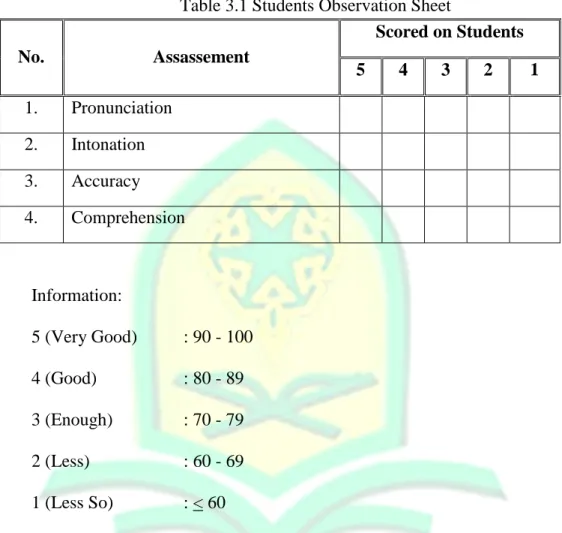
This technique is using by researcher to gets students data about students achievement levels infollowing the learning thats implemented. As for instrument used isas follows:
32 Mohammad Adnan Latief, Research Methods on Language Learning an Introduction, Malang: 2014, pg. 77
33 Ibid, pg. 149
Table 3.1 Students Observation Sheet
No. Assassement
Scored on Students
5 4 3 2 1
1. Pronunciation 2. Intonation 3. Accuracy 4. Comprehension
Information:
5 (Very Good) : 90 - 100 4 (Good) : 80 - 89 3 (Enough) : 70 - 79 2 (Less) : 60 - 69 1 (Less So) : < 60
The data collected good from achievemet test results or data from learning observation grouped based on the result that gets on the every cycle.
From that datas will be obtained the picture or action in improvement students English achievements after applied action from teacher or researcher.
As for the steps that implemented by researcher to collecting data on every cycle is covers:
a. The data that relate to observations or observation when on going the learning process.
b. The data that be related by learning achivement test obtainable by doing achievement test.
c. The data compiled echievement scores on the table form.
3. Documentation
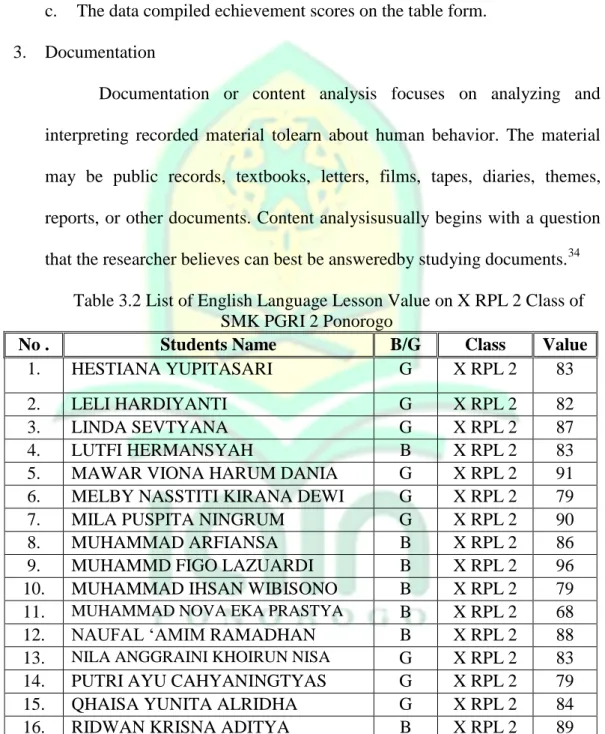
Documentation or content analysis focuses on analyzing and interpreting recorded material tolearn about human behavior. The material may be public records, textbooks, letters, films, tapes, diaries, themes, reports, or other documents. Content analysisusually begins with a question that the researcher believes can best be answeredby studying documents.34
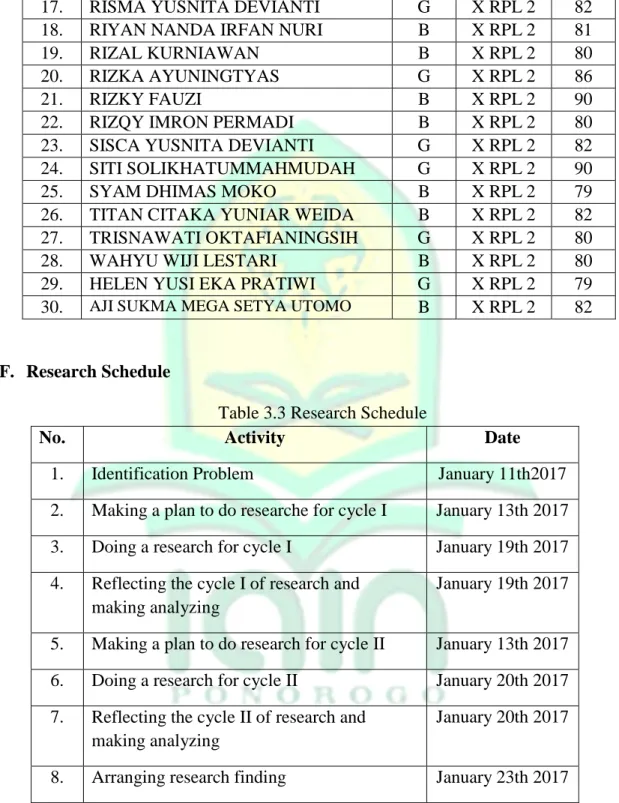
Table 3.2 List of English Language Lesson Value on X RPL 2 Class of SMK PGRI 2 Ponorogo
No . Students Name B/G Class Value
1. HESTIANA YUPITASARI G X RPL 2 83
2. LELI HARDIYANTI G X RPL 2 82
3. LINDA SEVTYANA G X RPL 2 87
4. LUTFI HERMANSYAH B X RPL 2 83
5. MAWAR VIONA HARUM DANIA G X RPL 2 91
6. MELBY NASSTITI KIRANA DEWI G X RPL 2 79
7. MILA PUSPITA NINGRUM G X RPL 2 90
8. MUHAMMAD ARFIANSA B X RPL 2 86
9. MUHAMMD FIGO LAZUARDI B X RPL 2 96
10. MUHAMMAD IHSAN WIBISONO B X RPL 2 79
11. MUHAMMAD NOVA EKA PRASTYA B X RPL 2 68
12. NAUFAL ‗AMIM RAMADHAN B X RPL 2 88
13. NILA ANGGRAINI KHOIRUN NISA G X RPL 2 83
14. PUTRI AYU CAHYANINGTYAS G X RPL 2 79
15. QHAISA YUNITA ALRIDHA G X RPL 2 84
16. RIDWAN KRISNA ADITYA B X RPL 2 89
34Donald Ary, Lucy C.J. Chris Sorensen, Introduction to Research in Education, 2010, Wadsworth, Cengage Learning, pg: 29
17. RISMA YUSNITA DEVIANTI G X RPL 2 82
18. RIYAN NANDA IRFAN NURI B X RPL 2 81
19. RIZAL KURNIAWAN B X RPL 2 80
20. RIZKA AYUNINGTYAS G X RPL 2 86
21. RIZKY FAUZI B X RPL 2 90
22. RIZQY IMRON PERMADI B X RPL 2 80
23. SISCA YUSNITA DEVIANTI G X RPL 2 82
24. SITI SOLIKHATUMMAHMUDAH G X RPL 2 90
25. SYAM DHIMAS MOKO B X RPL 2 79
26. TITAN CITAKA YUNIAR WEIDA B X RPL 2 82
27. TRISNAWATI OKTAFIANINGSIH G X RPL 2 80
28. WAHYU WIJI LESTARI B X RPL 2 80
29. HELEN YUSI EKA PRATIWI G X RPL 2 79
30. AJI SUKMA MEGA SETYA UTOMO B X RPL 2 82
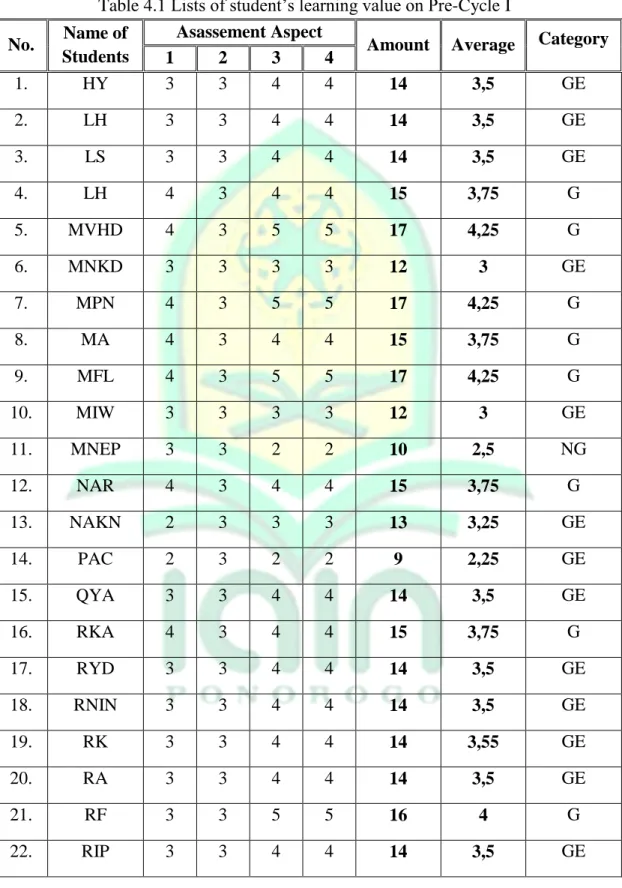
F. Research Schedule
Table 3.3 Research Schedule
No. Activity Date
1. Identification Problem January 11th2017
2. Making a plan to do researche for cycle I January 13th 2017 3. Doing a research for cycle I January 19th 2017 4. Reflecting the cycle I of research and
making analyzing
January 19th 2017
5. Making a plan to do research for cycle II January 13th 2017 6. Doing a research for cycle II January 20th 2017 7. Reflecting the cycle II of research and
making analyzing
January 20th 2017
8. Arranging research finding January 23th 2017