Journal of Caribbean Archaeology, volume 19, 2019 Page 1
Theodoor de Booy:
Caribbean Expeditions and Collections at the National Museum of the American Indian
L. Antonio Curet and Maria Galban National Museum of the American Indian
Smithsonian Institution [email protected] [email protected]
______________________________________________________________________________
Like many other regions throughout the world, the colonial experience in the Caribbean included the arrival of North American and European archaeologists representing museums, universities, or scientific academies. The objects, specimens, and archival documentation gathered during their research were taken back to their countries of origin and today form part of major collections in museums throughout the world. Theodoor de Booy of the Museum of the American Indian was one these early foreign scholars working in the Caribbean. He collected thousands of objects and created a large photographic collection from his 13 archaeological and one ethnographic expeditions throughout the region between 1911 and 1918. Considering the breadth of his work, de Booy could easily be considered the leading specialist of Caribbean archaeology of his time. Unfortunately, despite his successful career, his role in Caribbean archaeology and the quality of the collections he obtained are greatly underestimated by scholars working in the region. This paper discusses the nature of de Booy’s travels and research throughout the Caribbean, from Cuba and Jamaica to Venezuela, and characterizes the collections, now held by the National Museum of the American Indian. The projects, collections, and publications are assessed within the context of the period, and his impact on the archaeology of the region is discussed.
Como muchas otras regiones del mundo, la experiencia colonial en el Caribe incluyó la llegada de arqueólogos norteamericanos y europeos que representaban museos, universidades o academias científicas. Los objetos, especímenes y documentación de archivo reunidos durante sus investigaciones fueron transportados a los países de los investigadores y actualmente forman parte de importantes colecciones de museos alrededor del todo el mundo.
Theodoor de Booy, del Museo del Indígena Americano, fue uno de los primeros investigadores extranjeros que trabajaron en el Caribe. Coleccionó miles de objetos y creó una gran colección fotográfica de sus 13 expediciones arqueológicas y una etnográfica a través de toda la región entre 1911 y 1918. Teniendo en cuenta la amplitud de su trabajo, de Booy podría fácilmente ser considerado el principal especialista de la arqueología caribeña de su tiempo. Desafortunadamente, a pesar de su exitosa carrera, su papel en la arqueología caribeña y la calidad de las colecciones que obtuvo son muy subestimados por los estudiosos que trabajan en la región. Este artículo analiza la naturaleza de los viajes e investigaciones de De Booy a lo largo del Caribe, desde Cuba y Jamaica hasta Venezuela, y caracteriza las colecciones que hoy día se encuentran en los depósitos del Museo Nacional del Indígena
Americano. Los proyectos, colecciones y publicaciones son evaluados en el contexto del período y se discute el impacto de De Booy en la arqueología de la región.
Comme beaucoup d'autres régions du monde, l'expérience coloniale dans les Caraïbes a vu l'arrivée d'archéologues nord-américains et européens représentant des musées, des universités ou des académies scientifiques. Les objets, spécimens et documents d'archives recueillis au cours de leurs recherches ont été ramenés dans leur pays d'origine et font aujourd'hui partie des principales collections des musées du monde entier. Theodoor de Booy du Musée des Amérindiens était l'un de ces premiers érudits étrangers travaillant dans les Caraïbes. Entre 1911 et 1918, il collectionne des milliers d'objets et crée une grande collection photographique à partir de ses 13 expéditions archéologiques et d'une expédition ethnographique à travers la région. Compte tenu de l'ampleur de son œuvre, de Booy pourrait facilement être considéré comme le principal spécialiste de l'archéologie caribéenne de son époque.
Journal of Caribbean Archaeology, volume 19, 2019 Page 2 Malheureusement, malgré sa carrière couronnée de succès, son rôle dans l'archéologie caribéenne et la qualité des collections qu'il a obtenues sont largement sous-estimés par les chercheurs travaillant dans la région. Cet article traite de la nature des voyages et des recherches de M. de Booy dans les Caraïbes, de Cuba et de la Jamaïque au Venezuela, tout en caractérisant les collections aujourd'hui détenues par le National Museum of the American Indian. Les projets, collections et publications sont évalués dans le contexte de l'époque et l'impact de De Booy sur l'archéologie de la région est discuté.
Figure 1. Theodoor de Booy in the Dominican Republic in 1916 (National Museum of the American Indian [Neg. N04834]).
Introduction
Anthropology, archaeology, and museology are relatively young disciplines and it is clear that they were formed against a colonial background. Their perspective at that time was the study of the “other” or the exotic, which often was framed within the concept of natural history or the history of nature; it involved the non-civilized or acculturated world. This approach required sending expeditions to collect information and materials for study and exhibition to the
public. Like many other regions throughout the world, the Caribbean experienced this colonial endeavor that included the arrival of foreign archaeologists, mostly from the United States and Europe, representing museums, universities, or scientific academies as part of what has been called
“imperial science.” The objects, specimens, and archival documentation gathered during their research were taken to their countries
Journal of Caribbean Archaeology, volume 19, 2019 Page 3 of origin and today form part of major
collections throughout the world.
Theodoor de Booy of the Museum of the American Indian (MAI) in New York city was one of these foreign scholars working in the Caribbean early in the 20th century. He collected thousands of objects and created a large photographic collection from at least 14 expeditions between 1911 and 1918. These collections are now housed at the National Museum of the American Indian, Smithsonian Institution in Washington D.C. The primary purposes of the essay are to present the scope, range and limitations of both the objects and archival collections and to provide a view of their potential for future research.
Considering the breadth of his work, de Booy could easily be considered one of the leading and most prolific specialists of Caribbean archaeology of his time.
Unfortunately, despite his successful career, his role in Caribbean archaeology and the quality of the collections he obtained are greatly underestimated and underused by scholars working in the region. This paper discusses the nature of de Booy’s travels and research throughout the region, from Cuba and Jamaica to Trinidad and Venezuela, and characterizes the collections he obtained in these endeavors. De Booy’s projects, collections, and publications are assessed below within the context of the period, and his impact on the archaeology of the region is discussed. In order to contextualize de Booy’s work, we start with a general history of the institution that supported him followed by his biography.
From MAI to NMAI (based on McMullen 2009)
In 1897 George G. Heye, an engineer by training, conceived the collections now in the National Museum of the American Indian (NMAI) when he purchased a Navajo (today Diné) hide shirt. This event was to
become the catalyst for Heye’s intense interest in Indian cultures (especially material culture) and his eagerness, passion, or idée fixe on collecting both ethnographic and archaeological native objects. His collection continued to grow and by 1903 he was already purchasing large archaeological collections. By this time, Heye began building a professional staff for what was known informally as the “Heye Museum,”
sending out expeditions that involved not only purchasing objects, but also undertaking archaeological and ethnographic field research. By 1916, the collection had grown to 58,000 objects and he officially registered the Museum of the American Indian (MAI), Heye Foundation.
When the museum opened its doors to the public in 1922, it included ancient and ethnographic exhibits on North and South American and Caribbean indigenous cultures. Throughout the rest of Heye’s life the collections continued to grow. By the time of his death in 1957, it is estimated that the collections reached about 700,000 objects.
The museum struggled in the face of overwhelming financial difficulties in the late 1970s and 1980s. In 1989 the U.S.
Congress passed the NMAI Act, which provided the funds to purchase the MAI and transfer it to the Smithsonian Institution as the National Museum of the American Indian (NMAI).
Heye’s collection program in the Caribbean began with Frank D. Utley’s expedition to Puerto Rico in 1904-1905 to purchase objects from local collectors. In 1907, Rev. Thomas Huckerby became a collector for the MAI in the Lesser Antilles.
De Booy joined these efforts in 1912 when he began conducting archaeological expeditions to various parts of the Caribbean and Venezuela. Mark Harrington, mostly a North Americanist, led expeditions in 1915 and in 1919 to Cuba, where he excavated a
Journal of Caribbean Archaeology, volume 19, 2019 Page 4 large number of sites. Most, if not all, of
these expeditions also included purchasing collections and accepting donations.
In addition to contributing thousands of objects to the collections, these expeditions generated archaeological information and photographic records, much of which is still useful to archaeologists today. Although only two published reports by Huckerby on petroglyphs from Grenada and St. Vincent are available, de Booy and Harrington published the results of most of their work. Other professional archaeologists such as Marshall Saville, Jesse W. Fewkes, and Samuel K. Lothrop conducted minor MAI-sponsored expeditions to the region and donated some objects. Further additions to the collections were made by purchases or donations of objects provided by American, European, and local Caribbean collectors or art brokers.
Today, NMAI’s insular Caribbean collections include over 9,000 catalog records representing over 43,000 objects, most of which were obtained between 1905 and 1985. Of these objects, over 99% are archaeological in nature, arguably representing one of the largest Caribbean- wide archaeological collections in the world.
Despite this substantial quantity, the entirety of the Caribbean is not represented equally, as some islands are not represented and some are better represented than others.
De Booy: Archaeologist, Ethnographer, Geographer, and Spy
Theodoor de Booy (Fig. 1) was born in 1882 in Hellevoetsluis, Netherlands.
Little is known about his life before migrating to the U.S. According to some documents, he obtained a high school diploma and a college degree in general science from the Royal Navy Institute of Holland (National Archives, Washington [NA], RG 59 General Records of the
Department of State, Applications and Recommendations for Appointment to the Consular and Diplomatic Service, 1910;
NMAI Archives Box 58; Saville 1919: 182).
He was fluent in Dutch, English, German, and French (NA, Applications 1910) and possibly he was able to at least read Spanish judging from the references in his reports.
De Booy migrated to the United States in 1906 and, for at least three years, he lived in Minneapolis where he was employed by the Switch and Signal Company as a railroad signal engineer. He married Elizabeth Hamilton Smith in 1909 and moved to Kentucky with his wife’s family. They had two children, Mary Hobson and George. In 1910, he described his profession as
“agriculturalist” (agronomist, farmer?) in a naturalization form (National Archives at Atlanta, Declarations of Intention for Citizenship, compiled 1906 - 1976), while in other occasions he listed his trade as geographer (NA, World War I Selective Service System Draft Registration Cards, 1917-1918) or ethnographer, as well (NA, Records of the US Customs Service, RG36;
NAI Number: 2655153; Records of the Immigration and Naturalization Service, 1787-2004; Record Group Number: 85I). He became a U.S. citizen in 1916.
De Booy began his career in archaeology in the Turks and Caicos in 1911, publishing his results the following year in American Anthropologist (de Booy 1912). That same year George G. Heye hired him as a field explorer for MAI’s West Indies research program. Between this time and his resignation in March 1918, de Booy led at least 13 MAI archaeological expeditions to the region (Table 1) where he conducted site reconnaissance or excavations in many islands. In addition to conducting fieldwork, he also purchased or obtained donations of objects from local collectors.
Journal of Caribbean Archaeology, volume 19, 2019 Page 5 Table 1. De Booy’s Expeditions and Research Projects in the Caribbean Region.
Approx.
Dates Location Type of Work Photos
Cat. Nos./
No. of
Objects References 1911 Turks and
Caicos
Reconnaissance
and excavations 2 103/378 de Booy 1912 Jun-Dec 1912 Bahamas Reconnaissance
and excavations 3 18/23 de Booy 1913a Jan-Mar 1913 Jamaica Reconnaissance
and excavations 6 149/645 de Booy 1913b Jul-Oct 1913* Dominican
Republic
Reconnaissance
and excavations 53 255/682 de Booy 1915
Apr-May 1914 Dominican Republic
Reconnaissance and excavations
15 (check
cave images)
142/759 de Booy 1915
Feb. and Oct-
Nov 1914 Cuba Reconnaissance 100 89/722 Harrington 1921:
Chap IX
Feb-Apr 1915
Margarita Island, Venezuela
Reconnaissance
and excavations 75 161/787 de Booy 1916a, 1916b May-Sept
1915 Trinidad Reconnaissance
and excavations 27 151/2331 de Booy 1918d May-Aug 1916 Dominican
Republic Excavations 85 178/1218 de Booy 1919a 1916 Puerto Rico Reconnaissance
and excavations 71 75/847 Not Published
1916 Martinique Reconnaissance
16 (none archaeol
ogical)
3/8 Not Published
Oct 1916-Feb 1917
Danish West Indies
(Virgin Islands)
Reconnaissance
and excavations 224 348/2669 de Booy 1917c, 1919b
May-July 1918
Perijá Mnts., Venezuela
Ethnographic 11 E116/207 A2/5
de Booy 1918b, 1918c
*This number includes a few objects de Booy may have obtained during a stop in the Turks and Caicos.
Journal of Caribbean Archaeology, volume 19, 2019 Page 6 Interestingly, sometime before the
summer of 1917, de Booy was recruited by the U.S. Office of Naval of Intelligence (ONI) as an “agent in foreign lands”
(Browman 2011; Browman and Williams 2013: 346; Harris and Sadler 2003: 372). He formed part of a WWI program using American archaeologists and anthropologists as naval officers to conduct espionage in Latin America under the disguise of conducting field research. Many well-known archaeologists of that period were assigned to different countries/regions of Central and South America to collect information on many aspects, including the presence of groups, agents, or government officials with pro-German sentiments, possible assistance being given to German ships, and the presence of U-boat bases. In the case of de Booy, he was given the code number 142 and was assigned to Cuba.
According to a passport application, apparently he traveled to this island in that capacity at least once in June of 1917 (NA, U.S. Passport Applications, 1795-1925, Roll
# 370, Volume# 0370). Here he reported his profession as archaeologist, but it is not clear if he visited the island in that capacity as a cover. However, in an ONI list of agents dated December 1917, de Booy’s record is labeled as “closed” (NA, R38 ONI, Plan of Intelligence Service Office Through Commercial Firms, 1917).
In addition to his fascination with archaeology, de Booy was interested in history, folk traditions, and cultural and physical geography. Sections in many of his archaeological publications dedicated to some of these topics attest to this, as do a number of articles published in a variety of venues ranging from newspapers (e.g., de Booy 1917a, 1918a, 1918b, 1918c) to specialized journals like the Geographical Review, Bulletin of the Pan American Union, the Hispanic American Historical Review, Scientific Monthly, and Scientific
American (e.g., de Booy 1916 a, 1917b, 1918e, 1918f; see bibliography in Saville 1919).
For reasons that are not yet clear, de Booy resigned from MAI in March 1918.
Some documents in NMAI archives mention a letter from de Booy dated December 29, 1917 petitioning a leave with pay for six months to lead an ethnographic expedition to the Venezuelan and Colombian Guajiras.
In return, de Booy agreed to donate “all ethnographic and archaeological specimens collected by the expedition” (National Museum of the American Indian Archive Center [NMAIAC], Museum of the American Indian/Heye Foundation records, Minutes of the Board of Trustees’ Meetings, February 5, 1918). The Board of Directors authorized Heye to grant the leave in February 1918, and Heye informed de Booy of the board decision and the conditions for his leave in a letter dated March 2. On March 6, however, de Booy presented his immediate resignation (NMAIAC, Museum of the American Indian/Heye Foundation records, Box 213, Folder 6).
In April of the same year, de Booy approached the Penn Museum (PM) in Philadelphia with a similar proposal for an expedition to Venezuela. In a letter dated April 1918 to George B. Gordon, director of the latter museum, Heye explains that de Booy was asked to resign because “He [de Booy] has felt that he should be limited to the particular field [the Caribbean Region]
in which he has done his work, and objected to being sent elsewhere” and it was
“impossible for us [MAI] to do anything in the West Indies for an indefinite period…”
(Penn Museum, Administrative Records, American Curatorial Section, Box 27 folder 14; brackets added). Eventually, de Booy was temporarily hired as a curator by the PM and headed the ethnographic expedition to the Sierra de Perijá in Venezuela to research the Motilone Indians from May to
Journal of Caribbean Archaeology, volume 19, 2019 Page 7 August 1918. The expedition was funded
with a grant from the American Geographical Society and with the support of the PM (de Booy 1918g). Interestingly, in his draft registration card dated September 1918 (after his return from Venezuela), de Booy described himself as a geographer working for the State Department, but the address of his employment was the same as the offices of the American Geographical Society. It is highly possible that the Society hired him to work in President Wilson’s famous “Inquiry” to collect geographic information on a number of countries and colonies as part of his preparation to participate in the Paris Convention that ended World War I.
De Booy died of influenza at his home on February 18, 1919.
It is clear from this cursory biography of de Booy’s life and work that he was a very responsible, active, dedicated, and prolific researcher. According to Saville (1919: 183-184), he made a point of always preparing “reports immediately after each expedition.” In terms of his scholarly contributions, much of his work can be considered seminal. A number of his field projects, for example, were the first archaeological studies conducted on some of the islands (e.g., Virgin Islands [de Booy 1917c, 1919b]) or regions (e.g., eastern Dominican Republic [de Booy 1915]). Also, he was well acquainted with the archaeological literature of the region and was much familiarized with the early chronicles available at that time. With the help of specialists from other sciences, de Booy was probably one of the earliest, if not the first, to conduct some form of archaeometry in the region (see summaries of his projects below). Furthermore, the scope of his research program--which included all of the Greater and some of the Lesser Antilles, the continental island of Margarita, and Venezuela--was never
surpassed by any other early archaeologist in the region. Although several foreign archaeologists had already worked in the Caribbean prior to de Booy, it is clear that, with the possible exception of Fewkes, he could be considered the primary collector in the archaeology of the Caribbean of his time.
That said, however, the quality and depth of some of de Booy’s early publications were not up to par with those of his contemporaries. Many of his initial publications tended to be somewhat unsophisticated and amateurish. In some instances, his publications tended to be short, even when he had spent a relatively long time on an expedition, and his interpretations were inconsequential or relatively simplistic, even for his time. As Heye described it in the letter to director Gordon mentioned above: “…he knows more about collecting than he does about archaeological problems.” As time went on, however, de Booy’s reports improved considerably and became more professional as described below. Considering the broad and diverse scope of his projects and the number and quality of the archaeological and photographic collections, his work is not only a valuable resource for researchers, students, and others, but also a legacy that contributed to shaping the archaeology of the region. De Booy’s contribution continues today as some researchers (e.g., Ostapkowicz et al. 2012a; Rouse 1942, 1952) have used and still use his collections and work to advance our knowledge of the ancient past of the Caribbean.
De Booy’s Work: Expeditions, Objects, and Photographs
Unfortunately, despite the large number of de Booy’s published works, none of his field notes have been found in the archives of MAI. The amount and the level of detail in his publications suggest the
Journal of Caribbean Archaeology, volume 19, 2019 Page 8 existence of, at minimum, a journal, and
possibly other documentation. Apparently, de Booy’s field notes, photographs, and some objects were in his possession at his house at the time of his death. Records indicate that MAI purchased or accepted as donation a considerable number of de Booy’s photographs and some objects from his wife Mary. However, it is clear that these sets are incomplete, since several photographs published in his reports were not included in those transactions and no reference to any field notes is mentioned.
Nonetheless, despite the incompleteness of the archival materials, the body of photographic resources, combined with the object collections, the catalog cards, and his publications are a formidable resource of useful information for researchers.
The following sections include a summary and assessment of each one of de Booy’s archaeological (non-ethnographic) expeditions with the intent of gaining a better understanding of the evolution and trajectory of his work, career, and his legacy to Caribbean archaeology. Most of the discussion that follows is in chronological order. The only exceptions are his expeditions to Santo Domingo, today Dominican Republic, which he visited three times between 1913 and 1914 (de Booy 1915, 1919a). These are discussed together to avoid repetition. Table 1 lists these expeditions and provides summarized information about the collections and photographs available in NMAI’s archives.
It is important to repeat here that not all the objects in the collections are the product of de Booy’s excavations, since the collections may include objects purchased or accepted as donations from local collectors, farmers, or others. However, in many instances the catalog cards make this distinction.
Although, as shown below, de Booy’s publications evolved through time, in many ways, most of them follow a similar
organizational pattern. With few exceptions, most of them tended to begin with a background discussion that included the natural, geographical, and geological settings, a description of the native people based on ethnohistorical sources, ethnographic information from modern lowland South American groups for analogy purposes, and an account of the early European colonization and its impact on the indigenous population. Early on in his career, de Booy provided little detail or no information at all about his excavations.
Most of the time, the information was restricted to the location of the site (i.e., island, a region of an island, or the general locality) and the objects obtained. Little, if anything, is said about the size of the excavation units, their context, or the process of collection. However, as time went on, the reports began to include more details, additional sections, and, in some cases, the use of new analytical techniques.
For example, details tended to increase concerning the exact location and dimensions of the units, stratigraphy, description of vertebrate and invertebrate fauna, and description of the immediate landscape surrounding the sites. Frequently, de Booy recruited the help of specialists on malacology, mammals, and water chemistry from other institutions such as the American Museum of Natural History and the National Museum (today Smithsonian’s National Museum of Natural History). As de Booy gained more experience, the discussion in his publications became more complete and sophisticated, especially in the description of objects, as well as in the use of the comparative method by associating objects and assemblages from different islands.
Turks and Caicos (de Booy 1912, 1918h) De Booy’s first experience in archaeological work was his trip to the Turks and Caicos Islands in 1911. None of
Journal of Caribbean Archaeology, volume 19, 2019 Page 9 the above biographical and archival
information provided any indication on how a signal engineer living in Kentucky became interested in this field. At the time of this expedition he was yet not working for the MAI and it is unknown who funded this work. Even more mysterious is why he started his career in the Turks and Caicos.
The published report (de Booy 1912) is organized by the various islands he visited within Turks and Caicos, including Providenciales, the Ambergris Cays (Ambergris and Little Ambergris Cays)1, and North, Grand (today Middle), and East Caicos. He was able to find archaeological evidence on all of these islands with the exception of the Ambergris Cays. A total of ten sites were investigated: two of them open-air settlements (or “mound sites” as he called them) and the rest in caves.2 Most of
the information included consists of short and simple descriptions of these sites and their artifacts. The report ends abruptly with the description of the work on East Caicos and the objects collected. It does not include a discussion section, much less a conclusion segment. Although not recovered at that time by him, de Booy also shows the famous stone pendant (de Booy 1912: Pl. VI) (Fig.
2a). The object, which probably was owned by John S. Cameron, was acquired eventually by the MAI, probably in 1912, but the details of the accession are not available, yet. Eventually, de Booy sold, donated, or deposited most of the materials from this expedition in MAI, although a few pieces can also be found at the Smithsonian’s National Museum of Natural History.
Figure 2. A: Anthropomorphic stone pendant from Kew, North Caicos (National Museum of the American Indian Cat. No. 03220); B: monolithic stone axe from Juba Point, Providenciales Island (National Museum of the American Indian Cat. No. 031913).
Journal of Caribbean Archaeology, volume 19, 2019 Page 10 De Booy’s collection from the Turks
and Caicos consists mostly of pottery (N=
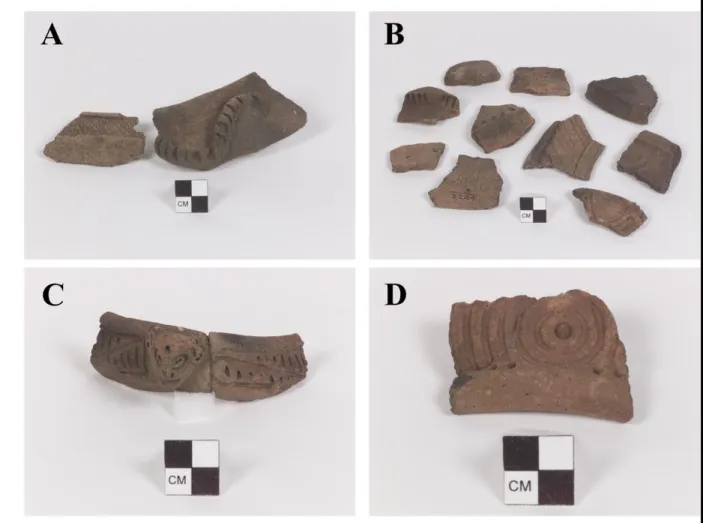
327 individual pieces). Although a thorough analysis has not been conducted, it seems that the majority of these belong to the Meillacan Ostionoid series, Chican Ostionoid series, and Palmetto ware (Fig. 3).
Moreover, the collection contains at least 26 stone artifacts made of non-local igneous rocks, including a monolithic axe (Fig. 2b) and the famous anthropomorphic pendant mentioned above. He also collected a large wooden mortar, but considering that de
Booy did not mention it in his report, it is possible that this is an ethnographic object and not an archaeological one. Only two field photographs are available in NMAI’s archives for this expedition, and only one of them is published in the report. The publication, however, includes an additional field photograph not present in NMAI’s archives. Moreover, his publication in Geographical Review (de Booy 1918a) describing the geography of these islands contains five additional photographs not present in NMAI’s archives.
Figure 3. Examples of pottery from the Turks and Caicos recovered by de Booy (National Museum of the American Indian, Cat. Nos.: A: 032211.001, Jacksonville, East Caicos or Providenciales (?); B: 032204; Chalk Sound, Providenciales Island; C: 031964, Pumpkin Bluff, North Caicos; D: 031965, West Harbor Bluff, Providenciales Island).
Journal of Caribbean Archaeology, volume 19, 2019 Page 11 Bahamas (de Booy 1913a)
De Booy’s first official expedition as MAI curator was for six months in the Bahamas (de Booy 1913a). Unfortunately, he did not publish a report on this work.
Instead, he prepared a short publication describing three “noteworthy” objects he collected: two made of wood and one of stone. The first one is the now well-known paddle (Fig. 4a) found by de Booy himself in a cave on Mores Island. This object was studied by Ostapkowicz and colleagues (2012a: Table 1) who identified the wood as mahogany (Swietenia sp.) and radiocarbon-
dated it to cal. AD 1436-1616 (2-sigmas).
The second was a gift from Dr. F. A.
Holmes, a dujo or stool (Fig. 4b) found in a small cave on Acklins Island. Ostapkowicz et al. (2012a: Table 1) identified the wood as Cordia sp. and obtained a date of cal. A.D.
1437-1618 (2-sigmas). The third object is a broken axe (axe-god) carved with a human figure on one of its faces (Fig. 4c), found in the bushes on the coast of Betsy Bay on Mayaguana Island. As in the case of the previous publication, the report ends abruptly with the description of the latter artifact and without a concluding section.
Figure 4. Paddle found by de Booy in Mores Island, Bahamas (National Museum of the American Indian, Cat. No. 032574); B: duho or stool from Spring Point, Acklins Island, Bahamas (National Museum of the American Indian, Cat. No. 032575); C: carved stone axe or axe-god from Mayaguana Island (National Museum of the American Indian, Cat. No.
032228).
Altogether, the collection for these islands consists of only 22 objects, none of them ceramics. Of these, there are 18 made of igneous stones, mostly axes, one shell celt, a human head made of coral, and the two wooden objects mentioned above.
Islands represented in the collections include Mayaguana, Mores, Aklins, Crooked, Ragged, Great Inagua, St. Georges, New Providence, Little Abaco, Eleuthera, and Eastern Plana Cay. To this day, it is difficult to explain or understand why de Booy
collected so few objects during an expedition that lasted from June to December and that visited at least ten islands. The lack of pottery is staggering, considering that de Booy’s collection from the Turks and Caicos, islands belonging to the same geographic Bahamian (Lucayan) archipelago, produced considerable numbers of ceramics.
Considering that most of the items are complete objects and unique or uncommon, it is possible that many of them
Journal of Caribbean Archaeology, volume 19, 2019 Page 12 were acquired from local collectors through
donations or purchases. This may suggest that the expedition consisted of obtaining existing collections instead of fieldwork, a common practice of museums at that time.
Only three photographs of coastal landscapes exist in the archives of NMAI:
two of Mayaguana Island and one of Acklins Island, the first two taken from the ocean. None of them were included in the publication.
Jamaica (de Booy 1913b)
From January to March of 1913, de Booy visited Jamaica and was “…enabled to excavate some of the typical aboriginal
kitchen-middens found in various parts of the islands” (de Booy 1913b: 425). He published the report later that same year.
Apparently, he concentrated his efforts on the site of Retreat (see Allworth-Jones 2008:
138-140), a hill-top site with at least 16 middens surrounding a supposed “artificially leveled central area” (de Booy 1913b: 427).
At the time of de Booy’s excavations the site had already been investigated by Miss Moulton Barrett and Dr. J. F. Duerden (1897). In his publication, de Booy discusses the excavations at the site, which, at first hand, seem to have concentrated solely on mounds no. 1 to 4 (Fig. 5).
Figure 5. Photographs of de Booy excavations at Retreat, Jamaica (National Museum of the American Indian [Neg. No.: A: N04876; B: N04875]).
This publication shows a great improvement compared to his previous writings in terms of the level of professionalism, quality of the writing, and detail of the information. These improvements include:
- mentioning specifically the purpose of some of the excavations (to obtain materials and to determine the location of the huts),
- describing and identifying in the map the location and dimensions of the excavation units, and providing photographs of some of the trenches,
- discussing in detail the internal organization of the site, its stratigraphy, its strategic location, settlement patterns, and the
Journal of Caribbean Archaeology, volume 19, 2019 Page 13 surrounding landscape--all this
accompanied by sketches,
- discussing the potential natural transformation processes to explain the differences in the physical properties of the pottery between middens,
- providing a detailed (for his time) description of the “diagnostic”
pottery, and comparing it with his material from Turks and Caicos and those excavated by Fewkes in Puerto Rico and Cuba, and concluding “…that the Jamaica pottery should not be included in the culture-type of that of Porto Rico, Hayti, Cuba, and the Bahamas, but that it belongs in a class by itself” (de Booy 1913b:
433),3
- describing the faunal assemblage and identifying species of land and marine invertebrates and at least one fish species.
Furthermore, the number of objects brought to the museum was triple the number he provided from Turks and Caicos.
As in his previous publications, however, he ends the article abruptly with a two-sentence paragraph describing only the stone and shell artifacts and in very broad strokes. Nonetheless, this improvement seems to suggest that he was trained or mentored by a more experienced archaeologist from MAI or from other institutions in the New York area (e.g., the American Museum of Natural History or Columbia University) or, perhaps, someone with more experience accompanied him in the field.
While de Booy published only his excavations on mounds 1 through 4 (out of
16 mounds) at the site of Retreat, documents and inventory4 associated with this collection present a view of a much broader excavation program. First, in addition to the excavations in the report, inventory lists include materials excavated from mounds 5, 6, and 7, suggesting that his publication was a partial report. Moreover, the lists also indicate that he excavated a cave in Rio Bueno (not necessarily the open-air site with the same name mentioned by Allsworth- Jones [2005: 94]) and the site of Moneague.
However, considering the relatively low number of artifacts from these sites in NMAI’s collections (see below) compared to the collections from Retreat, it is highly possible that he only conducted reconnaissance in these two sites. The expedition also purchased or accepted donations of large numbers of objects from all the sites mentioned above and other localities including Retreat, Orange Valley, Dry Harbour, Cedar Valley, Salt River, Ocho Rios, York, and from the country of Costa Rica. The discussion that follows concentrates exclusively on the collections excavated by de Booy and not from purchases or donations.
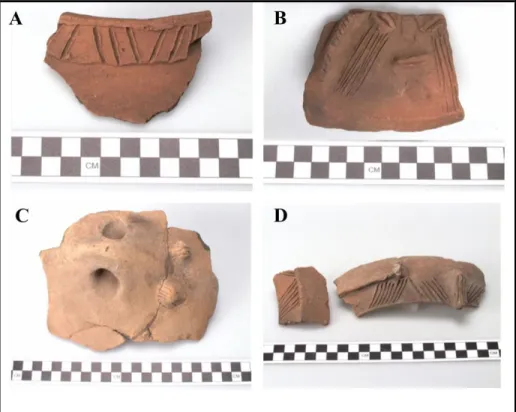
Understandably, the majority of objects are from the site of Retreat, where de Booy spent most of his efforts and time in Jamaica. The collections for this site include 68 catalog numbers and 252 objects (Figs. 6- 7). Thanks to the detailed information included in the shipping inventory, the catalog of these objects is organized mostly by midden number and the exact date when they were excavated. The objects consist mostly of pottery, but a few stone tools and samples of unmodified shells are also present.
Journal of Caribbean Archaeology, volume 19, 2019 Page 14 Figure 6. Examples of pottery recovered by de Booy at the site of Retreat (National Museum of the American Indian, Cat. Nos.: A: 033183; B: 033190; C: 033196; D: 033221).
Figure 7. Examples of stone (A and B) and shell (C and D) objects recovered by de Booy at the site of Retreat, Jamaica (National Museum of the American Indian, Cat. Nos.: A: 033278; B: 033275;
C: 033225; D: 033238).
Journal of Caribbean Archaeology, volume 19, 2019 Page 15 The collections excavated in
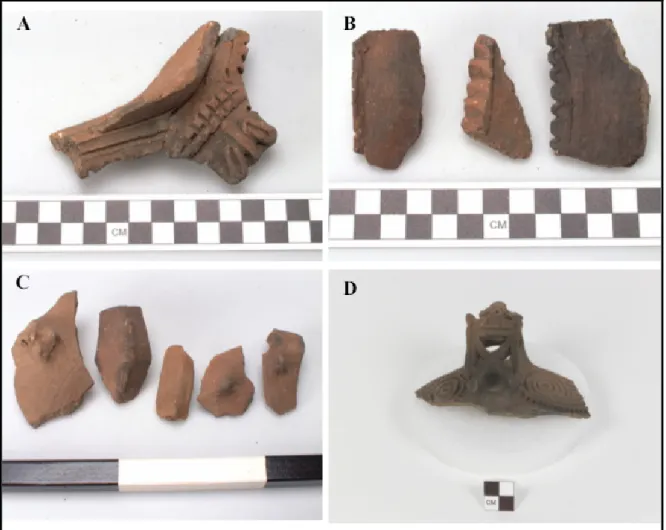
Moneague consist of only 17 objects distributed in 11 catalog numbers (see Fig.
8A and B): 4 stone artifacts and 13 ceramic fragments. The collections from Rio Bueno include 204 objects in 7 catalog numbers:
202 ceramic fragments (Fig. 8C and D), one whole ceramic vessel, and one stone celt. In addition to these objects, de Boy seems to have purchased or accepted objects from local collectors (Fig. 9).
Figure 8. Examples of ceramic objects recovered by de Booy at the sites of Moneague (A and B) and Río Bueno (C and D), Jamaica (National Museum of the American Indian, Cat.
Nos.: A: 033246; B: 033241; C: 035254; D: 046081).
With regards to field images, de Booy included only two photographs in his published report, both showing stratigraphic profiles. NMAI’s archives have only six photographs from this expedition and while one of them shows a profile, none of the published images are present. Three of the other archived photos are of the excavation process and the last two are “country
scenes.”
In conclusion, even though de Booy’s publication of his work in Jamaica was not as thorough and extensive in terms of its scope, the level of competence and adequacy of the descriptions and interpretations of the excavations at Retreat were of a much higher quality than in his previous work.
Journal of Caribbean Archaeology, volume 19, 2019 Page 16 Figure 9. Examples of objects obtained by de Booy from sites other than Retreat, Moneague, and Rio Bueno. (National Museum of the American Indian, Cat. Nos.: A: ceramic vessel, 033290, Bratt’s Hill District; B: 033302, stone mortar, Brownstown; C: 033300, wooden pestle, Cedar Valley; D: 033297, ceramic adornos, Clarendon Parish; E: 033295, decorated pottery, Clarendon Parish; F: 033273, stone pendant, Orange Valley).
Journal of Caribbean Archaeology, volume 19, 2019 Page 17 Dominican Republic (de Booy 1915, 1919a)
As mentioned before, de Booy visited Dominican Republic at least three times: in 1913, 1914, and 1916. As in previous expeditions, he conducted fieldwork, but also obtained other objects through donations or purchases from local individuals. Here, the first two expeditions are discussed together since they took place in the same regions and were reported in the same publication (de Booy1915).
Saona Island, Salado (Cape Macao) and Cape Engaño (de Booy 1915). The 1913 expedition began at the Island of Saona off the southeastern coast of Hispaniola and lasted for 16 days. The expedition suffered from mosquitoes and sand flies, lack of potable water, and heat. During this time, de
Booy surveyed the eastern side of Saona, close to the only sandy beach where boats (and canoes) are able to land and are protected (Fig. 10A). Despite his efforts to find a habitation site during those 16 days, he only found a shell deposit, where he conducted “extensive excavations” (de Booy 1915:78), without finding any obvious artifact. He also found ceramic concentrations at the bottom of inland cliffs and in front of cave entrances. These results led de Booy to conclude that no strong evidence of a significant indigenous occupation existed in the eastern side of Saona. Materials in NMAI collected by de Booy include 21 catalog numbers and 174 objects (Fig. 11), most of them pottery, along with a few stone tools, one clay sample, and 21 photographs.
Figure 10. Photographs of Saona and Macao taken by de Booy (National Museum of the American Indian Cat. Nos. A: N05065, south beach of the island; B: N05062 shell heap, Saona; C: N05028 Cape Macao; D: 05038, cave interior, Macao).
Journal of Caribbean Archaeology, volume 19, 2019 Page 18 Figure 11. Examples of objects obtained by de Booy on the island of Saona (National Museum of the American Indian, Cat. Nos.: A: 034138, stone celt; B: 036319, ceramic handle (?); C: 034128, decorated sherd; D: 034137, stone axes).
From Saona Island, de Booy traveled to the northeast of the main island via the village of Bayajibe and the town of Higüey to arrive at Salado in the Cape Macao region. Here, he concentrated his efforts on surveying and collecting objects (Fig. 12) from open-air surfaces, cave floors, and the bottom of subterranean lakes, as well as conducting “excavations at various sites”
(de Booy 1915:86). He re-visited this latter
area in April of 1914 to continue surveying the caves and expanded his search to caves further south, in the area around the Peñon de la Vieja Rufiña near Cape Engaño, south of Macao. Most of the objects collected were fragments of ceramic bottles, for which these archaeological regions are famous, and ceramic stamps. Moreover, de Booy obtained several objects from private collectors (Fig. 13).
Journal of Caribbean Archaeology, volume 19, 2019 Page 19 Figure 12. Examples of objects obtained by de Booy in the Salado region, Dominican Republic (National Museum of the American Indian, Cat. Nos.: A: 033921, ceramic bottle;
B: 033922, ceramic bottle; C: 033929, fragment of ceramic bottle; D: 034137, ceramic bottle; E: 033981, stone axe; F: 033935; ceramic bottle).
Journal of Caribbean Archaeology, volume 19, 2019 Page 20 Figure 13. Examples of objects obtained by de Booy from local collectors from Dominican Republic (National Museum of the American Indian, Cat. Nos.: A: 033941, stone three- pointer, San Pedro de Macorís; B: 036459, ceramic vessel, Altagracia; C: 036322, stone- collar, El Seibo; D: 036372, stone staff or “dagger,” Santo Domingo; E: 033941, stone three-pointer, San Pedro Macorís; F: 033931, ceramic effigy bottle, Santo Domingo).
Journal of Caribbean Archaeology, volume 19, 2019 Page 21 Although the publication provides
some details of the methodology used by de Booy, it does not report as much information as in the case of Jamaica. For Saona, he describes the “extensive excavations,” but does not discuss unit sizes or the stratigraphy. He only presents some sketches of the location of the few archaeological deposits in relation to the inland cliffs and caves. In the case of his work at the caves around Capes Macao and Engaño, he only mentions the strategy of surveying them and collecting objects, focusing mostly on bottoms of cave lakes and on areas between boulders fallen from the cave ceiling. No detail of any kind concerning the excavations (location, size, depth, etc.) is included. Since the caves did not seem to have been inhabited, de Booy tried unsuccessfully to find a nearby, permanent, open-air site in the Salado area. The rest of the report, however, concentrates on describing the ceramic bottles and stamps he found in the caves. Interestingly enough, de Booy had the water of one of the subterranean “lakes” chemically analyzed and included the results in this publication (de Booy 1915: 88). This is perhaps one of the earliest, if not the earliest, example of
“archaeometry” work in the region.
Altogether, the collections obtained by de Booy’s from these regions include:
-172 catalog numbers and 261 objects specifically from the Salado area, and 40 photographs of the Higuey/Salado/Macao region,
-31 catalog numbers and 185 objects for Cape Engaño.
No photographs of this last locality are present in the collections. At least 25 photographs of the fieldwork on Saona are present in our collections, as well as 21 of his explorations of the caves. The rest, about 22 photos, are not related to the archaeological work. All images included in
the 1915 report are present in NMAI’s photograph archives.
Unfortunately, while the objects are catalogued according to the region of origin, no records exist detailing which of the objects were obtained from surface collections and which from excavations. The great majority of the pottery belongs to the Boca Chica style of the Chican Ostionoid subseries of Hispaniola, although some Ostionan Ostionoid may be present.
Ingenio Cristóbal Colón, San Pedro de Macorís (de Booy 1919a). De Booy returned to Dominican Republic in 1916, a few days after the landing of U.S. forces that began the occupation of this country, which lasted until 1924. It is not clear, however, if by this time he had been already recruited by the Office of Naval Intelligence and was also acting as a U.S. government agent. The archaeological goal of this expedition was to excavate “a large shellheap on the Cristobal Colon sugar plantation” that was reported to him during his previous trip to the island by the administrator of the estate, E. Despaigne.
The plantation is located on the Higuamo River on the south-central coast of Dominican Republic.
During his stay at the estate, he investigated several mounds; all but two were relatively small and had been impacted by agricultural practices. The two exceptions were the largest mounds, one located under and impacted by the construction of the administrator’s house and the other an intact mound near the stables. Both of them were of the “same character…, that is, a combined burial-ground and kitchen midden” (de Booy 1915:114). It is in the latter mound that he decided to concentrate his work, since it had not been cultivated or heavily constructed upon. Interestingly, de Booy mentions that all these mounds were relatively near the river and near natural springs (Fig. 14).
Journal of Caribbean Archaeology, volume 19, 2019 Page 22 Figure 14. Photographs of Ingenio San Cristóbal and de Booy’s excavations; a: view of the Ingenio from the river Higuamo; B: view of the excavations; C: view of the excavations; D:
bird-eye view of de Booy’s excavation (National Museum of the American Indian Cat. Nos.
A: N04319; B: N04846; C: N04853; D: N04861).
The mound near the stables was relatively large, about 188 x 80 ft. (57 x 24 m), and was located on a bluff facing a mangrove area and the river. Two units were excavated in the mound. The initial, smaller unit was located on the northern edge of the mound and, based on the plan provided, it measured about 40 x 15 ft. (12 x 4.6 m).
Although at least three burials (two of them with pottery) were found, this unit was abandoned because of the shallowness of the deposit. The second unit was much larger with dimensions of 63 feet square (de Booy 1915: 116) or 19 x 19 m. Three general strata were identified by de Booy in this
location, and twenty burials were unearthed, all of them in the deepest layer.
About half of the report consisted of a description of the midden contents, mostly of the faunal remains and burials. Once again, de Booy collected samples of marine and terrestrial invertebrates, birds, and fish and sent them to specialists at the American Museum of Natural History and the U.S.
National Museum (today National Museum of Natural History) for their identification.
Although the samples probably are not representative, it is remarkable that by that time de Booy considered it important to identify these species. The burials included
Journal of Caribbean Archaeology, volume 19, 2019 Page 23 both children and adults, and all of them
were secondary or bundle-burials, as de Booy called them. Two-thirds of the burials had at least one ceramic vessel, on many occasions upside-down over the remains. In addition to these, the excavation produced a large number of artifacts including pieces of pottery, complete or partially complete pottery vessels, axes, other ground stones, and at least two shell bowls. Also of interest is a large charcoal sample collected for further study.
In some ways, this report is more detailed and complete than the previous ones. Although to a point it is similar to the one on his expedition to Jamaica, it also has some positive differences. In terms of field work, de Booy not only described and sketched the excavation units on a map, but he also included detailed descriptions and interpretations of the stratigraphy that allowed him to reconstruct the sequence of events or history of the mound. Analytically,
the discussion of the “content of the middens” is more elaborate and detailed mainly because of the inclusion of the identification of fish, invertebrate, and bird species and the description of the burials and funerary offerings.
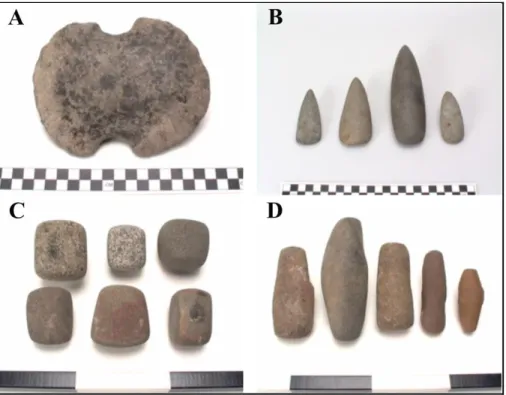
The collections at NMAI for this expedition include 135 catalog numbers and 1126 objects (Fig. 15-16). However, some of these objects may not have been the product of the excavations, but from purchases or donations. Almost all of the pottery seems to belong to the Chican Ostionoid subseries, which in Hispaniola is commonly dated from AD 800 to 1500 (Rouse 1992). The collections also include at least 33 photographs of the excavations at Ingenio Cristóbal Colón. In addition, about 80 other photographs from the Dominican Republic are archived at NMAI, but at the moment they cannot be associated with any particular expedition.
Figure 15. Examples of stone axes (A and B; scales 1 cm/square) and ground stones (C and D; scales 10 cm/square) obtained by de Booy at Ingenio San Cristóbal. (National Museum of the American Indian, Cat. Nos.: A: 072016; B: 058348; C: 058351; D: 058350).
Journal of Caribbean Archaeology, volume 19, 2019 Page 24 Figure 16. Examples of ceramic vessels obtained by de Booy in Ingenio San Cristóbal (National Museum of the American Indian, Cat. Nos.: A: 056599; B: 057139; C: 053750; D:
058289; E: 059303; F: 058290).
Journal of Caribbean Archaeology, volume 19, 2019 Page 25 Cuba 1914 (Harrington 1921)
De Booy made his first visit to Cuba in 1913 in a stop-over on his way to the Dominican Republic. During his stay he met with Dr. Luis Montané of the University of La Habana, who provided him with information on the archaeological region in the eastern part of the island. De Booy returned two more times to investigate that region. The first one was in February 1914 and the second one in October and November of 1914. According to a report de Booy prepared years later, it “…was not the object of this [expedition] trip to carry on extensive archaeological excavations or to make a systematic exploration of the numerous caves with which this region abounds…,” rather “…the nature of the work being more of a reconnaissance to determine the best localities for future operations…” (NMAIAC, Mus. American Indian/Heye Foundation records, Box 191, Folder 69). Those “future operations” were later led by Harrington (1921).5
De Booy never published the report or any other archaeological information on his expedition to Cuba. To complicate matters, only the first three pages of his unpublished manuscript mentioned in the previous paragraph have been found in NMAI’s archives, and none of them provide details on the archaeological work or its results. Fortunately, Harrington deemed
“…appropriate to incorporate [in his 1921 publication] …an account of the work done by the late Theodoor de Booy…”
(1921:230ff) and transcribed in his book selected sections that provide information on his archaeological activities. The discussion that follows is based on these accounts.
While de Booy’s work during his two trips to the region of Gran Tierra de Maya in eastern Cuba consisted of exploring and investigating locations, he also conducted some excavations at two sites. In the first one, Finca Caridad, he concentrated
his efforts on one of the few mounds not impacted by modern agricultural practices on the property. Here he excavated a trench 12 ft. (3.7 m.) wide and about 15-20 ft. (4.6- 6.1 m.) long and was able to identify four distinct strata. As in the case of Dominican Republic, this report includes a list of shell species present in the deposit and an interpretation of the strategies used by the ancient population to collect them. Using the information obtained from the trench and additional shovel-pits throughout the rest of the mound, de Booy was able to identify spatial patterns in the disposal of ashes and shells by the natives. The ashes concentrated in a section along the southern end of the mound, while shells were spread-out on the eastern and southern slopes. The northern side had considerably lower concentrations of remains, leading de Booy to conclude that the house was located on the top of the mound and that that section had served as access to the structure and workspace. The report includes a plan map of the mound showing the location of the trench and the concentration of ashes and shells, as well as a stratigraphic profile of the trench with a description of each stratum.
The report indicates that considerably more work was conducted at the site without providing any details beyond stating that no trench was excavated in other deposits and that the stratigraphy of those deposits was similar to the one already discussed above. The collections at NMAI for this site consist of 27 catalog numbers and 536 items. Most of the objects comprise plain-ware pottery, but the collections also include a few decorated sherds, a fragment of a stone axe, a stone bead, two small stone balls, and two pendants (Fig. 17A and B), one in the shape of the head of a parrot made of mother-of-pearl (Fig. 17C; Harrington 1921: Fig. 63). All the decorated and diagnostic pottery belongs to the Chican Ostionoid subseries.
Journal of Caribbean Archaeology, volume 19, 2019 Page 26 Figure 17. Examples of objects obtained by de Booy at Finca Caridad, Cuba (National Museum of the American Indian, Cat. Nos.: A: 037933, stone bead; B: 037929, shell bead;
C: 037928; D: 040673, ceramic sherds.
The second site is known as Finca Sitges. Excavations were conducted here, as well, but the number, location, and dimensions of the units are not detailed.
However, the lower number of objects from this site in the collection suggests a less extensive approach compared to the work at Finca Caridad. De Booy does mention that this site was more difficult to excavate because all of the mounds had been impacted by agriculture, but, with the exception of the presence of a layer of cobbles, their stratigraphic sequences were
similar to the ones found in Finca Caridad.
No plans of the mounds or excavations were included. The collection from this site in NMAI include only 94 pieces of pottery and one Oliva sp. bead distributed in12 records (Fig. 18).
Altogether, 100 photos related to de Booy’s expeditions to Cuba are present in NMAI’s archives, but only four pictures on the archaeological work. However, in a non- archaeological publication (de Booy 1917e), de Booy included seven photographs that are not present in NMAI’s archives.
Journal of Caribbean Archaeology, volume 19, 2019 Page 27 Figure 18. Examples of objects obtained by de Booy at Finca Sitges, Cuba (National Museum of the American Indian, Cat. Nos.: A: 037946; B: 037944).
In general terms this report is similar to the ones discussed for Dominican Republic. However, here he continues incorporating a comparative discussion into his analysis. For example, he dedicates a section to comparing the Cuban kitchen- middens with the ones in Jamaica, concluding that they are similar in content and organization but that the strata were thinner or shallower in the former case than in the latter. He concludes that the Cuban middens were occupied for a shorter time. A second discussion focuses on the predominance of shallow ceramic vessels in these two sites compared with the deposits he had investigated from other islands.
Finally, de Booy points out the similarity of the Cuban material (i.e., ceramic decoration and stone figures) and material from the Dominican Republic and Puerto Rico.
Margarita Island (de Booy 1916)
Margarita Island, an island that belongs to and is off the coast of Venezuela, was surveyed and investigated by de Booy (1916) from February to April 1915 with the
purpose “…of studying the cultural remains of its former aboriginal inhabitants” (de Booy 1916: 1) (Fig. 19). After surveying multiple areas throughout the island and interviewing informants in diverse localities, de Booy’s finds consisted mostly of a few surface materials or scatters. He found the only site with clear, formal deposits along the Rio Viejo, in a locality called Giri-gire, which is about 2.5 miles from the coast. The site is composed of three midden clusters.
Although he calls this site the “Giri-gire shell-middens” in the publication, the catalog cards refer to it with the name of the nearby modern community, San Jose de Paraguachi. The rest of the objects from the island that were collected, purchased, or accepted as donations also came mostly from surface finds. Other archaeological features reported by de Booy are non-natural depressions in the southern part of the island, a very arid area (see Fig. 19d).
According to local informants, these were dug in pre-Contact times by native groups to collect and preserve rainwater.
Journal of Caribbean Archaeology, volume 19, 2019 Page 28 Figure 19. Photographs of Margarita Island; A: shell deposit on seashore between Porlamar and Pampatar; B: “village site”; C: “pre-Columbian village site”; D: two of de Booy’s field assistants, “M. and Pedro Kaoba in artificial depression on village site”
(National Museum of the American Indian Cat. Nos. A: N04092; B: N04122; C: N04104; D:
N04126).
The collections at NMAI for this expedition consist of 161 catalog numbers and 787 objects, most of which are pottery (Fig. 20) and stone tools, although some worked and unworked shells and a few faunal remains are also present. Two whole and one partial ceramic vessels were collected, all of them relatively small. The first is, a small drinking vessel with one handle (Fig 20d), the second is a jar in the form of a foot (possibly another drinking
vessel; Fig. 20c), and the third is an incomplete shallow, open bowl with geometric incisions in the interior (Fig. 20b).
Stone artifacts (Fig. 21) include a good number of axes of different shapes, but also several unusual specimens that de Booy called double-point stones (Fig. 21d) and a bifacial projectile point (Fig. 21c). Some of the shell artifacts seem to have been axes or hoe blades made of Lobatus gigas (Queen conch). The unworked shells and faunal
Journal of Caribbean Archaeology, volume 19, 2019 Page 29 remains belong to a variety of taxa whose
species were identified and included in the publication (de Booy 1916: 15-16). Most of the pottery is plainware and not easy to classify. Nonetheless, a few Saladoid pottery sherds are present (Fig. 21A), as well as ceramics that have not been assigned to a
particular cultural category. The archival collections also include 75 photographs, but only ten of them are archaeological in nature. However, four photographs included in a non-archaeological publication (de Booy 1916a) are not in NMAI’s archives.
Figure 20. Examples of ceramics obtained by de Booy at Isla Margarita. (National Museum of the American Indian, Cat. Nos.: A: 043257; B: 043269; C: 043266; D: 043282).
Journal of Caribbean Archaeology, volume 19, 2019 Page 30 Figure 21. Examples of stone shell artifacts obtained by de Booy at Isla Margarita.
(National Museum of the American Indian, Cat. Nos.: A: 043204, stone axe; B: 043242, shell celts; C: 043326, stone projectile poing; D: 043218, unknown stone objects).
The report provides maps of the island and the region of San Jose Paraguachi, to show the general location of the nearby clusters of shell middens. In general, however, in this report de Booy offers less detail about the methodology, the excavations, and the sites than in previous publications.
Trinidad (de Booy 1918d)
After finishing his work on Margarita, de Booy visited Trinidad from May to September of 1915. The purpose of this project was to confirm that two collections obtained by MAI from this
island, which differed greatly from each other, actually represented two different cultures. The first collection was acquired by Fewkes, who in 1912 excavated a shell midden in Erin Bay on the south coast. The second was a small sample obtained by Huckerby, who conducted a limited reconnaissance and excavations on Cape Mayaro on the east coast. Since the latter collection was relatively small, de Booy concentrated his expedition on that region and its surroundings, focusing mostly on the same site where Huckerby had worked, the Saint Bernard Estate. Based on the photographs, it seems that he opened two